New Word Detection for Sentiment Analysis
Minlie Huang, Borui Ye*, Yichen Wang, Haiqiang Chen**, Junjun Cheng**, Xiaoyan Zhu
State Key Lab. of Intelligent Technology and Systems, National Lab. for Information Science
and Technology, Dept. of Computer Science and Technology, Tsinghua University, Beijing 100084, PR China *Dept. of Communication Engineering, Beijing University of Posts and Telecommunications
**China Information Technology Security Evaluation Center [email protected]
Abstract
Automatic extraction of new words is an indispensable precursor to many NLP tasks such as Chinese word segmentation, named entity extraction, and sentimen-t analysis. This paper aims at extract-ingnew sentiment words from large-scale user-generated content. We propose a ful-ly unsupervised, pureful-ly data-driven frame-work for this purpose. We design statisti-cal measures respectively to quantify the utility of a lexical pattern and to measure the possibility of a word being a new word. The method is almost free of linguistic re-sources (except POS tags), and requires no elaborated linguistic rules. We also demonstrate how new sentiment word will benefit sentiment analysis. Experiment re-sults demonstrate the effectiveness of the proposed method.
1 Introduction
New words on the Internet have been emerg-ing all the time, particularly in user-generated con-tent. Users like to update and share their infor-mation on social websites with their own language styles, among which new political/social/cultural words are constantly used.
However, such new words have made many natural language processing tasks more challeng-ing. Automatic extraction of new words is indis-pensable to many tasks such as Chinese word seg-mentation, machine translation, named entity ex-traction, question answering, and sentiment analy-sis. New word detection is one of the most critical issues in Chinese word segmentation. Recent stud-ies (Sproat and Emerson, 2003) (Chen, 2003) have shown that more than 60% of word segmentation errors result from new words. Statistics show that more than 1000 new Chinese words appear every
year (Thesaurus Research Center, 2003). These words are mostly domain-specific technical terms and time-sensitive political/social /cultural terms. Most of them are not yet correctly recognized by the segmentation algorithm, and remain as out of vocabulary (OOV) words.
New word detection is also important for sen-timent analysis such as opinionated phrase ex-traction and polarity classification. A sentiment phrase with complete meaning should have a cor-rect boundary, however, characters in a new word may be broken up. For example, in a sentence " 表 演/ n 非 常/ adv 给/ v 力/ n(artists' perfor-mance is very impressive)" the two Chinese char-acters“给/v力/n(cool; powerful)”should always be extracted together. In polarity classification, new words can be informative features for clas-sification models. In the previous example, "给 力(cool; powerful)" is a strong feature for clas-sification models while each single character is not. Adding new words as feature in classification models will improve the performance of polarity classification, as demonstrated later in this paper.
This paper aims to detect new word for senti-ment analysis. We are particulary interested in ex-tractingnew sentiment wordthat can express opin-ions or sentiment, which is of high value toward-s toward-sentiment analytoward-sitoward-s. New sentiment word, as ex-emplified in Table 1, is a sub-class of multi-word expressions which is a sequence of neighboring words "whose exact and unambiguous meaning or connotation cannot be derived from the mean-ing or connotation of its components" (Choueka, 1988). Such new words cannot be directly iden-tified using grammatical rules, which poses a ma-jor challenge to automatic analysis. Moreover, ex-isting lexical resources never have adequate and timely coverage since new words appear constant-ly. People thus resort to statistical methods such as Pointwise Mutual Information (Church and Han-ks, 1990), Symmetrical Conditional Probability
(da Silva and Lopes, 1999), Mutual Expectation (Dias et al., 2000), Enhanced Mutual Information (Zhang et al., 2009), and Multi-word Expression Distance (Bu et al., 2010).
New word English Translation Polarity
口爱 lovely positive
杯具 tragic/tragedy negative
给力 very cool; powerful positive 坑爹 reverse one's expectation negative
Table 1: Examples of new sentiment word.
Our central idea for new sentiment word de-tection is as follows: Starting from very few seed words (for example, just one seed word), we can extract lexical patterns that have strong statistical association with the seed words; the extracted lex-ical patterns can be further used in finding more new words, and the most probable new words can be added into the seed word set for the next iter-ation; and the process can be run iteratively un-til a stop condition is met. The key issues are to measure the utility of a pattern and to quantify the possibility of a word being a new word. The main contributions of this paper are summarized as fol-lows:
• We propose a novel framework for new word detection from large-scale user-generated da-ta. This framework is fully unsupervised and purely data-driven, and requires very lightweight linguistic resources (i.e., only POS tags).
• We design statistical measures to quantify the utility of a pattern and to quantify the possi-bility of a word being a new word, respective-ly. No elaborated linguistic rules are needed to filter undesirable results. This feature may enable our approach to be portable to other languages.
• We investigate the problem of polarity predic-tion of new sentiment word and demonstrate that inclusion of new sentiment word benefits sentiment classification tasks.
The rest of the paper is structured as follows: we will introduce related work in the next section. We will describe the proposed method in Section 3, including definitions, the overview of the algorith-m, and the statistical measures for addressing the
two key issues. We then present the experiments in Section 4. Finally, the work is summarized in Section 5.
2 Related Work
New word detection has been usually inter-weaved with word segmentation, particularly in Chinese NLP. In these works, new word detection is considered as an integral part of segmentation, where new words are identified as the most proba-ble segments inferred by the probabilistic models; and the detected new word can be further used to improve word segmentation. Typical models in-clude conditional random fields proposed by (Peng et al., 2004), and a joint model trained with adap-tive online gradient descent based on feature fre-quency information (Sun et al., 2012).
Another line is to treat new word detection as a separate task, usually preceded by part-of-speech tagging. The first genre of such studies is to lever-age complex linguistic rules or knowledge. For example, Justeson and Katz (1995) extracted tech-nical terminologies from documents using a regu-lar expression. Argamon et al. (1998) segmented the POS sequence of a multi-word into small POS tiles, counted tile frequency in the new word and non-new-word on the training set respectively, and detected new words using these counts. Chen and Ma (2002) employed morphological and statisti-cal rules to extract Chinese new word. The sec-ond genre of the studies is to treat new word de-tection as a classification problem. Zhou (2005) proposed a discriminative Markov Model to de-tect new words by chunking one or more separat-ed words. In (Li et al., 2005), new word detec-tion was viewed as a binary classificadetec-tion problem. However, these supervised models requires not on-ly heavy engineering of linguistic features, but also expensive annotation of training data.
known as multi-word expression extraction. To measure multi-word association, the first model is Pointwise Mutual Information (PMI) (Church and Hanks, 1990). Since then, a variety of sta-tistical methods have been proposed to measure
bi-gram association, such as Log-likelihood (Dun-ning, 1993) and Symmetrical Conditional Proba-bility (SCP) (da Silva and Lopes, 1999). Among all the 84bi-gram association measures, PMI has been reported to be the best one in Czech data (Pecina, 2005). In order to measure arbitrary n -grams, most common strategies are to separaten -gram into two parts X and Y so that existingbi -gram methods can be used (da Silva and Lopes, 1999; Dias et al., 2000; Schone and Jurafsky, 2001). Zhang et al. (2009) proposed Enhanced Mutual Information (EMI) which measures the co-hesion ofn-gram by the frequency of itself and the frequency of each single word. Based on the in-formation distance theory, Bu et al. (2010) pro-posed multi-word expression distance (MED) and the normalized version, and reported superior per-formance to EMI, SCP, and other measures.
3 Methodology
3.1 Definitions
Definition 3.1(Adverbial word). Words that are used mainly to modify a verb or an adjective, such as "太(too)", "非常(very)", "十分(very)", and "特 别(specially)".
Definition 3.2(Auxiliary word). Words that are auxiliaries, model particles, or punctuation marks. In Chinese, such words are like "着,了,啦,的,啊", and punctuation marks include ",。!?;:" and so on.
Definition 3.3 (Lexical Pattern). A lexical pat-tern is a triplet< AD,∗, AU >, whereADis an adverbial word, the wildcard∗means an arbitrary number of words1, andAU denotes an auxiliary word.
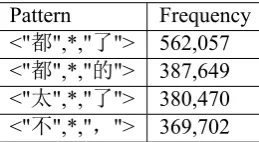
Table 2 gives some examples of lexical pat-terns. In order to obtain lexical patterns, we can define regular expressions with POS tags2and ap-ply the regular expressions on POS tagged texts. Since the tags of adverbial and auxiliary words are
1
We set the number to 3 words in this work considering computation costs.
2Such expressions are very simple and easy to write
be-cause we only need to consider POS tags of adverbial and auxiliary word.
relatively static and can be easily identified, such a method can safely obtain lexical patterns.
[image:3.595.351.481.101.172.2]Pattern Frequency <"都",*,"了"> 562,057 <"都",*,"的"> 387,649 <"太",*,"了"> 380,470 <"不",*,","> 369,702
Table 2: Examples of lexical pattern. The frequen-cy is counted on 237,108,977 Weibo posts.
3.2 The Algorithm Overview
The algorithm works as follows: starting from very few seed words (for example, a word in Table 1), the algorithm can find lexical pattern-s that have pattern-strong pattern-statipattern-stical apattern-spattern-sociation with the seed words in which the likelihood ratio test (L-RT) is used to quantify the degree of association. Subsequently, the extracted lexical patterns can be further used in finding more new words. We de-sign several measures to quantify the possibility of a candidate word being a new word, and the top-ranked words will be added into the seed word set for the next iteration. The process can be run iter-atively until a stop condition is met. Note that we do not augment the pattern set (P) at each iteration, instead, we keep a fixed small number of patterns during iteration because this strategy produces op-timal results.
From linguistic perspectives, new sentiment words are commonly modified by adverbial words and thus can be extracted by lexical patterns. This is the reason why the algorithm will work. Our al-gorithm is in spirit to double propagation (Qiu et al., 2011), however, the differences are apparen-t in apparen-thaapparen-t: firsapparen-tly, we use very lighapparen-tweighapparen-t linguis-tic information (except POS tags); secondly, our major contributions are to propose statistical mea-sures to address the following key issues: first, to measure the utility of lexical patterns; second, to measure the possibility of a candidate word being a new word.
3.3 Measuring the Utility of a Pattern
Algorithm 1:New word detection algorithm
Input:
D: a large set of POS tagged posts Ws: a set of seed words
kp: the number of patterns chosen at each
iteration
kc: the number of patterns in the candidate pattern set
kw: the number of words added at each iteration
K: the number of words returned
Output: A list of ranked new wordsW
1 Obtain all lexical patterns using regular expressions onD;
2 Count the frequency of each lexical pattern and extract words matched by each pattern ;
3 Obtain topkcfrequent patterns as candidate
pattern setPcand top 5,000 frequent words as candidate word setWc;
4 P = Φ;W=Ws; t = 0 ; 5 for |W|< Kdo
6 UseW to score each pattern inPcwith
U(p);
7 P ={top kppatterns};
8 UseP to extract new words and if the words are inWc, score them withF(w);
9 W =W∪{top kwwords};
10 Wc=Wc-W ;
11 Sort words inWwithF(w);
12 Output the ranked list of words inW ;
al., 2012).
The LRT is well known for not relying crit-ically on the assumption of normality, instead, it uses the asymptotic assumption of the generalized likelihood ratio. In practice, the use of likelihood ratios tends to result in significant improvements in text-analysis performance.
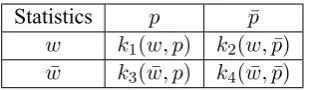
In our problem, LRT computes a contingency table of a pattern p and a word w, derived from the corpus statistics, as given in Table 3, where
k1(w, p)is the number of documents thatw
match-es patternp,k2(w,p¯)is the number of documents that w occurs while p does not, k3( ¯w, p) is the number of documents thatp occurs whilewdoes not, andk4( ¯w,p¯)is the number of documents con-taining neitherpnorw.
Statistics p p¯
w k1(w, p) k2(w,p¯)
¯
[image:4.595.340.495.61.106.2]w k3( ¯w, p) k4( ¯w,p¯)
Table 3: Contingency table for likelihood ratio test (LRT).
Based on the statistics shown in Table 3, the likelihood ratio tests (LRT) model captures the sta-tistical association between a patternpand a word
wby employing the following formula:
LRT(p, w) =log LL(ρ(ρ, k1, k1, n1)∗L(ρ2, k2, n2)
1, n1)∗L(ρ, k2, n2) (1)
where:
L(ρ, k, n) = ρk ∗(1−ρ)n−k; n
1 = k1 +k3; n2 = k2 +k4; ρ1 = k1/n1; ρ2 = k2/n2; ρ = (k1+k2)/(n1+n2).
Thus, the utility of a pattern can be measured as follows:
U(p) = ∑
wi∈W
LRT(p, wi) (2)
whereW is the current word set used in the algo-rithm (see Algoalgo-rithm 1).
3.4 Measuring the Possibility of Being New Words
Another key issue in the proposed algorithm is to quantify the possibility of a candidate word being a new word. We consider several factors for this purpose.
3.4.1 Likelihood Ratio Test
Very similar to the pattern utility measure, L-RT can also be used to measure the association of a candidate word to a given pattern set, as follows:
LRT(w) = ∑
pi∈P
LRT(w, pi) (3)
3.4.2 Left Pattern Entropy
If a candidate word is a new word, it will be more commonly used with diversified lexical pat-terns since the non-compositionality of new word means that the word can be used in many differ-ent linguistic scenarios. This can be measured by information entropy, as follows:
LP E(w) =− ∑
li∈L(Pc,w)
c(li, w) N(w) ∗log c
(li, w) N(w) (4)
whereL(Pc, w)is the set of left word of all pat-terns by which word w can be matched in Pc ,
c(li, w)is the count that word wcan be matched by patterns whose left word isli, andN(w)is the count that wordwcan be matched by the patterns inPc. Note that we usePc, instead ofP, because the latter set is very small while computing entropy needs a large number of patterns. Tuning the size ofPcwill be further discussed in Section 4.4.
3.4.3 New Word Probability
Some words occur very frequently and can be widely matched by lexical patterns, but they are not new words. For example, "爱吃(love to eat)" and "爱说(love to talk)" can be matched by many lexical patterns, however, they are not new words due to the lack of non-compositionality. In such words, each single character has high probability to be a word. Thus, we design the following mea-sure to favor this observation.
NW P(w) =∏n
i=1
p(wi)
1−p(wi) (5)
wherew=w1w2. . . wn, eachwiis a single char-acter, andp(wi)is the probability of the character
wibeing a word, as computed as follows:
p(wi) = all(walli)(−ws(wi) i)
where all(wi) is the total frequency of wi, and
s(wi)is the frequency of wi being a single char-acter word. Obviously, in order to obtain the value ofs(wi), some particular Chinese word segmen-tation tool is required. In this work, we resort to ICTCLAS (Zhang et al., 2003), a widely used tool in the literature.
3.4.4 Non-compositionality Measures
New words are usually multi-word expres-sions, where a variety of statistical measures have
been proposed to detect multi-word expressions. Thus, such measures can be naturally incorporated into our algorithm.
The first measure is enhanced mutual infor-mation (EMI) (Zhang et al., 2009):
EMI(w) =log2∏nF/N i=1FiN−F
(6)
whereF is the number of posts in which a multi-word expression w = w1w2. . . wn occurs,Fi is the number of posts wherewioccurs, andN is the total number of posts. The key idea of EMI is to measure word pair’s dependency as the ratio of its probability of being a multi-word to its probability of not being a multi-word. The larger the value, the more possible the expression will be a multi-word expression.
The second measure we take into account is normalized multi-word expression distance (Bu et al., 2010), which has been proposed to measure the non-compositionality of multi-word expressions.
NMED(w) = loglogN|µ(w)| −−loglog|ϕ|(ϕw()|w)| (7)
whereµ(w) is the set of documents in which all single words inw =w1w2. . . wnco-occur,ϕ(w) is the set of documents in which word w occurs as a whole, and N is the total number of docu-ments. Different from EMI, this measure is a strict distance metric, meaning that a smaller value in-dicates a larger possibility of being a multi-word expression. As can be seen from the formula, the key idea of this metric is to compute the ratio of the co-occurrence of all words in a multi-word expres-sions to the occurrence of the whole expression.
3.4.5 Configurations to Combine Various Factors
Taking into account the aforementioned fac-tors, we have different settings to score a new word, as follows:
FLRT(w) =LRT(w) (8)
FLP E(w) =LRT(w)∗LP E(w) (9)
FNW P(w) =LRT(w)∗LP E(w)∗NW P(w) (10) FEMI(w) =LRT(w)∗LP E(w)∗EMI(w) (11)
4 Experiment
In this section, we will conduct the following experiments: first, we will compare our method to several baselines, and perform parameter tun-ing with extensive experiments; second, we will classify polarity of new sentiment words using t-wo methods; third, we will demonstrate how new sentiment words will benefit sentiment classifica-tion.
4.1 Data Preparation
We crawled 237,108,977 Weibo posts from http://www.weibo.com, the largest social website in China. These posts range from January of 2011 to December of 2012. The posts were then part-of-speech tagged using a Chinese word segmentation tool named ICTCLAS (Zhang et al., 2003).
Then, we asked two annotators to label the top 5,000 frequent words that were extracted by lexi-cal patterns as described in Algorithm 1. The an-notators were requested to judge whether a candi-date word is a new word, and also to judge the po-larity of a new word (positive, negative, and neu-tral). If there is a disagreement on either of the two tasks, discussions are required to make the fi-nal decision. The annotation led to 323 new word-s, among which there are 116 positive wordword-s, 112 negative words, and 95 neutral words3.
4.2 Evaluation Metric
As our algorithm outputs a ranked list of words, we adapt average precision to evaluate the performance of new sentiment word detection. The metric is computed as follows:
AP(K) =
∑K
k=1∑P(k)∗rel(k)
K k=1rel(k)
whereP(k)is the precision at cut-offk,rel(k)is 1 if the word at positionkis a new word and 0 oth-erwise, andKis the number of words in the ranked list. A perfect list (all topKitems are correct) has an AP value of 1.0.
4.3 Evaluation of Different Measures and Comparison to Baselines
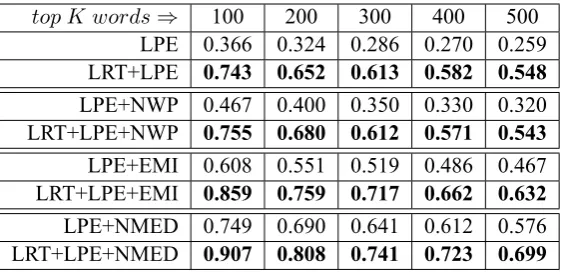
First, we assess the influence of likelihood ra-tio test, which measures the associara-tion of a word to the pattern set. As can be seen from Table 4, the association model (LRT) remarkably boosts the
3All the resources are available upon request.
performance of new word detection, indicating L-RT is a key factor for new sentiment word extrac-tion. From linguistic perspectives, new sentiment words are commonly modified by adverbial words and thus should have close association with lexical patterns.
Second, we compare different settings of our method to two baselines. The first one is en-hanced mutual information (EMI) where we set
F(w) = EMI(w) (Zhang et al., 2009) and the second baseline is normalized multi-word expres-sion distance (NMED) (Bu et al., 2010) where we setF(w) = NMED(w). The results are shown in Figure 1. As can be seen, all the proposed measures outperform the two baselines (EMIand
NMED) remarkably and consistently. The set-ting of FNMED produces the best performance. AddingNMEDorEMIleads to remarkable im-provements because of their capability of measur-ing non-compositionality of new words. Only us-ingLRTcan obtain a fairly good results whenKis small, however, the performance drops sharply be-cause it's unable to measure non-compositionality. Comparison between LRT + LP E (or LRT +
LP E + NW P) and LRT shows that inclusion of left pattern entropy also boosts the performance apparently. However, the new word probabili-ty (NW P) has only marginal contribution to im-provement.
In the above experiments, we setkp = 5(the number of patterns chosen at each iteration) and
[image:6.595.318.517.567.690.2]kw = 10(the number of words added at each iter-ation), which is the optimal setting and will be dis-cussed in the next subsection. And only one seed word "坑爹(reverse one's expectation)" is used.
top K words⇒ 100 200 300 400 500 LPE 0.366 0.324 0.286 0.270 0.259 LRT+LPE 0.743 0.652 0.613 0.582 0.548
LPE+NWP 0.467 0.400 0.350 0.330 0.320 LRT+LPE+NWP 0.755 0.680 0.612 0.571 0.543
LPE+EMI 0.608 0.551 0.519 0.486 0.467 LRT+LPE+EMI 0.859 0.759 0.717 0.662 0.632
[image:7.595.159.442.61.197.2]LPE+NMED 0.749 0.690 0.641 0.612 0.576 LRT+LPE+NMED 0.907 0.808 0.741 0.723 0.699
Table 4: Results with vs. without likelihood ratio test (LRT).
4.4 Parameter Tuning
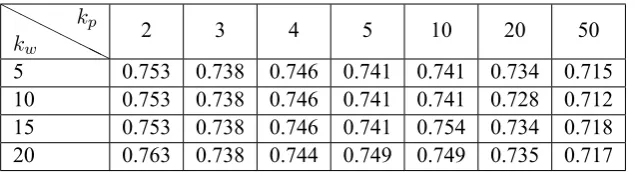
Firstly, we will show how to obtain the op-timal settings ofkp andkw. The measure setting we take here isFNMED(w), as shown in Formula (12). Again, we choose only one seed word "坑 爹(reverse one's expectation)", and the number of words returned is set toK = 300. Results in Ta-ble 5 show that the performance drops consistent-ly across differentkwsettings when the number of patterns increases. Note that at the early stage of Algorithm 1, largerkp(perhaps with noisy pattern-s) may lead to lower quality of new words; while larger kw (perhaps with noisy seed words) may lead to lower quality of lexical patterns. Therefore, we choose the optimal setting to small numbers, as
kp= 5, kw = 10.
Secondly, we justify whether the proposed al-gorithm is sensitive to the number of seed words. We setkp = 5andkw = 10, and take FNMED as the weighting measure of new word. We exper-imented with only one seed word, two, three, and four seed words, respectively. The results in Ta-ble 6 show very staTa-ble performance when different numbers of seed words are chosen. It's interesting that the performance is totally the same with dif-ferent numbers of seed words. By looking into the pattern set and the selected words at each iteration, we found that the pattern set (P) converges soon to the same set after a few iterations; and at the be-ginning several iterations, the selected words are almost the same although the order of adding the words is different. Since the algorithm will finally sort the words at step (11) andP is the same, the ranking of the words becomes all the same.
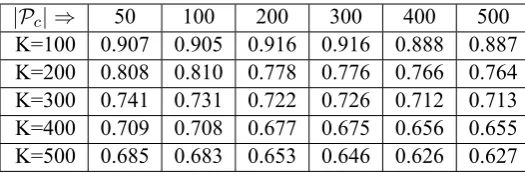
Lastly, we need to decide the optimal number of patterns in Pc (that is, kc in Algorithm 1) be-cause the set has been used in computing left pat-tern entropy, see Formula (4). Too small size of
Pcmay lead to insufficient estimation of left
pat-tern entropy. Results in Table 7 shows that larg-erPcdecrease the performance, particularly when the number of words returned (K) becomes larger. Therefore, we set|Pc|= 100.
4.5 Polarity Prediction of New Sentiment Words
In this section, we attempt to classifying the polarity of the annotated 323 new words. Two methods are adapted with different settings for this purpose. The first one is majority vote (MV), and the second one is pointwise mutual information, similar to (Turney and Littman, 2003). The ma-jority vote method is formulated as below:
MV(w) = ∑
wp∈P W
#(w, wp)
|P W| −
∑
wn∈NW
#(w, wn)
|NW|
whereP W andNW are a positive and negative set of emoticons (or seed words) respectively, and #(w, wp) is the co-occurrence count of the input wordwand the itemwp. The polarity is judged ac-cording to this rule: ifMV(w)> th1, the wordw is positive; ifMV(w)<−th1the word negative; otherwise neutral. The thresholdth1 is manually tuned.
And PMI is computed as follows:
P MI(w) = ∑
wp∈P W
P MI(w, wp)
|P W| −
∑
wn∈NW
P MI(w, wn)
|NW|
where P MI(x, y) = log2(P rP r(x)∗(x,yP r)(y)), and
P r(·) denotes probability. The polarity is judged according to the rule: if P MI(w) > th2, w is positive; ifP MI(w)<−th2 negative; otherwise neutral. The thresholdth2is manually tuned.
HH
HHHH
kw
kp 2 3 4 5 10 20 50
[image:8.595.142.460.61.147.2]5 0.753 0.738 0.746 0.741 0.741 0.734 0.715 10 0.753 0.738 0.746 0.741 0.741 0.728 0.712 15 0.753 0.738 0.746 0.741 0.754 0.734 0.718 20 0.763 0.738 0.744 0.749 0.749 0.735 0.717
Table 5: Parameter tuning results forkp andkw. The measure setting isFNMED(w), the seed word set is {"坑爹(reverse one's expectation)"}, and the number of words returned isK = 300.
#seeds⇒ 1 2 3 4
[image:8.595.72.285.201.287.2]K=100 0.907 0.907 0.907 0.907 K=200 0.808 0.808 0.808 0.808 K=300 0.741 0.741 0.741 0.741 K=400 0.709 0.709 0.709 0.709 K=500 0.685 0.685 0.685 0.685
Table 6: Performance with different numbers of seed words. The measure setting isFNMED(w), andkp = 5,kw = 10. The seed words are chosen from Table 1.
Large_Emo) is a set of most frequent 36 emoticons in which there are 21 positive and 15 negative e-moticons respectively. The second one (denoted by Small_Emo) is a set of 10 emoticons, which are chosen from the 36 emoticons, as shown in Table 8. The third one (denoted by Opin_Words) is two sets of seed opinion words, where P W={ 高 兴(happy),大 方(generous),漂 亮(beautiful), 善 良(kind),聪明(smart)} andNW ={伤心(sad),小 气(mean),难看(ugly),邪恶(wicked),笨(stupid)}.
The performance of polarity prediction is shown in Table 9. In two-class polarity classifi-cation, we remove neutral words and only make prediction with positive/negative classes. The first observation is that the performance of using emoti-cons is much better than that of using seed opin-ion words. We conjecture that this may be be-cause new sentiment words are more frequently co-occurring with emoticons than with these opin-ion words. The second observatopin-ion is that three-class polarity three-classification is much more diffi-cult than two-class polarity classification because many extracted new words are nouns such as "基 友(gay)","菇 凉(girl)", and "盆 友(friend)". Such nouns are more difficult to classify sentiment ori-entation.
4.6 Application of New Sentiment Words to Sentiment Classification
In this section, we justify whether inclusion of new sentiment word would benefit sentiment clas-sification. For this purpose, we randomly sampled and annotated 4,500 Weibo posts that contain at least one opinion word in the union of the Hownet
4 opinion lexicons and our annotated new
word-s. We apply two models for polarity classification. The first model is a lexicon-based model (denot-ed byLexicon) that counts the number of positive and negative opinion words in a post respective-ly, and classifies a post to be positive if there are more positive words than negative ones, and to be negative otherwise. The second model is a SVM model in which opinion words are used as feature, and 5-fold cross validation is conducted.
We experiment with different settings of Hownet lexicon resources:
• Hownet opinion words (denoted by Hownet): After removing some obviously inappropri-ate words, the left lexicons have 627 posi-tive opinion words and 1,038 negaposi-tive opin-ion words, respectively.
• Compact Hownet opinion words (denoted by cptHownet): we count the frequency of the above opinion words on the training data and remove words whose document frequency is less than 2. This results in 138 positive words and 125 negative words.
Then, we add into the above resources the la-beled new polar words(denoted byNW, including 116 positive and 112 negative words) and the top 100 words produced by the algorithm (denoted by
T100), respectively. Note that the lexicon-based model requires the sentiment orientation of each dictionary entry5, we thus manually label the
po-4
http://www.keenage.com/html/c_index.html.
5This is not necessary for the SVM model. All words in
|Pc| ⇒ 50 100 200 300 400 500 K=100 0.907 0.905 0.916 0.916 0.888 0.887 K=200 0.808 0.810 0.778 0.776 0.766 0.764 K=300 0.741 0.731 0.722 0.726 0.712 0.713 K=400 0.709 0.708 0.677 0.675 0.656 0.655 K=500 0.685 0.683 0.653 0.646 0.626 0.627
Table 7: Tuning the number of patterns inPc. The measure setting isFNMED(w),kp = 5,kw = 10, and the seed word set is {"坑爹(reverse one's expectation)"}.
Emoticon Polarity Emoticon Polarity
positive negative
positive negative
positive negative
positive negative
[image:9.595.74.253.334.464.2]positive negative
Table 8: The ten emoticons used for polarity pre-diction.
Methods⇒ Majority vote PMI Two-class polarity classification
Large_Emo 0.861 0.865
Small_Emo 0.846 0.851
Opin_Words 0.697 0.654
Three-class polarity classification
Large_Emo 0.598 0.632
Small_Emo 0.551 0.635
Opin_Words 0.449 0.486
Table 9: The accuracy of two/three-class polarity classification.
larity of all top 100 words (we did NOT remove incorrect new word). This results in 52 positive and 34 negative words.
Results in Table 10 show that inclusion of new words in both models improves the perfor-mance remarkably. In the setting of the original lexicon (Hownet), both models obtain 2-3% gains from the inclusion of new words. Similar improve-ment is observed in the setting of the compact lex-icon. Note, that T100 is automatically obtained from Algorithm 1 so that it may contain words that are not new sentiment words, but the resource also improves performance remarkably.
5 Conclusion
In order to extractnew sentiment wordsfrom large-scale user-generated content, this paper pro-poses a fully unsupervised, purely data-driven, and
# Pos/Neg Lexicon SVM
Hownet 627/1,038 0.737 0.756
Hownet+NW 743/1,150 0.770 0.779 Hownet+T100 679/1,172 0.761 0.774
cptHownet 138/125 0.738 0.758
cptHownet+NW 254/237 0.774 0.782 cptHownet+T100 190/159 0.764 0.775
Table 10: The accuracy of polarity classfication of Weibo post with/without new sentiment words. N-W includes 116/112 positive/negative words, and T100 contains 52/34 positive/negative words.
almost knowledge-free (except POS tags) frame-work. We design statistical measures to quantify the utility of a lexical pattern and to measure the possibility of a word being a new word, respec-tively. The method is almost free of linguistic re-sources (except POS tags), and does not rely on elaborated linguistic rules. We conduct extensive experiments to reveal the influence of different sta-tistical measures in new word finding. Compara-tive experiments show that our proposed method outperforms baselines remarkably. Experiments also demonstrate that inclusion of new sentiment words benefits sentiment classification definitely.
From linguistic perspectives, our framework is capable to extractadjectivenew words because the lexical patterns usually modify adjective word-s. As future work, we are considering how to ex-tract other types of new sentiment words, such as
nounalnew words that can express sentiment.
Acknowledgments
References
Shlomo Argamon, Ido Dagan, and Yuval
Krymolows-ki. 1998. A memory-based approach to
learning shallow natural language patterns. In
Proceedings of the 17th International Conference on Computational Linguistics - Volume 1, COL-ING '98, pages 67--73, Stroudsburg, PA, USA. Association for Computational Linguistics.
Fan Bu, Xiaoyan Zhu, and Ming Li. 2010. Measuring the non-compositionality of multiword expres-sions. In Proceedings of the 23rd International Conference on Computational Linguistics, COL-ING '10, pages 116--124, Stroudsburg, PA, USA. Association for Computational Linguistics.
Keh-Jiann Chen and Wei-Yun Ma. 2002.
Un-known word extraction for chinese documents. In Proceedings of the 19th International Conference on Computational Linguistics - Volume 1, COL-ING '02, pages 1--7, Stroudsburg, PA, USA. As-sociation for Computational Linguistics.
Aitao Chen. 2003. Chinese word segmentation us-ing minimal lus-inguistic knowledge. In Proceedus-ings of the Second SIGHAN Workshop on Chinese Language Processing - Volume 17, SIGHAN '03, pages 148--151, Stroudsburg, PA, USA. Associa-tion for ComputaAssocia-tional Linguistics.
Yaacov Choueka. 1988. Looking for
nee-dles in a haystack or locating interesting col-location expressions in large textual
databas-es. In Proceeding of the RIAO'88 Conference
on User-Oriented Content-Based Text and Image Handling, pages 21--24.
Kenneth Ward Church and Patrick Hanks. 1990. Word association norms, mutual information, and
lex-icography. Comput. Linguist., 16(1): 22--29,
March.
J Ferreira da Silva and G Pereira Lopes. 1999. A local maxima method and a fair dispersion normaliza-tion for extracting multi-word units from corpora. In Sixth Meeting on Mathematics of Language, pages 369--381.
Gaël Dias, Sylvie Guilloré, and José Gabriel Pereira Lopes. 2000. Mining textual associations in text corpora. 6th ACM SIGKDD Work. Text Mining.
Ted Dunning. 1993. Accurate methods for the statistics of surprise and coincidence. Comput. Linguist., 19(1):61--74, March.
Zhen Hai, Kuiyu Chang, and Gao Cong. 2012.
One seed to find them all: Mining opinion fea-tures via association. In Proceedings of the 21st ACM International Conference on Information and Knowledge Management, CIKM '12, pages 255--264, New York, NY, USA. ACM.
John S Justeson and Slava M Katz. 1995. Technical ter-minology: some linguistic properties and an algo-rithm for identification in text. Natural language engineering, 1(1):9--27.
Hongqiao Li, Chang-Ning Huang, Jianfeng Gao, and
Xiaozhong Fan. 2005. The use of svm for
chinese new word identification. In Natural
Language Processing--IJCNLP 2004, pages 723--732. Springer.
Pavel Pecina. 2005. An extensive empirical study of collocation extraction methods. In Proceedings of the ACL Student Research Workshop, ACLstu-dent '05, pages 13--18, Stroudsburg, PA, USA. Association for Computational Linguistics.
Fuchun Peng, Fangfang Feng, and Andrew
McCal-lum. 2004. Chinese segmentation and new
word detection using conditional random
field-s. In Proceedings of the 20th International
Conference on Computational Linguistics, COL-ING '04, Stroudsburg, PA, USA. Association for Computational Linguistics.
Guang Qiu, Bing Liu, Jiajun Bu, and Chun Chen. 2011. Opinion word expansion and target extrac-tion through double propagaextrac-tion. Computaextrac-tional linguistics, 37(1):9--27.
Patrick Schone and Daniel Jurafsky. 2001. Is
knowledge-free induction of multiword unit
dic-tionary headwords a solved problem. In Proc.
of the 6th Conference on Empirical Methods in Natural Language Processing (EMNLP 2001), pages 100--108.
Richard Sproat and Thomas Emerson. 2003. The first international chinese word segmentation bakeoff. In Proceedings of the Second SIGHAN Workshop on Chinese Language Processing - Volume 17, SIGHAN '03, pages 133--143, Stroudsburg, PA, USA. Association for Computational Linguistics.
Xu Sun, Houfeng Wang, and Wenjie Li. 2012.
Fast online training with frequency-adaptive learning rates for chinese word segmentation
and new word detection. In Proceedings of
the 50th Annual Meeting of the Association for Computational Linguistics: Long Papers -Volume 1, ACL '12, pages 253--262, Strouds-burg, PA, USA. Association for Computational Linguistics.
Beijing Thesaurus Research Center. 2003. Xinhua Xin Ciyu Cidian. Commercial Press, Beijing.
Peter D. Turney and Michael L. Littman. 2003. Mea-suring praise and criticism: Inference of seman-tic orientation from association. ACM Trans. Inf. Syst., 21(4):315--346, October.
-Volume 17, SIGHAN '03, pages 184--187, Stroudsburg, PA, USA. Association for Compu-tational Linguistics.
Wen Zhang, Taketoshi Yoshida, Xijin Tang, and
Tu-Bao Ho. 2009. Improving effectiveness of
mutual information for substantival multiword
expression extraction. Expert Systems with
Applications, 36(8):10919--10930.
Yan Zhang, Maosong Sun, and Yang Zhang. 2010.
Chinese new word detection from query logs. In Advanced Data Mining and Applications, pages 233--243. Springer.
Yabin Zheng, Zhiyuan Liu, Maosong Sun, Liyun Ru, and Yang Zhang. 2009. Incorporating user be-haviors in new word detection. In Proceedings of the 21st International Jont Conference on Artifical Intelligence, IJCAI'09, pages 2101--2106, San Francisco, CA, USA. Morgan Kaufmann Publish-ers Inc.