A Dependency-Based Neural Network for Relation Classification
Yang Liu1,2∗ Furu Wei3 Sujian Li1,2 Heng Ji4 Ming Zhou3 Houfeng Wang1,2
1Key Laboratory of Computational Linguistics, Peking University, MOE, China
2Collaborative Innovation Center for Language Ability, Xuzhou, Jiangsu, China
3Microsoft Research, Beijing, China
4Computer Science Department, Rensselaer Polytechnic Institute, Troy, NY, USA
{cs-ly, lisujian, wanghf}@pku.edu.cn {furu, mingzhou}@microsoft.com [email protected]
Abstract
Previous research on relation classification has verified the effectiveness of using de-pendency shortest paths or subtrees. In this paper, we further explore how to make full use of the combination of these de-pendency information. We first propose a new structure, termed augmented de-pendency path (ADP), which is composed of the shortest dependency path between two entities and the subtrees attached to the shortest path. To exploit the semantic representation behind the ADP structure, we develop dependency-based neural works (DepNN): a recursive neural net-work designed to model the subtrees, and a convolutional neural network to capture the most important features on the shortest path. Experiments on the SemEval-2010 dataset show that our proposed method achieves state-of-art results.
1 Introduction
Relation classification aims to classify the seman-tic relations between two entities in a sentence. It plays a vital role in robust knowledge extraction from unstructured texts and serves as an interme-diate step in a variety of natural language process-ing applications. Most existprocess-ing approaches follow the machine learning based framework and focus on designing effective features to obtain better classification performance.
The effectiveness of using dependency relation-s between entitierelation-s for relation clarelation-srelation-sification harelation-s been reported in previous approaches (Bach and Badaskar, 2007). For example, Suchanek et al. (2006) carefully selected a set of features from tokenization and dependency parsing, and extend-ed some of them to generate high order features
∗Contribution during internship at Microsoft Research.
in different ways. Culotta and Sorensen (2004) designed a dependency tree kernel and attached more information including Part-of-Speech tag, chunking tag of each node in the tree. Interesting-ly, Bunescu and Mooney (2005) provided an im-portant insight that the shortest path between two entities in a dependency graph concentrates most of the information for identifying the relation be-tween them. Nguyen et al. (2007) developed these ideas by analyzing multiple subtrees with the guid-ance of pre-extracted keywords. Previous work showed that the most useful dependency informa-tion in relainforma-tion classificainforma-tion includes the shortest dependency path and dependency subtrees. These two kinds of information serve different functions and their collaboration can boost the performance of relation classification (see Section 2 for detailed examples). However, how to uniformly and ef-ficiently combine these two components is still an open problem. In this paper, we propose a novel structure named Augmented Dependency Path (ADP) which attaches dependency subtrees to words on a shortest dependency path and focus on exploring the semantic representation behind the ADP structure.
Recently, deep learning techniques have been widely used in exploring semantic representation-s behind complex representation-structurerepresentation-s. Thirepresentation-s providerepresentation-s urepresentation-s an opportunity to model the ADP structure in a neural network framework. Thus, we propose a dependency-based framework where two neural networks are used to model shortest dependency paths and dependency subtrees separately. One convolutional neural network (CNN) is applied over the shortest dependency path, because CNN is suitable for capturing the most useful features in a flat structure. A recursive neural network (RN-N) is used for extracting semantic representations from the dependency subtrees, since RNN is good at modeling hierarchical structures. To connect these two networks, each word on the shortest
A thief who tried to steal the truck broke the ignition with screwdriver.
det rcmod
nsubj xcomp
aux dobj
det
dobj nsubj
det prep-with
On the Sabbath the det priests broke the commandment with priestly work.
prep-on det nsubj
det prep-with
amod dobj
S1:
[image:2.595.71.301.64.121.2]S2:
Figure 1: Sentences and their dependency trees.
broke prep-with screwdriver
ignition
dobj nsubj
thief
det
the A
det
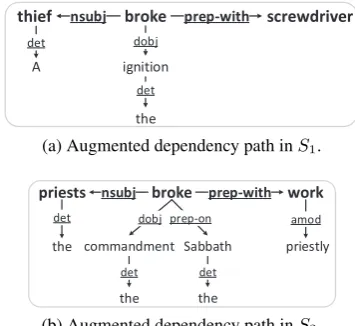
(a) Augmented dependency path inS1.
the
broke prep-with work
commandment
dobj
det
nsubj
priests
Sabbath
prep-on
det
the the
det
priestly
amod
(b) Augmented dependency path inS2. Figure 2: Augmented dependency paths.
path is combined with a representation generated from its subtree, strengthening the semantic rep-resentation of the shortest path. In this way, the augmented dependency path is represented as a continuous semantic vector which can be further used for relation classification.
2 Problem Definition and Motivation
The task of relation classification can be defined as follows. Given a sentence S with a pair of entitiese1 ande2annotated, the task is to identify
the semantic relation between e1 and e2 in
ac-cordance with a set of predefined relation classes (e.g., Content-Container, Cause-Effect). For ex-ample, in Figure 2, the relation between two en-titiese1=thief ande2=screwdriver is
Instrument-Agency.
Bunescu and Mooney (2005) first used short-est dependency paths between two entities to capture the predicate-argument sequences (e.g., “thief←broke→screwdriver” in Figure 2), which provide strong evidence for relation classification. As we observe, the shortest paths contain more information and the subtrees attached to each node on the shortest path are not exploited enough. For example, Figure 2a and 2b show two instances which have similar shortest dependency paths but belong to different relation classes. Methods only using the path will fail in this case. However, we
can distinguish these two paths by virtue of the attached subtrees such as “dobj→commandment” and “dobj→ignition”. Based on many observa-tions like this, we propose the idea that combines the subtrees and the shortest path to form a more precise structure for classifying relations. This combined structure is called “augmented depen-dency path(ADP)”, as illustrated in Figure 2.
Next, our goal is to capture the semantic repre-sentation of the ADP structure between two enti-ties. We first adopt a recursive neural network to model each word according to its attached depen-dency subtree. Based on the semantic information of each word, we design a convolutional neural network to obtain salient semantic features on the shortest dependency path.
3 Dependency-Based Neural Networks
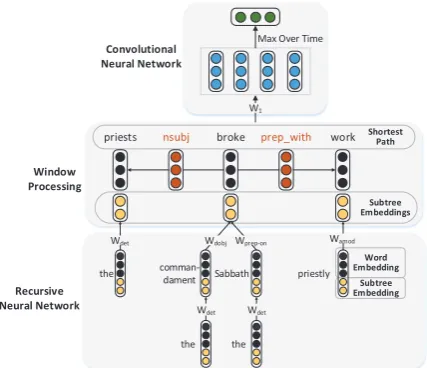
In this section, we will introduce how we use neu-ral network techniques and dependency informa-tion to explore the semantic connecinforma-tion between two entities. We dub our architecture of model-ing ADP structures as dependency-based neural networks (DepNN). Figure 3 illustrates DepNN with a concrete example. First, we associate each word w and dependency relationr with a vector representation xw,xr ∈ Rdim. For each word
w on the shortest dependency path, we develop an RNN from its leaf words up to the root to generate a subtree embeddingcwand concatenate
cw withxw to serve as the final representation of
w. Next, a CNN is designed to model the shortest dependency path based on the representation of its words and relations. Finally our framework can efficiently represent the semantic connection between two entities with consideration of more comprehensive dependency information.
3.1 Modeling Dependency Subtree
The goal of modeling dependency subtrees is to find an appropriate representation for the words on the shortest path. We assume that each word w can be interpreted by itself and its children on the dependency subtree. Then, for each wordwon the subtree, its word embeddingxw ∈Rdimand
sub-tree representationcw ∈ Rdimc are concatenated
to form its final representationpw ∈ Rdim+dimc.
For a word that does not have a subtree, we set its subtree representation ascLEAF. The subtree
[image:2.595.90.268.156.319.2]Wdet
priests nsubj broke prep_with work
the comman-dament Sabbath
the
priestly Max Over Time
Subtree Embeddings
Window Processing
Recursive Neural Network
Convolutional Neural Network
Shortest Path
Wdet Wdobj Wamod
W1
Word Embedding
Subtree Embedding
Wprep-on
Wdet
[image:3.595.74.288.62.246.2]the
Figure 3: Illustration of Dependency-based Neural Networks.
During the bottom-up construction of the subtree, each word is associated with a dependency rela-tion such asdobjas in Figure 3. For each depen-dency relation r, we set a transformation matrix Wr ∈ Rdimc×(dim+dimc) which is learned during
training. Then we can get,
cw =f(
X
q∈Children(w)
WR(w,q) ·pq+b) (1)
pq= [xq,cq] (2)
whereR(w,q)denotes the dependency relation
be-tween wordw and its child wordq. This process continues recursively up to the root word on the shortest path.
3.2 Modeling Shortest Dependency Path To classify the semantic relation between two en-tities, we further explore the semantic representa-tion behind their shortest dependency path, which can be seen as a sequence of words and dependen-cy relations as the bold-font part in Figure 2. As the convolutional neural network (CNN) is good at capturing the salient features from a sequence of objects, we design a CNN to tackle the shortest dependency path.
A CNN contains a convolution operation over a window of object representations, followed by a pooling operation. As we know, a word w on the shortest path is associated with the repre-sentation pw through modeling the subtree. For
a dependency relation r on the shortest path, we set its representation as a vector xr ∈
Rdim. As a sliding window is applied on the
sequence, we set the window size as k. For example, when k = 3, the sliding windows of a shortest dependency path with n words are: {[rs w1 r1],[r1 w2 r2], . . . ,[rn−1 wn re]}where
rs and re are used to denote the beginning and
end of a shortest dependency path between two entities.
We concatenate k neighboring words (or de-pendency relations) representations into a new vector. Assume Xi ∈ Rdim·k+dimc·nw as the
concatenated representation of the i-th window, wherenw is the number of words in one window.
A convolution operation involves a filter W1 ∈
Rl×(dim·k+dimc·nw), which operates onXito pro-duce a new feature vectorLiwithldimensions,
Li=W1Xi (3)
where the bias term is ignored for simplicity. Then W1 is applied to each possible window in the shortest dependency path to produce a feature map: [L0, L1, L2,· · ·]. Next, we
adop-t adop-the widely-used max-over-adop-time pooling opera-tion (Collobert et al., 2011), which can retain the most important features, to obtain the final representation L from the feature map. That is, L=max(L0,L1,L2, . . .).
3.3 Learning
Like other relation classification systems, we al-so incorporate al-some lexical level features such as named entity tags and WordNet hypernyms, which prove useful to this task. We concatenate them with the ADP representation L to produce a combined vector M. We then pass M to a fully connected softmax layer whose output is the probability distributionyover relation labels.
M = [L,LEX] (4)
y=softmax(W2M+b2) (5)
Then, the optimization objective is to minimize the cross-entropy error between the ground-truth label vector and the softmax output. Pa-rameters are learned using the back-propagation method (Rumelhart et al., 1988).
4 Experiments
We compare DepNN against multiple baselines on SemEval-2010 dataset (Hendrickx et al., 2010).
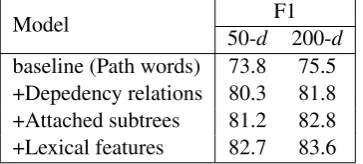
relation types, and each type has two directions. Instances which don’t fall in any of these classes are labeled asOther. The official evaluation metric is the macro-averaged F1-score (excludingOther) and the direction is considered. We use dependen-cy trees generated by the Stanford Parser (Klein and Manning, 2003) with thecollapsedoption. 4.1 Contributions of different components We first show the contributions from different components of DepNN. Two different kinds of word embeddings for initialization are used in the experiments. One is the 50-d embeddings pro-vided by SENNA (Collobert et al., 2011). The second is the 200-d embeddings used in (Yu et al., 2014), trained on Gigaword with word2vec1.
All the hyperparameters are set with 5-fold cross-validation.
Model 50-dF1200-d
[image:4.595.307.526.60.167.2]baseline (Path words) 73.8 75.5 +Depedency relations 80.3 81.8 +Attached subtrees 81.2 82.8 +Lexical features 82.7 83.6
Table 1: Performance of DepNN with different components.
We start with a baseline model using a CNN with only the words on the shortest path. We then add dependency relations and attached subtrees. The results indicate that both parts are effective for relation classification. The rich linguistic in-formation embedded in the dependency relations and subtrees can on one hand, help distinguish dif-ferent functions of the same word, and on the other hand infer an unseen word’s role in the sentence. Finally, the lexical features are added and DepNN achieves state-of-the-art results.
4.2 Comparison with Baselines
In this subsection, we compare DepNN with sev-eral baseline relation classification approaches. Here, DepNN and the baselines are all based on the 200-dembeddings trained on Gigaword due to the larger corpus and higher dimensions.
SVM (Rink and Harabagiu, 2010): This is the top performed system in SemEval-2010. It utilizes many external corpora to extract features from the sentence to build an SVM classifier.
1https://code.google.com/p/word2vec/
Model Additional Features F1
SVM POS, PropBank, morphologicalWordNet, TextRunner, FrameNet 82.2 dependency parse, etc.
MV-RNN POS, NER, WordNet 81.82
CNN WordNet 82.7
FCM NER 83.0
DT-RNN NER 73.1
[image:4.595.92.274.317.399.2]DepNN WordNetNER 83.083.6
Table 2: Results on SemEval-2010 dataset with Gigaword embeddings.
MV-RNN (Socher et al., 2012): This model finds the path between the two entities in the con-stituent parse tree and then learns the distributed representation of its highest node with a matrix for each word to make the compositions specific.
CNN: Zeng et al. (2014) build a convolutional model over the tokens of a sentence to learn the sentence level feature vector. It uses a special position vector that indicates the relative distances of current input word to two marked entities.
FCM (Yu et al., 2014): FCM decomposes the sentence into substructures and extracts features for each of them, forming substructure embed-dings. These embeddings are combined by sum-pooling and input into asoftmaxclassifier.
DT-RNN (Socher et al., 2014) : This is an RNN for modeling dependency trees. It combines node’s word embedding with its children through a linear combination but not a subtree embedding. We adapt the augmented dependency path into a dependency subtree and apply DT-RNN.
As shown in Table 2, DepNN achieves the best result (83.6) using NER features. WordNet fea-tures can also improve the performance of DepN-N, but not as obvious as NER. Yu et al. (2014) had similar observations, since the larger number of WordNet tags may cause overfitting. SVM achieves a comparable result, though the quality of feature engineering highly relies on human ex-perience and external NLP resources. MV-RNN models the constituent parse trees with a recursive procedure and its F1-score is about 1.8 percent lower than DepNN. Meanwhile, MVR-NN is very slow to train, since each word is associated with a matrix. Both CNN and FCM use features from the whole sentence and achieve similar performance. DT-RNN is the worst of all baselines, though it
2MV-RNN achieves a higher F1-score (82.7) on SENNA
also considers the information from shortest de-pendency paths and attached subtrees. As we ana-lyze, shortest dependency paths and subtrees play different roles in relation classification. However, we can see that DT-RNN does not distinguish the modeling processes of shortest paths and subtrees. This phenomenon is also seen in a kernel-based method (Wang, 2008), where the tree kernel per-forms worse than the shortest path kernel. We also look into the DepNN model and find it can identify different patterns of words and the dependency relations. For example, in theInstrument-Agency
relation, the word “using” and the dependency re-lation “prep with” are found playing a major role.
5 Conclusion
In this paper, we propose to classify relations between entities by modeling the augmented de-pendency path in a neural network framework. We present a novel approach, DepNN, to taking advantages of both convolutional neural network and recursive neural network to model this struc-ture. Experiment results demonstrate that DepNN achieves state-of-the-art performance.
Acknowledgments
We thank all the anonymous reviewers for their insightful comments. This work was partially sup-ported by National Key Basic Research Program of China (No. 2014CB340504), National Natural Science Foundation of China (No. 61273278 and 61370117), and National Social Science Fund of China (No: 12&ZD227). The correspondence author of this paper is Sujian Li.
References
Nguyen Bach and Sameer Badaskar. 2007. A survey on relation extraction. Language Technologies Insti-tute, Carnegie Mellon University.
Razvan C. Bunescu and Raymond J. Mooney. 2005. A Shortest Path Dependency Kernel for Relation Extraction. In North American Chapter of the As-sociation for Computational Linguistics.
Ronan Collobert, Jason Weston, L´eon Bottou, Michael Karlen, Koray Kavukcuoglu, and Pavel Kuksa. 2011. Natural language processing (almost) from scratch. The Journal of Machine Learning Re-search, 12:2493–2537.
Aron Culotta and Jeffrey S. Sorensen. 2004. De-pendency Tree Kernels for Relation Extraction. In
Meeting of the Association for Computational Lin-guistics, pages 423–429.
Iris Hendrickx, Zornitsa Kozareva, Preslav Nakov, Se-bastian Pad ok, Marco Pennacchiotti, Lorenza Ro-mano, and Stan Szpakowicz. 2010. SemEval-2010 Task 8: Multi-Way Classification of Semantic Rela-tions Between Pairs of Nominals.
Dan Klein and Christopher D. Manning. 2003. Ac-curate Unlexicalized Parsing. InMeeting of the As-sociation for Computational Linguistics, pages 423– 430.
Dat PT Nguyen, Yutaka Matsuo, and Mitsuru Ishizuka. 2007. Relation extraction from wikipedia using subtree mining. InProceedings of the National Con-ference on Artificial Intelligence, volume 22, page 1414. Menlo Park, CA; Cambridge, MA; London; AAAI Press; MIT Press; 1999.
Bryan Rink and Sanda Harabagiu. 2010. Utd: Clas-sifying semantic relations by combining lexical and semantic resources. InProceedings of the 5th Inter-national Workshop on Semantic Evaluation, pages 256–259, Uppsala, Sweden, July. Association for Computational Linguistics.
David E Rumelhart, Geoffrey E Hinton, and Ronald J Williams. 1988. Learning representations by back-propagating errors.Cognitive modeling, 5.
Richard Socher, Brody Huval, Christopher D. Man-ning, and Andrew Y. Ng. 2012. Semantic composi-tionality through recursive matrix-vector spaces. In
Proceedings of the 2012 Joint Conference on Empir-ical Methods in Natural Language Processing and Computational Natural Language Learning, pages 1201–1211, Jeju Island, Korea, July. Association for Computational Linguistics.
Richard Socher, Andrej Karpathy, Quoc V Le, Christo-pher D Manning, and Andrew Y Ng. 2014. Ground-ed compositional semantics for finding and describ-ing images with sentences. Transactions of the Association for Computational Linguistics, 2:207– 218.
Fabian M Suchanek, Georgiana Ifrim, and Gerhard Weikum. 2006. Combining linguistic and statistical analysis to extract relations from web documents. In Proceedings of the 12th ACM SIGKDD interna-tional conference on Knowledge discovery and data mining, pages 712–717. ACM.
Mengqiu Wang. 2008. A re-examination of dependen-cy path kernels for relation extraction. InIJCNLP, pages 841–846.
Mo Yu, Matthew Gormley, and Mark Dredze. 2014. Factor-based compositional embedding models. In
NIPS Workshop on Learning Semantics.