of IPR
Gil Su Yoon
1*, You Heon Kim
2, Sung Ju Lim
11Interdisciplinary Program of Intellectual Property, Graduate School, Pukyong National University, Busan, South Korea
2Invention and Promotion Association, Seoul, South Korea Email: [email protected]
Received September 28th, 2012; revised October 30th, 2012; accepted November 14th, 2012
We have developed a training tool of division technique among 5 techniques in ASIT for problem solving method for Intellectual Property Right. Even though with its good capability, there were not yet an appli- cable training tool to use for division training because of its easy disassembled shape with small distur- bance. To develop a division technique training tool, we have applied ASIT to game T. We have chosen game shape parts with magnetic rubber and board as the plate coated with zinc. The adhesive strength of the game shape parts to board is enough to keep fixed position even in turn down. Developed division training tool is expected to be used for the e-learning of problem solving training for student education and lifelong education. It is under Korean utility model application. E-learning with open resources in- cluding beneficial training for solving problem will be developed together with the foundation of life-long education. This division training device is proposed to younger generation as the educational auxiliary training tool for problem solving method. We are looking for the international cooperation with this divi- sion training tool. With the encouragement of this division training tool we have patented Korean patent of the lifting method of methane hydrate which can be extended to various fields of IPR.
Keywords: Division Technique; ASIT; Training Tool; Problem Solving Method; Intellectual Property Right
Problem Solving Methods
We are making decisions every day from a mere trifle to im- portant things. Making correct decision is quite important. Our future is full of vagueness which we don’t know about. It is news to us at all. So we should not afraid of our failures during our school days. There is a proverb that “Failure is but the threshold of success.” We should not be afraid of failure in our youth days. We can experience creative thinking indirectly by reading books and OCW resources et al. (Yoon, Kodama, & Park, 2007). There are many techniques for solving problems. Among them especially 3 types of thinking method, Brain- storming, TRIZ and ASIT will be briefly overviewed.
Brainstorming
Brainstorming is a usual group meeting technique designed to generate a large number of ideas for the solution to a prob- lem. Osborn proposed that groups could double their creative output by using the method of brainstorming. Although brain- storming has become a popular group technique, researchers have generally failed to find evidence of its effectiveness for enhancing either quantity or quality of ideas generated. Well known international consultant company Ideo is a famous con-
sultant company which uses brainstorming method very well for developing new products (Ideo, 2010). Even though Ideo used brainstorming method very well, brainstorming is a kind of trial and error method. Thinkmap is a kind of program for brainstorming. When we concentrate on a specific topic, we are apt to effluent many things unrelated to the topic. It is not to be blamed and it is only natural for human who uses right and left cerebral simultaneously. It uses parallel thinking around the main idea and vertical thinking with digging on specific topic.
TRIZ
TRIZ is a romanized acronym for Russian “Teoriya Resheniya Izobretatelskikh Zadatch” meaning “The theory of solving in- ventor’s problems” or “The theory of inventor’s problem solv- ing”. It was developed by a Soviet engineer and researcher Genrich Altshuller and his colleagues starting in 1946. TRIZ, in contrast to techniques such as brainstorming which is based on random idea generation, aims to create an algorithmic approach to the invention of new systems, and problem solving as Figure 1 (TRIZ, 2010).
TRIZ was developed with especially applicable to engineer- ing problems. Even though and LG and Samsung and many companies have developed new products with the application of TRIZ, there are many tools such as contradiction matrix, Su-Field analysis, ARIZ (Algorithm for TRIZ) which is not so easy to real problems. It needs much training and experiences to apply TRIZ to solve real problems which need approximate of 100 hours with the apprentice of TRIZ master.
*
Bibliography of G. S. Yoon:
Figure 1.
Structural diagram of TRIZ (from Wikipedia).
ASIT
ASIT (Advanced Systematic Inventive Thinking), is a modi- fied version of TRIZ by Israel prof. Roni Horowitz. He modi- fied the complication of TRIZ into 5 simple methods such as unification, multiplication, division, breaking symmetry and removal. Compared with other methods, ASIT is simple and easy to apply to solve real problems. TRIZ is more applicable to much complicated engineering problems, but ASIT is easier simple problem solver. Generally speaking compared with other methods, ASIT is a simple and easy to apply to solve real problems. To develop the ability of solving problems it is rec- ommended to train division technique with appropriate training tools (Yoon, Kodama, & Park, 2008; Yoon, 2009).
Problem Solving Process in ASIT
ASIT uses 3 stages for 1) finding out problem objects and environmental objects; 2) describing undesired effect and use for 5 technique templates; 3) Elaborating the solution as Figure 2.
In ASIT it is important to find out problem objects and select proper one of 5 provoking techniques, which are unification, multiplication, division, breaking symmetry and removal. Each technique uses template to help to find agent for desired action mechanically. Functional fixedness interrupt us from creative thinking, so in problem solving process in ASIT, 3 stages with templates are used for mechanical process that we are easy to neglect in normal way of thinking. As in Figure 2 we find pro- blem objects and environmental objects at the 1st stage. At 2nd stage we write down undesired effects. And write the desirable sentence from undesirable sentence. It is not easy to select a proper technique to solve problem. After selecting a proper technique we substitute automatically objects to that template. At 3rd stage we are elaborating the solution. There are 5 tech- nique templates in Table 1 (Horowitz, 2005).
Division Technique
Division technique is frequently used for ASIT solving problem among 5 techniques. The template of division tech- nique is that the object < > will be divided its part and will be reorganized in space and time. It is not so easy to divide and reorganize its parts for solution. We can show a match game how to divide with Figure 3. A cow is chased from a lion. The lion can’t catch the cow when the cow sees the lion. Moving with only 2 matches, how you save cow life from lion’s attack?
When asked with this problem, they are easy to solve this
Figure 2.
ges for solving process. Table 1.
ique templates.
emplate ASIT 3 sta
Five techn
Technique T
Unification The object < > will be the agent of the action < >.
Multiplication t
Division l be divided its part and will be Breaking symmetry
of the property < >. Removal
New object of the same type as < > will be the agen of the action < >.
The object < > wil
reorganized in space and time. At different locations in < > there will be a different value
The object < > will be removed from the problem world.
Figure 3.
me that a cow chased from a lion. A match ga
Figure 4.
back to lion.
But Figure 4 is not the same ow because of the tail position
is
Cow turns
c
Game T, Assembly Game
. Game T can be used as a prac- tic
with 4 fixed parts as Figure 6. It se
z shape is as- se
Division Technique Training Method
p arrow shape as
F
vase shape and inverse z shape as Figures 11 and
12
divide the inverse z shape with a line as Figure 12, yo
2007).
Game T is an assembly game
ing tool of division technique with 4 fixed shapes. Even th- ough we can not make use of arbitrary shapes in game T, it can be used for us as a good training tool for division technique to find out the prescribed shapes
A house shape is composed
ems that we cannot fully practice for training to find out composed component parts, but it is easy that we can practice to find out how to assemble predefined shape. So we can make use of game T as a division training tool of ASIT. There are more than 20 shapes assembled with only 4 fixed component parts as seen in Figure 6 (Karin & Kanel, 2008).
For example situated at the right below inverse mbled with 4 component parts as in Figure 7.
There are long arrow shape and short plum
igure 8. It takes some time and it is not easy to assemble these
two arrows continuously. It takes some time to find the assem- bled long shape and short plump arrow separately as in Figure 9. mono colored shapes are not so easy to assemble these two arrows continuously from slim arrows to taut arrows like Fig- ure 10.
There are
. These shapes are seemed to indifferent to short plump ar- row shape.
But if you
u can get easily short plump arrow by upside down left or right part as in Figure 13.
Figure 5.
only its face to lion. Cow turns
Figure 6.
shape with its 4 components. Assembled
Figure 7.
shape with its 4 components. Assembled
Figure 8.
ape with its 4 components. Inverse z sh
Figure 9. shapes. Two arrow
Figure 10.
hape of long arrow and short plump one. Assembled s
Figure 12. pe. Inverse z sha
Figure 13.
se z shape with a line.
How can you get the pentagon shape as in Figure 14? There ar
Electronic game installed cr
to find stronger materials. At the end we fi
Divide rever
e various methods to make the pentagon shape as Figure 14. But you can get pentagon shape of Figure 14 with moving only one part from short plump arrow as in Figure 10.
Application of ASIT to Game T
in smart handheld phone is in-easing in these days. But many electric games are biased with violence and erotic games which are not good for children. Conventional game such as game T needs consideration is ra- ther better in the mental health for creative thinking than elec- tronic games which stimulate one’s nerves. Nevertheless game T is easily scattered and it is greatly bothered to play with for children. The game T is a good tool for training tool of division technique to students. But it is inconvenient to practice game T to play with parts on the desk. I have applied ASIT to game T to solve this problem. In 1st stage, the problem object is game parts. Undesired effect is game parts are easily scattered with small disturbance. In 2nd stage, desired effect is the game parts are fixed in their position. In 3rd stage, I select IFR instead of 5 techniques. IFR is to keep their position without any movement for any arbitrary posture. If I use magnetic rubber game parts, they can stick to their position. If I can try this game on the vertical board, it will be easy to show that to the students. So I applied IFR to the game T. IFR is to stick game shape parts to the board automatically. If I can make use of magnetic force it is possible for the shape parts to stick on the board. At 1st, I find out magnetic rubber. It can stick magnetic rubber parts on the magnetic rubber board, but it is easily rumpled and corru- gated in Figure 15.
So we have tried
nd out a board as the plate coated with zinc. The adhesive strength of the game shape parts to board is enough to keep
Figure 14. ape. Pentagon sh
Figure 15.
bber board and parts.
fixed position on board withou falling down even
Application ASIT to Lifting Method of Methane
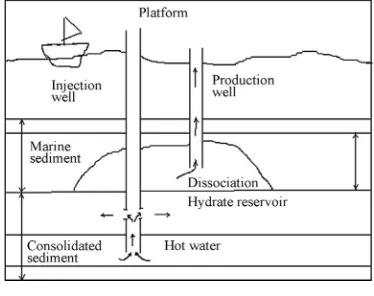
Conventional lifting m ethane hydrate was like
F
ed undesirable effects as gas leakage of
red for Korean patent Magnetic ru
t scattering or
in turn down position as Figure 13. It is now under Korean utility model. With this portable game we can practice division technique of ASIT as much as we likes. This can be used as the portable training tool of division technique among 5 techniques in ASIT for problem solving method. This is under Korean utility model (Yoon, 2011). Developed tool is expected also to use for the e-learning of problem solving method or even to IPR (Intellectual Property Right) for the education of younger generation and lifelong study.
Hydrate
ethod of m
igure 16. We have applied ASIT to the lifting method of me-
thane hydrate and we have registered Korean patent. At 1st stage, we selected problem objects as rising pipe, methane hy- drate and mother ship. And we selected waves and water depth as environmental objects.
At 2nd stage, we describ
methane hydrate. From this we can describe desirable effect as lifting with ice shape of methane hydrate. At 3rd stage we selected removal technique. Refrained a little from IFR with inter compressed container, we can remove rising pipe and mo- dified the lifting method of methane hydrate with ice shape. We have developed a new lifting method of methane hydrate with inter compressed container as Figure 17.
Figure 16.
[image:5.595.81.266.324.452.2] [image:5.595.90.253.481.715.2]l lifting method of methane hydrate. Conventiona
Figure 17.
method of methane hydrate. New lifting
Figure 18.
Registered certificate of Korean patent.
Following are r Leaders Industry
university
REFERENCES
Horowitz, R. (2005). In e Adobe pdf File Type E-Book.
t2Think.com
om/mic/2010/profile/ideo
K 08). The T puzzle.
r e-learning of division
011
T Y
emView.do?kemId=127676 for creative problem solv-
T. Y
om invent and patent to IP for SMEs. 3rd TRIZ In-
Y
education by way of So Applied with IFR, ASIT to the game T, we found out a solu- tion for board with zinc and magnetic rubber parts for division technique in any convenient posture. Some cases are shown for division technique training for children and students. As better achievement one gets, game T will be more difficult to find so- lution with black parts for tough training of division technique. We also applied ASIT to methane hydrate and we have Regis- tered Korean patent. We think it will be applicable from various games for younger generation as the education auxiliary tool such as ASIT division technique for problem solving to develop one’s ability for Intellectual Property Right (IPR) by way of e- learning and lifelong education. We would like to propose an international collaboration for various division technique train- ing tool. We are cordially appreciated any questions or com- ments and proposal or suggestion for international cooperation.
Acknowledgements
esults of a study on the “
Cooperation” Project, supported by the Ministry of Education, Science & Technology (MEST), Korea.
troduction to ASIT. Privat Horowitz, R. (2007). ASIT premier.
http://Star
Ideo (2010). http://www.fastcompany.c arin & Von Kanel, J. (20
http://www.woodpuzzles.com/Puzzles/T_Puzzle/T_Puzzle.html Lim, S. J. & Yoon, G. S. (2011). Proposal fo
technique training tool for problem solving method, ASIT. The 2 International Symposium on Advanced Engineering of College of Engineering, Pukyong National University.
RIZ (2010). http://tfc2010.unibg.it/ oon, G. S. (2009). Invention and patent.
http://www.kocw.net/home/search/k Yoon, G. S. (2009). Necessity of education
ing method modified lifting method for methane hydrate by ASI
2009 KSOE Joint Symposium of Ocean Science, 1787-1790. oon, G. S. (2011). Korea utility model registration application No. 20-
2011-0004070.
Yoon, G. S., Kodama, H., & Park, Y. W. (2007). How to apply TRIZ to the e-learning fr
ternational Symposium, Yokohama, 227-250.
oon, G. S., Kodama, H., & Park, Y. W. (2008). How to practice for the solving problems of invent, patent and IP