3136
CogNet: a Large-Scale Cognate Database
Khuyagbaatar Batsuren† Gábor Bella† Fausto Giunchiglia†§ DISI, University of Trento, Trento, Italy†
Jilin University, Changchun, China§
{k.batsuren; gabor.bella; fausto.giunchiglia}@unitn.it
Abstract
This paper introduces CogNet, a new, large-scale lexical database that provides
cognates—words of common origin and meaning—across languages. The database currently contains 3.1 million cognate pairs across 338 languages using 35 writing sys-tems. The paper also describes the automated method by which cognates were computed from publicly available wordnets, with an accuracy evaluated to 94%. Finally, statistics and early insights about the cognate data are presented, hinting at a possible future exploitation of the resource1 by various fields of lingustics.
1 Introduction
Cognates are words in different languages that share a common origin and the same meaning, such as the English letter and the French lettre. Cognates and the problem of cognate identifica-tion have been extensively studied in the fields of language typology and historical linguistics, as cognates are considered useful for research-ing the relatedness of languages (Bhattacharya et al.,2018). Cognates are also used in computa-tional linguistics, e.g., for lexicon extension (Wu and Yarowsky,2018) or to improve cross-lingual NLP tasks such as machine translation or bilingual word recognition (Kondrak et al.,2003;Tsvetkov and Dyer,2015).
Despite the interest in using cognate data for research, state-of-the-art cognate databases have had limited practical uses from an applied perspec-tive, for two reasons. Firstly, popular cognate-coded databases that are used in historical lin-guistics, such as ASJP (Wichmann et al., 2010),
1The CogNet resource and WikTra tool are available on
http://cognet.ukc.disi.unitn.it.
IELex2, or ABVD (Greenhill et al.,2008), cover
only the small set of 225Swadeshbasic concepts, although with an extremely wide coverage of up to 4000 languages. Secondly, in these databases, lex-ical entries that belong to scripts other than Latin or Cyrillic mostly appear in phonetic transcription instead of using their actual orthographies in their original scripts. These limitations prevent such re-sources from being used in real-world computa-tional tasks on written language.
This paper describesCogNet, a new large-scale, high-precision, multilingual cognate database, as well as the method used to build it. Our main technical contributions are (1) a general method to detect cognates from multilingual lexical re-sources, with precision and recall parametrable ac-cording to usage needs; (2) a large-scale cognate database containing 3.1 million word pairs across 338 languages, generated with the method above; (3) WikTra, a multilingual transliteration dictio-nary and library derived fromWiktionarydata; and (4) an online platform that lets users explore the resource.
The paper is organised as follows. Section 2
presents the state of the art. Section3 describes the main cognate discovery algorithm and sec-tion 4 the way various forms of evidence used by the algorithm are computed. The method is parametrised and the results are evaluated in sec-tion 5. Section 6 describes the resultingCogNet
database in terms of structure and statistical in-sights. Finally, section7concludes the paper.
2 State of the Art
To our knowledge, cognates have so far been defined and explored in two fundamental ways by two distinct research communities. On the
2Indo-European Lexical Cognacy Database,
one hand, cognate identificationhas been studied within linguistic typology and historical linguis-tics. On the other hand, computational linguists have been researching methods for cognate pro-duction.
The very definition of the term ‘cognate’ varies according to the research community. In histori-cal linguistics, cognates must have a provable ety-mological relationship and must be translated into each language (Bhattacharya et al., 2018). Ac-cordingly, the Englishskyscraperand the German
Wolkenkratzer are considered as cognates but the English song and the Japanese S⇣ /songu/)
are not. In computational linguistics, the notion of cognate is more relaxed with respect to etymol-ogy and loanwords are also considered as cognates (Kondrak et al.,2003). For our work we adopted the latter, computational point of view.
In historical linguistics, cognate identification methods proceed in two main steps. First, a sim-ilarity matrix of all words is estimated by three types of similarity measures: semantic similar-ity, phonetic similarsimilar-ity, and orthographic simi-larity. For information on semantic similarity, special-purpose multilingual dictionaries, such as the well-known Swadesh List, are used. For or-thographic similarity, string metrics (Hauer and Kondrak, 2011; St Arnaud et al., 2017) are of-ten employed, e.g., edit distance, Dice’s coeffi-cient, or LCSR. As these methods do not work across scripts, they are completed by phonetic similarity, exploiting transformations and sound changes across related languages (Kondrak,2000;
Jäger,2013;Rama et al.,2017). Phonetic similar-ity measures, however, require phonetic transcrip-tions to bea prioriavailable. More recently, his-torical linguists have started exploiting identified cognates to infer phylogenetic relationships across languages (Rama et al.,2018;Jäger,2018).
In computational linguistics, cognate produc-tion consists of finding for a word in a given lan-guage its cognate pair in another lanlan-guage. State-of-the-art methods (Beinborn et al., 2013; Sen-nrich et al.,2016) have employed character-based machine translation, trained from parallel corpora, to produce cognates or transliterations. (Wu and Yarowsky,2018) also employs similar techniques, as well as multilingual dictionaries, to produce large-scale cognate clusters for Romance and Tur-kic languages. Although the cognates produced in this manner are, in principle, a good source for
improving certain cross-lingual tasks in NLP, the quality of the output often suffers due to not be-ing able to handle certain lbe-inguistic phenomena properly. For example, words in languages such as Arabic or Hebrew are written without vowels and machine-produced transliterations often fail to vowelize such words (Karimi et al.,2011). The so-lution we propose is the use of a dictionary-based transliteration tool over machine transliteration.
Our method provides new contributions for both research directions. Firstly, to our knowledge no other work on cognate generation has so far used high-quality multilingual lexical resources on a scale as large as ours, covering hundreds of lan-guages and more than 100,000 cross-lingual con-cepts. Secondly, this large cross-lingual cover-age could only be achieved thanks to a robust transliteration tool that is part of the contributions of our paper. Finally, our novel, combined use of multiple—orthographic, semantic, geographic, and etymological—sources of evidence for detect-ing cognates was crucial to obtain high-quality re-sults, in terms of both precision and recall.
3 The Algorithm
For our work we have adopted a computational-linguistic interpretation of the notion of cognate (Kondrak et al.,2003): two words in different lan-guages are cognates if they have the same meaning and present a similarity in orthography, resulting from a supposed underlying etymological relation-ship (common ancestry or borrowing).
Based on this interpretation, our algorithm is based on three main principles: (1) semantic equivalence, i.e., that the two words share a com-mon meaning; (2) sufficient proof ofetymological relatedness; and (3) thelogical transitivityof the cognate relationship.
The core resource for obtaining cross-lingual evidence onsemantic equivalence—i.e., the same-ness of word meanings—is theUniversal Knowl-edge Core (UKC), a large multilingual lexico-semantic database (Giunchiglia et al., 2018) al-ready used both in linguistics research as well as for practical applications (Bella et al., 2016;
into wordnets (Bond and Foster, 2013)). As all of the resources composing the UKC were built and validated by humans(Giunchiglia et al.,2015), we consider the quality of our input data to be high enough for obtaining accurate results on cog-nates (Giunchiglia et al.,2017). As most wordnets map their units of meaning (synsets in WordNet terminology) to English meanings, they can effec-tively be interconnected into a cross-lingual lexi-cal resource. The UKC reifies all of these map-pings as supra-lingual lexical concepts (107,196 in total, excluding named entities such as Ulan-baatar). For example, if the GermanFahrradand the Italian bicicletta are mapped to the English
bicycle then a single concept is created to which all three language-specific meanings (i.e., wordnet synsets) will be mapped.
In terms ofetymological evidence, we use both direct and indirect evidence of etymological re-latedness. Direct evidence is provided by gold-standard etymological resources, such as the one we use and present in section4.1. Such evidence, however, is relatively sparse and would not, in it-self, provide high recall. We therefore also con-sider indirect evidence in the form of a combined
orthographic–geographic relatedness: a measure of geographic proximity of languages combined with the orthographic similarity of words, involv-ing transliteration, can provide strong clues on lan-guage contact and probable cross-lingual lexical borrowing.
Finally, we exploit logical transitivityin order further to improve recall: we build on the intu-ition that if wordswaandwbare cognates andwb
andwcare cognates thenwaandwc are also
cog-nates. For example, if the GermanKatzeis found to be a cognate of the English cat (based on di-rect etymological evidence) andcatis found to be a cognate of the Frenchchat (based on orthogra-phy) thenKatzeandchatare also considered to be cognates).
Based on these principles, we have imple-mented a cognate discovery algorithm as shown in algorithm1. Its input is a single lexical concept from the UKC (the algorithm being applicable to every concept in loop). It builds an undirected graph where each node represents a word and each edge between two nodes represents a cognate re-lationship.
The process starts by retrieving the lexicalisa-tions of the input concept in all available
lan-Algorithm 1:Cognate Discovery Algorithm
Input :c, a lexical concept
Input :R, a lexical resource
Output :G+, graph of all cognates ofc
1 V, E ;;
2 L LanguagesR(c);
3 foreach languagel2Ldo
4 foreach wordw2WordsR(c, l)do 5 V V [{v=<w, l>};
6 foreach nodev1 =<w1, l1>2V do
7 foreach nodev2=<w2, l2>2V do
8 ifl1 =l2then
9 continue;
10 ifEtyRel(w1, l1, w2, l2)then
11 E E[{e=<v1, v2>};
12 else ifOrthSim(w1, l1, w2, l2) +TG⇥
GeoP rox(l1, l2)> TF then
13 E E[{e=<v1, v2>};
14 G < V, E >;
15 G+=TransitiveClosure(G)
16 returnG+;
guages and creating the corresponding word nodes in the graph (lines 2–5). All such words thus fulfil the criterion of semantic equivalence above. Then, for all different-language word pairs that ex-press the concept (lines 6–9), we verify whether etymological evidence exists for a potential cog-nate relationship. The latter may either be direct evidence (EtyRel, line 10) or indirect, which we implement as a score of relatedness combined of orthographic similarity (OrthSim) and geographic proximity (GeoProx). We consider indirect evi-dence to be sufficient if this combined score is su-perior to an experimental thresholdTF (line 12).
In case either direct or indirect evidence is found, an edge between the two word nodes is created (lines 10–13). As the last step, in order to apply the principle of logical transitivity, thetransitive closureof the graph is computed (line 15). In the resulting graphG+each connected subgraph
rep-resents a group of cognate words.
theOrthSim function and on geographic proxim-ity using theGeoProxfunction.
4.1 Direct Etymological Evidence
The EtyRel function in algorithm 1 uses gold-standard evidence to compute the etymological re-latedness of words. It exploitsetymological ances-tor(marked asAncbelow) relations for each word of the word pair being evaluated as cognates. Two words are considered as etymologically related if they are found to have at least one common etymo-logical ancestor word (such as the German Ross
and the Englishhorsehaving as ancestor the proto-Germanic root*harss-).
EtyRel(w1, l1, w2, l2) =
=
(
true if Anc(w1, l1)\Anc(w2, l2)6=;
false otherwise
(1)
Ancestor relations are retrieved from the Etymo-logical WordNet(EWN)3(De Melo,2014), a
lex-ical resource providing relations between words, e.g., derivational or etymological. EWN was au-tomatically built by harvesting etymological infor-mation encoded in Wiktionary. In this work, we have only used its 94,832 cross-lingual etymolog-ical relations.
4.2 Orthographic Similarity
Orthographic similarity is computed using a string similarity metric LCSSim based on the longest common subsequence (LCS) of the two input words, returning a similarity score between 0 and 1:
LCSSim(w1, w2) =
2⇥len(LCS(w1, w2))
len(w1) +len(w2) (2)
When w1 and w2 belong to different writing
systems, LCS returns 0 and thus the formula above is not directly usable. In order to be able to identify cognates across writing systems, we ap-ply transliteration to the Latin script (also known as romanization) using the WikTra tool. Ortho-graphic similarity is thus computed as:
OrthSim(w1, w2) =max{LCSSim(w1, w2),
LCSSim(WikTra(w1),WikTra(w2))}
(3)
3http://www1.icsi.berkeley.edu/
⇠demelo/etymwn/, accessed on 10/14/2018.
WikTrais a dictionary-based transliteration tool compiled from information collected from Wik-tionary and developed specifically for this work by the authors4. It is Unicode-based and
sup-ports 85 languages in 35 writing systems, defing transliteration rules and codes accorddefing to in-ternational standards, as developed by the Wik-tionary community (the largest community in lex-icography).
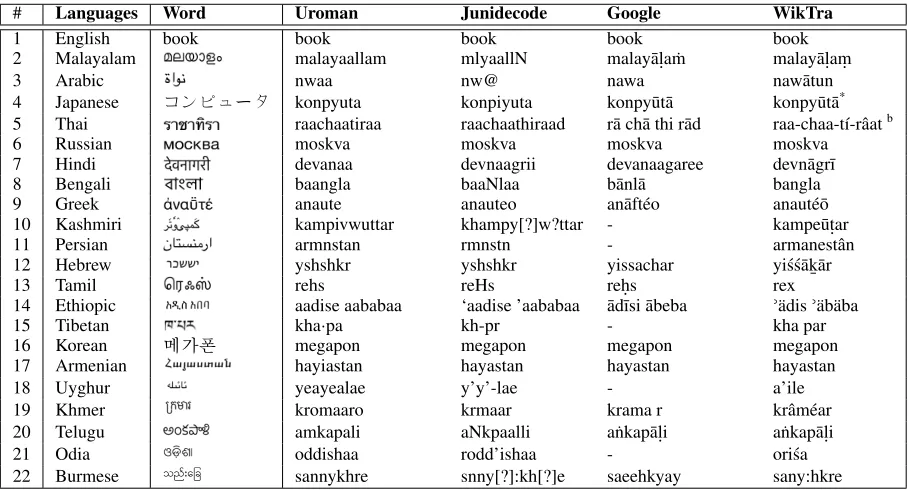
An illustration of the output provided by Wik-Tracompared to three existing transliteration tools is provided in table 1. The use of WikTra with respect to existing tools is justified by a need for high-quality results that also cover complex cases of orthography, e.g., in Semitic scripts where vow-els are typically omitted. In particular, Junide-code5 is a character-based transliterator, an
ap-proach that seriously limits its accuracy. The
Google transliterator is dictionary-based and is therefore of higher quality, but it supports a lower number of languages and is not freely available. Finally,uroman(Hermjakob et al.,2018) is a new, high-quality, dictionary-based tool that neverthe-less provides a limited support for scripts without vowels (e.g., Arabic or Hebrew), as also visible in table1.
While WikTra gains its high accuracy from human-curated Wiktionary data, it still needs to be improved for Thai and Japanese. In Thai,
WikTra only works on monosyllabic words, and it needs an additional tool to recognize sylla-bles. In Japanese, it only works with Hiragana and Katakana scripts and not with Kanji (Chinese characters). We therefore combinedWikTra with theKuromoji6transliteration tool.
4.3 Geographic Proximity
We exploit geographic information on languages in order to take into account the proximity of lan-guage speakers for the prediction of borrowing. Our hypothesis is that, even if in the last century lexical borrowing on a global scale has been faster than ever before, the effect of geographic distance is still a significant factor when applying cognate discovery to entire vocabularies. This effect is combined with orthographic similarity in line 12 of algorithm1, in a way that geographic proximity increases the overall likelihood of word pairs be-ing cognates, without bebe-ing a necessary condition.
Table 1: Comparison with state-of-the art transliteration tools
# Languages Word Uroman Junidecode Google WikTra
1 English book book book book book
2 Malayalam malayaallam mlyaallN malay¯al.a ˙m malay¯al.am.
3 Arabic nwaa nw@ nawa naw¯atun
4 Japanese ◆S4E⌧ konpyuta konpiyuta konpy¯ut¯a konpy¯ut¯a*
5 Thai raachaatiraa raachaathiraad r¯a ch¯a thi r¯ad raa-chaa-tí-râatb
6 Russian moskva moskva moskva moskva 7 Hindi devanaa devnaagrii devanaagaree devn¯agr¯ı 8 Bengali baangla baaNlaa b¯anl¯a bangla 9 Greek anaute anauteo an¯aftéo anauté¯o 10 Kashmiri kampivwuttar khampy[?]w?ttar - kampe¯ut.ar 11 Persian armnstan rmnstn - armanestân 12 Hebrew yshshkr yshshkr yissachar yi´s´s¯ak
¯¯ar
13 Tamil rehs reHs reh.s rex
14 Ethiopic aadise aababaa ‘aadise ’aababaa ¯ad¯ısi ¯abeba -ädis-äbäba
15 Tibetan kha·pa kh-pr - kha par
16 Korean Bj◆ò:r megapon megapon megapon megapon 17 Armenian hayiastan hayastan hayastan hayastan 18 Uyghur yeayealae y’y’-lae - a’ile 19 Khmer kromaaro krmaar krama r krâméar 20 Telugu amkapali aNkpaalli a˙nkap¯al.i a˙nkap¯al.i 21 Odia oddishaa rodd’ishaa - ori´sa 22 Burmese sannykhre snny[?]:kh[?]e saeehkyay sany:hkre
*WikTra in Japanese language only works with scripts of Hiragana and Katakana. bWikTra in Thai language only works with a sequence of syllables.
Our relatively simple solution considers only the languages of the input words, computing a lan-guage proximity value between 0 and 1, as fol-lows:
GeoProx(l1, l2) =min(
TD
GeoDist(l1, l2)
,1.0)
(4)
The function GeoDist(l1, l2)is an approximate
‘geographic distance’ between two languages l1
andl2, based on the geographical areas where the
languages are spoken. The constant TD
corre-sponds to aminimal distance: if two languages are spoken within this distance then they have max-imum geographic relatedness. TD is empirically
set as described in section5.2.
Distances between languages are provided by the WALS resource7, one of most comprehensive
language databases. WALS provides latitude and longitude coordinates for a language given as in-put. While a single coordinate returned for a lan-guage may in some cases be a crude approxima-tion of linguistic coverage (e.g., Spanish is spo-ken both in Spain and in most countries of Latin America), even this level of precision was found to improve our evaluation results.
7https://wals.info
5 Evaluation
This section describes how CogNet was evaluated on a manually built cognate corpus and how its parameters were tuned to optimise results.
5.1 Dataset Annotation
While our initial idea was to use existing cognate datasets for evaluation, the most comprehensive databases turned out to represent cognates in their phonetic transcriptions instead of having words written in their original scripts. Such data was not usable to test our method that performs transliter-ation on its own.
Consequently, we created a dataset of 40 con-cepts with fully annotated sets of cognate groups. On average, a concept was represented in 107 lan-guages by 129 words: 5,142 words in total for the 40 concepts. The concepts were chosen from the
Swadesh basic word list and from the WordNet
core concepts(Boyd-Graber et al.,2006). The lex-icalizations (words) corresponding to these cepts were retrieved from the UKC. For each con-cept, we asked two language experts to find cog-nate clusters among its lexicalizations. The ex-perts made their decisions based on online re-sources such as Wiktionary and the Online Ety-mology Dictionary8. Cohen’s Kappa score,
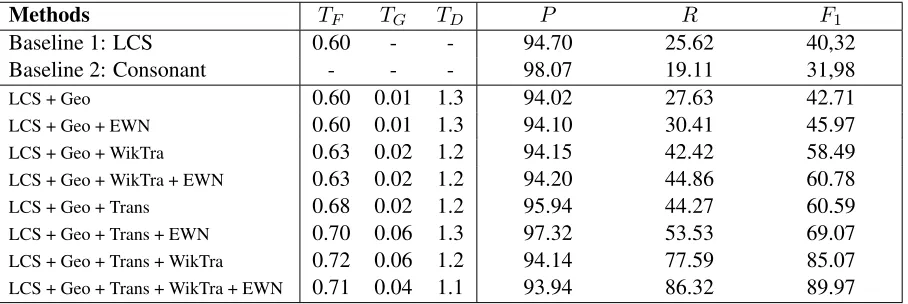
Table 2: Parameter configuration and comparisons.
Methods TF TG TD P R F1
Baseline 1: LCS 0.60 - - 94.70 25.62 40,32
Baseline 2: Consonant - - - 98.07 19.11 31,98
LCS + Geo 0.60 0.01 1.3 94.02 27.63 42.71 LCS + Geo + EWN 0.60 0.01 1.3 94.10 30.41 45.97 LCS + Geo + WikTra 0.63 0.02 1.2 94.15 42.42 58.49 LCS + Geo + WikTra + EWN 0.63 0.02 1.2 94.20 44.86 60.78 LCS + Geo + Trans 0.68 0.02 1.2 95.94 44.27 60.59 LCS + Geo + Trans + EWN 0.70 0.06 1.3 97.32 53.53 69.07 LCS + Geo + Trans + WikTra 0.72 0.06 1.2 94.14 77.59 85.07 LCS + Geo + Trans + WikTra + EWN 0.71 0.04 1.1 93.94 86.32 89.97
annotator agreement, was 95.15%. The resulting human-annotated dataset contained 5,142 words, 38,447 pairs of cognate words and 320,338 pairs of non-cognate words. We divided this dataset into two equal parts: the first 20 concepts for parame-ter configuration and the second 20 concepts for evaluation.
5.2 Algorithm Configuration
The goal of configuration was to optimise the al-gorithm with respect to three hyperparameters: the threshold of combined orthographic–geographic relatednessTF (section3), the geographic
proxim-ity contribution parameter TG, and the minimum
distanceTD (section4.3).
We have created a three-dimensional grid with
TF = [0.0; 1.0] (the higher the value, the more
the strings need to be similar to be considered as cognates), TG = [0.0; 1.0](the higher the value,
the more geographic proximity is considered as evidence), and TD = [0.0; 22.0] (here, the unit
of 1.0 corresponds to a distance of 1000km, within which geographic relatedness is a constant maxi-mum).
In this grid, we computed optimal values for each parameter (in increments of 0.01) based on performance on the configuration dataset de-scribed in section5.1. With these optimal settings, we evaluated all possible combinations of the vari-ous components of the cognate generation method, in order to understand their relative contribution to the overall score. Since our ultimate goal is to generate high-quality knowledge, we favoured precision over recall, setting our minimum pre-cision threshold to 95% and maximizing recall with respect to this constraint. The best settings (computed on the parameter configuration dataset)
as well as the corresponding precision–recall fig-ures (computed on the evaluation dataset) are re-ported in table2. Although we set the precision threshold to 95% for the configuration dataset, we obtained precision results that are slightly lower, about 94%, on the evaluation dataset.
The results of configuration can be seen in ta-ble 2. The optimal geographic region parame-ter TD varies between 1.1 and 1.3, which
corre-spond to a radius of 1,100–1,300km: languages spoken within such a distance tend to share more cognates.
One interesting insight from table 2 concerns the use of logical transitivity. While it is an ex-tremely efficient component in our algorithm, in order to maintain precision it requires the related-ness thresholdTSto be increased from [0.6; 0.63]
to [0.68; 0.71] and the influence of geographic re-latedness TG from [0.1; 0.2] to [0.2; 0.6]. This
means that in order for transitivity to hold, both the overall relatedness criterion and the geographic proximity need to become more strict.
5.3 Evaluation Results
We evaluated the effect of the various components of our method (geographic relatedness, WikTra transliteration, Etymological WordNet, transitiv-ity) on its overall performance. As a baseline, we used two string similarity methods often used in cognate identification (St Arnaud et al.,2017):
LCS, i.e., the longest common subsequence ratio of two words (which we also use in equation2), andConsonant, which is a heuristic method that checks if the first two consonants of the words are identical. Although the baseline Consonant
lim-ited to Latin characters.
Adding geographic proximity, direct etymolog-ical evidence, and transliteration to the algorithm increased recall in a consistent manner, by about 2%, 3%, and 15%, respectively, all the while maintaining precision at the same level. Comput-ing the transitive closure, finally, had a major mul-tiplicator effect on recall, bringing it to 86.32%. With this full setup we were able to generate 3,167,642 cognate pairs across 338 languages.
In order to cross-check the quality of the out-put, we randomly sampled 400 cognate pairs not covered by the evaluation corpus and had them re-evaluated by the same experts. Accuracy was found to fall in the 93–97% range, very much in line with the goal of 95% we initially set in sec-tion5.2.
6 Exploring CogNet
At an accuracy of 94%, our algorithm has gen-erated 3,167,642 cognates. They cover 567,960 words and 80,836 concepts, corresponding to 33.06% of all words and 73.52% of all concepts in the UKC: one word out of three and three concepts out of four have at least one cognate relationship.
In terms of WordNet formalism, cognate rela-tionships can be expressed ascross-lingual sense relationsthat connect (word,synset) pairs—reified in wordnets as senses—across languages. As not all wordnets represent senses explicitly, CogNet encodes these relationships in the following tuple form:
(PWN_synset,w1,l1,w2,l2,metadata)
wherePWN_synsetis the Princeton WordNet En-glish synset ID representing the shared meaning of the cognate pair,w1andw2 are the two words,
l1andl2are their respective languages (expressed
as ISO-639-3 codes), andmetadatais a set of at-tributes describing the cognate pair, such as the type of evidence for the relationship (direct etymo-logical or indirect). The entire CogNet resource is described and freely downloadable from the web9.
While we expect CogNet to provide linguistic insights for both theoretical and applied research, we are just starting to exploit its richness. As a first result, we have developed an online tool10for
the visual exploration of cognate data (see figure1
for an illustration). In the long term, this web tool
9http://cognet.ukc.disi.unitn.it 10http://linguarena.eu
is intended for linguists both for the exploration of data and for collaborative work on extending the resource.
We also carried out an initial exploration of cog-nate data along the axes of language, language family, andgeographic distance. Figure2shows the number of cognates found at a given geo-graphic distance (i.e., the distance of the speakers of the two languages, as defined in section 4.3). We observe that the vast majority of cognates is found within a distance of about 3,000km. Our in-terpretation of these results is that, by and large, locality is still a major influence on modern lexi-cons, despite the globalising effects of the last cen-turies. Let us note that the geographic proximity component of our algorithm alone could not have caused this distribution, as it had a relatively mi-nor overall contribution on the results (see the ge-ographic factorTG= 0.04in table2).
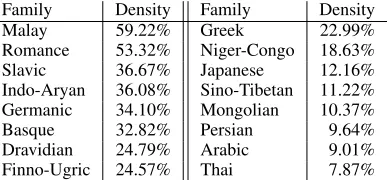
In order to avoid biasing per-language statistics by the incompleteness of the lexicons (wordnets) used, we limited our study to the 45 languages with a vocabulary size larger than 10,000 words. As a further abstraction from lexicon size, we in-troduce the notion ofcognate density, defined over a set of words as the ratio of words covered by at least one cognate pair of CogNet. In other words, working with cognate densities allows us to char-acterise the ‘cognate content’ of each language in-dependently of the wordnet size.
Figure 1: Cognate sets of the concept ‘song’, represented with different colours. It is easy to observe the effects of language families (e.g., red triangles stand for Romance languages) and geographic proximity (e.g., the higher density of orange in South-West Asia and green in Central Asia).
0 50000 100000 150000
0 5 10 15
geographic distance (1 in 1000km)
#cognates
Figure 2: The number of cognates according to the ge-ographic distance of the language speakers.
Thai.
In order to verify these intuitions, we examined cognate densities for the 45 languages manually clustered into 16 language families (see table 3, the language name was kept for clusters of size 1). Indeed, families such as Malay, Romance, Slavic, or Indo-Aryan, well known for containing several mutually intelligible language pairs, came out on top, while families with generally fewer or mutu-ally non-intelligible members at the bottom. The only outlier is Basque that, despite being an iso-late, is close to the resource-wide average cognate density of 33%.
7 Conclusions
In this paper, we have demonstrated a general method for building a cognate database using ex-isting wordnet resources. Identifying cognates based on orthography for words written in 35 dif-ferent writing systems, as opposed to phonetic data, made the problem statement novel with re-spect to existing research in cognate identification.
[image:8.595.322.517.284.374.2]Family Density Family Density Malay 59.22% Greek 22.99% Romance 53.32% Niger-Congo 18.63% Slavic 36.67% Japanese 12.16% Indo-Aryan 36.08% Sino-Tibetan 11.22% Germanic 34.10% Mongolian 10.37% Basque 32.82% Persian 9.64% Dravidian 24.79% Arabic 9.01% Finno-Ugric 24.57% Thai 7.87%
Table 3: Cognate density by language family, com-puted over the 45 largest-vocabulary languages.
The use of a large-scale cross-lingual database and a combination of linguistic, semantic, etymologi-cal, and geographic evidence resulted in what in our knowledge is the largest cognate database both in terms of the number of concepts and of the writ-ing systems covered. The evaluation showed that the resource has promisingly high quality, with precision and recall adjustable through the algo-rithm parameters. The resource has been made available online, together with a graphical web-based tool for the exploration of cognate data, our hope being to attract both linguists and computer scientists as potential users.
Acknowledgments
This paper was partly supported by the In-teropEHRateproject, co-funded by the European Union (EU) Horizon 2020 programme under grant number 826106.
[image:8.595.76.287.287.398.2]References
Lisa Beinborn, Torsten Zesch, and Iryna Gurevych. 2013. Cognate production using character-based machine translation. InProceedings of the Sixth In-ternational Joint Conference on Natural Language Processing, pages 883–891.
Gabor Bella, Fausto Giunchiglia, and Fiona McNeill. 2017. Language and Domain Aware Lightweight Ontology Matching. Web Semantics: Science, Ser-vices and Agents on the World Wide Web.
Gabor Bella, Alessio Zamboni, and Fausto Giunchiglia. 2016. Domain-Based Sense Dis-ambiguation in Multilingual Structured Data. In
The Diversity Workshop at the 22nd European Conference on Artificial Intelligence (ECAI 2016). Tanmoy Bhattacharya, Nancy Retzlaff, Damián E
Blasi, William Croft, Michael Cysouw, Daniel Hr-uschka, Ian Maddieson, Lydia Müller, Eric Smith, Peter F Stadler, et al. 2018. Studying language evo-lution in the age of big data. Journal of Language Evolution.
Francis Bond and Ryan Foster. 2013. Linking and ex-tending an open multilingual wordnet. InACL (1), pages 1352–1362.
Jordan Boyd-Graber, Christiane Fellbaum, Daniel Os-herson, and Robert Schapire. 2006. Adding dense, weighted connections to wordnet. In Proceedings of the third international WordNet conference, pages 29–36. Citeseer.
Gerard De Melo. 2014. Etymological wordnet: Trac-ing the history of words. In LREC, pages 1148– 1154. Citeseer.
Fausto Giunchiglia, Khuyagbaatar Batsuren, and Ga-bor Bella. 2017. Understanding and exploiting lan-guage diversity. InProceedings of the Twenty-Sixth International Joint Conference on Artificial Intelli-gence (IJCAI-17), pages 4009–4017.
Fausto Giunchiglia, Khuyagbaatar Batsuren, and Abed Alhakim Freihat. 2018. One world—seven thousand languages. In Proceedings 19th Inter-national Conference on Computational Linguistics and Intelligent Text Processing, CiCling2018, 18-24 March 2018.
Fausto Giunchiglia, Mladjan Jovanovic, Mercedes Huertas-Migueláñez, and Khuyagbaatar Batsuren. 2015. Crowdsourcing a large scale multilingual lexico-semantic resource. In AAAI Conference on Human Computation and Crowdsourcing (HCOMP-15).
Simon J Greenhill, Robert Blust, and Russell D Gray. 2008. The austronesian basic vocabulary database: from bioinformatics to lexomics. Evolutionary Bioinformatics, 4:EBO–S893.
Bradley Hauer and Grzegorz Kondrak. 2011. Cluster-ing semantically equivalent words into cognate sets in multilingual lists. InProceedings of 5th interna-tional joint conference on natural language process-ing, pages 865–873.
Ulf Hermjakob, Jonathan May, and Kevin Knight. 2018. Out-of-the-box universal romanization tool uroman. Proceedings of ACL 2018, System Demon-strations, pages 13–18.
Gerhard Jäger. 2013. Phylogenetic inference from word lists using weighted alignment with empiri-cally determined weights. Language Dynamics and Change, 3(2):245–291.
Gerhard Jäger. 2018. Global-scale phylogenetic lin-guistic inference from lexical resources. CoRR, abs/1802.06079.
Sarvnaz Karimi, Falk Scholer, and Andrew Turpin. 2011. Machine transliteration survey. ACM Com-puting Surveys (CSUR), 43(3):17.
Grzegorz Kondrak. 2000. A new algorithm for the alignment of phonetic sequences. In Proceedings of the 1st North American chapter of the Asso-ciation for Computational Linguistics conference, pages 288–295. Association for Computational Lin-guistics.
Grzegorz Kondrak, Daniel Marcu, and Kevin Knight. 2003. Cognates can improve statistical translation models. In Proceedings of the 2003 Conference of the North American Chapter of the Association for Computational Linguistics on Human Language Technology: companion volume of the Proceedings of HLT-NAACL 2003–short papers-Volume 2, pages 46–48. Association for Computational Linguistics.
George A Miller. 1995. Wordnet: a lexical database for english. Communications of the ACM, 38(11):39– 41.
Taraka Rama, Johann-Mattis List, Johannes Wahle, and Gerhard Jäger. 2018. Are automatic methods for cognate detection good enough for phylogenetic re-construction in historical linguistics? In Proceed-ings of the 2018 Conference of the North American Chapter of the Association for Computational Lin-guistics: Human Language Technologies, volume 2, pages 393–400.
Taraka Rama, Johannes Wahle, Pavel Sofroniev, and Gerhard Jäger. 2017. Fast and unsupervised meth-ods for multilingual cognate clustering. arXiv preprint arXiv:1702.04938.
Adam St Arnaud, David Beck, and Grzegorz Kondrak. 2017. Identifying cognate sets across dictionaries of related languages. InProceedings of the EMNLP 2017, pages 2519–2528.
Yulia Tsvetkov and Chris Dyer. 2015. Lexicon stratifi-cation for translating out-of-vocabulary words. In
Proceedings of the 53rd Annual Meeting of the Association for Computational Linguistics and the 7th International Joint Conference on Natural Lan-guage Processing (Volume 2: Short Papers), vol-ume 2, pages 125–131.
Søren Wichmann, André Müller, Viveka Velupillai, Cecil H Brown, Eric W Holman, Pamela Brown, Se-bastian Sauppe, Oleg Belyaev, Matthias Urban, Za-rina Molochieva, et al. 2010. The asjp database (ver-sion 13). URL: http://email. eva. mpg. de/˜ wich-mann/ASJPHomePage. htm, 3.