Proceedings of the Fourteenth Workshop on Innovative Use of NLP for Building Educational Applications, pages 240–245 240
Improving Precision of Grammatical Error Correction with a Cheat Sheet
Mengyang Qiu†‡∗ Xuejiao Chen†∗
Maggie Liu† Krishna Parvathala§ Apurva Patil§ Jungyeul Park† †Department of Linguistics
‡Department of Communicative Disorders and Sciences §Department of Computer Science and Engineering
State University of New York at Buffalo
{mengyang,xuejiaoc,mliu22,leelasai,acpatil,jungyeul}@buffalo.edu
Abstract
In this paper, we explore two approaches of generating error-focused phrases and examine whether these phrases can lead to better per-formance in grammatical error correction for the restricted track of BEA 2019 Shared Task on GEC. Our results show that phrases di-rectly extracted from GEC corpora outperform phrases from a statistical machine translation phrase table by a large margin. Appending er-ror+context phrases to the original GEC cor-pora yields comparably higher precision. We also explore the generation of artificial syntac-tic error sentences using error+context phrases for the unrestricted track. The additional train-ing data greatly facilitates syntactic error cor-rection (e.g., verb form) and contributes to bet-ter overall performance.
1 Introduction
Grammatical Error Correction (GEC) is a natu-ral language processing (NLP) task of automat-ically detecting and correcting grammatical er-rors in the text. With the ever-growing number of second language learners of English and de-mand to facilitate their learning with timely feed-back, GEC has become increasingly popular and attracted much attention in both academia and in-dustry in recent years. In a typical GEC task, for example, Travel and bored. in the sentence Travelby bus is expensive andboredneeds to be first detected as incorrect and then be modified to their correct forms (Travelling andboring). Var-ious approaches have been proposed to solve this problem including language modeling, rule-based classifiers, machine-learning based classifiers, ma-chine translation (MT), and etc. (Ng et al.,2013, 2014). In the past few years, both GEC-tuned statistical machine translation (SMT) and neu-ral machine translation (NMT) using
sequence-to-∗
Equally contributed authors
sequence (seq2seq) learning have demonstrated to be more effective in grammatical error correction than other approaches (Chollampatt and Ng,2017, 2018;Ge et al.,2018;Zhao et al.,2019).
Just as in other machine translation tasks, the quantity anfd quality of data play an important role in the MT approach to grammatical error correc-tion. While several recent studies have focused on generating artificial grammatical error sentences (e.g.Rei et al.,2017;Kasewa et al.,2018), the cur-rent study explores how error-focused phrases in-fluence the performance of grammatical error cor-rection. There are slightly over half million error-contained sentences in the training data provided by the BEA 2019 Shared Task, and the total num-ber of errors is over 1.3 million, which means there are on average 2 or 3 errors in each error sentence. Our intuition is that multiple errors in one sentence can be challenging for MT models to learn and generalize, especially when the amount of training data is limited. Thus, by augmenting the training data with error-focused phrases, which we term “cheat sheet”, MT models can directly “see” the errors and their corrections. We predict that this will lead to better overall performance and preci-sion in particular. We examine two ways of cre-ating a cheat sheet–one extracting errors and sur-rounding context and the other one extracting from a SMT phrase table (§2). Phrases extracted from the first method are also used to generate artificial
to current state-of-the-art results, the recall of our models is considerably lower. These results and future work are discussed in the last section.
2 Cheat Sheet
2.1 Error+Context Dictionary
Artificial Error Generation has been a long-studied technique for creating more training data for Grammatical Error Correction systems. In pre-vious studies, there are two types of methods of generating an artificial error, one making use of the real learner data statistics and the other treats all types of errors uniformly. Through experi-ments, it has been shown that accuracy improves when training and test data are more similar to each other (Felice,2016). This observation is one reason that motivates us to use directly the ex-tracted parallel phrase dictionary from the com-bined m2 files as part of our training data since the dictionary preserves the original error distri-bution. In the dictionary, each pair of the phrases contains one edit in the m2file and contains one context word on both sides of the edit (one con-text word if the edit is at the start of the end of the sentence). The instances in the dictionary have shorter lengths compared to the parallel sentences.
2.2 SMT Phrase Translation Table
Generating a large table of phrase pairs is an inte-gral part of statistical machine translation. These phrase pairs and their corresponding scores (e.g., translation probability and lexical weighting) are the knowledge source during translation/decoding. These phrases are not linguistically well-formed (e.g., noun phrases and prepositional phrases). Rather, they are just sequences of words of arbi-trary length. One major difference between the er-ror+context approach and this one is that error is always centered in the former approach, while an error can appear in any position in a phrase in this one.
The Moses SMT system (Koehn et al., 2007) was used to generate a phrase translation table. We used Giza++ (Och and Ney, 2003) for word alignment, and a 3-gram language model trained on 2 million sentences from the AFP news corpus1 with KenLM (Heafield,2011). Our input and out-put sentence length was limited to 40 to ensure the quality of the phrase table, as longer sentences are
1FromEnglish Gigaword,https://catalog.ldc.
upenn.edu/LDC2003T05
harder to train using SMT because of their com-plex syntax and long dependency structures (Bach, 2012). We then extracted phrase pairs with five or more words and the direct translation probability over 95%. Phrase pairs that were same on the er-ror and correct side were also discarded.
3 Pseudo Corpus with Syntactic Errors
We can define syntactic errors as errors that are grammatically incorrect but in most cases, the meaning is still conveyed as compared to seman-tic errors where the learner fails to convey the de-sired meaning across to the reader but the sentence structure is correct. Observing syntactic errors is crucial in improving grammatical error correction since they have a direct correlation to grammati-cal errors since syntactic errors produce grammat-ically incorrect sentences.
Learners usually make these errors mostly due to overgeneralizations and simplifications ( Hey-dari and Bagheri,2012). The learner will overgen-eralize and apply the grammatical rule to a place where it does not apply. For simplification, the learner will omit the rule in the context when the rule is supposed to apply. Most of this is due to the learner not having a frame of reference for that rule in their native language. For example, Chi-nese does not use article or determiners so they tend to overgeneralize or simplify and some times insert or omit an article or determiner (Robertson, 2000). Table1shows examples of a syntactic error and a semantic error. In the syntactic error exam-ple, the use of the form of the verb is incorrect.
Workingshould be changed toto work. In the se-mantic example,Latelyshould be changed to Re-cently.
For the unrestricted track, we created a pseudo corpus by using the syntactic errors from the dic-tionary described in the previous section. We used 6 types of syntactic errors based on the ERRANT annotation (Bryant et al., 2017), in-cluding ADJ:FORM (is good for our health than – is better for our health than), MORPH (the everydayinvents –the everydayinventions), NOUN:INFL (TVs companies –TV companies), VERB:FORM (make my dreamcomestrue–make my dream come true), VERB:INFL (hethinked–
hethought) and VERB:SVA (therearea–thereis
sen-Syntactic Error: I wantworkingin our cafe.
[image:3.595.308.526.130.216.2]Semantic Error: LatelyI have seen a very interesting TV show.
Table 1: Examples of a syntactic error and a semantic error
tences from the AFP news corpus. Each error in the syntactic error dictionary can be used at most once. We keep the numbers of different types of errors the same and thirty percent of the sentences in the pseudo learner corpus contains exactly one error. For each sentence, the search of the phrase starts from the longest length. Once we find an n-gram that appeared in the correct side of the dic-tionary, we replace it with the incorrect countpart. The cheat sheet and the pseudo syntactic er-ror corpus improved our results by emphasizing the learners’ errors and their contexts.
4 Experiments and Results
4.1 Experiment settings
We used all the four datasets — FCE, NUCLE, W&I+LOCNESS and Lang-8 — provided in the BEA 2019 Shared Task2 as our baseline data (1,171,078 sentence pairs). For the restricted track, we appended the baseline data with our cheat sheet (in total over 2M sentence / phrase pairs), and for the unrestricted track, the additional syntactic pseudo corpus was supplemented on top of the training data in the restricted track (over 4M sentences in total). The official W&I+LOCNESS development set and test set were used as devel-opment and evaluation3. We did not use any spell check to pre- or post-process our data, which could affect our results negatively (Chollampatt and Ng, 2017).
For the SMT approach to GEC, we used the same Moses (Koehn et al., 2007) setup as in
§2.2, except for the sentence length, which we changed to the default value (1 – 80). The standard Minimum Error Rate Training (MERT) algorithm (Och, 2003) was used for tuning. For the NMT approach, we used a 7-layer convolutional seq2seq model4as described inChollampatt and Ng(2018) with similar hyper-parameters, such as the top 30K BPE tokens as the input and output vocabular-ies, 1,024 (hidden size)×3 (convolution window
2
https://www.cl.cam.ac.uk/research/nl/ bea2019st/
3
https://competitions.codalab.org/ competitions/21922
4https://github.com/pytorch/fairseq
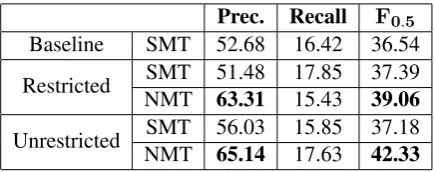
Prec. Recall F0.5
Baseline SMT 52.68 16.42 36.54
Restricted SMT 51.48 17.85 37.39 NMT 63.31 15.43 39.06
Unrestricted SMT 56.03 15.85 37.18 NMT 65.14 17.63 42.33
Table 2: Baseline result and results submitted to the BEA 2019 Shared Task
size) in the encoders and decoders, Nesterov Ac-celerated Gradient as the optimizer with a momen-tum of 0.99, dropout rate of 0.2 and an adaptive learning rate (initially 0.25, minimum10−4). Un-likeChollampatt and Ng (2018), we set the word embedding dimensions in both encoders and de-coders to 300 rather than 500, and we trained the word embeddings separately using the error and correct side training data instead of external cor-pora. During inference, we used a beam size of 10.
4.2 Results
Table 2 shows the baseline result and the results we submitted to the BEA 2019 Shared Task. The submitted results were all from the versions with an error+context cheat sheet because our phrase table cheat sheet yielded much worse results. Overall, our models with an error+context cheat sheet achieved higher precision and F0.5 in both
restricted and unrestricted tracks than the baseline model. Within our own models, GEC-tuned NMT, as expected, consistently outperformed the generic SMT models. In the unrestricted setting, for ex-ample, the gap inF0.5 was over 5%. When
com-paring the two NMT models across the two tracks, our results clearly show that the additional pseudo corpus contributed to better performance in preci-sion, recall andF0.5.
5 Conclusion and Future Work
error phrases is not a new method per se, as pre-vious studies have used these phrases to generate artificial errors (e.g.,Felice,2016). However, we purposefully included these phrases in our training in order for our models to pay attention to these er-rors and to focus on one error at a time. As a result, the precision of our GEC models gained much im-provement.
The second approach was to incorporate phrases from SMT-generated phrase translation ta-ble. In the current study, we extracted parallel phrases with five or more words and the direct translation probability (from error to correct) over 95%. Contrary to our prediction, appending these phrases to our training data dramatically decreased the performance. A closer examination of the phrases shows that there are many partial redun-dancies, which may have caused our models to miss focus. Thus, we plan to investigate various techniques to prune the phrase table (e.g.Johnson et al., 2007; Zens et al., 2012) so that errors are truly highlighted as in the error+context approach. In the unrestricted track, we injected syntactic errors from our error+context dictionary to a clean corpus and appended the artificial error corpus to the training data for the restricted track. When training with SMT, there was no performance gain overall and at the syntactic error type level. For example, the precision of the VERB:FORM error type was only 48.98% and theF0.5 was 35.40%.
However, when the same data was trained with NMT, the benefit of additional data was evident. The precision and F0.5 of VERB:FORM almost
doubled in this setting, compared to that in SMT. These results, again, demonstrate the limitations of the generic SMT approach to grammatical error correction (e.g.Yuan and Felice,2013).
The recall of our models stayed low across all the settings, which indicates our models were too conservative. The conservativeness can be mainly attributed to the large proportion of unchanged sentences in the training data. Indeed, our pseudo corpus generation process was constrained as only 30% of the two million sentences were applied er-ror injection. We will further explore the relation-ship between recall and proportion of unchanged sentences in GEC.
Finally, our current study only focused on syn-tactic errors, which should be easier for MT mod-els to detect and correct compared to semantic er-rors, because semantic errors require knowledge
about meaning in addition to structure. Given the complexity of language, the individual meaning of a word in a sentence changes according to the con-text. A simple example, She kicked the bucket.
andHe filled the bucket with soda. both contain the wordbucket, but the meanings are drastically different. Traditional word embeddings such as word2vec (Mikolov et al.,2013), GloVe ( Penning-ton et al., 2014) and fastText (Bojanowski et al., 2017) only have one representation per word. As the meaning of each word changes based on the surrounding context, in which previous methods fail. Therefore, we require a model that is capa-ble of understanding the variations in meaning of the given word based on its surrounding text in the sentence. ELMo is another method for text em-bedding (Peters et al., 2018) which uses a deep, bi-directional LSTM model that takes contextual information into account and achieves state-of-the-art results in many NLP tasks. ELMo anal-yses words within the context that they are used, hence the way ELMo is used is quite different to word2vec or fastText. As opposed to having a dic-tionary of words and their corresponding vectors, ELMo instead creates vectors on-the-fly by pass-ing text through the deep learnpass-ing model. The model is character based and hence forms repre-sentations of out-of-vocabulary words. We will investigate whether incorporating ELMo in our NMT model can improve the performance of cor-recting semantic errors in the near future.
References
Nguyen Bach. 2012. Dependency Structures for Sta-tistical Machine Translation. Ph.D. thesis, Carnegie Mellon University.
Piotr Bojanowski, Edouard Grave, Armand Joulin, and Tomas Mikolov. 2017. Enriching Word Vectors with Subword Information. Transactions of the Associa-tion for ComputaAssocia-tional Linguistics, 5:135–146.
Christopher Bryant, Mariano Felice, and Ted Briscoe. 2017. Automatic Annotation and Evaluation of Er-ror Types for Grammatical ErEr-ror Correction. In Pro-ceedings of the 55th Annual Meeting of the Associa-tion for ComputaAssocia-tional Linguistics (Volume 1: Long Papers), pages 793–805, Vancouver, Canada. Asso-ciation for Computational Linguistics.
Shamil Chollampatt and Hwee Tou Ng. 2018. A Mul-tilayer Convolutional Encoder-Decoder Neural Net-work for Grammatical Error Correction. In Pro-ceedings of The Thirty-Second AAAI Conference on Artificial Intelligence (AAAI-18), New Orleans, Louisiana.
Mariano Felice. 2016. Artificial error generation for translation-based grammatical error correction. Technical Report UCAM-CL-TR-895, University of Cambridge, Computer Laboratory.
Tao Ge, Furu Wei, and Ming Zhou. 2018. Fluency Boost Learning and Inference for Neural Grammati-cal Error Correction. InProceedings of the 56th An-nual Meeting of the Association for Computational Linguistics (Volume 1: Long Papers), pages 1055– 1065, Melbourne, Australia. Association for Com-putational Linguistics.
Kenneth Heafield. 2011. KenLM: Faster and Smaller Language Model Queries. In Proceedings of the Sixth Workshop on Statistical Machine Translation, pages 187–197, Edinburgh, Scotland. Association for Computational Linguistics.
Pooneh Heydari and Mohammad S Bagheri. 2012. Er-ror analysis: Sources of l2 learners’ erEr-rors. Theory & Practice in Language Studies, 2(8).
Howard Johnson, Joel Martin, George Foster, and Roland Kuhn. 2007. Improving Translation Qual-ity by Discarding Most of the Phrasetable. In Pro-ceedings of the 2007 Joint Conference on Empirical Methods in Natural Language Processing and Com-putational Natural Language Learning (EMNLP-CoNLL), pages 967–975, Prague, Czech Republic. Association for Computational Linguistics.
Sudhanshu Kasewa, Pontus Stenetorp, and Sebastian Riedel. 2018. Wronging a Right: Generating Bet-ter Errors to Improve Grammatical Error Detec-tion. In Proceedings of the 2018 Conference on Empirical Methods in Natural Language Process-ing, pages 4977–4983, Brussels, Belgium. Associ-ation for ComputAssoci-ational Linguistics.
Philipp Koehn, Hieu Hoang, Alexandra Birch, Chris Callison-Burch, Marcello Federico, Nicola Bertoldi, Brooke Cowan, Wade Shen, Christine Moran, Richard Zens, Chris Dyer, Ondrej Bojar, Alexandra Constantin, and Evan Herbst. 2007. Moses: Open Source Toolkit for Statistical Machine Translation. In Proceedings of the 45th Annual Meeting of the Association for Computational Linguistics Compan-ion Volume Proceedings of the Demo and Poster Ses-sions, pages 177–180, Prague, Czech Republic. As-sociation for Computational Linguistics.
Tomas Mikolov, Kai Chen, Greg Corrado, and Jeffrey Dean. 2013. Efficient Estimation of Word Representations in Vector Space.
http://arxiv.org/abs/1301.3781.
Hwee Tou Ng, Siew Mei Wu, Ted Briscoe, Christian Hadiwinoto, Raymond Hendy Susanto, and Christo-pher Bryant. 2014. The CoNLL-2014 Shared Task on Grammatical Error Correction. InProceedings of the Eighteenth Conference on Computational Nat-ural Language Learning: Shared Task, pages 1– 14, Baltimore, Maryland. Association for Compu-tational Linguistics.
Hwee Tou Ng, Siew Mei Wu, Yuanbin Wu, Christian Hadiwinoto, and Joel Tetreault. 2013. The CoNLL-2013 Shared Task on Grammatical Error Correction. In Proceedings of the Seventeenth Conference on Computational Natural Language Learning: Shared Task, pages 1–12, Sofia, Bulgaria. Association for Computational Linguistics.
Franz Josef Och. 2003. Minimum Error Rate Train-ing in Statistical Machine Translation. In Proceed-ings of the 41st Annual Meeting of the Association for Computational Linguistics, pages 160–167, Sap-poro, Japan. Association for Computational Linguis-tics.
Franz Josef Och and Hermann Ney. 2003. A System-atic Comparison of Various Statistical Alignment Models.Computational Linguistics, 29(1):19–51.
Jeffrey Pennington, Richard Socher, and Christo-pher D. Manning. 2014. GloVe: Global Vectors for Word Representation. In Proceedings of the 2014 Conference on Empirical Methods in Natural Language Processing (EMNLP), pages 1532–1543, Doha, Qatar. Association for Computational Lin-guistics.
Matthew Peters, Mark Neumann, Mohit Iyyer, Matt Gardner, Christopher Clark, Kenton Lee, and Luke Zettlemoyer. 2018.Deep Contextualized Word Rep-resentations. In Proceedings of the 2018 Confer-ence of the North American Chapter of the Associ-ation for ComputAssoci-ational Linguistics: Human Lan-guage Technologies, Volume 1 (Long Papers), pages 2227–2237, New Orleans, Louisiana. Association for Computational Linguistics.
Marek Rei, Mariano Felice, Zheng Yuan, and Ted Briscoe. 2017. Artificial Error Generation with Ma-chine Translation and Syntactic Patterns. In Pro-ceedings of the 12th Workshop on Innovative Use of NLP for Building Educational Applications, pages 287–292, Copenhagen, Denmark. Association for Computational Linguistics.
Daniel Robertson. 2000. Variability in the use of the english article system by chinese learners of english.
Second language research, 16(2):135–172.
Richard Zens, Daisy Stanton, and Peng Xu. 2012. A systematic comparison of phrase table pruning tech-niques. In Proceedings of the 2012 Joint Confer-ence on Empirical Methods in Natural Language Processing and Computational Natural Language Learning, pages 972–983, Jeju Island, Korea. As-sociation for Computational Linguistics.