14
Learning-based Composite Metrics for Improved Caption Evaluation
Naeha Sharif, Lyndon White, Mohammed Bennamoun and Syed Afaq Ali Shah, {naeha.sharif, lyndon.white}@research.uwa.edu.au,
and {mohammed.bennamoun, afaq.shah}@uwa.edu.au The University of Western Australia.
35 Stirling Highway, Crawley, Western Australia
Abstract
The evaluation of image caption quality is a challenging task, which requires the as-sessment of two main aspects in a caption: adequacy and fluency. These quality as-pects can be judged using a combination of several linguistic features. However, most of the current image captioning metrics fo-cus only on specific linguistic facets, such as the lexical or semantic, and fail to meet a satisfactory level of correlation with hu-man judgements at the sentence-level. We propose a learning-based framework to in-corporate the scores of a set of lexical and semantic metrics as features, to cap-ture the adequacy and fluency of captions at different linguistic levels. Our experi-mental results demonstrate that composite metrics draw upon the strengths of stand-alone measures to yield improved correla-tion and accuracy.
1 Introduction
Automatic image captioning requires the under-standing of the visual aspects of images to gen-erate human-like descriptions (Bernardi et al., 2016). The evaluation of the generated captions is crucial for the development and fine-grained analysis of image captioning systems (Vedantam et al., 2015). Automatic evaluation metrics aim at providing efficient, cost-effective and objective assessments of the caption quality. Since these automatic measures serve as an alternative to the manual evaluation, the major concern is that such measures should correlate well with human as-sessments. In other words, automatic metrics are expected to mimic the human judgement process by taking into account various aspects that humans consider when they assess the captions.
The evaluation of image captions can be charac-terized as having two major aspects: adequacy and
fluency. Adequacy is how well the caption reflects the source image, and fluency is how well the cap-tion conforms to the norms and convencap-tions of hu-man language (Toury,2012). In the case of man-ual evaluation, both adequacy and fluency tend to shape the human perception of the overall caption quality. Most of the automatic evaluation metrics tend to capture these aspects of quality based on the idea that “the closer the candidate description to the professional human caption, the better it is in quality” (Papineni et al.,2002). The output in such case is a score (the higher the better) reflect-ing the similarity.
The majority of the commonly used metrics for image captioning such as BLEU (Papineni et al., 2002) and METEOR (Banerjee and Lavie,2005) are based on the lexical similarity. Lexical mea-sures (gram based) work by rewarding the n-gram overlaps between the candidate and the ref-erence captions. Thus, measuring the adequacy by counting the n-gram matches and assessing the fluency by implicitly using the reference n-grams as a language model (Mutton et al.,2007). How-ever, a high number of n-gram matches cannot al-ways be indicative of a high caption quality, nor a low number of n-gram matches can always be reflective of a low caption quality (Gim´enez and M`arquez, 2010). A recently proposed semantic metric SPICE (Anderson et al.,2016), overcomes this deficiency of lexical measures by measuring the semantic similarity of candidate and reference captions usingScene Graphs. However, the major drawback of SPICE is that it ignores the fluency of the output caption.
by a set of measures that are commonly used for captioning and combine them through a learning-based framework. In this work:
1. We evaluate various combinations of a chosen set of metrics and show that the proposed com-posite metrics correlate better with human judge-ments.
2. We analyse the accuracy of composite metrics in terms of differentiating between pairs of cap-tions in reference to the ground truth capcap-tions.
2 Literature Review
The success of any captioning system depends on how well it transforms the visual informa-tion to natural language. Therefore, the signifi-cance of reliable automatic evaluation metrics is undeniable for the fine-grained analysis and ad-vancement of image captioning systems. While image captioning has drawn inspiration from the Machine Translation (MT) domain for encoder-decoder based captioning networks (Vinyals et al., 2015), (Xu et al.,2015), (Yao et al., 2016), (You et al.,2016), (Lu et al.,2017), it has also benefited from automatic metrics which were initially pro-posed to evaluate machine translations/text sum-maries, such as BLEU (Papineni et al.,2002), ME-TEOR (Denkowski and Lavie,2014) and ROUGE (Lin,2004).
In the past few years, two metrics CIDEr (Vedantam et al., 2015) and SPICE (Anderson et al., 2016) were developed specifically for im-age captioning. Compared to the previously used metrics, these two show a better correlation with human judgements. The authors in (Liu et al., 2016) proposed a linear combination of SPICE and CIDEr called SPIDEr and showed that op-timizing image captioning models for SPIDEr’s score can lead to better quality captions. How-ever, SPIDEr was not evaluated for its correlation with human judgements. Recently, (Kusner et al., 2015) proposed the use of a document similar-ity metricWord Mover’s Distance(WMD), which uses the word2vec (Mikolov et al.,2013) embed-ding space to determine the distance between two texts.
The metrics used for caption evaluation can be broadly categorized as lexical and semantic mea-sures. Lexical metrics reward the n-gram matches between candidate captions and human generated reference texts (Gim´enez and M`arquez,2010), and can be further categorized as unigram and n-gram
based measures. Unigram based methods such as BLEU-1 (Papineni et al., 2002), assess only the lexical correctness of the candidate. However, in the case of METEOR or WMD, where some sort of synonym-matching/stemming is also involved, unigram-overlaps help to evaluate both the lexi-cal and to some degree the semantic aptness of the output caption. N-gram based metrics such as ROUGE and CIDEr primarily assess the lex-ical correctness of the caption, but also measure some amount of syntactic accuracy by capturing the word order.
The lexical measures have received criticism based on the argument that the n-gram overlap is neither an adequate nor a necessary indicative measure of the caption quality (Anderson et al., 2016). To overcome this limitation, semantic met-rics such as SPICE, capture the sentence meaning to evaluate the candidate captions. Their perfor-mance however is highly dependent on a success-ful semantic parsing. Purely syntactic measures, which capture the grammatical correctness, exist, and have been used in MT (Mutton et al.,2007), but not in the captioning domain.
While fluency (well-formedness) of a candidate caption can be attributed to the syntactic and lexi-cal correctness (Fomicheva et al.,2016), adequacy (informativeness) depends on the lexical and se-mantic correctness (Rios et al.,2011). We hypoth-esize that by combining scores from different met-rics, which have different strengths in measuring adequacy and fluency, a composite metric that is of overall higher quality is created (Sec. 5).
Machine learning offers a systematic approach to integrate the scores of stand-alone metrics. In the MT evaluation, various successful learn-ing paradigms have been proposed (Bojar et al., 2016), (Bojar et al., 2017) and the existing learning-based metrics can be categorized as
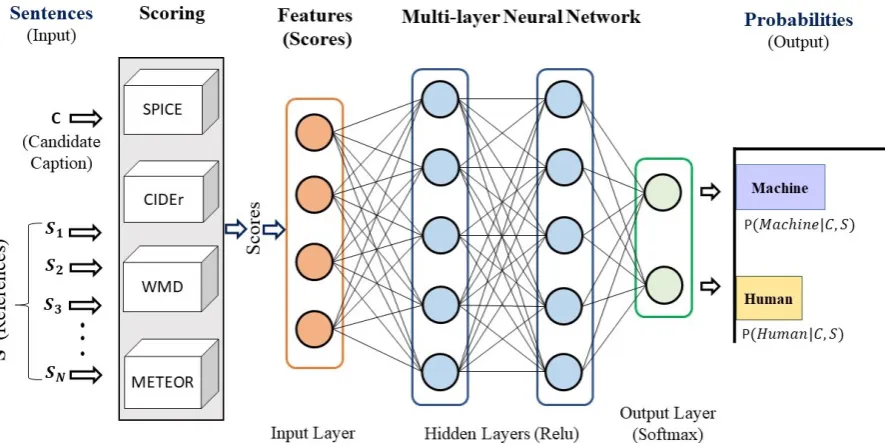
Figure 1: Overall framework of the proposed Composite Metrics
different linguistic levels) in terms of their correla-tion with human judgements at the sentence level.
3 Proposed Approach
In our approach, we use scores conferred by a set of existing metrics as an input to a multi-layer feed-forward neural network. We adopt a training criteria based on a simple question: is the caption machine or human generated? Our trained classi-fier sets a boundary between good and bad quality captions, thus classifying them as human or ma-chine produced. Furthermore, we obtain a contin-uous output score by using the class-probability, which can be considered as some “measure of be-lievability” that the candidate caption is human generated. Framing our learning problem as a classification task allows us to create binary train-ing data ustrain-ing the human generated captions and machine generated captions as positive and nega-tive training examples respecnega-tively.
Our proposed framework shown in Figure1first extracts a set of numeric features using the can-didate “C” and the reference sentences “S”. The extracted feature vector is then fed as an input to our multi-layer neural network. Each entity of the feature vector corresponds to the score generated by one of the four measures: METEOR, CIDEr, WMD1 and SPICE respectively. We chose these measures because they show a relatively better correlation with human judgements compared to
1We convert the WMD distance score to similarity by
us-ing a negative exponential, to use it as a feature.
the other commonly used ones for captioning (Kil-ickaya et al., 2016). Our composite metrics are namedEvalM S,EvalCS, EvalM CS,EvalW CS,
EvalM W S and EvalM W CS. The subscript
let-ters in each name corresponds to the first letter of each individual metric. For example,EvalM S
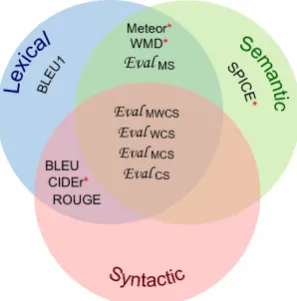
corresponds to the combination of METEOR and SPICE. Figure2shows the linguistic aspects cap-tured by the stand-alone2 and the composite met-rics. SPICE is based on sentence meanings, thus it evaluates the semantics. CIDEr covers the syntac-tic and lexical aspects, whereas Meteor and WMD assess the lexical and semantic components. The learning-based metrics mostly fall in the region formed by the overlap of all three major linguis-tics facets, leading to better a evaluation.
We train our metrics to maximise the classifica-tion accuracy on the training dataset. Since we are primarily interested in maximizing the correlation with human judgements, we perform early stop-ping based on Kendallsτ (rank correlation) with the validation set.
4 Experimental Setup
To train our composite metrics, we source data from Flicker30k dataset (Plummer et al., 2015) and three image captioning models namely: (1) show and tell (Vinyals et al.,2015), (2) show, at-tend and tell (soft-attention) (Xu et al.,2015), and (3) adaptive attention (Lu et al.,2017). Flicker30k
Figure 2: Various automatic measures (stand-alone and combined) and their respective linguis-tic levels. See Sec. 3 for more details.
dataset consists of 31,783 photos acquired from Flicker3, each paired with 5 captions obtained through the Amazon Mechanical Turk (AMT) (Turk,2012). For each image in Flicker30k, we randomly select three of the human generated cap-tions as positive training examples, and three ma-chine generated (one from each image captioning model) captions as negative training examples. We combined the Microsoft COCO (Chen et al.,2015) training and validation set (containing 123,287 im-ages in total, each paired with 5 or more captions), to train the image captioning models using their official codes. These image captioning models achieved state-of-the-art performance when they were published.
In order to obtain reference captions for each training example, we again use the human writ-ten descriptions of Flicker30k. For each neg-ative training example (machine-generated cap-tion), we randomly choose 4 out of 5 human writ-ten captions originally associated with each im-age. Whereas, for each positive training example (human-generated caption), we use the 5 human written captions associated with each image, se-lecting one of these as a human candidate caption (positive example) and the remaining 4 as refer-ences. In Figure3, a possible pairing scenario is shown for further clarification.
For our validation set, we source data from Flicker8k (Young et al., 2014). This dataset contains 5,822 captions assessed by three expert judges on a scale of 1 (the caption is unrelated to the image) to 4 (the caption describes the
[image:4.595.310.526.123.208.2]im-3https://www.flickr.com/
Table 1: Kendall’s correlation co-efficient of au-tomatic evaluation metrics and proposed compos-ite metrics against human quality judgements. All correlations are significant at p<0.001
Individual Metrics
Kendall
τ
Composite Metrics
Kendall
τ
BLEU 0.202 EvalM S 0.386
ROUGE-L 0.216 EvalCS 0.384
METEOR 0.352 EvalM CS 0.386
CIDEr 0.356 EvalW CS 0.379
SPICE 0.366 EvalM W S 0.367
WMD 0.336 EvalM W CS 0.378
age without any errors). From our training set, we remove the captions of images which overlap with the captions in the validation and test sets (discussed in Sec. 5), leaving us with a total of 132,984 non-overlapping captions for the training of the composite metrics.
5 Results and Discussion
5.1 Correlation
The most desirable characteristic of an automatic evaluation metric is its strong correlation with hu-man scores (Zhang and Vogel,2010). A stronger correlation with human judgements indicates that a metric captures the information that humans use to assess a candidate caption. To evaluate the sentence-level correlation of our composite met-rics with human judgements, we source data from a dataset collected by the authors in (Aditya et al., 2017). We use 6993 manually evaluated human and machine generated captions from this set, which were scored by AMT workers for correct-ness on the scale of 1 (low relevance to image) to 5 (high relevance to image). Each caption in the dataset is accompanied by a single judgement. In Table1, we report the Kendalls τ correlation co-efficient for the proposed composite metrics and other commonly used caption evaluation metrics.
It can be observed from Table1that composite metrics outperform stand-alone metrics in terms of sentence-level correlation. The combination of Meteor and SPICE (EvalM S) and METEOR,
CIDEr and SPICE (EvalM CS) showed the most
Figure 3: Shows an example of a candidate and reference pairing that is used in the training set. (a) Image, (b) human and machine generated captions for the image, and (c) candidate and reference pairings for the image.
dictionary based look-up for synonyms and para-phrases (Banerjee and Lavie, 2005). CIDEr uses higher order n-grams to account for fluency and down-weighs the commonly occurring (less infor-mative) n-grams by performing Term Frequency Inverse Document Frequency (TF-IDF) weighting for each n-gram in the dataset (Vedantam et al., 2015). SPICE on the other hand is a strong in-dicator of the semantic correctness of a caption. Together these metrics assess the lexical, seman-tic and syntacseman-tic information. The composite met-rics which included WMD in the combination achieved a lower performance, compared to the ones in which WMD was not included. One possi-ble reason is that WMD heavily penalizes shorter candidate captions when the number of words be-tween the output and the reference captions are not equal (Kusner et al.,2015). This penalty might not be consistently useful as it is possible for a shorter candidate caption to be both fluent and adequate. Therefore, WMD is a better suited metric for mea-suring document distance.
5.2 Accuracy
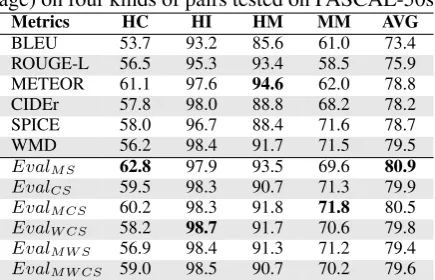
We follow the framework introduced in (Vedan-tam et al., 2015) to analyse the ability of a met-ric to discriminate between pairs of captions with reference to the ground truth caption. A met-ric is considered accurate if it assigns a higher score to the caption preferred by humans. For this experiment, we use PASCAL-50s (Vedan-tam et al., 2015), which contains human judge-ments for 4000 triplets of descriptions (one refer-ence caption with two candidate captions). Based on the pairing, the triplets are grouped into four categories (comprising of 1000 triplets each) i.e.,
Table 2: Comparative accuracy results (in percent-age) on four kinds of pairs tested on PASCAL-50s
Metrics HC HI HM MM AVG
BLEU 53.7 93.2 85.6 61.0 73.4
ROUGE-L 56.5 95.3 93.4 58.5 75.9
METEOR 61.1 97.6 94.6 62.0 78.8
CIDEr 57.8 98.0 88.8 68.2 78.2
SPICE 58.0 96.7 88.4 71.6 78.7
WMD 56.2 98.4 91.7 71.5 79.5
EvalM S 62.8 97.9 93.5 69.6 80.9
EvalCS 59.5 98.3 90.7 71.3 79.9
EvalM CS 60.2 98.3 91.8 71.8 80.5
EvalW CS 58.2 98.7 91.7 70.6 79.8
EvalM W S 56.9 98.4 91.3 71.2 79.4
EvalM W CS 59.0 98.5 90.7 70.2 79.6
Human-Human Correct (HC), Human-Human In-correct (HI), Human-Machine (HM), Machine-Machine (MM). We follow the original approach of (Vedantam et al., 2015) and use 5 reference captions per candidate to assess the accuracy of the metrics and report them in Table 2. Table 2 shows that on average composite measures pro-duce better accuracy compared to the individual metrics. Amongst the four categories, HC is the hardest, in which all metrics show the worst per-formance. Differentiating between two good qual-ity (human generated) correct captions is challeng-ing as it involves a fine-grained analysis of the two candidates. EvalM S achieves the highest
accu-racy in HC category which shows that as caption-ing systems continue to improve, this combination of lexical and semantic metrics will continue to perform well. Moreover, human generated cap-tions are usually fluent. Therefore, a combination of strong indicators of adequacy such as SPICE and METEOR is the most suitable for this task.
[image:5.595.308.526.305.445.2]differ-entiating between machine captions, which is an-other important category as one of the main goals of automatic evaluation is to distinguish between two machine algorithms. Amongst the composite metrics,EvalM S is again the best in
distinguish-ing human captions (good quality) from machine captions (bad quality) which was our basic train-ing criteria.
6 Conclusion and Future Works
In this paper we propose a learning-based ap-proach to combine various metrics to improve cap-tion evaluacap-tion. Our experimental results show that metrics operating along different linguistic di-mensions can be successfully combined through a learning-based framework, and they outperform the existing metrics for caption evaluation in term of correlation and accuracy, with EvalM S and
EvalM CS giving the best overall performance.
Our study reveals that the proposed approach is promising and has a lot of potential to be used for evaluation in the captioning domain. In the fu-ture, we plan to integrate features (components) of metrics instead of their scores for a better per-formance. We also intend to use syntactic mea-sures, which to the best of our knowledge have not yet been used for caption evaluation (except in an indirect way by the n-gram measures which capture the word order) and study how they can improve the correlation at the sentence level. Ma-jority of the metrics for captioning focus more on adequacy as compared to fluency. This aspect also needs further attention and a combination of met-rics/features that can specifically assess the flu-ency of captions needs to be devised.
Acknowledgements
The authors are grateful to Nvidia for providing Titan-Xp GPU, which was used for the experi-ments. This research is supported by Australian Research Council, ARC DP150100294.
References
Somak Aditya, Yezhou Yang, Chitta Baral, Yiannis Aloimonos, and Cornelia Ferm¨uller. 2017. Image understanding using vision and reasoning through scene description graph. Computer Vision and Im-age Understanding.
Joshua S Albrecht and Rebecca Hwa. 2008. Regres-sion for machine translation evaluation at the sen-tence level. Machine Translation, 22(1-2):1.
Peter Anderson, Basura Fernando, Mark Johnson, and Stephen Gould. 2016. Spice: Semantic propo-sitional image caption evaluation. In European Conference on Computer Vision, pages 382–398. Springer.
Satanjeev Banerjee and Alon Lavie. 2005. Meteor: An automatic metric for mt evaluation with improved correlation with human judgments. InProceedings of the acl workshop on intrinsic and extrinsic evalu-ation measures for machine translevalu-ation and/or sum-marization, pages 65–72.
Raffaella Bernardi, Ruket Cakici, Desmond Elliott, Aykut Erdem, Erkut Erdem, Nazli Ikizler-Cinbis, Frank Keller, Adrian Muscat, Barbara Plank, et al. 2016. Automatic description generation from im-ages: A survey of models, datasets, and evaluation measures. J. Artif. Intell. Res.(JAIR), 55:409–442.
Ondˇrej Bojar, Yvette Graham, Amir Kamran, and Miloˇs Stanojevi´c. 2016. Results of the wmt16 met-rics shared task. In Proceedings of the First Con-ference on Machine Translation: Volume 2, Shared Task Papers, volume 2, pages 199–231.
Ondˇrej Bojar, Jindˇrich Helcl, Tom Kocmi, Jindˇrich Li-bovick`y, and Tom´aˇs Musil. 2017. Results of the wmt17 neural mt training task. InProceedings of the Second Conference on Machine Translation, pages 525–533.
Xinlei Chen, Hao Fang, Tsung-Yi Lin, Ramakr-ishna Vedantam, Saurabh Gupta, Piotr Doll´ar, and C Lawrence Zitnick. 2015. Microsoft coco captions: Data collection and evaluation server. arXiv preprint arXiv:1504.00325.
Michael Denkowski and Alon Lavie. 2014. Meteor universal: Language specific translation evaluation for any target language. InProceedings of the ninth workshop on statistical machine translation, pages 376–380.
Marina Fomicheva, N´uria Bel, Lucia Specia, Iria da Cunha, and Anton Malinovskiy. 2016. Cobaltf: a fluent metric for mt evaluation. InProceedings of the First Conference on Machine Translation: Vol-ume 2, Shared Task Papers, volVol-ume 2, pages 483– 490.
Jes´us Gim´enez and Llu´ıs M`arquez. 2010. Linguistic measures for automatic machine translation evalua-tion. Machine Translation, 24(3-4):209–240.
Francisco Guzm´an, Shafiq Joty, Llu´ıs M`arquez, and Preslav Nakov. 2015. Pairwise neural machine translation evaluation. In Proceedings of the 53rd Annual Meeting of the Association for Computa-tional Linguistics and the 7th InternaComputa-tional Joint Conference on Natural Language Processing (Vol-ume 1: Long Papers), vol(Vol-ume 1, pages 805–814.
Alex Kulesza and Stuart M Shieber. 2004. A learn-ing approach to improvlearn-ing sentence-level mt evalu-ation. InProceedings of the 10th International Con-ference on Theoretical and Methodological Issues in Machine Translation, pages 75–84.
Matt Kusner, Yu Sun, Nicholas Kolkin, and Kilian Weinberger. 2015. From word embeddings to docu-ment distances. InInternational Conference on Ma-chine Learning, pages 957–966.
Chin-Yew Lin. 2004. Rouge: A package for auto-matic evaluation of summaries. Text Summarization Branches Out.
Siqi Liu, Zhenhai Zhu, Ning Ye, Sergio Guadarrama, and Kevin Murphy. 2016. Improved image caption-ing via policy gradient optimization of spider. arXiv preprint arXiv:1612.00370.
Jiasen Lu, Caiming Xiong, Devi Parikh, and Richard Socher. 2017. Knowing when to look: Adaptive at-tention via a visual sentinel for image captioning. In Proceedings of the IEEE Conference on Computer Vision and Pattern Recognition (CVPR), volume 6.
Tomas Mikolov, Ilya Sutskever, Kai Chen, Greg S Cor-rado, and Jeff Dean. 2013. Distributed representa-tions of words and phrases and their compositional-ity. InAdvances in neural information processing systems, pages 3111–3119.
Andrew Mutton, Mark Dras, Stephen Wan, and Robert Dale. 2007. Gleu: Automatic evaluation of sentence-level fluency. In Proceedings of the 45th Annual Meeting of the Association of Computational Linguistics, pages 344–351.
Kishore Papineni, Salim Roukos, Todd Ward, and Wei-Jing Zhu. 2002. Bleu: a method for automatic eval-uation of machine translation. In Proceedings of the 40th annual meeting on association for compu-tational linguistics, pages 311–318. Association for Computational Linguistics.
Bryan A Plummer, Liwei Wang, Chris M Cervantes, Juan C Caicedo, Julia Hockenmaier, and Svet-lana Lazebnik. 2015. Flickr30k entities: Col-lecting region-to-phrase correspondences for richer image-to-sentence models. In Computer Vision (ICCV), 2015 IEEE International Conference on, pages 2641–2649. IEEE.
Miguel Rios, Wilker Aziz, and Lucia Specia. 2011. Tine: A metric to assess mt adequacy. In Proceed-ings of the Sixth Workshop on Statistical Machine Translation, pages 116–122. Association for Com-putational Linguistics.
Xingyi Song and Trevor Cohn. 2011. Regression and ranking based optimisation for sentence level ma-chine translation evaluation. In Proceedings of the Sixth Workshop on Statistical Machine Translation, pages 123–129. Association for Computational Lin-guistics.
Gideon Toury. 2012. Descriptive Translation Studies and beyond: revised edition, volume 100. John Ben-jamins Publishing.
Amazon Mechanical Turk. 2012. Amazon mechanical turk.Retrieved August, 17:2012.
Ramakrishna Vedantam, C Lawrence Zitnick, and Devi Parikh. 2015. Cider: Consensus-based image de-scription evaluation. In Proceedings of the IEEE conference on computer vision and pattern recog-nition, pages 4566–4575.
Oriol Vinyals, Alexander Toshev, Samy Bengio, and Dumitru Erhan. 2015. Show and tell: A neural im-age caption generator. InComputer Vision and Pat-tern Recognition (CVPR), 2015 IEEE Conference on, pages 3156–3164. IEEE.
Kelvin Xu, Jimmy Ba, Ryan Kiros, Kyunghyun Cho, Aaron Courville, Ruslan Salakhudinov, Rich Zemel, and Yoshua Bengio. 2015. Show, attend and tell: Neural image caption generation with visual at-tention. In International Conference on Machine Learning, pages 2048–2057.
Ting Yao, Yingwei Pan, Yehao Li, Zhaofan Qiu, and Tao Mei. 2016. Boosting image captioning with at-tributes. OpenReview, 2(5):8.
Quanzeng You, Hailin Jin, Zhaowen Wang, Chen Fang, and Jiebo Luo. 2016. Image captioning with seman-tic attention. InProceedings of the IEEE Conference on Computer Vision and Pattern Recognition, pages 4651–4659.
Peter Young, Alice Lai, Micah Hodosh, and Julia Hockenmaier. 2014. From image descriptions to visual denotations: New similarity metrics for se-mantic inference over event descriptions. Transac-tions of the Association for Computational Linguis-tics, 2:67–78.