Original Article
The expression level of lncRNA-ATB associates with
clinicopathological parameters and
prognosis of cervical cancer
Xiao-Liang Mo, Dian-Zhong Luo, Xiao-Li Jiang, Gui-Rong Qin, Yan Sun
Department of Gynecology and Obstetrics, The First Affiliated Hospital of Guangxi Medical University, Nanning 530021, Guang Xi, PR China
Received November 2, 2016; Accepted December 20, 2016; Epub February 1, 2017; Published February 15, 2017
Abstract: Background: Long noncoding RNAs (lncRNAs) play important roles in tumor development and progression.
Previous studies have found that dysregulation of lncRNA-ATB was significantly associated with tumor progression
and poor survival outcome in various cancers. However, whether the expression level of lncRNA-ATB is associated with the clinicopathological parameters and prognosis of patients with cervical cancer is still unclear. Methods: A to-tal of 128 patients with primary cervical cancer were included in this retrospective study. Quantitative real-time PCR assay was performed to evaluate lncRNA-ATB expression levels. The Kaplan-Meier method was used to estimate survival, log-rank test was used to test differences between the survival curves. Results: As revealed by quantitative
RT-PCR analysis, lncRNA-ATB expression was significantly higher in cervical cancer tissues compared with normal
adjacent tissues (8.826±3.155 vs. 3.372±1.043, P<0.001). High lncRNA-ATB expression level was observed to be closely correlated with tumor differentiation (P<0.001) and FIGO stage (P<0.001). The overall survival of patients
in the high lncRNA-ATB group showed significantly worse survival rates than those who were in the low lncRNA-ATB
group (P=0.024). Furthermore, multivariate analysis of the prognosis factors with a Cox proportional hazards model
showed that high lncRNA-ATB expression (HR=2.535, CI: 1.372-10.376, P=0.012) was a significant independent
predictor of poor survival in cervical cancer. Conclusion: Our results suggested that upregulation of lncRNA-ATB was
significantly correlated with tumor progression and might be a potent prognostic marker of cervical cancer.
Keywords: Cervical cancer, lncRNA-ATB, prognosis, biomarker
Introduction
Cervical cancer is the fourth most common cancer and fourth most frequent cause of can-cer mortality affecting woman in the world [1]. Despite marked efforts in developing multi-modal treatments, the clinical outcome of cer-vical cancer patients remains unfavorable. Many studies have shown that tumor size, lymph node metastasis and lymph-blood ves-sel invasion are independent prognostic fac-tors for survival of cervical cancer patients. However, these factors may not accurately esti-mate prognosis because of heterogeneity in the patient population [2-4]. Thus, it is highly necessary to explore novel biomarkers for the early identification of a more effective, clinical therapeutic strategy against cervical cancer. Long non-coding RNA (lncRNA) is an RNA mol-ecule with a length of 200 bp-100 kbp that
lacks protein-coding potential [5]. Recent stud-ies revealed that lncRNAs play a pivotal role in the regulation of gene expression, such as chro-matin modification, transcription and post-tran -scriptional processing [6-8]. Furthermore, more and more evidences revealed the contribution of lncRNAs as having oncogenic and tumor sup-pressor roles in tumorigenesis [9-12].
Materials and methods
Patients and tissue samples
A total of 128 patients with primary cervical cancer who underwent surgery at the De- partment of Gynecology and Obstetrics, The First Affiliated Hospital of Guangxi Medical University, Nanning, were included in this retro-spective study. These patients were diagnosed as cervical cancer between 2009 and 2016. None of the patients recruited in this study had chemotherapy or radiotherapy before the
sur-Total RNA was extracted from tissues using TRIzol reagent (Invitrogen). For qRT-PCR, RNA was reverse transcribed to cDNA by using a Reverse Transcription Kit (Takara). Real-time PCR analyses were performed with Power SYBR Green (Takara). The PCR primers for lncRNA-ATB or GAPDH were as follows: lncRNA-lncRNA-ATB sense, 5’-CTTCACCAGCACCCAGAGA-3’ and re- verse, 5’-AAGACAG AAAAACAGTTCCGAGTC-3’; GAPDH sense, 5’-GTCAACGGATTTGGTCTGTATT- 3’ and reverse, 5’-AGTCTTCTGGGTGGCAGTGAT- 3’. Data was collected and analyzed by SDS2.3 Software (Applied Biosystems). The expres- sion level of lncRNA-ATB was internally nor- malized against that of the GAPDH. The relative quantitative value was expressed by the 2-ΔΔCt method. Each experiment was performed in triplicates and repeated three times.
Statistical analysis
[image:2.612.87.309.105.524.2]All statistical analyses were made using Sta- tistical Package for Social Science (SPSS; ver-sion 18.0) for Windows (SPSS Inc, Chicago, IL). Relationships between lncRNA-ATB expres-sion level and other parameters were studied using the chi-square test and Fisher’s exact test or independent t test. The Kaplan-Meier method was used to estimate survival; log-rank test was used to test differences between the survival curves. A multivariate survival analysis Table 1. Association between lncRNA-ATB
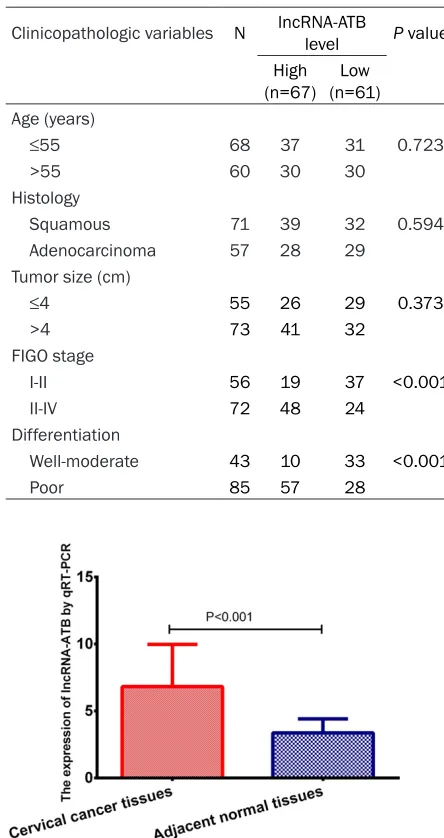
expression and patients’ clinicopathologic features
Clinicopathologic variables N lncRNA-ATB level P value High
(n=67) (n=61)Low
Age (years)
≤55 68 37 31 0.723
>55 60 30 30
Histology
Squamous 71 39 32 0.594
Adenocarcinoma 57 28 29 Tumor size (cm)
≤4 55 26 29 0.373
>4 73 41 32
FIGO stage
I-II 56 19 37 <0.001
II-IV 72 48 24
Differentiation
Well-moderate 43 10 33 <0.001
Poor 85 57 28
Figure 1. The expression levels of lncRNA-ATB in 128 pairs of primary tumor and normal adjacent samples from 128 cervical cancer patients.
gery. Once the tissues were dissected they were immersed in RNAlater (Qiagen GmbH, Hilden, Germany) for 30 min, and were then stored at -80°C until further use. The collect-ed adjacent normal tissues were 2 cm away from visible cervical cancer lesions. Cervical cancer diagnosis was based on World Health Organization (WHO) criteria. Tumor staging was determined according to the sixth edi-tion of the tumor-node-metastasis (TNM) classification of the International Union against Cancer. The clinicopathological fea-tures of 128 patients are summarized in Table 1. The study was approved by the Research Ethics Committee of The First Affiliated Hospital of Guangxi Medical University. Informed consent was obtained from all of the patients. All specimens were handled and made anonymous according to the ethical and legal standards.
was performed for all parameters that were sig-nificant in the univariate analyses using the Cox regression model. Results were considered sta-tistically significant when P≤0.05 was obtained.
Results
The expression level of lncRNA-ATB in cervical cancer samples and normal adjacent tissues
We analyzed the expression levels of lncRNA-ATB in 128 pairs of primary tumor and normal adjacent samples from 128 cervical cancer patients. As revealed by quantitative RT-PCR analysis, lncRNA-ATB expression was signifi -cantly higher in cervical cancer tissues com-pared with normal adjacent tissues (8.826± 3.155 vs. 3.372±1.043, P<0.001, shown in Figure 1). The 128 cervical cancer patients were classified into two groups according to the median of lncRNA-ATB expression level as determined by quantitative RT-PCR. 67 cases were placed in the high expression group and 61 in the low expression group.
Correlations of lncRNA-ATB expression with clinicopathologic features of cervical cancer patients
The correlations of lncRNA-ATB expression with clinicopathologic features of patients with cer-vical cancer were statistically analyzed. As shown in Table 1, high lncRNA-ATB expression
level was observed to be closely correlated with tumor differentiation (P<0.001) and FIGO stage (P<0.001). However, there were no significant correlations between lncRNA-ATB expression level and other clinicopathologic factors, includ-ing age (P=0.723), histology (P=0.594), and tumor size (P=0.373).
Correlation between lncRNA-ATB expression and prognosis of cervical cancer patients
Kaplan-Meier overall survival curve of the cervi-cal cancer patients according to the status of lncRNA-ATB level was examined. The overall survival of patients in the high lncRNA-ATB group showed significantly worse survival rates than those who were in the low lncRNA-ATB group (P=0.024, shown in Figure 2), suggesting that high expression of lncRNA-ATB is associat-ed with poor prognosis in cervical cancer patients. A multivariate analysis of the progno-sis factors with a Cox proportional hazards model showed that high lncRNA-ATB expres-sion (HR=2.535, CI: 1.372-10.376, P=0.012), high FIGO stage (HR=4.551, CI: 2.017-12.895, P=0.002), and worse tumor differentiation (HR=3.123, CI: 2.128-9.067, P<0.001) were significant independent predictors of poor sur -vival in cervical cancer (shown in Table 2). Discussion
The dysregulation of lncRNA is common in vari-ous carcinomas and plays an important role in cancer progression by altering normal gene expression. It has been noted that alterations in single lncRNA expression correlate highly with the progression and prognosis of human tumors. Thus, identification of lncRNA molecu -lar profiles associated with the prognosis of patients with cervical cancer may not only eluci-date the underlying biological mechanisms involved in the development or progression of the disease but also provide the opportunity to identify novel targets for cervical cancer therapy.
Overexpression of lncRNA-ATB has been observed in several types of cancer. For exam-ple, in the study by Saito et al, they found that lncRNA-ATB was significantly upregulated in gastric cancer tissues, and lncRNA-ATB played an important role in epithelial-mesenchymal transition (EMT) to promote invasion and metastasis through the TGFb/miR-200s/ZEB axis [16]. Shi et al found that lnc-ATB was sig-nificantly upregulated in the tissues of trastu -Figure 2. The overall survival of patients in the high
[image:3.612.91.289.70.279.2]zumab resistance breast cancer patients and trastuzumab resistance SKBR-3 cells. Lnc-ATB could promote trastuzumab resistance and invasion-metastasis cascade in breast cancer by competitively biding miR-200c, upregulating ZEB1 and ZNF-217, and then inducing EMT. In addition, the high level of lnc-ATB was correlat-ed with trastuzumab resistance of breast can-cer patients. Thus, these findings suggested that lncRNA-ATB, a mediator of TGF-β signaling, could predispose breast cancer patients to EMT and trastuzumab resistance [17]. In agree-ment with these studies, we confirmed that the expression levels of lncRNA-ATB in cervical can-cer tissues were significantly higher than those in normal adjacent tissues. Furthermore, high lncRNA-ATB expression level was observed to be closely correlated with tumor differentiation and FIGO stage, suggesting lncRNA-ATB may be involved in cervical cancer progression. Pre- viously, several studies have found that overex-pression of lncRNA-ATB was closely associated with poor survival outcome in some cancers. For example, in the study by Saito et al, they found that the lncRNA-ATB expression level was significantly associated with the overall survival rate after curative surgery for gastric cancer. Patients in the high lncRNA-ATB group had poorer prognoses than patients in the low lncRNA-ATB group (median overall survival, 1.35 vs. 2.08 years; P=0.0074). The results of multivariate analysis for overall survival rate suggested that lncRNA-ATB expression level was independent prognostic factor (hazard ratio 3.50, 95% CI 1.73-7.44, P=0.0004) in patients with gastric cancer [16]. Iguchi et al found that patients in the high-lncRNA-ATB expression group had significantly poorer out -comes than those in the low-expression gr- oup in terms of recurrence-free survival (P= 0.022) in colorectal cancer [20]. However,
prognosis factors with a Cox proportional haz-ards model showed that high lncRNA-ATB expression was a significant independent pre -dictor of poor survival in cervical cancer. In conclusion, our results suggested that upreg-ulation of lncRNA-ATB was significantly corre -lated with tumor progression and may be a potent prognostic marker of cervical cancer. In addition, more high quality studies are needed to confirm our findings.
Acknowledgements
Guangxi health department general scientific research project (Z2015534).
Disclosure of conflict of interest
None.
Address correspondence to: Yan Sun, Department
of Gynecology and Obstetrics, The First Affiliated
Hospital of Guangxi Medical University, No. 6 Shuangyong Road, Nanning 530021, Guangxi, PR China. Tel: 5356697; Fax: 086-0771-5356697; E-mail: [email protected]
References
[1] Torre LA, Siegel RL, Ward EM and Jemal A. Global Cancer Incidence and Mortality Rates and Trends--An Update. Cancer Epidemiol Bio-markers Prev 2016; 25: 16-27.
[2] Hillemanns P, Soergel P, Hertel H and Jen-tschke M. Epidemiology and Early Detection of Cervical Cancer. Oncol Res Treat 2016; 39: 501-506.
[3] Dryden-Peterson S, Bvochora-Nsingo M, Sune-ja G, Efstathiou JA, Grover S, Chiyapo S, Ramo-gola-Masire D, Kebabonye-Pusoentsi M, Clay-man R, Mapes AC, Tapela N, Asmelash A, Medhin H, Viswanathan AN, Russell AH, Lin LL, Kayembe MK, Mmalane M, Randall TC, Chab-Table 2. Multivariate analyses of parameters associated
with overall survival of 128 cervical cancer patients Variable Hazard ratio 95% CI P-value
Age 1.322 0.579-3.542 0.177
Histology 2.263 0.872-7.133 0.091
Tumor size 3.283 0.857-6.765 0.067 FIGO stage 4.551 2.017-12.895 0.002 Differentiation 3.123 2.128-9.067 <0.001 lncRNA-ATB expression level 2.535 1.372-10.376 0.012
ner B and Lockman S. HIV Infection and Sur-vival Among Women With Cervical Cancer. J Clin Oncol 2016; [Epub ahead of print]. [4] Chuang LT, Feldman S, Nakisige C, Temin S
and Berek JS. Management and Care of Wom-en With Invasive Cervical Cancer: ASCO
Re-source-Stratified Clinical Practice Guideline. J
Clin Oncol 2016; 34: 3354-3355.
[5] Zhang Q, Chen CY, Yedavalli VS and Jeang KT. NEAT1 long noncoding RNA and paraspeckle bodies modulate HIV-1 posttranscriptional ex-pression. MBio 2013; 4: e00596-00512. [6] Kitagawa M, Kotake Y and Ohhata T. Long
non-coding RNAs involved in cancer development and cell fate determination. Curr Drug Targets 2012; 13: 1616-1621.
[7] Yoon JH, Abdelmohsen K and Gorospe M. Post-transcriptional gene regulation by long non-coding RNA. J Mol Biol 2013; 425: 3723-3730. [8] Yoon JH, Abdelmohsen K, Srikantan S, Yang X,
Martindale JL, De S, Huarte M, Zhan M, Becker KG and Gorospe M. LincRNA-p21 suppresses target mRNA translation. Mol Cell 2012; 47: 648-655.
[9] Gibb EA, Brown CJ and Lam WL. The functional role of long non-coding RNA in human carcino-mas. Mol Cancer 2011; 10: 38.
[10] Liz J and Esteller M. lncRNAs and microRNAs with a role in cancer development. Biochim Biophys Acta 2016; 1859: 169-176.
[11] Pandey GK and Kanduri C. Long noncoding RNAs and neuroblastoma. Oncotarget 2015; 6: 18265-18275.
[12] Roth A and Diederichs S. Long Noncoding RNAs in Lung Cancer. Curr Top Microbiol Im-munol 2016; 394: 57-110.
[13] Li W and Kang Y. A new Lnc in metastasis: long noncoding RNA mediates the prometastatic functions of TGF-beta. Cancer Cell 2014; 25: 557-559.
[14] Qu S, Yang X, Song W, Sun W, Li X, Wang J, Zhong Y, Shang R, Ruan B, Zhang Z, Zhang X and Li H. Downregulation of lncRNA-ATB cor-relates with clinical progression and unfavor-able prognosis in pancreatic cancer. Tumour Biol 2016; 37: 3933-3938.
[15] Richards EJ, Zhang G, Li ZP, Permuth-Wey J, Challa S, Li Y, Kong W, Dan S, Bui MM, Coppola D, Mao WM, Sellers TA and Cheng JQ. Long non-coding RNAs (LncRNA) regulated by trans-forming growth factor (TGF) beta: LncRNA-hit-mediated TGFbeta-induced epithelial to mes-enchymal transition in mammary epithelia. J Biol Chem 2015; 290: 6857-6867.
[16] Saito T, Kurashige J, Nambara S, Komatsu H, Hirata H, Ueda M, Sakimura S, Uchi R, Takano Y, Shinden Y, Iguchi T, Eguchi H, Ehata S, Mu-rakami K, Sugimachi K and Mimori K. A Long Non-coding RNA Activated by Transforming Growth Factor-beta is an Independent Prog-nostic Marker of Gastric Cancer. Ann Surg On-col 2015; 22 Suppl 3: S915-922.
[17] Shi SJ, Wang LJ, Yu B, Li YH, Jin Y and Bai XZ. LncRNA-ATB promotes trastuzumab resistance and invasion-metastasis cascade in breast cancer. Oncotarget 2015; 6: 11652-11663. [18] Xu S, Yi XM, Tang CP, Ge JP, Zhang ZY and Zhou
WQ. Long non-coding RNA ATB promotes growth and epithelial-mesenchymal transition and predicts poor prognosis in human prostate carcinoma. Oncol Rep 2016; 36: 10-22. [19] Yue B, Qiu S, Zhao S, Liu C, Zhang D, Yu F, Peng
Z and Yan D. LncRNA-ATB mediated E-cadherin repression promotes the progression of colon cancer and predicts poor prognosis. J Gastro-enterol Hepatol 2016; 31: 595-603.