Reproductive parameters in Yorkshire terrier dogs
in Poland
M. Goleman
1*, M. Karpinski
1, P. Czyzowski
1, W. Tuszynska-Bogucka
2,
L. Drozd
11Faculty of Biology, Animal Sciences and Bioeconomy, University of Life Sciences, Lublin, Poland 2Faculty of Administration and Social Sciences, University of Economics and Innovations,
Lublin, Poland
*Corresponding author: [email protected]
ABSTRACT: The aim of this study was to determine the basic reproductive parameters, i.e., litter size, gestation
length, neonatal mortality rate and the type of delivery in Yorkshire terrier dogs, one of the most popular breeds in Poland. We have verified a hypothesis put forward by breeders that larger females have fewer whelping difficulties and produce larger litters and that pregnancies of females having one or two pups last longer. The focus of investigation was reproductive data from 66 Yorkshire terrier females registered in the Lublin Branch of the Polish Kennel Club, an FCI (Federation Cynologique Internationale) member, which whelped 124 litters comprising in total 508 pups from 37 fathers. The data were collected between August 2009 and December 2014. The significance of differences was verified using Mann-Whitney U and Kruskal-Wallis H-tests. The relationships between the recorded dogs’ reproduction traits were estimated by calculation of Spearman’s correlation coefficients with the use of the statistical programmes Statistica and SPSS 20. The investigations have confirmed the hypothesis concerning the larger litter size produced by larger females and the lower incidence of postpartum dystocia; however, the hypothesis of the impact of body weight on the length of pregnancy was rejected. The differences between the body weights of stud females and males reached 125%. The Yorkshire terrier appears to be a good reproductive breed with normal reproductive functions and good reproductive parameters.
Keywords: small dog breeds; reproduction; litter size; completion of pregnancy
In dog breeding, the knowledge of the exact pregnancy due date is extremely important, since small-breed females require assistance during de-livery, particularly at the first one, in a majority of cases. One of the major clinical problems is the varying duration of pregnancy (57–72 days), which makes it impossible to plan obstetric and neonatal care of pups and their mother (Luvoni and Grioni 2000; Kutzler et al. 2003; Eilits et al. 2005). Ultrasonographic foetometry is helpful in predicting the time of parturition. As shown in investigations on Yorkshire terriers conducted by Socha and Janowski (2011), this examination method had a prediction accuracy of 57–93%, de-pending on the assumed accuracy level and used measurement, whereas its reliability increased to 80–100% in the Golden retriever breed. However,
systematic ultrasound monitoring of pregnancy is not available to some breeders, and its lower range of accuracy (57%) is not satisfactory. Therefore, factors that determine the length of the pregnancy period should be taken into account by breeders.
not exceed 3.2 kg, is taken into account (Standards and Nomenclature 2012). Most representatives of the current Yorkshire terrier population have a bal-anced personality and do not cause trouble with their behaviour. Therefore, they can be kept as pets by families with children and by the elderly.
The physical traits of females such as body weight, physiological traits such as fertility and psychological attributes such as readiness to take care of offspring, which is evidenced by the rate of pup survival, normal development and rearing, are important for breeders.
Due to the large population size, Yorkshire terri-ers can be a good model for determining the repro-ductive parameters in small dogs in general (with the exception of miniature and brachycephalic dog breeds). The aim of this study was to determine the basic reproductive parameters, i.e., the litter size, gestation length, neonatal mortality rate and type of delivery, and to assess the relationships between the body weight in females and males and the repro-ductive parameters mentioned above. Additionally, an attempt was made to verify a belief shared by breeders of Yorkshire terriers that larger females have fewer whelping difficulties and produce larger litters and that pregnancies of females whelping one or two pups last longer.
MATERIAL AND METHODS
The focus of investigation was reproductive data from 66 Yorkshire terrier females registered in the Lublin Branch of the Polish Kennel Club, which whelped 124 litters comprising 508 pups from 37 fathers during the study period. The data were obtained from the database of the branch and from breeders between August 2009 and December 2014.
The investigations were carried out in small breeding sites, where a maximum of five stud fe-males were kept and only one female had pups at a time. This allowed an individual approach to each expectant mother with particular emphasis on rou-tine monitoring of the calcium and acid-base bal-ance. In all breeding sites, the females were family dogs, lived at the breeders’ homes (no cage breed-ing), and were walked at least three times a day. They received commercial premium quality feed designed for pregnant bitches at a constant dose until gestation day 42 twice a day. After day 42 of pregnancy, the frequency of feeding was increased
initially to three and then four times a day and the feed dose was increased as well (by 10% in each sub-sequent week of gestation). No additional diet sup-plementation was introduced. All the bitches were naturally mated twice. The mating day was estab-lished based on the behavioural method (female’s behaviour towards the male; behavioural changes observed in females); the bitches were mated one day after acceptance of the male, and mating was repeated after 48 hours. The first mating day was regarded as the first day of gestation (day 0).
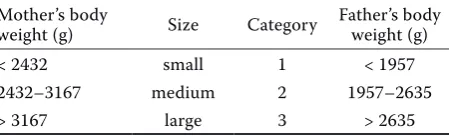
The following parameters were determined: ges-tation length (based on the dates of mating and whelping), litter size, pups’ sex in each litter, com-pletion of pregnancy (natural delivery or a cae-sarean section) and possible dystocia. Data of the female and male body weights before mating were also collected. The body weight was measured with the use of paediatric scales, and the animals’ con-dition during the weighing period was assumed as optimal. Adult individuals were divided into small, medium and large sizes according to the scheme presented in Table 1. The classification was devel-oped based on the arithmetic means of the body weights of male and female dogs in the analysed population of Yorkshire terriers and standard de-viation (females: M ± SD, 2800 ± 367.99; males: M ± SD, 2296 ± 338.99).
The sex ratio in born pups, frequency of preg-nancies terminated with a caesarean section, pup mortality rate, mean litter size and mean preg-nancy length were determined. Additionally, we determined the correlations between the female body weight and litter size, gestation length, rate of caesarean sections and neonatal mortality rate; the correlations between male body weight and litter size; the correlations between the litter size and number of stillborn pups and mode of pregnancy termination; and the correlations between the ges-tation length and litter size, neonatal mortality rate and frequency of caesarean sections.
Statistical analysis. The results were summarised
in tables and graphs, and the significance of the
dif-Table 1. Division of dogs according to body weight
Mother’s body
weight (g) Size Category Father’s body weight (g)
< 2432 small 1 < 1957
2432–3167 medium 2 1957–2635
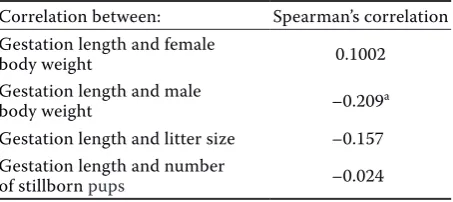
[image:2.595.306.531.690.758.2]tistically significant negative correlation was found between the gestation length and the male body weight, i.e., the smaller the male parent, the longer the gestation period; yet this seemed to be a ran-dom result that was not confirmed in the breeding. Statistical analyses did not reveal significant correlations between the length of pregnancy and the litter size. It can be assumed that the length of pregnancy is a specific trait of each female, but this requires further investigations.
The analysis of the impact of the gestation length on the frequency of stillborn pups per litter did not show statistically significant correlations. Similarly, preg-nancies terminated with a caesarean section (M ± SD, 63.73 ± 3.217) were not statistically significantly longer than those terminated with a natural delivery (M ± SD, 62.42 ± 2.381), (U = 628.50, z = –1.257, P = 0.208). All caesarean sections were performed with medical indications. The litter sizes were determined based on the mean and standard deviations: small litter (M = 2.552) one to two pups, medium litter three to five pups, and large litter six (M = 5.648) and more pups. No correlation was found between the litter size (in the litter size categories) and stillborn pups (H (2, n = 121) = 2.0366; P = 0.3612).
Since the compared groups were characterised by different values of pregnancy termination frequen-cies, the non-parametric Mann-Whitney U-test was employed. A comparison of the litter size and mode of pregnancy completion (natural birth or a caesarean section) in the groups differing in the mode of delivery revealed a statistically significant difference in the number of pups per litter in the caesarean section group (U = 605.0, z = –1926, P = 0.049). This implies that is probably necessary to carry out a caesarean section when the number of pups in the litter is increased. There was also a cor-relation between the type of pregnancy completion and the presence of stillborn pups in the litter. In comparison to vaginal deliveries, a greater number of stillborn pups were born by caesarean section and the differences were statistically significant. The rate of stillbirth was 0.33 per litter (SD, ± 0.611) in vaginal deliveries and 0.69 (SD, ± 0.602) in the case of caesarean section. These differences were statis-tically significant (U = 561, z = –2.738, P = 0.006). The mean body weight of the examined stud fe-males was 2800 g (SD, ± 367.9 g; min. 2000 g, max. 3600 g) with differences in the body weight reach-ing 80%. In turn, breeders usually choose small stud males to match the size of the female parent. ferences was verified with the Mann-Whitney U-test
and Kruskal-Wallis H-test. Non-parametric statistics were used, since the results of the Shapiro-Wilk test indicated abnormal distribution (female body weight SW-W = 0.9643, P = 0.004; male body weight SW-W= 0.9146, P = 0.000001). We also determined the relationships between the dogs’ reproductive traits by calculating Spearman’s correlation coefficients with the use of the Statistica statistical programme.
RESULTS
A total of 213 males (46.1% of births) and 249 fe-males (53.9% of births) were born in the 124 lit-ters of the Yorkshire terrier dogs. The differences between the number of males and females born were verified with the Mann-Whitney U-test and were found to be statistically non-significant: U = 6633, z = –1.866, P = 0.06 n (M ± SD, 1.72 ± 1.213 for males, M ± SD, 2.01 ± 1.241 for females). The analysis of perinatal complications in all the litters revealed 46 stillborn pups (both sexes, without de-termination of the sex ratio), which accounted for 9.05% of all born pups. Only 16 out of the 124 de-liveries were terminated with a caesarean section, which represented 3.15% of all deliveries.
The gestation length is a very important repro-ductive parameter in breeding. In the Yorkshire ter-rier females, it was on average 62.59 (± 2.522) days with a maximum and minimum of 55 and 71 days, respectively. Correlations between the gestation length and body weight, litter size and stillbirth frequency were analysed in the females.
The results indicated that the body weight of the female parent had no statistically significant effect on the length of gestation (Table 2). However, a
sta-Table 2. Spearman’s correlation coefficients for the rela-tionships between gestation length and the parents’ body weights, litter size and number of stillborn pups
Correlation between: Spearman’s correlation Gestation length and female
body weight 0.1002
Gestation length and male
body weight –0.209a
Gestation length and litter size –0.157 Gestation length and number
of stillborn pups –0.024
[image:3.595.64.291.637.738.2]The mean body weight of males in the analysed litters was 2295.79 g (SD, ± 338.99 g; min. 1600 g, max. 3000 g) and the difference in the weight be-tween the smallest and largest individuals reached 87.5%. The difference between the maximum fe-male weight and the minimum fe-male weight was as high as 125%. The Yorkshire terrier is one of the few breeds in which differences in body weight between individuals may exceed 100%.
Yorkshire terrier females representing the large and medium size groups are preferred by breeders as prospective mothers. Small females are chosen as stud dogs less frequently, which is related to the breeders’ belief that larger females have larger lit-ters. The mean number of Yorkshire terrier pups per litter was 4.1.
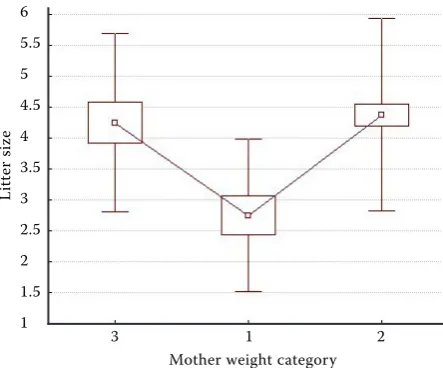
Comparison of the litter size from females from each weight category performed using the Kruskal-Wallis test (H (2, n = 113) = 13.624, P = 0.001) and the multiple comparisons revealed a statistically significant difference in the litter sizes between the large and small females (category 1–3) (P = 0.019) and between the medium and small females (category 1–2) (P = 0.00098). There was no statisti-cally significant difference in the litter size between the medium and large females (category 2–3). This analysis confirmed the hypothesis of the effect of the female size (determined by the mother’s body weight) on the litter size, i.e., the larger the female, the larger the litter size (Figure 1).
Comparison of the correlation between the male body weight and the litter size (in the weight
cat-egories) did not show statistically significant dif-ferences (H (2, n = 110) = 1.8803, P = 0.390). This indicates that the father’s size (determined by body weight) had no effect on the litter size.
According to another popular belief, smaller fe-males develop perinatal complications requiring a caesarean section or have stillborn pups. In the analysed data, the female body weight had no statis-tically significant effect on the mode of pregnancy completion (natural birth or a caesarean section (U = 598.50, z = 1.150, P = 0.249). However, the lowest incidence of caesarean deliveries was re-ported in the large female group (Table 3). There were no statistically significant differences between the female body weight and the number of stillborn pups per litter (H (3, n = 110) = 0.5101, P = 0.9167) and between the male body weight and the neonatal mortality rate (H (3, n = 110) = 3.0383, P = 0.3857).
DISCUSSION
[image:4.595.66.288.522.706.2]Gestation length ranges from 62 to 64 days (63 ± 2 days) between ovulation and delivery, and ovu-lation typically occurs 48–60 h after the LH peak (Concannon 2000; Concannon 2011). In the pre-sent study, when the day of the first mating was regarded as the first day of pregnancy, the Yorkshire terrier females whelped between 55 and 71 days after mating and the mean gestation length was 62.57 ± 2.524 days. In the investigations carried out by Okkens et al. (1993) on 77 large breed dogs (e.g., German shepherd, Bouvier des Flandres, Old English sheepdog, Bernese mountain dog, Boxer), the mean gestation length was estimated at 62.1 days (with a variation of 11 days). In inves-tigations conducted by Son et al. (2001), the mean length of pregnancy in Yorkshire terrier females was estimated at 63.4 (± 0.5) days, i.e., it was less than one day longer than that determined in the present study. In turn, the mean gestation length
Figure 1. Correlation between the litter size and mother’s weight (in the different weight categories)
-□-= mean,
□
= mean + SEM, ¯|_ = mean ± SDTable 3. Mean size of litters from bitches in the different weight categories
Weight categorya n M SD
3 20 4.250 ± 1.446
2 77 4.376 ± 1.556
1 16 2.750 ± 1.238
aFor details on weight categories see Table 1
Lit
ter si
ze
Mother weight category
3 1 2
[image:4.595.301.531.681.738.2]was similar to that in West highland white terriers, i.e., 62.8 (± 1.5) days, and greater than the value estimated in German shepherds (60.4 ± 1.7; P ≤ 0.001), Labrador retrievers (60.9 ± 1.5; P ≤ 0.001) and Dobermans (61.4 ± 1.0; P ≤ 0.025) reported by Okkens et al. (2001). In the study of Zonturlu and Kacar (2012), the gestation length ranged from 58 to 64 days with an average of 62.6 (± 1.5) days in German shepherd dogs and 61.6 (± 2.0) days in Labrador retrievers. Pregnancy length in the Drever breed was 61.48 (± 2.24) with a minimum of 56 and a maximum of 72 days (Bobic Gavrilovic et al. 2008).
Okkens et al. (1993) reported that gestation length in a dog population was negatively corre-lated (r = –0.96, P < 0.001, n = 44) with the lit-ter size in the case of litlit-ters comprising seven or fewer pups. Subsequent investigations conducted by Okkens et al. (2001) on German shepherd, Labrador retriever, Doberman pinscher, Bernese mountain dog, Golden retriever, and West high-land white terrier dogs confirmed the results of Okkens et al., who reported that the length of ges-tation was negatively correlated with the litter size (r = –0.73), i.e., the larger the litter, the shorter the pregnancy period. Similar results were obtained in the present study, although without statistically significant correlations. Similarly, Eilts et al. (2005) found that the litter size was an important factor determining gestation length. They showed that pregnancies with four or fewer pups per litter were significantly longer than pregnancies with five or more pups. Additionally, a considerable effect of the breed on gestation length was found. The study conducted by Bobic Gavrilovic (2008) on Drever dogs confirmed the negative correlation between the gestation length and litter size (r = –0.18; P < 0.001). With each additional pup above the average, the pregnancy period was shortened by 0.25 days.
In the investigations carried out by Zonturlu and Kacar (2012), the litter size did not have an effect on gestation duration (P ≥ 0.05). In the study pre-sented by Seki et al. (2010), no impact of the litter size on the gestation length was found in Beagle females. Similarly, Kutzler et al. (2003) showed no effect of litter size on gestation length in their re-search. However, they divided the dogs from dif-ferent breeds into body weight groups and showed that the body weight had a significant effect on the gestation length in dogs at the extreme values of this trait (the smallest and the largest). It was found that
pregnancy was prolonged by 1.44 days in the lightest (< 9 kg) females and shortened by 2.44 days in the heaviest (> 40 kg) dogs, compared to the expected gestation length determined by USG examination. No effect of the female body weight on the gesta-tion length was shown in the present investigagesta-tions. Holst and Phemister (1974) reported that a sin-gleton pregnancy in Beagle females lasted signifi-cantly longer than multiple pregnancies in this breed. In fact, a one-foetus pregnancy can occur in any breed. The observations made by Domoslawska et al. (2011) demonstrate that the most frequent indication for ultrasound monitoring is singleton pregnancies, which are burdened with high risk. Singleton litters are rare in large and giant breeds, whereas miniature and brachycephalic breeds such as the Chihuahua or the Russian toy are particu-larly predisposed to the phenomenon. Some au-thors, e.g., Domoslawska et al. (2011), also classify Yorkshire terriers into this group. However, in the present investigations, there were only four single-ton litters out of the total of 124, which accounted for 3.2% of all completed pregnancies. Another problem associated with singleton pregnancies is the difficulty in predicting the time of parturition. In the case of multiple pregnancies, the placenta is unable to meet the growing foetuses’ needs at the end of the pregnancy. Therefore, as a result of stress stimuli caused by insufficient supply of nu-trients and oxygen through the placenta, cortisol is released (activated hypothalamic-pituitary-adrenal axis) and reaches the mother’s organism through the placenta, leading to PGF2α release, which ini-tiates luteolysis (Ochota et al. 2014). Frequently, a single large foetus necessitates a caesarean sec-tion (Domoslawska et al. 2011). In our investiga-tions, only one of the four singleton pregnancies was terminated with a caesarean section. In turn, a statistically significant correlation was found in the case of litters with multiple pups (five or more), which implies that the larger the litter, the higher the probability of a caesarean section.
of the selection criteria considered by breeders. The incidence of caesarean sections was 5.36% in Drever dogs (Bobic Gavrilovic 2008) and 2.68% in Dogo Argentino females (Caffaratti et al. 2013).
The analysis of the sex ratios carried out in the present study did not reveal an effect of the pup’s sex on the gestation length. Although greater num-bers of female (53.9%) compared to male (46.1%) pups were born, the difference was not statistically significant. As for the sex ratio in other breeds, the percentage of male pups was 50.8% in Dogo Argentino (Caffaratti et al. 2013) and 50.5% in Drever breeds (Bobic Gavrilovic 2008). This cor-responds with the results presented by Tedor and Reif (1978) in their study of different dog breeds, where 50.6% of male pups were born, and with the report of investigations conducted by Goleman et al. (2015) on eight small dog breeds, where the fre-quency of born males was 50.04%.
In female dogs, the litter size varies according to the breed, with smaller breeds tending to have smaller litters than larger breeds (Johnson 2008). In investigations of the reproductive parameters of the Dogo Argentino breed (Caffaratti et al. 2013), the mean litter size was 8.12 (± 3.44), which was in agreement with the study of Feldman and Nelson (2007), who reported an average of eight to ten pups per litter of large breeds. In the investigations con-ducted by Borge et al. (2011), the number of pups in miniature breed (below 5 kg) litters reached 3.5 (± 0.04). In the same study, the mean litter size ob-served in 35 deliveries in Yorkshire terriers was 3.5 (± 0.3) with a minimum of one and maximum of six pups. The mean number for the breed reported by Borge et al. (2011) was lower than that obtained in the present study, where the mean litter size was 4.1, but the number of observed deliveries was 3.5-fold higher. There was one litter with eight pups (ter-minated with a caesarean section) and as many as ten litters with seven pups in each. In our previous analysis of 318 Yorkshire terrier litters (1137 pups) (Goleman et al. 2015), the results were similar to those reported by Borge et al. (2011): the mean litter size was 3.58 (± 0.1), but stillborn pups were not included in the analysis. Kelley (2002) reported that the litter size in Yorkshire terrier and Chichuahua breeds ranged from two to five pups, with 80% of the litters having four pups. It was also found in the present study that larger females whelped larger lit-ters and the correlation was statistically significant, although the study involved only one breed.
No case of postpartum tetany, i.e., one of the post-partum complications prevalent in small breeds, was observed during the course of the conducted observations. The decreased serum calcium levels in the females may be a consequence of impaired gastrointestinal absorption of this element (as well as calcium and vitamin D deficiency), excessive deposi-tion of calcium in tissues, excessive urinary calcium loss, impaired action of parathyroid hormone (PTH) and vitamin D3 as well as magnesium deficiency (Jakubas-Kwiatkowska et al. 2005; Holowaychuk 2013). The absence of these symptoms in the 124 de-liveries observed may imply a high awareness of breeders, proper nutrition and good preparation of females for the delivery in the gestation period.
Due to the large population size and body struc-ture of Yorkshire terrier individuals, the breed can serve as a model of reproduction in small dogs.
The investigations have confirmed the hypoth-esis that larger female dogs produce larger litters. The best reproductive performance was exhibited by females with body weights exceeding 2432 g. The lowest incidence of postpartum complications, e.g., caesarean section or stillborn pups, was found in the large females. The statistical analyses con-firmed the relevance of choosing large and medium size female dogs for breeding.
The hypothesis of the impact of the body weight on the length of pregnancy was rejected, mean-while, since no such correlation was found in the present study. Additionally, the hypothesis of long-er gestation plong-eriods in the case of smalllong-er littlong-ers has not been supported.
Statistical analysis of the data revealed that the differences in the stud female body weight reached 80% and as high as 125% when the maximum female body weight and the minimum male body weight were compared.
The Polish population of the Yorkshire terrier appears to be a good reproductive breed with nor-mal reproductive functions and good reproductive parameters. Rates of caesarean sections as well as neonatal mortality were negligible. No cases of postpartum tetany were observed.
Acknowledgements
REFERENCES
Bobic Gavrilovic B, Andersson K, Linde Forsberg C (2008): Reproductive patterns in the domestic dog – a retrospec-tive study of the Drever breed. Theriogenology 70, 783–794. Borge KS, Tonnessen R, Nodtvedt A, Indrebo A (2011):
Litter size at birth in purebred dogs – A retrospective study of 224 breeds. Theriogenology 75, 911–919. Caffaratti M, Gonzalez G, Gorla N, Guendulain C (2013):
Reproductive parameters of the Dogo Argentino bitch. Journal of Veterinary Medicine, doi: 10.1155/2013/495975. Concannon PW (2000): Canine pregnancy: Predicting par-turition and timing events of gestation. In: England E, Verstegen J (eds): Recent Advances in Small Animal Re-production. International Veterinary Information Service (www.ivis.org).
Concannon PW (2011): Reproductive cycles of the domes-tic bitch. Animal Reproduction Science 124, 200–210. Domoslawska A, Jurczak A, Janowski T (2011): A
one-foetus pregnancy monitored by ultrasonography and progesterone blood levels in a German Shepherd bitch: a case report. Veterinarni Medicina 56, 55–57.
Eilts BE, Davidson AP, Hosgood G, Paccamonti DL, Baker DG (2005): Factors affecting gestation duration in the bitch. Theriogenology 64, 242–251.
Feldman EC, Nelson RW (2007): Reproduction in Canine Female (in Portuguese). In: Endocrinologia y Reproduc-cion Canina y Felina. 3rd edn. Intermedica, Buenos Aires.
833–1036.
Goleman M, Karpinski M, Czyzowski P, Drozd L (2015): Litter size variation in Polish selected small dog breeds. Italian Journal of Animal Science 14, 476–478.
Holowaychuk MK (2013): Hypocalcemia of critical illness in dogs and cats. Veterinary Clinics of North America – Small Animal Practice 43, 1299–1317.
Holst PA, Phemister RD (1974): Onset of diestrus in the Beagle bitch: definition and significance. American Jour-nal of Veterinary Research 35, 401–406.
Jakubas-Kwiatkowska W, Blachowicz A, Franek E (2005): Hypocalcemia in clinical practice – causes, symptoms and treatment (in Polish). Choroby Serca i Naczyn 2, 232–237.
Johnson CA (2008): Pregnancy management in the bitch. Theriogenology 70, 1412–1417.
Kelley R (2002): Canine reproductive management: factors affecting litter size. In: Proceedings of the Annual
Confer-ence of the Society for Theriogenology and American College of Theriogenology. 291–301.
Kutzler MA, Yeager AE, Mohammed HO, Meyers-Wallen VN (2003): Accuracy of canine parturition date predic-tion using fetal measurements obtained by ultrasonog-raphy. Theriogenology 60, 1309–1317.
Luvoni GC, Grioni A (2000): Determination of gestational age in medium and small size bitches using ultrasono-graphic fetal measurements. Journal of Small Animal Practice 41, 292–294.
McGreevy PD, Nicholas FW (1999): Some practical solu-tions to welfare problems in dog breeding. Animal Wel-fare 8, 329–341.
Ochota M, Mackowiak M, Nizanski W (2014): A weak new-born. Critical 24 hours (in Polish). Weterynaria w prak-tyce 9, 46–53.
Okkens AC, Hekerman TWM, de Voge JWA (1993): Influ-ence of litter size and breed on variation in length of ges-tation in the dog. The Veterinary Quarterly 15, 160–161. Okkens AC, Teunissen JM, Van Osch W, Van Den Brom WE,
Dieleman SJ, Kooistra HS (2001): Influence of litter size and breed on the duration of gestation in dogs. Journal of Reproduction and Fertility, Supplement 57, 193–197. Seki M, Watanabe N, Ishii K, Kinoshita Y, Aihara T, Takeiri
S, Otoi T (2010): Influence of parity and litter size on gestation length in beagle dogs. The Canadian Journal of Veterinary Research 74, 78–80.
Socha P, Janowski T (2011): Predicting the parturition date in Yorkshire Terrier and Golden Retriever bitches using ultrasonographic fetometry. Bulletin of the Veterinary Institute in Pulawy 55, 71–75.
Son CH, Jeong KA, Kim JH, Park IC, Kim SH, Lee CS (2001): Establishment of the prediction table of parturition day with ultrasonography in small pet dogs. Journal of Vet-erinary Medical Science 63, 715–721.
Standards and Nomenclature (2012): FCI-Standard N° 86 – Yorkshire Terrier. Available at www.fci.be/Nomencla-ture/Standards/086g03-en.pdf (Accessed April 25, 2016). Tedor JB, Reif JS (1978): Natal patterns among registered
dogs in the United States. Journal of the American Vet-erinary Medical Association 172, 1179–1185.
Zonturlu AK, Kacar C (2012): Effect of gestation length of litter size, and inter-pup interval, change od rectal tem-perature in German shepherd and Labrador retriever bitches. Harran Universitesi Veteriner Fakultesi Dergisi 1, 103–106.