Abstract— In this paper, initial boundary value problems with non local boundary conditions are presented. The homotopy perturbation method (HPM) is used for solving linear and non linear initial boundary value problems with non classical conditions. The obtained results as compared with previous works are highly accurate. Also HPM provides continuous solution in contrast to finite difference method, which only provides discrete approximations. It is found that this method is a powerful mathematical tool and can be applied to a large class of linear and nonlinear problem in different fields of science and technology
Index Terms— Homotopy perturbation method (HPM), Partial differential equations, Initial boundary value problems,
I. INTRODUCTION
ecently, much attention has been to partial differential equations with non local boundary conditions, this attention was driven by the needs from applications both in industry and sciences. Theory and numerical methods for solving initial boundary value problems with nonlocal conditions were investigated by many researchers see [1-10, 12-14,16-18,22-27] and the reference therein. In the last decade, there has been a growing interest in the analytical new techniques for linear and nonlinear initial boundary value problems with non classical boundary conditions. The widely applied techniques are perturbation methods. J.He [20] has proposed a new perturbation technique coupled with the homotopy technique, which is called the homotopy perturbation method (HPM). In contrast to the traditional perturbation methods. a homotopy is constructed with an embedding parameter 2 [01], which is considered as a small parameter. HPM has gained reputation as being a powerful tool for solving linear or nonlinear partial differential equations. This method has been the subject of intense investigation during recent years and many researchers have used it in their works involving differential equations see in [11,15]. He [19], applied HPM to solve initial boundary value problems which is governed by the nonlinear ordinary (Partial) differential equations, the results show that this method is efficient and simple. Thus, the main goal of this work is to apply the homotopy perturbation method (HPM) for solving linear and nonlinear
Manuscript received January 05, 2013; revised April, 10, 2013. A. Cheniguel is with Department of Mathematics and Computer Science, Faculty of Sciences, Kasdi Merbah University Ouargla, Algeria (e-mail: [email protected] )
M. Reghioua is with Constantine higher education school, Constantine, Algeria, (e-mail : [email protected]).
initial boundary value problems with nonlocal boundary conditions. The general form of equation is given as:
, , , , , 0 (1) Subject to the initial condition:
, 0 , 0 (2) And the non local boundary conditions
, , , , 0 (3)
, , , , 0 (4)
Where , , , , are sufficiently smooth known functions and T is a given constant.
II. ANALYSISOFHOMOTOPYPERTURBATION METHOD
To illustrate the basic ideas, let and be the topological spaces. If and are continuous maps of the spaces into
, it is said that is homotopic to if there is continuous map : 0,1 ⟶ such that , 0 and , 1 for each 2 , then the map is called homotopy between and .
We consider the following nonlinear partial differential equation:
0, Ω (5) Subject to the boundary conditions
, 0, ∈ Γ (6) Where is a general differential operator. is a known analytic function, Γ is the boundary of the domain Ω and
denotes directionalderivative in outward normal direction to Ω. The operator , generallydivided into two parts,
and , where is linear, while is nonlinear.Using
=+, eq. (5) can be rewritten as follows:
()+()-()=0
(7)
By the homotopy technique, we construct a homotopy defined as
, : Ω 0,1 ⟶ (8) Which satisfies:
, 1 , ∈
0,1 , ∈ Ω (9)
Homotopy Perturbation Method for Solving
Some Initial Boundary Value Problems with
Non Local Conditions
A. Cheniguel and M. Reghioua
Or ,
0, ∈ 0,1 , ∈ Ω (10)
Where 2 [01] is an embedding parameter , 0 is an
initial approximation of equation (5), which satisfies the boundary conditions. It follows from the equation (10) that
, 0 0 (11) , 1 0 (12) The changing process of from 0 to 1 monotonically is a
trivial problem. , 0 0is
continuously transformed to the original problem , 1 0. (13)
In topology, this process is known as continuous
deformation. and are called
homotopic. We use the embedding parameter as a small parameter , and assume that the solution of equation (10) can be written as a power series of :
⋯ ⋯(14) Setting =1we obtain the approximate solution of equation (5) as:
lim → ⋯ ⋯ (15)
The series of equation (15) is convergent for most of the cases, but the rate of the convergence depends on the nonlinear operator (). He (1999) has suggested that: - The second derivative of () with respect to should be small because the parameter may be relatively large i.e
! 1and the norm of must be smaller than one in order for the series to converge.
III. EXAMPLES A. Example 1
We consider the problem
4 12 4 12 (16)
0 1, 0
With the initial condition:
, 0 , , 0 =0, 0 1, 0 (17) And the boundary conditions:
0, , , 1 (18)
Where , and
1, , , 1 (19)
Where , and
For solving this problem, we construct HPM as follows:
, 1
4 12 4 12 0 (20) The component vi of (15) are obtained as follows:
0, , 0 (21)
∂ ∂
∂ ∂
∂
∂ 4 12 4 12
0,
, 0 0 (22)
∂
∂ 4 , ∂
∂ 12 , ∂
∂ 0
4 12 Hence
4 (23) 0, , 0 0 (24)
∂
∂ 12 24 , ∂
∂ ∂
∂ 0 12 24
Then, we have
4 12 (25) For the next component:
∂ ∂
∂ ∂
∂
∂ 0, , 0 0
12 24 , 24 , (26) And so on, we obtain the approximate solution as follows:
lim
→ ⋯ ⋯
And this leads to the following solution
, (27) We can, immediately observe that this solution is exact.
B. Example 2
Consider the following nonlinear reaction-diffusion equation:
0 1, 0 (28) Subject to the initial condition
, 0 0 1, (29) And the boundary conditions:
0, , , (30)
With , 1 and
1, , , (31)
With , and
Solving the equation (28) with the initial condition (29), yields:
0,
∂
∂ ∂
∂ v 0, , x, 0 0
∂ ∂
∂
∂ v 0, 2! , And we can deduce the remaining components as:
! , . . , ! ,, (32)
Using equation we get :
, 1
1! 2! 3! ⋯ ! ⋯
C. Example 3 Consider the problem
0 , , 1, 0
(34)
Subject to the initial condition:
, , , 0 (35)
And the boundary conditions
0, , , , , , , , 0
1, , , , , , ,
,
, 0, , , , , , 1 ,
, 1, , , , , , 3 ,
, , 0, , , , , ,
, , 1, , , , , ,
, (36)
As above, we get the components of (15):
0, (37) 1
6 0, , 0 0
1
6 2 2 2
1! 1
6 0, , 0 0
1
6 2 2 2
2!
1
6 0, , 0 0
1
6 2 2 2 2!
2!
3!
And we deduce the general form of vn as follows : 1
6
0, , 0 0 1
6 2 2 2 1 !
1 !
! (38)
Hence, the approximate solution is given by: , , , lim
→ ⋯ ⋯
Now, the solution of (34) when ! 1 reduces to :
, , , 1
1! 2! 3! ⋯ ! ⋯
And the solution in a closed form is given by:
, , , (39)
D. Example 4
As a last example, consider the following problem:
0 , , 1, 0 (40) With the initial condition
, 0 , , 0 =0, (41)
And the boundary conditions:
0, , , 1 0.5 ,
With , 1 and 0.5
1, , , 1 0.125
With , 0.25 and 0.875 According to the HPM, we have:
, 1
0 (20)
By equating the terms with the identical powers of , yields : 0, 0, (43)
: 0, , 0 0,
2 1
2 2! 1
: 0, , 0 0,
2
1 ⟹
2 2! 1
We then obtain the exact solution:
Table 1 Example 1 , ,
3-iterates
0.0 2.56 10 -1.92000 10 0.0224 0.1 0.0001 -9.2 10 8.0 10 0.2 0.0016 1.584 10 1.6 10 0.3 0.0081 7.908 10 1.92 10 0.4 0.0256 2.5408 10 1.92 10 0.5 0.0625 6.2308 10 1.92 10 0.6 0.1296 0.12941 0.00019 0.7 0.2401 0.23991 0.00019 0.8 0.4096 0.40941 0.00019 0.9 0.6561 0.65591 0.00019 1.0 1.0 0.99981 0.00019
Variation of = 12 for different values of x and t
Table 2 Example 2 , ,
5-iterates
0.0 1.004 1.004 0
0.1 1.1096 1.1096 0
0.2 1.2263 1.2263 0
0.3 1.3553 1.3553 0
0.4 1.4978 1.4978 0
0.5 1.6553 1.6553 0
0.6 1.8294 1.8294 0
0.7 2.0218 2.0218 0
0.8 2.2345 2.2345 0
0.9 2.4695 2.4695 0
1.0 2.7292 2.7292 0
Variation of for different values of x and t
Varition of approximate solution for different values of x and t
0 0.2
0.4 0.6
0.8 1
0 0.5
1 -15 -10 -5 0 5
x t
z
0
0.2 0.4
0.6 0.8 1
0 0.5
1 0 0.5 1 1.5 2
x t
z
0 0.2
0.4
0.6 0.8 1
0 0.5
1 0 2 4 6 8
x t
[image:4.595.322.530.583.746.2]Table 3 Example 3
,
5-Iterates
0 0 0 0 0 0
0.1 0.1 0.1 1.004×10 1.004×10 0
0.2 0.2 0.2 6.4257×10 6.4257×10 0
0.3 0.3 0.3 7.3192×10 7.3192×10 0
0.4 0.4 0.4 4.1124×10 7.1124×10 0
0.5 0.5 0.5 1.5688×10 1.5688×10 0
0.6 0.6 0.6 4.6843×10 4.6843×10 0
0.7 0.7 0.7 0.11812 0.11812 0
0.8 0.8 0.8 0.26319 0.26319 0
0.9 0.9 0.9 0.53357 0.53357 0
1.0 1.0 1.0 1.004 1.004 0
Variation of approximate solution for different values of x , y and z for t=0.004
IV. CONCLUSION
[image:5.595.48.276.96.444.2] [image:5.595.309.534.299.613.2]In this paper, we have made a detailed study of homotopy perturbation method. For this, we discussed in length its applications in solving various diversified initial boundary value problems with non local boundary conditions. This is employed without using linearization, discretization, transformation or restrictive assumptions. The results demonstrate the stability and convergence of the method, the obtained solutions are shown graphicllay. . Moreover, the method is easier to implement than the traditional techniques. It is worth mentioning that the technique and ideas presented in this paper can be extended for findng the analytic solution of the obstacle, unilateral and contact problems which arise in mathematical and engineering sciences.
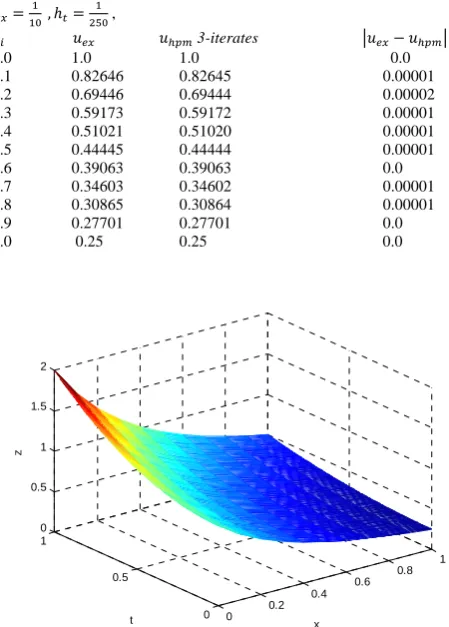
Table 4 Example 4
, ,
3-iterates 0.0 1.0 1.0 0.0 0.1 0.82646 0.82645 0.00001 0.2 0.69446 0.69444 0.00002 0.3 0.59173 0.59172 0.00001 0.4 0.51021 0.51020 0.00001 0.5 0.44445 0.44444 0.00001 0.6 0.39063 0.39063 0.0 0.7 0.34603 0.34602 0.00001 0.8 0.30865 0.30864 0.00001 0.9 0.27701 0.27701 0.0 1.0 0.25 0.25 0.0
Variation of approximate solution for different values of x and t
0
0.2 0.4 0.6
0.8 1
0 0.5
1 0 0.2 0.4 0.6 0.8 1
x y
z
0 0.2
0.4
0.6 0.8 1
0 0.5
1 0 0.5 1 1.5 2
x t
REFERENCE
[1] A. Cheniguel, Numerical method for solving Wave Equation with non local boundary conditions, Proceedings of the International MultiConfernce of Engineers and Computer Scientists 2013 Vol II, IMECS 2013, March 13-15, 2013, Hong Kong
[2] A. Cheniguel, Numerical Simulation of Two-DimensionalDiffusion Equation with Non Local Boundary Conditions. International Mathematical Forum, Vol. 7. 2012, no. 50, 2457-2463
[3] A. Cheniguel, Numerical Method for solving Heat Equation with Derivatives Boundary Conditions, Proceedings of the World Congress on Engineering and Computer Science 2011 Vol II WCECS 2011. October 19-21, 2011. San Francisco. USA.
[4] A. Cheniguel and A. Ayadi, Solving Non-Homogeneous Heat Equation by the Adomian Decomposition Method. International Journal of Numerical Methods and Applications Volume 4, Number . 2010. pp. 89-97
[5] A. Cheniguel, Numerical Method for Non Local Problem. International Mathematical Forum. Vol. 6. 2011. No.14. 659-666.
[6] M. Siddique. Numerical Computation of Two-dimensional Diffusion Equation with Nonlocal Boundary Conditions. IAENG International Journal of Applied Mathematics. 40:1, pp26-31 (2010)
[7] M. A. Rahman. Fourth-Order Mmethod for Non-Homogeneous Heat Equation with Non Local Boundary Conditions, Applied Mathematical Sciences, Vol. 3,2009, no.37, 1811-1821;
[8] Xiuying Li,Numerical Solution of an Initial Bounday Value Problem with Non Local Condition for the Wave Equation, Mathematical Sciences, Vol. 2. No. 3 (2008) 281-292.
[9] M. Ramezan et al. Combined Finite Difference and Spectral Methods for Numerical Solution of Hyperbolic Equation with an Integral Condition.(WWW.Interscience. Wiley.com). DOI 10. 1002/num.20230 Vol 24 (2008)
[10] Jichao Zhao and Robert M. Corless, Compact Finite Difference Method for Integro-Differentiatl Equations, Applied Mathematics and Computation, Vol 177, Issue1, June 2006.
[11] He. J. H. 2006a. Homotopy Perturbation Method for Solving Boundary Value Problems. Phys. Lett. A 350:87-88.
[12] M. A. Akram and M.A. Pasha,Numerical Method for the Heat Equation with Non Local Boundary Condition, International Journal Information and Systems Sciences, Vol 1, Number 2 (2005) 162-171 [13] H. Sun and J. Zhang, A highly Accurate Derivative
Recovery Formula to Integro-Differential Equations , Numerical Mathematics Journal of chineese Universities, 2004 Vol 26 (1). pp. 81-90
[14] M. Dehghan.. On the Numerical Solution of the Diffusion Equation with a Non Local Boundary Condition. Mathematical Problems In Engineering 200:2(2003), 81-92
[15] He. J. H. 2003. A simple Perturbation Approach to Blasius Equation. Appl. Math. Comput. 140:217-222.
[16] W. T. Ang. A method for Solution of the One-Dimensional Heat Equation subject to Non Local Conditions; SEA Bull. Math. 26 (2) (2002) 185-191. [17] A. V.Goolin, N.I. Ionkin and V; A. Morozova,
Difference Schemes with Non Local Boundary Condition, Comp. Methods Appl. Math, 11 (2001), No. 1, pp.62-71
[18] Zhi-Zhung Sun, a High-Order Diffrence Scheme for Non Local Boundary Value-Problem for the Heat Equation, Computaional Methods in Applied Mathematics, Vol.1(2001), No. 4, pp. 398-414.
[19] He. J. H. 2000, A coupling Method of Homotopy Technique for Non Linear Problems. Int. J. Non Linear Mech, 35:37-43.
[20] He. J. H. 1999. Homotopy Perturbation Technique. Comput. Methods Appl. Mech. Eng. 178(3/4):257-262.
[21] A. B. Gumel, On the Numerical Solution of the Diffusion Equation subject to the Specification of Mass, J. Auster. Math. Soc. Ser. B, 40 (1999) 475-483. [22] A. B. Gumel. W. T. Ang. And F. H. Twizell.”Efficient Parallel Algorithm for the Two-Dimensional Diffusion Equation subject to Specification of Mass” Inter. J. Computer. Math. Vol 64, pp. 153-163 (1997).
[23] G. Ekolin, Finite Difference Methods for a Non Local Boundary-Value Problem for the Heat Equation, Bit. 31 (1991) pp. 245-261.
[24] Y. Lin and S. Wang,”A numerical Method for for the Diffusion Equation with Non Local Boundary Conditions”, Int.J. Eng.Sci. 28 (1990), 543-546;
[25] Cannon. J. R. and Van der Hoek. J. Diffusion Equation subject to the Specification of Mass, J. Math. Anal. Appl, 115. pp. 517-529.
[26] Cannon. J. R. The Solution of Heat Equation subject to the Specification of Energy. Quart. Appl. Numer. Math. 21 (1983) 155-160.