Cluster-based Particle Swarm Algorithm for
Solving the Mastermind Problem
Dan Partynski
Abstract—In this paper we present a metaheuristic algorithm that is inspired by Particle Swarm Optimization. The algorithm maintains a set of intercommunicating particle clusters and equips each particle with a specialized local search function. To demonstrate the effectiveness of the algorithm, we analyze its ability to solve Mastermind codes and compare its performance with other algorithms found in the literature. For the Master-mind problem, we have found that our algorithm is comparable to other algorithms for small problem sizes, but has much more efficient scaling behavior.
Index Terms—particle swarm optimization (PSO), cluster, mastermind.
I. INTRODUCTION
P
ARTICLE Swarm Optimization (PSO), an algorithm by Kennedy and Eberhart described in [1], is a popular method for optimizing continuous nonlinear functions. The algorithm is inspired by the interactions between agents in a flock of birds or a school of fish. Each agent initially begins in a random region of the search space, and more favorable regions are found iteratively as the agents begin to follow the best particle. While the algorithm was designed for continuous problems, various researchers have used the algorithm to solve various discrete problems, such as the Travelling Salesman Problem [2].Mastermind is a code-breaking game for two players: an encoder and a decoder. The encoder selects a secret permutation of P digits from a list of N digits. There are no limits on the values of P and N, but during a single game these values are fixed. The decoder makes a series of guesses and for each guess gains information about how close the guess is to the secret code. When a guess is presented, the user receives a number of “dark pegs” which correspond to digits that have the correct value in the correct position. The user also receives a number of “light pegs” which correspond to the remaining digits that have the correct value but are in the incorrect position. Note that the dark pegs take precedence over the light pegs. For example, if the secret code is [1 2 2 4] and the guess is [1 4 3 2], then the decoder will receive one dark peg and two light pegs. We shall represent this as (1, 2).
Mastermind can be viewed as a dynamic-constraint opti-mization problem. The decoder continues to make guesses and receives more information about what the secret code can and cannot be. Every (guess,response) pair imposes an additional constraint on the decoder. This information can be used to form an optimization function, and as a result various researchers have attempted to solve Mastermind codes using metaheuristics such as genetic algorithms. As the game
Manuscript received December 07, 2013; revised January 10, 2014. Dan Partynski is a student of the Department of Mathematics and Computer Science, University of San Diego, San Diego, CA, 92110 USA e-mail: ([email protected]).
progresses, it is increasingly difficult to identify a guess that could still be the secret code. A potential guess is considered “consistent” if it could still be the secret code given the current list of constraints, and “inconsistent” otherwise.
The general goal of Mastermind is to break the secret code as quickly as possible. Thus there are two values that a Mastermind algorithm could minimize:
1) Number of Guesses:An algorithm’s performance may be measured by the average of number of guesses needed to break the secret code. A guess is one submission of a code to the encoder.
2) Number of evaluations: An algorithm will analyze several potential codes before making a guess. We define an “evaluation” as one call of the fitness function that the algorithm uses to analyze a single code. Minimizing the number of guesses presents an interesting challenge for large problem sizes, but it is not our main focus. Since we are interested in optimization, our algorithm will attempt to minimize the number of evaluations needed to break the secret code.
In this paper we describe a cluster-based particle swarm algorithm for solving the game of Mastermind. Our algo-rithm is not a direct application of PSO, rather it uses the underlying idea of communicating particles as inspiration. The algorithm is similar to PSO in that it maintains a group of communicating agents, but it organizes them into clusters. It also introduces a local search function that greedily moves each agent across neighbor states to more promising regions. This combination of local and global search functions allows for more efficient exploration of the search space. Later in this paper we will demonstrate that the algorithm is able to solve high-dimenionsal instances of the Mastermind problem.
Section II discusses the various Mastermind algorithms found in the literature. Section III describes the algorithm we used to solve the problem. Section IV discusses the experiments that we ran to test the algorithm’s performance, and Section V concludes this paper.
II. LITERATUREREVIEW
The first Mastermind algorithm to appear in the literature was by Knuth [3] in 1976. This algorithm chooses the next guess that will minimize the maximum number of remaining possibilities. If there is a tie among potential guesses, the algorithm chooses the guess that is still consistent. Knuth tested this algorithm with P = 4 and N = 6, and was able to break the secret code in 4.478 guesses on average (5 in the worst case).
guesses to break the secret code, but has a lower average of 4.373. These averages were obtained when P = 4 and N = 6.
Temporel and Kovacs describe an algorithm in [5] which attempts to minimize the number of evaluations required when P = 4 and N = 6. The algorithm requires 4.64 guesses on average which is slightly higher than the previous algo-rithms, but only evalutes 41.2 codes on average. However, no data is given on larger problem sizes.
These algorithms work well for small instances of Mas-termind, but because they require either searching or storing the entire search space, they are computationally infeasible for large values of P and N. Bernier et al. describe the use of genetic algorithms and simulated annealing to solve larger instances of Mastermind [6]. Simulated annealing was better in terms of minimizing the number of evaluations, but the genetic algorithm resulted in a lower number of guesses on average.
Berghman et al. describe an improvement to the genetic algorithm in [7]. They use genetic algorithms to create a set of consistent guesses, and use an exhaustive strategy to select the best guess from the set. This algorithm is comparable to the full-enumeration strategies in terms of average number of guesses, but outperforms them in terms of speed. When P = 8 and N = 12, the algorithm can find the secret code in an average of 20.571 seconds.
Merelo et al. also use this approach in [8]. They use genetic algorithms to create a set of consistent guesses and use the “Most Parts” strategy to select one to use. This algorithm was tested with P = 5 and N = 9 and yielded 5.95 guesses and 38,485 evaluations on average.
III. ALGORITHM
Our algorithm always selects a guess that is consistent with the previous guesses. The general outline is as follows:
whileSecret Code not found do Find a consistent guessg;
Submit gget responser = (ndark,nlight);
if ndark = Pthen
Secret Code has been found; end
end
Fig. 1. Mastermind Algorithm
We now will define a formula for a consistent guess so that we can phrase the Mastermind problem as an optimization problem. We first define a ruleas a guess submitted by the decoder and the corresponding response from the encoder. More formally, we define a rule as a (guess,response) pair where guess is a vector of size P and response is a pair of integers (ndark, nlight) representing dark pegs and light
pegs.
Now given two guesses gi and gj we define a new
function:
h(gi, gj) = (ndark, nlight) (1)
wherendark is the number of dark pegs andnlight is the
number of light pegs the decoder would receive if gi was
the secret code and gj was submitted as a guess. We now
define a measure of the similarity of two responses ri and
rj as follows:
d(ri, rj) =abs(ri dark−rj dark) +abs(ri light−rj light)
(2) Informally, the distance between two responses is 0 if they have identical dark and light peg counts. Otherwise the function returns the Manhatten distance between the two response vectors. Now assume the decoder has made n guesses and has received n responses, so we have (g1,r1), (g2, r2), ..., (gn, rn) as our rule list. We now define the
fitness of some potential guessgas follows:
f(g) =
n
X
i=1
d(h(g, gi), ri) (3)
We know that the secret code must match each of the given responses when compared to the given guesses. Thus for a guess to be consistent its fitness value must be 0. The higher the fitness value, the farther away a guess is from being consistent. Thus finding a consistent guess can be reduced to minimizing the above function. The following sections describe the algorithm used to achieve this minimization.
A. Local Function
Our algorithm maintains a collection of potential guesses, called agents, each equipped with a function that allows it to explore neighboring states. If the function to minimize was differentiable, then the agents could use gradient descent or some other fast optimization strategy as their local search function. Mastermind is a discrete problem, so we created a custom search function to move an agent across the search space. Given some guessg= [d1 d2...dP], we define three
possible ways to move to a neighboring state: 1) Replace some digitdi with a different value
2) Take two digitsdi anddj and swap them
3) Take three digitsdi,dj, and dk where i <j <k. Here
there are two possible neighbor states. Swap so that the order isdk di dj or dj dk di. Notice that in each
of these new states, every digit is in a new location. If this were not the case, the change could be made by only swapping two elements.
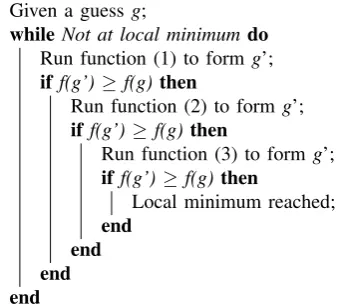
Based on these possible neighbor states, we define three different local functions. Local function (1) iteratively looks at each digit and finds the replacement digit that reduces the fitness value the most. If no replacement digit reduces the fitness, the function does not change the guess vector.
Local function (2) iteratively looks at each pair of digits and swaps them. If the fitness after the swap is less than or equal to the old fitness, the change to the vector is kept. Notice that unlike local function (1), we keep the resultant vector if the new fitness is equal to the old fitness rather than strictly less. This was found to be beneficial through experimentation.
leads to the largest reduction. If each reduction is equal, one of the two swaps is chosen at random.
Note that all three of these functions exhaustively test each possible neighbor state. This was possible to do for the Mastermind problem, but for some problems this may be computationally infeasible. A possible solution in these cases is to only test the fitness ofk random neighbors.
The agents in the search space need a way to use these functions to move towards more favorable regions of the search space. We decided to simply run these functions sequentially, only moving from function (i) to function (j) if function (i) failed to improve the fitness ofg. Once function (i) improves the fitness of g, the algorithm moves back to function (1). If function (3) fails to improve the fitness of g, then the algorithm stops as it has converged on a local minimum. Here is a more formal description of the local search algorithm:
Given a guess g;
whileNot at local minimum do Run function (1) to formg’; if f(g’)≥f(g)then
Run function (2) to formg’; if f(g’)≥f(g)then
Run function (3) to formg’; if f(g’)≥f(g)then
Local minimum reached; end
[image:3.595.52.224.274.427.2]end end end
Fig. 2. Local Search Function
B. Metaheuristic
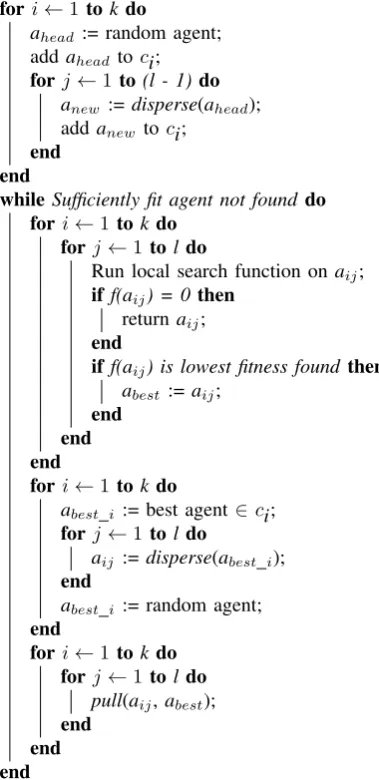
The function described in the previous section often leads agents to a local minimum. Thus we introduce a metaheurtis-tic that uses the local search function to help locate the global minimum. Intuitively the idea is simple. We define kagent clusters{c1,c2, ...,ck}where each cluster containslagents. Each cluster is initially given a cluster head, which is set randomly in the search space. Each cluster head then uses a dispersefunction to distribute (l - 1) agents around it up to some predefined max distance. Each agent in each cluster uses the local search function until all agents arrive at a local minimum. When this happens, we identify the fittest agent in each cluster and redistribute the remaining agents in that cluster around it. We then locate the fittest individual amongst all the clusters and use apullfunction to move each agent in its direction. This allows communication between the clusters and moves large amounts of agents to favorable regions of the search space. Our final step is to take the fittest individual in each cluster and set it equal to a random vector, leaving the other agents in the cluster to explore the region that had been discovered. This was introduced primarily as a measure to increase diversity and perhaps allow an agent to move to a favorable region of the search space that no cluster is exploring.
Before giving a formal description of the algorithm, we need to define the disperse and pull functions that are required by the algorithm. Like the local search function,
these functions are dependent on the optimization problem, so we will explain how the functions were defined for the Mastermind problem. The function disperse(agent) when given some agent will randomly move a new agent to a close region of the search space. The functionpull(agenti,agentj)
will moveagenti closer toagentj.
We first give our defintion of thedispersefunction. Given some agenta= [d1d2...dP], we would like to producea’ by
dispersing slightly froma. To do this, we will simply move a across some small number of neighbor states randomly. The number of neighbor states to move across is a random integer between two bounds: distmin and distmax. A more
formal description of thedispersefunction is as follows:
Given agenta;
dist:= random integer∈[distmin,distmax];
fori←1 todistdo
Choose random valuer∈[0, 1); ifr<.5then
Randomly swap two digits ina; else
Change a random digit ina; end
end
Fig. 3. Disperse Function
This produces a new agent that is slightly farther away from the central agent. Note that for simplicity, ourdisperse function does not move to neighbors that require a triple swap. As an illustration, suppose we have the guess vector [1 2 3 4 5] and we wish to use the disperse function to create a new vector. If the random distance is 2, then the function may replace the second digit with the value 5 and swap the fourth and fifth digits. The resulting guess vector is [1 5 3 5 4], which is 2 neighbor states away from the original.
We now define ourpullfunction. For this, we use an extra parameter calleddistpull.
Givenagenti andagentj;
fori←1 todistpull do
k:= radom integer∈ {1, 2, 3,...,P};
kthdigit of agenti :=kthdigit of agentj;
end
Fig. 4. Pull Function
This function takes digits from the best agent and places them into the corresponding digit of the agent being moved. The valuekcan be selected with or without replacement. In our implementation, we select k with replacement because we found through experimentation that this strategy produces slightly better results. As an example, suppose we wish to use the pull function to move the vector [1 2 3 4 5] in the direction of the vector [6 7 7 3 4]. Depending on the random values, the function may replace the third digit of the first vector with the third digit of the second vector, resulting in [1 2 7 4 5].
fori←1 to kdo
ahead := random agent;
addahead toci;
forj←1 to (l - 1)do anew :=disperse(ahead);
addanew toci;
end end
whileSufficiently fit agent not found do fori←1 to kdo
forj←1 to ldo
Run local search function onaij;
if f(aij) = 0then
returnaij;
end
if f(aij) is lowest fitness found then
abest :=aij;
end end end
fori←1 to kdo
abest i:= best agent ∈ci;
forj←1 to ldo
aij :=disperse(abest i);
end
abest i:= random agent;
end
fori←1 to kdo forj←1 to ldo
pull(aij,abest);
[image:4.595.57.247.57.448.2]end end end
Fig. 5. Particle Cluster Search Algorithm
We will now summarize the parameters used by this algorithm:
1) k: The number of clusters
2) l: The number of agents in a cluster
3) distmin: The minimum number of neighbor states to
move across in thedispersefunction
4) distmax: The maximum number of neighbor states to
move across in thedispersefunction
5) distpull: The maximum number of neighbor states that
agenti will move across toward agentj in the pull
function
These parameters have a strong impact on the performance of the algorithm. Higher values ofkandlare often better in terms of avoiding local minima, but lead to higher amounts of computation. The distance parameters are highly dependent on the size of the problem. As we describe in our experiment section, we do not perform extensive analysis to determine good values for these parameters, but rather use our judge-ment depending on the size of the Mastermind problem being solved.
C. Domain Heuristics
Domain-specific heuristics can greatly improve the con-vergence speed of the algorithm. Based on the reponses of
the decoder, we are able to eliminate large poritions of the search space. We do this by maintaining a 2-dimensional array calledvalid[][], which has P rows and N columns. We say that valid[i][j] is true iff it’s possible for a consistent guess to have the value j for di. If it is impossible, then
valid[i][j] is false. Initially, all entries in the array are set totrue. Thedispersefunction and all local search functions avoid setting some digitdi to some value j if valid[i][j] is
false. Thus the more entires that are set to false, the more inconsistent guesses will be avoided by the algorithm.
The question then is how to determine if an array entry can be set to false. Our algorithm identifies three general categories of a responser = (ndark,nlight) that allow us to
alter this array:
1) Supposendark =nlight= 0. This is the most
informa-tive case, since no digit in the guess g can appear in a consistent guess. Thus∀ i∈ {1, 2, 3,...,P}and∀dj
∈g,valid[i][dj] =false
2) Suppose ndark = 0 but nlight >0. In this case, a
consistent guess cannot have any digit dj in slot j
because this would produce a dark peg. Thus ∀ dj
∈g valid[j][dj] =false
3) Supposendark + nlight = P. In this case, the decoder
has identified all of the digits that appear in the secret code, but not in the right order. Thus the secret code is a permutation of the digits in g, so all digits not in g can be eliminated. More formally,∀i∈ {1, 2, 3,...,P} and∀j ∈ {1, 2, 3,...,N},valid[i][j] =false iff j∈/ g
After condition (3) is met, we also flag a special variable calledendgame. The endgameoccurs after all of the digits have been identified and the algorithm simply needs to find a permutation of them. When this happens, the algorithm first runs local functions (2) and (3) on the most recent guess played in the hopes that only a few swaps are needed to produce a consistent guess. If this fails, then the algorithm proceeds as normal. We have found experimentally that this enhancement often does lead to the quick discovery of a consistent guess.
IV. EXPERIMENTS ANDRESULTS
To test the performance of the proposed algorithm, we ran several trials for several values of P and N. We used an Inspiron N4010 computer with a 2.43 GHz Intel i3 processor and 4 GB of RAM. The computer was equipped with the Windows 7 operating system. The programming language we chose was C++ for purposes of speed. Each agent is represented as a 64-bit integer, with each digit given 4 bits of information. Thus each digit can have a maximum of 16 posssible values.
A. P = 4 and N = 6
For this configuration, we used [0 0 1 1] as our first guess. We ran 10 trials for each possible secret code and averaged the results. As expected, our algorithm has a worse performance in terms of the average number of guesses. However, it is efficient in terms of the number of evaluations required to find the secret code.
TABLE I
COMPARISON OF ALGORITHMS FORP = 4ANDN = 6
Algorithm Guesses Evaluations Time
Berghman et al. 4.39 N/A .614 sec
Merelo et al. 4.414 3899 N/A
New Algorithm 4.64 253 0.003 sec
B. P = 5 and N = 8
For this configuration we use [0 1 2 3 4] as our first guess and run 10000 trials, each with a randomaly generated secret code.
TABLE II
COMPARISON OF ALGORITHMS FORP = 5ANDN = 8
Algorithm Guesses Evaluations Time
Berghman et al. 5.618 N/A N/A
Merelo et al. 5.619 19758 N/A
New Algorithm 5.95 1464 0.009 sec
C. P = 8 and N = 12
This is the largest configuration of Mastermind that we were able to find in the literature. We chose [0 0 1 1 2 2 3 3] as our first guess and ran 3000 trials with randomly generated secret codes. We compare our results to Berghman et al. We see that our algorithm exibits a higher guess average, but the time needed to break the secret code is significantly reduced.
TABLE III
COMPARISON OF ALGORITHMS FORP = 8ANDN = 12
Algorithm Guesses Evaluations Time Berghman et al. 8.366 N/A 20.571 sec
New Algorithm 8.92 26149 0.18 sec
D. Higher Dimensions
To demonstrate that our algorithm can scale to higher dimensions, we present data on higher values of P and N. Due to our representation of Mastermind Codes as 64-bit integers, we limited P and N to a maximum of 16.
As we can see, the algorithm scales very well to higher dimensions of Mastermind. Observe that when P = N = 16, there are1616possible secret codes, which is approximately 1019. This means that, on average, the algorithm evalutes only 10113 of the search space.
TABLE IV
PERFORMANCE FOR HIGH DIMENSIONS
(P, N) Guesses Evaluations Time (10, 12) 10.385 69057 .655 sec (10, 16) 11.53 131925 1.32 sec
(11, 16) 12.43 195126 2.2 sec
(12, 16) 13.19 355021 4.41 sec (13, 16) 14.19 402877 5.81 sec (14, 16) 15.11 604736 9.95 sec
(15, 16) 16.03 1.003×10⁶ 18.54 sec
(16, 16) 17.26 1.557×10⁶ 33.70 sec
V. CONCLUSION
In this paper we presented a new algorithm inspired by PSO. The algorithm is similar to PSO in that it uses a swarm of agents to explore a search space, but it introduces particle clusters and a specialized local search function. We have shown that the algorithm works well for solving Mastermind codes compared to other algorithms found in the literature.
We plan to further analyze the parameters of the algorithm to determine good rules of thumb for parameter selection. We would also like to test the algorithm’s performance on var-ious other discrete optimization problems that are typically solved with genetic algorithms or other metaheuristics. This would require modifying thedisperse,pull, and local search functions in order to suit the given optimization problem. We further plan to enhance the algorithm through parallelism by assigning each particle cluster its own processing core.
REFERENCES
[1] J. Kennedy, “Particle swarm optimization,” inEncyclopedia of Machine Learning. Springer, 2010, pp. 760–766.
[2] X. H. Shi, Y. C. Liang, H. P. Lee, C. Lu, and Q. Wang, “Particle swarm optimization-based algorithms for tsp and generalized tsp,”Information Processing Letters, vol. 103, no. 5, pp. 169–176, 2007.
[3] D. E. Knuth, “The computer as master mind,”Journal of Recreational Mathematics, vol. 9, no. 9, pp. 1–6, 1976.
[4] B. P. Kooi, “Yet another mastermind strategy.”ICGA Journal, vol. 28, no. 1, pp. 13–20, 2005.
[5] A. Temporel and T. Kovacs, “A heuristic hill climbing algorithm for mastermind,” inProceedings of the 2003 UK Workshop on Computa-tional Intelligence (UKCI-03), 2003, pp. 189–196.
[6] J. L. Bernier, C. I. Herr´aiz, J. Merelo, S. Olmeda, and A. Prieto, “Solving mastermind using gas and simulated annealing: a case of dynamic constraint optimization,” in Parallel Problem Solving from NaturePPSN IV. Springer, 1996, pp. 553–563.
[7] L. Berghman, D. Goossens, and R. Leus, “Efficient solutions for mas-termind using genetic algorithms,”Computers & operations research, vol. 36, no. 6, pp. 1880–1885, 2009.