Abstract—We propose a new improved bio-inspired ant colony optimization (ACO) algorithm using the back-tracing strategy of current global path and diversification strategy. In fact, in general, ACO algorithm, the initial position of agents assigned to an each node at randomly. But, when the global optimal value does not change for N iterations, the proposed method assigns the initial position of agent to the end point of current global best tour path, re-initialize the pheromone of current global best tour path, and the agent re-searches the optimal path. And we evaluate the proposed algorithm with original ACS algorithm. The results of a simulation experiment demonstrate that the proposed algorithm is better than, or, at least, as good as, that of original ACS algorithm in most sets.
Index Terms—Ant Colony Optimization, Traveling Salesman Problems, Diversification, Back-tracing, Bio-inspired
I. INTRODUCTION
nt colony optimization (ACO) is a metaheuristic approach and bio-inspired algorithm that can be used to find approximate solutions to difficult optimization problems[13, 14], including traveling salesman problems (TSP), quadratic assignment, job-shop scheduling, course timetabling, project scheduling, set covering, constraint satisfaction, vehicle routing, sequential ordering, graph coloring and routing in communication networks, etc.
It is a population-based approach that uses an exploitation of positive feedback, distributed computation as well as a greedy heuristic [11, 22].
In recent years, individuals and research groups that are interested in ACO algorithm have increased significantly.
Ant system (AS) was the first ACO algorithm to be proposed by Dorigo et al. for solving the hard combinatorial optimization problems [1, 2, 3]. Ant colony system (ACS) was the first improvement over the ant system to be proposed by Dorigo et al. [5, 6, 7]. And, several individual cases of the ACO metaheuristic have been proposed. Ant system using elitist strategy (ELITIST AS) is another improvement, proposed by Dorigo et al. [2, 3], MAX-MIN ant system (MMAS) is introduced by Stützle et al. [8, 9, 10], Rank-based ant system (RANK-BASED AS) is proposed by Bullnheimer Manuscript received March 06, 2016; revised April 08, 2016. This research was supported by Basic Science Research Program through the National Research Foundation of Korea (NRF) funded by the Ministry of Education (NRF-2015R1D1A1A01059147).
S.G. Lee is with the Humanitas College, Kyung Hee University, Deogyeong-daero, Giheung-gu, Yongin-si, Gyeonggi-do, 446-701, South Korea. (e-mail: [email protected]).
S.H. An is with the Humanitas College, Kyung Hee University, Deogyeong-daero, Giheung-gu, Yongin-si, Gyeonggi-do, 446-701, South
et al. [11, 12], and Gambardella et al. [4, 15] proposed Q-learning based ant system (ANT-Q) over the ant system.
In fact, in addition to these initial basic algorithms, many successful applications of ACO algorithm for many fields to solve complex combinatorial optimization problem have developed continuously. But there are still exists the demerits of time consuming, falling into local minimum quickly. So, in many cases, it does not guarantee to find the global optimum solution. Thus, many researchers have done a lot of researches on it.
Mahi et al. [16] proposed a hybrid method (PSO-ACO-3Opt) which optimizes parameters that affect the performance of the ACO algorithm through PSO and reduces the probability of falling into local minimum with the 3-Opt algorithm. Tseng et al. [17] proposed pattern reduction enhanced ant colony optimization (PREACO) for eliminating the redundant computations of ACO algorithms using the concept of overlapping edges. Liu et al. [18] proposed an improved ACO algorithm based on the idea of PREACO [17]. In this algorithm, the common paths are overlapping edges of the current optimal and suboptimal solution. Also, Lee et al. [19, 20, 21, 22] proposed an improved ACO algorithm using the concept of overlapping edges. This algorithm considering the overlapping edges of a global best path of the previous iteration and the current iteration. Tuba et al. [23] proposed a suspicious elements exclusion pheromone correction strategy (SEE). This approach adds a new heuristic for determining the undesirability of edges belonging to the tour and significantly decreases their pheromone values. Bai et al. [24] proposed a model induced max-min ant colony optimization (MIMM-ACO) to bridge the gap between hybridizations and theoretical analysis. This method exploits analytical knowledge from both the ATSP model and the dynamics of ACO guiding the behavior of ants which forms the theoretical basis for the hybridization. Jun-man et al. [25] proposed an individual variation and routing strategies (IVRS). IVRS introduce the two improvements. The first is a novel optimized implementing an approach which is designed to reduce the processing costs involved with a routing of ants in the ACO. The second, the individual variation is introduced to the ACO, which enables the ants to have different route strategies. In this model, we adjust the routing policy of the ant who worked better, and that is to enhance the impact of pheromones in the route of this ant. Hlaing et al. [26] proposed an improved ant colony optimization algorithm for solving TSP using candidate set strategy and dynamic updating of a heuristic parameter. Dong et al. [27] proposed a new hybrid algorithm, cooperative genetic ant system (CGAS) to improve a performance of ACO for solving TSP. Liu et al. [28]
Ant Colony Optimization Algorithm using
Back-tracing and Diversification Strategy
SeungGwan Lee and SangHyeok An
based on pheromone backtracking algorithm [30]. The backtracking technique is a method that optimizes the search by returning to new selection if it fails to achieve the objectives. [29]
In this paper, we propose a new improved bio-inspired ant colony algorithm using the back-tracing strategy of current global path and diversification strategy.
In fact, in general, ACO algorithm, the initial position of agents assigned to an each node at randomly. But, when the global optimal value does not change for N iterations, the proposed method assigns the initial position of agent to the end point of current global best tour path, re-initialize the pheromone of current global best tour path, and the agent re-searches the optimal path.
The rest of the paper is organized as follows: In Section 2, the basic ant colony optimization algorithms for traveling salesman problem. The proposed method is introduced in Section 3. The results are given in Section 4. Consequently, in Section 5, we conclude the paper with a summarization of results of this research.
II.THE BASIC ANT COLONY OPTIMIZATION ALGORITHM FOR TRAVELING SALESMAN PROBLEM
Many ACO algorithms are proposed for solving traveling salesman problem (TSP).
ACO algorithm has emerged recently as a relatively novel metaheuristic for hard combinatorial optimization problems. It is designed to simulate the ability of ant colonies to determine the shortest path to food. In the following, we explain the state transition rule, the local updating rule, and the global updating rule [4, 5, 6, 13, 14, 15, 22, 35, 36, 37, 38, 39, 40].
Let k be an agent whose task is to make a tour: visit all the nodes and return to the starting one. Associated to k
there is the list
J
k(r)
of nodes still to be visited, where r is the current node. An agent(k) situated in node(r) moves to node( s ) using the follow rule, called pseudo-random proportional action choice rule(or state transition rule):
otherwise , S q q if , u) η(r, u) τ(r, J max arg s 0 β (r) uk (1)
Where, τ(r,u) is the amount of pheromone trail on the edge between nodes. η(r,u) is a heuristic function which is the inverse of the distance between nodes r and u, β is a parameter which weighs the relative importance of pheromone trail agents, qis a value chosen randomly with uniform probability in [0,1], q0(0q0 1) is a parameter, and S is a random variable selected according to the distribution is given by Eq.(2) which gives the probability with which an agent in node r choose the node s to move to.
otherwise , 0 (r) s if , J u) η(r, u) τ(r, s) η(r, s) τ(r, s) (r,J
p
u (r) β kβ
k
k
(2)
While building a solution of the TSP, agents visit edges and change their amount of pheromone trail by applying the following local updating rule:
s)
Δτ
(r,
ρ
s)
τ
(r,
ρ
)
(1
s)
τ
(r,
(3)Where, ρ(0ρ1) is the pheromone decay parameter.
1 nn
0 (n L )
τ s)
Δτ(r, is the initial pheromone level, where Lnn is the tour length produced by the nearest neighbor heuristic and n is the number of nodes.
Global updating is performed after all agents have completed their tours. The pheromone amount is updated by applying the follow global updating rule:
otherwise , 0 tour best global s) if(r, , ) (L s) Δτ(r, where s) Δτ(r, α s) τ(r, α) (1 s) τ(r, 1 gb (4) 1) α
α(0 is the pheromone decay parameter, and Lgb
is the length of the globally best tour from the beginning of the trail.
III.THE BACK-TRACING STRATEGY AND DIVERSIFICATION STRATEGY IN ANT COLONY OPTIMIZATION
In fact, in general, ACO algorithm, the initial position of agents assigned one agent in an each node at randomly. But, in this paper, we propose a new improved bio-inspired ant colony algorithm using the back-tracing strategy of current global path and diversification strategy.
ACO algorithm searches the optimal solution through the state transition rule, the local updating rule, and the global updating rule.
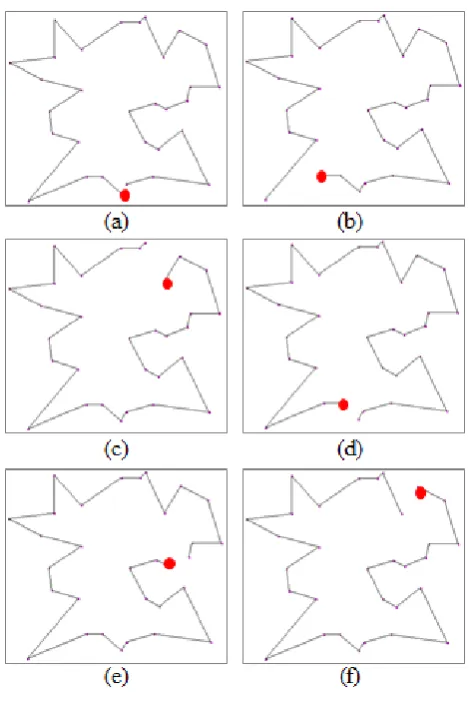
ACO algorithm assigns the initial positions of agents randomly. So, a variety of start and end of the paths are generated as figure.1 shows.
After all, agents have completed their tours for N
[image:3.595.313.535.354.505.2]
Figure 1. 31-cites best path by ACO
Figure 2. The proposed algorithm
The proposed method reinitializes the amount of pheromone Δτ(r,s) on the edge between nodes r and s by Eq.(5).
s)
Δτ(r, 1 s)
Δτ(r, (5)
Next time, to improve the performance, pheromones are updated on updating rules in the ACO algorithm, as given by Eq. (1), (3) and (4), respectively.
IV. THE EXPERIMENTAL RESULTS
The running simulation environment: Intel® Core (TM) i-7-4771, 3.50GHz processor; 8.00G RAM, Windows 7 operating system.
We experiment the proposed ant colony algorithm by using TSPLIB [31, 32] which is a famous TSP example. In this paper, we compare the proposed ant colony algorithm with original ACS [34]. In here, we use the basic ACOTSP [33].
To avoid the effects caused by the randomness of the algorithm, for each set problems have been executed 10 trials independently. The parameters of proposed method are given in Table 1. And, the initial position of agents assigned one agent in an each node at randomly.
Table 1. Parameter setting
Parameter Value
m 10or20
α 0.1
ρ 0.1
2
0
q 0.95
time {10,20,30}sec
search
Local 3opt
s)
Δτ(r, 1
nn
0 (n L )
τ
N 10
Table 2 shows the performance of Best, Average Best,
Error Rate, Worst, Average Time(s) and Average Iterations
of each algorithm for each TSP problem considering the maximum time (10, 20, 30 sec) for each trial.
Now, in tables, let Error Rate denote the enhancement of
Best (proposed algorithm) on Optimal value in percentage and it is defined as follows:
100% Optimal
Optimal
-Best Rate
Error
(6)
From the bold columns in Table 2, it is observed that the
Best of proposed algorithm is better than, or, equal, that of ACS.
[image:3.595.48.289.444.695.2]Table 2. The results of simulation and performance comparisions
TSP Optimal Iteration Time Algorithm Best Average Best Error Rate Worst Average Time(s) Iterations Average
pcb442 50778
10 ACS 50778 50793.8 0.000% 50912 3.62 367.0
Proposed 50778 50793.1 0.000% 50912 4.28 609.7
20 ACS 50778 50873.1 0.000% 50927 3.31 762.6
Proposed 50778 50791.4 0.000% 50912 6.29 870.4
30 ACS 50778 50864.3 0.000% 50954 8.55 2089.1
Proposed 50778 50791.4 0.000% 50912 8.88 1134.4
att532 27686
10 ACS 27686 27706.9 0.000% 27734 4.78 298.9
Proposed 27686 27703.5 0.000% 27736 3.48 266.3
20 ACS 27686 27707.1 0.000% 27742 9.19 487.5
Proposed 27686 27705.2 0.000% 27738 3.42 254.8
30 ACS 27686 27696.3 0.000% 27706 12.96 723.7
Proposed 27686 27697.6 0.000% 27708 8.77 729.9
rat783 8806
10 ACS 8812 8832.5 0.068% 8851 8.10 148.8
Proposed 8812 8825.6 0.068% 8837 7.43 379.0
20 ACS 8810 8821.8 0.045% 8844 12.66 581.6
Proposed 8806 8828.7 0.000% 8849 11.54 663.1
30 ACS 8806 8825.8 0.000% 8847 18.38 870.0
Proposed 8806 8814.9 0.000% 8824 17.77 1049.0
pr1002 259045
10 ACS 259757 260516.7 0.275% 261189 9.72 128.3
Proposed 259111 259967.0 0.025% 261066 8.88 171.8
20 ACS 259045 259739.7 0.000% 260541 16.29 351.1
Proposed 259045 259794.3 0.000% 260636 17.12 425.3
30 ACS 259045 259681.5 0.000% 260259 23.82 538.6
Proposed 259045 259542.4 0.000% 259898 20.30 653.5
V.CONCLUSION
In this paper, we propose a new improved bio-inspired ant colony algorithm using the back-tracing strategy of current global path and diversification strategy.
When the global optimal value does not change for N iterations, the proposed method assigns the initial position of agent to the end point of current global best tour path, re-initialize the pheromone of current global best tour path and the agent re-searches the optimal path.
The performance of proposed Algorithm is better than, or, at least, as good as, that of ACS algorithms in the most sets.
REFERENCES
[1] M. Dorigo, V. Maniezzo, and A. Colorni, “Positive feedback as a search strategy”, Dipartimento di Elettronica, Politecnico di Milano, Italy, Tech. Rep. 91-016, 1991.
[2] M. Dorigo, “Optimization, learning and natural algorithms (in italian) ”, Ph.D. dissertation, Dipartimento di Elettronica, Politecnico di Milano, Italy, 1992.
[3] M. Dorigo, V. Maniezzo, and A. Colorni, “Ant System: Optimization by a colony of cooperating agents”, IEEE Transactions on Systems, Man, and Cybernetics—Part B, vol. 26, no. 1, pp. 29–41, 1996. [4] L.M. Gambardella and M. Dorigo, “Ant-Q: A reinforcement learning
approach to the traveling salesman problem”, in Proc. Twelfth International Conference on Machine Learning (ML-95), A. Prieditis and S. Russell, Eds., Morgan Kaufmann Publishers, pp. 252–260, 1995.
[5] M. Dorigo and L.M. Gambardella, “Ant colonies for the traveling salesman problem”, BioSystems, vol. 43, no. 2, pp. 73–81, 1997. [6] M. Dorigo and L.M. Gambardella, “Ant Colony System: A cooperative
learning approach to the traveling salesman problem”, IEEE Transactions on Evolutionary Computation, vol. 1, no. 1, pp. 53-66, 1997.
[7] L.M. Gambardella and M. Dorigo, “Solving symmetric and asymmetric TSPs by ant colonies”, 1996 IEEE International Conference on Evolutionary Computation (ICEC’96), T. Baeck et al., Eds. IEEE Press, Piscataway, NJ, pp. 622-627, 1996.
[8] T. Stützle and H.H. Hoos, “Improving the Ant System: A detailed report on the MAX–MIN Ant System”, FG Intellektik, FB Informatik, TU Darmstadt, Germany, Tech. Rep. AIDA–96–12, Aug. 1996. [9] T. Stützle, “Local Search Algorithms for Combinatorial Problems:
Analysis, Improvements, and New Applications”, ser. DISKI. Infix, Sankt Augustin, Germany, vol. 220, 1999.
[10] T. Stützle and H.H. Hoos, “MAX–MIN Ant System”, Future Generation Computer Systems, vol. 16, no. 8, pp. 889-914, 2000. [11] B. Bullnheimer, R.F. Hartl, and C. Strauss, “A new rank based version
of the Ant System a computational study”, Institute of Management Science, University of Vienna, Tech.Rep., 1997.
[12] B. Bullnheimer, R.F. Hartl, and C. Strauss, “A new rank-based version of the Ant System: A computational study”, Central European Journal for Operations Research and Economics, vol. 7, no. 1, pp. 25-38, 1999. [13] M. Dorigo, “Ant colony optimization”, Scholarpedia, 2(3), 1461. 2007. [14] M. Dorigo, M. Birattari, and T. Stützle, “Ant colony optimization”,
IEEE Computational Intelligence Magazine, vol. 1, no.4, pp.28-39, 2006
[15] M. Dorigo, and L. M. Gambardella, “A study of some properties of Ant-Q”, In Parallel Problem Solving from Nature—PPSN IV, pp. 656-665, 1996.
[17] S.P. Tseng, C.W. Tsai, M.C. Chiang, and C.S. Yang, “A fast Ant Colony Optimization for traveling salesman problem”, Proceedings of IEEE Congress on Evolutionary Computation, CEC 2010, pp.1-6, 2010.
[18] Y. Liu, X. Shen and H. Chen, “An adaptive ant colony algorithm based on common information for solving the Traveling Salesman Problem”, Proceedings of International Conference on Systems and Informatics, ICSAI 2012, pp.763-766, 2012.
[19] S.G. Lee and M.J. Kang, “Ant Colony System for solving the traveling Salesman Problem Considering the Overlapping Edge of Global Best Path”, Journal of The Korea Society of Computer and Information, vol.16, no.3, pp.203-210, 2011.
[20] S.G. Lee, S.H. An, and S.W. Lee, “Improved Hybrid Ant Colony Bio-Inspired Algorithm for the Traveling Salesman problems”, Proceedings of international Conference on Data Mining and Intelligent Information Technology Applications, ICMIA 2013, pp.98-101, 2013.
[21] S.G. Lee, S.H. An, and S.W. Lee, “Bio-Inspired Ant Colony Optimization Algorithm for the Traveling Salesman problems“, Journal of Convergence Information Technology, vol.8 no.15, pp.149-155, 2013.
[22] S.G Lee and S.W. Lee, “Bio-Inspired Algorithm for the Shortest Path According to the Maximum Time for Each Trial”, Advanced Materials Research vol. 717, pp. 455-459, 2013.
[23] M. Tuba, and R. Jovanovic, “Improved ACO algorithm with pheromone correction strategy for the traveling salesman problem”, International Journal of Computers Communications & Control, vol.8, no.3, pp.477-485, 2013.
[24] J. Bai, G. K. Yang, Y. W. Chen, L. S. Hu, and C. C. Pan, “A model induced max-min ant colony optimization for asymmetric traveling salesman problem”, Applied Soft Computing, vol.13, no.3, pp.1365-1375, 2013.
[25] K. Jun-man, and Z. Yi, “Application of an improved ant colony optimization on generalized traveling salesman problem”, Energy Procedia, vol.17, pp.319-325, 2012.
[26] Z. C. S. S. Hlaing, and M. A. Khine, “Solving traveling salesman problem by using improved ant colony optimization algorithm” International Journal of Information and Education Technology, vol.1, no.5, pp.404-409, 2011.
[27] G. Dong, W. W. Guo, and K. Tickle, “Solving the traveling salesman problem using cooperative genetic ant systems”, Expert systems with applications, vol.39, no.5, pp.5006-5011, 2012.
[28] Z. Liu, T. Liu, and X. Gao, “An Improved Ant Colony Optimization Algorithm Based on Pheromone Backtracking”, 2011 IEEE 14th International Conference on Computational Science and Engineering (CSE), pp. 658-661, 2011.
[29] B. BENHALA, “Backtracking ACO for an Operational Amplifier Design Optimization”. 3rd International Conference on OPTIMIZATION TECHNIQUES in ENGINEERING (OTENG '15) Rome, Italy November 7-9, 2015.
[30] Li, Wang, and Li Dong. "Special factor backtracking algorithm for optimizing." 2010 International Conference on Intelligent Computing and Integrated Systems, pp.27-30, 2010.
[31] TSPLIB. Library of Traveling Salesman Problems. [Online]. Available:http://comopt.ifi.uni-heidelberg.de/software/TSPLIB95/ST SP.html, 1995
[32] G. Reinelt, TSPLIB-A Traveling Salesman Problem Library. INFORMS Journal on Computing, vol. 3, no.4, pp.376-384. 1991 [33] T. Stützle, ACOTSP Software package, Version 1.03. [Online].
Available: http://www.aco-metaheuristic.org/aco-code, 2004 [34] M. Dorigo and T. Stützle, “Ant Colony Optimization“. MIT Press,
Cambridge, MA, USA. 2004.
[35] S.G. Lee, “Multiagent elite search strategy for combinatorial optimization problems” In Computer and Information Sciences-ISCIS 2005, pp. 432-441, 2005.
[36] Z. Wang and A. Zhang, “An improved ACO algorithm for multicast routing”, In Network and Parallel Computing, pp.238-244, 2005. [37] L. Oumarou, D. Jiang, and C. Yijia, “Optimal reactive power
optimization by ant colony search algorithm”, 2009 Fifth International Conference on Natural Computation, vol.3, pp.50-55, 2009.
[38] Lee, S., Jung, T., & Chung, T. “An effective dynamic weighted rule for ant colony system optimization”, 2001 Congress on Evolutionary Computation, vol. 2, pp.1393-1397, 2001.
[39] Ahn, S., Lee, S., & Chung, T. “Modified ant colony system for coloring graphs”, In Information, Communications and Signal Processing, 2003 and Fourth Pacific Rim Conference on Multimedia. Proceedings of the 2003 Joint Conference of the Fourth International Conference on, vol. 3, pp.1849-1853, 2003.