An Iterative Process for Solving Fixed Point
Problems for Weak Contraction Mappings
Wutiphol Sintunavarat
Abstract—The aim of this work is to investigate a strong convergence theorem of the three step iterative process for the class of weak contraction mappings in Banach spaces. The analytical proof is supported via two numerical examples. The first example claims that the new process converges faster than all of Mann iterative process, Ishikawa iterative process and Agarwal iterative processes via the rate of convergence in the sense of Berinde. The second example compares the behavior of new iterative process with all of Mann iterative process, Ishikawa iterative process and Agarwal iterative process by using a numerical result.
Index Terms—Picard iterative process, Mann iterative pro-cess, Ishikawa iterative propro-cess, rate of convergence; Mean valued theorem.
I. INTRODUCTION AND PRELIMINARIES
T
HERE are several methods to face, from a theoret-ical aspect, to numerous problems which arise from real-world environment. Due to their possible applications, throughout the last years, the fixed point theory becomes the most interesting branch in mathematics. It is well-known that several mathematical and real-word problems are naturally formulated as a fixed point problem, that is, a problem for finding a point xin a domain of an appropriate mapping Tsuch that
T x=x. (1)
A pointxsatisfying the condition (1) is called a fixed point of the mappingT. Furthermore, fixed point theory has been effectively applied in various topics, including differential equation, integral equation, matrix equation, convex mini-mization and split feasibility, as well as for finding zeros of contractive mappings.
Example 1. Let a,b ∈R with a<b and C[a,b] be a
collection of all continuous real-valued functions defined on the closed interval[a,b]. For a given mappingsφ:[a,b]→R
and K:[a,b]×[a,b]×R→R, a solution of the following nonlinear integral equation:
x(c) =φ(c) +
Z b
a
K(c,r,x(r))dr, (2)
wherex∈C[a,b], is equivalently with the fixed point problem for the mapping T:C[a,b]→C[a,b] defined by
(T x)(c) =φ(c) + Zb
a
K(c,r,x(r))dr
for allx∈C[a,b]andc∈[a,b].
Manuscript received January 8, 2017; revised February 2, 2017. This work was supported in part by the Department of Mathematics and Statistics, Faculty of Science and Technology, Thammasat University Rangsit Center, Thailand (sponsor and financial support acknowledgment goes here).
W. Sintunavarat is with the Department of Mathematics and Statistics, Faculty of Science and Technology, Thammasat University Rangsit Center, Pathumthani 12121, Thailand. e-mail: [email protected].
Throughout this work, for a given mappingT, we denote byFix(T) the set of all fixed points ofT.
For a given self mappingT on a nonempty setX,the fixed
point iteration (or the Picard iteration, or the Richardson
iteration, orthe method of successive substitution) is defined
by
xn+1=T xn, n=0,1,2, . . . , (Pn)
wherex0is an arbitrary point but fixed inX. This iteration is investigated in the following famous result called the Banach contraction mapping principle.
Theorem 2 ([3]). Let (X,d) be a complete metric space
and T :X→X be a contraction mapping, i.e., a mapping
for which there exists a constant k∈[0,1)such that
d(T x,Ty)≤kd(x,y) (3)
for all x,y∈X . Then T has a unique fixed point x∗∈X
and the iterative process (Pn) converges to the fixed point x∗.
Moreover, for each x∈X , we have
d(Tnx,x∗)≤ k n
1−kd(x,T x) for all n∈N.
If we drop k in the condition (3), then T is called a nonexpansive mapping. In approximation fixed points of nonexpansive mappings, the Picard iterative process (Pn) has not been successfully employed. In order to claim this fact, we give the following well-known example.
Example 3. LetT :[0,1]→[0,1] be defined byT x=1−x
for allx∈[0,1]. ThenT is a nonexpansive mapping with a usual metric and it has a unique fixed pointx∗=12. It is easy to see that the Picard iterative process (Pn) with x06= 12 as follows:
1−x0, x0, 1−x0, . . .
Also, it does not converge to the fixed pointx∗ ofT. From the above example, several iterative processes are needed to introduce. Next, we give some concepts of these processes. Throughout this paper, unless otherwise specified, letE be a normed space andT:E→Ebe a given mapping. In 1953, the Mann iterative process{xn} was introduced
by Mann [11] and it is defined by the following:
x0∈E,
xn+1= (1−αn)xn+αnT xn, n=0,1,2, . . .
(Mn)
where{αn}∞n=0 is a sequence in the interval[0,1].
Remark 4. Ifαn=α∈[0,1]for alln=0,1,2, . . ., then the
iterative process (Mn) reduces to the Krasnoselskij iterative process. Also, if αn =1 for all n=0,1,2, . . ., then the
Afterward, Ishikawa [9] introduced an iterative process
{xn}defined by
x0∈E,
yn= (1−βn)xn+βnT xn,
xn+1= (1−αn)xn+αnTyn, n=0,1,2, . . . ,
(In)
where {αn}∞n=0,{βn}∞n=0 are two sequences in the interval [0,1].
Remark 5. Ifβn=0 for alln=0,1,2, . . ., then the Ishikawa
iterative process (In) reduces to the Mann iterative process (Mn).
In 2007, Agarwal et al. [1] introduced an iterative process
{xn}defined by
x0∈E,
yn= (1−βn)xn+βnT xn,
xn+1= (1−αn)T xn+αnTyn, n=0,1,2, . . . ,
(ARSn)
where {αn}∞n=0,{βn}∞n=0 are two sequences in the interval [0,1].
Recently, Sintunavarat and Pitea [2] introduced the new iterative process {xn} defined by
x0∈C,
yn= (1−βn)xn+βnT xn, zn= (1−γn)xn+γnyn,
xn+1= (1−αn)T zn+αnTyn, n=0,1,2, . . . ,
(Sn)
where{αn}∞n=0,{βn}∞n=0,{γn}∞n=0 are real control sequences in the interval[0,1].
Now, we again consider the contractive condition (3). It is east to see that the contractive condition (3) implies the continuity of T. So it is inherent to ask that there exist contractive conditions which do not imply the continuity of
T. In order to solve this question, Kannan [10] introduced the following contractive condition:
• there existsk∈[0,1/2)such that
d(T x,Ty)≤k[d(x,T x) +d(y,Ty)] (4)
for allx,y∈X.
Example 6. LetX=Rbe a usual metric space andT:X→ X be defined by
T x=
0, x≤2
−1
2, x>2.
Then T is not continuous on X and T satisfies contractive condition (4) withk=15.
Afterward, the similar contractive condition of (4) was introduced by Chatterjea [7] as follows:
• there existsk∈[0,1/2)such that
d(T x,Ty)≤k[d(x,Ty) +d(y,T x)] (5)
for allx,y∈X.
Note that conditions (3) and (4), (3) and (5), respectively, are independent contractive conditions (see more details in [12]).
In 1972, Zamfirescu [13] obtained a stupendous fixed point result by merging the contractive conditions (3), (4) and (5) as follows:
Theorem 7. Let(X,d)be a complete metric space and T:
X→X be a Zamfirescu mapping, i.e., there exist the real
numbers a,b and c satisfying a∈[0,1) and b,c∈[0,1/2)
such that for each pair x,y∈X , at least one of the following
is true:
(Z1) d(T x,Ty)≤ad(x,y);
(Z2) d(T x,Ty)≤b[d(x,T x) +d(y,Ty)]; (Z3) d(T x,Ty)≤c[d(x,Ty) +d(y,T x)].
Then T has a unique fixed point x∗ and the Picard iterative
process (Pn) converges to x∗ for arbitrary but fixed x0∈X .
In 2004, Berinde [4] introduced a very remarkable kind of contractive condition as follows:
Definition 8. Let (X,d) be a metric space. A mappingT :
X→X is called a weak contraction mapping if there exist
δ∈[0,1)andL≥0 such that
d(T x,Ty)≤δd(x,y) +Ld(x,T x) (6)
for anyx,y∈X.
Remark 9. It is easy to see that each Zamfirescu mapping is a weak contraction mapping. So any mappings satisfying the contractive condition (3) or (4) or (5) is also a weak contraction mapping.
In the next year, Berinde [6] proved the strong convergence theorem for approximating fixed points of weak contraction mappings on normed linear spaces using the Ishikawa iter-ative process (In). Afterward, by using the iterative process (ARSn), Hussain et al. [8] established the following result:
Theorem 10 ([8]). Let C be a nonempty closed convex
subset of a Banach space E and T :C→C be a weak
contraction mapping. Suppose that {xn} is defined by the
iterative process (ARSn) and x0∈C, where{αn}n∞=0,{βn}∞n=0
are sequences in the interval [0,1] satisfying ∑∞
n=0
αn=∞. If
Fix(T)6=0/, then the sequence{xn}converges strongly to the fixed point of T .
They also gave some example to show that iterative process (ARSn) is faster than the iterative process (Mn) and the iterative process (In) in the sense of Berinde [5] (see in Definition11).
Definition 11 ([5]). Let {an} and {bn} be two sequences
of real numbers that converge toa and b, respectively, and assume that there exists
l:=lim
n→∞
|an−a| |bn−b|.
(
R
1) If l=0, then it can be said that {an} convergesfaster toa than{bn} tob.
(
R
2) If 0<l<∞, then it can be said that{an}and{bn}have the same rate of convergence.
II. THEORETICAL RESULT
In this section, we prove the strong convergence theorem for weak contraction mappings on a nonempty closed convex subset of normed spaces by using iterative process (Sn).
Theorem 12. Let C be a nonempty closed convex subset of
a Banach space E and T :C→C be a weak contraction
mapping with constants δ∈[0,1) and L≥0. Suppose that
{xn} is defined by the iterative process (Sn) such that
∞
∑
n=0
βnγn=∞. If Fix(T)6=0/, then {xn} converges strongly to the fixed point of T .
Proof: Since Fix(T)6=0/, we may assume that there
exists w∈Fix(T). For eachn∈ {0,1,2, . . .}, by using (Sn), we get
kxn+1−wk = k(1−αn)T zn+αnTyn−wk
= k(1−αn)(T zn−w) +αn(Tyn−w)k ≤ (1−αn)kT zn−wk+αnkTyn−wk ≤ (1−αn)δkzn−wk+αnδkyn−wk ≤ (1−αn)kzn−wk+αnkyn−wk. (7)
Using (Sn) again, for eachn∈ {0,1,2, . . .}, we have
kyn−wk = k(1−βn)xn+βnT xn−wk
= k(1−βn)(xn−w) +βn(T xn−w)k ≤ (1−βn)kxn−wk+βnkT xn−wk ≤ (1−βn)kxn−wk+βnδkxn−wk
= (1−(1−δ)βn)kxn−wk
≤ (1−(1−δ)βnγn)kxn−wk (8)
and
kzn−wk = k(1−γn)xn+γnyn−wk
= k(1−γn)(xn−w) +γn(yn−w)k ≤ (1−γn)kxn−wk+γnkyn−wk
≤ (1−γn)kxn−wk+γn(1−(1−δ)βnγn)kxn−wk
= (1−(1−δ)βnγn)kxn−wk. (9)
From (7), (8) and (9), we have
kxn+1−wk ≤ [(1−αn)(1−(1−δ)βnγn)
+αn(1−(1−δ)βnγn)]kxn−wk
= (1−(1−δ)βnγn)kxn−wk (10)
for alln∈ {0,1,2, . . .}. By (10), we inductively obtain that
kxn+1−wk ≤
n
∏
k=0
[1−(1−δ)βkγk]kx0−wk, for n=0,1,2, . . . (11) From the fact that 0≤δ<1, 0≤βnγn≤1 and
∞
∑
n=1
βnγn=∞,
it results that
lim
n→∞
n
∏
k=0
[1−(1−δ)βkγk]
!
=0
which by (11) implies
lim
n→∞
kxn+1−wk=0.
This means that lim
n→∞
xn=w∈Fix(T).
III. NUMERICAL RESULTS
In this section, we give two examples to show that our iterative process (Sn) is faster than the iterative processes (Mn), (In) and (ARSn) for some weak contraction mapping. In the first example, we also prove that our iteration (Sn) is faster than the above mentioned iterative processes in the sense of rate of convergence in Definition11.
Example 13. LetE=Rbe a usual normed,C= [0,1] and T:C→C be defined by
T x=x
2
for allx∈C. It is easy to see thatT satisfies the condition
(6)with a unique fixed pointw:=0. Let
αn=βn=γn:=
(
0, n=0,1, . . . ,15; 4
√
n, n=16,17, . . .
Also, it clear that sequences{αn}∞n=0,{βn}∞n=0,{γn}∞n=0 sat-isfy all the conditions of Theorems10and12. Next, we will prove that our corresponding iterative process (Sn) is faster than all of Mann iterative process (Mn), Ishikawa iterative process (In) and Agarwal iterative process (ARSn) with the initial pointx06=0.
Forn=16,17, . . ., we have
Mn = (1−αn)xn+αnT xn
=
1−√4
n
xn+
4
√ n
1 2xn
=
1−√2
n
xn
.. .
=
n
∏
i=16
1−√2
i
x16, (12)
In = (1−αn)xn+αnT((1−βn)xn+βnT xn)
=
1−√4
n
xn+
4
√ n
1 2
1−√2
n
xn
=
1−√2
n−
4
n
xn
.. .
=
n
∏
i=16
1−√2
i−
4
i
x16, (13)
ARSn = (1−αn)T xn+αnT((1−βn)xn+βnT xn)
=
1−√4
n
1 2xn+
4
√ n
1 2
1−√2
n
xn
=
1 2−
4
n
xn
.. .
=
n
∏
i=16
1 2−
4
i
Sn = (1−αn)T((1−γn)xn+γn((1−βn)xn+βnT xn)) +αnT((1−βn)xn+βnT xn)
=
1−√4
n
1 2
1−√4
n
xn+
4
√ n
1−√2
n
xn
+√4 n
1 2
1−√2
n
xn
=
1−√4
n
1 2
1−8
n
xn+√2 n
1−√2
n xn = 1 2− 8 n+ 16
n√n
xn .. . = n
∏
i=16
1 2− 8 i + 16
i√i
x16. (15)
Forn=16,17, . . ., we obtain
Sn−w
Mn−w
= n ∏
i=16
1 2− 8 i+ 16
i√i
x16
n
∏
i=16
1−√2
i x16 = n
∏
i=16
1 2−
8
i+
16
i√i
1−√2
i
=
n
∏
i=16
1− 1 2− 2 √ i+ 8 i− 16
i√i
1−√2
i
!
≤ n
∏
i=16
1−1
i = 15 16· 16 17· 17 18· · · ·
n−1
n
= 15
n , (16)
Sn−w
In−w = n ∏
i=16
1 2− 8 i+ 16
i√i
x16
n
∏
i=16
1−√2
i− 4 i x16 = n ∏
i=16
1 2− 8 i+ 16
i√i
n
∏
i=16
1−√2
i− 4 i ≤ n ∏
i=16
1 2− 4 i n ∏
i=16
1−√2
i− 4 i = n
∏
i=16
1 2−
4
i
1−√2
i− 4 i = n
∏
i=16
1− 1 2− 2 √ i
1−√2
i− 4 i ! ≤ n
∏
i=16
1−1
i = 15 16· 16 17· 17 18· · · ·
n−1
n
= 15
n , (17)
Sn−w
ARSn−w
= n ∏
i=16
1 2− 8 i+ 16
i√i
x16
n
∏
i=16
1 2− 4 i x16 = n ∏
i=16
1 2− 8 i+ 16
i√i
n
∏
i=16
1 2− 4 i = n
∏
i=16
1 2−
8
i+
16
i√i
1 2− 4 i = n
∏
i=16
1−
4
i−
16
i√i
1 2− 4 i ! ≤ n
∏
i=16
1−1
i = 15 16· 16 17· 17 18· · · ·
n−1
n
= 15
n . (18)
From (16), (17) and (18), we get
lim n→∞
Sn−w
Mn−w
=0,
lim n→∞
Sn−w
In−w
=0 and lim n→∞
Sn−w
ARSn−w
=0.
This implies that our iterative process (Sn) converges faster than the Mann iterative process (Mn), the Ishikawa iterative process (In) and the Agarwal iterative process (ARSn) to the fixed point 0 ofT.
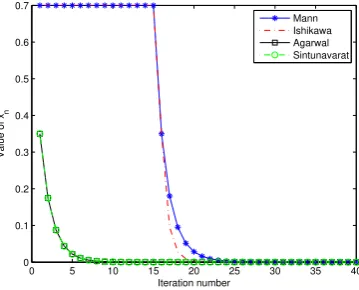
For the initial point x0=0.7, our corresponding itera-tive process (Sn), the Agarwal iterative process (ARSn), the Ishikawa iterative process (In), the Mann iterative process (Mn), respectively, and its behaviors is given in Figure1.
0 5 10 15 20 25 30 35 40 0 0.1 0.2 0.3 0.4 0.5 0.6 0.7 Iteration number
Value of x
n
[image:4.595.333.513.534.679.2]Mann Ishikawa Agarwal Sintunavarat
Fig. 1. Behavior of of the Mann iterative process (Mn), the Ishikawa
itera-tive process (In), the Agarwal iterative process (ARSn), and the Sintunavarat
iterative process (Sn) for the function given in Example13.
Example 14. LetE=Rbe a usual normed,C= [1,200]and
T :C→Cbe defined by
T x=px2−8x+40
for allx∈C. By the mean valued theorem, we can compute thatT satisfies the condition(6). It is easy to see thatT has a unique fixed point w:=5. Let
αn=βn=γn:=
1 2
for all n = 0,1,2, . . . Also, it clear that sequences
{αn}∞n=0,{βn}∞n=0,{γn}∞n=0 satisfy all the conditions of The-orems10and12.
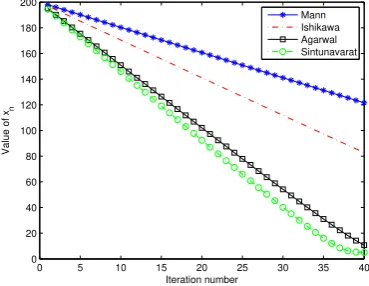
For the initial point x0=200, our corresponding itera-tive process (Sn), the Agarwal iterative process (ARSn), the Ishikawa iterative process (In), the Mann iterative process (Mn), respectively, and its behaviors are given in Figures2 and3.
Step Iteration (Mn) Iteration (In) Iteration (ARSn) Iteration (Sn)
1 198.0306 197.0462 195.0768 194.5846 2 196.0615 194.0932 190.1556 189.1717 3 194.0928 191.1408 185.2366 183.7613 4 192.1243 188.1892 180.3197 178.3536 5 190.1562 185.2385 175.4051 172.9488 6 188.1884 182.2885 170.4930 167.5471 7 186.2210 179.3393 165.5835 162.1486 8 184.2539 176.3910 160.6768 156.7536 9 182.2872 173.4436 155.7730 151.3624 10 180.3209 170.4971 150.8723 145.9752
. . .
. . .
. . .
. . .
. . . 36 129.3581 94.3736 26.6285 12.0452 37 127.4060 91.4745 22.3050 8.5957 38 125.4546 88.5789 18.1415 6.2591 39 123.5039 85.6868 14.2209 5.2682 40 121.5541 82.7987 10.6933 5.0416
. . .
. . .
. . .
. . .
[image:5.595.68.266.283.414.2]. . .
Fig. 2. Comparative results of Example14
0 5 10 15 20 25 30 35 40 0
20 40 60 80 100 120 140 160 180 200
Iteration number
Value of x
n
Mann Ishikawa Agarwal Sintunavarat
Fig. 3. Behavior of of the Mann iterative process (Mn), the Ishikawa
itera-tive process (In), the Agarwal iterative process (ARSn), and the Sintunavarat
iterative process (Sn) for the function given in Example14.
REFERENCES
[1] R. P. Agarwal, D. O’Regan and D. R. Sahu, “Iterative construction of fixed points of nearly asymptotically nonexpansive mappings,”Journal
of Nonlinear and Convex Analysis, vol. 8, no. 1, pp. 61–79, 2007.
[2] W. Sintunavarat, A. Pitea, “On a new iteration scheme for numerical reckoning fixed points of Berinde mappings with convergence analysis,”
The Journal of Nonlinear Science and Applications, vol. 9, no. 5, pp.
2553–2562, 2016.
[3] S. Banach, “Sur les op´erations dans les ensembles abstraits et leurs applications aux ´equations int´egrales,”Fundamenta Mathematicae, vol. 3, no. 1, pp. 133–181, 1922.
[4] V. Berinde, “Approximating fixed points of weak contractions using the Picard iteration,”Nonlinear Analysis Forum, vol. 9, no. 1, pp. 45–53, 2004.
[5] V. Berinde, “Picard iteration converges faster than Mann iteration for a class of quasicontractive operators,” Fixed Point Theory and
Applications, vol. 2004, no. 2, pp. 97–105, 2004.
[6] V. Berinde, “A convergence theorem for some mean value fixed point iteration procedures,” Demonstratio Mathematica, vol. 38, no. 1, pp. 177–184, 2005.
[7] S. K. Chatterjea, “Fixed point theorems,”Comptes rendus de l’Academie bulgare des Sciences Proceedings of the Bulgarian Academy of
Sci-ences, vol. 25, pp. 727–730, 1972.
[8] N. Hussain, A. Rafiq, B. Damjanovic and R. Lazovic, “On rate of convergence of various iterative schemes,” Fixed Point Theory and
Applications, vol. 2011, no. 45, pp. 1–6, 2011.
[9] S. Ishikawa, “Fixed point by a new iteration method,”Proceedings of
the American Mathematical Society, vol. 44, no. 1, pp. 147–150, 1974.
[10] R. Kannan, “Some results on fixed points II,” ) The American
Mathematical Monthly, vol. 76, no. 4, pp. 405–408, 1969.
[11] W. R. Mann, “Mean value methods in iteration,”Proceedings of the
American Mathematical Societyvol. 4, no. 3, pp. 506–610, 1953.
[12] B. E. Rhoades, “A comparison of various definitions of contractive mappings,” Transactions of the American Mathematical Society, vol. 226, 257–290, 1977.
[13] T. Zamfirescu, “Fixed point theorems in metric spaces,”Archiv der
[image:5.595.72.257.462.605.2]