Method of justification of the grain cleaning assembly
performance
Vladimir Shepelev
1, Sergey Shepelev
2, Zlata Almetova
11
Department of road transport, Faculty of Automobile and Tractor, South Ural State
University, Chelyabinsk, Russia
2
Department of Machine-Tractor Fleet Operation, South Ural State Agrarian University,
Chelyabinsk, Russia
Corresponding author: [email protected]
Abstract
Shepelev V., Shepelev S., Almetova Z. (2018): Method of justification of the grain cleaning assembly performance. Res. Agr. Eng., 64: 115–120.
The performance potential of the existing grain cleaning assemblies meant for nominal and stable gross grain flow in view of the agrotechnical harvest time is not realized to the full extent. It is preconditioned by the instability of the technical and technological parameters of the harvesting processes. It results in a disproportion between the harvesting and the grain cleaning process, which is manifested in accumulation of bulks of grains within open areas in uncon-trolled conditions or preconditions over-estimation of the rated performance of the grain cleaning assemblies. Their required performance can be decreased and the alignment of functioning of the process system can be increased by introduction of compensating and back-up components in view of the seasonal and daily performance indicators of the combine harvesters.
Keywords: service life of combines; performance of combine harvesters; harvesting process; grain flow rate; grain
moisture content; storage hopper
115 https://doi.org/10.17221/14/2017-RAE
Organization of the harvesting process largely predetermines the final crop output. The sophisti-cated and expensive harvesting and grain cleaning process requires an alignment of all the process links (Läänemets 2011; Pexa 2011; Akbarnia 2014). The hourly performance of the harvesting complex can vary throughout a day within a wide range and depends on the main natural and production fac-tors, such as: technical condition of combine har-vesters, transport support, crop yield, grain par-ticle size and moisture content (Pugachev 1983; Kroulík et al. 2011; Risius et al. 2017). The vari-ability of the total hourly performance of combine harvesters throughout a day poses special require-ments to justification of the grain cleaning assem-bly performance. For alignment of the harvesting
complex and the grain cleaning assembly perfor-mance in view of the natural and production con-ditions it is necessary to develop an economic and mathematical model based on the minimum cost criterion.
MATERIAL AND METHODS
The current production situation calls for an im-provement of the methodological approaches to de-sign engineering of the process system based on a uniform complex of harvesting, transportation and post-harvesting grain handling. At design engineer-ing of the flow lines for post-harvestengineer-ing grain han-dling the basis is generally formed by the average
116
ductivity of fields ignoring the technical equipment level of the harvesting complex and the weather con-ditions (Shepelev, Okunev 2006; Okunev 2011). The performance of the process line of harvesting and post-harvesting grain handling is unstable due to the fluctuations of the grain mass throughout the day (Bracacescu et al. 2012; Qiao et al. 2016; Wang et al. 2016). The performance of combine harvest-ers is considerably decreased in the morning and in the evening. In the modern conditions, in the hours, when the performance of combine harvesters reaches the maximum value, enterprises use a reserve area to ensure straight-line grain receiving. This results is expenses caused by additional transshipment operations in the open area (
C
op) due to the mis-alignment in the performance of the harvesting and grain cleaning lines, which can be presented as fol-lows:Cpo=CT +Cc+Co+Pd+Cl (1) where: CT – transport expenses (RUB); CC – open area construction and maintenance expenses (RUB);
CO – expenses on loading and reloading operations (RUB); Pd – damage caused by grain losses (RUB) (Tava-koli et al. 2009); Cl– labor costs (RUB)
Let us present the cost crop losses at application of the open area as follows:
Pd=Qtr
(
1−Kl)
Cg (2)where: Kl – coefficient considering product losses caused by additional transshipment operations in the open area;
Cg – cost of grain (RUB/t)
The grain volume subject to transshipment in the open area can be calculated by the graphical inte-gration method:
Qtr=
g t
( )
−z t( )
gt ⎛ ⎝⎜ ⎞⎠⎟
t1 t2
∫
dtQdhcktur (3)where: t1, t2 – beginning and end of operation of the har-vesting complex; Qhc
d – daily performance of the harvest-ing complex; ktur – useful shift time utilization rate; g(t) – function of the harvesting complex performance of time
Function of the harvesting complex performance of time depends on the moisture content, impurity, lodging, content of straw, yield of the grain mass, number of combine harvesters, shift time utiliza-tion rate, weather condiutiliza-tions and is described by the following equation:
g t
( )
=K0+K1t+K2t2+K3exp( )
t (4)The function of the grain cleaning assembly per-formance z(t) of the time of operation is described by the following equation:
z t
( )
=K0+K1t+K2t2+K3exp( )
t (5)where: K– general linear regression coefficient
The specific technical equipment of the harvest-ing process is calculated by the formula:
Nte=Nc1,000
W (6)
where: Nc – number of combine harvesters (pcs); W – total harvested area (ha)
The hourly performance of the harvesting com-plex (Qhc
h) is calculated by the expression: Qhhc=0.1Q
h haYK
mTKsKwcNc (7)
where: Qha
h – hourly performance of the harvesting assembly; Y – yield (t/ha); Km – moisture-content coef-ficient of the grain mass; T – shift time (h); Ks – shift coefficient; Kwc – weather conditions coefficient
Considering Eq. (7), the harvesting complex per-formance will be as follows:
Qhhc=0.1BVk
turYKmTKsKwc
WNte
1,000 (8)
where: B – width of the grain head (m); V – combine harvester’s speed (km·h–1)
The hourly performance of the grain cleaning as-sembly (Qca
h) depending on the grain moisture is described by the expression:
Qhca=Q
prpKmKrKz (9)
where: Qrp
p – rated performance of the grain cleaning machines (t·h–1); K
m, Kz, Kr – degradation factor due to the moisture content and impurity of the grain and the engineering reliability of the machines
When rather large grain volumes are received for handling it is expedient to use a compensating component in the form of an interoperable storage hopper, which will allow to partially break the rigid connection between harvesting and post-harvest-ing grain handlpost-harvest-ing (Oko et al. 2010). Its volume (Vb) is calculated by the expression:
117 https://doi.org/10.17221/14/2017-RAE
where: Qca
p – performance of the grain cleaning assem-bly (t h–1); t
d – operation time of the grain cleaning assembly throughout a day (h); to – operation time of the harvesting complex (h)
A significant reserve to compensate the misalign-ment of the process links is installation of addi-tional pre-cleaning machines. Max. efficiency of reduction in the expenses for the additional grain transshipment operations is achieved at the cost of the application of a complex variant of the grain cleaning assembly in conjunction with the storage hopper and grain heap pre-cleaning machines.
For justification of the grain cleaning assembly performance in view of the technical equipment it is proposed to use the following expression (Shepelev, Shepelev 2007):
QTE= Qrcaµ +B
b+Bbca+Bbcm+Bh
(
)
α +B+Zat f(
ε( )
Qrca)
Qtr ⎛ ⎝ ⎜ ⎜ ⎞ ⎠ ⎟ ⎟⇒min
(11) where: f(ε) = 0, if ε < 0; ε = Qtr – Qr
chtr – V – Vb; tr – operation time of the backup machines (h); Qcar – reserve perfor-mance of the grain cleaning assembly (t/h); μ – depen-dency of the balance cost of the backup grain cleaning assembly on its performance (RUB); Bb – balance price
of the receiving apparatus (RUB); Bcab – balance price of a base grain cleaning assembly (RUB); Bcm
b – bal-ance cost of the pre-cleaning machines (RUB); Bh – bal-ance cost of the storage hopper (RUB); α – coefficient reflecting the distribution costs for the acquisition, physical deterioration and recovery machines and units depending on their life; B – conventionally proportional expenses (RUB); Zat – expenses caused by the additional
transshipment operations in the open area (RUB·ha–1).
RESULTS AND DISCUSSION
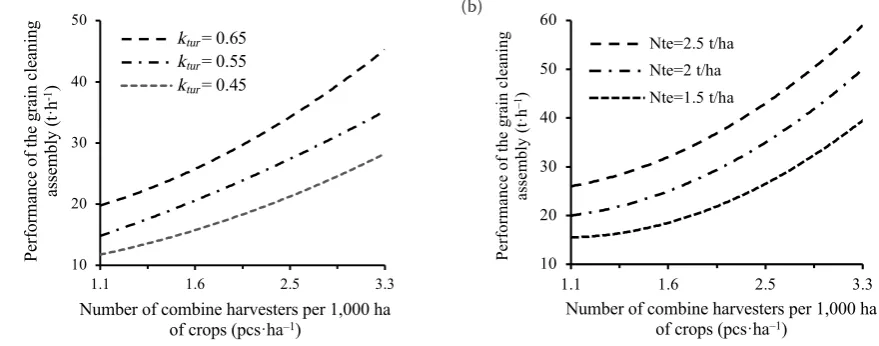
Based on the Eq. (9) we calculated the influ-ence of the technical equipment level of the har-vesting process on the grain cleaning assembly performance. The simulation results have shown a dependency of the grain cleaning assembly per-formance on the number of combine harvesters of class 3 with the capacity of 5 kg·s–1 per 1,000 ha and the combine harvester’s useful shift time utilization rate. It has been determined that with the increase of the technical equipment of the harvesting pro-cesses from one to three pcs·ha–1 the rated perfor-mance of the grain cleaning assembly is increased from 12 to 28 t·h–1 at the combine harvester’s use-ful shift time utilization rate of 0.45 (Fig. 1). With the increase of the combine harvesters’ useful shift time utilization rate from 0.45 to 0.65 the grain cleaning assembly performance is increased from 20 to 35 t·h–1 at pcs·ha–1.
The statistical data collection and the production verification of grain cleaning assemblies when re-ceiving products with compensating elements were carried out in agricultural enterprises of the steppe and forest-steppe zones of the Southern Urals.
[image:3.595.74.514.547.720.2]Theoretical researches have shown that the as-sembly performance is considerably influenced by the shift time utilization rate, which, in its turn, depends on the service life of the harvesting as-semblies (Shepelev, Shepelev 2007; Okunev et al. 2015).
Fig. 1. Dependency of the hourly performance of the grain cleaning assembly on the technical equipment of the harvest-ing processes at (a) varied shift time utilization rate (ktur) and (b) varied yield (Nte)
(a)
(b)
Fig. 1. Dependency of the hourly performance of the grain cleaning
assembly on the technical equipment of the harvesting processes at (a)
varied shift time utilization rate (k
tur) and (b) varied yield (N
te)
10 20 30 40 50
1.1 1.6 2.5 3.3
Perfor mance of th e gr ain clean in g assembly (t· h -1)
Number of combine harvesters per 1,000 ha of crops (pcs·ha–1)
ktur=0.65
ktur=0.55
ktur=0.45
10 20 30 40 50 60
1.1 1.6 2.5 3.3
Performance of the grain cleaning assembly (t· h –1)
Number of combine harvesters per1,000 ha of crops (pcs/ha)
Nte=2.5 t/ha Nte=2 t/ha Nte=1.5 t/ha
(a)
(b)
Fig. 1. Dependency of the hourly performance of the grain cleaning
assembly on the technical equipment of the harvesting processes at (a)
varied shift time utilization rate (k
tur) and (b) varied yield (N
te)
(a)
10 20 30 40 501.1 1.6 2.5 3.3
Perfor mance of th e gr ain clean in g assembly (t· h -1)
Number of combine harvesters per 1,000 ha of crops (pcs·ha–1)
ktur=0.65 ktur=0.55 ktur=0.45
10 20 30 40 50 60
1.1 1.6 2.5 3.3
Performance of the grain cleaning assembly (t· h –1)
Number of combine harvesters per1,000 ha of crops (pcs/ha)
Nte=2.5 t/ha Nte=2 t/ha Nte=1.5 t/ha (a) (b)
(a)
(b)
Fig. 1. Dependency of the hourly performance of the grain cleaning
assembly on the technical equipment of the harvesting processes at (a)
varied shift time utilization rate (k
tur) and (b) varied yield (N
te)
10 20 30 40 50
1.1 1.6 2.5 3.3
Perfor mance of th e gr ain clean in g assembly (t· h -1)
Number of combine harvesters per 1,000 ha of crops (pcs·ha–1)
ktur=0.65
ktur=0.55
ktur=0.45
10 20 30 40 50 60
1.1 1.6 2.5 3.3
Performance of the grain cleaning assembly (t· h –1)
Number of combine harvesters per1,000 ha of crops (pcs/ha)
118
The statistical material having been analysed, we have obtained the regression equation of the de-pendency of the daily performance (Qd) and the shift time utilization rate (ktur) of the harvesting as-semblies of class 3 on the service life:
Qd =5.3te−0.612t+11.6 (12)
ktur=0.179te−0.612t+0.386 (13)
where: t – the service life of grain harvesting assemblies
The analysis of the materials shows that with the increase of the service life of the harvesting as-semblies from 2 to 10 years their daily output and
the useful shift useful time utilization rate are de-creased in 1.1 to 1.3 times.
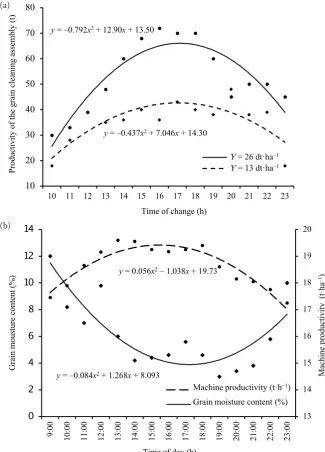
To reveal the daily productivity fluctuations of harvesting-transporting and grain-cleaning lines, the statistical data were collected in the basic en-terprises (Fig. 2).
[image:4.595.64.390.103.556.2]The unevenness rate of fluctuations of the hourly harvesting-transporting line productiv-ity is 0.93...0.96, with the variation coefficient be-ing 32...33% and the shift time utilization rate of combine harvesters ranging within 0.50...0.62. The productivity of the grain cleaning assembly U12 2.4 PETKUS is established to reduce by 30% dur-ing morndur-ing and evendur-ing hours, with the variation
Fig. 2. Changes in productivity and grain moisture during a day of (a) the harvesting assembly and (b) the grain cleaning assembly
(b)
y= –0.792x2+ 12.90x+ 13.50
y= –0.437x2+ 7.046x+ 14.30
10 20 30 40 50 60 70 80
10 11 12 13 14 15 16 17 18 19 20 21 22 23
Pr od uc tiv ity of th e gra in cl ea ni ng asse m bl y (t)
Time of change (h)
Y= 26 dt·ha–1
Y = 13 dt·ha–1
y= –0.084x2+ 1.268x+ 8.093
y= 0.056x2– 1.038x+ 19.73
13 14 15 16 17 18 19 20 0 2 4 6 8 10 12 14 9: 00 10: 00 11: 00 12: 00 13: 00 14: 00 15: 00 16: 00 17: 00 18: 00 19: 00 20: 00 21: 00 22: 00 23: 00 M ac hi ne pr od uc tiv ity (t· ha –1) G rain m ou sture cont ent (% )
Time of day (h)
Machine productivity (t·h–1)
Grain moisture content (%)
(b)
y= –0.792x2+ 12.90x+ 13.50
y= –0.437x2+ 7.046x+ 14.30
10 20 30 40 50 60 70
10 11 12 13 14 15 16 17 18 19 20 21 22 23
Pr od uc tiv ity of th e gra in cl ea ni ng asse m bl y (t)
Time of change (h)
Y= 26 dt·ha–1
Y = 13 dt·ha–1
y= –0.084x2+ 1.268x+ 8.093
y= 0.056x2– 1.038x+ 19.73
13 14 15 16 17 18 19 20 0 2 4 6 8 10 12 14 9: 00 10: 00 11: 00 12: 00 13: 00 14: 00 15: 00 16: 00 17: 00 18: 00 19: 00 20: 00 21: 00 22: 00 23: 00 M ac hi ne pr od uc tiv ity (t· ha –1) G rain m ou sture cont ent (% )
Time of day (h)
Machine productivity (t·h–1)
Grain moisture content (%) (a)
119 https://doi.org/10.17221/14/2017-RAE
coefficient averaging 23% and the unevenness rate of fluctuations being 0.81.
The decrease of the performance indicators of the combine harvesters when their service life increas-es is due to their technical availability decreasing (Shepelev et al. 2015). Therefore, when justifying their seasonal loading it is necessary to take into account their operational reliability. Thus, works Shepelev et al. (2016) and Shepelev et al. (2015) and Shepelev et al. (2015) contain recommenda-tions to increase reliability of the combine harvest-ers due to repair and maintenance operations.
An expression to describe the dependence of the ZAV-20 shift time utilization rate (τz
tur) on the vol-ume of the compensator is obtained:
τturz =−0.0009Vb2+0.017Vb+0.358 (14)
where: Vb – volume of the compensating reservoir (t)
The production inspection showed that for a grain cleaning assembly with the 20 t·h–1 produc-tivity, it is most reasonable to use a bunker-com-pensator with a volume of 100–120 m3. In general, the use of bunker-compensators for grain receiving makes it possible to increase the utilization rate of a harvesting-transporting line during a season by 1.1–1.2 times and of the grain-cleaning assembly by 1.2–1.3 times, respectively (2b).
Due to the use of the bunker-compensator, it was possible to avoid losses of 50–60 t of products when cleaning and to increase the daily productiv-ity of the grain cleaning assembly by 20%.
The regression equation of the shift time utiliza-tion rate of the grain harvesting-transporting line at different volumes of the compensating reservoir is the following:
τhtl=0.21×Vb0.154 (15)
The productivity changes of the combine har-vester assembly “Yenisei-1200” (Qha) and the grain cleaning assembly (Qca) during a day with 5% grain dockage is determined:
Qha=−0.04t2+0.63t+0.87 (16)
Qca=−0.06t2+0.97t+5.1 (17)
Thus, the experimental studies confirmed the the-ory on improving the construction of grain clean-ing lines, their operatclean-ing modes and the reasonabil-ity of used compensating and reserve technological elements to increase the daily productivity of the
grain cleaning line by 25 to 30%. The introduction of the developed methods ensured an annual effect of agricultural enterprises up to 15–30 EUR/ha.
CONCLUSIONS
It has been determined that for each 1000 hect-ares of the harvested area the performance of grain cleaning assemblies of 5.0 to 6.0 t·h–1 and the vol-ume of the compensating hopper of 40 to 50 m3 are needed, at the specific technical equipment of the harvesting processes of 3 pcs per 1,000 ha. At alignment of the operational and technological pa-rameters of the flow harvest line its performance is increased by 10–15% and the rated performance of the grain cleaning complex is decreased by 30–40%.
Thus, we have developed an economic and math-ematical model, which allows to justify rational parameters of the grain cleaning assembly. The experimental researches in a production environ-ment have proved the results of the theoretical re-searches.
References
Akbarnia A. (2014): Study of fuel consumption in three till-age methods. Research in Agricultural Engineering, 60: 142–147.
Bracacescu C., Pirna I., Sorica C., Popescu S., Stan, O. (2012): Experimental researches on influence of functional param-eters of gravity separator on quality indicators of separa-tion process with applicasepara-tion on cleaning of wheat seeds. Presented at: Rural Development, 11:16–21.
Kroulík M., Mašek J., Kvíz Z., Jošt B., Prošek, V. (2011): Sen-sors connection for yield determination on rund balers with variable chamber. Research in Agricultural Engineering, 57: 57–55.
Läänemets O. (2011): Price, Yield, and Revenue Risk in Wheat Production in Estonia. Agronomy Research, 9: 421–426. Oko C.O., Diemuodeke E.O., Akilande I.S. (2010): Design
of Hoppers Using Spreadsheet.Research in Agricultural Engineering, 56: 53–58.
Okunev G.А. (2011): Technical and technological reserves for improvement of mechanized processes in agriculture. Agroindustrial Complex of Russia, 58: 57–62.
Okunev G.А., Shepelev S.D., Marinin S.P. (2015): Design En-gineering and Organization of Machine Use in Agriculture. Chelyabinsk, South Ural State Agrarian University. Pexa M. (2011): Measurements of tractor power parameters
120
Pugachev А.I. (1983): Influence of the grain mass moisture on the quality of the combine harvester performance throughout a day. Grain Farming, 6: 37–39.
Qiao, J., Han, Z., Hong, K., Chen, H., Hao, Y., & Zhang, X. (2016): Variation of technology productivity of harvesting outfit along with site conditions.Nongye Gongcheng Xue-bao/Transactions of the Chinese Society of Agricultural Engineering, 32: 43–50.
Risius H., Prochnow A., Ammon C., Mellmann J., Hoffmann T. (2017): Appropriateness of on-combine moisture meas-urement for the management of harvesting and postharvest operations and capacity planning in grain harvest. Biosys-tems Engineering, 156: 120–135.
Shepelev S., Shepelev V., Almetova Z. (2016): Optimization of technical equipment for crop sowing processes. Procedia Engineering, 150: 1258–1262.
Shepelev S., Shepelev V., Cherkasov Yu. (2015): differentiation of the seasonal loading of the combine harvester depend-ing on its technical readiness. Procedia Engineerdepend-ing, 129: 161–165.
Shepelev S.D., Cherkasov Yu.B. (2015): Justification of dif-ferentiated reliability of combine harvesters in view of
their seasonal leading. Agroindustrial Complex of Russia, 72: 54–56.
Shepelev S.D., Okunev G.А. (2006): Design Engineering of Flow Lines at Harvesting. Chelyabinsk, Federal State Educational Institution of Higher Education Chelyabinsk State Agroengineering Academy.
Shepelev S.D., Shepelev V.D. (2007): Justification of the tech-nical and technological parameters of the grain cleaning assemblies. Mechanization and Electrification of Agricul-ture, 2: 9–11.
Shepelev S.D., Shepelev V.D., Cherkasov Yu.B. (2015) Sta-tistical performance indicators of combine harvesters depending on the service hours. Agrofood Policy of Rus-sia, 1: 36–40.
Tavakoli H., Mohtasebi S.S., Jafari A. (2009): Effects of moisture content, internode position and loading rate on the bending characteristics of barley straw. Research in Agricultural Engineering, 55: 45–51.
Wang G., Yi Z., Chen C., Cao G. (2016): Effect of harvesting date on loss component characteristics of rice mechanical harvested in rice and wheat rotation area.Transactions of the Chinese Society of Agricultural Engineering, 32: 36–42.