Paper is published as: Mater. Sci. Techn, 2001, vol. 17, 1324-28
The Effect of Compositional Variations on the Characteristics of Coarse Intermetallic Particles in Overaged 7xxx Al Alloys
X.-M. Li and M. J. Starink
Materials Research Group, School of Engineering Sciences, University of Southampton, Southampton, SO17 1BJ, UK
Abstract
To provide an understanding of how compositional variations affect the characteristics of coarse intermetallic particles in 7xxx alloys, three Al-Zn-Mg-Cu-Zr aluminium alloy plates with different Zn, Mg and Cu contents were studied by optical microscopy based image analysis, scanning electron microscopy (SEM), energy disperse X-ray spectroscopy (EDS) and differential scanning calorimetry (DSC). These coarse intermetallic particles are detrimental, especially to the toughness of the alloy. The experimental observations were interpreted successfully on the basis of the phase diagram and the temperature dependent S phase solvus which was derived on the basis of the regular solution model. The temperature dependent S phase solvus indicates that some compositions in the composition windows of 7050 and 7x75 type alloys will give rise to the detrimental S phase that can not be dissolved during solution treatment. Also the T phase is analysed and conditions for its formation and dissolution are discussed. It is shown that the present results can produce useful information on alloy design and thermo-mechanical processing via microstructural control.
Introduction
especially to the toughness, and in 7xxx alloys these particles are especially the Fe-rich and S (Al2CuMg) intermetallic phases [2]. Consequently, investigation into these intermetallic particles in 7xxx alloys with an aim to predict the properties is of key industrial interest.
The Al-Zn-Mg-Cu system is a highly complex one, with existing literature [3-6] indicating that at the Al end temperature between 400ºC and the solidus, five intermetallic phases can occur (see Table 1). Of these five, θ is essentially a binary phase (Al2Cu), S is essentially ternary (Al2CuMg), whilst η, T and Z are solid solutions with extended composition ranges containing all four elements. Of these five phases only η, T and S appear in commercial 7xxx alloys.
The objective of this work is to provide an understanding of how compositional variations and heat treatments affect the characteristics of intermetallic particles in 7xxx alloys. We will specifically interpret the presence of S and T phase using the phase diagrams as well as a regular solution model for the S phase solvus. An analysis of coarse intermetallic particles in three alloys is presented. Compared with typical (7050/7x75) type compositions, one alloy has a high Cu content, one has a high Mg content, whilst the third one has medium Cu and Mg contents.
Experimental
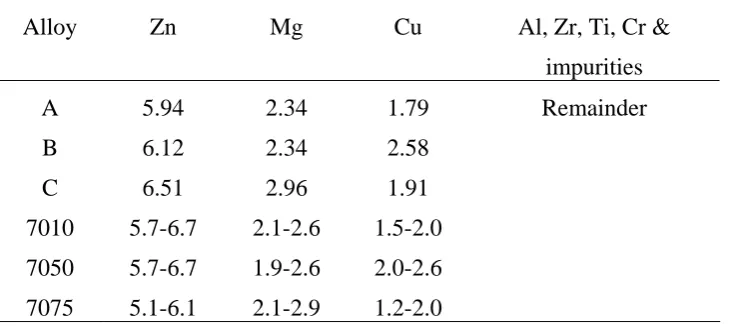
Three Al-Zn-Mg-Cu-Zr alloys, with Zn, Mg and Cu levels broadly in the range of 7010, 7050 to 7075 compositions were studied. The alloys were produced at the Defence Evaluation and Research Agency (DERA), Farnborough, UK, and processed to plate of 25 mm thickness. The measured (by optical emission spectroscopy (OES)) chemical compositions of the alloys investigated as well as the composition ranges for 7010, 7050 and 7075 commercial alloys are shown in Table 2. All alloys contain 0.02wt%Ti and 0.12wt%Zr. 99.90% aluminium was used as base to ensure Fe<0.15% and Si<0.1%. All three alloys were solution treated at temperatures ranging from 437 to 485ºC (mostly 475ºC was used) for 1h and subsequently aged to T7 temper (artificial ageing).
Two samples were selected for Scanning Electron Microscopy (SEM) / Energy Disperse X-ray Spectroscopy (EDS) analysis: the high Cu alloy B and the high Mg alloy C. The SEM facility was a Jeol JSM-6400. Chemical compositions of various particles in the samples were determined using EDS.
Table 1 Intermetallic phases in Al-rich Al-Zn-Mg-Cu alloys. The various compositions and phase indications suggested in the literature [3,4,6] have been included in the table.
Phase indications (alternative)
Composition in Al-Zn-Mg (alternative indications)
Composition in Al-Cu-Mg (alternative indications)
θ - Al2Cu
Z Mg2Zn11 Cu6Mg2Al5
S - Al2CuMg
T (τ) AlMgZn (Mg3Zn3Al2, Al6Mg11Zn11, (Al,Zn)49Mg32)
CuMg4Al6*
η (M,σ) MgZn2, ((Al,Zn)2Mg) AlCuMg (Al6Cu4Mg2)
* Note that the existence of the cubic phase CuMg4Al6 (Im3 structure [3,10]) appearing in phase diagrams by Mondolfo [3,10] and Strawbridge et al. [4], has not been confirmed in Ref. [6]. This indicates
that Zn is essential for the stability of the cubic T phase.
Table 2 Chemical compositions of three 7xxx alloys studied and commercial 7xxx alloys (wt%)
Alloy Zn Mg Cu Al, Zr, Ti, Cr &
impurities A
B C 7010 7050 7075
5.94 6.12 6.51 5.7-6.7 5.7-6.7 5.1-6.1
2.34 2.34 2.96 2.1-2.6 1.9-2.6 2.1-2.9
1.79 2.58 1.91 1.5-2.0 2.0-2.6 1.2-2.0
A Shimadzu DSC-50 (heat-flux type) was employed for the Differential Scanning Calorimetry (DSC) experiments. The DSC samples were machined from the 7xxx plates to 5mm in diameter and 1mm in thickness with average mass of about 63 mg. A pure aluminium reference (99.9%) with a mass and shape close to that of the sample was used. The heating rate was 10°C/min. Further details of the DSC experimental procedures are presented elsewhere [8].
Results and Discussion
MICROSCOPY
Optical microscopy and SEM revealed a partially recrystallised grain structure for all alloys with small amounts of intermetallic particles. Image analysis was used to quantify the volume fraction of coarse particles. The results also indicate that the high Cu alloy has the highest percentage of coarse particles with an average of 2.6%, whilst the high Mg alloy and the alloy with medium Cu and medium Mg have similar volume fractions of about 1.7%. This implies that Cu content plays an important role in the formation of coarse particles.
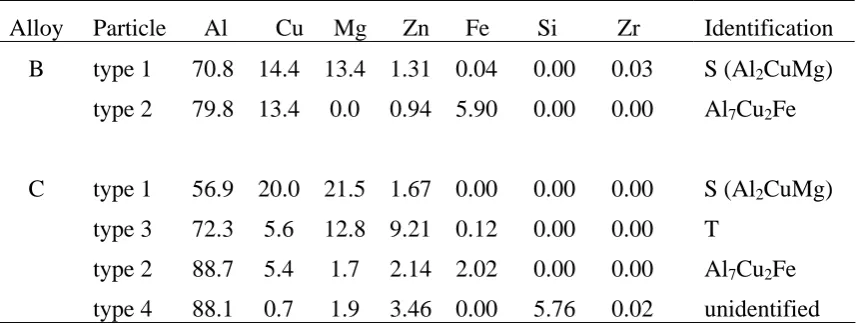
SEM micrographs of alloy B and alloy C are presented in Fig. 1. The identification of specific particles was obtained from compositional analysis using EDS, examples of which are presented in Table 3. Note that in all cases the Al matrix contributes to the compositional analysis.
to the EDS signal by the Al-rich matrix into account by assuming that the EDS signal is a weighted average of particle and matrix contributions. This procedure, which is described in detail in the Appendix, showed that the EDS signal is consistent with the particle being T phase and the calculated composition of the T phase particles is about Al40Cu15Mg25Zn20, illustrating that T phase is a quaternary phase which can be thought of as resulting from the extended solubility of Cu and Al in the Mg3Zn3Al2 phase.
Table 3 EDS compositional analysis of typical particles (at%). In all cases, the Al matrix contributes to the compositional analysis.
Alloy Particle Al Cu Mg Zn Fe Si Zr Identification B
C
type 1 type 2
type 1 type 3 type 2 type 4
70.8 14.4 13.4 1.31 0.04 0.00 0.03 79.8 13.4 0.0 0.94 5.90 0.00 0.00
56.9 20.0 21.5 1.67 0.00 0.00 0.00 72.3 5.6 12.8 9.21 0.12 0.00 0.00 88.7 5.4 1.7 2.14 2.02 0.00 0.00 88.1 0.7 1.9 3.46 0.00 5.76 0.02
S (Al2CuMg) Al7Cu2Fe
S (Al2CuMg) T
Al7Cu2Fe unidentified
DSC
a GP zone dissolution effect prior to the η′ precipitation effect. In the following discussion, the focus is placed on the heat effects of the first DSC run since it is the most important heating cycle reflecting reactions in a solution treated, quenched and aged sample.
The DSC curves of three alloys solution treated at 475ºC and aged to T7 condition is shown in Fig. 3. It is noticed that the high Cu alloy B has the strongest S melting peak, followed by the high Mg alloy C and medium Cu and Mg alloy A.
CONDITIONS FOR THE PRESENCE OF S AND T PHASE
In interpreting the results, we will make use of published phase diagrams at 460ºC as well as a temperature dependent solvus diagram for S phase which we will derive below. For the latter, we use a regular solution model [14,15]. In this model the solvus related to an intermetallic phase MmAaBbCc (M is the main constituent of the alloy, and A, B, C are the alloying elements) is given by [13]:
( ) ( ) ( )
⎥⎦ ⎤ ⎢
⎣ ⎡− =
T k
H c
c c c
B sol o
c C b B a
A exp (1)
where Hsol is the solution enthalpy, kB is the Boltzmann constant, T is the temperature. If appropriate values for Hsol, c0, a, b and c for each phase can be derived from available solubility and compositional data, a phase diagram can be constructed. However, only for T=460°C significant data on the solvi of all phases are available [4]. For the S phase, Hsol(S) has been determined before [8], and by combining solvus data at 460°C with Hsol the S solvus as a function of the temperature can be estimated, as plotted in Fig. 4.
higher than 3.2wt%, i.e. alloy C, which contains 3.0wt%Mg is within the α+S phase field. However, the α+S+T phase field in the phase diagram at compositions around alloy C expands substantially with increasing Zn content, such that for a Zn content of 8wt% at 460ºC, T phase is stable for Mg contents as low as 2.7wt% [4]. This suggests that alloy C, at the solution treatment temperatures used, may be in or very close to the α+S+T phase field. A small amount of Mg segregation, which originates from the solidification processing and which is not entirely removed during the thermomechanical and thermal processing, can thus cause the presence of T phase in alloy C. This finding will have consequences for solution treatment practice of 7xxx alloys, i.e. the 7050 and 7010 alloys which have Mg contents lower than 2.6wt%, are not expected to contain T phase and, provided they are well homogenised, they can be solution treated up to the incipient melting temperature of S phase (490ºC). However, for alloys with Mg contents at the high end of the 7075 composition range (2.9wt%), some T phase can be present and they should be solution treated below the melting point of T phase (480ºC).
In general, the DSC data on S phase and T phase melting are in good agreement with the SEM/EDS observations. It is also noted that the identification of effect V in the DSC curve of the high Cu alloy B (Fig. 2) as due to the dissolution of S phase is consistent with the S phase solvus in Fig. 4, as the latter indicates that on heating, substantial S phase dissolution should occur from about 440ºC. On further heating, the original solution treatment temperature will be reached and further dissolution of S phase would involve the coarse S phase particles left undissolved after the solution treatment (475ºC). As dissolution of these coarse particles will be slow, the S phase dissolution effect during DSC heating would be expected to decrease substantially at this temperature. This explains why the S phase dissolution effect is situated between about 440 and 475ºC, and lends further support to our earlier interpretation of effect V (in Ref. [13] and the previous section).
Conclusions
In DSC scans of solution treated high Cu and high Mg 7xxx alloys, substantial melting of S phase at 490°C was observed. In the alloy with medium Cu and Mg content very little S phase melting was observed. Melting of T phase at 480°C was observed only for the alloy with high Mg content. DSC as well as SEM indicate that in the high Mg alloy the main coarse particles are S (Al2CuMg) and T phase, whilst in the high Cu 7xxx alloy the main coarse particles are S and Al7Cu2Fe. The high Cu alloy has the highest volume fraction of coarse particles. These observations can be interpreted well on the basis of the phase diagram and the temperature dependent S phase solvus based on the regular solution models. It is shown that some compositions in the composition windows of 7050 and 7x75 type alloys will give rise to the detrimental S phase which can not be dissolved during solution treatment. Results indicate that T phase is present only if Mg content approaches the high Mg end of the composition range for the 7075 alloy.
Acknowledgements
The financial support from Alcoa Europe (formerly British Aluminium Plate) is gratefully acknowledged. Technical discussions with Drs J. Newman, A. J. Morris, S. Khosla and S. Waters (Alco Europe) and Dr P.D. Pitcher (DERA, Farnborough), and additional DSC and image analysis work by Mr. O. Rousseau are gratefully acknowledged.
Appendix
v x x x x A B C = ⎛ ⎝ ⎜ ⎜ ⎜ ⎜ ⎜ ⎜ ⎞ ⎠ ⎟ ⎟ ⎟ ⎟ ⎟ ⎟ ... ... (A1)
where A, B, C .. etc. are the (major) elements present in the alloy. In the following we will assume that the ZAF type correction applied in the standard EDS software used is, at least in good approximation, valid for the multiphase samples considered. Under this assumption, measured EDS compositions, xvEDS, should be a linear combination of the compositions of the individual phases:
∑
= i e P P EDS f ix ixv v (A2)
where Pi are the phases present in the alloy and fPi are the fractions at which these respective phases contribute to the EDS signal. If the accuracy of the determination of the composition is similar for all elements, and i is smaller than the number of elements analysed, the values of the fractions f can be determined by minimising the expression:
χ = −
∑
i e P P EDS f ix ixv v (A3)
The accuracy of the various assumptions and the expected compositions is reflected in the value of χ obtained - the smaller χ, the greater the accuracy.
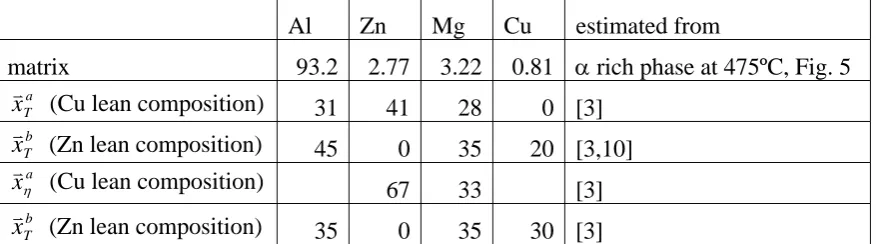
In the present paper we want to make the distinction between T and η, based on EDS data which contains a contribution from the matrix. Whilst the composition of matrix, xvM, can be estimated quite well (it should be given by the solvus at the solution treatment temperature, and is given in Table 4), the compositions of T and η phase are at the outset not known. However, this problem can be resolved as follows. We first assume that for the narrow range of compositions of our alloys all possible T and η phase compositions can be approximated by a linear combination of two compositions (see e.g. phase diagram data from Mondolfo [3]), i.e. for T phase:
b T T a T T
T x x
where xvTa and xvTb are two possible compositions of T phase (at the extremes of the stability range, e.g. a Cu lean and a Zn lean composition) and λT is a parameter between 0 and 1. Thus, if an analysed particle is T phase then the composition measured by EDS should be given by:
[
b]
T T a T T M
EDS x x x
xv =λ1v +(1−λ1)λ v +(1−λ )v
(A5)
where λ1 is between 0 and 1. A similar equation is valid for EDS analysis of η phase:
[
a b]
M
EDS x x x
xv =λ2v +(1−λ2)ληvη +(1−λη)vη (A6)
where λ2 is between 0 and 1. The deviations are defined as:
[
b]
T T a T T M EDS
T x x x x
v v
v
v (1 ) (1 )
1
1 λ λ λ
λ
χ = − + − + −
(A7)
and, analogously:
[
a b]
M
EDS x x x
x η η η η
η λ λ λ λ
χ = v − 2v +(1− 2) v +(1− )v (A8)
Next, optimised values of the λ parameters are calculated by minimising χT and χη, and the values obtained for χT and χη are compared. For the particles in Alloy C which contain Mg, Cu and Zn it was found that χT = 10 (i.e. the average deviation is about 2.5 at% per alloying element) with always χT < χη. This indicates that the measured compositions of these particles are consistent with them being T phase.
As an extension of the method outlined, we can calculate the composition of the particles using (see [16]): M EDS M EDS x x x x x j
P v v
v v v 1 1 λ λ − −
= (A9)
with v
x = xA+xB+xC...etc (A10)
Table 4 Composition of matrix, and compositions of T and η phase estimated from data in Refs. [3,10], as used for the analysis of EDS data (see Appendix).
Al Zn Mg Cu estimated from
matrix 93.2 2.77 3.22 0.81 α rich phase at 475ºC, Fig. 5 a
T
xv (Cu lean composition) 31 41 28 0 [3] b
T x
v (Zn lean composition)
45 0 35 20 [3,10]
a
xvη (Cu lean composition) 67 33 [3] b
T x
v (Zn lean composition)
35 0 35 30 [3]
References
1. I. J. POLMEAR, ‘Light Alloys –Metallurgy of the Light Metals’, 1995, St. Edmundsbury Press Ltd,
UK.
2. A. J. MORRIS, R. F. ROBEY, P. D. COUCH and E. DE LOS RIOS, Mater. Sci. Forum, 1997, 242,
181.
3. L.F. MONDOLFO, ‘Aluminium Alloys’, 1976, Butterworths & Co Ltd, London.
4. D. J. STRAWBRIDGE, W. HUME-ROTHERY and A. T. LITTLE, J. Inst. Metals, 1948,74, 191.
5. J.A. WERT, Scr. Metall., 1981, 15, 445.
6. P. VILLARS, A. PRINCE and H. OKAMOTO, ‘ASM Handbook of Ternary Alloy Diagrams’, 1995,
ASM International, Materials Park, Ohio.
7. J. BOSELLI, P. PITCHER, P. J. GREGSON and I. SINCLAIR, J. Microscopy, 1998, 194, 483.
8. M. J. STARINK and P. J. GREGSON, Mater. Sci. Eng A.,1996, 211, 54.
9 A.M. ZAKHAROV, Tsvet. Metally, 1961, 1, 124.
10 L.F. MONDOLFO, Metall. Rev , 1971, 16, 95.
11. C. GARCIA-CORDOVILLA, Mater. Sci. EngA, 1991, 132, 135.
12. A. DESCHAMPS, Y. BRECHET, P. GUYOT and F. LIVET, Z. Metallkd, 1997, 88, 601.
13. XIAOMEI LI and M. J. STARINK, Mater. Sci. Forum, 2000, 313-317, 1071.
14. R.H. BROWN and L.A. WILLEY, ‘Aluminium Vol. I: Properties, Physical Metallurgy and Phase
Diagrams’, K. R. Van Horn, ed., 1967, ASM, Metals Park, Ohio, USA, p. 31.
15. M.J. STARINK and P.J. GREGSON, Scr. Metall. Mater., 1995, 33, 893.
1 (a) SEM micrograph of alloy B (Al-6.1Zn-2.3Mg-2.6Cu), showing the main particles: S and Al7Cu2Fe; (b) SEM micrograph of alloy C (Al-6.5Zn-3.0Mg-1.9Cu), showing the main particles: S and T phases. Both samples are T-S sections.
(a)
S
S = Al2CuMg T≈ Mg3Zn3Al2
T T
(b)
10μm
S
Al7Cu2Fe
10μm
S
2 Three DSC runs of Alloy B (Al-6.1Zn-2.3Mg-2.6Cu) aged at 172°C for 16h, heating rate 10°C/min.
3 DSC curves of three alloys aged at 172°C for 16h, heating rate 10°C/min. A: medium Cu and medium Mg; B: high Cu; C: high Mg.
-0.4 -0.3 -0.2 -0.1 0 0.1 0.2
0 100 200 300 400 500 600
Temperature(°C)
Heat Flow in J/g.K
1st run 2nd run 3rd run
I
II
III
IV
V
VI VII
-0.4 -0.3 -0.2 -0.1 0 0.1
0 100 200 300 400 500 600
Temperature(°C)
Heat Flow in J/g.K
A
B
4 Solvi of S phase in Al-Zn-Mg-Cu with Zn=6 wt%, temperature range 440-490°C.
5 The quaternary system Al-Zn-Mg-Cu at 460°C with 6%Zn, θ: CuAl2, Z: Mg2Zn11, data from Ref. [4].
× C
B A
7075
7050
× ×
0 1 2 3 4 5 6
0 1 2 3 4 5 6 7 8 9
Mg (wt.%)
C
u
(w
t.%)
α
α+Τ α+S+Τ
α+S
α+θ
α+Ζ+S
α+θ+Ζ α+Ζ
×
× ×
7075
7050
Α Β
6 DSC curve of alloy C at different solution treatment temperatures: 437°C and 467°C for 1h.
-0.4 -0.3 -0.2 -0.1 0 0.1 0.2 0.3
0 100 200 300 400 500 600
Temperature(°C)
Heat Flow in J/g.K 437°C