F
OUNDATIONS OF
G
LOBAL
C
OMPUTING
N
ETWORK OF
E
XCELLENCE
University of Aarhus (DK)
Universit`a di Bologna (I)
University of Cambridge (UK)
Trinity College, University of Dublin (IRL)
´
Ecole Normale Sup´erieure, Paris (F)
University of Edinburgh (UK)
Universit`a di Firenze (I)
Universit`a di Genova (I)
Imperial College, University of London (UK)
INRIA – Grenoble (F)
INRIA – Roquencourt (F)
INRIA – Sophia Antipolis(F)
´
Ecole Polytechnique F´ed´erale de Lausanne (CH)
Universidade de Lisboa (P)
Universit´e de Provence, Marseille (F)
Ludwig-Maximilians-Universit¨at M¨unchen (D)
Universit`a di Pisa (I)
University of Sussex (UK)
Universit`a di Torino (I)
Uppsala Universitet (SE)
Universit`a ‘Ca Foscari’ di Venezia (I)
P
REPARED IN RESPONSE TO CALL
E
O
I.FP6.2002
J
UNE
7
TH
, 2002
1
Relevance of the Network
Ambient intelligence (AmI) envisions four scenarios
where people interact with ubiquitous networks of var-ious dimensions (Personal and Vehicle Area Networks) via (wearable) digital devices (Digital-Me, Personal-Com) sensitive to the ‘intelligent’ enclosing ambient (e.g. automatic debiting systems). Technical require-ments for AmI are at the hardware level (miniaturised components, network devices far beyond the current plug-and-play capabilities) as well as at the network level. Global computing (GC) refers to
computa-tion over seamless, massively distributed networks with swiftly changing topologies, where a multitude of dig-ital, possibly embedded devices use distributed, not centrally-owned resources. GC is thus one of the fun-damental components of AmI and, consequently, a key target for Europe and its IST and eEurope programme.
The aim of this proposal is to establish Europe as the international scientific leader in Foundations of Global Computing. Several research projects focusing on GC are currently active in Europe, some of which funded under the European Commission’s Framework V pro-gramme, including a dedicated FET proactive initiative. The variety of aspects of GC, however, make it a very difficult research topic, one that demands much higher integration and joint efforts at European level for Eu-rope to be successful. And EuEu-rope needs to be suc-cessful to support its future economic strategies (cur-rently IST represents 10% or more in European market economies). The recent rise of GC as a focal research topic makes the current moment particularly suitable to found a network of excellence on the theme. Five years ago it would have not been possible to put together the needed critical mass of researchers, five years from now it would be too late for Europe to gain leadership in the field and, consequently, retain it in related areas.
The proposed Network of Excellence “Foundations
of Global Computing” (FOG) aims at gathering together the strongest European researchers in the field with a joint programme of scientific activities, involving re-search, integration, and dissemination. The Consor-tium’s overall strategic objectives are:
Research: to develop programming language
abstrac-tions and software developer’s level construction and analysis tools for GC;
Integration: to initiate a lasting integration of the
part-ners to work together at a supranational level for research, experimentation and education;
Dissemination: to spread excellence in science and
technology, with particular attention to the needs and activities of small/medium enterprises (SME). The partners have been selected among the European research groups involved in GC research of the highest
quality and willing to commit to integrate their activ-ities with the network’s. The synergy will deliver re-sults much beyond the sum of the individual efforts: as we will document shortly, the complexity of the field is such that no partner is likely to succeed without strict, continuous, programmed contact with the other part-ners’ knowledge, insights, activities and results.
Contribution to the FP6 priority thematic areas.
Central to FP6 is the Information Society Technolo-gies Advisory Group’s (ISTAG) AmI vision. AmI is introduced by four near future scenarios (Maria, or personal ambient communicator; Dimitrios, or digi-tal me; Carmen, or traffic optimisation; Annette and Solomon, or social learning), and ISTAG extracts from them five key technological factors for AmI to de-liver. Three of these are directly addressed at the foun-dational level by FOG’s research, namely ‘Seamless mobile/fixed web-based communication infrastracture,’ ‘Dynamic and massively distributed device networks,’ and ‘Dependability and security.’ Similarly, FOG
tar-gets exactly not less than three of the six fundamental technologies pinned down by the Commission after the recent round of consultation meetings on FP6 as the ma-jor enablers for the IST applications envisioned for the years 2010–2020, and pinpointed as the pillars of FP6.
In terms of the FP6 Priority Thematic Research areas, FOG is central to 1.2.2 ‘Communication, computing, software technologies,’ and in particular to its subtheme ‘Software technologies, embedded and distributed sys-tems,’ which aims at the realisation of the AmI land-scape. Of clearly related interest is the subtheme of 1.2.1 ‘Technologies for trust and security.’
Contribution to the European Research Area. The Commission identifies the main problems of the Euro-pean research in the fragmentation of its base, the brain drain to the United States, and its weakness in convert-ing RTD into useful social economical benefits. FOG
has the excellence to address in its application area all of these problems. GC is unique in that it has emerged very recently as one of the most relevant areas for the future of the information technology industry. Europe
is at the moment the worldwide leader on basic research
in GC; yet, the complexity of the issues involved is overwhelming, and it is recognised that major break-throughs will need a substantially greater commitment to foundational research.
2
Excellence of the Network
GC has many aspects to it, ranging from network and domain mobility, to security and trust, to software in-teroperability and adaptability to multi-linguistic plat-forms. In order to tackle it in a comprehensive manner, a successful network should need be knowledgeable at least in the following technologies:
concurrency and mobility; distributed, real-time algorithms and systems; computer se-curity and trust; components and middle-ware; web programming and semi-structured data; distributed (OO) modelling; program-ming language design;
and in the following theories and techniques: semantics of programming languages; type systems and static analysis; verification tech-niques; specification logics.
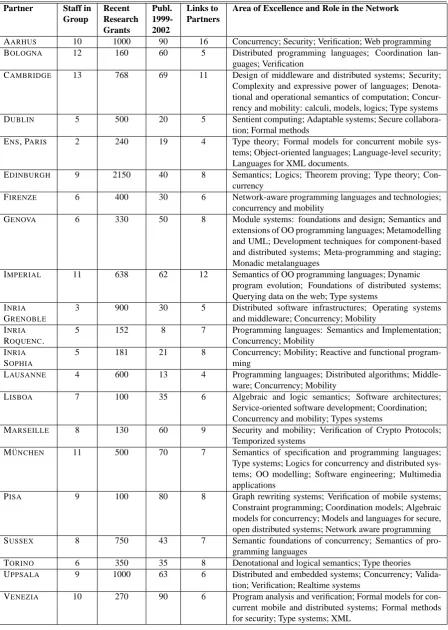
Although this is manifestly beyond the expertise of any single site, it transpires clearly from Table 1 that the joint expertise of the core sites of our proposed network cover all these aspects. The critical mass we bring to-gether is remarkable, in that it is very homogeneous for research focus and interests, whilst being very hetero-geneous for techniques and approaches to GC research, and will trigger common activity and results. The forth-coming project proposal will detail the initial activity making clear synergies and connections.
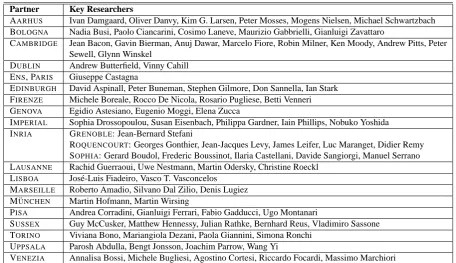
Table 1 shows the quality of the research groups in-volved and, in turn, the excellence of their universities. The figures therein refer to the number of full-time re-searcher (with at least four years experience) dedicated to FOG, the groups’ research income (in KEuro) in the last 12 months, the number of international refereed publications, and number of FOG’s partners with whom the site has an active institutional cooperation. Table 2 argues for the quality of the network’s individual mem-bers. They include the top European scientists in the field (with the noticeable omission of the people at MSR Cambridge).
3
Activities of the Network
The scientific activities of the network can be classified into research, integration and dissemination activities. We outline the main point of each of these below.
Research Activities. FOG’s research activity aims at establishing solid foundations for the software technol-ogy of the future, dealing with the complexity of the es-sential aspects of GC. To gain a leading edge in the field will be crucial for the success of European industry, and one of the challenges FOG will be facing throughout
its lifetime is to enhance its ability to impact industry. More immediately, the purpose of foundational theories is to provide a formal understanding of the difficulties of GC, as well as new specification formalisms to cope with them and to develop the corresponding verification techniques.
Before discussing some of the gaps theory needs to address, it is worth remarking that foundations will be directly useful for a series of programmer level ab-stractions that FOGwill positively develop, prototype, and experiment with. A programming paradigm for GC requires a blend of features not present in cur-rent programming languages. These include, network-awareness and mobility (ambient-based technology), encapsulation and controlled access to resources (ob-ject-based technology), security (static type-based and dynamic execution-monitoring), searching for services (enhanced tuple-space and pattern matching), reusabil-ity and customisation to user needs and local envi-ronment (generative components, dynamic assembly, mixin modules), reconfiguration and adaptability to en-vironment changes. Object technology itself needs to be improved to support the evolution of code and inter-faces at run-time, as well as the deployment of service-oriented software architectures. FOG will engage in experimental distributed implementation of program-ming languages and libraries that integrate and reforce mainstream programming practice for GC, in-cluding mechanisms for mobility, security, coordina-tion, service-orientacoordina-tion, and fault-tolerance. It will also focus on critical large-scale distributed execution platforms, such as distributed operating systems and middleware architectures.
Programming abstractions which will be considered, both for design and for implementation, include the fol-lowing.
. Network-aware programming languages, and their experimentation on non-trivial applications.
. Programming languages for space-restricted com-putation to be used in e.g. smart cards, wearable computers and mobile phones.
. Programming languages and component infras-tructures well suited for the construction of web services. Generative programming, mixin mod-ules and types here will have to be compatible with the multilingual nature of the programming environment. Such languages will interoperate smoothly with mainstream languages and attempt to unify major programming paradigms, e.g. such us the object-oriented and the functional.
will be powerful pattern matching, very rich type systems and precise type inference.
Such a body of experimental activity needs theoret-ical support. Often, the relevant theory does not exist and will have to be developed. FOG will provide for that by focusing on models, semantics, specifications, and types. A fundamental activity will be to design new expressive foundational calculi in which a wide variety of phenomena (mobility, security, uncertainty, trust) can be described. Such calculi will require a semantic the-ory to support new reasoning principles, and new logics for expressing network and agent behaviours, as well as specification and verification techniques. The coordina-tion aspects of mobile code will be studied by defining new models under the hypothesis of open environments with dynamically reconfigurable topologies supporting both physical and logical mobility. Further along this avenue, FOGwill develop a formal model for the sep-aration of the three main concerns involved in service-oriented architectures: computation, coordination, and distribution.
A parallel research stream will address the develop-ment of process calculi for mobile object-oriented pro-grams, by relying on a mixin-based approach and, in general, on integrated formal models of concurrency, mobility and object-oriented programming.
Following an established trend, types will provide a fundamental vehicle for the analysis and enforcement of security. Among the issues of major interest is the study of mixed static/dynamic techniques, including the design of type systems supporting run-time type check-ing of (part of) programs and dynamic change of the capabilities assigned to them.
From the specification point of view, FOG will
ex-tend the standard modelling language UML for GC, and integrate it with formal validation and verification methods. Due to its inherent complexity, GC requires new software engineering techniques; to be applicable in practice these need to be compatible with UML, the standard of semiformal engineering methods. The in-tegration with UML will be a major factor to import the new technology into the typical SME’s development process, as software engineers will easily adapt to it.
Semi-structured data play an important role in the exchange of information between globally distributed applications. A key example is XML, the universally agreed standard for describing and exchanging data on the Web. FOG’s work on languages for XML process-ing and queryprocess-ing will be supported by the study of their formal foundations and their relationships to logical for-malisms, issues that are poorly understood at present. In particular, FOGwill focus on spatial logics for semi-structured data and their application to query languages. The power of spatial logics is that they can reason lo-cally about a property’s truth value, and hence integrate
well with models of distributed data. FOG’s ambition is to achieve a level of understanding of query languages for semi-structured data which rivals that of languages associated with the relational model.
Among the most challenging requirements of the GC infrastructure is security. FOGwill be concerned with the design and semantics study of processes with cryp-tographic primitives, as well as the development of tools for their analysis. Validation of cryptographic proto-cols will be one of the main applications of the theory. A challenging goal will be to develop decision meth-ods (exact or approximated) for fragments of first-order logic suitable to express the specifications of such pro-tocols, and to evaluate them on real examples.
Further on verification, we plan to advance the state of the art on formal modelling and automated checking and testing of (realtime) systems with a dynamic pro-cess and linking structure, and develop the correspond-ing tools. We will work on semi-automatic verification for globally distributed systems, such as entire phone networks and ‘the grid.’
Integration Activities. FOG’s work-programme will make provisions for the integration of its partners to last beyond the natural end of the Commission’s finan-cial support. The programme will include the creation of joint research infrastructure, including common pro-grammes to provide education by training and research. The consortium will commit to exchange of PhD stu-dents and research fellows. An exchange programme will be set up that enhances quality and timeliness of research, whilst maximising the opportunity for young researcher to receive training on GC at the highest level in the best suitable European institution.
The consortium will keep a positively open-ended at-titude, trying to tighten links with new emerging groups, as well as to attract top researchers from all over the world to visit or even be recruited by the participating sites. In addition FOGwill issue open calls for SMEs to join the consortium on specific experimental tasks or for the selection of case studies of real interest. In this way, we will set up small collaborative projects with potential users.
FOG will organise scientific meetings and internal workshops at regular intervals, so as to guarantee that partners are fully aware of advances obtained at the var-ious sites. The leadership of such meetings will be cir-culated among the core sites. It is envisaged that the links between partners will tighten along the duration of the project, so as to become ‘hardwired’ into their future GC activities.
are committed to spreading excellence by novel means devised specifically for this project’s purposes. These include organising scientific meetings and workshops on the subject of GC with active industrial participa-tion. Excellence will be pursued also by initiating joint programmes for training of young researcher, both at master and doctoral level. FOGwill also organise train-ing activities for the dissemination of GC literacy to small and medium enterprises (SME). The preferred method will be to package results into course material and teach courses at various levels, including summer schools for PhD students and mini courses for potential users. Following such a strategy, FOG will reach re-searchers, users groups, as well as industries, contribut-ing to international standards and feedcontribut-ing input to EU and national policy makers.
FOGwill found a yearly scientific meeting on GC and make of it the worldwide meeting point for the interna-tional GC community. The success of such a meeting, both in terms of participants and number and variety of scientific works submitted, will be an objective measure of the consortium’s success in upholding FOG’s aims.
FOG’s dissemination strategy will include the release of research software, such as experimental program-ming languages, libraries, distributed systems, real case studies, and more, to demonstrate the ideas arising from its approach to GC.
4
Effects of the Network
The network’s success will have the effect to advance the foundational theories underpinning the development of programming languages and paradigms for GC, as well as the corresponding specification and verification techniques. Primary effects are also a tight, perma-nent integration between partners and the dissemina-tion of knowledge to young researchers and SMEs. A schematic view of the long term effects and results ex-pected of FOGis illustrated in Table 3.
The joint programme of activities is carefully de-signed to boost integration and multiply occasions of common scientific development. In particular, we ex-pect to advance the state of the art of several key en-abling technologies for the FP6’s IST vision by address-ing them by the joint strengths of the network members. The partners are committed to integration of research and educational programmes, by actively pursuing the adaptation of nationally funded (research) activities to the network’s activities. Among these, the design and realisation of common research and dissemination infrastructures, viz. joint programmes of studies and a detailed institutional plan for short/middle-term ex-changes of research personnel: young researchers mov-ing to complete their formation, and senior ones brmov-ing- bring-ing new knowledge to partner institutions.
The role of SMEs. By the year 2010 an estimated 30% of SMEs will be using IST, in particular eBusi-ness, to carry out their business profitably. FOG’s work-programme will thus address central needs of SMEs, and impact them both indirectly, as our research topics underly the deployment of eBusiness applications, and directly, by means of open calls to participate in the net-work’s activities and to inform the consortium by pre-senting major problems and challenges. SMEs will also be called to attend FOG’s dissemination activity.
The structuring effect. FOG has the potential for triggering a very long term institutional collaboration between its partners. As shown in Table 1 (column ‘Links to Partners’, that counts the institutional, official relationship of each site with the others), the partners have already a long history and a solid pattern of collab-oration. This witnesses the extent, quality, and duration of the integration FOGproposes. The network will work to establish a permanent structuring and integrating ef-fect on the European research in the field. In particular, it will reduce the level of fragmentation of the research and facilitate a united European strategy on GC, both by providing the context for constant dialogue among the main researchers in the field. As a matter of fact, due to its pervasive presence in future applications, GC could very well be a suitable topic for a major European scheme of training young researchers based on a dedi-cated grant from EU. It is envisaged that the network’s dissemination and training programme (mini courses, summer schools, PhD courses, etc) will have the effect of giving rise to a European school of GC.
5
Management of the Network
The network will have a Coordinator (for the Commis-sion to interact with) whose role will be as indicated in the Commission’s documents. Furthermore, there will be a Governing Council formed by senior representa-tives of the core partners. Assistant partners will be se-lected as the need arises, mainly to incorporate emerg-ing groups and isolated researchers into the network, and for selecting SMEs willing to propose interesting, real case studies and engage into experimental activ-ity in the network. FOGwill have an Industrial Board formed by people from industry. An initial list of poten-tial candidates is given in Table 4 who will be contacted in due time. Senior researchers among those in Table 2 will be responsible for units of FOG’s activity and will act as site leaders.
Partner Staff in Group
Recent Research Grants
Publ. 1999-2002
Links to Partners
Area of Excellence and Role in the Network
AARHUS 10 1000 90 16 Concurrency; Security; Verification; Web programming BOLOGNA 12 160 60 5 Distributed programming languages; Coordination
lan-guages; Verification
CAMBRIDGE 13 768 69 11 Design of middleware and distributed systems; Security; Complexity and expressive power of languages; Denota-tional and operaDenota-tional semantics of computation; Concur-rency and mobility: calculi, models, logics; Type systems DUBLIN 5 500 20 5 Sentient computing; Adaptable systems; Secure
collabora-tion; Formal methods
ENS, PARIS 2 240 19 4 Type theory; Formal models for concurrent mobile sys-tems; Object-oriented languages; Language-level security; Languages for XML documents.
EDINBURGH 9 2150 40 8 Semantics; Logics; Theorem proving; Type theory; Con-currency
FIRENZE 6 400 30 6 Network-aware programming languages and technologies; concurrency and mobility
GENOVA 6 330 50 8 Module systems: foundations and design; Semantics and extensions of OO programming languages; Metamodelling and UML; Development techniques for component-based and distributed systems; Meta-programming and staging; Monadic metalanguages
IMPERIAL 11 638 62 12 Semantics of OO programming languages; Dynamic program evolution; Foundations of distributed systems; Querying data on the web; Type systems
INRIA GRENOBLE
3 900 30 5 Distributed software infrastructures; Operating systems and middleware; Concurrency; Mobility
INRIA ROQUENC.
5 152 8 7 Programming languages: Semantics and Implementation; Concurrency; Mobility
INRIA SOPHIA
5 181 21 8 Concurrency; Mobility; Reactive and functional program-ming
LAUSANNE 4 600 13 4 Programming languages; Distributed algorithms; Middle-ware; Concurrency; Mobility
LISBOA 7 100 35 6 Algebraic and logic semantics; Software architectures; Service-oriented software development; Coordination; Concurrency and mobility; Types systems
MARSEILLE 8 130 60 9 Security and mobility; Verification of Crypto Protocols; Temporized systems
M ¨UNCHEN 11 500 70 7 Semantics of specification and programming languages; Type systems; Logics for concurrency and distributed sys-tems; OO modelling; Software engineering; Multimedia applications
PISA 9 100 80 8 Graph rewriting systems; Verification of mobile systems; Constraint programming; Coordination models; Algebraic models for concurrency; Models and languages for secure, open distributed systems; Network aware programming SUSSEX 8 750 43 7 Semantic foundations of concurrency; Semantics of
pro-gramming languages
TORINO 6 350 35 8 Denotational and logical semantics; Type theories UPPSALA 9 1000 63 6 Distributed and embedded systems; Concurrency;
Valida-tion; VerificaValida-tion; Realtime systems
[image:6.595.75.524.101.732.2]VENEZIA 10 270 90 6 Program analysis and verification; Formal models for con-current mobile and distributed systems; Formal methods for security; Type systems; XML
Partner Key Researchers
AARHUS Ivan Damgaard, Oliver Danvy, Kim G. Larsen, Peter Mosses, Mogens Nielsen, Michael Schwartzbach BOLOGNA Nadia Busi, Paolo Ciancarini, Cosimo Laneve, Maurizio Gabbrielli, Gianluigi Zavattaro
CAMBRIDGE Jean Bacon, Gavin Bierman, Anuj Dawar, Marcelo Fiore, Robin Milner, Ken Moody, Andrew Pitts, Peter Sewell, Glynn Winskel
DUBLIN Andrew Butterfield, Vinny Cahill ENS, PARIS Giuseppe Castagna
EDINBURGH David Aspinall, Peter Buneman, Stephen Gilmore, Don Sannella, Ian Stark FIRENZE Michele Boreale, Rocco De Nicola, Rosario Pugliese, Betti Venneri GENOVA Egidio Astesiano, Eugenio Moggi, Elena Zucca
IMPERIAL Sophia Drossopoulou, Susan Eisenbach, Philippa Gardner, Iain Phillips, Nobuko Yoshida INRIA GRENOBLE: Jean-Bernard Stefani
ROQUENCOURT: Georges Gonthier, Jean-Jacques Levy, James Leifer, Luc Maranget, Didier Remy SOPHIA: Gerard Boudol, Frederic Boussinot, Ilaria Castellani, Davide Sangiorgi, Manuel Serrano LAUSANNE Rachid Guerraoui, Uwe Nestmann, Martin Odersky, Christine Roeckl
LISBOA Jos´e-Luis Fiadeiro, Vasco T. Vasconcelos MARSEILLE Roberto Amadio, Silvano Dal Zilio, Denis Lugiez M ¨UNCHEN Martin Hofmann, Martin Wirsing
PISA Andrea Corradini, Gianluigi Ferrari, Fabio Gadducci, Ugo Montanari
SUSSEX Guy McCusker, Matthew Hennessy, Julian Rathke, Bernhard Reus, Vladimiro Sassone TORINO Viviana Bono, Mariangiola Dezani, Paola Giannini, Simona Ronchi
UPPSALA Parosh Abdulla, Bengt Jonsson, Joachim Parrow, Wang Yi
VENEZIA Annalisa Bossi, Michele Bugliesi, Agostino Cortesi, Riccardo Focardi, Massimo Marchiori
Table 2: KEYRESEARCHPERSONNEL
Expected Result Users / Effects of the Results
Programming languages and paradigms for GC Sofware designers, developers, and engineers; Software compa-nies; Application service providers; Manufacturers of embedded devices; Web site developers.
Specification and verification techniques for GC. Security policy designers, engineers, and administrators; Com-puting center administrators; Protocol designers; Academic re-searchers.
Calculi, models and types for GC. Programming language designers; Protocol designers; Academic researchers.
Integration of the partners; Spreading of excellence; The creation of a European school of GC; A structur-ing effect on the field and a consequent defragmenta-tion of research base.
Achieved by means of adaptation of national research and teach-ing schemes and by packagteach-ing research material into courses of various levels, this will reach: PhD students, young researchers, SMEs, and the European Research Area (ERA) in general.
Table 3: THEEFFECTS OF THENETWORK
Company Contact Person Company Contact Person
ALTRAN (I) Renato Bellavita ATX Software (P) Luis Andrade
Cryptomatic (DK/UK) Peter Landrock Microsoft Research (UK) Luca Cardelli, Andrew D. Gordon EDS (UK) Sharman Walker FAST GmBH (D) Rudolf Haggenm¨uller
France Telecom R&D (F) Pierre Cregut Marconi (UK) Derek Macaulay Protos Software (D) Klaus Birken Softlab GmBH (D) G¨unther Merbeth Telecom Italia Lab Corrado Moiso
[image:7.595.68.525.100.363.2]OTHERINTERESTEDPARTIES: ASTEC (SE); British Telecom (UK); BMW (D); Cryo Networks (F); DataCall Systeme (D); Ericsson (SE); Fluxmedia (F); Gemplus (DK/F); Infineon (D); MediaOnAir Technologies (D); Telecom Italia Mobile (I); TXT E-Solutions (I)