The intermolecular potential energy surface of the He
"
NO
¿cationic complex
Pavel Solda´na)
Department of Chemistry, University of Durham, South Road, Durham DH1 3LE, United Kingdom
Edmond P. F. Leeb)
Department of Chemistry, University of Southampton, Highfield, Southampton SO17 1BJ, United Kingdom and Department of Applied Biology and Chemical Technology, Hong Kong Polytechnic University, Hung Hom, Hong Kong
Timothy G. Wrightc)
School of Chemistry, Physics and Environmental Science, University of Sussex, Falmer, Brighton BN1 9QJ, United Kingdom
共Received 15 October 2001; accepted 16 November 2001兲
Close-coupling calculations of bound rotational and vibrational states are carried out on a new intermolecular potential energy function based on 200 energies of the He•NO⫹ cationic complex calculated at the coupled-cluster single double 共triple兲/aug-cc-pV5Z ab initio level of theory at a range of geometries and point-by-point corrected for basis set superposition error. The potential energy function is constructed by combining the reciprocal power reproducing kernel Hilbert space interpolation with Gauss–Legendre quadrature. The best estimate of the intermolecular dissociation energy, De, is 198⫾4 cm⫺1, obtained by extrapolations to the complete basis set limit, and
calculating estimates for relativistic effects and core and core-valence correlation effects. © 2002 American Institute of Physics. 关DOI: 10.1063/1.1433507兴
I. INTRODUCTION
The interaction between a rare gas atom and a closed-shell diatom represents one of the simplest atom–molecule interactions. Such interactions are, however, difficult to study as the surfaces are very shallow, and zero-point energies of-ten form a large percentage of the total binding energy, lead-ing to very floppy systems. On the other hand, complexes between a rare gas atom and a closed-shell cation are much more strongly bound. In addition, such species are a good test of the accuracy and reliability of modern ab initio meth-ods, as the whole potential energy surface 共PES兲 may be calculated with modern codes and computers. Such PESs may be employed to calculate spectroscopic quantities, which may be compared to experiment, where available, and the reliability of the methodology judged. Such surfaces are of use in the calculation of transport properties1 and colli-sional dynamics.2– 4The interaction between NO⫹and He is also inevitably important in the detailed understanding of NO⫹ embedded in helium droplets: Callicoatt et al.5 have shown that He⫹ charge transfers to NO with a very high probability in such an environment. In addition, the work is also pertinent to Rydberg states of NO interacting with rare gas matrices and liquid rare gases.6
There have been several theoretical studies of the He
•NO⫹ species. Robbe et al.7 performed a CIPSI set of cal-culations using a relatively small basis set, generating a PES
for He•NO⫹. They deduced a single energy minimum at R ⫽2.96 Å and⫽109.9°, where R and are Jacobi coordi-nates, defined in Sec. II. Zenevich et al.2generated a global PES based on the Gislason–Ferguson model,8 but with a number of assumptions about various parameters. The most detailed surface prior to the present study was that from Pogrebnya et al.3Their surface was based on 210 points cal-culated at the CCSD共T兲ab initio level of theory. The basis set consisted of the sp functions from the standard aug-cc-pVQZ basis set, combined with the d and f functions from the standard aug-cc-pVTZ basis set for N and O, with the He basis set being (8s3 p2d)/关4s3 p2d兴. By comparing the cal-culated dissociation energy employing this basis set with that calculated using aug-cc-pVQZ 共no g兲 and the full aug-cc-pVQZ basis sets, it was concluded that the resulting surface should be very accurate. The dissociation energy was calcu-lated to be De⬇186.5 cm⫺1, the minimum energy geometry being R⫽2.80 Å and ⫽79.8°. Finally, Viehland and co-workers1 recently calculated a surface at the MP4共SDTQ兲/6-311⫹G共2df,p兲 level of theory, obtaining a minimum energy geometry of R⫽2.90 Å and ⫽80°. We note that recently we calculated the dissociation energy of He•NO⫹ using a variety of basis sets from aug-cc-pVDZ through to aug-cc-pV5Z employing MP2, MP4, QCISD共T兲, and CCSD共T兲methods. In that work, our best value for dis-sociation energy of He•NO⫹ was De⫽192.1 cm⫺1obtained
at the CCSD共T兲/aug-cc-pV5Z//QCISD/aug-cc-pVTZ level of theory.9
The present work also follows on from that of Ar•NO⫹, whose PES has been investigated by Wright and co-workers in some detail.10–12In that work, it was found that the MP2 a兲Author to whom all correspondence should be addressed; electronic mail:
b兲Electronic mail: [email protected] c兲Electronic mail: [email protected]
2395
method performed to a very high level of accuracy with re-gard to the vibrational frequencies, although it was clear that this was due to a fortuitous cancellation of errors. The He
•NO⫹complex is more weakly bound than Ar•NO⫹, owing to the lower polarizability of He compared to Ar. Conse-quently the basis set superposition error is likely to be, per-centagewise, more important, and therefore using a rather large basis set and performing a full counterpoise correction13at each point is necessary. In addition, the high-est available level of theory should be used in order to mini-mize the effects of various approximations on the values of interaction energy.
II. CALCULATIONAL DETAILS
A.Ab initio calculations
As the quality of an ab initio interaction potential de-pends greatly on the computational method and basis set employed, our aim is to generate the He•NO⫹ potential en-ergy surface at the highest affordable level of theory. In the present work, we have used a closed-shell variant of the coupled-cluster method14with direct single and double exci-tations and a perturbative treatment of triples 关CCSD共T兲兴. An augmented correlation-consistent polarized valence quintuple-zeta basis set15共aug-cc-pV5Z兲has been used in its contracted form for He, N, and O. The resulting basis set consists of 334 contracted Gaussian-type orbitals共GTOs兲 in-cluding higher angular momentum and diffuse basis func-tions. There are 80 GTOs on He 关6s5 p4d3 f 2g兴 and 127 GTOs 关7s6 p5d4 f 3g2h兴 on both N and O. Only valence orbitals were correlated in the calculations, i.e., orbitals 1s on O and 1s on N were kept frozen in the coupled-cluster cal-culations.
Jacobi coordinates R,, and r were used to parametrize the molecule. R is the distance of He to the center of mass
共c.m.兲of NO⫹, corresponds to the angle He–c.m.–N, and r is the NO⫹bond length. The NO⫹bond length r was kept fixed at its experimental equilibrium value,16 re⫽1.063 22
Å. Interaction and vibrational energies are reported with re-spect to the He⫹NO⫹dissociation limit.
The intermolecular potential, V(R,), is defined as the electronic energy, W(R,), of the complex with respect to that of the monomers. In practice, it is important to include the counterpoise correction13 for the basis set superposition error, so that the monomer energies are calculated in the complete supermolecular basis set 共and therefore dependent on R and)
V共R,兲⫽WHeNO⫹共R,兲⫺WHe共R,兲⫺WNO⫹共R,兲.
共1兲 The comparison of monomer energiesWHeandWNO⫹ with those calculated in the monomer basis set alone shows that the total basis set superposition error is not larger than 3 cm⫺1 in the region of the potential well. This indicates that basis set superposition error is almost converged with respect to the basis set. The counterpoise-corrected interaction ener-giesV(Ri,j) were calculated for 200 points on the product
grid (Ri,j), where Ri⫽1.0, 1.3,1.5, 1.65, 1.8, 2.0, 2.2, 2.4,
2.6, 2.7, 2.8, 2.9, 3.0, 3.2, 3.5, 4.0, 5.0, 7.0, 10.0, 15.0 and
j, j⫽1, . . . ,10, were selected so that cosjare the zeros
of the Legendre polynomial P10(x). All ab initio calculations were carried out using theMOLPRO 2000.1program suite.17,18
B. Potential energy surface
The potential energy function V(R,) used for the bound-state calculations was represented in terms of radial functions V(R) and Legendre polynomials P(cos)
V共R,兲⫽
兺
⫽09
V共R兲P共cos兲. 共2兲
The radial functions were constructed from the ab initio points, V(Ri,j), by combining the reciprocal power repro-ducing kernel Hilbert space interpolation procedure
共RP-RKHS兲19,20with Gauss–Legendre quadrature
V共R兲⫽
兺
i⫽1 20
␣i
[n,m]
q[n,m]共Rl,Ril兲, 共3兲
where
␣i
[n,m]⫽2⫺1 2 j
兺
⫽110
wj␣i
[n,m]共
j兲P共cosj兲 共4兲
and wjare Gauss-Legendre weights corresponding to
abscis-sas cosj, j⫽1, . . . ,10. For each j the coefficients
␣i
[n,m](
j) are solutions of the system of linear equations
V共Rk,j兲⫽
兺
i⫽1 20␣i
[n,m]共
j兲q[n,m]共Rk l
,Ril兲,
k⫽1, 2, . . . ,20. 共5兲
In order to obtain the correct long-range behavior21 of the interaction potential
V共R,兲⬃⫺C4 R4⫺
C6共兲
R6 ⫹¯, 共6兲
we choose l⫽2 and the RP-RKHS parameters as m⫽1 and n⫽2, i.e.,
q[2,1]共x, y兲⫽ 2 3 z⬎2
冉
1⫺1
2 z⬍
z⬎冊, 共7兲
where z⬍⫽min(x,y) and z⬎⫽max(x,y). This choice also en-sures that the radial functions V(R), as well as their first and second derivatives, are continuous.
C. Bound states
momentum J and parity, is written as a set of coupled differ-ential equations in R. The close-coupled equations were solved using the diabatic modified log-derivative method,23 for step sizes h⫽0.005 and 0.01 Å with a grid from 1.6 to 30.0 Å. The results were extrapolated to zero step size using the Richardson h4extrapolation.24The resulting eigen-values are converged to better than 0.001 cm⫺1. The actual bound-state calculations were carried out using the BOUND
program.24,25
III. RESULTS AND DISCUSSION
A. Equilibrium geometry and the potential energy surface
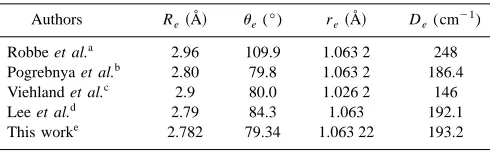
The contour plot of the resulting intermolecular potential energy surface is shown in Fig. 1. It has a single minimum at Re⫽2.782 Å,e⫽79.34° at an energy of 193.2 cm⫺1 with respect to the He⫹NO⫹ asymptote. These values are com-pared to previous ab initio calculations1–3,7,9in Table I.
As in the case of the Ar•NO⫹cationic complex,10–12our surface differs significantly from that of Robbe et al.7 Con-trary to Ref. 7 our results indicate that He is lying on the nitrogen side of the molecule. Viehland et al.1used the NO⫹ bond length fixed at the value obtained from an HF/6-311 ⫹G共2df,p兲geometry optimization, and this value differs
sig-nificantly from the experimental NO⫹bond length. Although they did not correct the potential energies for the basis set superposition error, their minimum energy geometry agrees reasonably well with ours. It is clear from the values in Table I that the results from Ref. 3 are extremely close to the val-ues obtained herein.
For the present surface, linear saddle points are located at R⫽3.487 Å for He–NO⫹ and at R⫽3.277 Å for He–ON⫹, 98.7 and 112.7 cm⫺1 below the dissociation threshold respectively.
B. Rovibrational states
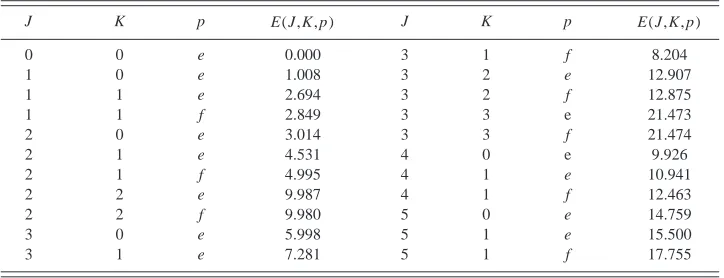
Vibrational energy levels are presented in Table II. In order to get an approximate assignment we also performed calculations in the adiabatic approximation. The assignment is given in terms of the stretch,, and bend,, quantum numbers, and is presented together with the corresponding adiabatic energies in Table III. At low energies, this assign-ment is probably quite reasonable; however, to higher en-ergy, the coupling of the bend and stretch vibrations will eventually render an assignment in terms of these quantum numbers meaningless. These energies should prove useful in the assignment of either infrared spectra of He•NO⫹ or ZEKE photoelectron spectra of He•NO.
[image:3.612.74.274.48.245.2]The results of rotational energy calculations are shown in Table III for the ground vibrational state. At low J, the assignment should be relatively reliable and these values should prove useful in the assignment of microwave or rota-tionally resolved infrared spectra of He•NO⫹. However, at high J the rotational energy spacing will become comparable to the vibrational energy spacing, and almost free internal rotation of NO⫹will occur, making assignment of rotational levels difficult.
[image:3.612.314.561.83.269.2]FIG. 1. Contour plot of the potential energy surface of He•NO⫹.
TABLE I. Equilibrium geometry and dissociation energy of He•NO⫹.
Authors Re共Å兲 e(°) re共Å兲 De(cm⫺
1
)
Robbe et al.a 2.96 109.9 1.063 2 248
Pogrebnya et al.b 2.80 79.8 1.063 2 186.4
Viehland et al.c 2.9 80.0 1.026 2 146
Lee et al.d 2.79 84.3 1.063 192.1
This worke 2.782 79.34 1.063 22 193.2
a
refixed; Ref. 7.
br
efixed; Ref. 3.
cr
efixed; Ref. 1.
dFull 3D optimization at the QCISD/aug-cc-pVTZ level of theory; D
e
cal-culated and counterpoise-corrected at the CCSD共T兲/aug-cc-pV5Z level of theory; Ref. 9.
er
[image:3.612.52.297.613.689.2]efixed at the experimental value.
TABLE II. Calculated intermolecular vibrational levels (cm⫺1) of He
•NO⫹( denotes the intermolecular stretch anddenotes the intermo-lecular bend; the assignment of the higher energy levels is tentative兲.
 Adiabatica Nonadiabaticb
0 0 ⫺131.535 ⫺129.353
0 1 ⫺106.759 ⫺102.940
0 2 ⫺83.926 ⫺84.464
1 0 ⫺68.580 ⫺70.079
0 3 ⫺62.147 ⫺58.298
1 1 ⫺51.184 ⫺53.245
0 4 ⫺39.174 ⫺38.560
1 2 ⫺33.555 ⫺33.713
2 0 ⫺28.801 ⫺27.974
2 1 ⫺17.822 ⫺17.399
1 3 ⫺13.779 ⫺15.554
0 5 ⫺13.329 ⫺13.764
3 0 ⫺9.119 ⫺7.268
2 2 ⫺4.590 ⫺3.561
3 1 ⫺2.268 ⫺1.786
4 0 ⫺1.869 ⫺0.218
aAdiabatic approximation calculation. bClose-coupling calculation.
2397
C. Dissociation energy
As may be seen from Table I, the value for the dissocia-tion energy from Robbe et al.7is far too high: since it is clear from the fact that their minimum energy geometry is in dis-agreement with that obtained by ourselves and those from Refs. 1 and 3, we conclude that there is something funda-mentally wrong with that PES and discuss it no further.
The binding energy is severely underestimated in Ref. 1 when compared to our value of 193.2 cm⫺1. Moreover, as mentioned previously, no counterpoise correction for basis set superposion error was made by Viehland et al.,1and this would make the dissociation energy even lower. The basis set they used is rather small, and we have previously shown9 that the basis set is the main factor in calculating the disso-ciation energies of the Rg•NO⫹cationic complexes at a cor-related ab initio level.
On the other hand, the value from Ref. 3 is in a good agreement with our value; however, it is clear that the basis set limit has not yet been reached in either study. For this reason we perform further calculations and use extrapolation techniques to obtain a better estimate of the dissociation en-ergy 共see the following兲.
At the minimum energy geometry of the potential energy surface additional single-point CCSD共T兲 calculations were performed using s-aug-cc-pVXZ, X⫽T,Q,6, and d-aug-cc-pVXZ, X⫽T,Q,5, where s-aug-cc-pVXZ 共s implies singly augmented兲is actually the standard aug-cc-pVXZ basis set, and d-aug-cc-pVXZ is the aug-cc-pVXZ basis set augmented in the even-tempered manner by additional set of diffuse functions 共d implying doubly augmented兲. The results of these additional single-point calculations are summarized in Table IV 共all interaction energies were counterpoise cor-rected for the basis set superposition error兲. As may be seen, the results obtained using the d-aug-cc-pVXZ basis sets
con-verge slightly faster than those obtained using the s-aug-cc-pVXZ ones. As the quality of basis sets is improved with increasing X, the most reliable estimate of the interaction energy in the complete basis set limit, ⌬E(Re,e;⬁),
should be obtained by extrapolating energies corresponding to the highest X values. Applying the two-point extrapolation formula
⌬E共Re,e;X兲⫽⌬E共Re,e;⬁兲⫹A共Re,e兲X⫺3 共8兲
by Helgaker et al.26,27to the aug-cc-pVXZ, X⫽5,6, interac-tion energies we obtain 198.7 cm⫺1. The same formula ap-plied to d-aug-cc-pVXZ, X⫽Q,5, gives 198.1 cm⫺1. How-ever, these values are still subject to errors that arise from relativistic, and core and core-valence correlation effects.
An estimate of the relativistic corrections to the interac-tion energy were made by computing the expectainterac-tion values of the mass-velocity and one-electron Darwin integrals within the Cowan–Griffin approach28 at the Hartree–Fock level. The correction was found to be negligible (⬇0.04 cm⫺1).
An all-electron-correlated calculation with augmented correlation-consistent polarized core-valence quadruple-zeta basis set, aug-cc-pCVQZ,29compared to frozen-core aug-cc-pVQZ calculation indicated that the interaction energy would decrease by about 3.5 cm⫺1 owing to the core and core-valence correlation effects. Overall, then, we cite a final value of⌬E(Re,e;⬁)⫽198⫾4 cm⫺1. Because the level of
theory used to generate the He•NO⫹potential energy surface is very high, we believe that the position of the He•NO⫹ minimum is well determined. Therefore we will use the value of⌬E(Re,e;⬁) as an estimate of the He•NO⫹ inter-molecular dissociation energy De⫽198⫾4 cm⫺1.
IV. CONCLUSIONS
[image:4.612.126.488.63.202.2]The He•NO⫹ cationic complex has been investigated using high level ab initio methods. A high-quality potential energy function was constructed from 200 energies calcu-lated at the CCSD共T兲/aug-cc-pV5Z level of theory and coun-terpoise corrected for the basis set superposition error. Vibra-tional energy levels supported by this potential energy surface, and rotational energy levels of the ground vibra-tional state were determined by close-coupling calculations. In addition, the intermolecular dissociation energy was cal-culated using a range of correlation-consistent basis sets and
TABLE III. Calculated rotational energies (cm⫺1) of the ground vibrational state (
⫽0,⫽0).
J K p E(J,K, p) J K p E(J,K, p)
0 0 e 0.000 3 1 f 8.204
1 0 e 1.008 3 2 e 12.907
1 1 e 2.694 3 2 f 12.875
1 1 f 2.849 3 3 e 21.473
2 0 e 3.014 3 3 f 21.474
2 1 e 4.531 4 0 e 9.926
2 1 f 4.995 4 1 e 10.941
2 2 e 9.987 4 1 f 12.463
2 2 f 9.980 5 0 e 14.759
3 0 e 5.998 5 1 e 15.500
[image:4.612.54.298.691.756.2]3 1 e 7.281 5 1 f 17.755
TABLE IV. CCSD共T兲intermolecular interaction energies (cm⫺1) calculated
at the CCSD共T兲/aug-cc-pV5Z counterpoise-corrected minimum using s-aug-cc-pVXZ and d-aug-s-aug-cc-pVXZ basis sets.
X s-aug-cc-pVXZ d-aug-cc-pVXZ
T 181.4 185.0
Q 189.1 193.3
5 193.2 195.6
extrapolated to the complete basis set limit. By calculating estimates of the relativistic, and core and core-valence cor-relation corrections, we obtain a final value of De⫽198⫾4
cm⫺1.
ACKNOWLEDGMENTS
The authors would like to thank the EPSRC for the award of computer time at the Rutherford Appleton Labora-tories, which enabled the ab initio part of these calculations to be performed. P.S. would like to thank the EPSRC for his present funding at Durham共Senior Research Assistantship兲. E.P.F.L. is grateful to the Research Committee of the Hong Kong Polytechnic University for support. T.G.W. would like to thank the EPSRC for the award of an Advanced Fellow-ship.
1
L. A. Viehland, A. S. Dickinson, and R. G. A. R. Maclagan, Chem. Phys. 211, 1共1996兲.
2V. A. Zenevich, W. Lindinger, S. K. Pogrebnya, M. Cacciatore, and G. D.
Billing, J. Chem. Phys. 102, 6669共1995兲.
3
S. K. Pogrebnya, A. Kliesch, D. C. Clary, and M. Cacciatore, Int. J. Mass Spectrom. Ion Processes 149Õ150, 207共1995兲.
4R. Baranowski and M. Thachuk, J. Chem. Phys. 111, 10061共1999兲. 5B. E. Callicoatt, D. D. Mar, V. A. Apkarian, and K. C. Janda, J. Chem.
Phys. 105, 7872共1996兲.
6
F. Vigliotti and M. Chergui, Eur. Phys. J. D 10, 379共2000兲, and references cited therein.
7J.-M. Robbe, M. Bencheikh, and J.-P. Flament, Chem. Phys. Lett. 210,
170共1993兲.
8
E. A. Gislason and E. E. Ferguson, J. Chem. Phys. 87, 6474共1987兲.
9E. P. F. Lee, P. Solda´n, and T. G. Wright, J. Phys. Chem. A 102, 6858
共1998兲.
10T. G. Wright, V. Sˇpirko, and P. Hobza, J. Chem. Phys. 100, 5403共1994兲. 11T. G. Wright, J. Chem. Phys. 105, 7579共1996兲.
12A. M. Bush, T. G. Wright, V. Sˇpirko, and M. Jurˇek, J. Chem. Phys. 106,
4531共1997兲.
13S. F. Boys and F. Bernardi, Mol. Phys. 19, 553共1970兲. 14J. Cˇ ı´zˇek, J. Chem. Phys. 45, 4526共1966兲.
15D. E. Woon and T. H. Dunning, Jr., J. Chem. Phys. 100, 2975共1994兲. 16F. P. Billingsley II, Chem. Phys. Lett. 23, 160共1973兲.
17
MOLPROis a package of ab initio programs written by H.-J. Werner and P. J. Knowles with contributions from others; for more information see the web page http://www.tc.bham.ac.uk/molpro/
18The CCSD treatment is described in C. Hampel, K. Peterson, and H.-J.
Werner, Chem. Phys. Lett. 190, 1共1992兲; the program to compute pertur-bative triples corrections was developed by M. J. O. Deegan and P. J. Knowles.
19T.-S. Ho and H. Rabitz, J. Chem. Phys. 104, 2584共1996兲.
20T. Hollebeek, T.-S. Ho, and H. Rabitz, Annu. Rev. Phys. Chem. 50, 537
共1999兲.
21P. Solda´n and J. M. Hutson, J. Chem. Phys. 112, 4415共2000兲. 22J. M. Hutson, Adv. Mol. Vib. Collision Dyn. 1, 1共1991兲.
23D. E. Manolopoulos and D. Phil. thesis, University of Cambridge, 1988. 24J. M. Hutson, Comput. Phys. Commun. 84, 1共1994兲.
25
J. M. Hutson,BOUNDcomputer program, version 6共1993兲, distributed by Collaborative Computational Project No. 6 of the UK Science and Engi-neering Research Council.
26
T. Helgaker, W. Klopper, H. Koch, and J. Noga, J. Chem. Phys. 106, 9639 共1997兲.
27
A. Halkier, T. Helgaker, P. JÖrgensen, W. Klopper, H. Koch, J. Olsen, and A. K. Wilson, Chem. Phys. Lett. 286, 243共1998兲.
28
R. D. Cowan and D. C. Griffin, J. Opt. Soc. Am. 66, 1010共1976兲.
29D. E. Woon and T. H. Dunning, Jr., J. Chem. Phys. 103, 4572共1995兲. 2399