Variable Sociability in Agent-Based
Decision Making
Lisa Hogg and Nicholas R. Jennings
Department of Electronic Engineering, Queen Mary and Westfield College
London, England, E1 4NS
fl.m.hogg, [email protected]
Abstract. Multi-agent system research is concerned with the issues surrounding the performance of collections of interacting agents. A major concern, therefore, is with the design of the decision making mechanism that the individual agents employ in order to determine which actions to take to achieve their goals. An attractive and much sought after property of this mechanism is that it produces decisions that arerationalfrom the perspective of the individual agent. However, agents are also inherently social. Moreover, individual and social concerns often conflict, perhaps leading to inefficient performance of the individual and the sys-tem. To address these problems we propose a formal decision making framework, based on social welfare functions, that combines social and individual perspec-tives in a unified andflexible manner. The framework is realised in an exemplar computational setting and an empirical analysis is made of the relative perfor-mance of varyingly sociable decision making functions in a range of environ-ments.
1 Introduction
An increasing number of applications are being implemented as multi-agent systems in which individual agents interact with one another in pursuit of both individual and system goals. When building such systems, a number of fundamental design questions continually arise: what underlying motivations should the agents possess to achieve the required overall results?; how should agents make decisions given that they inhabit a multi-agent environment and that their choices effect others?; and to what extent should individual agent autonomy be sacrificed for global concerns? Answers to these basic questions are needed if robust and reliable agent-based systems are to be developed.
notions of social rationality [15, 14] are emerging. This notion of socially acceptable decisions has long been of interest in the field of socio-economics [9]. However, to date, there has been comparatively little cross fertilization with agent based computing research. To help rectify this situation, this research seeks to examine the link and use its insights to explore the conflict between individual and social concerns in multi-agent systems.
In addition to balancing individual and social concerns, agents typically need to op-erate in a resource bounded manner. They do not have unlimited time or computational resources. Moreover, such bounded rationality should be responsive tofluctuations in the amount of resources available. Hence, agents should be able to modify how they make decisions based on their current context. In our case, this means agents should be able to dynamically vary their balance between individual and social considerations depending on the amount of resources available in the system. Moreover, because com-puting the social effects of action choices consumes resources, agents need to be able to vary the effort they expend on this task. Thus, when resources are plentiful an agent may wish to expend a significant amount of effort computing the social implications of an important choice. However, when resources become scarce, the same agent may choose to adopt a computationally cheaper approach to the same decision.
As afirst step towards this long term vision, this paper investigates, in an empirical fashion, the feasibility and performance of socially rational decision making. We define a decision making framework based on work found in socio-economics that explicitly characterises how agents can determine which action to perform in terms of a balance between individual and social concerns. By being explicit about the constituent compo-nents, the framework provides theflexibility to enable agents to dynamically tune their operation in order to be as rational as possible in the prevailing circumstances. In partic-ular, this paper extends previous work in two main ways. Firstly, it describes a marriage of socio-economic and agent-based techniques to investigate how social reasoning can be effectively employed by an agent situated in a multi-agent system. Secondly, it stim-ulates ideas as to how social reasoning agents may be controlled in times of resource constraints, allowing inroads to be made in the construction of socially rational, re-source bounded reasoners.
The remainder of the paper is structured as follows. Section 2 details the socially rational decision making framework and introduces the multi-agent platform used in our empirical evaluation. Section 3 describes the experiments we performed to assess our hypotheses about socially rational decision making. Related work is discussed in section 4, followed by the conclusions and future work in section 5.
2 Balancing Con
fl
icting Needs
of subordinating an agent’s autonomy to the needs of the system. For this reason, we believe such top-down approaches fail to exploit the full potential of the agent-oriented approach; therefore we propose an alternative means of achieving the same end. Thus we wish to build agents from the micro to macro level, but still retain the benefits of a more social perspective. To this end, our approach is to incorporate an element of social consideration into each agent’s individual decision making function.
One means of achieving good system performance from the micro level is to in-corporate all the necessary social information into a single, amorphous utility function. This is the method that would be followed by advocates of traditional decision theoretic approaches. However, such an approach conceals important details of how (and why) the agent actually reasons. Such details are not only important for the analysis of agent behaviour, but also provide a vital tool to designers when building complex systems. Therefore we advocate an approach that provides detailed guidance as to how social agents may be constructed.
Making the theory of social decision makingfiner grained in this manner is also essential for progress on the issue of bounded social rationality. Here, parallels can be drawn between conceptions of meta-reasoning [19] and the idea of controlling the amount of social reasoning that should be performed by contracting and expanding the set of acquaintances the agent considers in its reasoning.
2.1 A Social Decision Making Framework
In order to ascertain the social impact of an action, an agent needs to be able to deter-mine the value that a state (as a result of an action) has for other individuals and possibly for the whole society. To do this, the agent needs to empathise with what others value (i.e. know how others value states and be able to make interpersonal comparisons). In this case, the social decision framework developed here builds upon and extends the idea of social rationality proposed by Jennings and Campos [15] and is based on Harsanyi’s social welfare function [13]. Social welfare functions werefirst introduced by sociologists and they deal with choice by a group of individuals in a society. The decision maker can either be a group making a joint decision or an individual making a choice that has global consequences. The general theory of social welfare is formalised as follows. A set of individuals If1 ::: ngmust produce a collective decision over a set of alternative social situations Afa
1
:::: a
m
g. Each individual has a preference or-deringPi
of the alternatives (this could be a simple ordinal ranking or a cardinal utility function). The group preference ordering, or social choice function, is some function W, such that W represents the preferences of the group:P
I
=W(P1 P
2
::: P
n
) (1)In Harsanyi’s formulation of social choice, each individual’s preferences are represented by a von Neumann-Morgenstern cardinal utility functionu
i
that obeys the standard axioms of Bayesian rationality [21]. Hence, in equation (1) the preference functionPI
becomes the utility functionUI
:U
I
=W(u1 u
2
In particular, W is defined to be the weighted summation of the individual utilities:
W(u
1
:: u
n
)= Xi
2I
i
ui
(3)where
i
represents the weight given to agent i’s utility function in the overall equa-tion. To be socially rational, an individual maximises W over the different alternatives. This function represents how an individual agent may judge states of the world from a moral or social perspective by taking into consideration the benefit to others of its course of action and weighing it against its own benefits. Harsanyi [13] has shown that his social welfare function satisfies the following important postulates. Firstly, the util-ity functions of all the individuals satisfy the axioms of rational behaviour under risk. Secondly, the social preference function (PI
) also satisfies these axioms. Finally, if all individuals are indifferent between any two alternatives, from the viewpoint of their personal preferences, then an individual j will be indifferent between them from the standpoint of its social preference function. This provides an invaluable link between conceptions of individual and social rationality.Our work adopts the basic mechanism of social choice defined in equation (3) (al-though see [17] for variants) as the means of ensuring that individual agents make so-cially responsible decisions. Using this formulation of social welfare, an individual has two separate preference orderings: its individual preferences (indicating an agent’s own preference structure); and its social preferences (representing what an agent believes is best for the society in which it is situated). The task of analysing how the agent de-cides what action to perform can be formulated by differentiating how the agent makes decisions in terms of what it expects to get out of the action itself and what effect the action has on others. The effect that an action has on other agents can be determined by examining their utility functions. This is a feasible method for agent systems consisting of tens of agents, which is our primary target. However, when the number grows to hun-dreds or even thousands, agents will have large acquaintance sets and the calculation of all the necessary utility functions will be computationally prohibitive in most cases. In such circumstances, the agent will need to control this calculation by considering how resource bounded it currently is (see section 5 for a further discussion of this point). A further potential difficulty with the approach we have advocated stems from the inclu-sion of the acquaintances’ utility functions. In an ideal world, each agent would know the utility function of all the other agents. However, in practice this is infeasible. Thus, in the formulation given here each agent uses an approximation,u
0, of what it believes the other agents’ utility functions to be. In terms of the balance between individual and social needs, equation (3) can be re-written as:
W
i
(aj
)=i
ui
(aj
)+ Xk
2fI
;i
gk
u 0k
(aj
) (4)individual or social concerns. Thus we can say at a coarse level, equation (4) becomes:
W
i
(aj
)=i
ui
(aj
)+soc
Xk
2fI
;i
gu 0
k
(aj
) (5)where
soc
is the weighting given to the social utility part of the function. To gain a perspective on the feasibility of using such a mechanism in practical systems, the above decision making function has been implemented in a multi-agent testbed and evaluated as follows.2.2 The Experimental Domain
The decision making framework was evaluated by applying it to the Phoenixfire fight-ing multi-agent simulation [8]. Here, the park is policed by severalfirebosses, each of which is responsible for a specific geographic region. Firebosses control a number of firefighting resources (bulldozers), that can be exchanged as and when necessary. The goal of thefirebosses is to preventfires claiming too much land. Hence, the success of an agent, and the utility it achieves, is measured as a function of land loss. The system’s overall utility can also be measured in this way (i.e. land lost in the whole park). In order to use the framework described in section 2.1, we assume that the agents’ util-ity functions are comparable1. Afireboss can estimate, given the current environmental conditions, how afire is likely to spread and it can therefore choose the most effec-tive allocation of its firefighting resources. These projections provide the agent with a means of determining the likely outcomes of different courses of action. Thus, for example, an agent can ascertain whether asking for a loan of resources from another fireboss is likely to be profitable. This choice is affected by the uncertainty of the reply of the other agents, and hence the decision maker will use a probability distribution based on whether the agent believes that i) there is afire in the other agent’s part of the park; and ii) whether the other agent is likely to give resources if it is possible for it to do so.
In what follows, we assume all agents are motivated towards the goal of reducing the amount of land lost as a result offires. If an action results in a large land loss, then that action has less utility in comparison with an action that produces lower land loss. Attaining more resources allows the agent to completefighting thefire more quickly and so is preferred to simplyfighting thefire with its current resources. However, asking for extra resources from another fireboss decreases that fireboss’s effectiveness (and utility) when it is faced with a fire of its own. Therefore agents need to be able to estimate the likely utility of a particular resource distribution to their acquaintances in terms of predicted land lost in their region. Agents do this by assessing whether a fire is likely to occur in the acquaintance’s area of the park and what effect particular resource distributions will have for the agent in this context (based on the acquaintance’s estimated utility function). This is then used in equation (5) to determine which action is socially preferred.
To illustrate the nature of social decision making in Phoenix, consider a scenario involving three agents (A, B and C)2, each of which has control over two bulldozers. If afire breaks out in A’s area, A must decide whether to ask B or C for extra resources or proceed tofight thefire with its current resources. By obtaining an extra bulldozer, A will probably reduce the amount of land it loses and hence increase its utility. However, taking a bulldozer from B or C reduces theirfirefighting power and hence decreases their expected utility in the event of a fire. In addition, sharing bulldozers involves overheads based on the time it takes to communicate, as well as the delay of waiting for the extra resource(s) to arrive. Furthermore, A is not certain that its request will be granted, hence time may be wasted if its request is refused. Against this background, A’s decision can be formulated in the following manner:
W(ask
C
)=
A u
A (ask
C )+
soc X
k 2fBCg u
0 k
(ask C
) (6)
whereW(ask
C
)represents the social welfare function of agent A asking agent C for a loan of resources,A
represents the weighting A gives to its own utility function,soc
is the weighting given to the social part of the utility equation andu0
k
is the expected utility function offireboss k. The utility functionsuA
andu0
k
capture the domain specific considerations detailed above, such as the likelihood of success and the communication overheads involved in requesting a bulldozer. Each agent uses a discrete probability distribution to represent the likelihood that a resource request is accepted. Initially all agents use the same distribution, but these are updated over time as a result of interaction and resource exchange between the agents (e.g. when resource requests are accepted or rejected). Agent A will compute similar formulations for its other options (ask B and fight thefire with current resources) and then select the action that maximises the social welfare.3 Evaluating the Effectiveness of Social Decision Making
Our aim is to evaluate the effectiveness of different decision making attitudes under varying levels of resource pressure. To this end, the experimental control variables are:
– The utility function weightings
i
andsoc
(from equation (5)). These values can be altered to implement a wide range of decision making strategies. Here we use the following values:0 : 1Selfless: care nothing about their own utility. These agents will not ask for help, but will grant any resource request that they receive (provided they are able to do so);
1 : 0Selfish: care only about their own utility. They will ask for resources from others, but will not loan out their own resources;
0.5 : 0.5Balanced: place equal concern on individual and social needs; 0.25 : 0.75Social tendency: are more social than selfish;
0.75 : 0.25Selfish tendency: are more selfish than social.
– The number offirefighting resources each agent controls (1, 2 or 3 bulldozers. In this context, 3 represents as many as the agent ever needs tofight a singlefire); – How fast eachfireboss can make a decision (slow, medium or fast).
Resource pressure is exerted by: (i) altering the number of resources an agent con-trols and (ii) manipulating how quickly an agent can make its decisions. A given simu-lation run involves specifying when and wherefires occur, how large they are initially, and what the environmental conditions are (wind speed etc.). Each run is randomly generated, involving between 2 and 6fires. Statistically significant results are obtained by averaging over 12 runs. There are sixfirebosses in these experiments; although this number represents a fairly small multi-agent system, it nevertheless provides a reason-able indication of the feasibility of our decision making mechanism.
Two broad types of experiment were carried out. Firstly, ones where all agents used the same decision making attitude (section 3.1). This is to ascertain the performance profile of the various attitudes under varying resource constraints. Secondly, those in which agents have different attitudes (section 3.2). This is to ascertain the robustness of the decision making attitudes against a range of heterogeneous opponents. In all the experiments, individual utility is measured as a function of land lost and system utility is measured as a function of the land lost in the entire park. The latter is calculated as the aggregation of the land lost by all thefirebosses.
3.1 Homogeneous Agent Societies
These experiments seek to test the following hypotheses about social decision making:
1. The performance of the self-biased attitudes (selfish, selfish tendency) will deteri-orate, both at the individual and system level, as the number of resources in the system are reduced;
2. The performance of the society-based attitudes (selfless, balanced and social ten-dency) will slowly degrade as resources are reduced, but not as much as the self-interested types;
3. Balanced agents will achieve the best system level performance since their deci-sions are based upon the welfare of the whole system.
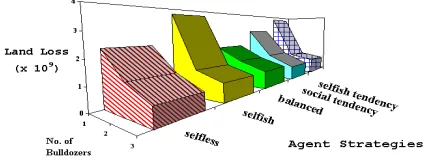
Figure 1 shows how the average individual performance, for one sample agent, of the different agent strategies is affected when resource pressure is exerted on the system. Runs using different rates of thinking (the other form of resource pressure) produce similar results, but because of space limitations are not shown here. It can be seen that self-biased agents, as predicted in hypotheses 1, perform poorly in times of scarce resources. This is because they waste time trying to obtain extra resources when i) it is perhaps unnecessary and ii) the system is comprised of agents of the same type that will not provide assistance in any case. Furthermore, we can see their performance degrades more rapidly than those with social tendencies as stated in hypotheses 2.
more valuable, these agents are likely to ask for help since the value of those extra re-sources outweighs any social considerations it has. However, the acquaintances are less likely to loan out their resources as it is too costly for them on an individual basis. This introduces a delay in thefirefighting and so means more land is lost. Balanced agents perform well since all utilities are considered equally and so the costs of asking for resources and loaning them out play an important role in the decision. This means bal-anced agents ask for and loan out resources, but only if it is clearly beneficial. In times of plentiful resources, the performance of the different types becomes less disparate since agents generally have sufficient resources to minimise the impact of social interchange. Figure 2 shows the cumulative land loss of the entire system. Here, agents with social
Fig. 1.Individual Agent Performance.
[image:8.612.200.414.482.562.2]tendencies generally perform well as they explicitly attempt to assess the system wide implication of their choices. We can also see that balanced agents perform the best (hy-potheses 3) as they work towards overall utility maximisation. However, selfless agents perform worse than the balanced or social tendency agents because they miss the op-portunity of attaining available resources from elsewhere (cf. balanced/social tendency attitudes). They do, however, perform better than the self-biased strategies as they do not waste time asking for resources unless they really need to (i.e. when they have no resources) and simply get on with the task at hand.
3.2 Heterogeneous Agent Societies
To investigate the performance of a system comprising of agents using different strate-gies, the runs described for homogeneous societies were repeated using different per-centage mixtures of the various strategies. In particular, different perper-centages of selfish agents (25%, 50% and 75%) were introduced into societies of the other decision making attitudes with the resource pressure kept at a constant level. We are especially interested in the impact of selfish agents since these should have the greatest detrimental effect on the performance of socially rational societies. To this end, we wish to explore the fol-lowing hypotheses:
4. The performance of selfless agents will decrease rapidly as more selfish agents are introduced;
5. The performance of balanced agents will be resilient to the introduction of selfish agents;
[image:9.612.185.427.417.495.2]6. Mixing selfish and socially motivated agents in one society may produce system performance that is superior to that of the homogeneous societies of either type.
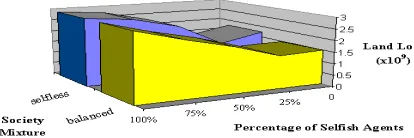
Figure 3 shows two graphs:(a)shows both the average individual performance of self-less and selfish agents in societies in which the percentage of selfish agents is steadily increased; and(b)a similar graph, but with societies that are a mixture of balanced and selfish agents. The individual performance of both the selfless and the balanced agents suffer as the number of selfish agents is increased. However, the balanced agents are less susceptible to the increase in the number of selfish agents since they have an inbuilt concern for their own utility (hypothesis 5). This means they will not unquestioningly give resources to others if they can profit from retaining them. It can also be seen that the performance of the selfless agents decrease more rapidly than the balanced agents as more selfish agents are introduced (hypothesis 4).
Fig. 3.Individual Performance in (a) Selfish/Selfless and (b) Selfish/Balanced Societies
altruistic concerns. One point to note is the initial performance improvement of the self-less/selfish society. When there are a small number of selfish agents, and several selfless agents willing to accede to requests, overall performance improves since resources in the system are being distributed more effectively than would be the case if the system consisted solely of selfless agents. This can be related to hypothesis 6 where we ex-pected that system performance would actually improve with some mixtures of agents. As the number of selfish agents increases, however, there are fewer opportunities for these agents to gain resources, so performance again deteriorates.
Fig. 4.System Performance of Heterogeneous Societies.
4 Related Work
A consistent theme in the work of Castelfranchi [4, 6] is the concept that sociality is derived from the individual mind and social action. Social rationality, and in particular an agent’s social power, is described via manipulation of dependence relationships be-tween agents. Agents may interfere, influence and adopt goals of their acquaintances as a result of the manipulation of these relationships. Such notions can then form the basis of a variety of social actions. Although underlining the need to explore and emphasise the social aspects of an agent’s make-up, this line of work addresses the philosophical rather than practical questions of how this should be achieved. Building on this, Cesta
et al.[7] explore the practicalities of social decision making by experimenting with a variety of social attitudes. Their work mainly covers simple, rather rigid, agent systems and concentrates on how the introduction of exploiters into a society effects system performance. Their results are consistent with ourfindings regarding the introduction of what we have called selfish agents. When exploiters (selfish agents) are introduced into their system, the performance of the system decreases, a result which is magnified as resource pressure is exerted. Although they look at some effects of resource bounds, this is not the main thrust of the work. Also, there is no discussion of how individual autonomy is balanced with social concerns in such contexts.
Boella et al. [1] use the concept that a group of agents working together will have a group utility function that is shared amongst the members of the group. It is assumed that all members know of this function and believe that the other agents in the group do as well. This function is combined in a weighted sum with the agent’s other preferences, for example personal interests not related to group activity, and determines whether an agent chooses to act towards group interests or towards its own goals. Their approach resembles ours in the way that a form of weighting is applied to the agents’ different interests, but it differs in that they chose to address the problem of multi-agent planning and do not seem to address concerns of scalability and resource boundedness.
In [3], Brainov defined a range of social decision making strategies that differ in their attitudes towards other agents: altruistic agents consider other agents in their deci-sion making; self-interested agents never consider other agents when making decideci-sions; and envious agents consider others, but in a negative sense. In [2] he extends this work by comparing the use of these different attitudes in multi-agent planning and negoti-ation. Our different social attitudes follow his basic definitions, but are grounded in a particular utility configuration: that of Harsanyi’s welfare function. This provides a means of moving the theory into practice and allows us to begin our investigations into resource bounded social agents.
is needed. Like the social rationality work presented here, they experiment with various social strategies, but differ by examining the effect on performance of how much time the agent is committed to group tasks.
Jennings and Campos [15] define a social equivalent of Newell’s conceptualisation of individual agent rationality that they term the Principle of Social Rationality. Social rationality is defined as the action choice of an individual based on global concerns. To add substance to this definition, Kalenka and Jennings [16] describe several so-cial attitudes that can be ascribed to agents under this principle. Their work provides a framework for defining the different social attitudes that an agent may possess, includ-ing helpfulness and cooperativity. However, the missinclud-ing element in their work is the practical consideration of resource bounds on the performance of social agents. Their framework also restricts the level of analysis that can be performed with regards to an agent’s different relationships in the society. For instance, there is no mechanism to employ when the agentfinds itself as a member of multiple groups or coalitions.
More socially minded decision making attitudes have been investigated in the socio-economic literature under the umbrella of social welfare functions (also collective choice rules or preference aggregation rules) [9]. Here the main emphasis is on how a group of agents can collectively make decisions. The decision maker can either be several agents making a joint decision or an individual making a decision that has global con-sequences. These functions have been shown to have the advantage of Pareto optimality, but have the disadvantage that equity is not preserved in the group (i.e. the decision is not fair to everyone, for example in the case of the distribution of wealth). There are also concerns as to how the utility functions are derived and how they should be combined in an overall function to reflect group choice. These issues are also important when we consider software agents and, at present, there are no comprehensive solutions to these problems. However, we do believe that practical assumptions can be made about the origin and structure of the utility functions used by agents, and that with further experimentation into these issues, useful insights can be found.
5 Conclusions and Future Work
and social concerns by demonstrating the robustness of balanced agents in the face of exploitation by selfish agents. These experiments also demonstrate the importance to the performance of the individual and the system, of the mixture of strategies used by the participating agents and how this must be considered in the individual’s decision making function.
The next step is to utilise our empiricalfindings to construct resource bounded so-cially rational decision makers. Here, the empirical data provides the basic knowledge about social decision making. The results indicate when the various attitudes are ef-fective (both from an individual and system perspective). This know-how can now be used as a basis for the meta-reasoning component of a resource bounded reasoner. In particular, we are currently embedding the keyfindings into the control level of our Phoenix agents. We envisage that our agents will use the basic social decision function described in section 2, but to the address problems of resource bounded behaviour they will: i) dynamically modify the weightings given to the respective parts of the social welfare function; and ii) alter the amount of computation performed by modifying the acquaintances used in the calculation. When taken together, this will enable an agent to adjust its behaviour over different resource contexts. Thus, for example, the agent may weight its own utility higher than others and only include a subset of its peers in the social utility calculation in times of heavy resource pressure and when it believes it can obtain resources from others. This can be seen in the situations as described by hypothesis 6 when mixtures of different agent strategies distribute the resources more efficiently. However, when the agent has more time or resources to play with, then it may fully consider all parts of the social welfare function when deciding what to do as we have seen by the results obtained both at the individual and system level.
In terms of extending our work, we need to further investigate how agents can dy-namically build relationships with one another and then use this knowledge to learn how to operate more efficiently. For instance, an agent may learn to ask certain acquaintances for help and not others (e.g. if it has received negative responses to previous resource requests). Such interaction adaption can also help agents choose which acquaintances they should consider in the social part of their utility equation. This is especially useful when the agent is faced with heavy time pressures since it need only perform calcu-lations for the acquaintances that it deems important. This adaption can also be used to consider what effect the appearance of coalitions or sub-groups has on the agent’s decision making strategy.
Acknowledgements
The authors would like to thank all the reviewers of this paper for their helpful comments, espe-cially Cristiano Castelfranchi for his constructive feedback and thought provoking discussions.
References
1. G. Boella, R. Damiano, and L. Lesmo. Cooperating to the groups utility. In N. Jennings and Y. Lesperance, editors,Intelligent Agents VI. Springer Verlag, 1999.
3. S. Brainov. The role and the impact of preferences on multi-agent interaction. In N. Jennings and Y. Lesperance, editors,Intelligent Agents VI. Springer Verlag, 1999.
4. C. Castelfranchi. Social power a point missed in multi-agent, DAI and HCI. In Y. Demazeau and J.P. Muller, editors,Decentralised AI., pages 49–62. Elsevier Science Publishers, 1990. 5. C. Castelfranchi. Limits of economic and strategic rationality for agents and MA systems.
Robotics and Autonomous Systems, 24:127–139, 1998.
6. C. Castelfranchi. Modelling social action for AI agents.Artificial Intelligence, 103:157–182, 1998.
7. A. Cesta, M. Micheli, and P. Rizzo. Effects of different interaction attitudes on multi-agent system performance. In W. Van de Welde and J. Peram, editors,Proc. of MAAMAW 96, pages 128–138. Springer Verlag, 1996.
8. P. R. Cohen, D.M. Hartland M. L. Greenberg, and A.E. Howe. Trial byfire: Understanding the design requirements for agents in complex environments. A.I. Magazine, 10(3):32–48, 1989.
9. K. P. Corfman and S. Gupta. Mathematical models of group choice and negotiations. In J. Eliahberg and G.L. Lilien, editors,Handbook in OR and MS, pages 83–142. Elsevier Sci-ence Publishers, 1993.
10. J. Doyle. Rationality and its role in reasoning. Computational Intelligence, 8(3):376–409, 1992.
11. A. Glass and B. Grosz. Socially conscious decision making. InProc. of BISFAI-99 (Bar-Ilan Symposium on the Foundations of AI), 1999.
12. B. Grosz. Collaborative systems.A.I. Magazine, 17:67–85, 1996.
13. J. C. Harsanyi. Rational Behaviour and Bargaining Equilibrium in Games and Social Situ-ations. Cambridge University Press, 1977.
14. L. Hogg and N. R. Jennings. Socially rational agents. InProc. of AAAI Fall symposium on Socially Intelligent Agents, pages 61–63, 1997.
15. N. R. Jennings and J. Campos. Towards a social level characterization of socially responsible agents.IEE Proceedings on Software Engineering, 144(1):11–25, 1997.
16. S. Kalenka and N. R. Jennings. Socially responsible decision making by autonomous agents. In K. Korta, E. Sosa, and X. Arrazola, editors,Cognition, Agency and Rationality, pages 135–149. Springer Verlag, 1999.
17. J. F. Nash. The bargaining problem.Econometrica, 28:155–162, 1950.
18. S. Russell and P. Norvig.Artificial Intelligence: A Modern Approach. Prentice Hall, 1995. 19. S. Russell and E. Wefald.Do The Right Thing: Studies in Rationality. MIT Press, 1991. 20. Stuart Russell. Rationality and intelligence.Artificial Intelligence, 94(1):55–57, 1997. 21. L. J. Savage.The Foundations of Statistics. Wiley, New York, 1954.
22. T. C. Schelling.The Strategy of Conflict. Harvard University Press, Cambridge Massachuttes, 1963.