Molecular Computing with Artificial Neurons
Michael Conrad and Klaus-Peter Zauner Department of Computer Science
Wayne State University Detroit, MI 48202, U.S.A. e-mail: [email protected]
Abstract—Today’s computers are built up from a minimal set of standard pattern recognition opera-tions. Logic gates, such as NAND, are common ex-amples. Biomolecular materials offer an alternative approach, both in terms of variety and context sensi-tivity. Enzymes, the basic switching elements in bio-logical cells, are notable for their ability to discrimi-nate specific molecules in a complex background and to do so in a manner that is sensitive to particular mi-lieu features and indifferent to others. The enzyme, in effect, is a powerful context sensitive pattern rec-ognizer. We describe a tabletop pattern processor that in a rough way can be analogized to a neuron whose input-output behavior is controlled by enzy-matic dynamics.
Keywords artificial neural networks, pattern recogni-tion, biological information processing, enzyme kinet-ics, signal processing
1 Neuronal Pattern Processing
In 1904 a school teacher found that he was able to successfully teach his horse, Clever Hans, elementary mathematics. If he asked Hans for the sum of two dig-its, the horse would tap out the correct result. It turned out, however, that the horse was not doing arithmetic. It used minute involuntary reactions of its teacher to de-cide when to stop tapping (O’Grady et al. 1997, p. 612). At the time, the summary judgment was that Hans was not at all clever. But just try to program a computer to perceive and learn how to utilize subtle changes in ex-pression. From the viewpoint of today’s computer tech-nology adding the digits seems trivial compared to the pattern recognition problem the horse chose to solve.
The eloquence with which biological organisms han-dle pattern processing tasks can be traced to molecu-lar pattern recognition capabilities of macromolecules
(Conrad 1992). Proteins are particularly versatile in this respect. Protein catalysts, or enzymes, are capable of discriminating and acting on specific molecular shapes in a complex milieu and doing so in a manner that is selectively sensitive to the milieu context.
To what extent does this intrinsic capability of macro-molecules percolate up into the perception-action capa-bilities of a Clever Hans? The question clearly has much to do with the capabilities of neurons. Is the neuron a mere summator of its inputs, reacting only to an aver-age field, or is it itself a powerful molecular computer? One of the great pioneers of neural computing, Warren McCulloch, made a comment pertinent to this point:
“For our purpose of proving that a real ner-vous system could compute any number that a Turing machine could compute with a fixed length of tape, it was possible to treat the neuron as a simple threshold element. Unfortunately, this misled many into the trap of supposing that threshold logic was all one could obtain in hard-ware or softhard-ware. This is false. A real neuron, or Crane’s neuristor, can certainly compute any Boolian [sic] function of its inputs—to say the least!” (McCulloch 1965, pp. 393, 394)
To this it is perhaps worth adding that in the cerebral cortex of the mouse, for example, the average number of synapses (inputs) per neuron is 8000 (Sch¨uz 1995). It is awkward even to think of Boolean logic in the face of such high connectivity.
this job, as can laboratory rats (Griffith et al. 1968). But then the definite learning algorithm used by Rosenblatt no longer applied. Evolutionary methods of learning could be employed. However, for various reasons the computer science community at the time was not pre-pared to accept self-organizing systems and evolution-ary methods. Handcrafted approaches were the order of the day. Neural nets and evolutionary approaches had to sit on the sidelines until relatively recently.
There is another way out of the XOR limitation. The neuron, as noted by McCulloch, need not be a simple threshold element. We will show here that individual enzymes can be used to perform the XOR operation. Neurons and other biological cells contain thousands of interlinked enzymes. Our assumption is that the oppor-tunity seeking process of evolution uses these enzyme networks to implement complex information process-ing functions at the cellular level. We have developed a tabletop prototype, a crude artificial neuron of sorts, that makes it possible to investigate how such molecular pattern recognizers could be utilized in a device context. Conceivably the pattern recognition virtuosity of natural biological cells is based on similar operative principles.
2 Enzyme Basics
Enzymes are proteins that act as highly specific cata-lysts capable of discriminating particular substrates in a complex chemical background. The catalytic func-tion performed is controlled by the enzyme’s shape— its 3-D spatial structure (Friedrich 1984). This struc-ture is largely determined by amino acid sequence. The structure is not rigid; it undergoes considerable con-formational motion, i.e., rotation around atomic bonds (Frauenfelder et al. 1988; Yon et al. 1998). Which subset of conformational states is favored is a function of an enzyme’s physiochemical environment. Catalytic activity is critically dependent on conformational state and therefore provides a sensitive and convenient probe for conformation change. The intricate conformational dynamics of the enzyme fuses signals from its physio-chemical milieu and modulates catalytic activity. The enzyme is in effect an implementation of a function that maps numerous selected variables presented as physio-chemical context into output communicated as catalytic activity.
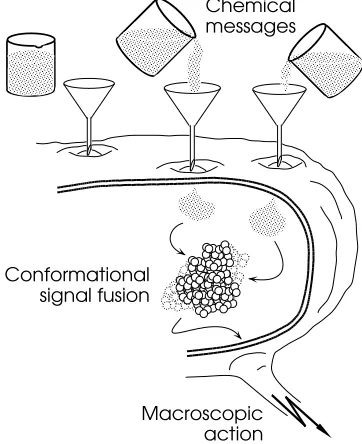
The cell, as noted earlier, contains thousands of en-zymes. In single celled organisms, such as amoeba or paramecium, all the information processing is me-diated by the internal molecular network. Chemical sig-nals from the environment are communicated through the cell membrane, either directly or by triggering the release of internal chemicals through interaction with membrane receptors (see Fig. 1). The signals
!"
# $ %
[image:2.612.343.524.232.454.2]&
Figure 1: Conformational signal processing in bi-ological cells. Impinging chemical signals directly or indirectly affect the internal milieu of the cell. The conformational dynamics of proteins and other macromolecules is selectively sensitive to these milieu features. These nonlinear dynamics in ef-fect process the milieu influences to yield internal or external cellular actions.
(Liber-man et al. 1975).
The cell in Fig. 1 is schematically pictured as a kind of mixing chamber. In fact the interior of the cells of higher organisms is highly structured, with many fibers and membranous interfaces. The fibers, as noted above, are referred to as the cytoskeleton, since they are re-sponsible for maintaining the structure of the cell. They are sometimes thought of as micro-muscle, since they contribute significantly to cellular motions and to the movement of materials within the cell. Some lines of evidence suggest that the cytoskeletal fibers also act as a kind of micronervous system within cells and neu-rons that serves to coordinate internal activities (like the highly choreographed process of cell division) and plau-sibly to mediate more subtle forms of signal processing pertinent to the cell’s capability of integrating external signals in space and time (Matsumoto and Sakai 1979; Liberman et al. 1985; Hameroff 1987).
The tabletop device to be described is a highly ab-stracted version of this complex intracellular processing. Three basic elements enter into this abstraction. Macro signals must be transduced to a form that affects the ac-tivity of an enzyme or a collection of enzymes. The action of the enzyme must not be confined to an aver-aging process that could be performed by a transistor (e.g., OR, AND, NAND). If this were the case all of the powerful shape-based recognition activity of the en-zyme would be lost. Programmability should not be im-posed since this requires each component to have a con-text independent description that would vitiate the dis-tinctive advantage of enzyme-driven computing, namely the possibility of utilizing the vast number of potential interactions in multiple ways for multiple purposes. The key to the power of the system is self-organizing dy-namics at the level of the enzyme and at the level of macromolecular networks. If the system could be pro-grammed prescriptively, like a digital machine, then all the power of this self-organization would have to be sup-pressed. Self-organizing systems after all have a mind of their own. Evolutionary adaptive approaches are called for (Conrad 1985; 1990).
3 The Tabletop Neuron
We constructed a tabletop prototype that uses the en-zyme malate dehydrogenase (MDH) to classify input signal patterns. MDH occurs in a wide variety of species including the microbial world and in plants. In our ex-periments we used mitochondrial MDH from pig heart, a homodimer with each monomer consisting of 314 amino acids (Gleason et al. 1994).
MDH catalyzes the oxidation of malate to oxalac-etate by reducing the oxidized form (NAD' ) of
nicoti-namide adenine dinucleotide (NAD) to the reduced form NADH.
L-malate
(*),+-'
.0/1
23
oxalacetate(4)+,-654(45
'
NADH differs significantly from NAD' in its
absorp-tion of ultraviolet light. This property of the reacabsorp-tion product makes it convenient to monitor the activity of malate dehydrogenase by spectrophotometric methods.
For high pH the equilibrium of the reaction is on the right side. The time course of the reaction is affected by the sensitivity of the enzyme to chemical context, i.e., the milieu in which the reaction takes place. The mi-lieu is composed from a number of fixed components, such as the substrates and pH buffer, plus the compo-nents representing the signals. In the experiments to be described here MgCl7 was used as the signaling
sub-stance. Similar effects can also be achieved with CaCl7 ,
but the method is not restricted to ions or to any definite number of signal carriers.
The device itself is schematically illustrated in Fig. 2. Signals are injected into a mixing chamber in two 1 ml portions, taken in any of four possible combinations from the two signaling solutions. Solutions representing 0 and 1 contain substrate in the same quantity, but the 1-solution in addition contains signaling ions. The quan-tity of MgCl7 representing a 1-signal is chosen so that
Mixing chamber
Spectrophotometer Peristaltic pump 1-Signal,
Substrate
0-Signal, Substrate
Enzyme
H2O for clearing
R1
R2
R4
R3
S1 S2
S3 S4
S5
V1 V2
V3 V4
V5 V6
atm V7 T1 T2 T3
atm
T4
T5 T6
atm atm 1
1
0 0
[image:4.612.341.526.109.181.2]atm
Figure 2: Flow system used in the XOR experi-ments. Signals are injected from any two of four sy-ringes (S1 to S4). The 1-sysy-ringes (S1 and S2) are filled from reservoir R1 that contains signal sub-stance (Mg7
' ) plus substrate. R2, the reservoir
for the 0-syringes (S3 and S4), contains substrate in the same concentration as R1 but no signaling substance. Signals are injected through valves (la-beled by V) into the mixing chamber. Enzyme so-lution (MDH and NAD' in buffer) is stored in the
thermally isolated reservoir R3. The reaction is ini-tiated by injecting this solution, using syringe S5, into the mixing chamber. The reaction mixture is drawn by a peristaltic pump into a flow cuvette in-stalled in the spectrophotometer. The absorbance of the product NADH at 339 nm serves as output signal. Reservoir R4 contains distilled water which is used to wash the system clean after the input pattern is processed. T valves (T1 to T6) are used to switch from processing to clearing. Tubes la-beled atm (atmosphere) are air in/outlets.
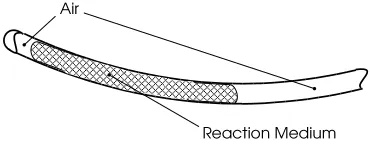
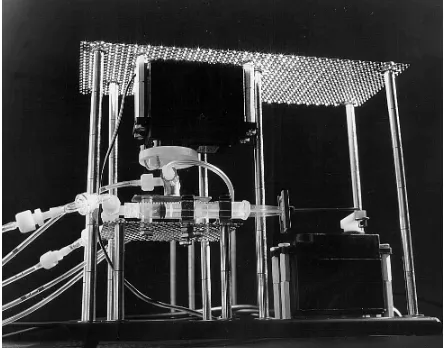
water through it. The output signal is sent to a computer. If the signal is above a single prescribed threshold level a 1 is displayed, otherwise a 0. Several trials are run to calibrate the threshold. When the reaction mixture reaches the cuvette the absorbance increases. This in-crease is used to trigger a countdown to a subsequent absorption measurement that decides the output. The actual implementation is pictured in Fig. 4.
8:9;
<>=@?BACD9E@FHGI=JK9LNM
[image:4.612.63.285.109.293.2]Figure 3: Two phase transport utilized in the table-top implementation. The reaction medium (fluid phase) travels in air-filled (gas-phase) tubing from the mixing chamber to the detector.
Figure 4: Laboratory setup used to implement the arti-ficial neuron.
4 Enzymatic Pattern Classification
[image:4.612.332.534.257.509.2]ex-ceeds a higher threshold. If the response of the element is nonlinear (strictly speaking nonmonotonic) then it is possible to eliminate the need for the higher threshold and therefore to convert the linearly inseparable pattern recognition problem to a linearly separable problem.
An enzyme, to satisfy this requirement, must increase its activity in response to one dose of the signaling sub-stance but decrease it in response to two doses. We found that MDH satisfies the requirement with respect to MgCl7 used as a signaling substance. Thus when
[image:5.612.327.544.112.263.2]MDH is used as the enzyme in the mixing chamber the device yields a 0 output when the input is 00, a 1 output when the input is 10 or 01, and a 0 output when the input is 11.
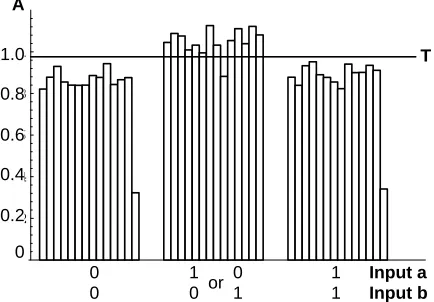
Fig. 5 illustrates a series of 42 XOR tests, with the trigger set for an average 10 second response. The threshold was set based on the first measurement of the three distinguishable input patterns (since 01 is the same as 10). Only one input pattern was incorrectly classi-fied. It is possible to choose a threshold that separates the cases more securely (but all settings would leave at least one failure in this series). Ten seconds is near the limit of the device in its present form, due in part to the type of pump and spectrophotometer employed. The re-action that drives the device is the only fundamental lim-iting factor. This can be sped up by increasing the con-centration of enzyme or by warming the reaction fluid. The important point is that MDH serves as a transform that converts a linearly inseparable pattern recognition task into a linearly separable one.
5 Temporal Signal Processing
The XOR operation was implemented by taking a snap-shot of the response of our tabletop neuron at a partic-ular point in time as output value. The chemically en-coded signals were present at the start of the reaction. The course of the reaction was determined by the initial reaction conditions. Reducing the amount of enzyme slows the reaction down. Its progress can then conve-niently be followed and is shown in Fig. 6 for various amounts of MgCl7 . As can be seen from the crossing
curves in Fig. 6, a change in MgCl7 concentration has a
qualitative effect on the course of the reaction.
To utilize the phenomenological enzyme behavior we
0-0 0-1/1-0 1-1
0.2 0.4 0.6 0.8
1 T
Input a Input b
0 0
0 1 1 0 or
1 1
A
0.8
0.6 0.4 0.2 1.0
0
Figure 5: Pattern grouping with MDH as illustrated by XOR task. The three distinguishable input pat-terns are grouped into two output categories de-pending on whether the amount of product formed is above or below the threshold (T). The time when measurements used for classification are taken is controlled by a trigger mechanism. The times fall between 9 and 11 seconds after start of the reac-tion, with two exceptions. The last measurement in the 00 and also the 11 pattern sets were triggered early, leading to low absorbance values (denoted by A). The 10 second absorbance values recorded were below the threshold and hence would still have been correctly classified. A 0-signal is rep-resented by 1 ml of 7.1 mM malate and 112 mM glycine. A 1-signal is represented by 1 ml of 190 mM MgCl7 , 7.1 mM malate, and 112 mM glycine.
Both signal solutions are adjusted to pH 10.5 with NaOH. Two ml of input signal solution constitute an input pattern. The reaction is initiated when this combines with 1 ml of MDH-NAD' solution (5.3
mM NAD' in MOPS buffer adjusted to pH 7.4 with
NaOH).
need to decide on an encoding for the signal patterns to be processed. A simple encoding scheme represents a 1-signal arriving on a signal line by a fixed amount of one substance and a 0-signal by the absence of this sub-stance. Such an encoding allows for the implementation of commutative operations (OQPRTSURPO ) only, since
Absorbance (339 nm)
t [s] MgCl2
none 16.7 mM 33.3 mM 66.7 mM 100 mM 133.3 mM
500 1000 1500 2000 2500 3000 3500 4000 0.5
[image:6.612.55.289.111.217.2]1 1.5 2 2.5
Figure 6: Measured absorbance change over time for various Mg7
' concentrations. The
re-action medium contained 4.8 mM L-malic acid,
1.8 mM NAD' , and 13.2 mM MOPS
(3-[N-morpholino]propanesulfonic acid, used to buffer the enzyme (porcine heart mitochondrial MDH) and NAD' solutions) and was buffered by 92 mM
glycine adjusted to pH 10 with NaOH. The protocol was derived from the assay described by Englard and Siegel (1969).
calledV for a 00-input,W for either 01- or 10-input, and
X
for 11-input. If operations are to be implemented that are not commutative, a larger number of signaling sub-stances could be used. It is then possible to encode the signal line together with the signal, i.e., the state of the line.
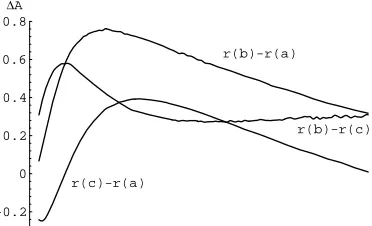
With the signal encoding decided upon, the possible milieu conditions at the start of the reaction are known. Differences in the starting milieu are mapped by the re-action into different absorbance values. From the ab-sorbance measurements in Fig. 6 it is possible to cal-culate how the reaction groups the input signal patterns. The time development of the grouping is shown in Fig. 7 as distances among the responses to the 3 possible mi-lieu states. For implementing a desired input-output map the minimum difference in the response to sig-nal patterns that need to be differentiated is important, since this distance corresponds to the signal strength. Fig. 8 shows the signal strength for the XOR opera-tion. The signal strengths for particular classifications change with the progress of the reaction. Signals arriv-ing at different times will therefore meet different states of the reaction medium and accordingly affect the re-action differently. Enzyme controlled devices could be used in this way to integrate signals in space and time,
500 1000 1500 2000 2500 3000 3500 4000 -0.2
0 0.2 0.4 0.6 0.8
t [s]
∆A
r(c)-r(a)
r(b)-r(a)
[image:6.612.327.513.112.225.2]r(b)-r(c)
Figure 7: Absorbance difference (Y[Z ) in response
(r) to the three possible milieu states that can result from 2-bit input patterns (V = 00,W = 01 or 10,
X
= 11). The curves are computed from data in Fig. 6, assuming a 1-signal is represented by 66.7 mM MgCl7 .
in analogy to the spatiotemporal processing performed by natural biological cells.
t [s]
∆s
500 1000 1500 2000 2500 3000 3500 4000 0
0.1 0.2 0.3 0.4 0.5 0.6
Figure 8: Time development of XOR signal strength. The signal strength (Y]\ ) is given by r(b)
-Max( r(a), r(c) ); cf. Fig. 7 for notation. The increase in noise for longer reaction times is associated with the high absorbance values at those times. The curve is calculated assuming the same signal en-coding as in Fig. 7.
[image:6.612.321.544.393.523.2]6 Toward Molecular Co-processors
Our prototype could be migrated to a more practical device using microfluidics (Hadd et al. 1997; Unger et al. 2000) and optoelectronics (Zauner and Conrad 1997). Such lab-on-a-chip modules could be adapted for desired function by varying the coding of the in-puts and tuning the reaction milieu (as in the tabletop experiments above), choosing the reaction parameters used for readout (Kessler 1994), varying and combin-ing enzymes, or modifycombin-ing enzymes through directed evolution (Beaudry and Joyce 1992; Gao et al. 1997). The addition of more types of signaling substances and coupling to other enzymatic reactions should increase the complexity of the patterns that can be processed. MDH is frequently used as an indicator reaction in as-says and therefore protocols for linking to other en-zymes are available (cf. Williamson and Corkey 1969). Our expectation is that the computational capabilities of many enzymes could usefully be investigated using the methodology outlined here.
The evolutionary adaptation approach is called for due to the context sensitive dynamics of enzyme net-works. This is incompatible with conventional pro-grammability. It might be possible to eliminate the con-text sensitivity, but this would abrogate the unique ad-vantage of enzyme-based computing (Conrad 1988).
We envision migrating elaborated signal processing modules to microchip devices that can be integrated with conventional electronic signal processing. The de-crease in reaction volume would inde-crease speed. Alter-native designs using enzyme immobilization techniques (DuVal et al. 1985) and coupling to dies for optoelec-tronic readout could be utilized (Whitaker 1969; Michal et al. 1983).
The tabletop device can be used to experiment with such hybrid architectures. Servos intended for model airplanes can be employed as shown in Fig 9 to operate the valves and syringes.
7 Artificial Neuromolecular Architectures
[image:7.612.322.545.110.284.2]Automation should speed the development of a use-ful repertoire of biochemical neurons, but this is still a big task. In the meantime it is possible to experiment
Figure 9: Interfacing the artificial enzymatic neuron with a conventional architecture. Servos from radio controlled models can be operated through pulse-width modulation by a digital computer. The servo on the left side steers a T-valve and the servo on the right positions a syringe pump.
with simulated neuromolecular architectures. The idea is to use neurons that draw on internal signal integration mechanisms to perform complicated input-output trans-forms and to combine these into structures that can per-form coherent perception-action tasks. Our group has developed a series of such models (e.g., Kampfner and Conrad 1983; Kirby and Conrad 1986; Conrad et al. 1989; Ugur and Conrad 1999). An architecture devel-oped with J.-C. Chen is indicative. This consists of cel-lular automaton neurons that model cytoskeletal signal processing. The complex internal dynamics of the neu-rons allows for the evolution of a wide variety of input-output transforms. Redundant subnetworks can evolve independently and the resulting neurons are then har-vested and combined in different ways by a higher level evolutionary algorithm. The system has been applied to a variety of problem domains, including maze naviga-tion (Chen and Conrad 1994), Chinese character classi-fication (Chen and Conrad 1997), and most recently to hepatitis diagnosis (Chen 2000).
possible with actual biochemical embodiments. That useful functionality is obtained with a simulated system suggests that replacing the simulated biochemical neu-rons with actual biochemical neuneu-rons would yield much more powerful computational capabilities.
8 Directions
The results reported here appear to have implications for the neuron doctrine. Most technical neural computing models still assume essentially rather simple neurons. Many brain models take their cue from these technolog-ical systems, despite the evident complexity of real neu-rons. The fact that a single enzyme type can transform a linearly inseparable problem to a linearly separable one strongly suggests that real biological neurons have ca-pabilities that far exceed those typically represented in current neurocomputing models.
Our working hypothesis is that multi-enzyme ex-tensions of the enzyme-driven system prototyped here could transform difficult pattern grouping problems into forms manageable by conventional techniques. Devices of this type could serve as molecular co-processors that provide novel computational synergies for digital ma-chines. In time networks of artificial molecular neurons may be evolved for a wide variety of special purpose ap-plications that are refractory to currently available tech-nologies. Much remains to be done, but perhaps some day it will be possible to achieve an artificial Clever Hans.
Acknowledgments This material is based upon work supported by the U.S. National Science Foundation un-der Grant Nos. ECS-9704190, CCR-9610054 and EIA-9729818.
Bibliography
Beaudry, A. A. and G. F. Joyce (1992). Directed evolution of an RNA enzyme. Science 257, 635–641.
Chen, J.-C. (2000). Data differentiation and parameter analysis of a chronic heptatitis B database with an ar-tificial neuromolecular system. BioSystems. (in press).
Chen, J.-C. and M. Conrad (1994). Learning synergy in a multilevel neuronal architecture. BioSystems 32, 111– 142.
Chen, J.-C. and M. Conrad (1997). Evolutionary learn-ing with a neuromolecular architecture: A biologically motivated approach to computational adaptability. Soft
Computing 1, 19–34.
Conrad, M. (1985). On design principles for a molecular computer. Commun. ACM 28, 464–479.
Conrad, M. (1988). The price of programmability. In R. Herken (Ed.), The Universal Turing Machine: A
Fifty Year Survey, pp. 285–307. Oxford: Oxford
Uni-versity Press.
Conrad, M. (1990). Molecular computing. In M. C. Yovits (Ed.), Advances in Computers, Volume 31, pp. 235– 324. Boston: Academic Press.
Conrad, M. (1992). Molecular computing: The lock-key paradigm. Computer (IEEE) 25(11), 11–20.
Conrad, M., R. R. Kampfner, K. G. Kirby, E. N. Rizki, G. Schleis, R. Smalz, and R. Trenary (1989). Towards an artificial brain. BioSystems 23, 175–218.
DuVal, G., H. E. Swaisgood, and H. R. Horton (1985). Some kinetic characteristics of immobilized pro-tomers and native dimers of mitochondrial malate de-hydrogenase: An examination of the enzyme mecha-nism. Biochemistry 24, 2067–2072.
Englard, S. and L. Siegel (1969). Mitochondrial L-malate dehydrogenase of beef heart. In J. M. Lowenstein (Ed.), Citric Acid Cycle, Volume XIII of Methods in
Enzymology, pp. 99–106. New York: Academic Press.
Frauenfelder, H., F. Park, and R. D. Young (1988). Con-formational substates in proteins. Ann. Rev. Biophysics
and Biophysical Chem. 17, 451–479.
Friedrich, P. (1984). Supramolecular Enzyme
Organiza-tion. Oxford: Pergamon Press.
Gao, C., C.-H. Lin, C.-H. L. Lo, S. Mao, P. Wirsching, R. A. Lerner, and K. D. Janda (1997). Making chem-istry selectable by linking it to infectivity. Proc. Natl.
Acad. Sci. USA 94, 11777–11782.
Gleason, W. B., Z. Fu, J. Birktoft, and L. Banaszak (1994). Refined crystal structure of mitochondrial malate de-hydrogenase from porcine heart and the consensus structure for dicarboxylic acid oxidoreductases.
Bio-chemistry 33, 2078–2088.
Griffith, V. V., J. A. Davis, and R. H. Kause (1968). Learning of the exclusive-or logic function in rats. In H. Oestereicher and D. R. Moore (Eds.), Cybernetic
Problems in Bionics, pp. 587–595. New York:
Gor-don and Breach.
Hameroff, S. R. (1987). Ultimate Computing. Amsterdam: North-Holland.
Kampfner, R. and M. Conrad (1983). Computational mod-eling of evolutionary learning processes in the brain.
Bull. of Math. Biol. 45, 931–968. Reprinted in
Evolu-tionary Computation: The Fossil Record, D.B. Fogel (Ed.), IEEE, New York, 1998.
Kessler, C. (1994). Non-radioactive analysis of biomolecules. J. Biotech. 35, 165–189.
Kirby, K. G. and M. Conrad (1986). Intraneuronal dy-manics as a substrate for evolutionary learning.
Phys-ica 22D, 205–215.
Liberman, E. A., S. V. Minina, and K. V. Golubtsov (1975). The study of the metabolic synapse II: Com-parisson of cyclic 3’,5’-AMP and cyclic 3’,5’-GMP effects. Biophysics 22, 75–81.
Liberman, E. A., S. V. Minina, O. L. Mjakotina, N. E. Shklovsky-Kordy, and M. Conrad (1985). Neuron generator potentials evoked by intracellular injection of cyclic nucleotides and mechanical distension. Brain
Research 338, 33–44.
Matsumoto, G. and H. Sakai (1979). Microtubules inside the plasma membrane of squid giant axons and their possible physiological function. J. Membr. Biol. 50, 1– 14.
McCulloch, W. S. (1965). “What’s in the brain that ink may character?”. In Embodiments of Mind, pp. 387– 397. Cambridge, MA: MIT Press.
Michal, G., H. M¨ollering, and J. Siedel (1983). Chemi-cal design of indicator reactions for the visible range. In H. Bergmeyer, J. Bergmeyer, and M. Graßl (Eds.),
Fundamentals (3 ed.), Volume I of Methods of Enzy-matic Analysis, Chapter 2.6, pp. 197–232. Weinheim:
VCH Publishers (Verlag Chemie).
Minsky, M. L. and S. Papert (1969). Perceptrons: An
In-troduction to Computational Geometry. Cambridge,
MA: MIT Press.
O’Grady, W., M. Dobrovolsky, and M. Aronoff (1997).
Contemporary Linguistics (3rd ed.). New York: St.
Martin’s Press.
Rosenblatt, F. (1962). Principles of Neurodynamics,
Per-ceptrons and the Theory of Brain Mechanisms.
Wash-ington, DC: Spartan Books.
Sch¨uz, A. (1995). Neuroanatomy in a computational per-spective. In M. A. Arbib (Ed.), The Handbook of Brain
Theory and Neural Networks, pp. 622–626.
Cam-bridge, MA: MIT Press.
Ugur, A. and M. Conrad (1999). Building evolution friend-liness into cellular automaton dynamics: the cy-tomatrix neuron model. In Proceedings of the 1999
Congress on Evolutionary Computation (CEC99, Washington DC, USA, July 1999), Volume 3,
Piscat-away, NJ, pp. 2071–2077. IEEE.
Unger, M. A., H.-P. Chou, T. Thorsen, A. Scherer, and S. R. Quake (2000). Monolithic microfabricated valves and pumps by multilayer soft lithography.
Sci-ence 288, 113–116.
Whitaker, J. F. (1969). A general colometric procedure for the estimation of enzymes which are linked t the NADH/NAD^ system. Clinica Chimica Acta 24, 23–
37.
Williamson, J. R. and B. E. Corkey (1969). Assays of in-termediates of the citric acid cycle and related com-pounds by flourometric enzyme methods. In J. M. Lowenstein (Ed.), Citric Acid Cycle, Volume XIII of
Methods in Enzymology, Chapter 65, pp. 434–513.
New York: Academic Press.
Yon, J. M., D. Perahia, and C. Gh´elis (1998). Conforma-tional dynamics and enzyme activity. Biochimie 80, 33–42.
Zauner, K.-P. and M. Conrad (1997). Conformation-driven molecular computing: The optical connection. Optical