Abstract— In a refrigeration system, an ejector can improve the performance of a vapor-compression cycle by recovering the work of expansion and converting it into additional compression. Adding the converted work in the compressor inlet basically reduce the compressor working pressure. This possibility is further exploited in this study, where the additional recompression is located after the compression process. This study deals with the mathematical modeling and investigation of a modified vapor compression refrigeration system with the incorporation of two ejectors. The modified system uses two ejectors: one ejector essentially acting as a second stage compressor and, the second ejector is for expansion work recovery that acts as a pre-compression process before the actual compression. The major compression is done by a compressor wherein the vapor at the inlet is compressed to a superheated state. The fluid at the condenser outlet is divided into two flows. One flow becomes the motive flow of the pre-compression ejector while the other one is pumped. A one-dimensional ejector flow simulation and COP analysis were conducted. The resulting COP is 12.56% higher compared to that of the corresponding vapor compression system when operated at the conditions and working fluid. This indicates that the modified system is a better alternative in terms of COP.
Index Terms— ejector, refrigeration, COP, modelling
I.
I
NTRODUCTIONHE global energy production has been continuously growing to cater to the increasing power demand. The International Energy Agency plotted the trend of the global energy consumption with a projected 30% increase from 2012 to 2040 [1] as shown in Fig. 1. Most of the world’s
Manuscript received March 6, 2017; revised March 31, 2017 This work was supported in part by Engineering Research and Development for Technology (ERDT) program of the Department of Science and Technology –Science Education Institute (DOST –SEI) of the Republic of the Philippines.
F. M. M. Orden is a Masters of Science student in the Department of Mechanical Engineering College of Engineering, University of the Philippines, Diliman, Quezon City, Philippines 1101 (phone: +63-998-553-7720, +63-2-981-8500 loc 3130; fax: +63-2-709-8786; e-mail: [email protected]).
M. S. Berana is an associate professor in the Department of Mechanical Engineering, associate dean in the College of Engineering, University of the Philippines – Diliman, Quezon City, 1101 Philippines (phone: +63-915-412-0022, +63-2-981-8500 loc 3130; fax: +63-2-709-8786; e-mail: [email protected]).
recent increase in energy consumption comes from nations that are not members of the Organization for Economic Cooperation and Development, where strong economic and population growth are the key contributors.
[image:1.595.311.547.492.656.2]The Philippines, for example, is part of these developing nations. The residential, industrial and commercial sectors are accounting for 28%, 27% and 24%, respectively, of the total consumption. In 2013, space cooling in Filipino households using electric fans and air-conditioner units was accounted at about 66% of the total electricity usage while the industrial and commercial space cooling and refrigeration consumption are at 30-50% combined. Refrigeration and air-conditioning has become an essential commodity on various industries and households which make this system one of the largest consumers of energy in the world in all sectors. This is why performance enhancements and modification to lower the energy consumption of the system is a continuous interest in the industry around world.
Fig. 1. Global projection of energy demand, IAE Outlook 2016.
For decades, the commonly used refrigeration system has been the vapor compression cycle (VCC) due to its high system performance and wide applicability. This system efficiency can be analyzed through the Coefficient of Performance (COP). The vapor compression cycle is prominently used from small scale applications such as household refrigeration to commercial and industrial cooling applications. However, mechanically driven cycles such as the vapor compression cycle use a fair amount of electricity
Design and Analysis of Incorporating Two
Ejectors for Compression Recovery in the Inlet
and Outlet Points of the Compressor in a Vapor
Compression System
France Marie M. Orden and Menandro S. Berana
to drive the system. Thus, further system improvement is vital to reduce the power consumption of the cycle.
One of the promising modifications to enhance the refrigeration system is through the integration of an ejector [2]. The main components of an ejector includes a primary nozzle, suction and mixing chamber and the diffuser. Ejector utilizes the kinetic energy of a motive fluid, injected in a primary nozzle into a zone of lower pressure, to entrain a secondary fluid with a lower pressure and compress the mixed flow to the desired pressure.
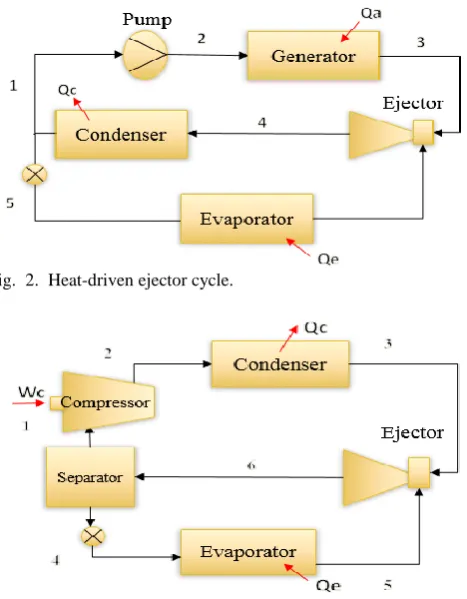
[image:2.595.305.549.197.383.2]Ejectors have been used comprehensively in areas such as power generation, chemical processing, and nuclear industry for decades [3]. There are two commonly used ejector cycles, the heat-driven ejector cycle and compressor-driven ejector cycle. In a heat-driven ejector cycle as shown in Fig. 2, the ejector, pump and generator drives the system as the compressor does in a conventional vapor compression system. The generator is typically powered by a low-grade type of heat source. Fig. 3 shows a compressor-driven ejector cycle, where the ejector is between the condenser and the evaporator to improve the throttling losses associated with an expansion valve that is used in a typical cycle.
Fig. 2. Heat-driven ejector cycle.
Fig. 3. Compressor-driven ejector cycle.
With a projected international yearly increase in power consumption of 8.09% in the next 20 years, cost and the growing awareness and need to mitigate the harmful emissions are vital [1]. These emissions brought by power generation contributes greatly to global warming. Taking advantage of the improvements in a heat-driven and compressor-driven ejector cycle, the authors opted to integrate 2 ejectors in a vapor compression cycle. This is to aid the compressor in lowering the power consumption of the system and thereby increasing the COP.
II. SYSTEM AND DESIGN DESCRIPTION
A. System Discussion
The present study investigates the performance of two ejectors for compression recovery in the inlet and outlet points of the compressor in a vapor compression system, as shown in Fig. 4. Aside from the incorporation of 2 ejectors, the novelty of the present study as compared to the typical ejector refrigeration system lies on the ejector design that features a supersonic diffuser and the addition of low-grade heat in the primary fluid.
Fig. 4. Hybrid ejector cycle with two ejectors placed before and after the compressor. The ejector after the compressor serves as the secondary compression while the ejector before is for expansion recovery.
[image:2.595.53.287.319.619.2]Fig. 5. Pressure-enthalpy diagram of the hybrid ejector system with comparison to a vapor compression system.
With the possibility of attaining an improved COP with the system that uses an ejector in the compressor discharge side [3] and addition of another ejector in the inlet of the compressor, the present study investigates the performance of the hybrid cycle. However the mechanical work needed to drive the liquid pump is relatively small compared to the compressor work, it is not to be omitted in this study to achieve a better analysis of the system thermodynamically (1) and economically (2). And to arrive with a COP, it is necessary to compute for the heat absorbed in the system (3) – (4), total work (5), compressor and pump works (6) – (7), respectively.
COP:
(1)
(2) Thermal performance of evaporator or the refrigeration effect:
Heat absorbed in the evaporator:
(3) Heat absorbed in the generator:
(4) Total Work:
(5) Compressor work:
(6) Pump work:
(7) The over-all performance of an ejector refrigeration system is greatly dependent on the performance of the ejector which is schematically shown in Fig. 6. Ejector is a simple device that allows for a primary flow to entrain another stream of fluid. The primary nozzle can either be a converging or a converging-diverging nozzle depending on the inlet properties of the primary and secondary fluid. The
high pressure-subsonic motive fluid enters the primary nozzle where it accelerates and flows out of the exit nozzle with a high velocity creating a low pressure zone. The difference in the pressure between the streams at the secondary fluid inlet and the primary nozzle exit creates an entrainment effect where the secondary fluid is drawn to the suction chamber. The two fluids then mix completely at a constant pressure and flows further to the diffuser where the compression of the mixture occurs.
Fig. 6. Ejector geometry with a supersonic diffuser.
B. Primary Nozzle
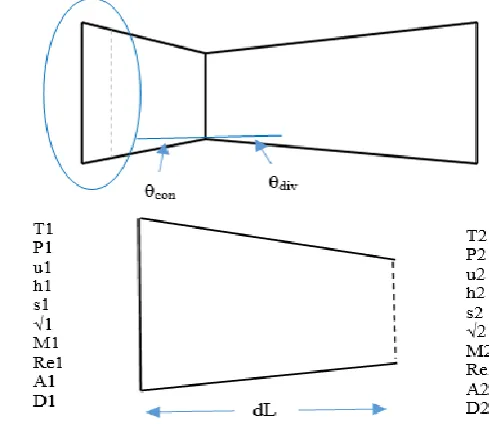
[image:3.595.306.546.165.288.2]The high pressure-subsonic motive fluid enters the primary nozzle where it accelerates and flows out of the exit nozzle with a high velocity creating a low pressure zone. The primary nozzle, as shown in Fig. 7., can either be a converging or a converging-diverging nozzle depending on the inlet properties of the primary and secondary fluid.
Fig. 7. Primary nozzle geometry and numerical implementation.
[image:3.595.294.539.402.614.2]ASHRAE Handbook for steam ejector refrigeration [5] which are in the ranges of 30-60° and 4-9° [6], respectively.
The equations governing the ejector design are shown in (8) – (11):
Conservation of Mass
= (8) Simplifying the conservation of mass as:
(9)
Conservation of Energy
The inside walls of the ejector is assumed to be adiabatic, resulting to a simplified conservation of energy equation (10):
(10) Conservation of Momentum
(11) Where the Blasius friction factor (12), f, was introduced by one of the authors in his past studies [8, 9].
(12) The Reynold’s Number, Re, can be computed (13), whereas the constants C and n in the Blasius friction factor depends on the computed value of Reynold’s Number [10, 11].
(13) Where the resulting Re corresponds to a specific Blasius friction-type factor coefficient and Blasius index value shown below [10]:
0 < Re < 2900, C =64 and n = 1; 2900 < Re < 3050, C= 4.1 x 10⁻¹⁶ and n = -4; 3050 < Re < 240000, C = 0.351 and n = 0.225;
Re > 240000, C = 0.118 and n = 0.165
Speed of Sound
A two-phase flow is expected in the ejector for the proposed cycle. The speed of sound equation for a two-phase flow is shown (14).
(14)
Where the Clasius-Clapeyrone, equation can be written as,
(15)
In the assumption that there is no heat transfer from and to the nozzle, the energy equation is simplified while equations for the conservation of mass and momentum are kept in its simplified forms (8) and (10). Due to the non-linear behavior of the solution for these equations, an iterative solution is used until convergence criteria (16) is met. This is basically the combination of the equations for conservation of energy and momentum.
(16) The length and the diameter of the converging nozzle can be solved as (17) and (18), respectively. The iteration process will continue until the fluid reaches Mach 1 or the sonic speed. The section where the sonic speed is reached is the throat of the nozzle.
(17)
(18) Fluid at Mach 1 will continue to gain speed and expand as it flows through a diverging nozzle. Whilst the length and diameter of the diverging nozzle can be determined through the use of (19) and (20), respectively.
(19)
(20)
C. Suction Chamber
The suction chamber or the pre-mixing section is where the partially compressed low velocity vapor from the compressor or the flow from the evaporator, depending on the ejector location, will be entrained since the primary fluid continues to expand as it flows through the nozzle, creating a lower pressure area.
Munday and Bagster [11] hypothesized that after expanding from the primary nozzle, the primary fluid does not mix instantaneously with the entrained fluid. The primary fluid fans out of the nozzle inducing a converging duct for the secondary fluid creating a duct. The duct acts as a converging nozzle, accelerating the secondary flow to sonic velocity and creating a hypothetical throat for it.
D. Mixing Chamber
The fluid starts to mix at constant pressure when the secondary fluid reaches the sonic speed. In normal operation, a shockwave occurs when the mixed fluid exceeds the speed of sound but in the present study, this phenomena will be avoided. The length of the mixing chamber as suggested is to be at least 3 times the diameter; whereas, the mixing chamber diameter is to be at least 10 times the diameter of the throat of the primary nozzle [12]. Assuming that the completely mixed state is reached at the end of the mixing chamber.
(21)
E. Diffuser
The diffuser is where the pressure is recovered to reach the condenser pressure. In the present study, the authors avoided the occurrence of a shockwave. By avoiding the shockwave, the fluid enters the diffuser at a supersonic speed. The design of the diffuser will be of a converging-diverging channel, this will allow for a gradual pressure recovery, avoiding the irreversibilities and the sudden kinetic energy, KE, losses in the occurrence of a shockwave. The analysis for the diffuser will be the same as of the primary nozzle, using the iteration process and convergence criterion (15) to achieve compression. In this case, the temperature will be incremented.
III. CALCULATIONRESULTS,DESIGNAND DISCUSSION
The present system investigates the full possible extent of ejector recompressions as transcritical CO2 system gives the highest pressure differences among common refrigerants. The incorporation of the two ejectors resulted to a reduction in compressor work and expansion recovery. As referred to Fig. 5., the first ejector causes the secondary pressurization until the condensing pressure is reached while the ejector for expansion work recovery essentially causes a pre-compression process before the actual pre-compression in the compressor. In addition, the second ejector allows for an increase in refrigerating effect as reflected in Fig 5.
A one dimensional mathematical simulation was developed through the use of NIST database used in Refprop 9.1 to analyze the resulting data [13]. To allow system comparison with the conventional refrigeration system, operating conditions and refrigerating capacity are set constant. The operating conditions and resulting ejector geometry are presented in Tables I and II.
TABLE I.
OPERATING CONDITIONS OF THE EJECTOR SYSTEM
Operating Conditions Values Vapor Generator Temperature 80 °C Condenser Temperature 40 °C Evaporator Temperature 5 °C
TABLE II.
GEOMETRICAL SPECIFICATION OF THE EJECTOR.
A 40.8% decrease in compressor work was achieved by the incorporation of the ejectors at the suction and discharge side. The large decrease in the compressor work is due to second-step compression done by the ejector as well as the re-compression at the suction side of the compressor, providing for a higher suction pressure compared to a standard vapor compression system. However, with the addition of a pump in the system, the total work needed to power the present system is still less than the normal compressor work needed in a vapor compression system. This translates to a COPth of 1.76 while in an economic point of view, the system has a COPecon of 7.64. The resulting thermodynamic COP has a 12.56% increase compared to the COP of a vapor compression system running at the same conditions and working fluid.
IV. CONCLUSION
The benefits of the heat-driven and compressor-driven ejector is exploited in the present system. One ejector is used as the secondary compression after a partial compression in the compressor, reducing the compressor work needed to attain the condensing pressure. Another ejector is added to pre-compress the fluid as it enters the compressor, with the additional advantage of the resulting increase in refrigerating capacity.
A one-dimensional simulation for CO2 was done to achieve the performance of the system and the corresponding ejector geometry. Low grade heat can be freely or economically used in heating the primary fluid in the ejector for secondary compression for more effective re-pressurization to the condensing pressure.
With the integration of ejectors at the inlet and outlet of the compressor, a resulting increase in COP of 12.56 % compared to that of the corresponding vapor compression system is attained when operated at the equivalent conditions and refrigerant. The incorporation of two ejectors clearly shows a significant increase in COP which is impossible to achieve with previous designs that uses only one ejector. The study showed the superiority of the modified refrigeration cycle over the conventional VCC, which indicates that the modified system is a better alternative in terms of COP.
NOMENCLATURE
A cross sectional area (m2)
C Blasius friction-type factor coefficient (-) COP coefficient of performance (-) D hydraulic diameter (m) f homogeneous friction factor (-) h enthalpy (J/kg)
KE kinetic energy (m2/s2)
L length (m) mass flow rate (kg/s) mu viscosity (Pa-s) n Blasius index (-) P pressure (MPa) Q heat (W) Re Reynolds number (-) s entropy (J/kgK) T temperature (°C) u velocity (m/s)
vcc vapor compression cycle
WC compressor work (kJ) WP pump work (kJ) x quality (-) z axis of flow (m)
Greek
angle (°)
Subscripts
1 inlet, state point 2 outlet, state point c
con
condenser converging cv control volume div diverging
e evaporator
econ economic
f liquid state
g vapor state
ge generator
m average/mean value mix state in the mixing section
nozzle state in the primary nozzle
p primary flow
py primary flow at the inlet of mixing chamber
s secondary flow; constant entropy se secondary fluid expansion
sy secondary flow at the inlet of mixing chamber
th thermal
vcc vapor compression cycle y mixing section inlet
ACKNOWLEDGMENT
The authors are sincerely thankful to the University of the Philippines - Diliman, College of Engineering for the support and to the Engineering Research and Development for Technology (ERDT) Program of the Department of Science and Technology – Science Education Institute (DOST – SEI) of the Republic of the Philippines for funding this research and its dissemination.
REFERENCES
[1] World Energy Outlook 2016. International Energy Agency. 9 rue de la Fédération. 75739 Paris Cedex 15, France.
[2] Besagni, G., Mereu, R., Inzoli, F. Ejector refrigeration: A comprehensive review. Renewable and Sustainable Energy Reviews 53. pp. 373–407 2016.
[3] Bergander, M., Schmidt, D., Herbert, D., Wojciechowski, J., Szklarz, M. Condensing. Ejector for second step compression in refrigeration cycles. International Refrigeration and Air Conditioning Conference. Paper 885. 2008.
[4] Belhub, M., Mohd, K. Review of ejector design parameters and geometry for refrigeration and air conditioning application. Computer Applications in Environmental Sciences and Renewable Energy. [5] ASHRAE. Steam-Jet Refrigeration Equipment Handbook, Vol. 13,
pp. 13.1-13.6. 1979.
[6] ESDU. Ejectors and Jet Pumps, Design for Steam Driven Flow. Engineering Science Data item 86030, Engineering Science Data Unit, London. 1986.
[7] Berana, M.S. Characteristics of supersonic two-phase flow of carbon dioxide through a converging-diverging nozzle of an ejector used in a refrigeration cycle, Master’s Thesis, Toyohashi University of Technology,Toyohashi, Aichi, Japan. 2005.
[8] Berana, M.S. Characteristics and shock waves of supersonic two-phase flow of CO2 through converging-diverging nozzles, Doctoral Dissertation, Toyohashi University of Technology,Toyohashi, Aichi, Japan. 2009.
[9] Joseph, D. & Yang, B. Friction factor correlations for laminar, transition and turbulent flow in smooth pipes. Physica D 239, pp. 1318-1328. 2010.
[10] McKeon, B.J., Swanson, C.J., Zaragola M.V., Donnelly, R.J. & Smits, A.J. Friction factors for smooth pipe flow. J. Fluid Mech., Vol. 511, pp. 41-44. 2004.
[11] Munday, J. & Bagster, D. A new theory applied to steam jet refrigeration. Industrial and Engineering Chemistry Process Design and Development, Vol. 16, pp. 442–451 (1977)
[12] T. Sankarlal, A. Mani. Experimental investigations on ejector refrigeration system with ammonia. Renewable Energy, Vol. 32, pp. 1403-1413. 2007.