Complex Region Spatial Smoother (CReSS)
1L.A.S. Scott-Hayward
∗M.L. Mackenzie,
C.R. Donovan,
CREEM, University of St. Andrews
C.G. Walker,
Department of Operations Research, University of Auckland
and
E. Ashe,
SMRU, University of St. Andrews
2August 24, 2011
3Abstract 4
Conventional smoothing over complicated coastal and island regions may result in errors across 5
boundaries, due to the use of Euclidean distances to represent inter-point similarity. The new Complex 6
Region Spatial Smoother (CReSS) method presented here, uses estimated geodesic distances, model 7
averaging and a local radial basis function to provide improved smoothing over complex domains. 8
CReSS is compared, via simulation, to recent related smoothing techniques, Thin Plate Splines (TPS, 9
Harder and Desmarais, 1972), geodesic low rank TPS [Wang and Ranalli, 2007] and the Soap film
10
smoother [Wood et al.,2008]. The GLTPS method cannot be used in areas with islands and SOAP 11
can be hard to parameterize. CReSS is comparable with, if not better than, all considered methods 12
on a range of simulations. Supplementary materials for this article are available online. 13
Geodesic Distance, Local Radial Basis, Thin Plate Splines, Model Averaging
14
1
Introduction
15
Every year hundreds of surveys are carried out to monitor spatial and temporal trends in abundance and
16
distribution of animals and, in particular, develop management frameworks for individual species. As an
17
example, here we consider the 2006 survey of inshore waters around San Juan Island, Washington State
18
(USA) and adjacent Canadian waters with a view to designing Marine Protected Areas (MPA’s) for killer
19
whales. For this survey (and similar land or water-based surveys) to be an effective tool for conservation,
20
accurate maps of animal densities are required.
21
Conventional smoothers such as Thin Plate Splines (TPS; Harder and Desmarais,1972) are currently
22
employed to construct many density surfaces. However, these smoothing methods can struggle to produce
23
good estimates for highly variable animal densities over complex topographies. For example the West coast
24
of Canada/USA (Figure1(a)) or the man-made palm developments off the coast of Dubai (Figure 1(b)),
25
where the topography includes coastline and island regions. These represent unique ecosystems where
26
long-term monitoring is underway, and where accurate mapping of animal densities and environmental
27
data is of great scientific interest.
28
−123.4 −123.2 −123.0 −122.8
[image:2.612.104.513.275.486.2]48.4 48.6 48.8 49.0 Longitude Latitude ●● ● ● ● ● ● ● ● ● ● ● ●● ● ●● ● ● ●● ● ● ● ● ● ● ● ●●●●● ● ● ● ●●●●● ● ● ● ● ● ● ● ● ● ● ● ● ● ● ● ● ● ● ● ● ● ● ● ● ● ● ● ● ● ● ● ● ● ● ● ● ● ● ● ● ● ● ● ● ●●● ●●● ●● ● ● ●● ● ● ● ● ● ● ● ● ● ● ● ● ● ● ● ● ● ● ● ● ● ● ● ● ● ● ● ● ● ● ● ● ● ● ● ● ● ● ● ● ● ● ● ● ● ●● ● ● ● ● ● ● ● ● ● ● ● ● ● ● ● ● ● ● ● ● ● ● ● ● ● ● ● ● ● ● ● ● ● ● ● ● ● ● ● ● ● ● ● ● ● ● ●● ● ● ● ● ● ● ● ● ●● ●● ●● ●● ● ● ● ●● ● ● ● ● ● ● ● ● ● ● ● ● ● ● ● ● ● ● ● ● ● ●●● ● ● ● ● ●● ● ● ● ● ● ● ● ● ● ● ● ● ● ● ● ● ● ●● ●● ● ● ● ● ● ● ●●● ●● ●●●● ● ● ● ● ● ● ● ● ● ● ● ● ● ● ● ● ● ● ● ● ● ● ● ● ● ● ● ● ● ● ● ●● ● ● ● ● ●● ● ● ●● ●● ● ● ● ● ● ● ● ●● ● ● ● ● ● ●● ● ● ● ● ● ● ● ● ●●● ●● ●●●●●● ● ●● ● ● ●●● ● ● ● ● ● ● ● ● ● ● ● ● ● ● ● ● ●● ● ●● ●●● ●● ● ● ● ● ● ● ● ● ● ●● ● ●● ● ● ●● ●●●●● ●● ● ● ● ● ● ● ●●●●● ●● ● ●●●●● ●● ● ● ● ●● ● ● ● ● ● ● ● ● ● ● ● ● ● ●●● ● ● ● ● ● ● ● ● ● ● ●● ●●● ●● ●● ● ● ● ● ● ● ● ●● ●● ●●● ●● ●● ● ● ● ● ●● ● ● ● ● ● ● ● ● ● ● ● ● ● ● ● ● ● ● ●●●● ●●●● ● ● ● ●●● ●●●●●●● ●● ● ● ● ● ● ● ● ● ● ● ●● ● ● ● ●●●● ● ● ● ● ● ●●● ● ● ●● ● ● ● ● ●●● ● ● ● ● ● ● ● ● ● ● ● ● ● ● ● ●● ● ● ●● ●● ●● ●● ● ● ● ● ● ● ● ● ● ● ● ● ● ● ● ● ● ● ●● ● ● ● ● ● ● ● ● ● ● ● ● ● ● ● ● ● ● ● ● ●● ● ●● ● ● ● ● ● ● ● ●● ● ● ● ●● ● ●● ● ● ● ●● ●● ● ● ● ● ●●●● ● ● ● ● ● ● ●●●● ● ●● ● ● ● ● ● ● ● ● ● ● ● ● ● ● ● ● ● ● ● ● ● ● ● ●● ● ● ● ● ● ●● ●●● ● ● ●● ● ● ●● ●● ● ●● ● ● ●● ● ● ● ● ● ● ● ● ● ● ●● USA Canada (a) (b)
Figure 1: Killer whale group size off the West coast of the USA/Canada (a) and Palm Jumeirah in the
Persian Gulf off the coast of Dubai [McMorrow, 2004] (b). Red dots are killer whale group size, with the
size of the dots representing relative group size. The range of the group sizes is 1 to 50 individuals.
TPS are often the default method for modelling spatial data and tend to use the Euclidean (straight
29
line) distance between two points to define the basis functions. This is not always a realistic representation
30
of distance, as a straight path between points may cross an exclusion zone. For example, in measuring
31
the distance between abundance observations of a marine species, a straight line may cross a coastline.
32
This can result in ‘leakage’ in the model predictions, where high or low densities in one body of water can
33
have undue influence across boundaries into another. This results in over- or under-prediction in certain
regions which is purely an artefact of the distance measure.
35
There are recent alternatives to the TPS method which are designed to respect complex boundaries.
36
Finite Element L-Splines (FELS, Ramsay, 2002) utilise a mesh that is constrained to the domain and the
37
observed points within it. The FELS approach has been shown to be a marked improvement over TPS
38
Ramsay[2002].
39
A more recent alternative, the Geodesic Low rank Thin Plate Spline method (GLTPS; Wang and
40
Ranalli, 2007), involves a mixed model representation of the TPS basis and uses local neighbourhoods
41
around points to estimate geodesic inter-point distances (see Section 2.3 for more details). The amount
42
of leakage that is permitted by GLTPS can be small if the size of the neighbourhood chosen is also small,
43
but there is no inherent constraint to prevent leakage across boundaries. This method also requires that
44
a grid is chosen prior to modelling, to which the solution is sensitive. Additionally, GLTPS uses global
45
basis functions, meaning individual points can be influential over the entire surface.
46
The most recent alternative to conventional TPS is SOAP film smoothing (SOAP; Wood et al.,2008)
47
which uses a specific basis function to model the domain interior, alongside a cyclic penalised cubic
48
regression spline to model each boundary. This method respects boundaries and has been shown to
49
perform well compared with TPS and FELS but has not yet been compared with the GLTPS method.
50
This method respects boundaries but employs at least two tuning parameters: one global parameter for
51
the interior, which may struggle to approximate surfaces with spatially varying complexity, and one for
52
each boundary.
53
In this paper we provide a review of current methods along with a new smoothing method, the
54
Complex Region Spatial Smoother (CReSS), which respects boundaries and employs both global and
55
local smoothers. This method uses a more accurate estimate of the geodesic distance than Wang and
56
Ranalli [2007] and allows the choice of a local or global radial basis function. In contrast to the TPS
57
and GLTPS methods, we explicitly use points on the domain boundary in the function construction.
58
This explicitly constrains connections between points to be within the domain, allowing more accurate
59
distances to be determined, even for sparse data sets.
60
This article is organised as follows. Section 2 first gives a brief explanation of TPS as a precursor to
61
SOAP and GLTPS (Sections 2.1, 2.2 and 2.3, respectively). Section 2.4 introduces the CReSS method.
62
Two simulation studies are used to compare the performance of the TPS, GLTPS, SOAP and CReSS
63
methods. The first study (Section 3.1) uses the, now-standard, horseshoe region [Ramsay, 2002] while
64
the second study (Section 3.2) is loosely based on a newly constructed palm development off the coast of
Dubai. Section4 describes the application of CReSS and other methods to killer whale data around the
66
West coast of Canada/USA, followed by a discussion of the relative merits of CReSS and the TPS, GLTPS
67
and SOAP methods for this application (Section5). A FELS comparison has not been explicitly included
68
in this paper as our simulation conclusions were very similar to those ofWang and Ranalli [2007] &Wood
69
et al. [2008]. Specifically, GLTPS and SOAP both clearly outperform the FELS method. However, there
70
has been no comparison of GLTPS and SOAP to date, so this is undertaken.
71
2
Methods
72
We consider here a regression problem, where a functional relationship is sought between a single response
73
variable and a set of covariates. The observed data are n observations consisting of the covariate vector
74
xi (i = 1, ..., n) and the corresponding scalar response yi. The general model assumed is yi =s(xi) +ei,
75
and the problem consists of approximating the underlying function s from the data in the presence of
76
noise. The surface approximation, ˆs, can then be used for prediction or to explain the systematic process
77
generating the observations.
78
The assumed function can be defined exactly, however it is often desirable to let the data dictate the
79
functional form of the relationship between the response and the covariates. The Generalized Additive
80
Model [GAM, Hastie and Tibshirani,1990] has popularised this approach, where splines are usually used
81
to capture non-linear additive components of the regression function. The methods described here are
82
useful components in GAM problems, particularly when a response is functionally related to interactions
83
of several covariates, but where little can be assumed about the functional form.
84
2.1
Thin Plate Splines (TPS)
85
TPS are a well studied generalisation of a smoothing spline, providing a flexible smooth function in
86
multiple dimensions [Green and Silverman, 1994, Harder and Desmarais, 1972]. Only two-dimensional
87
penalised low rank thin plate regression splines are considered here, where the number of underlying basis
88
functions is less than the set ofn observations. A low rank TPS requires some decision for the number and
89
location of basis functions - referenced spatially by points called knots,κt (t= 1, .., T). TPS used in this
90
paper are of the form inHastie[1993] and implemented using themgcvpackage inR [R Development Core
91
Team, 2009, Wood, 2003]. TPS can be used to estimate the smooth surface, s, by finding the function g
92
that minimises
ky−gk2+λJ(g)
where y is the vector of yi response data, g = (g(x1), g(x2), ..., g(xn)), J is a functional measuring
94
the wiggliness and k · k is the euclidean norm. The smoothing parameter, λ, which controls the
trade-95
off between fitting the response data and function smoothness, is typically estimated, for example, by
96
Generalised Cross Validation (GCV).
97
TPS use a radial basis function:
98
η(di,t) = d2i,tlogdi,t =kκt−xik2log(kκt−xik) (1)
wherexi = [x1,i, x2,i]T andκt = [κ1,t, κ2,t]T are coordinates inR2. Variabledi,t represents the distance,
99
in this case Euclidean, between the tth knot (κ
t) and ith datum (xi) [Green and Silverman,1994, Harder
100
and Desmarais, 1972].
101
Therefore, givenκ, the equation for the smooth surface ˆsat a pointxi using this low rank radial basis
102
is
103
ˆ
s(xi) = ˆβ0+ ˆβ1x1,i+ ˆβ2x2,i+
T
X
t=1 ˆ
δtη(di,t) (2)
where the ˆβ’s and ˆδ’s are estimated coefficients.
104
2.2
Soap Film Smoothing
105
SOAP uses the same GAM framework for fitting as the TPS but specifies a SOAP basis rather than a
106
TPS basis [Wood, 2010, Wood et al., 2008]. SOAP smoothing is actually constructed using two sets of
107
basis functions; one for the interior region of interest and one for finding values on each boundary. These
108
are then summed to form
109
s(x1, x2) = J
X
j=1
αjaj(x1, x2) + K
X
k=1
γkgk(x1, x2) (3)
where the γk and αj are the parameters to be estimated. The boundary basis is the first part in
110
Equation 3, where aj are known cyclic cubic spline basis functions for J knots.
111
For the internal part of the smooth, a set of functions ρ(x1, x2) are found such that they are each
solutions to the Laplace’s equation in two dimensions
113
∂2ρ
∂x12
+ ∂
2ρ
∂x22 = 0
except at one of the knots. Then Poisson’s equation is solved in 2-dimensions
114
∂2gk
∂x12
+ ∂
2g
k
∂x22
=ρk(x1, x2)
for K knots. When the boundary condition ρk(x1, x2) = 0 is applied, the set of basis functions for the
115
soap film smoother,gk(x1, x2) is found.
116
Therefore, knots must be chosen for the internal basis and for every boundary basis constructed. For
117
further details of this method refer toWood et al. [2008].
118
2.3
Geodesic Low-Rank Thin Plate Splines (GLTPS)
119
The geodesic distance between two pointsxi and xj in a regionA, inR2, is the length of the shortest path
120
between xi and xj that lies within A. Wang and Ranalli [2007] describe GLTPS within a mixed model
121
framework using a modified version of low rank thin plate splines, where an estimated geodesic distance
122
is used to determine the similarity between all observations and knot locations.
123
They estimate the geodesic distance by viewing the data set ofn points as a set of vertices in a graph.
124
Edges are included between every data point and its k closest data points (using Euclidean distance to
125
measure closeness). This permits calculation of a matrix of distances between the (i, j)th pair of points,
126
restricted to paths involving this set of edges. The resulting restricted inter-point distances are equal to
127
the Euclidean distance if there is an edge between them, and infinity otherwise.
128
Floyds algorithm [Floyd, 1962] is then used to establish the shortest path between points based upon
129
this restricted distance matrix. Wang and Ranalli [2007] recommend using the smallest k for which there
130
are no infinite values in the shortest path distance matrix (all points can be reached from every other
131
point).
132
The mixed model representation of low rank TPS with geodesic distances is
133
where matrix Z∗ is defined:
134
Z∗ = [C(|xi, κt|G)] 1≤i≤n
1≤t≤T
[C(|κt, κt0|G)]−1/2
1≤t, t0≤T (5)
κt are the knot locations and| · |G denotes Geodesic distance. The functionC is the same as Equation
135
1but with geodesic distance (dG) between the tth knot (κt) andith datum (xi) or between two knots (κt,
136
κt0), replacing di,t.
137
While the GLTPS technique has been shown to perform better than TPS and FELS it does not
138
preclude the shortest distance between two points crossing a boundary. The choice of k is fixed for the
139
entire surface and represents a trade-off between accuracy and computational feasibility. Ideally,k is small
140
so that in areas where the exclusion area between boundaries is small, the possibility and extent of leakage
141
is also small. However, ifk is too small, the points in the network may be poorly connected. Furthermore,
142
if k is too big then points are connected directly by Euclidean distance and boundaries will be breached.
143
To alleviate problems associated with relatively smallk,Wang and Ranalli[2007] use a pre-defined grid
144
over the region. The finer the grid, the greater the likelihood of the distances between points converging on
145
the true geodesic distance. While this provides a lower likelihood of leakage, grid resolution is constrained
146
by computational resources in practice. Notably, Wang and Ranalli [2007] do not explicitly include the
147
boundary points in the grid.
148
Owing to leakage and plotting artefacts created using distances calculated byWang and Ranalli [2007],
149
we use an alternative method of calculation of geodesic distance (Section 2.4). Thus, the modelling
150
framework of GLTPS is assessed without being compromised by geodesic distance calculations.
151
2.4
Complex Region Spatial Smoother (CReSS)
152
CReSS is able to utilise a locally or globally acting basis, uses a model averaging framework and yields
153
a more accurate estimate of the geodesic distance than the GLTPS method. An overview of the CReSS
154
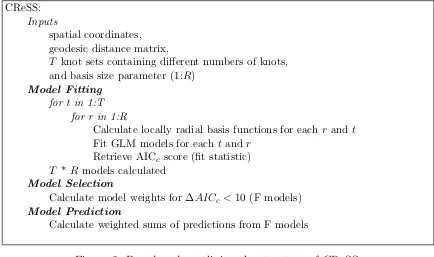
method can be seen in Figure 2.
155
Firstly for the CReSS method we must calculate geodesic distances between points. In GLTPS the
156
data points are viewed as a set of vertices in a graph. However for CReSS, edges are only included between
157
pairs of points where the straight line distance between these pairs does not cross the boundary polygon(s).
158
In cases where the straight line between two observations is not contained within the region of interest,
159
A, a value of infinity is entered in the corresponding position of the restricted distance matrix. Floyds
CReSS:
Inputs
spatial coordinates, geodesic distance matrix,
T knot sets containing different numbers of knots, and basis size parameter (1:R)
Model Fitting
for t in 1:T for r in 1:R
Calculate locally radial basis functions for each r and t
Fit GLM models for each tand r
Retrieve AICc score (fit statistic) T *R models calculated
Model Selection
Calculate model weights for ∆AICc<10 (F models)
Model Prediction
[image:8.612.88.522.37.294.2]Calculate weighted sums of predictions from F models
Figure 2: Pseudocode outlining the structure of CReSS.
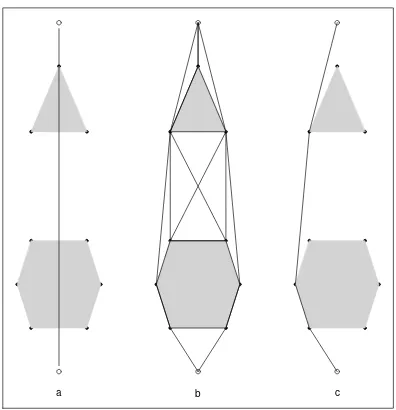
algorithm is then run on the restricted matrix containing the distances between data, knot points, and
161
the boundary points (which GLTPS does not explicitly include). The boundary is defined by one or more
162
polygons, the vertices of which are included in the distance network to accommodate the calculation of
163
the geodesic distance between the pairs of data points. All edges between the data points and the polygon
164
vertices that are contained withinAare also included in the distance network. In the case when the edge
165
between two data points is not included in A, the geodesic distance is calculated using these additional
166
edges (see example in Figure3).
167
A local radial basis can accommodate spatially varying complexity which is more difficult under a
168
globally defined radial TPS basis (Equation 1). A test region (Web Figure 1), which shows a triangular
169
exclusion region, is used to show the global nature of TPS, using one of the usual TPS basis functions
170
(Web Figure 2(a)). For instance, when choosing a new basis, the behaviour of many radial basis functions
171
near the boundaries is cause for concern [Fornberg et al.,2002]. The values of the TPS basis increase with
172
distance from each knot location often leading to errors at the edges of the plot [Fornberg et al., 2002],
173
which give rise to pronounced edge-effects. These effects are exaggerated when non-Euclidean distances
174
are used, since the furthest distance from a knot point is no longer at the edge of the plot and the radial
175
pattern may no longer be guaranteed if distances are modified to accommodate boundaries. In some
176
cases, the basis is distorted, leading to areas of reinforcement (Web Figure 2(b)) where large distances
a b c
Figure 3: An example of graph construction using the CReSS method, where the grey areas represent exclusion zones, filled circles represent the polygon vertices and lines represent edges. (a) is the Euclidean distance between two points (open circles). (b) is the distance network created by CReSS for these two points and (c) is the geodesic distance between the two points using only the edges shown in b.
compound. This could make some surfaces difficult to approximate and prediction errors are typically
178
greatest where reinforcement occurs (Web Figure 2(d)). A local basis restricts the distance from each
179
knot over which the basis is effective and reduces the likelihood of reinforcement occurring (Web Figure
180
2(c)).
181
Thus, CReSS replaces global radial basis functionη(d), (Equation1) withη(G, r) = exp(−G/r2), where
182
r determines the radius of this Exponential [Rathbun, 1998], and thus its local nature, and G is a more
183
realistic distance matrix with elements gi,t. Parameter r takes a range of values that results in local to
184
global basis functions. These values are dependent upon the range and units of the spatial covariates. A
185
range of knot numbers is also selected and the best model set chosen using AICcmodel weights [Burnham
186
and Anderson, 2002, Hurvich and Tsai, 1989]. AICc is a small sample AIC and Burnham and Anderson
187
[2002] recommend it be used when the ratio n/k < 40, where n is the sample size and k is the total
188
number of estimated regression parameters (including the intercept andσ2). For values of this ratio>40
189
AIC and AICc converge. Other information criteria may be substituted for AICc. We have also removed
190
the planar parts of Equation 2 since a linear trend in x1 or x2 could be based on unrealistic Euclidean
distance. Thus the equation for the smooth surface s at point xi, knot set T and parameter r using the
192
CReSS method is
193
sT ,r(xi) = β0+ T
X
t=1
δtη(gi,t, rT)
The candidate model set is all possible combinations of knot numbers and r’s. A model set, F, of
194
models with a ∆AICc <10 have weights calculated using
195
wi =
exp(−1
2∆i)
F
P
f=1
exp(−1
2∆f)
Predictions are made for model setF and a weighted sum of these is calculated to get an overall model
196
prediction. Burnham and Anderson [2002] suggest that a model, i, with a ∆i > 10 shows no empirical
197
support for that model.
198
Knot placement in this paper followsWang and Ranalli [2007] by using a space filling design, such as
199
that of John et al. [1995] from the FIELDS package [Furrer et al., 2010]. The knots for all methods were
200
generated from the observed data so as to minimise a geometric space-filling criterion. Therefore, for a
201
given simulation run each method has the same knot choices.
202
3
Simulation Studies
203
We consider CReSS’s performance using two simulation studies and compare with TPS, GLTPS and
204
SOAP. The first simulation employs the horseshoe [Ramsay, 2002, Wang and Ranalli, 2007] (Figure 4,
205
Section 3.1) and the second is inspired by a land reclamation project in the Persian Gulf near the coast
206
of the United Arab Emirates (Figure 9, Section 3.2). Both are examples of areas with irregular shaped
207
boundaries and sharp changes in the response across these boundaries, though the latter shows more
208
complexity.
209
3.1
Horseshoe Simulation
210
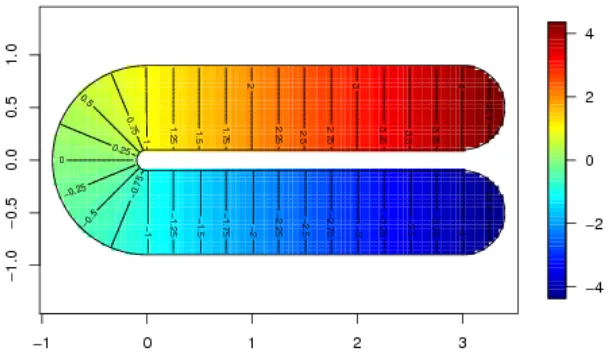
The horseshoe (Figure 4) varies smoothly from approximately 4 to -4 from the right hand end of the
211
top arm to the right hand end of the lower arm [Ramsay, 2002]. Three test cases were generated, for
212
evaluation of the different methods, by randomly choosing n = 600 points from the surface and adding
Figure 4: The underlying function on the horseshoe region.
a normal errors noise term with standard deviation 0.05, 1 and 5 to the function values (low, medium
214
and high noise respectively). Predictions were obtained on a grid of N = 3584 points. For the GLTPS
215
method, the geodesic distances calculated using code by Wang and Ranalli [2007] were poor and led to
216
artefacts. Therefore, the same geodesic distances were used for both GLTPS and CReSS and calculated
217
using the method in Section2.4. SOAP is constructed using a cyclic penalised cubic regression spline (40
218
knots) to estimate the unknown boundary values [Wood et al.,2008]. There is no guidance for boundary
219
knot allocation, so the authors use the same as Wood et al. [2008]. Additionally, for CReSS, parameter
220
r took values between 2 and 10,000 for basis calculation. All methods use a choice of 10 to 100 knots
221
(by 5) generated using the space-filling algorithm. As per author’s recommendations, model selection was
222
performed using GCV for TPS and SOAP, AIC for GLTPS and AICc for weights calculation for CReSS.
223
Three measures were employed to determine the performance of each of the methods: The estimation
224
bias, ˆb(Equation6), Mean Squared Error (MSE; Equation7), andk-fold Cross Validation (CV; Equation
225
8). The estimation bias, ˆb, is a vector of bias evaluations ˆbj at each of N points, tj (j = 1, ..., N):
226
ˆ
bj = 100−1
100
X
p=1 ˆ
zp(tj)−z∗(tj) forj = 1, ..., N, (6)
where ˆzp(tj) is the method’s estimate of the true value,z∗(tj), at replicatep(random data realisations
from a surface with noise) for p = 1, ...,100. MSE considers differences in predictions to the underlying
228
function and is calculated for out-of-set prediction locations (locations unseen by the fitting process,
229
Equation 7). Both MSE and CV are calculated for each replicate, p:
230
\
M SEp =N−1
N
X
j=1
{zˆp(tj)−z∗(tj)}2. (7)
where z(tj) are the observed response values i.e. z∗(t)j+ error.
231
10-fold CV was calculated where for each iteration, 10% of the data is removed prior to fitting and
232
then used for assessing prediction.
233
CV = 10−1
10
X
g=1
X
q
(ˆzq−zq)2 (8)
with q being an index providing a random sample of 90% of the data, without replacement.
234
(a) (b) (c)
● ●
● ● TPS GLTPS SOAP CReSS
0.00
0.05
0.10
0.15
0.20
0.25
0.30
CV Score
[image:12.612.89.525.324.642.2](d) (e) (f)
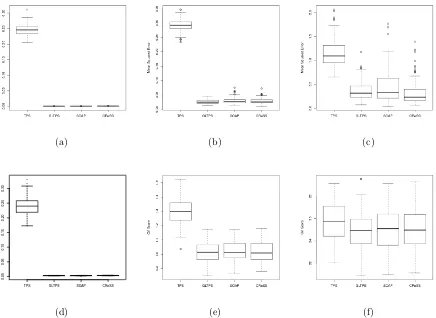
Figure 5: Boxplots of MSE (top) and CV scores (bottom) for 100 simulations on the horseshoe (a, d) Low
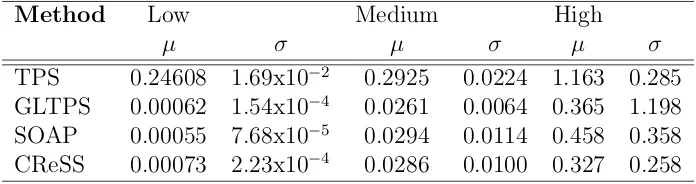
CReSS, SOAP and GLTPS all perform substantially better than TPS for this function at all noise
235
levels (Table 1 and Figure 5). Consistent with other analyses [Ramsay, 2002, Wang and Ranalli, 2007,
236
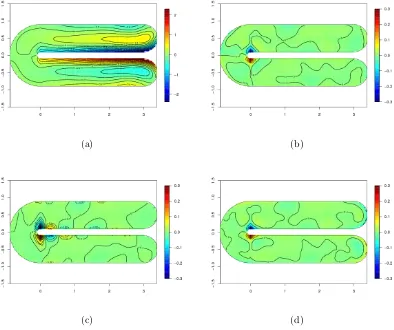
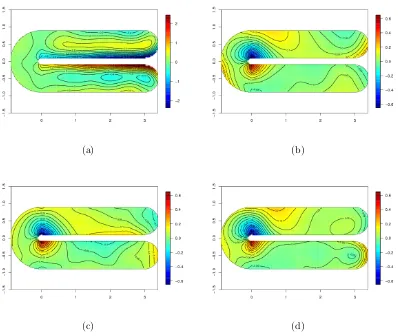
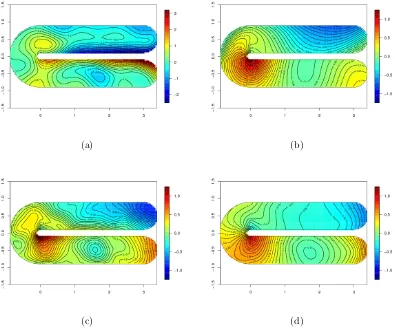
Wood et al., 2008] the main error for TPS is along the inner edges of the two arms and while GLTPS,
237
SOAP and CReSS show their greatest error in the elbow region (Figure6-8). The range of the estimation
238
bias, ˆb, is comparable for complex region methods, but slightly lower for CReSS at high noise (Figure
239
6-8). CReSS also has the best mean MSE score (and smallest σ) at high noise. At other noise levels the
240
methods are very similar with soap marginally better at low noise and GLTPS medium noise. A single
241
model tended to be chosen at low noise using CReSS, but for high noise many more were chosen and
242
averaged. CReSS also describes the increasing function along the arms better than SOAP or GLTPS
243
(Figure 8).
[image:13.612.130.478.294.386.2]244
Table 1: Mean MSE scores and standard deviation for all methods at all noise levels on the horseshoe simulation.
Method Low Medium High
µ σ µ σ µ σ
TPS 0.24608 1.69x10⁻² 0.2925 0.0224 1.163 0.285
GLTPS 0.00062 1.54x10⁻⁴ 0.0261 0.0064 0.365 1.198
SOAP 0.00055 7.68x10⁻⁵ 0.0294 0.0114 0.458 0.358
(a) (b)
[image:14.612.112.506.59.389.2](c) (d)
(a) (b)
[image:15.612.111.509.53.389.2](c) (d)
Figure 7: Bias for medium noise, (a) TPS, (b) GLTPS, (c) SOAP and (d) CReSS
3.2
Palm Simulation
245
The simulated palm region is inspired by the palm structures in the Persian Gulf off the coast of Dubai
246
(Figure 9&1(b)). The upper-hat shaped island and edge pieces represent the outer breakwater with two
247
channels, whilst the inner segment represents a palm leaf with three fronds on each side. The surface is
248
constructed using the definitions in Web Table 2 and the zones in Figure 9, and was created to test the
249
performance of the method when the function changes greatly across small exclusion areas.
250
The function varies smoothly from approximately -40 to 110 and contains an island, which can give
251
rise to the reinforcement issue outlined in Section 2.4. Three test cases were generated, for evaluation
252
of the different methods, by randomly choosing n = 500 points from the surface and adding a normal
253
errors noise term with standard deviation 0.5, 9 and 50 to the function values. The noise was added such
254
that the signal-to-noise ratio is similar to that of the horseshoe simulation. Predictions were obtained on
255
N = 2518 points. SOAP is constructed with unknown boundary values and, after some trial and error,
(a) (b)
[image:16.612.112.507.58.387.2](c) (d)
Figure 8: Bias for high noise, (a) TPS, (b) GLTPS, (c) SOAP and (d) CReSS
50 knots for the outer boundary and 40 for the island. There is no guidance for boundary knot selection
257
and the default (10 knots) is too small in many situations, so these knot numbers were found to be the
258
best after an extensive non-exhuastive search. As for the simulation study in Section 3.1, parameter r,
259
for the CReSS method, took values between 2 and 10,000. For all methods a choice of 10 to 100 knots
260
was allowed and finalised using GCV (TPS and SOAP), AIC (GLTPS) and AICc (CReSS). In the case of
261
SOAP these knots are for the interior soap basis.
262
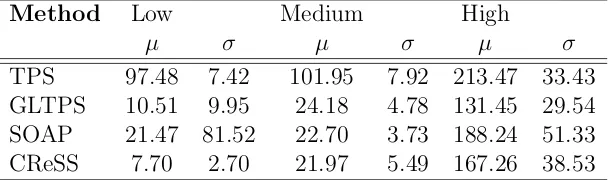
Of the methods trialled, the CReSS method exhibited the lowest MSE scores at low and medium noise
263
for this region and, unsurprisingly, TPS has the worst fit to the data and underlying function across all
264
noise levels (Table2 and Figure 10). CV distinguishes TPS from the other methods at low and medium
265
noise but at high noise, no clear distinction can be made between model fits (Figure 10). The lack of fit
266
of TPS becomes more pronounced as noise increases and is mainly due to leakage across the island where
267
the difference in underlying function values is greatest (Figures 11(a), 13(a), 13(a)). At high noise there
(a)
Figure 9: The underlying function on the simulated palm region. The letters refer to the regions in Web Table 2 used to construct the function.
is also some evidence of leakage down through the palm fronds from the hotspot at the top. As expected,
269
there was is no evidence of leakage for GLTPS, SOAP or CReSS, however, all methods (including TPS)
270
struggled to model the high and low function values to the left of the stem (Figures 11 - 13). These
271
errors may be due to lack of coverage by the data points here or an inflexibility in knot number and/or
272
placement.
273
Table 2: Mean MSE scores and standard deviation for all methods at all noise levels for the palm simu-lation.
Method Low Medium High
µ σ µ σ µ σ
TPS 97.48 7.42 101.95 7.92 213.47 33.43
GLTPS 10.51 9.95 24.18 4.78 131.45 29.54
SOAP 21.47 81.52 22.70 3.73 188.24 51.33
CReSS 7.70 2.70 21.97 5.49 167.26 38.53
GLTPS shows a good numerical fit, particularly at high noise, but exhibits some problems visually
274
due to artefacts (striations) to the upper right and left of the island. These are particularly apparent
[image:17.612.153.458.520.610.2]on the prediction plot for medium noise (Figure 14(b)). We consider that this is due to reinforcement
276
issues arising from the global function basis and thus while giving reasonable MSE scores, the errors are
277
clearly concentrated spatially. SOAP deals very well with the breakwater though there is some evidence
278
of errors on the ends of the upper fronds (Figure 13(c)). CReSS respects all the boundaries, keeping
279
the high values under the breakwater and the low values above it without leakage. Based upon MSE
280
scores, CReSS performs best at low and medium noise, however it is also best at high noise since, while
281
MSECReSS > MSEGLTPS, the local concentration of errors and associated artefacts make GLTPS a poor
282 choice. 283 ● ● ● ● ● ● ● ● ●● ● ● ● ● ● ● ● ● ● ● ● ● TPS GLTPS SOAP CReSS
0
200
400
600
800
Mean Squared Error
(a) ● ● ● ● ● ●
TPS GLTPS SOAP CReSS
20 40 60 80 100 120 140
Mean Squared Error
(b) ● ● ● ● ● ●
TPS GLTPS SOAP CReSS
100 150 200 250 300 350
Mean Squared Error
(c) ● ● ● ● ● ● ● ● ● ● ● ●
TPS GLTPS SOAP CReSS
0 20 40 60 80 100 120 140 CV Score (d) ● ● ● ●
TPS GLTPS SOAP CReSS
80 100 120 140 160 180 200 220 CV Score (e) ● ●
TPS GLTPS SOAP CReSS
[image:18.612.84.525.225.544.2]2200 2400 2600 2800 3000 3200 CV Score (f)
Figure 10: Boxplots of MSE (top) and CV scores (bottom) for 100 simulations on the palm function. (a,
2 4 6 8 10 12 14
2
4
6
8
10
−80 −60 −40 −20 0 20 40
(a)
2 4 6 8 10 12 14
2
4
6
8
10
−30 −20 −10 0 10 20 30
(b)
2 4 6 8 10 12 14
2
4
6
8
10
−30 −20 −10 0 10 20 30
(c)
2 4 6 8 10 12 14
2
4
6
8
10
−30 −20 −10 0 10 20 30
[image:19.612.111.505.59.386.2](d)
2 4 6 8 10 12 14
2
4
6
8
10
−80 −60 −40 −20 0 20 40
(a)
2 4 6 8 10 12 14
2
4
6
8
10
−40 −20 0 20 40
(b)
2 4 6 8 10 12 14
2
4
6
8
10
−40 −20 0 20 40
(c)
2 4 6 8 10 12 14
2
4
6
8
10
−40 −20 0 20 40
[image:20.612.111.506.59.385.2](d)
Figure 12: Bias for medium noise (a) TPS, (b) GLTPS, (c) SOAP and (d) CReSS
4
Killer whale analysis: Mapping killer whale group size off
284
the West coast of the Canadian/USA border
285
The region of this study contains a complex area of coastline with 15 islands (Figure1). The data consist
286
of n = 763 group size estimates from 1 to 50. A choice of 10 to 60 knots were chosen randomly from a
287
sample of 200 space-filled knots. This prevented over-populating the ‘arms’ of the data and thus having
288
too many knots where there is no data support. The data is over-dispersed and therefore modelled using
289
a quasipoisson error distribution with a log link. A more realistic surface could be produced by including
290
other covariates, such as depth or chlorophyll, however the two-dimensional smooth serves as a good
291
exemplar. Predictions were made on a grid of N = 4799 points, with GCV used to choose knots for TPS
292
and SOAP, QAICc [Lebreton et al., 1992] for CReSS and Residual Sums of Squares (RSS) for GLTPS.
293
All of the methods showed a decent fit to the data using RSS scores, with SOAP having the best fit
2 4 6 8 10 12 14
2
4
6
8
10
−80 −60 −40 −20 0 20 40 60
(a)
2 4 6 8 10 12 14
2
4
6
8
10
−60 −40 −20 0 20 40 60
(b)
2 4 6 8 10 12 14
2
4
6
8
10
−60 −40 −20 0 20 40 60
(c)
2 4 6 8 10 12 14
2
4
6
8
10
−60 −40 −20 0 20 40 60
[image:21.612.111.505.59.384.2](d)
Figure 13: Bias for high noise, (a) TPS, (b) GLTPS, (c) SOAP and (d) CReSS
to the data, and CReSS having the best QAICc score (Table 3). However, even very minor extrapolation
295
presented some interesting problems. TPS and GLTPS both show edge effects from the use of a global
296
basis function, but the range of group size predictions for TPS is much closer to the data (Figure 15).
297
GLTPS also shows some effect of reinforcement errors in the very centre of the plot. SOAP was particularly
298
difficult to parameterise with knot choices needed for all 16 boundaries (1 outer box and 15 islands). There
299
is no guidance for selection so, after various combinations tried, the authors chose 40 knots for the outer
300
box and 5 for all remaining polygons. SOAP is notably poor for extrapolation in this region, with values
301
of infinity predicted in the centre of the plot (Figure 15). To see if SOAP could extrapolate a small
302
distance from the data the prediction area was restricted to a non-convex bounding polygon close-fitting
303
to the data. No values of infinity were predicted but 6 points had predictions>103, which is well outside
304
the data range (Web Figure 5). CReSS fits the data better than TPS and GLTPS and predicts a surface
305
which would seem more realistic. Hotspots are produced in areas where there are large group sizes in the
2 4 6 8 10 12 14
2
4
6
8
10
0 50 100
(a)
2 4 6 8 10 12 14
2
4
6
8
10
0 50 100
(b)
2 4 6 8 10 12 14
2
4
6
8
10
0 50 100
(c)
2 4 6 8 10 12 14
2
4
6
8
10
0 50 100
[image:22.612.111.505.59.384.2](d)
Figure 14: Example predictions for medium noise, (a) TPS, (b) GLTPS, (c) SOAP, (d) CReSS (iteration 80)
data and the surface declines to approximately zero elsewhere.
307
5
Conclusions
308
CReSS has been developed by extending an existing method in two ways to deal with issues arising from
309
biologically meaningless distances in complex regions. Firstly, an accurate estimate of geodesic distance
310
between points (that which an animal may travel) is used as a measure of inter point similarity. Secondly, a
311
locally varying basis function is employed to accommodate local smoothing requirements while alleviating
312
problems with reinforcement. Further, since these modifications are made prior to or at the basis function
313
stage, it allows the basis to be used in a wide variety of statistical models. The use of model averaging
314
eliminates the need for choice of radius.
Table 3: Knots chosen, RSS and QAICc scores for the killer whale data
Method Knot Number RSS QAICc
TPS 60 46169 788
GLTPS 40 46911
-SOAP 60 34487 844
CReSS 45 41833 95
−123.4 −123.2 −123.0 −122.8 −122.6
48.3 48.4 48.5 48.6 48.7 48.8 48.9 49.0 Longitude Latitude 0 10 20 30 40 50 60 5 5 5 5 5 5 5 10 10 10 10 10 15 15 15 15 20 20 20 25 25 25 30 30 30 35 35 35 35 40 40 45 50 50 55 (a)
−123.4 −123.2 −123.0 −122.8 −122.6
48.3 48.4 48.5 48.6 48.7 48.8 48.9 49.0 Longitude Latitude 0 20 40 60 80 100 5 5 5 5 5 5 5 10 10 10 10 10 15 15 15 15 15 15 20 20 20 20 25 25 25 30 30 30 35 35 35 40 40 45 45 50 50 65 75 75 (b)
−123.4 −123.2 −123.0 −122.8 −122.6
48.3 48.4 48.5 48.6 48.7 48.8 48.9 49.0 Longitude Latitude 0 20 40 60 80 100 5 5 5 5 5 5 5 5 5 5 5 5 5 10 10 10 10 10 10 10 10 10 10 10 15 15 15 15 15 15 15 20 20 20 20 20 25 25 25 30 30 35 40 40 45 45 55 55 60 65 70 75 ● ● ● ● ● ● ● ● ● ● ● ● ● ● ● ● ● ● ● ● ● ● ● ● ● ● ● ● ● ● ● ● ● ● ● ● ●● ● ● ● ● ● ● ●● ● ● ● ● ● ● ● ●●● ● ● ●● ●● ● ● ● ● ● ●● ● ● ● ●● ●● ● ● ● ●●● ● ●● ● ●● ● ● ● ● ● ● ● ● ●● ● ● ● ● ● ● ● ● ● ● ● ● ● ● ● ● ● ● ● ● ● ● ● ●● ● ● ● ● ● ● ● ● ● ● ● ● ● ● ● ● ● ● ● ● ● ●● ● ● ● ● ●● ● ●● ● ●● ● ● ● ●● ● ●● ● ● ● ● ● ● ● ● ●● ● ● ●● ● ● ● ● ●● ● ● ● ● ●● ● ●● ● ●● ● ●● ●● ● ● ● ● ● ● ● ● ● ● ● ● ● ● ● ● ●● ●●●● ●●●● ●●●● ●●●●● ●●●●●● ●●●●●●●● ●●●● ●● ●● ●●●●● ●●●● ●● ●●● ●●● ●●●●●● ●●●● ●● (c)
−123.4 −123.2 −123.0 −122.8 −122.6
48.3 48.4 48.5 48.6 48.7 48.8 48.9 49.0 Longitude Latitude 0 10 20 30 40 50 5 5 5 5 5 5 5 5 5 5 10 10 10 10 10 10
10 10
10 15 15 15 15 15 20 20 20 25 30 35 (d)
Figure 15: Plots of predictions for the killer whale data using (a) TPS, (b) GLTPS (c) SOAP and (d) CReSS. The density scale is wider for GLTPS and SOAP to accommodate higher predictions. Grey dots
represent points with counts>100 and black dots represent points where a value of infinity was predicted.
Colour plots may be found in Web Figure 5.
After reviewing the methods in this paper, the GLTPS method cannot be used in areas with islands
316
and SOAP is hard to parameterise, particularly with increasing boundary loops. We have attempted to
317
provide the best results from all methods for comparison, frequently trialling many parameterisations
[image:23.612.100.510.164.520.2]many more than would be reasonably expected for general use. CReSS is very simple to implement and
319
is comparable with, if not better than, other methods in all examples shown.
320
The issue of knot selection is common to all the methods seen in this paper. Here, the knots are chosen
321
using a space filling algorithm which does not necessarily allow surface flexibility in the areas it is most
322
required, particularly for the sparse killer whale test data set. In the one dimensional case, a new Spatially
323
Adaptive Local Smoothing Algorithm (SALSA, Walker et al., 2010) has proved to be very effective for
324
knot placement and is currently being incorporated into the CReSS method.
325
SUPPLEMENTAL MATERIALS
326
Supplementary Material
327
Web Tables and Figures referenced in Sections 2 and 4 are available at the web link given.
328 329
References
330
K. P. Burnham and D. R. Anderson. Model Selection and Multimodel Inference: A practical
information-331
theoretic approach. Springer, 2 edition, 2002.
332
R. W. Floyd. Algorithm 97: Shortest path. Communications of the ACM, 5:345, 1962.
333
B. Fornberg, T. Driscoll, G. Wright, and R. Charles. Observations on the behavior of radial basis function
334
approximations near boundaries. Computers & Mathematics with Applications, 43(3-5):473–490, 2002.
335
R. Furrer, D. Nychka, and S. Sain. fields: Tools for spatial data, 2010. URL http://CRAN.R-project.
336
org/package=fields. R package version 6.3.
337
P. J. Green and B. W. Silverman. Nonparametric Regression and Generalised Linear Models (A roughness
338
penalty approach). Chapman and Hall, England, 1994.
339
R. L. Harder and R. N. Desmarais. Interpolation using surface splines. Journal of Aircraft, 9:189–191,
340
1972.
341
T. Hastie. Statistical models in S. Chapman and Hall, 1993.
T. J. Hastie and R. J. Tibshirani. Generalized Additive Models. Chapman & Hall, 1990.
343
C. M. Hurvich and C.-L. Tsai. Regression and time series model selection in small samples. Biometrika,
344
76(2):297–307, 1989. doi: 10.1093/biomet/76.2.297. URL http://biomet.oxfordjournals.org/
345
content/76/2/297.abstract.
346
P. W. M. John, M. E. Johnson, L. M. Moore, and D. Ylvisaker. Minimax distance designs in two-level
347
factorial experiments. Journal of Statistical Planning and Inference, 44:249–263, 1995.
348
J.-D. Lebreton, K. P. Burnham, J. Clobert, and D. R. Anderson. Modeling survival and testing biological
349
hypotheses using marked animals: A unified approach with case studies. Ecological Monographs, 62(1):
350
pp. 67–118, 1992. ISSN 00129615. URL http://www.jstor.org/stable/2937171.
351
B. McMorrow. Palm jumeirah photograph. World Wide Web, 2004. URL http://www.pbase.com/
352
bmcmorrow.
353
R Development Core Team.R: A Language and Environment for Statistical Computing. R Foundation for
354
Statistical Computing, Vienna, Austria, 2009. URLhttp://www.R-project.org. ISBN 3-900051-07-0.
355
T. O. Ramsay. Spline smoothing over difficult regions. Journal of the Royal Statistical Society: Series B
356
(Statistical Methodology), 64(1):307–319, 2002.
357
S. L. Rathbun. Spatial modelling in iregularly shaped regions: Kriging estuaries. Environmetrics, 9:
358
109–129, 1998.
359
C. Walker, M. Mackenzie, C. Donovan, and M. O’Sullivan. Salsa - a spatially adaptive local smoothing
360
algorithm. Journal of Statistical Computation and Simulation, 81(2):179–191, 2010.
361
H. Wang and M. G. Ranalli. Low-rank smoothing splines on complicated domains. Biometrics, 63(1):
362
209–217, 2007.
363
S. N. Wood. Thin plate regression splines. J. R. Statist. Soc. B, 65(1):95–114, 2003.
364
S. N. Wood. soap: Soap film smoothing, 2010. R package version 0.1-5.
365
S. N. Wood, M. V. Bravington, and S. L. Hedley. Soap film smoothing. J. R. Statist. Soc. B, 70(5), 2008.
Web-based Supplementary Materials for
Complex Region Spatial Smoother
August 24, 2011
0.0 0.2 0.4 0.6 0.8 1.0
0.0
0.2
0.4
0.6
0.8
1.0
0.0 0.5 1.0 1.5 2.0
0.0 0.2 0.4 0.6 0.8 1.0
0.0
0.2
0.4
0.6
0.8
1.0
−0.15 −0.10 −0.05 0.00 0.05 0.10
(a)
0.0 0.2 0.4 0.6 0.8 1.0
0.0
0.2
0.4
0.6
0.8
1.0
−0.1 0.0 0.1 0.2 0.3
(b)
0.0 0.2 0.4 0.6 0.8 1.0
0.0
0.2
0.4
0.6
0.8
1.0
0.2 0.4 0.6 0.8
(c)
0.0 0.2 0.4 0.6 0.8 1.0
0.0
0.2
0.4
0.6
0.8
1.0
−0.2 0.0 0.2 0.4 0.6
(d)
Web Figure 2: Graphical representations of one basis (out of a possible 30 knots) for TPS (a) a global basis function (b) and a local basis function (c). The global basis shows reinforcement at the top of the triangle and this is also shown by the area of greatest prediction error (d) for the surface in Figure 1
Web Table 1: The benchmark function, F, is defined by region as shown. We
denote the geodesic distance between two pointsX andY asd(X, Y). The
left-most red dot at co-ordinate (2,5) we denote byL. The rightmost dot at co-ordinate
(14,5) we denote byR.
Region F(X) =F(X1,X2)
A d(X, L)−(X1−2)2
B d(X, L) + (X1−2)2 + (X1−4)3
C d(X, L) + (X1−2)2
D d(X, L) + (X1−2)2 + (4−X2)3+ (X1−4)4
E d(X, L) + (X1−2)2 + (4−X2)3−(X1−4)4
F d(X, L) + (X1−2)2 + (4−X2)3
G d(X, R)−(14−X1)2
H d(X, R)−(14−X1)2−(12−X1)3
I d(X, R) + (14−X1)2
J d(X, R) + (14−X1)2+ (4−X2)
K d(X, R) + (14−X1)2+ (4−X2)−(12−X1)2
L d(X, R) + (14−X1)2+ (4−X2)−(12−X1)
2 4 6 8 10 12 14
0
2
4
6
8
10
12
X1
X2
−40 −20 0 20 40 60 80 100
A
B
C
D
E F
G
H
I
J K
L
−123.4 −123.2 −123.0 −122.8
48.4
48.6
48.8
49.0
Longitude
Latitude
0 10 20 30 40 50 60 70
(a)
−123.4 −123.2 −123.0 −122.8
48.4
48.6
48.8
49.0
Longitude
Latitude
0 50 100 150 200 ●●●
●●●● ●●●● ●●●● ●●●●● ●●●●● ●●●●● ●●●●●●
(b)
−123.4 −123.2 −123.0 −122.8
48.4
48.6
48.8
49.0
Longitude
Latitude
0 50 100 150 200
● ● ● ● ● ● ● ● ● ● ● ● ● ● ● ● ● ● ● ● ● ● ● ● ● ● ● ● ● ● ● ● ● ● ● ● ● ● ● ● ● ● ●● ● ● ● ● ●● ● ● ● ● ● ● ● ● ● ● ● ● ● ● ●● ● ● ●● ● ● ● ●● ●
● ● ● ● ● ● ●●● ● ● ● ● ● ● ● ● ● ●● ● ● ● ● ● ● ● ● ● ● ● ● ● ● ● ● ● ● ● ● ● ● ● ●● ● ● ● ● ● ● ● ● ● ● ● ● ● ● ● ● ● ● ● ● ● ●● ● ● ● ● ●● ● ● ● ●● ● ●
● ● ● ● ● ● ● ●●
● ● ● ● ● ● ● ● ● ● ● ● ● ● ● ● ● ● ● ● ●
●● ●●●● ●●●● ●●●● ●●●●● ●●●●●● ●●●●●●●● ●●●●●● ●● ●●●●● ●●●● ●● ●●● ●●●
●●●●●● ●●●● ●●
(c)
−123.4 −123.2 −123.0 −122.8
48.4
48.6
48.8
49.0
Longitude
Latitude
0 10 20 30 40 50
(d)
Web Figure 4: Plots of predictions for the killer whale data using (a) TPS, (b) GLTPS (c) SOAP and (d) CReSS. The density scale is wider for GLTPS and SOAP
to accommodate higher predictions. Grey dots represent points with counts>100
and black dots represent points where a value of infinity was predicted.
−123.4 −123.2 −123.0 −122.8
48.4
48.6
48.8
49.0
Longitude
Latitude
0 50 100 150 200
x x x x xx
Web Figure 5: Reduced extrapolation for killer whale region, red crosses represent
![Figure 1: Killer whale group size off the West coast of the USA/Canada (a) and Palm Jumeirah in thePersian Gulf off the coast of Dubai [McMorrow, 2004] (b)](https://thumb-us.123doks.com/thumbv2/123dok_us/8655991.374413/2.612.104.513.275.486/figure-killer-canada-jumeirah-thepersian-coast-dubai-mcmorrow.webp)