NON RADIATIVE TRANSITIONS
Neil Robertson
A Thesis Submitted for the Degree of PhD
at the
University of St Andrews
1977
Full metadata for this item is available in
St Andrews Research Repository
at:
http://research-repository.st-andrews.ac.uk/
Please use this identifier to cite or link to this item:
http://hdl.handle.net/10023/14593
N on - R a cl i a t i ve T r a n s i t i on s
A th e sis presented by
N e il Robertson
to the
U n iv e rs ity o f St, Andrews
in a p p lic a tio n fo r the Degree o:
Doctor o f Philosophy .
ProQuest Number: 10171151
All rights reserved
INFORMATION TO ALL USERS
The quality of this reproduction is dependent upon the quality of the copy submitted.
In the unlikely event that the author did not send a com plete manuscript and there are missing pages, these will be noted. Also, if material had to be removed,
a note will indicate the deletion.
uest
ProQuest 10171151
Published by ProQuest LLO (2017). Copyright of the Dissertation is held by the Author.
All rights reserved.
This work is protected against unauthorized copying under Title 17, United States C ode Microform Edition © ProQuest LLO.
ProQuest LLO.
789 East Eisenhower Parkway P.Q. Box 1346
D e cla ra tio n
. The accompanying th e s is is my own com position. I t is based
on work c a rrie d out by me and no p a rt o f i t has p re v io u s ly been
presented in a p p lic a tio n fo r a Higher Degree.
C e rtific a te
I c e r tify ' th a t the co n d itio n s o f the Ordinance and
R egulations have been f u l f i l l e d ,
A b s tra c t, on the th e s is
"N o n -R a d ia tiv e T r a n s itio n s " , by N e il A lb e rt R obertson
T h is th e s is d e sc rib e s th e o r e tic a l research in to m u ltip h o n o n non-
r a d ia tiv e tr a n s itio n s in s o lid s . These processes occur when an im p u rity
ce n tre e le c tro n w hich has been ra is e d to an e x c ite d s ta te re tu rn s to i t s
ground s ta te by e m ittin g phonons in to the la t t ic e ra th e r th a n by e m ittin g
l i g h t .
The o r ig in a l c o n tr ib u tio n o f th is th e s is is concerned w ith c e r ta in
th e o r e tic a l aspects o f n o n -ra d ia tiv e tr a n s itio n s . For the f i r s t tim e the
M o le c u la r C ry s ta l Model o r ig in a lly developed by H o ls te in to s tu d y s m a ll-
p o la ro n m otion is usëd to in v e s tig a te t h is problem . In p a r t ic u la r , the
e f fe c t th a t weak d is p e rs io n o f th e v ib r a t io n a l modes has on the t r a n s it io n
ra te s is s tu d ie d . The in c lu s io n o f weak d is p e rs io n is e s s e n tia l f o r a
rig o ro u s tre a tm e n t o f n o n -ra d ia tiv e t r a n s it io n s , and w ith o u t th is fe a tu re
the t r a n s it ip n ra te s are n o t w e ll d e fin e d . We a ls o use th e w e ll known
s in g le c o n fig u ra tio n c o o rd in a te model to d e riv e re co m b in a tio n ra te s ,
g iv in g p a r t ic u la r a tte n tio n to th e unequal fre q u e n cy case. F in a lly an
a d a p ta tio n o f the M o le c u la r C ry s ta l Model is considered w hich more c lo s e ly
resem bles r e a l p h y s ic a l systems in th a t the e le c tro n is coupled to b o th
Ackn ow le dgemen t s
I should lik e to express my thanks to the fo llo w in g ;
Dr. L.R. Friedman, my research su p e rviso r fo r suggesting th is research
problem and fo r h is constant encouragement and help w ith o u t which th is
work would n o t have been completed,
P rofessor R.B. D ingle and Mr, «l.W. A lle n fo r t h e ir in te r e s t in my work
and t h e ir help at vario u s tim es,
Mr. R .L. G i l l , Mrs, M, Saglam^ Mr, J,M , Noras and Miss H,R, Szawelska
fo r th e ir help and moral supp ort.
Mrs, P, Cooper, my^ ty p is t^ fo r h e r patience in ty p in g th is th e sis very
CONTENTS
Chapter l î In tro d u c tio n
Chapter 2: Review
Part I; Thé Single C o n fig u ra tio n a l Côotdiriàté 'Model
Chapter 3? Tine Single C o n fig u ra tio n a l Coordinate Model
Chapter 4; The g e n e ra lis a tio n o f die S,C,C,M, to in clu d e
d iffe r e n t v ib ra tio n a l frequencies fo r the ground and e x c ite d e le c tro n ic s ta te s .
Part I I : ^ The M olecular CryvS'to.1 Model Chapter 5; The M olecular C ry s ta l Model
Chapter 6 ; The D e riv a tio n o f th,e Recombination Rates in
the M olecular C ry s ta l Model using co m b in a to ria l arguments,
Chapter 7; The C a lc u la tio n o f Recombination Rates in the M,C,M, using die (d e riv a tiv e * non-^adiabatic
term s,
■ P art 'I I I ; ' ' The M olecular C ry s ta l Model 'ta kin g weak 'but 'f in i t e dxspersr on into^ account,
Chapter 8; The M olecular C ry s ta l Model ta kin g weak b u t f i n i t e d isp e rsio n in to account.
Chapter 9; An a lte rn a tiv e method o f c a lc u la tio n o f the Recombination Rates in the M,C,M,
'Ràff ' IV'*' ' ''The 'in c o rp o ra tio n 'o f ^a 'lo c a l 'ràôde'''în 'the MdTéCiilarI f «■ "» 1 n- i r - i ,1 .1 "! r - r - f , ' « « - ' j < > . ,; ■ t ' ■ «'- v ; i r - f ''«I'V "# -T, w v - ' V . ^ 'C ry s ta l M odel,
Chapter 10; Tlie in c o rp o ra tio n o f a lo c a l mode in the M olecu lar C ry s ta l Model,
Conclusions and Suggestions fo r fu tu re work,
References
I m ®.
V '." ,. - - y , '.■ T .-v, ■ ■ ■ « A ■ ■ X S C - ' f ; " '
CHAPTER 1
In tro d u c tio n *
This th e s is describes th e o re tic a l research in to m ultiphonon
n o n -ra d ia tiv e tra n s itio n s in s o lid s . Such.processes take place in molecules
and im p u rity centres in c ry s ta ls , From an experim ental p o in t o f view
n o n -ra d ia tiv e processes are most im portant when they quench competing
ra d ia tiv e tra n s itio n s . This s itu a tio n may a rise as fo llo w s ; A fte r
absorbing lig h t an e le c tro n on a c r y s ta llin e im p u rity centre o r ig in a lly
in it s ground s ta te is ra is e d to an e x c ite d s ta te . Luminescence may then
fo llo w as the e le c tro n re tu rn s to the ground s ta te and em its a photon.
A lte rn a tiv e ly , th is luminescence may be quenched i f the e le c tro n ic re la x a tio n
is accompanied by the em ission o f phonons in to the la t t ic e in a
m ultiphonon n o n -ra d ia tiv e tra n s itio n , Id e a lly the e x p e rim e n ta lis t would
lik e a th e o ry w ith the a b ilit y to p re d ic t the occurrence o f luminescence
at a given im p u rity ce n tre , However, estim ates o f the a ctu a l magnitude o f
n o n ? ra d ia tlve processes have proved alm ost im possible to o b ta in ;
in ste a d researchers have concentrated m ostly on the v a ria tio n w ith
temperature which such processes e x h ib it,
The o r ig in a l c o n trib u tio n o f th is th e sis is concerned w ith c e rta in
th e o re tic a l aspects o f n o n -ra d ia tiv e tra n s itio n s . For the f i r s t time
the M olecular C ry s ta l Model, o r ig in a lly developed by H o lste in to study
sm a ll-p o la ro n m otion is used to study n o n -ra d ia tiv e tra n s itio n s . In
p a r tic u la r the e ffe c t th a t weak d is p e rs io n has on the tra n s itio n ra te s
in the M olecu lar C ry s ta l Model is stu d ie d , The recom bination rate s
which r e s u lt are somewhat more com plicated than those derive d by previous
in v e s tig a to rs (e ,g , Engl and J o rtn e r), We also use the w e ll
known s in g le c o n fig u ra tio n coordinate model to d e rive recom bination
ra te s , g iv in g p a r tic u la r a tte n tio n to the unequal frequency case. F in a lly
c lo s e ly resembles re a l p h y s ic a l systems in th a t the e le c tro n is coupled
to both c r y s ta llin e modes and a lo c a l mode, We have published some o f
these re s u lts p re v io u s ly (Robertson and Friedman, I and I I ) ,
This in tro d u c to ry chapter contains a b r ie f non-m athem atical account
o f the theory o f n o n -ra d ia tiv e tra n s itio n s , The p h y s ic a l processes
which give ris e to the p r in c ip a l tra n s itio n rate s are then discussed
and f in a lly there is a d e s c rip tio n o f the b a sic contents o f each
chapter in the th e s is ,
We c a lc u la te recom bination ra te s using two models, the Single
C o n fig u ra tio n a l Coordinate Model hen cefo rth denoted by S,C,C,M, and the
M olecular C ry s ta l Model h en cefo rth denoted by M,C,M, Both these models
are considerably s im p lifie d versions o f the re a l systems s tu d ie d in the
la b o ra to ry . However, they are b e lie v e d to contain most o f the e s s e n tia l
feature s re q u ire d in the recom bination problem. One o f the p re re q u is ite s
fo r the occurrence o f n o n -ra d ia tiv e tra n s itio n s is the existence o f some
form o f e le c tr o n -la ttic e coup ling, In the S,C,C,M. the e le c tro n is
coupled to only one lo c a l mode, w h ile in the M,C,M, the e le c tro n is
coupled to a l l the c r y s ta llin e modes,
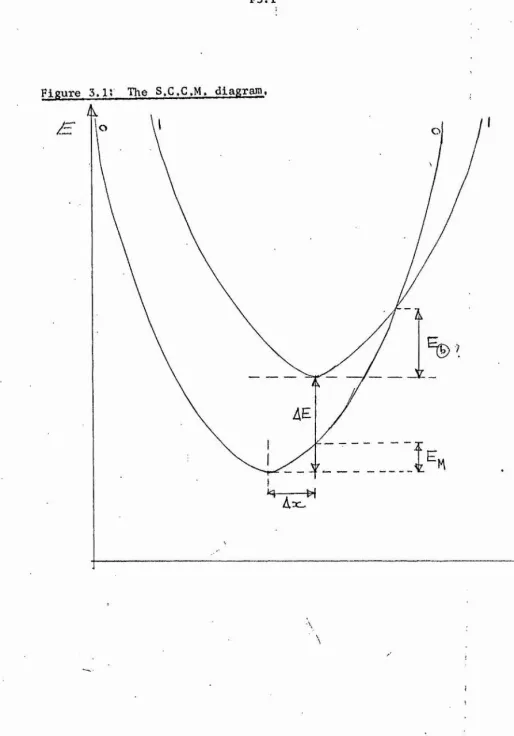
Tire S,C,C,M, is the sim p le r o f the two models. The la tt ic e is
described by o n ly one gen eralised c o o rd in a te , X » which could be the
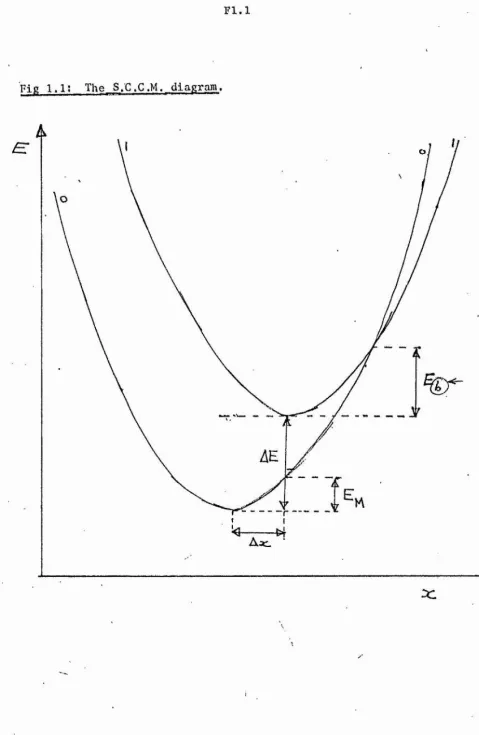
b re a th in g mode o f an im p u rity in a c ry s ta l, The Bem^Oppenheimer
method which has been discussed q u ite e x te n s iv e ly in the lite r a tu r e is
used to tre a t the e le c tr o n - la ttic e in te r a c tio n . The p h y s ic a l basis o f
th is method lie s in the e le c tro n ic m otion being much more ra p id than
the nuclear m otion so th a t the e le c tro n ic wavefunctions are assumed to
be capable o f a d ju s tin g instantaneously^ to changes o f n u cle a r p o s itio n .
Thus the e le c tro n ic wavefunctions and t h e ir energy eigenvalues
£ ^ (y c ) depend p a ra m e tric a lly on the la tt ic e configuration^,->^ , The
la tt ic e is assumed to move in a p o te n tia l which in clud es n o t o n ly the
sim ple harmonie o s c illa to r p o te n tia l % b u t also the e le c tro n ic
energy eigenvalue £ i(p c ), We assume th a t £ i,C £ ) contains a lin e a r
in te ra c tio n te rm ,~ /4^ X , w ith the e le c tro n -la ttic e coupling constant depending on which e le c tro n ic s ta te is occupied, Tîius, because
the n u c le i move in a p o te n tia l — the la tt ic e
wavefunctions are displaced sim ple harmonic o s c illa to r sta te s
where and where the displacem ent . Since the la tt ic e
e q u ilib riu m displacem ent depends on which e le c tro n ic s ta te is
occupied, the p o te n tia l energy curves are displaced w ith respect to
one another as shown in f ig 1. 1* w ith the r e la tiv e displacem ent being
A x.= I t is the coup ling stre n g th
which proves to be a very im portant parameter throughout the th e o ry.
(See f ig 1 .1 ),
However, the sta te s y b j E- Ôc- ar e n o t s ta tio n a ry
in the Bom-Oppenheimer approxim ation as a p e rtu rb a tio n arises from the
n u cle a r k in e tic energy a c tin g upon the c o n fig u ra tio n dependent e le c tro n ic
wavefunctions These so c a lle d ’n o n -a d ia b a tic * terms provid e
the coupling between the e le c tro n ic sta te s and are the o rig in o f the
recom bination processes, There are two n o n -a d ia b a tic terms which have
d iffe r e n t e le c tro n ic and v ib ra tio n a l fa c to rs . The f i r s t type co n sists
o f the terms o f the form
where the v ib ra tio n a l
overlap in te g ra l o f displa ced sim ple harmonic o s c illa to r s . This term
y ie ld s the sim p le st tra n s itio n p r o b a b ilitie s and we s h a ll c a ll th is
henceforth the standard term . The o th e r type o f n o n -a d ia b a tic process
in vo lve s terms o f the form ^ Vviti
where the v ib ra tio n a l fa c to r X
We s h a ll hen cefo rth c a ll these terms the 'd e riv a tiv e * n o n -a d ia b a tic
terras. The recom bination ra te s which a ris e from both kinds o f
n o n -a d ia b a tic process w i l l be considered in th is th e s is .
We w i l l assume throughout th is th e sis th a t the n o n -a d ia b a tic
terms are sm all enough to be tre a te d by tim e“ dependent p e rtu rb a tio n
th e o ry. There is no re a l th e o re tic a l or experim ental ju s t if ic a t io n
fo r th is assumption. However, even i f the n o n -a d ia b a tic terms are
sm all there is s t i l l a fundamental problem w hith the use o f tim e -
dependent p e rtu rb a tio n theory in the S.C.C.M, For the a p p lic a tio n o f,
tim e“ dependent p e rtu rb a tio n th e o ry to be v a lid , the system must re la x
in to f in a l s ta te s which form a continuum over the energy range. I f
th is c o n d itio n is not s a tis fie d then no w e ll defined tra n s itio n
p r o b a b ilitie s e x is t. However, in the S,C,C,M. the f in a l sta te s are
q u ite d is c re te , being separated from one another by a s in g le phonon
energy, 7^0^ . Throughout P art I we w i l l e s s e n tia lly replace the D ira c
d e lta fu n c tio n which expresses energy conservation by a Kronecker
d e lta fu n c tio n to obtain se n sib le tra n s itio n ra te s . This is a
fundamental d i f f ic u l t y w ith the S,C,C,M ., fo r unless the e le c tro n is
coupled to la tt ic e modes as w e ll, or unless the 3,C,C,M, energy le v e ls
are broadened, the re s u lts derive d using th is model are n o t e n tir e ly
rig o ro u s .
To overcome th.ese d if f ic u lt ie s we have adapted the M,C,M, to stu d y
n o n -ra d ia tiv e processes. This model was o r ig in a lly developed by
H o lste in to in v e s tig a te sm all polaron m otion, The la t t ic e in the
consists o f a set o f N d ia to m ic molecules w ith harmonic
in tra -a to m ic p o te n tia ls , These sim ple harmonic o s c illa to rs are coupled
to one another by s u ita b le in te rm o le c u la r coupling term s. There is
an e x tra e le c tro n in the m olecu lar chain which is lo c a lis e d on one o f
the m olecules. T liis e le c tro n is considered to have o n ly two s ta te s ,
a ground s ta te (0) and an e x c ite d s ta te (1 ), As in the S,C,C,M,, the
Bom-Oppenheimer approxim ation is assumed v a lid in th a t the energy
« . ' ••• Î-. " - '.. • vV.. -' y-' -“ 'f': i- .-•< - ,
eigenvalue o f the e x tra e le c tro n on the p 'th molecule contains a lin e a r
term , This lin e a r e le c tr o n - la ttic e in te ra c tio n forms p a rt o f
the p o te n tia l in which the la tt ic e moves. Thus, the la tt ic e
w avefunction is a poduct o f disp la ce d sim ple harmonic o s c illa to r
w avefunctions, where is the k 't h normal
co o rd in a te ,
The 's ta n d a rd ' and ' d e riv a tiv e ' n o n -a d ia b a tic terms in the
H am iltonian are assumed to be sm all p e rtu rb a tio n s which give ris e
to n o n -ra d ia tiv e tra n s itio n s . However, u n lik e the S,C,C,M, the existence
o f f i n i t e d isp e rsio n o f the c r y s ta llin e modes in the M.C.M, provides
a continuum o f f in a l s ta te s , so th a t the a p p lic a tio n o f p e rtu rb a tio n
theory is on a firm fo u n d a tio n . In p a rt I I we in v e s tig a te the M.C.M,
in the lim it o f zero d isp e rsio n fo r which we fin d the same n o n -ra d ia tiv e
tra n s itio n rates re s u ltin g from tlie 's ta n d a rd ' n o n -a d ia b a tic terms as
occur in the S,C,C,M, In p a rt I I I we w i l l consider the e ffe c ts o f
d isp e rsio n in the M,C,M* e x p lic it ly fin d in g considerably m odified
re s u lts , F in a lly , in P art IV we discuss a development o f the M.C.M. in
which the e le c tro n is coupled to both a lo c a l mode and to a l l the
c r y s ta llin e modes. This more r e a lis t ic model y ie ld s more com plicated
tr a n s itio n ra te s than those obtained from the previous trea tm ents.
We now discuss the recom bination rate s obtained in P arts I and I I
using the 's ta n d a rd ' n o n -a d ia b a tic term s. For a l l these re s u lts we
assume th a t the e le c tro n ic energy d iffe re n c e is an in te g ra l number o f .
phonons,
AE
We do not discuss the more general case,u n t il e x p lic it account is taken o f d isp e rsio n in P a rt I I I , The va rio u s
p rin c ip a l re s u lts are also referenced by t h e ir te x t equation numbers
h e re ,
where K is the e le c tro n ic fa c to r, K ^
w h ile £"yv/ is the coup ling s tre n g th , (see f ig 1, 1)
C<
T liis re s u lt is o fte n w ritte n in the form i t assumes in the s t a t is t ic a l
AE im it p
-
Wn-namo ly*
-k - iiu io A E j ' (/ \
Thus, i f the e le c tro n ic energy d iffe re n c e ^ A E , is la rg e the recom bination
ra te decreases e x p o n e n tia lly w ith in cre a sin g A E ,
The tra n s itio n ra te j-n the f i n i t e tem perature, weak coupling
lim it IS
W -|-— D “f" ^ o / ~
In the h ig h tem perature \ ^ strong coupling
r\ tv_çj lim it the recom bination ra te is ^
W r - ^ ( I 'f l
where is the 'a c tiv a tio n * energy shown in f ig 1 .1 , This is the
w e ll known a c tiv a tio n energy, 'o y e r the b a r r ie r ' type o f tra n s itio n .
The various cases f o r which the above re s u lts are re le v a n t w i l l
be discussed in the fo llo w in g chapters.
We now discuss b r ie f ly the p h y s ic a l processes which give ris e to
these recom bination ra te s , These processes depend on whether we are
using the S.G,G,M, o r the M.C,M.; in the S.C.C.M,, p phonons are em itte d
in to one lo c a l mode w h ile in the M.C.M, each o f the N c r y s ta llin e modes
may e ith e r remain u n a lte re d o r else em it or absorb one phonon *. From
the p o in t o f view o f the M.C.M.', the absolute zero and f i n i t e temperature
processes occur by the em ission o f one phonon in to each o f p modes
w ith the remaining modes having th e ir phonon occupation numbers unchanged.
However, in the high temperature | strong coupling |
case more general types o f m ultiphonon process take place provided
Y til a t they conserve energy. In fa c t, fo r A E the
m ultiphonon processes which take place are those in which ^ modes
each ôm it one phonon w h ile modes each absorb a phonon, where ^
is summed over a l l p o ssib le values co n siste n t w ith energy conse rva tion, From the p o in t o f view o f the S,C,C,M. n o n -ra d ia tiv e tra n s itio n s
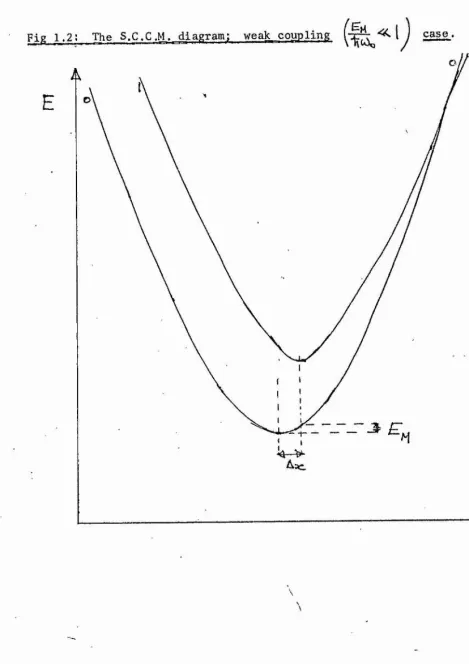
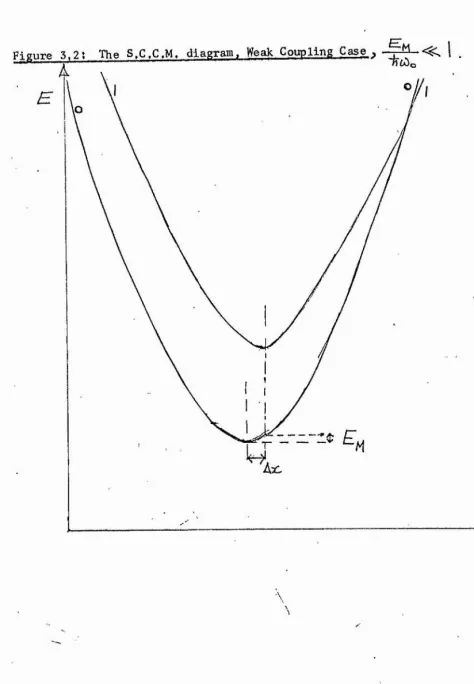
take place when p phonons are e m itte d in to the lo c a l mode, In the weak coupling case (sec f ig 1, 2) , the crossover p o in t lie s w e ll above
the minimum o f the e x c ite d s ta te curve, Hence a t f i n i t e temperatures
only those i n i t i a l sta te s w e ll below the crossover p o in t have a
s ig n ific a n t p r o b a b ility o f occupation, Thus, the recom bination proceeds
by quantum mechanical processes which tunnel under the p o te n tia l
energy b a r r ie r , Since the p r o b a b ility o f emission o f one phonon in to
a mode is / + where — "JJ , the therm al p ro b a b ility
o f occupation o f a mode^ fr e q u e n c y ,^ ] the p r o b a b ility o f emission o f
phonons is j j • This is the o rig in o f the tra n s itio n
ra te (1 ,2 ), , T his case is to be contraste d w ith
* A t th is p o in t i t is u s e fu l to c la r if y our use o f the terms ’ em ission’ and
’ a b so rp tio n ’ o f phonons. We always mean th a t a phonon is e m itte d
in to a mode, so th a t the occupation number increases b y one, S im ila rly ,
a phonon is absorbed from a mode so th a t the phonon occupation number
the high temperature «
I
, stron g couplingI
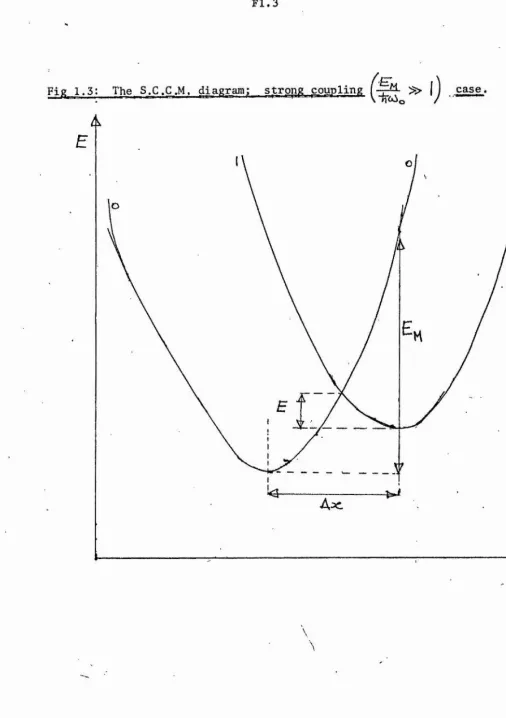
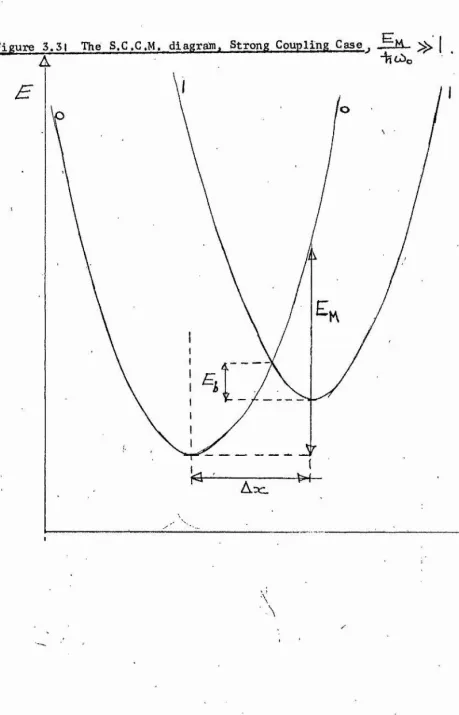
case. Here the p ro b a b ility o f occupation o f the i n i t i a l v ib ra tio n a lsta te s in the v ic in it y o f the crossover is s ig n ific a n t, (see f ig 1 .3 ).
Hence the tra n s itio n may occur c la s s ic a lly by a process which moves
over the p o te n tia l energy b a r r ie r . From a c la s s ic a l p o in t o f view , the
recom bination ra te is p ro p o rtio n a l to the p ro b a b ility th a t the system
reaches the crossover p o in t and then moves over in to the ground
e le c tro n ic s ta te . The p r o b a b ility th a t the system does reach the cross
over p o in t is p ro p o rtio n a l to 6" .
We conclude th is in tro d u c to ry chapter w ith a b r ie f d e s c rip tio n o f the
contents o f each chapter in the th e s is . Chapter 2 is a review o f
previous experim ental and th e o re tic a l work done on the recom bination
problem. We then give in the main body o f the te x t a f a ir ly complete
account o f the various th e o re tic a l approaches to n o n -ra d ia tiv e tra n s itio n s •
In p a rt I we adopt the S.C.C.M. which is the sim plest model used to tre a t
n o n -ra d ia tiv e tra n s itio n s . This model is employed in Chapter 3 to d e rive
the w ell-known recom bination ra te s which we have ju s t discussed using both
the ’ standard' and the 'd e r iv a tiv e ' n o n -a d ia b a tic terms. These calcu
la tio n s were f i r s t performed by K ie l^ fo r the standard term s, w h ile S truck
and Fonger^ have employed a d iffe r e n t method to d e rive the tra n s itio n
p r o b a b ilitie s using the 'd e r iv a tiv e ' term s. The p a rt o f th is chapter
which derives tra n s itio n ra te s w ith the ’ standard' n o n -a d ia b a tic terms has
been pub lish e d , (Robertson and Friedman, 1)3. We extend these re s u lts in
Chapter 4, c a lc u la tin g the v ib ra tio n a l overlap in te g ra l fo r p o te n tia l
energy w e lls which have d iffe r e n t cu rva tu re s. ( i. e . d iffe r e n t frequencies
o f v ib ra tio n associated w ith the ground and f i r s t e x c ite d s ta te s .) The
re s u lts thus obtained are very com plicated so th a t we discuss only the
p o s s ib ility o f an ’ energy g ^ ' law i f c e rta in co n d itio n s are s a tis fie d .
Tliese c a lc u la tio n s were perform ed w ith o u t re a lis in g th a t the
general re s u lt had already been derive d by Hutchisson. The ’ energy-
gap’ law case is a new a p p lic a tio n o f e x is tin g theory which is to be
p u b lish e d , (Robertson and Friedman, I I ) ,
I
In P a rt I I o f th is th e s is we use H o ls te in 's m olecular c ry s ta l
model (M.C.M.) to study the recom bination problem fo r the f i r s t tim e ,
assuming no d isp e rsio n o f the o p tic a l modes. In Chapter 5 we employ
the 's ta n d a rd ' n o n -a d ia b a tic terms to d e rive the w e ll known tra n s itio n
p r o b a b ilitie s which we have already obtained using the S.C.C.M.
in Chapter 3. This work has already been p u b lish e d , (Robertson and
Friedman, I ) . In Chapter 7 we c a lc u la te the more complex c o n trib u tio n s
to the recom bination ra te which r e s u lt from the 'd e riv a tiv e * non-
a d ia b a tic term s. We o b ta in the same re s u lts as Huang and Rhys found
o rig in h i ly w ith a model s im ila r to the M.C.M, in which the e le c tro n
is coupled to a l l the c r y s ta llin e modes. However, our method o f
c a lc u la tio n is q u ite d iffe r e n t and more general. F in a lly in Chapter 6
we re d e rive the re s u lts o f Chapter 5 using com b in a to ria l arguments.
This a lte rn a tiv e method o f c a lc u la tio n is less form al than our
previous techniques b u t gives more p h y s ic a l in s ig h t in to the problem .
This c a lc u la tio n is very s im ila r to the method Huang and Rhys adopted
in t h e ir paper.
We present in P a rt I I I o r ig in a l c a lc u la tio n s o f recom bination
rate s in the M.C.M, which take weak b u t f in i t e d isp e rsio n in to account,
We fin d in Chapter 8 th a t the re s u ltin g tra n s itio n ra te s are
considerably m o d ifie d from those de rive d in Parts I and I I , Wè d is tin g u is h
between 'on resonance' tra n s itio n ra te s when and
'o f f resonance' tra n s itio n ra te s when . When the
resonance c o n d itio n is s a tis fie d , the tra n s itio n ra te is an a d d itiv e
. '( I
10
se rie s o f term s, w ith the f i r s t term being the recom bination ra te
we have already d e rive d . When the resonance c o n d itio n is not
s a tis fie d , n o t a ll terms in the s e rie s have the same s ig n , so th a t
the recom bination ra te is reduced compared w ith the resonance case. In p a r tic u la r in the se rie s fo r the e x a c tly off-resonance case
(p44il) ^ ^ o successive terms have a lte rn a tin g signs suggesting
a lo c a l minimum in the recom bination ra te as a fu n c tio n o f A E ,
4-Some o f th is m a te ria l is to be p u b lis h e d , (Robertson and Friedman, I I ) .
In Chapter 9 we use a d iffe r e n t method o f c a lc u la tio n to d e rive s im ila r
r e s u lts .
We have assumed in a l l our c a lc u la tio n s th a t the e le c tro n is
e ith e r coupled to one lo c a l mode or to a l l the p e rfe c t c r y s ta llin e
modes. However experim ental evidence on o p tic a l a b so rp tio n , (Dean
and Henry)^ p o in ts s tro n g ly to e le ctro n s on im p u rity centres being
coupled to both lo c a l and c r y s ta llin e modes o f v ib ra tio n . In the
f in a l chapter o f th is th e s is . Chapter 10, we in co rp o ra te a lo c a l
mode in to the M.C.M. U n fo rtu n a te ly , in th is more complex model fo r
the recom bination problem some o f the parameters which were p re v io u s ly
w e ll defined become phenom enological, However, although some o f the
discussion is more q u a lita tiv e than b e fo re , th is model seems u s e fu l
as recom bination may take place by the em ission o f pho nons.in to both
lo c a l and la tt ic e modes,
Most o f the re s u lts fo r recom bination rate s have been derive d using
the M.C.M. which is a s p e c ific model. However, the H am iltonian in the
M.C.M. has a very general form so th a t the recom bination ra te s derived
using i t have a wide a p p lic a b ility . This p o in t is discussed more f u ll y
F l . l
[image:20.615.58.538.26.761.2]F I . 2
Fig 1.2; The S.C.C.M. diagram; weak coupling case
[image:21.612.49.518.69.733.2]F I .3
F ig 1.3: The S.C.C.M. diagram; strong
A
1*4
I
[image:22.620.36.542.28.746.2]11
•CHAPTER 2
Review
There have been many papers w ritte n on the re la te d subjects o f
n o n -ra d ia tiv e tra n s itio n s and the abso rp tion o f lig h t a t im p u rity
centres in c ry s ta ls . These papers f a l l in to two ca te g o rie s , f i r s t l y
those in v o lv in g the S.C,C,M, in which the e le c tro n in te ra c ts w ith only
a s in g le lo c a l mode, and secondly those in which the e le c tro n in te ra c ts
w ith a l l the c r y s ta llin e modes. In a d d itio n to papers d e a lin g w ith
the s o lid s ta te , there have been many papers d e a lin g w ith both ra d ia tiv e
and n o n -ra d ia tiv e processes in m olecules, A good review o f th is work lo in m olecular physics is th a t w r itte n by Frank-Kam enetskii and Lukaskin,
II
Frenkel wrote one o f the f i r s t papers to deal w ith n o n -ra d ia tiv e
processes in 1930, He d id n o t consider recom bination between lo c a lis e d
e le c tro n ic sta te s on im p u rity s ite s in c ry s ta ls . Instead he considered
n -e le c tro n s ta te s fo r which the ground s ta te co n sists o f each e le c tro n
being in it s ground s ta te w h ile there are n f i r s t e x c ite d sta te s in each
o f which one e le c tro n has been ra is e d to i t s f i r s t e x c ite d s ta te , Due
to in te ra to m ic in te ra c tio n s each o f the n e x c ite d s ta te s has a s lig h t ly
d iffe r e n t energy so th a t a continuum o f e x c ite d s ta te s r e s u lts . ' These
e le c tro n sta te s are what were la te r to become known as Frenkel e x c ito n s ,
Frenkel was the f i r s t to apply the ideas o f m olecular physics to the
s o lid s ta te , According to p re v io u s ly accepted th e o ry n o n -ra d ia tiv e decay
occurred from the e xcite d e le c tro n ic sta te s due to the p e rtu rb a tio n
caused by anharmonic terms in the la t t ic e p o te n tia l. However, since the
e le c tro n ic energy d iffe re n c e is o f the order o f one hundred phonons the
p e rtu rb in g terms which could produce the em ission o f such a large number
o f phonons would have to be o f a v e ry h ig h order indeed. The re s u ltin g
n o n -ra d ia tiv e tra n s itio n ra te s would be v e ry sm a ll, Frenkel developed
12
‘ V.
f
'■i
la ttic e are dependent on which e le c tro n ic s ta te is occupied. He
c a lcu la te d the changes in e q u ilib riu m p o s itio n and frequency o f the
la ttic e modes which occur. He then computed the v ib ra tio n a l overlap
in te g ra ls , commenting th a t only changes in e q u ilib riu m p o s itio n and
n o t changes in frequency are im p ortant fo r c r y s ta llin e modes. D espite
th is g re a t advance the tru e Born-Oppenheimer theory o f the e le c tro n -
la tt ic e in te ra c tio n was n o t developed and, in p a r tic u la r , Frenkel s t i l l
used anharmonic terms as the p e rtu rb a tio n ra th e r than the n o n -a d ia b a tic
terms. The c a lc u la tio n a l methods he employed to c a lc u la te the tra n s itio n
rate s are b a s ic a lly c o m b in a to ria l,
Contemporary w ith F re n k e l’ s paper is H utchisson’ s (1930) work on
the abso rp tion band spectra o f sym m etrical diato m ic molecules such as Na^, , I2 and H^, This was the f i r s t paper to introduce the S,G.C,M,
in to tl\o f ie ld o f m olecular physics, The p e rtu rb a tio n which acts to
produce the a b so riitio n o f lig h t is the e le c tr ic d ip o le moment a c tin g
between the i n i t i a l and f in a l e le c tr o n - la ttic e s ta te s , The Condon
approxim ation is used so th a t Hutchisson was the f i r s t to c a lc u la te
the v ib ra tio n a l overlap in te g ra ls using the generating fu n c tio n method,
Hutchisson’ s c a lc u la tio n s take in to account both a r e la tiv e
displacem ent o f the o s c illa to rs and d iffe r e n t freq uencies, Our re s u lts
derived in Chapter 4 agree w ith h is c a lc u la tio n s , Hutchisson goes on
to use experim ental values o f the r e la tiv e displacem ents and frequencies
fo r the aforementioned d ia to m ic molecules to c a lc u la te the absorption ‘
lin e s tre n g th s , When Hutchisson compared h is re s u lts w ith experiment
he found th a t the agreement was reasonably good and f o r Na^ p a r t ic u la r ly ,7
good, Hutchisson discovered th a t the values o f the v ib ra tio n a l overla p
in te g ra ls are q u ite s e n s itiv e to the size o f the r e la tiv e displacem ent
o f the p o te n tia l energy curves,
13
12.
Kubo's (1952) paper on the therm al io n iz a tio n o f trapped e le ctro n s on
im p u rity centres in c ry s ta ls used the Bom-Oppenheimer theory to
describe the e le c tr o n -la ttic e in te ra c tio n w ith n o n -a d ia b a tic terms
a ctin g as the p e rtu rb a tio n . Kubo contrasted h is treatm ent w ith th a t o f
Goodman, Lawson and S c h iff (1947) who used the v a ria tio n o f p o te n tia l
which the e le c tro n experiences as the la tt ic e v ib ra te s as the p e rtu rb a tio n
which produces n o n -ra d ia tiv e tra n s itio n s , Kubo contended th a t the
re s u lta n t n o n -ra d ia tiv e tra n s itio n rate s are much too s m a ll,
In Kubo’ s treatm ent the trapped e le c tro n is coupled to a ll the
c r y s ta llin e modes o f the la tt ic e which have no d is p e rs io n , An in te re s tin g
fe a tu re o f Kubo’ s treatm ent is the a lte ra tio n o f frequency b u t not
e q u ilib riu m p o s itio n o f each la tt ic e mode when the e le c tro n changes
from the h y d ro g e n -like l~S s ta te o f the im p u rity to the plane wave
s ta te in the conduction band, Kubo used the S la te r sum fo r a harmonic
o s c illa to r to c a lc u la te the tra n s itio n ra te s , The n o n -ra d ia tiv e tra n s itio n s
occur between the sta te s illu s tr a te d in fig u re 2 ,1 , I t was found th a t
the io n iz a tio n ra te was given by ^ '4 *^1 TL.
at low temperatures and ^
at h ig h tem peratures, "10F
In these expressions AE* j ^ = A E -t
and is the fra c tio n a l change o f frequency when the e le c tro n changes s ta te .
Thus, th is e a rly paper revealed the c la s s ic a l ’ a c tiv a tio n energy law'
fo r h ig h tem peratures, A t low temperatures the lo w -ly in g v ib ra tio n a l
le v e ls belonging to the ground e le c tro n ic s ta te must be a c tiv a te d
c la s s ic a lly to the same energy as the ground v ib ra tio n a l le v e l o f the
e x c ite d e le c tro n ic s ta te re s u ltin g in the fa c to r,
Tl\o system then tunnels under the p o te n tia l energy b a r r ie r to the
e xcite d e le c tro n ic s ta te ,
One o f the b est known e a rly papers which d e a lt w ith n o n -ra d ia tiv e
14
f i r s t to p ic which th is paper is concerned w ith is the absorptiop o f lig h t
by F-centres in io n ic c ry s ta ls . The absorption lin e s are broadened due
to the emission and absorption o f la tt ic e phonons co n c u rre n tly w ith
the absorption o f lig h t . The e x c ite d F -centre s ta te lie s below the
conduction band b u t even so p h o to c o n d u c tiv ity re s u lts . Years e a r lie r
It
M ott had suggested th a t th is p h o to c o n d u c tiv ity a rise s from a ra d ia tio n le s s
tra n s itio n in which the e le c tro n in the e x c ite d F -centre s ta te absorbs
phonons from the la t t ic e to ra is e i t s e l f in to the conduction band.
This p h o to c o n d u c tiv ity is observed to vary w ith tem perature as exp (-W /kT)/
In the Huang-Rhys model the Bom-Oppenheimer method is fo llo w e d ,
A continuum model is used f o r the la t t ic e and the e le c tro n in te ra c ts
w ith th is through the s t a tic charge d is tr ib u tio n due to i t s own
w avefunction, This allows s p e c ific values to be c a lc u la te d fo r the lin e a r
e le c tr o n - la ttic e coupling constants, This c o n tra sts w ith most o th e r
treatm ents in c lu d in g the presen t one in which the e le c tr o n - la ttic e
coupling constant is assumed to be a phenomenological constant.
However a weakness o f th is model is the lack o f any d is p e rs io n in the
c r y s ta llin e modes,
lliG e le c tr ic d ip o le term a ctin g between the i n i t i a l and f in a l e le ctro n ?
la tt ic e sta te s is the p e rtu rb a tio n which allow s the o p tic a l a b so rp tio n ,
The n o n -ra d ia tiv e tra n s itio n a rises from the ’.d e riv a tiv e ' n o n -a d ia b a tic
terms which, re s u lt in the recom bination ra te s which we d e rive in
Chapter 7, The a ctu a l method o f c a lc u la tio n employed is the com binational
type w liich we use in Chapter 6. A disadvantage w ith th is type o f
c a lc u la tio n is th a t i t would be very'^ d i f f i c u l t to extend to the general
case where there is f in i t e d is p e rs io n o f the la tt ic e modes. Huang and
Rhys e v e n tu a lly derive the tem perature a c tiv a tio n type laW'
w hich is re q u ire d to e x p la in the observed p h o to c o n d u c tiv ity . \5
(. ' ' i ; % ■ v ? v - " v v u - '; •
15
more general forms o f coupling o f the e le c tro n to the la t t ic e . The
Huang-Rhys treatm ent was re s tr ic te d to the in te ra c tio n o f an im p u rity
e le c tro n in an io n ic c ry s ta l w ith lo n g itu d in a l o p tic a l modes which have
no d is p e rs io n . Kubo and Toyozawa n o t o n ly in trodu ced d isp e rsio n
in to the o p tic a l modes b u t considered the in te ra c tio n o f an im p u rity
e le c tro n in a non«polar c ry s ta l w ith lo n g itu d in a l a co u stic modes,
However, although form al expressions are presented fo r the tra n s itio n
rates in these cases, the only e x p lic it re s u lts obtained r e fe r to
in te ra c tio n o f the im p u rity e le c tro n w ith d isp e rsio n le ss o p tic a l
modes, In p a r tic u la r the ’ d e riv a tiv e ’ n o n -a d ia b a tic terms are used
to d e rive the same recom bination ra te s th a t Hbang and Rhys had p re v io u s ly
c a lc u la te d ,
Kubo and Toyozawa employ tKe generating fu n c tio n method which is a
com ple te ly d iffe r e n t technique o f c a lc u la tio n to th a t used b y Huang-Rhys;'
This method in vo lve s ta k in g a hap lace transform o f the o p tic a l absorption
ra te s and when the in ve rse tra n sfo rm is taken the moments o f the o p tic a l
absorption band may be c a lc u la te d ,
Kubo and Toyozawa que stion the common assumption th a t a l l the
la tt ic e v ib ra tio n a l modes extend throughout the c ry s ta l, In p a r tic u la r
q u a d ra tic terms in the im p u rity e le c tr o n * la ttic e in te ra c tio n wh!ich cause
modes to change t h e ir freq uencies may w e ll produce some v ib r a tio n a l
modes w hich are lo c a lis e d around the im p u rity s it e . These modes in te ra c t
more s tro n g ly w ith the im p u rity electron ^ than the c r y s ta llin e v ib r a tio n a l
modes, However no c a lc u la tio n s using these ideas are a c tu a lly perform ed,
The HuangrRhys model p re d ic te d th a t n o n rra d ia tiv e tra n s itio n s at I
an Fncentre in KCl are n e g lig ib le at low temperatures'. Hence,. ; the re
was s u rp ris e when i t was discovered b y K lic k C1954) th a t th is centre
; 16
does n o t lum inesce, In 1955 D e x te r, K lic k and R u ssell put forvfard a
novel id e a to account f o r these experim ental re s u lts , These authors
b e lie v e the n o n ^ra d ia tiv e tr a n s itio n process occurs b e fo re the th e rm a lis a tio n
16
which ensures a canonical d is tr ib u tio n over the v ib ra tio n a l le v e ls takes , ,
place, Thus, as th e rm a lis a tio n proceeds there w i l l be a tim e , before
there is a canonical d is tr ib u tio n over the v ib ra tio n a l s ta te s , a t which
those le v e ls in the v ic i n i t y o f the crossover C in fig u re 2,2 may
have a large p r o b a b ility o f being occupied, The n o n ? ra d ia tive tra n s itio n
ra te from these sta te s is large and thus recom bination takes p la ce ,
ITius the c r ite r io n fo r luminescence to be very weak at low temperatures
is th a t the system f a lls through the crossover p o in t d urin g the
th e rm a lis a tio n process. Hence, luminescence does n o t occur i f in f i g 2 ,2 ^ 0
lie s below B, In a l l our work we do assume th a t there is a canonical
d is tr ib u tio n over the i n i t i a l v ib ra tio n a l le v e ls . In 1967 Siebrand .
considered ra d ia tio n le s s tra n s itio n s in polyatom ic m olecules such as
arom atic hydrocarbons which in te r a c t w ith a so lve n t a t low tem peratures,
The ro le o f the so lve n t is to absorb the v ib ra tio n a l energy which the
molecule gains a fte r d e e x c ita tio n o f the e le c tro n . In Siebrand’ s model
the e le c tro n in te ra c ts w ith a l l the normal modes o f v ib ra tio n o f the
m olecule, The treatm ent o f the non?adiabatic fa c to rs ,
where r is the e le c tro n ic coordinate and are the m o le cu la r
I ' '
normal coordinates is d iffe r e n t from our method, Siebrand does n o t
use the Condon approxim ation in w hich the e le c tro n ic fa c to r
is a constant, Instead he expands th is e le c tro n ic fa c to r about the
'"ji
e q u ilib riu m m olecular p o s itio n s , > !
The tra n s itio n rate s which r e s u lt from the use o f the lin e a r term
o n ly are v e r y s im ila r to those d erive d ns in g the sim ple v ib r a tio n a l overlap in te g ra ls .
'S '" ' ' ‘-’ Y {C'-t/J-y;.
17
Siebrand used the general v ib ra tio n a l overlap fa c to rs p re v io u s ly
derived by Hutchisson fo r the T = 0 case. We discuss the form o f these
tra n s itio n a l p ro b a b ilitie s in Chapter 4. Siebrand showed th a t i f the
e le c tro n ic energy d iffe re n c e is la rge ^ then frequency
s h ifts (d is to rtio n s ) dominate the ra d ia tio n le s s tra n s itio n ra te
ra th e r than s h ifts in e q u ilib riu m distance (displacem ents). Indeed the
re la tiv e importance o f these two e ffe c ts fo r n o n -ra d ia tiv e tra n s itio n s
is reversed compared w ith ra d ia tiv e tra n s itio n s , Siebrand f in a lly
concluded th a t the recom bination ra te decreases e x p o n e n tia lly w ith
in cre a sin g e le c tro n ic energy gap ^
AE ,
S'
Another re le v a n t paper was th a t w ritte n by K ie l in 1965, This
paper is concerned w ith ra d ia tiv e ra th e r than n o n -ra d ia tiv e tra n s itio n s
w ith the im p u rity absorption bands in s o lid s being c a lc u la te d ,
K ie l’ s d e s c rip tio n o f the BomnOppenheimer e le c tro n ^ la ttic e sta te s
is q u ite e n lig h te n n in g , The p o te n tia l in which the n u c le i move when
the e le c tro n is in it s ground s ta te is ^ \ ^ ^
where the normal coordinates, However, in g e n e ra l, when
the e le c tro n is in it s e x c ite d s ta te the n u c le i move in the p o te n tia l
where the new normal coordinates
are d iffe r e n t from , This a lte ra tio n o f the normal coordinates
makes the c a lc u la tio n o f tra n s itio n ra te s v e ry com plicated. A lte rn a tiv e ly
the p o te n tia l in which the la t t ic e moves when the e le c tro n is in it s
e x c ite d s ta te may be w ritte n in terms o f the o ld normal coordinates as.
I f the la s t term were not present the v ib ra tio n a l w a v e fu n c tio n ;fo r the
e x c ite d s ta te would be a product o f harmonic o s c illa to r fu n c tio n s o f q ^ ,
w ith 'l displaced e q u ilib riu m p o s itio n s due to the lin e a r terms A^q^ and
18
, q^ couple to g e th e r a l l the modes q^ rendering th is d e s c rip tio n
in v a lid . K ie l uses the v a ria tio n a l p r in c ip le to fin d the v ib ra tio n a l
wave fu n ctio n s which take account o f the coupling terms Using
th is method i t is found th a t the w avefunctions are s o lu tio n s o f,
=
From the form o f th is equation i t is seen th a t the normal coordinates
f q jç l app ro priate to the e le c tro n in i t s ground s ta te are re ta in e d ,
The s o lu tio n fo r the v ib ra tio n a l w avefunction is a displa ced harmonic
o s c illa to r w avefunction w ith frequency ^ , However, the lin e a r
in te ra c tio n constant which gives ris e to the displacem ent o f the
o s c illa to r is no longer b u t i t now becomes i
Til us ^ the general feature s o f the ra d ia tio n le s s decay problem are not
changed even when the normal coordinates o f the la tt ic e are a lte re d
when the e le c tro n d e e xcite s. The o n ly change a rise s w ith the re la tiv e
displacem ent o f the two p o te n tia l energy curves being no lo nger re la te d
to s im p ly the lin e a r e le c tro n la tt ic e in te ra c tio n constant A^. K ie l
proceded to discuss the tra n s itio n ra te s due to disp la ce d sim ple harmonic
o s c illa to r s w ith the same frequency, o b ta in in g the same expression
f o r the v ib ra tio n a l overlap in te g ra l as we do in Chapter 3.
A more re ce n t paper on ra d ia tio n le s s tra n s itio n s in la rg e m olecules
^ !
was pub lish e d b y Knglman and J o rtn e r in 19.70, The e le c tro n is coupled
to a l l the normal modes, o f the m olecule, The ’ sta n d a rd ’ nonT.atjiabatic
terms are used to c a lc u la te the tra n s itio n p r o b a b ility u s in g a generating
1ST ;
fu n c tio n method s im ila r to Kubo and Toyozawa, The harmonic o s c illa to rs
are assumed to be displaced b u t w ith the same frequency, This |is in
(q. I
disagreement w ith % ebrand ’ s as sumption o f the p rim a ry im portance o f „
freq uency s h ifts in the la rg e arom atic hydrocarbons^ such as beqzene
(
19
considered here, Englman and J o rtn e r consider both the stro n g and the
weak coupling cases. In the stron g co u p lin g , h igh tem perature regime
they derive d the temperature a c tiv a te d tra n s itio n p r o b a b ility which we
fin d in Chapters 3 and 5, However, they s ta te th a t such h igh tem peratures
as are re q u ire d here 0^^® n o t a c tu a lly achieved in p ra c tic e .
They also d e rive a stron g co u p lin g , | low tem perature | I y ' "" "* "1 ^ ' M
r e s u lt, |K | w h e re is the average
phonon frequency. However, Englman and Jortner are not aware of any
large molecules which a c tu a lly s a tis fy the large coupling c r ite r io n ,
/ , N e xt, the weak coupling li m i t , I at absolute
aero, T = 0 is considered; a saddle p o in t method being used to d e riv e
the energy gap law, We do n o t b e lie v e th a t the co n d itio n s fo r the
Î
I a p p lic a b ility o f th is method are s a tis fie d and we d e rive the energy gap
1 law using our own methods in Chapter 5, The energy gap law is v a lid fo r many non«^radiative tra n s itio n s in arom atic hydrocarbons C^Fy such as
benzene, As we have p re v io u s ly commented Siebrand has c a lc u la te d a
s im ila r expo nentia l decrease in tra n s itio n ra te w ith in cre a sin g e le c tro n ic
energy d iffe re n c e A E assuming th a t frequency s h ifts ra th e r than
r e la tiv e displacements are im p o rta n t,
/P
Another in te re s tin g recent paper was w ritte n by Warren-JMoos [1970),
R elaxation processes between Stark groups in the energy le v e ls
in ra re ea rth s a lts are discussed, T y p ic a l, ’h o s t' c y rs ta ls ate
EaClg, EaBTg and EaP^ w h ile the ra re e a rth ions in vo lve d are Dy and Nd,
The 4f o rb its o f the ra re -e a rth ions are so deeply b u rie d w ith fn the
e le c tro n ic s h e ll th a t the energy le v e ls o f the [4 f) " c o n fig u ra tio n are
o n ly s lig h t ly p e rtu rb e d , As a re s u lt o f th is r e la t iv e ly weak in te ra c tio n
w ith the la tt ic e y Warren-Moos uses, the p ic tu re o f an is o la te d ion
slightly^ perturbed by^ the surrounding crystal, The. Bom^Oppenheimer
1
20
fo r the n u c le i in th e ir e q u ilib riu m p o s itio n s . The in te ra c tio n o f the
rnre earth ion w ith the la tt ic e which produces the n o n -ra d ia tiv e tra n s itio n
is assumed to be due to the m odulation o f the c r y s ta llin e fie ld , by the
m otion o f the io n s .
The re s u ltin g tra n s itio n ra te s are so complex th a t a phenomenological
approach is used. This re s u lts in an 'energy gap* law a t T « 0 , and the
tem perature dependence, 0 + ^ ^ a t f in i t e tem peratures.
Thus the same type o f n o n -ra d ia tiv e tra n s itio n ra te s r e s u lt even although
a d iffe r e n t model from the standard Born-Oppenheimer type is used. Both ,
these re s u lts are w e ll founded e xp e rim e n ta lly fo r the ra re e a rth ions in
c ry s ta ls stu d ie d by Warren-Moos. A t absolute zero the n o n -ra d ia tiv e
tr a n s itio n ra te s decrease ra p id ly w ith in cre a sin g e le c tro n ic energy
d iffe re n c e , A.E as in fig u re 2 .3 . For la rg e e le c tro n ic energy d iffe re n c e
A E, re la x a tio n o f an e x c ite d s ta te takes place r a d ia tiv e ly b u t fo r sm all
A E the ra d ia tiv e process is quenched. The temperature dependence
Q t W y is illu s tr a te d in fig u re 2 .4 . Thus, although when
p is la rg e , W^_q is very s m a ll, does increase more ra p id ly w ith
in c re a s in g temperatures in th is case than when p is sm a ll. Warren-Moos
a lso fin d s th a t hydrated c ry s ta ls such as Eu(NO^)^.6H20 are poor flu o re s c e rs .
In th is case the e le c tro n ic s ta te is coupled to lo c a l modes o f the HgO
molecule which have h ig h fre q u e n cie s. The energy gap law is '
~ ^ j — iJ ^ » th a t i f the v ib ra tio n a l frequency is la rg e , the number o f phonons e m itte d is sm all and thus the
re la x a tio n ra te is la rg e . Hence, n o n -ra d ia tiv e processes are im p ortant and
!
quench the competing ra d ia tiv e process in hydrated c ry s ta ls .
In the recent paper S truck and Fonger^^ (1975) have in v e s tig a te d the
abso rp tion and em ission o f lig h t a t im p u ritie s in c ry s ta ls tog e th e r w ith
21
This paper contains d e ta ile d comparison between num erical values o f the
th e o re tic a l expressions fo r the non—ra d ia tiv e rate s and experim ental
va lu e s,
The SjC.C.M. is used to tre a t b o th ra d ia tiv e and n o n -ra d ia tiv e
processes. In regard to energy consideration s f o r the n o n -ra d ia tiv e
tra n s itio n s . Struck and Fonger comment th a t at le a s t one phonon
from the continuum o f la tt ic e modes is re q u ire d to conserve energy.
However, no attem pt is made to d isco ve r the a lte ra tio n s to the tra n s itio n
rate s re s u ltin g from th is k in d o f process. The v ib ra tio n a l overlap
in te g ra ls are n o t c a lc u la te d using the generating fu n c tio n meth.od b u t b y
the a p p lic a tio n o f the Manneback re cu rsio n form ulas.
Struck and Fonger stu d y n o n -ra d ia tiv e tra n s itio n ra te s fo r va rio u s
num erical values o f th.e coup ling s tre n g th and the e le c tro n ic energy
d iffe re n c e A E , For each case th e y c a lc u la te num erical values f o r the
v ib ra tio n a l overlap in te g ra ls ^ and the th e rm a lly weighted
Prankr.Condon fa c to rs where
^ ' F in a lly num erical values fo r
ZZ are c a lc u la te d assuming a ^numerical value
fo r the e le c tro n ic fa c to r , The tra n s itio n ra te U /p is s tu d ie d
as a fu n c tio n o f tem perature and th e quenching o f the corresponding n
ra d ia tiv e tra n s itio n s is give n , The f i r s t case d e a lt w ith is the f i n i t e 1
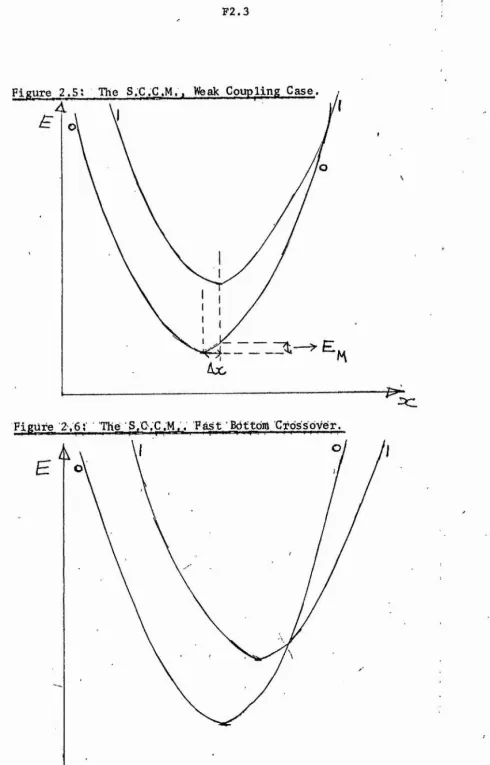
tem perature, weak coupling case illu s tr a te d in fig u re 2 ,5 , I The ’ Sm
all-o ffs e t m ultiphall-onall-on em issiall-on’ case in the te rm in all-o lall-o g y all-o f Struck and Fall-onger,]
The n o n -ra d ia tiv e processes are found to be in s ig n ific a n t a t low
temperatures b u t to increase w ith tem perature to quench competing ra d ia tiv e
processes , An example o f th is type o f tra n s itio n is the 4 -^ 181
ra re e a rth process in v e s tig a te d b y Warren-Moos',’
Another c h a ra c te ris tic type o f n o n ~ ra d ia tive tra n s itio n
id e n tifie d is . the ’ fa s t bottom cro sso ve r’- illu s tr a te d in fig u re , 2 ,6 . In
22
and do n o t increase a great deal w ith in cre a sin g quantum number, m.
The re s u ltin g n o h ^ a d ia tiv e tra n s itio n ra te s are large and quench
competing ra d ia tiv e processes fo r a l l tem peratures. Struck and Fonger
give as examples o f the ’ fa s t b ottom ’ crossover the fa s t £ u ^ ^ C .T S ^
feeding in oxysulphides and fa s t ^ T ï . ^ feeding in
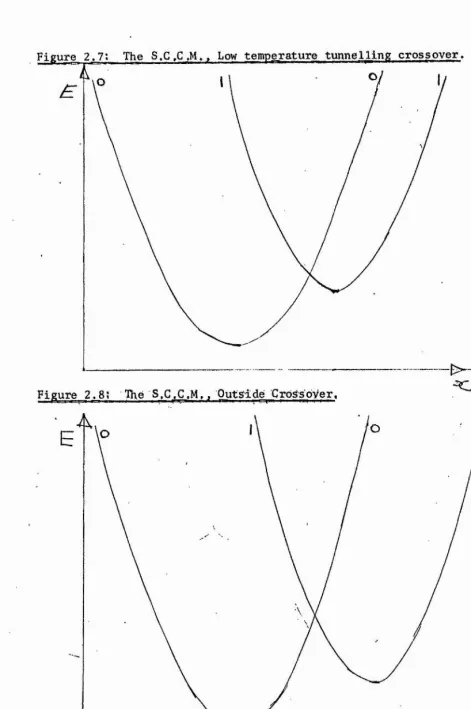
The ’ low-tem perature tu n n e llin g crossover' illu s tr a te d in fig u re 2,7
is s im ila r to the ’ fa s t bottom crossover’ . However, fo r sm all
v ib ra tio n a l quantum number ve ry sm all because
these terms represent quantum mechanical tu n n e llin g processes. However,
once m is large enough fo r the crossover p o in t to be reached th e re is a X
2-The re s u ltin g n o n -ra d ia tiv e tra n s itio n rates are v e ry sm all at low
temperatures b u t increase v e ry ra p id ly over a sm all tem perature range.
The competing ra d ia tiv e tra n s itio n s are thus present below a c e rta in
temperature but are ra p id ly quenched once th is tem perature has been
reached. An example o f the low tem perature tu n n e llin g crossover is the
quenching o f the T m ^ narrow lin e emission m O^lS ,
The f in a l case d e a lt, w ith by Struck and Fonger is the ’ outside
crossover’ illu s tr a te d in fig u re 2 ,8 , For th is type o f n o n -ra d ia tiv e
tra n s itio n the v ib ra tio n a l overlap in te g ra ls I L are sm all
fo r sm all m b u t increase w ith in c re a s in g m, Thus the n o n -ra d ia tiv e
tra n s itio n rate s increase as the tem perature ris e s ,. This ra te lof
increase o f the recom bination ra te s is g re a te r than in the ’weak c o u p lin g ’
case b u t less than in the ’ low tem perature tu n n e llin g crossover’ case,
An example o f the ’ o utsid e crossover’ type o f n o n -ra d ia tiv e tra n s itio n is
the C / " in M A i t is in te re s tin g ^that in none o f the v a rio u s types o f n o n -ra d ia tiv e tra n s itio n s is a ter^pera tu re
23
dependence o f the 'a c tiv a tio n ty p e ', W y observed.
In a la te r paper, Struck and Fonger^(1976) extend t h e ir previous
work to cover tr a n s itio n rate s in the S,C,C,M, using the 'd e riv a tiv e *
n o n -a d ia b a tic term s, Denoting th is tra n s itio n ra te b y compared
w ith the tra n s itio n ra te due to the 's ta n d a rd ' n o n -a d ia b a tic terms
W p I where A E = pti&bo ] S truck and Fonger fin d
= a
, f .
€ r È ) 2Wp.
dx. ^ nM^ci &In th is expression fo r ^ is the a c tiv a tio n energy,
w h ile E ^ i 'V ) is the a c tiv a tio n energy obtained b y f i t t i n g the
tra n s itio n ra te to an a c tiv a tio n energy law as shown below .
^ ^ h i « o !
Struck and Fonger fin d th a t is given b y
£ ^ ( t ) - ( < ^ y ^—< y n y ) 'k c ^ ^
where <Cbi^ is the therm al p r o b a b ility o f occupation o f the lo c a l mode,
w h ile is the average v a lu e o f m at
w hich the non ra d ia tiv e tra n s itio n takes p la ce ,
' - O - r A - ' : '
Now, at the absolute zero o f tem perature E p ^ o ) » O {
so th a t yh w i l l prove th is re s u lt in C haptef 3,
although we are unable to show the more general r e s u lt
^ using our methods. As the temperature
increases so does so th a t l\Jp becomes sm a lle r compared
\ I '
to A W p .
\ Struck and Fonger conclude that the magnitude and temperature
■ V .;- ’t™' •;■
i
24
h : dependence o f the 's ta n d a rd ', IaJ^ and the 'd e r iv a tiv e ', W; _
tra n s itio n rate s are s im ila r and would be very d i f f i c u l t to d is tin g u is h
e xp e rim e n ta lly.
'icy.T-..
F2.1
Figure 2 .1 : The c o n fig u ra tio n coordinate diagram considered by Kubo
Figuré 2.2: The c fité ÿ ïô m f o r luminescence
[image:37.616.41.491.67.782.2]F2.2
Figure 2.3: The Recombination Rate, as a fu n c tio n e le c tro n ic energy
gap A E as found by Warren-Moos,
G o |p CA£^
Figure 2 ,4 : ' Thé Temperature Dependence o f tKe 'Récdirtüi'iiàtion
^9.tes as found b y WàrfëpmMôos,
[image:38.615.17.525.65.779.2].'. T V.
<. ' —-.e '\i' .T ' - ^ ’ I • • • , t ;•:.■!»»i-i,s.><.'.;
F2.3
Figure 2 .5 : The S.C,C>M., Weak C oupling Case
Figure 2 ,6 ; Thé 'S/O.C.M. . F à ë f Bôttditt Crossover.
E
> z
[image:39.612.42.532.22.787.2]F2.4
::g
Figure 2.7: The S.G.G.M.. Low tem perature tu n n e llin g crossover
[image:40.618.27.498.62.770.2]Part 1
26
CmPTBR 5 '
The Single C o nfijj^ura tional Coordinate Model
The sim p le r o f the two models we use to study n o n -ra d ia tiv e tra n s itio n s
is the s in g le c o n fig u ra tio n a l coordinate model, (S,C,C,M,) in which
the e le c tro n is coupled to only one lo c a l v ib ra tio n a l mode, This
co n tra sts w ith the m olecular c ry s ta l model, (J-I.C.M,) in tro d u ce d in
Chapter 5 which in clud es coupling o f the e le c tro n to a l l tKe c r y s ta llin e
modes o f v ib ra tio n , D espite th is s im p lic ity , the S,C,C,M. may
represent sane aspects o f the recom bination problem more r e a lis t ic a lly
than the M,C,M, as the im p u rity centres in c ry s ta ls where recom bination
o fte n occurs may be strongly^ coupled to a few lo c a l modes, However,
the 3,C,C,M, does s u ffe r from d if f ic u lt ie s regarding energy» conse rva tion,
These d i f f ic u lt ie s are discussed b rie fly ^ in th is chapter and more f u l l y
in chapters 8 and 10, F in a lly , n o t le a s t o f the advantages which the
3,C,C,M, gives us is the use o f the ra th e r famous l i t t l e S.C.C.M,
diagram to th in k about the p h y s ic a l processes in v o lv e d in the recom bination
problem,
We s h a ll now c a lc u la te the recom bination ra te s using tim e-dependent
p e rtu rb a tio n th e o ry. These c a lc u la tio n s are not o r ig in a l b u t they have
been independently re d e rive d , We consider the 3chréîdinger e q u a tio n ,
^ • It - ^ e . o
wKere th,e S.C.C.M, Hamiltonian H- is
Ifere, is the single configurational coordinate, — V l
-are the electronic and la ttic e k in e tic energies respectively, U J —
is the molecular p o ten tial in which the electron moves, while is the quadratic la ttic e p o te n tia l energy,
I
i
i 27
As a general s o lu tio n o f (3.1) we w rite
| J f a , H ) f , j l , , (3.5)
where in the Bom-Oppenheimer approxim ation the e le c tro n ic wavefunctions
and t h e ir energy eigenvalues depend on the
la tt ic e c o n fig u ra tio n . The e le c tro n ic w avefunctions
are s o lu tio n s o f
r - £ i V r + ü ( r , x ) \ % ( r j , x . ) = ^ (3 .4 )
L. -J
The sim p le st assumption about the energy eigenvalue we can
make is th a t i t contains a lin e a r e le c tr o n - la ttic e in te ra c tio n term ,
O c) = (3.53
the s ig n ific a n c e o f which w i l l be discussed s h o rtly . In the Bom-Oppenheimer
approxim ation the p o te n tia l in which the n u c le i move in clud es the
e le c tro n la tt ic e in te ra c tio n terms so th a t the v ib r a tio n a l sta te s i are s o lu tio n s o f
which may be w ritte n as r~ 12- \2_
Thus the v ib ra tio n a l w avefunctions are disp la ce d sim ple harmonic
o s c illa to r fu n c tio n s
where N j j ^ J> and the la tt ic e e n e rg / eigenvalues
a re .
K. . (3 ,8 )
28
occupied since i t is p ro p o rtio n a l to the lin e a r in te ra c tio n constant
The r e a lly im portant param eter throughout the th e o ry is the r e la tiv e
displacement o f the minima o f the p o te n tia l energy curves,
A x - = A x! — Ax.^ t=. (A I Aq) /ife VMo),
This reveals the s ig n ific a n c e o f the lin e a r e le c tro n -1 a ttic e in te ra c tio n
term in the e le c tro n ic energy, (3 ,5 ),
The S,C,C,M, diagram, fig u re 3 ,1 , (p .F S .l) represents the two p o te n tia l k
(3.10)
energy curves
and ■Â
Moi!
by
At
and -i-A E re s p e c tiv e ly . The b in d in g
energy terms have been in clu d e d in the e le c tro n ic energy
d i f fe ren ce, A E .
I n i t i a l l y at tim e t«0 the system is assumed to be in the q x c ite d
e le c tro n ic s ta te as a r e s u lt o f the absorption o f in c id e n t ra d ia tio n .
Thus, the i n i t i a l c o n d itio n fo r eq^uation (3,1) is Q ,( û ) ^ \ and C L^(o}=o.
We fin d in Appendix A 3 ,l th a t the p e rtu rb a tio n which gives ris e to
n o n -ra d ia tiv e tra n s itio n s is the n u cle a r k in e tic energy^ i t y A Pu ' a ctin g on the c o n fig u râ tion-dependent e le c tro n ic w avefunction
, The q u a n tity | C L ^ lt) j is thé p r o b a b ility fo r the ground s ta te to
be occupied at tim e t and is thus ; the tra n s itio n p r o b a b ility w ^ich we
w ish to c a lc u la te .
We fin d in Appendix (A 3.1), equation (A 3 ,1 ,7 ), th a t is a
s o lu tio n o f