Journal of Second Language Teaching and Research. Volume 4 Issue 1
111
The impact of Rapid Serial Visual Presentation (RSVP) on reading by nonnative speakers
Zann Boo & Kathy Conklin, School of English University of Nottingham
Abstract
With the proliferation of cell phones and other small handheld electronic devices, more and more people are using software that presents texts one word at a time. This trend can be attributed to the small screen sizes afforded by these modern electronics. Importantly, software companies often claim that such products, which present texts word-by-word, make reading more efficient, as reading speed is increased without sacrificing comprehension. Alongside this, nonnative speakers are often told to read more in their second language to improve their language skills. This leads to important questions about whether the manner in
which reading is done is important. To address this, the current study explores the impact of word-by-word presentation of a text on nonnative reading comprehension, as well as on
native speakers who provide a baseline of performance. Nonnative and native speakers were presented with a full text on a piece of paper to read naturally, as well as texts
presented one word at a time at rates of 500-wpm and 1000-wpm. For native speakers, reading comprehension was impaired when single words were presented at rates of
500-wpm and 1000-500-wpm compared to natural reading. When compared to the native speakers, the nonnative speakers show the same pattern of impaired reading comprehension for words presented one at a time at rates of 500-wpm and 1000-wpm compared to natural reading.
Keywords: RSVP, speed reading, reading comprehension, second language, nonnative speakers
“The more that you read, the more things you will know. The more you learn, the more places you’ll go.”
- Dr. Seuss, I Can Read With My Eyes Shut!
Introduction
Nearly everyone would agree with Dr. Seuss’s characterization of the importance of reading.
For second language learners it can be the gateway to new vocabulary, more colloquial language, and new grammatical constructions (Wilkinson, 2012). Further, good reading skills
Journal of Second Language Teaching and Research. Volume 4 Issue 1
112
often need to be able to understand a text without spending too much time on it. Modern technology is making methods for supposedly more efficient reading widely available.
However the question is whether such techniques improve reading speed, while at the same time sacrificing understanding of a text. In other words, if efficiency is conceived of as
reading rate, or ability to read quickly, and comprehension (for a discussion see Lee, 2006), do technologies that increase reading speed sacrifice comprehension?
An example of one of these new technologies is the software Spritz, which presents readers with a text one word at a time. Spritz says that they provide a “focused reading experience and help readers get their content faster, with less effort” (Spritz Homepage). Crucially, they maintain that their “testing shows that the retention levels when spritzing are at least as good
as with traditional reading and that, with just a little bit of experience, you will retain even more than you did before” (Spritz FAQs). Further, Spritz touts its software as being able to
help people with reading issues because it delimits the content (a single word), which improves readability and comprehension (Spritz FAQs). Thus, nonnative speakers, whose
reading can be slow, labored and have breakdowns in comprehension under normal circumstances, might benefit from a technology like Spritz.
While Spritz has come on to the scene relatively recently, presenting readers with a text one
word at a time has been around since the 50s (Gilbert, 1959). The technique is commonly referred to as Rapid Serial Visual Presentation (RSVP), in which single words (or sometimes small groups of words) are presented at a set rate, and at a fixed point (Forster, 1970).
Throughout its history, RSVP has been widely used by psycholinguists and psychologists
because it allows researchers to control the exposure duration of stimuli and assess its impact on recognition, recall, and comprehension (for a comprehensive discussion of RSVP
see Öquist & Goldstein, 2003). RSVP differs from natural reading, in which
comprehenders spend different amounts of time reading words depending on their length, frequency, whether they introduce a new topic, are in difficult syntactic constructions, and are
at the end of sentences (Just & Carpenter, 1980). Importantly, by eliminating this variability, readers may not have enough time to process certain words, which could negatively impact
comprehension. Additionally, RSVP forces comprehenders to read each word, even those that may have been skipped in natural reading. Thus RSVP at certain presentation rates could
potentially slow reading. Further, RSVP removes the possibility of regressions and rereading of previous parts of a text. Because regressions and rereading tend to occur when readers have
Journal of Second Language Teaching and Research. Volume 4 Issue 1
113
Clearly RSVP has the potential to impact reading comprehension, and this has been
widely studied (e.g., Benedetto et al., 2015; Bouma & de Voogd, 1974; Cocklin, Ward, Chen, & Joula, 1984; Forster, 1970; Juola, Ward, & McNamara, 1982; Just, Carpenter, &
Woolley, 1982; Masson, 1983; Proaps & Bliss, 2014; Potter, Kroll, & Harris, 1980). Most studies on RSVP have shown that comprehension can be good and even equivalent to or
better than normal reading. However, a number of factors have been shown to impair reading comprehension in RSVP. For example, Just, Carpenter and Woolley (1982) demonstrated that comprehension was impaired when readers only briefly saw individual
words (e.g. for 86 ms). Further, Masson (1983) showed that if readers were not given a pause at the end of a sentence, their ability to answer comprehension questions correctly
diminished. Importantly, research thus far has been carried out on native speakers, and the impact of RSVP on nonnative reading comprehension is an open question.
If RSVP does not disrupt comprehension, it has the potential to make reading more efficient
by eliminating the time required to plan and launch eye movements. It has been suggested that typical eye movements are inefficient because in normal reading comprehenders move
their eyes in smaller forward saccades and in more frequent regressions than are necessary (Crowder, 1982). From a pedagogical perspective, more efficient reading is what we would
like from our students. However, this leads to the question of how we operationalize reading efficiency. As was alluded to at the outset, efficient reading is being investigated in terms of reading rate and comprehension; and there are good reasons to do this. According to Perfetti’s verbal efficiency theory (1985), reading ability can be attributed to reading speed
and comprehension. In a similar vein, Grabe (1991) concluded that two important characteristics of fluent reading in a first and second language are reading rapidly and comprehension. Crucially, RSVP allows us to explicitly control the reading rate, while at the
same time ensuring that readers reach the end of the text in the set amount of time. This is in contrast to more traditional timed reading tasks where some readers may not reach the end
of a text in the specified amount of time. However, because of the nature of RSVP, it precludes the use of skimming and scanning techniques, which are often encouraged in
second language classrooms (Harmer, 1998), and which are thought to aid comprehension. Consequently, RSVP may remove valuable tools that learners rely on to aid their
understanding.
Journal of Second Language Teaching and Research. Volume 4 Issue 1
114
the end of the text. This will allow us to establish how reading rate impacts comprehension when an entire text has been attended to equally. Previous research with native speakers
indicates that, on the whole, RSVP can speed reading without sacrificing comprehension. However, an open question is whether RSVP (as implemented in technologies such as
Spritz) makes second language readers more efficient. Therefore, the research question posed by this paper is: for nonnative speakers, what is the impact of reading rate and single
word presentation on the comprehension English texts?
Study
The relatively recent news stories about Spritz have generated public interest in reading texts presented one word at a time (e.g. BBC, 2014; CNN, 2014). However, it is important to point
out that the current study is not specifically studying Spritz software. The research simply draws attention to software like Spritz because of its recent popularity and the spotlight it has
put on RSVP as a method for presenting texts. Importantly, as will be taken up in the Discussion section, there are some differences between Spritz and RSVP. That being said,
the current study will explore whether a word-by-word method of reading is suitable for nonnative speakers by investigating reading comprehension at different speeds of single
word presentation and how this impacts the ability to answer different comprehension questions.
Method Participants
Fifteen native English speaking and 15 nonnative speaking postgraduate students from a
British University participated in the study (15 = male, 15 = female; age: M = 25.9, SD = 3.1). The nonnative speakers had various first languages (German = 9, Italian = 2, Dutch = 1, Swedish = 1, Greek = 1, Spanish = 1), but all had an IELTS or TOEFL with an average
reading score in the top percentile. Table 1 provides an overview of the participants’ self-assessment of their English proficiency, as well as an indication of how much time they
spend reading in English every day. As can be seen in the table, the nonnative speakers have a high reading proficiency and spend a similar amount of time to the native speakers
Journal of Second Language Teaching and Research. Volume 4 Issue 1
[image:5.595.78.508.149.226.2]115
Table 1. Mean of participant’s self-assessment of reading skill on a 5-point scale (5 = high
proficiency, 1 = low proficiency) and their estimation of time reading in English every day with standard deviation in parentheses
English reading
proficiency
Hours per day reading
anything in English
Hours per day reading
academic English
Native 4.73 (0.46) 6.29 (2.18) 2.77 (1.57) Nonnative 4.26 (0.80) 6.61 (3.57) 2.93 (2.19)
Materials
Three reading texts from Cambridge Instant IELTS (Brook-Hart, 2004) were shortened to be
less than 500 words (texts: genetically modified crops = 483 words; watching television = 409 words; immigration = 485 words, see Appendix) so that participants could read them and
answer questions about them in a twenty minute testing session. The texts were selected because they were in a style and register that would be familiar to the nonnative speakers.
All of the participants confirmed that they had not read the texts before.
Five multiple-choice questions were created for each text to test reading comprehension
(Appendix). While multiple-choice questions may not provide a perfect picture of
understanding (Hughes, 2003), they are practical and reliable (Brown & Abeywickrama,
2010). The multiple-choice questions were designed based on the guidelines set out in Brown (2005) and Brown and Abeywickrama (2010), and using aspects of Bachman’s
framework (1990). Each set of five questions contained a gist question, to assess global understanding of the content, and four detailed questions, targeting specifics from the text.
There were always three response choices; a key and two distractors, which were presented in a random order to prevent guessing, predictability and an automated patterned-response. Responses were scored on a ‘correct answer’ scoring criteria (Bachman & Palmer, 1996,
2010).
Before conducting the main study the materials were piloted with two native English
speakers and a nonnative English speaker, whose level of proficiency was similar to that of
those in the main study. This was done to ensure that the texts were appropriate for our target participants and that the questions were well designed. The texts were presented in
their entirety on a piece of paper. The participants read the texts at their own speed. When they were done, the text was removed and the participants were given a paper with the five
Journal of Second Language Teaching and Research. Volume 4 Issue 1
116
76%, which provides a good indication of test reliability and construct validity (Brown & Abeywickrama, 2010). From the pilot, three questions were found to be problematic: one
because the question was ambiguous and the other two because the key and a distractor were too closely worded. In order to address these issues, these questions were reworded
before the main study was carried out.
Procedure
The experimental session began by participants giving their informed consent for taking part in the study. They then completed a language self-assessment questionnaire, which asked
them to rate their linguistic abilities on a 5-point scale and to provide information about their reading habits (see Table 1). Participants read all three texts, but at a different presentation
rate (1000 words per minute (wpm), 500-wpm, at their own pace). It was important to include a self-paced condition to provide a baseline for comprehension at a speed that was
comfortable. Participants saw one of the texts at 1000-wpm, which Spritz claims readers can achieve using their technology (Spritz FAQs). Participants also saw one of the texts at the
rate of 500-wpm, which is half of the speed that readers should be able to achieve using Spritz, and more importantly it is only a slightly faster rate than what skilled readers are
thought to read at (Rubin & Turano, 1992).
The presentation of the texts was counterbalanced, such that each of the three texts was presented at all three presentation rates (1000-wpm, 500-wpm, own pace) an equal number of times across participants, and each presentation rate occurred equally in each position
(first, second, third). Because there was no Spritz Software Development Kit available to us,
when texts were displayed at 1000-wpm and 500-wpm they were presented using the 7 Speed Reading software from eReflect which presented words one at a time in the center of the screen. When participants could read at their own pace, they were given the text printed
on an A4 sheet of paper.
After reading each text, participants were given the multiple-choice questions. They could pause as needed before beginning the next text. The experimental session took
approximately 15 minutes for native speakers and 18 minutes for nonnative speakers.
Results
The mean percent of correctly answered questions by type (gist, details, and both) and word
Journal of Second Language Teaching and Research. Volume 4 Issue 1
117
[image:7.595.80.500.205.362.2]Performance of the native and nonnative speakers was analyzed separately and then performance by the two groups was compared.
Table 2. Mean percent of gist and detail questions answered correctly, as well as the mean
percent of both answered correctly at each reading rate by native and nonnative speakers, with standard deviation in parentheses
Own Pace 500-wpm 1000-wpm
Gist Detail Both Gist Detail Both Gist Detail Both
Natives 80% (.41) 82% (.18) 81% (.31) 60% (.51) 53% (.28) 57% (.40) 47% (.52) 55% (.24) 51% (.40)
Nonnatives 67% (.49) 75% (.31) 71% (.41) 53% (.52) 60% (.25) 57% (.40) 67% (.49) 52% (.24) 59% (.39) Both Groups 73% (.45) 78% (.25) 76% (.36) 57% (.50) 57% (.26) 57% (.40) 57% (.50) 53% (.23) 55% (.39)
The native speakers were significantly better at answering comprehension questions when
they read at their own pace than when reading at 1000-wpm (z = -2.89, p = .01), and this difference was true for both the detail questions (z = -2.72, p = .01), and the gist questions (z
= -2.24, p = .03). They were also significantly better at the comprehension questions when they read at their own pace than when reading at 500-wpm (z = -2.42, p = .02), which was
true for details (z = -2.78, p = .01), but not the gist (z = -1.13, p = .26). The native speakers showed no difference in performance when reading at 1000-wpm and 500-wpm (z = -0.21, p
= .83), and not on either question type (detail: z = -0.21, p = .83; gist: z = -0.82, p = .41). Thus it appears that allowing readers to see all of the text at once and reading at their own
pace leads to better comprehension, while reading one word at a time hampers performance. Interestingly, when words were presented one word at a time at a reading rate of 500-wmp vs. 1000-wpm, the rate of presentation did not appear to have a differential impact on
comprehension.
The nonnative speakers demonstrated no overall difference in ability to answer
comprehension questions when reading at their own pace compared to reading at 1000-wpm
(z = -1.57, p = .12). However, there was a significant difference in their ability to answer detail questions, with better performance when they read at their own pace than at
Journal of Second Language Teaching and Research. Volume 4 Issue 1
118
vs. 500-wpm: both question types z = -1.00, p = .32, detail z = -1.21, p = .23, gist z = -0.82, p = .41; 1000-wpm vs. 500-wpm: both question types z = -0.51, p = .61, detail z = -0.85, p =
.40, gist z = -0.71, p = .48).
It appears that the nonnative speakers’ performance is impacted less by the mode and
speed of presentation. However inspection of the data in Table 2 reveals that, in contrast to
the native speakers, nonnative speakers had a smaller difference between self-paced reading and the 500-wpm and 1000-wpm conditions, which appears to be due to
performance in the self-paced condition. If the native speaker self-paced reading condition is
treated as the baseline for comprehension, we see that comprehension of the nonnative speakers is significantly less at a reading rate of 1000-wpm (both question types z = -2.48, p
= .01, detail z = 2.71, p = .01, gist z = 0.82, p = .41) and 500wpm (both question types z = -2.00, p = .05, detail z = -2.22, p = .03, gist z = -1.23, p = .21). If we treat traditional reading by native speakers as the baseline, in other words compare nonnative’s word-by-word reading
to it, we see that comprehension for nonnative speakers is impaired when words are
presented at both 1,000-wpm and 500-wpm.
If we compare the native and nonnative speakers at each of the reading speeds, we see that none of the other comparisons reach significance (own pace: both question types z = -1.58,
p = .12, detail z = 0.97, p = .33, gist z = 0.82, p = .41; 500wpm: both question types z = -0.63, p = .53, detail z = -0.67, p = .51, gist z = -0.38, p = .71; 1000-wpm: both question types z = -0.31, p = .75, detail z = -0.28, p = .78, gist z = -1.00, p = .32). Thus, overall the ability to read and answer comprehension questions was similar in the two groups. However, as both
the number of and type of questions and participants in this study are quite small, such a conclusion should be regarded with caution. Further research is needed to establish if this holds true, in particular for different question types and groups of participants with more
varied levels of proficiency.
Discussion
With new technologies like Spritz, it has become easier than ever for people to read
wherever they are simply by having their cell phone with them. Importantly, second language learners are often encouraged to read because it is thought to improve their overall second
language competence (Krashen & Terrell, 1983). However, a question arises about whether the manner in which reading is done is important. This is a first, albeit small attempt, to
Journal of Second Language Teaching and Research. Volume 4 Issue 1
119
The results indicate that for native speakers, compared to natural reading, comprehension
was significantly impaired when reading one word at a time at rates of 500-wpm and 1000-wpm. This diminished performance could be due to the unnaturalness of reading one word at
a time and the inability to go back to previous sections of a text. Further, it could be attributed to a reading rate of more than 250-wpm, which has been found to negatively impact
comprehension (Proaps & Bliss, 2014). Importantly, if the tradeoff for speed is impaired comprehension, there is little use for a technology like Spritz beyond the ability to read from a small screen. However, further research is needed to determine whether training can
improve comprehension, and whether there is a speed, that is faster than traditional reading, which spares comprehension.
The results from the nonnative speakers are less straightforward. It appears that reading
comprehension was not as affected by the mode and speed of presentation, with only the detail questions at 1000-wpm exhibiting impaired performance. However, if native speaker
performance in the traditional reading mode serves as a baseline for comprehension, we see that nonnative speakers do indeed have impaired performance reading one word at a time at
both 1000-wpm and 500-wpm.
It is important to bear in mind that this study was carried out with very high proficiency participants, whose reading habits were very similar to those of the native speaker participants. Thus, an open question is the impact that Spritz-style reading might have on
other proficiency groups. Additionally, learners often engage in purpose-oriented reading, in
which comprehension questions are given before exposure to a text. An important question is how previewing the questions would benefit reading in the word-by-word presentation mode. Further, future research should explore the impact of word-by-word reading on a wider
variety of comprehension questions, as well as types of texts. For example, in their study with native speakers, Benedetto et al. (2015) found impaired performance on literal questions
but not inferential ones. Thus, RSVP might impair different kinds of comprehension questions differentially in nonnative speakers. Also, the texts were all of a similar nature as they were
taken from an IELTS training book. It would be useful to investigate the impact of RSVP on a range of genres as well as on texts of varied difficulties. Finally, similar to the suggestion for
Journal of Second Language Teaching and Research. Volume 4 Issue 1
120
The above discussion highlights some limitations of the study, as well as some potential directions for future research. An additional aspect of the study that not been mentioned, and
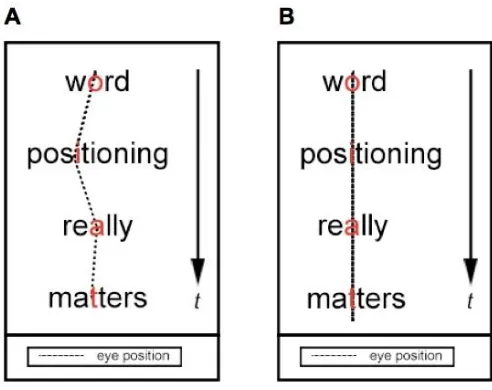
which has potential important implications for reading, is the format of the visual presentation of the individual words on the screen. Traditionally, words presented using RSVP are
centered on the screen (Figure 1A), which is what we have done in this study. In contrast, the Spritz software uses something that they have termed the “Optimal Recognition Point”
(ORP), which is the point on the screen where they believe the eye fixates. Their software positions each word such that the eye should land directly on the ORP instead of having to search for it (Figure 1B). This should reduce saccades, thereby increasing reading speed.
However, because Spritz does not disclose how they determine the ORP, we had to rely on the traditional RSVP alignment on the screen, as in Figure 1A. Thus, an open question
remains about whether reading speed and comprehension are enhanced when words are positioned on the screen using the ORP. Additionally, word-by-word presentation is ideal for
small handheld devices like phones or small tablets. Consequently, further research should be done investigating the impact of comprehension and single word presentation using such
[image:10.595.76.322.516.711.2]devices instead of presenting them on a computer screen.
Figure 1. A comparison of word position on a screen using Spritz and RSVP with the preferred fixation point indicated in red (Spritz Why It Works). Panel A shows that the
Journal of Second Language Teaching and Research. Volume 4 Issue 1
121
Finally, as was mentioned in the introduction, in natural reading readers spend different amounts of time reading words depending on their length, frequency, whether they introduce
a new topic, are in difficult syntactic constructions, and are at the end of sentences (Just & Carpenter, 1980). Eliminating this variability might impair reading and therefore impact
comprehension. Thus, it would be interesting to explore whether adjusting the presentation rate for each word to account for such factors helps readers, in particular second language
learners who may need more time.
Conclusions
Previous research has shown the value of reading for improving second language skills, yet important questions remain about how new reading technologies can be made useful for
second language learners. This small-scale study demonstrates that word-by-word reading diminishes comprehension for native speakers, and suggests that this might be true of highly
proficient nonnative speakers as well. However, more research is needed to determine what underpins this impaired comprehension, and how new technologies can be employed to help
second language learners read more extensively without harming performance.
Biodata
Zann Boo is a PhD candidate at the University of Nottingham. Her research interests are in
the areas of the psychology of language learners, individual differences, implicit-explicit L2 learning, and learner attitudes. Her research investigates the role of the subconscious and its impact on language learners’ attitudes.
Dr. Kathy Conklin is an Associate Professor in psycholinguistics at the University of
Nottingham. Her research addresses the representation and processing of multiword units, automatic word activation and reading in an L1 vs. L2, implicit L2 learning, grammatical
gender and anaphor resolution in an L1 and L2, and bilingual/monolingual cognitive control.
References
7 Speed Reading [Computer software]. (2014). Retrieved June 6 from
http://www.7speedreading.com
Bachman, L. (1990). Fundamental Considerations in Language Testing. Oxford, UK: Oxford
University Press.
Bachman, L. & Palmer, A. (1996). Language Testing in Practice. Oxford, UK: Oxford
Journal of Second Language Teaching and Research. Volume 4 Issue 1
122
Bachman, L. & Palmer, A. (2010). Language Assessment in Practice. Oxford, UK: Oxford University Press.
Benedetto, S., Carbone, A., Pedrotti, M., Le Fevre, K., Bey, L., & Baccino, T. (2015). Rapid serial visual presentation in reading: The case of Spritz. Computers in Human
Behavior, 45, 352–358. doi: http://dx.doi.org/10.1016/j.chb.2014.12.043
Bouma, H. & deVoogd, A. (1974). On the control of eye saccades in reading. Vision Research, 14, 272–84. doi:10.1016/0042-6989(74)90077-7
Brook-Hart, G. (2004). Instant IELTS. Cambridge, UK: Cambridge University Press. Brown, J. (2005). Testing in language programs (2nd ed.). New York, NY: McGraw-Hill.
Brown, D. & Abeywickrama, P. (2010). Language Assessment: Principles and Classroom Practices. New York, NY: Pearson Education.
Burke, S. (13 March 2014). App lets you speed-read 'Harry Potter' in an hour. Retrieved from http://money.cnn.com/2014/03/13/technology/innovation/spritz/
Cocklin, T., Ward, N., Chen, H., & Juola, J. (1984). Factors influencing readability of rapidly presented text segments. Memory and Cognition, 12, 431-442. doi:
10.3758/BF03198304
Could Spritz boost your reading speed? (14 March 2014). Retrieved from http://www.bbc.co.uk/news/technology-26577462
Crowder, R. (1982). The psychology of reading: An introduction. New York, NY: Oxford
University Press.
Dr. Seuss. (1978). I Can Read With My Eyes Shut! New York, NY: Random House. Forster, K. (1970). Visual perception of rapidly presented word sequences of varying
complexity. Perception & Psychophysics, 8, 215-221.
http://dx.doi.org/10.3758/BF03210208
Gilbert, L. (1959). Speed of processing visual stimuli and its relation to reading. Journal of Educational Psychology, 55, 8-14. http://dx.doi.org/10.1037/h0045592
Grabe, W. (1991). Current developments in second language reading research. TESOL Quarterly, 25(3), 375–406. doi: 10.2307/3586977
Harmer, J. (1998). How to teach English. Harlow, UK: Pearson Education Limited.
Hughes, A. (2003). Testing for Language Teachers. Cambridge, UK: Cambridge University
Press.
Juola, J., Ward, N., & McNamara, T. (1982). Visual search and reading of rapid serial
presentations of letter strings, words and text. Journal of Experimental Psychology (General), 111, 208-227. http://dx.doi.org/10.1037/0096-3445.111.2.208
Journal of Second Language Teaching and Research. Volume 4 Issue 1
123
Just, M., Carpenter, P., & Woolley, J. (1982). Paradigms and processes in reading comprehension. Journal of Experimental Psychology (General), 111, 228-238.
http://dx.doi.org/10.1037/0096-3445.111.2.228
Krashen, S. & Terrell, T. (1983). The natural approach: Language acquisition in the
classroom. London, UK: Prentice Hall Europe.
Lee, G. (2006). Three Factors in L2 Reading Ability: Using Rauding Theory to Reanalyze a
Study by Nassaji and Geva. Reading Psychology, 27, 405-433. doi: 10.1080/02702710600846936
Masson, M. (1983). Conceptual processing of text during skimming and rapid sequential
reading. Memory and Cognition, 11, 262-274. doi: 10.3758/BF03196973
Öquist, G. & Goldstein, M. (2003). Towards an improved readability on mobile devices:
evaluating adaptive rapid serial visual presentation. Interacting with Computers, 15, 539-558. doi:10.1016/S0953-5438(03)00039-0
Perfetti, C. A. (1985). Reading ability. New York: Oxford University Press.
Potter, M., Kroll, J., & Harris, C. (1980). Comprehension and memory in rapid serial
sequential reading. In R. Nickerson (Ed.), Attention and performance VIII (pp. 98-118). Hillsdale, N.J: Erlbaum.
Proaps, A. & Bliss, J. (2014). The effects of text presentation format on reading
comprehension and video game performance. Computers in Human Behavior, 36,
41-47. doi:10.1016/j.chb.2014.03.039
Spritz FAQs. Retrieved June 6, 2015 from http://spritzinc.com/faqs Spritz Homepage. Retrieved June 6, 2015 from http://www.spritzinc.com
Spritz The Science. Retrieved November 4, 2015 from http://spritzinc.com/the-science
Spritz Why It Works. Retrieved June 6, 2015 http://www.spritzinc.com/why-spritz-works-its-all-about-the-alignment-of-words/
Reichle, E., Rayner, K., & Pollatsek, A. (2003). The E-Z Reader model of eye-movement
control in reading: Comparisons to other models. Behavioral and Brain Sciences, 26, 445-476. doi:10.1017/S0140525X03000104
Renandya, W. (2007). The power of extensive reading. RELC Journal, 38, 133–149. doi:
10.1177/0033688207079578
Rubin, G. & Turano, K. (1992). Reading without saccadic eye movements. Vision Research, 32, 895–902. doi:10.1016/0042-6989(92)90032-E
Wilkinson, D. (2012). A data-driven Approach to increasing student motivation in the reading classroom. Language Education in Asia, 3, 252-262.
Journal of Second Language Teaching and Research. Volume 4 Issue 1
124
AppendixThe modified texts are taken from Cambridge Instant IELTS (Brook-Hart, 2004)
Text 1:
A lot of people think we could be headed for trouble by tampering with Mother Nature and producing genetically altered food. But those who promote genetically modified foods say it’s
no more unnatural than traditional selective breeding, to say nothing about synthetic fertilizers and chemical pesticides.
Most Canadians regularly eat bioengineered food. Anyone who consumes cheese, potatoes, tomatoes, soybeans, corn, wheat, and salmon is taking in genetically modified (GM) food. In
addition, 75% of processed foods contain GM ingredients. In fact, around 65% of the food we get from the shops has some genetically modified component. GM food does not have to be labelled as such in Canada, so most of us don’t know we’re eating it. Some of the items that
have a high likelihood of containing GM material might surprise you. They include chocolate
bars, baby food, margarine, canned soup, ice cream, salad dressing, yoghurt, cereals, cookies, and frozen French fries. And, there’s nothing new about this.
Farmers and plant breeders have used genetically modified foods for centuries; if they hadn’t, we’d probably still be eating grass instead of wheat. They’ve refined the foods we eat
through selective crossbreeding, combining different types of wheat, for example, and eliminating weaker varieties. Today, however, genetic engineering is changing the nature of plant breeding even more: it’s no longer just a case of mixing different varieties of the same species. Now, genes from completely different life forms are being combined – fish genes
into tomatoes to make the latter more frost resistant, for example.
Such “tampering with Nature” makes a lot of people anxious. They wonder if the foods that
come out of genetic modification are safe for human consumption. Scientists say they are completely safe; GM is just a way of adding genes to plants to make it possible for them to
survive without the use of pesticides and to increase yields. But, the nonbelievers point out that scientists said that nuclear power, the toxic insecticide DDT, and a host of other things,
were also completely harmless.
Fans of agricultural biotechnology think producing GM food is a move in the right direction, that it will ultimately improve health, the environment, and the economy. They’re convinced it will solve the world’s hunger problems by boosting the nutritional content of foods, lead to a
Journal of Second Language Teaching and Research. Volume 4 Issue 1
125
say it could also create superweeds and insects, disrupt global food systems, destroy ecological diversity, put small farms out of business, and cause long-term environmental
problems. All that aside, they think consumers have a right to know what is in their food.
Questions for Text 1 with correct answer in bold: 1. Choose the most suitable title for this article.
a. General information about GM food b. The debate about GM food c. GM food and the environment
2. According to the passage, Canadians do not know they are eating GM food because
a. GM food does not have to be labelled in Canada b. they are not concerned if they are eating GM food
c. everything they eat is already genetically modified
3. According to the text, which of the following methods did farmers use to improve the quality of crops before genetic modification became possible?
a. Random crossbreeding b. Liberal use of herbicides c. Eliminating weaker varieties
4. According to the passage, genetic engineering is changing the nature of plant breeding
even more by
a. eliminating genes from undesirable life forms b. implementing genes from synthetic life forms
c. combining genes from completely different life forms
5. Genetic modification is expected to increase the
a. nutritional level of food b. varieties of food
Journal of Second Language Teaching and Research. Volume 4 Issue 1
126
Text 2:What is it about TV that has such a hold on us? In part, the attraction seems to arise from our biological “orienting response”. First described by Ivan Pavlov in 1927, the orienting
response is an instinctive reaction to anything sudden or new, such as movement or possible
attack by a predator. Typical orienting reactions include the following: the arteries to the brain grow wider allowing more blood to reach it, the heart slows down and arteries to the large
muscles become narrower so as to reduce blood supply to them. Brain waves are also interrupted for a few seconds. These changes allow the brain to focus its attention on gathering more information and becoming more alert while the rest of the body becomes
quieter.
To study people’s reactions to TV, researchers have undertaken laboratory experiments in
which they have monitored the brain waves, skin resistance or heart rate of people watching
television. To study behaviour and emotion in the normal course of life, as opposed to the artificial conditions of the laboratory, we have used the Experience Sampling Method (ESM).
Participants carried a beeper, and we signalled them six to eight times a day, at random, over the period of a week; whenever they heard the beep, they wrote down what they were
doing and how they were feeling.
As one might expect, people who were watching TV when we beeped them reported feeling relaxed and passive. The laboratory studies similarly show less mental stimulation, as measured by brain-wave production, during viewing than during reading.
What is more surprising is that the sense of relaxation ends when the TV is turned off, but
the feelings of passivity and lowered alertness continue. Viewers commonly report that television has somehow absorbed or sucked out their energy, leaving them exhausted. They say they have more difficulty concentrating after viewing than before. In contrast, they rarely
report such difficulty after reading. After playing sports or doing hobbies, people report improvements in mood. After watching TV, people’s moods are about the same or worse
than before.
Within moments of sitting or lying down and pushing the “power” button, viewers report
feeling more relaxed. Because the relaxation occurs quickly, people are conditioned to
associate viewing with rest and lack of stress. The association is positively reinforced because viewers remain relaxed throughout viewing.
Journal of Second Language Teaching and Research. Volume 4 Issue 1
127
Questions for Text 2 with correct answer in bold:1. Choose the most suitable title for this article. a. The orientation for TV
b. TV and its benefits c. An addiction to TV
2. When the beeper was signalled, participants had to
a. write down what they were doing and how they were feeling b. stop what they were doing and watch some television
c. go to the lab and have their brain waves monitored
3. Compared to reading, people’s brains show ______________ while watching television.
a. more stimulation b. equal stimulation
c. less stimulation
4. From the passage, which of the following option is correct? After watching TV, viewers commonly report that TV has a. left them exhausted
b. improved their moods
c. increased their concentration
5. According to the passage, people watch a great deal of TV longer than they plan to a. because it is a great way to kill boredom
Journal of Second Language Teaching and Research. Volume 4 Issue 1
128
Text 3:During successive waves of globalisation in the three centuries leading up to the first world
war, migration of labour was consistently one of the biggest drivers of economic change. Since 1945 the world has experienced a new era of accelerating globalisation, and the
international movement of labour is proving once again to be of the greatest economic and social significance.
The first era of mass voluntary migration was between 1850 and 1913. Over 1m people a year were drawn to the new world by the turn of the 20th century. Growing prosperity, flaling
transport costs and lower risk all pushed in the same direction. Between 1914 and 1945, war, global depression and government policy reduced migration. During some years in the
1930s, people returning to Europe from the United States, even though comparatively few, actually outnumbered immigrants going the other way. After the second world war the cost of
travel fell steeply. But now the pattern changed. Before long Europe declined as a source of immigration and grew as a destination. Emigration from developing countries expanded
rapidly: incomes there rose enough to make emigration feasible, but not enough to make it pointless. Many governments began trying to control immigration. Numbers, legal and illegal,
surged nonetheless, as economics had its way.
The economic conditions now seem propitious for an enormous further expansion of migration. On the face of it, this will be much like that of a century ago. As before, the main expansionary pressures are rising incomes in the rich countries and rising incomes in the
poor ones. This second point is often neglected: as poor countries get a little less poor,
emigration tends to increase, because people acquire the means to move. There are, however, two crucial differences between then and now.
One is that, in the first decade of the 20th century, the receiving countries needed lots of unskilled workers in industry and farming. In the first decade of the 21st century, in contrast,
opportunities for unskilled workers are dwindling. In the United States, wages of unskilled workers are falling. The fall is enough to hurt the workers concerned, but not to deter new
immigrants.
And the other big difference between now and a century ago? It is that the affected rich-country workers are in a stronger position to complain, and get something done. The most
Journal of Second Language Teaching and Research. Volume 4 Issue 1
129
Today’s migration, much more than the migration of old, poses some insoluble dilemmas.
Belief in individual freedom suggests that rich countries should adopt more liberal
immigration rules, both for unskilled migrants are skilled ones. With or without such rules, more migrants are coming. And in either case, the question of compensation for the losers, in
rich countries and poor countries alike, will demand some attention.
Questions for Text 3 with correct answer in bold: 1. Choose the most suitable title for this article.
a. Global depression and government policy reduced migration
b. Rich countries adopting more liberal immigration rules c. Migration as a driver of economic change
2. According to the text, pressure to migrate is increasing now because
a. people generally earn more
b. there is a greater need for unskilled workers
c. economic conditions have become more desperate
3. According to the passage, many governments tried to control immigration a. however it was useless
b. but it led to protests c. and it was effective
4. After the Second World War there was a great increase in emigrants from
a. developed countries b. developing countries c. undeveloped countries
5. According to the passage, nowadays, receiving countries generally prefer immigrants with
a. skills
b. overseas working experience