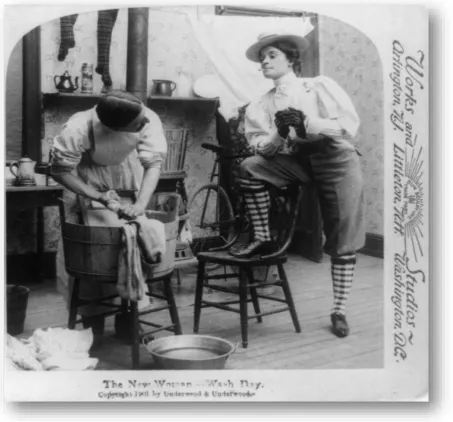
ATTEMPTS TO RECONSTRUCT THE BINARY CODE
Elena Rebekka Götting
A Thesis Submitted for the Degree of PhD at the
University of St Andrews
2014
Full metadata for this item is available in Research@StAndrews:FullText
at:
http://research-repository.st-andrews.ac.uk/
Please use this identifier to cite or link to this item:
http://hdl.handle.net/10023/6612
Challenging Maleness – The New Woman’s Attempts to
Reconstruct the Binary Code
Elena Rebekka Götting
This thesis is submitted in partial fulfilment
for the degree of Ph.D.
at the
University of St Andrews
THESIS ABSTRACT
This thesis explores the construction of masculinity in novels written by New Women
authors between the years 1881-1899. The fin de siècle was a period during which
gender roles were renegotiated with fervour by both male and female authors, but it was
the so-called New Woman in particular who was trying to transform the Victorian
notion of femininity to incorporate the demands of the burgeoning women’s movement.
This thesis argues that in their fiction, New Women authors often tried to achieve this
transformation by creating male characters who were designed to justify and to mitigate
the New Woman protagonist’s departure from traditional structures of heterosexual
relationships.
The methodology underlying this thesis is the notion that men and women were
perceived as binary opposites during the Victorian period. I refer to this as the binary
code of the sexes. This code assumes that men and women naturally possess
diametrically opposed character attributes, and also that “masculine” attributes are
perforce better than “feminine” ones. In the body of this work, I argue that New Women
authors attempted to contest both of these assumptions by creating, on the one hand,
traditional male characters whose masculinity is corrupted in crucial and recurring
ways, and on the other, impaired male characters who cannot assume the traditional role
of man. The comparison of the New Woman protagonist with the corrupt traditional
man elevates her feminine attributes, while the impaired man’s dependency legitimises
her acquisition of what were otherwise considered “masculine” attributes and privileges,
thereby contesting the notion that men and women possess sex-specific attributes at all.
The second part of my thesis examines contrasting examples, in which this way
of characterising masculinity – as traditional or impaired – is questioned and
manipulated. It examines the limitations of the New Women authors’ specific approach
DECLARATIONS
1. Candidate’s declarations:
I, Elena Rebekka Götting, hereby certify that this thesis, which is approximately 80000
words in length, has been written by me, that it is the record of work carried out by me
and that it has not been submitted in any previous application for a higher degree.
I was admitted as a research student in September 2009 and as a candidate for the
degree of Ph.D. in September 2010; the higher study for which this is a record was
carried out in the University of St Andrews between 2009 and 2013.
I, Elena Rebekka Götting, received assistance in the writing of this thesis in respect of
language, grammar and syntax, which was provided by Dr. Laura Hodsdon.
Date…...……signature of candidate …...……
2. Supervisor’s declaration:
I hereby certify that the candidate has fulfilled the conditions of the Resolution and
Regulations appropriate for the degree of Ph.D. in the University of St Andrews and
that the candidate is qualified to submit this thesis in application for that degree.
3. Permission for electronic publication:
In submitting this thesis to the University of St Andrews I understand that I am giving
permission for it to be made available for use in accordance with the regulations of the
University Library for the time being in force, subject to any copyright vested in the
work not being affected thereby. I also understand that the title and the abstract will be
published, and that a copy of the work may be made and supplied to any bona fide
library or research worker, that my thesis will be electronically accessible for personal
or research use unless exempt by award of an embargo as requested below, and that the
library has the right to migrate my thesis into new electronic forms as required to ensure
continued access to the thesis. I have obtained any third-party copyright permissions
that may be required in order to allow such access and migration, or have requested the
appropriate embargo below.
The following is an agreed request by candidate and supervisor regarding the electronic
publication of this thesis:
Access to printed copy and electronic publication of thesis through the University of St
Andrews.
Date …...…
For my Grandfathers
ACKNOWLEDGEMENTS
I owe special thanks to my supervisor Phillip Mallett for trusting me to develop my own
ideas even when they seemed far from his own, and for pulling me back when they went
off the map completely. I have profited from his vast knowledge of New Woman
fiction, and from his discreet way of steering me into profitable directions, in more
ways than I probably realise.
I am very thankful for the support of my university during the years I had to be absent
from St Andrews, and to Sandra McDevitt for answering all my questions, even those I
had not asked yet. Chera Ann Cole has been a fantastic roommate, and has acted as my
stand-in during my absence; thank you for that.
This thesis would not exist without the men of my family – my father, my three
brothers, my uncles and cousins, and my grandfathers – who have shared with me their
thoughts and fears on becoming and on being men. Neither would it exist without my
mother’s unceasing efforts to determine at all times just “how the boys are doing”,
which has inspired me to ask the same.
I am deeply grateful to my parents Martin and Elke Götting, who paved the way for my
university education by imparting their love for learning to me. Their emotional and
financial support during my studies has been invaluable. Thank you for being who you
are, and for loving the woman I have become.
I also owe special thanks to my youngest brother Leon Balthasar Götting, who has read
large parts of this thesis and helped me to shape my thoughts, and to my honorary little
sister Laura Jäger, whose wonderful individuality has sparked my interest in gender
studies, and who has encouraged and soothed me throughout all these years.
Finally, a special thank you goes to Ingiberg Thor Thorsteinsson, who has been with me
from the beginning of this project, and who has never lost faith either in my “big essay”,
TABLE OF CONTENTS
THESIS ABSTRACT ... iii
DECLARATIONS ... iv
ACKNOWLEDGEMENTS ... vii
ABBREVIATIONS ... x
INTRODUCTION ... 1
The New Woman and Her Time ... 1
Methodology: Binary Codes ... 11
Pairing ... 19
Attribute Clustering ... 21
Valuation ... 25
On the Arbitrariness of Valued Binaries – Thesis Structure ... 28
The Binary Code of the Sexes ... 33
I. REVALUATION AND THE PHENOMENON OF THE BINARY MAN ... 37
The Beth Book, Sarah Grand ... 42
From Man to Man; or, Perhaps Only..., Olive Schreiner ... 49
The Daughters of Danaus, Mona Caird ... 56
Red Pottage, Mary Cholmondeley ... 64
The Main Findings of the First Chapter ... 70
II. RE-ASSOCIATION AND THE PHENOMENON OF THE IMPAIRED MAN ... 81
The Beth Book, Sarah Grand ... 87
“A Regeneration of Two”, George Egerton ... 97
The Heavenly Twins, Sarah Grand ... 104
Gloriana; or, The Revolution of 1900, Lady Florence Dixie ... 115
III. THE HEROIC MAN AND THE PHENOMENON OF RECOIL ... 129
Kith and Kin, Jessie Fothergill ... 132
Diana Tempest, Mary Cholmondeley ... 144
A Yellow Aster, Iota ... 151
The Main Findings of the Third Chapter ... 157
IV. THE POLLUTED MAN AND THE LIMITS OF IMPAIRMENT ... 165
Miss Brown, Vernon Lee ... 168
The Years that the Locust Hath Eaten, Annie E. Holdsworth ... 176
Poor Max, Iota ... 181
The Main Findings of the Fourth Chapter ... 189
CONCLUSION ... 195
Revaluation and the Binary Man ... 198
Re-association and the Impaired Man ... 201
The Heroic Man and the Phenomenon of Recoil ... 205
The Polluted Man and the Limitations of Impairment ... 209
The New Woman’s Attempts to Renegotiate the Binary Code of the Sexes ... 211
The Effects and the Limitations of Revaluation ... 213
The Effects and the Limitations of Re-association ... 216
From Contradictory to Contrary Dichotomies... 222
APPENDIX: SYNOPSES ... 232
Chapter I: Revaluation and the Phenomenon of the Binary Man ... 232
Chapter II: Re-association and the Phenomenon of the Impaired Man ... 234
Chapter III: The Heroic Man and the Phenomenon of Recoil ... 236
Chapter IV: The Polluted Man and the Limits of Impairment ... 240
ABBREVIATIONS
of frequently used primary texts
Brooke, Emma Frances
ASW A Superfluous Woman (1894)
Broughton, Rhoda
DF Dear Faustina (1897)
Caird, Mona
WoA The Wing of Azrael (1889) DoD The Daughters of Danaus (1894)
Cholmondeley, Mary
DT Diana Tempest (1893) RP Red Pottage (1899)
Dixie, Lady Florence
GL Gloriana; or, The Revolution of 1900 (1890)
Dixon, Ella Hepworth
SMW The Story of a Modern Woman (1894)
Egerton, George (Mary Chavelita Dunne Bright)
RoT “A Regeneration of Two” (1894)
ABBREVIATIONS
of frequently used primary texts
Fothergill, Jessie
KK Kith and Kin (1881)
Grand, Sarah (Frances Elizabeth Bellenden Clarke)
HT The Heavenly Twins (1893) BB The Beth Book (1897)
Holdsworth, Annie E.
YLHE The Years that the Locust Hath Eaten (1895)
Iota (Kathleen Mannington Caffyn)
AYA A Yellow Aster (1894) PM Poor Max (1898)
Lee, Vernon (Violet Paget)
MB Miss Brown (1884)
Meade, L.T. (Elizabeth Thomasina Meade Smith)
GoP A Girl of the People (1890)
Schreiner, Olive
SAF The Story of an African Farm (1883)
INTRODUCTION
The New Woman and Her Time
The fin de siècle possesses what one may call, without fear of exaggeration, an aura.
The very term itself seems to evoke the odour of absinthe, the splendour of the dandy’s
elaborate wardrobe, and the excitement of a wide-spread apocalyptic mood. Over the
course of the last century, popular representations of the fin de siècle have made a habit
of emphasising these cultic paraphernalia, and as a result, the period has fascinated
many of those cultural latecomers who were born after the turn of the century
transformed this fin into merely another beginning. With its emphasis on style, its
predilection for scandals, and its great scientific advances side by side with its abysses –
from the literary monstrosities of Mr Hyde and Count Dracula to the real, but hardly
less shadowy, Ripper – there is very little doubt that the period will continue to excite
and inspire even in the twenty-first century.
To the critic of literature, perhaps the 1890s register as, above all, a time of
unrest. Even a cursory glance at the table of contents of Sally Ledger and Roger
Luckhurst’s Fin de Siècle Reader reveals the multitude and weight of discourses that the
intellectual circles of this period engaged in. “The Metropolis and Outcast London”,
“The New Imperialism”, “Socialism” and “Anarchism”, “Psychology and Psychical
Research”, “Anthropology and Racial Science”, “Sexology” and “Degeneration”,1 these
topics inspired contemporary debate and were crucial to the intellectual climate that
characterised the end of the nineteenth century.
If pressed for a succinct definition, perhaps the fin de siècle is best described as
an age of contradictions. It is commonly regarded as the period in which modern
science was born, but it was also the period in which phrenology and mesmerism were
able to masquerade, however briefly, as science, while Ignaz Semmelweis was driven to
madness by the contempt of his colleagues for the idea that there was a connection
between infant mortality rates and the attending physician’s lack of hygiene. It is this
vast number of contradictions that is largely responsible for the period’s continuing
fascination.
The phenomenon of New Woman literature plays its part in fin-de-siècle
contradictoriness. Since its recovery from “the dustbin of literature”,2 there have been a
number of important studies on the subject of New Woman literature, beginning in 1973
with A. R. Cunningham’s essay “The ‘New Woman Fiction’ of the 1890s”,3 and
followed in 1982 by Elaine Showalter’s overview of women writers from Charlotte
Brontë to Doris Lessing, in which chapter VII, “The Feminist Novelists”, considered
New Women authors.4 In 1977, Lloyd Fernando published a book-length study on New
Woman writing,5 but, apart from George Eliot,6 he considered only male authors:
George Meredith, George Moore, George Gissing and Thomas Hardy.
In the 1990s and at the beginning of the twenty-first century, book-length studies
by Ann Ardis,7 Sally Ledger8 and Ann Heilmann9 drew attention to the female authors
of the fin de siècle, and widened and consolidated the academic and the popular
2 This is Lyn Pykett’s phrase: Lyn Pykett, The “Improper” Feminine: the Women’s Sensation Novel and
the New Woman Writing (London: Routledge, 1992), p. 204.
3 A. R. Cunningham, “The ‘New Woman Fiction’ of the 1890’s”, Victorian Studies 17.2 (1973), pp.
177-86.
4 Elaine Showalter, A Literature of Their Own: From Charlotte Brontë to Doris Lessing (1977) (London:
Virago, 1982).
5 Lloyd Fernando, “New Women” in the Late Victorian Novel (University Park: Pennsylvania State
University Press, 1977).
6 Though perhaps a peculiar choice, Fernando argues that Eliot was in many ways not just an early
contemporary, but a predecessor of the New Woman. In her writing, he argues, Eliot gives women “an unprecedented role in human life, complementary not subservient to that of man”. Fernando, New Women, p. 31. He also claims that “with [The Mill on the Floss] the opening salvoes in a coming revolution of morality had been fired”. Cf. Fernando, New Women, p. 38.
7 Ann Louise Ardis, New Women, New Novels: Feminism and Early Modernism (New Brunswick:
Rutgers University Press, 1990).
8 Sally Ledger, ed., The New Woman. Fiction and Feminism at the Fin de Siècle (Manchester: Manchester
University Press, 1997).
9 Ann Heilmann, New Woman Fiction – Women Writing First-Wave Feminism (Basingstoke: Palgrave
understanding of this genre. Ann Ardis has addressed, among other matters, the subject
of realism and fiction that was discussed controversially during the period, and
concludes that New Women authors insisted on the importance of realism in fiction.
Sally Ledger’s study is particularly wide-ranging. After an initial discussion of the
phenomenon of the New Woman, the study examines the New Woman’s connection to
socialism, imperialism, and mass culture. Ann Heilmann, on the other hand, has drawn
parallels between the awakening of women’s literary self-consciousness, and the second
wave of feminist criticism in the twentieth century. Her study covers a vast number of
works and focuses, among other topics, on the subject of marriage, the crisis of gender,
and the artistic New Woman protagonist. In 2004, Ann Heilmann also published New
Woman Strategies: Sarah Grand, Olive Schreiner, Mona Caird, in which she compares several of the works of these authors with a view to the transformations of traditional
notions of femininity, allegory and mythology which each of them achieved.10 The
contents of these studies have gone a long way towards establishing the object of New
Woman criticism, as well as providing an overview of the many different influences on
the fiction of fin-de-siècle women writers. A minimal canon has since been established
which provides a common ground for criticism, and yet this canon is still – thankfully –
in the process of expanding, as the 2010-11 publication of Carolyn W. de la L. Oulton’s
edition of New Woman fiction shows.11
Since the early beginnings of New Woman criticism in the 1970s and 80s, which
were in part dedicated to rescuing these works and their authors from oblivion and
supplied broad overviews rather than detailed comparisons, recent criticism has become
increasingly specialised, and has begun to examine in more detail the genre’s
connection to a number of contemporary issues that make adopting the New Women as
10 Ann Heilmann, New Woman Strategies: Sarah Grand, Olive Schreiner, Mona Caird (Manchester:
Manchester University Press, 2004).
11 Carolyn W. de la L. Oulton, ed., New Woman Fiction, 1881-1899, 9 vols. (London: Pickering &
“mothers” of feminism a complicated issue. Angelique Richardson has written on the
connections between New Woman fiction and the eugenic movement,12 T. J. Boisseau,
among others, has addressed issues of imperialism and racism.13 The interaction
between fin-de-siècle women writers and the movement of modernism that Ann Ardis
explored in her doctoral thesis in 1988 (published in 1990), has been researched further
by Elizabeth MacLeod Walls,14 among others, and there is an ever-increasing awareness
of the class bias of this fiction. Kheagan Kane Turner’s 2006 thesis on nursing in New
Women novels, for instance, compares Margaret Harkness’ depiction of hospital staff
reactions to different social classes in A City Girl to those in Ella Hepworth Dixon’s The
Story of a Modern Woman.15
Another topic that has received more attention in recent years is the topic of the
New Man – of masculinity as constructed in New Woman fiction. While Elaine
Showalter’s early survey of women’s literature from Brontë to Lessing also featured a
chapter on what she called “The Woman’s Man”, meaning male characters created by
female authors, more recent studies have focused exclusively on the New Woman
period to unearth the permutations of the masculine gender role in the works of women
who wrote during these turbulent times. Stephanie Forward’s 1998 article “The ‘New
Man’ in Fin-De-Siècle Fiction” is a case in point. Forward’s analysis identifies a great
number of New Men, and she is on the whole very positive in her assessment of these
characters. Barbara Tilley’s 2002 thesis “New Men? Exploring Constructions of
Masculinity in Late Nineteenth-Century New Women Novels” focuses on the figures of
12 Angelique Richardson, Love and Eugenics in the Late Nineteenth Century: Rational Reproduction and the New Woman (Oxford: Oxford University Press, 2003).
13 T. J. Boisseau, “White Queens at the Chicago World’s Fair, 1893: New Womanhood in the Service of
Class, Race, and Nation”, Gender & History 12.1 (2000), pp. 33-81.
14 Elizabeth MacLeod Walls, “‘A Little Afraid of the Women of Today’: The Victorian New Woman and
the Rhetoric of British Modernism”, Rhetoric Review 21.3 (2002), pp. 229-46.
15 Keaghan Kane Turner, “In Perfect Sympathy: Representations of Nursing in New Woman Fiction”,
“the lover, the husband and the doctor”16 in New Woman fiction. Her selection of these
character types is motivated by the fact that all three are “intimately involved with
women’s bodies, desires, and their sexuality”.17 She examines a wide range of novels
and finds a number of interesting parallels between these types of men in very different
New Women novels, but is more careful about referring to these characters as “New
Men” than Stephanie Forward. Gabriele Pamperl’s 2008 thesis “The Subversion of
Gender: Representations of New Women in Literature of the Fin de Siècle” deals with
the New Woman’s subversion of the feminine gender role, rather than the masculine,
but with chapters on “Denaturalizing the Heterosexual Matrix” and “Androgyny and the
Destabilization of the Sex Dichotomy”18 her account of the New Woman’s gender
subversion naturally touches on the construction of masculinity as well.
What many of these studies have in common is the idea that there are certain
recurrent types of men in New Woman fiction. Considering the numerous and often
fundamental differences in the approach of different New Women writers, this result is
surprising, yet it mirrors the feelings of the New Woman’s contemporaries, whose
attacks on this body of fiction frequently targeted specifically its representation of
masculinity. For instance, when Margaret Oliphant reviewed Hardy’s Jude the Obscure
in her 1896 article “The Anti-Marriage League”, she was especially indignant about his
characterisation of the male protagonist, whom she calls “a very poor creature” that is
“always the puppet, always acted upon by the others”. This, to Oliphant, is
characteristic of New Woman fiction:
[i]t is the women who are the active agents in all this unsavoury imbroglio: the story is carried on, and life is represented as carried on, entirely by their means. The men are passive, suffering, rather good than otherwise, victims of these and of fate. Not only do they never dominate,
16 Barbara Tilley, “New Men? Exploring Constructions of Masculinity in Late Nineteenth-Century New
Woman Novels”, Ph.D., University of Florida, 2002, p. 7.
17 Tilley, “New Men?”, p. v.
18 Gabriele Pamperl, “The Subversion of Gender: Representations of New Women in Literature of the Fin
but they are quite incapable of holding their own . . . This is one of the most curious developments of recent fiction.19
Only a year later, in the same magazine, Hugh Stutfield also complained about the
typical New Woman’s man, yet to him, this type was diametrically opposed to the one
Oliphant had identified: “man is represented by so many lady novelists as a blackguard
or an idiot, or both, sometimes diseased, always a libertine and a bully”,20 he wrote in
“The Psychology of Feminism”.
In these two reviews, both Margaret Oliphant and Hugh Stutfield claim that they
have identified the “typical man” in New Woman fiction, yet they describe him very
differently, and this difference intrigued me. Is the New Woman’s man a bully, or a
puppet? A blackguard or a victim? He cannot well be both, and in all likelihood
Oliphant and Stutfield reacted to different, but recurrent types of male characters
created by New Women writers. This conclusion raises several questions: did New
Women authors really create recurrent and diametrically opposed “types” rather than
individual male characters? And if so, what was the purpose of representing men either
as diseased tyrants, or as ineffectual puppets? This thesis attempts to answer both
questions by arguing that the reason for the New Woman’s particular representation of
masculinity was the fact that she attempted to justify the protagonist’s departure from
traditional patterns of femininity.
The traditional Victorian notion of femininity postulated that women were the
opposite of men in all their defining character attributes. In latter-day criticism, this
ideology is sometimes referred to as domestic ideology, and sometimes as the ideology
of separate spheres, but underlying both these terms is the notion that during this
particular timeframe, men and women were perceived as binary opposites, meaning that
19 Margaret Oliphant, “The Anti-Marriage League”, Blackwood’s Edinburgh Magazine 159 (1896), pp.
135-49: p. 140.
20 Hugh E. M. Stutfield, “The Psychology of Feminism”, Blackwood’s Edinburgh Magazine 161 (1897),
they formed (or were ideally supposed to form) a binary code in which the concept of
man was defined by its opposition to the concept of woman. In the body of this thesis, I
will refer to this notion as the binary code of the sexes.
The idea that men and women were perceived to stand in binary opposition to
one another is one that many critics have worked with when examining the gender
relations of the Victorian and the fin-de-siècle period. For instance, in New Women,
New Novels, Ann Ardis writes: “[New Women] challenge . . . the pattern of thinking in hierarchically organised binary oppositions that pits men against women”.21 She also
takes issue with Martha Vicinus’ claim that women in late Victorian England were
“widening” their sphere because, as she argues convincingly, this phrase “suggests a
continuum, a smooth and gradual process of cultural change” that is contradicted by the
basic assumptions on which separate spheres ideology rests. In reality, Ardis argues,
“disputes about gender roles entailed the reconceptualization of the relation between
domestic (female) and public (male) spaces”. In this analysis, binary thinking is
criticised implicitly, as an underlying condition that forbade an easy widening of
women’s (or men’s) allotted sphere.
However, Ardis does not elaborate on these thoughts on the following pages.
She opens a discussion of the different types of advanced women who tried to
reconceptualise woman’s role, but curiously refrains from exploring how these types
would or did affect man’s role in turn. It is not that she retracts her previous statement
that men’s and women’s roles are inextricably connected, however, she chooses not to
explore this connection any further, and instead focuses on women’s role only. Her
concentration on this side of the matter is so marked that she discusses Lady Florence
Dixie’s Gloriana entirely without mentioning the protagonist’s friend/lover Lord
Evelyn, whose express femininity is one of the most obvious examples of the
interdependence of the spheres under the binary code that Ardis herself had noted in her
critique of Martha Vicinus.22 As a result, Ardis only scratches the surface of gender
relations. Jane Campbell has noted this in her review of New Women, New Novels,
where she summarises that Ardis does not “explore – as she had originally planned to
do – the work of modernism in further destabilizing notions of gender.”23
Ardis’ study is in its essence a work on the relation between the New Woman
novel and realism in fiction, and not a work on gender relations.24 Insofar, it is perhaps
not surprising that she does not discuss the gender binary at any length, but it is
significant that she would introduce the subject in her introduction, and yet feel no need
to pursue it any further. This is to some extent a typical approach – as a phenomenon,
binary opposition often remains relatively unexamined, even as it is used to explain
highly problematic issues.
Among the critics who have elaborated a little further on their understanding of
binary pairs and binary opposition is Gail Cunningham. In her 2001 essay “‘He-Notes’:
Reconstructing Masculinity”, she argues that the typical “despair-and-death fixation” of
New Woman fiction can be traced back to the fact that
[t]he New Woman’s attempts to claim parity were . . . attempts to annex space for women within a system of binaries which continued
unquestioningly to privilege the male.25
She concludes that the representation of masculinity in certain New Woman texts
“invert[s] the oppositional terms and, in different ways, attempt[s] to valorize the
female”.26 Although this analysis takes the binary code of the sexes as its starting point,
22 C.f. Ardis, New Women, New Novels, pp. 119-22.
23 Jane Campbell, “Review of Ann Ardis' New Women, New Novels: Feminism and Early Modernism”,
The International Fiction Review 19.2 (1992), pp. 133-34: p. 134.
24 She is primarily interested in the relation of New Woman literature with Modernism on the one hand,
and with Victorian Realism on the other.
25 Gail Cunningham, “‘He-Notes’: Reconstructing Masculinity”, in Angelique Richardson and Chris
Willis (eds.), The New Woman in Fiction and in Fact: Fin-de-Siècle Feminisms (Basingstoke: Palgrave Macmillan, 2001), p. 95. The title is a play on the 1894 Punch parody entitled “She-notes”, which in turn parodies the title and style of George Egerton’s 1893 short story collection Keynotes.
it still does not inquire sufficiently into its effects, and it is exactly this gap which my
thesis is supposed to fill. What is the “system of binaries” that Cunningham refers to,
and within this system, what is the space New Women tried to annex? What influence
did the attempted “valorisation” of “the female” have on the contemporary perception of
the concepts of woman and of man? And how do Margaret Oliphant’s and Hugh
Stutfield’s diametrically opposed “types” relate to this peculiar approach of New
Woman fiction?
Contrary to Gail Cunningham, who argues that New Woman texts which
attempt to redefine the binary relation of men and women “are found in the latter part of
the 1890s, after the period of the New Woman fiction’s prime flourish”,27 I believe that
novels which attempt to renegotiate the relative positions of men and women with a
specific view to their binary connection are not exclusively a phenomenon of the later
years of the 1890s. In my view, this renegotiation had been present in New Woman
fiction from the outset, and indeed continued a trend that had characterised women’s
writing since at least the middle of the nineteenth century. It is therefore essential to
examine this ideology of binary opposition, or binary code of the sexes, not only in its
social manifestations, as has hitherto happened, but at the level of its conception.
The body of this work consists of a number of close readings of New Women
novels. It will be my argument that the two different types of men that reoccur in New
Woman fiction so frequently – the “bully” and the “puppet”, in Stutfield’s and
Oliphant’s terms – were created independently in a wide range of New Women novels
to help the author renegotiate the binary code of the sexes. In other words, the objective
of my study is to examine how the New Woman’s representation of masculinity was
affected by the contemporary prevalence of binary thinking, and by the resulting notion
that men and women formed a binary pair. This approach attempts to unearth structures
that underlie New Woman writing, and intriguingly, that also seem to have shaped
modern criticism of New Woman writing to a certain degree.
On the following pages, I will introduce some of the philosophical speculations
which have inspired my particular reading of New Woman fiction. Taking Gail
Cunningham’s essay as a starting point, I will examine some philosophers, feminist and
otherwise, who have written on binary structures and binary thinking, and from these
and from my own observations, I hope to develop a methodology that will allow me to
uncover and to analyse New Woman fiction from the point of view of its interaction
Methodology: Binary Codes
A binary code, in the common usage of the phrase, is the encoding of a message with
the help of only two variables, traditionally zero (0) and one (1). By extension, “binary
code” can also refer to any system in which binary opposites are employed to structure
the world.28 The fact that men and women were connected in a binary construction
during the Victorian Age is one that critics have acknowledged for many years, at times
explicitly, and at other times without drawing the reader’s attention specifically to this
underlying assumption. Nor am I, by any means, the first to enquire into the nature of
binary thinking.29 Simone de Beauvoir’s 1949 study The Second Sex, for instance, is an
example of an early insight into the harmfulness of binary thinking for the concept of
woman. In her introduction, de Beauvoir refers to the fundamentality of the concept of
otherness in the formation of binary thinking: “[i]n the most primitive societies, in the
most ancient mythologies, one finds the expression of a duality – that of the Self and the
Other”.30
The tendency to code the world in binaries is without doubt ancient. Perhaps one
of the most striking examples is the origin of the term “barbarous”, which in the original
Greek meant “anyone who is not Greek”. Greek and not-Greek is a very encompassing
binary that seems to order the entirety of the world into two neatly separated categories.
But in order to maintain these categories, difference between them had to be established
and enforced continuously, lest the whole system should collapse into undifferentiated
chaos.
In the twentieth century, the observation that binary pairs have a tendency to
systematise chaos became the primary focus of the critical method now commonly
28 Cf. Benjamin Isaac, “Barbarians”, The Oxford Encyclopedia of Ancient Greece and Rome, Michael
Gagarin (ed.), 2010.
29 Nancy Jay, “Gender and Dichotomy”, Feminist Studies 7.1 (1981), pp. 38-56: p. 46.
30 Simone de Beauvoir, “‘Introduction’ to the Second Sex”, in Linda Nicholson (ed.), The Second Wave –
A Reader in Feminist Theory (New York: Routledge, 1997), p. 13. De Beauvoir’s Le Deuxième Sexe was
referred to as structuralism. Structuralism originated in Ferdinand de Saussure’s
approach to linguistics, and it made the existence of binary pairs the lynchpin of its
worldview. Without opposition, or so structuralist linguistics posited, there could be no
meaning in language, since words can never connect directly to their referents and
instead rely only on their difference from other signs of the same system for their
meaning.31 Structuralism has been criticised for, at times, granting a quasi-religious
element to binary pairs and the structures resulting from them. The anthropologist
Claude Lévi-Strauss in particular believed that the tendency to pair concepts in binaries
reflected the human brain structure, and proceeded to analyse human culture from this
point of view.32
This uncomplicated approach to binary structures came under discussion in the
1960s and 70s in the works of Jacques Derrida.33 Derrida explicitly problematised the
formation of binary structures. He drew attention to the fact that the ordering of the
world into binary partner concepts, which has been crucial to the majority of Western
culture and philosophy, by force implied a valuation of the terms thus connected. The
notion of valued binary terms is the basis for Derrida’s advocacy of deconstruction, the
method he developed for contesting binary coding and its implicit valuation. In
Derrida’s view, since every privileged binary term always implies its devalued opposite
as an integral part of its own definition, neither term is in fact privileged over the other,
and texts must be examined with a view to bringing the underprivileged, devalued term
31 In the terms of a famous example, the animal standing in the field is the referent, while “horse” is one
possible sign for this referent. The arbitrariness of the connection between sign and referent (signifier and signified in Saussure’s terminology) is made obvious by the fact that different language systems have different words for the same referents (cheval, Pferd), and “horse” carries meaning only insofar as it is different from hose, house, Morse, and so forth.
32 The notion of binary pairs became the focal point of Claude Lévi-Strauss’s anthropological studies, in
which he attempted to demonstrate that binary thinking underlies – and can therefore help to explain – much of mankind’s philosophy and culture. For an example, cf. for instance his exploration of the structural similarities between the myths of different South American tribes: Claude Lévi-Strauss, The Raw and the Cooked, transl. John and Doreen Weightman, Introduction to a Science of Mythology vol. 1, 4 vols. (London: Jonathan Cape, 1970).
33 Derrida elaborates on binary pairs in Writing and Difference and Of Grammatology, both published in
back to the centre of the text. A successful deconstruction reveals where the text
implicitly rests on binary opposites and how the inferior term establishes itself even as
the privileged term tries to suppress it.34
One of Derrida’s examples of such a hierarchized binary was the pair
man-woman. He did not necessarily connect this observation with a political or social appeal,
but feminist philosophers and critics quickly realised that binary codes and compulsory
valuation could explain many of the facets of women’s age-long oppression. Thus
began a long and fruitful engagement of feminist philosophy with the topic of binary
coding, and the practice of deconstruction, an engagement which was not always
straightforwardly affirmative, but one which has enriched feminist thought. I will
briefly trace this engagement on the following pages to locate my own enquiry of binary
codes within the rich and multi-facetted feminist tradition.
The first feminist thinkers who elaborated on the ideas of Derrida were, perhaps
inevitably, French. In her 1975 essays “Le rire de la Méduse” and “Sorties”,35 Hélène
Cixous investigated the psychoanalytic theories of Sigmund Freud and of Jacques
Lacan, among others, under the aspect of binary oppositions and valuation, and came to
the conclusion that the opposition of male and female represented the culmination point
of a long series of binary pairs that had structured Western civilisation. She too enforced
the idea that binaries are of necessity valued, and distanced herself from what she
perceived as the aim of radical feminism, namely, to reverse hierarchisation rather than
to do away with it.
34 Derrida has shown this to be the case in Saussure’s Course in General Linguistics, in which Saussure
codes speech and writing in just such a valued binary, although he is otherwise very careful of the mechanics of binary pairs. Cf. “Linguistics and Grammatology”, the second chapter of Derrida’s
influential Of Grammatology. In: Jacques Derrida, Of Grammatology (1967), transl. Gayatri Chakravorty Spivak (Baltimore: The Johns Hopkins University Press, 1998).
Luce Irigaray, in Ce sexe qui n’en est pas un (1977),36 concerned herself with ways to
think “woman” outside of the term’s traditional dependence on its binary opposite, man.
Écriture féminine, a concept which was introduced by Cixous and expanded by Irigaray,
among others, is thus in its essence an attempt to think woman outside of binary
dependencies – as an “other” which does not presuppose a one. However, the concept of
écriture feminine, because it rests on the assumption that it is an inherently feminine
way of expression, has itself been criticised as perpetuating “natural” sex differences,
even as it attempted to change the traditional valuation of the concepts of man and
woman.
In the Anglo-American tradition, Derrida’s theories have undergone more
questioning and redressing than in the French tradition. For one, the characteristically
continental leaning towards literary theory and psychoanalytic theory of Derrida’s work
complicated its assimilation into the work of feminist philosophers of the
Anglo-American tradition, as did the simple fact that De la Grammatologie was not translated
until 1976. For another, the appeal for the deconstruction of binary opposites intersected
at odd angles with another, older discussion that had characterised the feminist tradition
until the arrival of poststructuralism: the sameness /difference debate. The arrival of
Derrida’s theories in the Anglo-American tradition widened this debate, or rather,
changed its focus, but it was not an easy adjustment.
Feminism and poststructuralism, as has frequently been remarked,37 are uneasy
allies. Linda Alcoff, for instance, pointed out in 1988 that Derrida’s advocacy of
decentralisation, and the dissolution of all binaries, may leave feminism without a
“subject”:
For Derrida, women have always been defined as a subjugated difference within a binary opposition: man/woman, culture/nature,
positive/negative, analytic/intuitive. To assert an essential gender
36 Luce Irigaray, Ce sexe qui n'en est pas un (Paris: Éditions de Minuit, 1977).
difference as cultural feminists do is to reinvoke this oppositional structure. The only way to break out of this structure, and in fact to subvert the structure itself, is to assert total difference, to be that which cannot be pinned down or subjugated within a dichotomous hierarchy. Paradoxically, it is to be what is not. Thus feminists cannot demarcate a definitive category of “woman” without eliminating all possibility for the defeat of logocentrism and its oppressive power.... Following Foucault and Derrida, an effective feminism could only be a wholly negative feminism, deconstructing everything and refusing to construct anything.38
Derrida’s theories are not easily wedded with several of the more central concerns of
feminism in its broadest definition. The notion of the decentralised subject and the
constitutional impossibility of a fixed stand- and viewpoint which characterise this
method at first glance seem to forbid the appropriation of deconstruction for a
movement that has always understood itself as political, among other things.
Consequently many feminists have attempted to answer, redress, and criticise Derrida’s
ideas, and although deconstruction has entered feminist theory, it has done so in
ever-altering shapes.
I will give two examples of the engagement of feminist thought with the
post-structuralist notion of binary coding and valuation here, both of which transcend the
sameness/difference debate so crucial to earlier years. This is to show how fruitful the
notion of binary codes and their compulsory valuation has been to feminist theory,
despite the apprehension with which it has been approached.
In 1991, Moira Gatens published Feminism and Philosophy: Perspectives on
Difference and Equality, in which she criticises radical feminism for its essentialist belief in natural sex differences. Gatens points out that many feminist thinkers have
insisted on coding men and women as binary opposites, even if they rejected the
traditional valuation of this binary by arguing for women’s innate superiority. She traces
the association of women with nature in Simone de Beauvoir’s work, and in that of de
Beauvoir’s critic, Carol MacMillan. In Gatens’ view, the difference between them lies
only in the fact that MacMillan argued for a positive valuation of nature versus its
binary other, culture – this revaluation had not occurred to de Beauvoir. However, both
women share a belief in women’s innate connection to nature, and this association
enforces binary coding. Gatens argues that it is necessary “[f]or feminist theory to break
and go beyond these associations” because “[t]o affirm women’s nature as ‘naturally’ or
‘innately’ nurturing, sensitive or biophilic is to ignore the ways in which those qualities
have been constructed by social, political and discursive practices.” Gatens aims to
redress the “distorted and partial perspective” that philosophy as a discipline had
sustained from the adherence of so many of its disciples, misogynist and feminist, to the
idea of natural binary opposition between the sexes. To question that women, as a
group, possess any attributes naturally, is also to question that woman is by nature
man’s binary opposite. If there is no essential feminine nature, it cannot stand in
opposition to any, by deduction equally non-existent, masculine nature. In Gatens’
argument, the sameness/difference debate is thus not so much answered as ousted by
what is commonly called postmodern feminism.
The next step in this process of questioning the binary man-woman was to
question not only the existence of an essentialist feminine nature, but even that of an
essentialist female nature. Some postmodern philosophers like Judith Butler, Linda
Nicholson, and Elizabeth Grosz have argued that the body, and specifically the notion
of biological sex, is as much a social construct as is the notion of gender. These
philosophers followed the traces of binary thinking into dimensions which previous
generations of researchers had perceived as pre-discursive, and therefore exempt from
the cultural practice of binary coding. Elizabeth Grosz’ 1994 Volatile Bodies – Toward
untenable. Bodies are not fixed, inert, purely genetically or biologically programmed entities… . 39
Grosz explores various routes to overcome binarisation, and to arrive at a model of
sexual difference “which resists, as much as possible, both dualism and monism”.40 She
proposes the model of the Möbius strip to think of the interconnectedness of mind and
body in an attempt to overcome Cartesian dualism. Both Gatens and Grosz perceive
Cartesianism as the starting point for “a dualism which three centuries of philosophical
thought have attempted to overcome or reconcile”, as Grosz terms it, and both examine
alternate models of the world, such as the thought system of Baruch Spinoza, a
contemporary of Descartes and at the same time one of the strongest opponents of
Cartesian Dualism. Leaning on Julia Kristeva and Iris Young, Grosz also explores the
possibility and the usefulness of thinking bodies not as solids, but as fluids, arguing that
fluids are more difficult to code in binary opposition because of their formlessness, and
lack of boundaries. Although these are fascinating thought models, it is apparent that
Grosz is struggling to theorise about the thought construct that must replace binary
thinking, should we ever succeed in abandoning it.41
This struggle, this difficulty of thinking beyond binary thinking is precisely why
I have decided to read New Woman literature from the point of view of its
deconstruction of the binary code. I see a struggle to abolish the traditional, binary
gender roles in this body of fiction which is quite unmatched by any body that has come
before it, an honest, at times painful desire to restructure sexual relations that permeates
a wondrously wide variety of fin-de-siècle issues, societies, causes, and bodies. From
my position of historical distance, I also see the failure of this enterprise – and yet, as
39 Elizabeth A. Grosz, Volatile Bodies: Toward a Corporeal Feminism (Bloomington: Indiana University
Press, 1994), p. 190.
40 Grosz, Volatile Bodies, pp. 188-9.
41 Indeed she openly addresses her struggle: “This book has been a preliminary exploration of some of the
the philosophers of our own time are evidently still struggling with the abolition of
binary thinking, failure to succeed alone can be no reason not to enquire into the how
and why. Perhaps, in examining why New Woman literature did not successfully
abandon the binary code, we can learn how to do better.
In order to read New Women novels as deconstructions of the binary code of the
sexes, as I will attempt to do here, it is imperative first to examine the formation of
binary pairs as such. My view on the construction of binary pairs and their implications
was developed independently of the research conducted within post-structuralist and
other schools of thought,42 yet it intersects with them at crucial points.Along with
structuralist thinkers, I propose that the ordering of the world into binary pairs is indeed
a tendency which has coloured Western philosophy since its beginning. And with
post-structuralism, I believe that valuation inevitably besets any binary pair. In addition to
these initial considerations, I suggest that binary concepts are furthermore likely to
become linked with a host of additional attributes, which are attached over time to the
binary terms and define and strengthen their opposition. This latter process I call the
formation of attribute clusters. Each of these three steps that lead to a pronounced
binary pair (the pairing of the two terms itself, the subsequent association of attributes,
and their valuation) is, I suggest, arbitrary and can be negotiated. In order to validate
this claim, it is necessary to briefly consider these three steps.
42 I originally developed this methodology for my master’s thesis, which examined mid-Victorian fiction:
Pairing
The binarization of the sexes, the dichotomisation of the world and of knowledge has been effected already at the threshold of Western reason.43
Elisabeth Grosz
Binary pairs can be found in all cultures. They impose order on the world by
introducing partner concepts, and within each binary connection, both concepts gain
additional identity through being defined as the other’s opposite. However, the pairing
of two concepts in a binary is in itself deeply problematic. Consider, for example, the
binary day – night. Although the partnering of these concepts seems to be based on a
universal human experience, its specific meaning is subject to the culture that employs
it. In the polar regions and in large parts of Scandinavia, for instance, day and night
have different implications than in areas closer to the earth’s equatorial belt.
As cultural concepts evolve to greater complexity, the seemingly intuitive
tendency to form binary concepts becomes gradually more problematic. Consider, as an
example, the binary heterosexual – homosexual. The intricacy of each individual
concept has not prevented the two from being paired in a binary, at the expense of other
valid options (why not pair heterosexual with bisexual, or asexual?). The first problem
about binaries, then, is that the pairing of concepts itself is arbitrary. Binary relations,
even those that seem to suggest themselves from the observation of natural rules, are
cultural constructions.44
The second problem inherent in the pairing of two (more or less arbitrarily
chosen) concepts is the fact that a binary relation perforce privileges the differences
between the two terms thus connected, over and at the expense of their similarities. In
43 Grosz, Volatile Bodies, p. 5.
44 The arbitrariness of binaries had already been noted by Ferdinand de Saussure – cf. for instance John
an essay entitled “Gender and Dichotomy”, the feminist philosopher Nancy Jay has
suggested that the mere pairing of two concepts in a binary – what she calls an A/Not-A
opposition – by definition erases the possibility of overlap between these two concepts.
According to Jay, all binaries are constructed on three abstract logical principles: the
“Principle of Identity (if anything is A, it is A); the Principle of Contradiction (nothing
can be both A and Not-A); and the Principle of the Excluded Middle (anything, and
everything, must be either A or Not-A)”.45
Because of the “Principle of the Excluded Middle”, any two terms which are
brought into binary opposition are artificially constructed as incommensurable. Jay is
especially careful to point out that the three logical principles which govern the
formation of binary pairs do not correspond to a universe in which most, if not all
things, are actually in a state of flux. If we consider the example of man and woman, for
instance, the pairing of these concepts in a binary enforces an abstract logical
understanding of the two terms as radically different – as oppositional – when in reality,
this is an incorrect assumption. The incommensurability suggested by the binary pairing
is established at the cost of a host of similarities between individuals who, for the
purpose of opposing them, are defined exclusively or at least predominantly in terms of
their sex. This in turn negates the (potentially) infinite similarities between individuals
of the “opposite” sex (both men and women can be, for instance, tax payers, dog
owners, residents of town X, spouses, parents, fans of a particular team, conservatives,
or liberals, and both certainly are carbon-based life forms, human beings, and subject to
mortality). The mere formation of binary pairs, then, is problematic, because the
deceptively simple act of connecting concepts through binary opposition creates the
fiction of incommensurability between two concepts whose very connection is arbitrary
to begin with, and which have, at any time, more in common than differentiates them.
Attribute Clustering
In addition to the arbitrariness of the original pairing, I would like to suggest another
point of arbitrariness which, in my view, pertains inseparably to the formation of any
binary pair: the formation of attribute clusters. Consider the following statement by
Elizabeth Grosz:
the mind/body opposition has always been correlated with a number of oppositional pairs. Lateral associations link the mind/body opposition to a whole series of other oppositional (binarized) terms, enabling them to function interchangeably, at least in certain contexts.46
The idea of correlation which Grosz introduces here is a focal point of my thesis. In
truth, it would seem an impossible task to come up with a binary pair that does not carry
a host of associated concepts on both sides of the opposition. In the binary day – night,
it seems reasonable to assume that attributes commonly associated with the concept of
day are (for instance) light, warmth, and safety, and that these are mirrored in the
attributes darkness, cold, and danger commonly associated with the concept of night.
Attribute clusters define binary opposition: they add additional meaning and depth to
the incommensurability established between the original pair by, in Grosz’s terms,
correlating with it. Similarly to the attribute clusters of day and night, the concepts of
man and woman had already acquired a host of associated attributes which defined the
pair, both positively and negatively, at the time when New Woman fiction was
flourishing.47
At first glance, attribute clusters are as inconspicuous as the formation of the
binary itself. Association is a basic function of intelligence which is not even reserved
for humans; a wide range of other animals displays this ability as well, if on a lower
scale. On the face of it, there seems to be nothing arbitrary about associating the concept
46 Grosz, Volatile Bodies, p. 3.
47 Either concept in a binary pair derives identity also from its lack of the attributes associated with the
day with the attribute light. However, just as the pairing of concepts in a binary is
arbitrary and simplistic, the attribute clusters that form around binary pairs partake in
this arbitrariness. Although the concepts in a simple binary such as day and night seem
to connect naturally to “their” attributes, upon closer examination this turns out to be
another fiction. Polar nights can be quite light, and tropical nights are warm compared
to at least half of all days in a mid-European country. Accordingly, although the
attribute clusters of day and night seem to have universal application, these clusters are
actually highly specific to the time and locale of their origin.
As a further example, consider the binary pair forest – human settlement. While
in itself an arbitrary binary connection (it can only be established through the lens of
human culture), the attributes commonly associated with the two terms (forest with
danger, settlement with safety) have not only lost their relation to the reality of modern
Europeans, but have actually been turned on their head. From the early beginnings of
human settlement until well after the days in which Shakespeare used this binary to
structure Midsummer Night’s Dream, it made a certain amount of sense to associate the
attribute danger with the concept of forest. However, considering how infinitely more
likely a person in our day and part of the world is to come to harm in one of our cities,
as opposed to one of our forests, and considering for how long this has been so, and not
the other way around, the attribute clusters of this binary should have been reversed
many years ago. And yet it seems safe to assume that most people would readily prefer
a night alone in a big city to a night alone in a small forest. The attribute clusters of
forest and human settlement, although they have become to some extent arbitrary, are
handed down the generations as if nothing has changed.48
48 The concept of human settlement is itself internally divided into more binaries. During the nineteenth
This tendency of attribute clusters to remain alive even after the conditions of their
creation have become radically altered is both a foundation of human culture, and
deeply problematic.On the one hand, attribute clusters are excellent building blocks for
the construction of stories, as even Shakespeare’s use of the binary couple forest –
human settlement suggests. They often become a kind of cultural shorthand that enables
the passing on of valuable information. Binary terms and their attribute clusters are thus
an important part of human culture. On the other hand, it is problematic that their
construction is so vulnerable to arbitrariness. Even associations that seem to represent
natural rules (forest with danger) run the risk of becoming outdated. Moreover, many
attribute associations never had a “natural” justification in the first place – consider, for
instance, the association of hot and dry with men, and cold and wet with women in
Renaissance permutations of the system of humorism,49 or, perhaps more elucidating,
the historical association of “single old woman” with evil. This latter example is
particularly helpful because it complicates even the positive aspects of binaries and their
clusters mentioned just above: their potential to serve as story building blocks.
On a daily basis, every member of a society that has acquired a basic grasp of
his or her cultural matrix relies on attribute clusters for a broad range of decisions, yet
as a rule, these decisions are not questioned as to their underlying assumptions, and
most people remain unaware of how crucially their interaction with other people and
with their culture is affected by their acquired knowledge of the attribute clusters of
binary concepts. For instance, there are colour guides for marketing and advertisement
that predict how people will react to a product package tinted in red as opposed to blue,
based on the finding that many cultures tend to associate red with aggression, and blue
with placidity. This is despite the fact that red and blue are an arbitrary pair of concepts,
49 The system of humorism, which originated in the theories of Galen of Pergamon around the second
and that the association of character attributes to colour values is at best non-intuitive.
For an example which better illustrates the problematic nature of attribute associations,
consider the fact that most children growing up today are trained in various
circumstances to associate ugliness with evil, for unless his or her ugliness adds to the
moral,50 the hero or heroine of a children’s story is unlikely to be ugly, in contrast to the
villain. Continental Punch-and-Judy shows operate with entire subsets of characters that
are readily identifiable by their facial features, clothes and colours. These attribute
clusters are crucial to efficient storytelling, yet they also train children to connect certain
facial features with an evil disposition.
The same considerations apply to the concepts of man and woman. Both
acquired a host of attributes during the many years of this binary’s currency, and in
analogy to the examples above, these attribute clusters began to dominate the perception
of what the individual man or woman was supposed to be like. At some point during the
history of our culture, an ugly hero, a fiery red package for sleeping pills, and a strong
woman all became suspicious. In conclusion, attribute clusters are not innocent
constructions. They crucially influence the way a culture thinks about the binary terms
with which they become associated. The greatest danger, perhaps, lies in the fact that
attribute clusters have a habit of posing as natural – as if the binary concept to which
they have become attached somehow suggested them in the first place.
50 As for instance in Victor Hugo’s The Hunchback of Notre Dame (1831), or Hans Christian Andersen’s
Valuation
Dichotomous thinking necessarily hierarchizes and ranks the two
polarized terms so that one becomes the privileged term and the other its suppressed, subordinated, negative counterpart.51
Elisabeth Grosz
Both Jacques Derrida and Nancy Jay have argued that the issue of valuation is
intricately connected with the nature of binary opposition. I will trace Jay’s line of
thought here, because her account is more lucid than Derrida’s. She writes:
[t]o begin with, all dichotomous distinctions are not necessarily phrased as A/Not-A. Consider some differences between the phrasings A/B and A/Not-A. A and B are mere contraries, not logical contradictories, and continuity between them may be recognized without shattering the distinction.
Jay also points out that the dichotomy between man and woman is “particularly
susceptible”52 to being structured in the form of A/Not-A (a contradictory dichotomy),
rather than as A/B (a contrary dichotomy). This susceptibility leads directly into the
matter of valuation, for, as Jay points out, “in A/B distinctions both terms have positive
reality. In A/Not-A dichotomies only one term has positive reality; Not-A is only the
privation or absence of A”.53 This argument is congruous with Derrida’s notion of
absence versus presence as the structuring principle behind the valuation of binary
opposites.54 In his view, the negative term in any particular binary can be defined, quite
simply, as the absence of its oppositional, positive term. Accordingly, weakness can be
explained as the absence of strength, sickness is the absence of health. For a great many
binary concepts, I think this is a valid thesis. However, I would like to complicate this
51 Grosz, Volatile Bodies, p. 3.
52 Jay, “Gender and Dichotomy”: p. 44, p. 43. 53 Jay, “Gender and Dichotomy”: p. 44.
54 Interestingly, James Williams has pointed out that in the early reception of Derrida “he was seen as
attempting to reverse key oppositions and hierarchies in the texts to be deconstructed . . . This would
merely invert the presupposed metaphysics, replacing one by another”. James Williams, Understanding
notion by claiming that the presence/absence dichotomy does not fully explain the
negative valuation of all attributes to which a negative value is attached.
Consider for a moment the binary pair intellectuality – emotionality. Few people
would deny that these two concepts indeed formed a binary pair for the time under
consideration here, and it is equally safe to assume that intellectuality is generally seen
as the positive term, emotionality as the devalued other. However, emotionality, taken
by itself, is not an absence, and certainly not simply a lack of intellectuality, but on the
contrary a positive presence, a characteristic cognitive ability of the human race which
presupposes an intelligence that is unique to humans.55 This presents us with a puzzle: if
emotionality is uniquely human, and furthermore a positive presence rather than an
absence, how are we to explain the negative valuation it has gained during the course of
history? In order to explain this phenomenon, I would like to advance the theory that,
within an attribute cluster, valuation is contagious. Instead of assuming that valuation
always arises from an absence/presence differentiation, I suggest that attributes which
are clustered together assume a similar value, even if none or very few of them
constitute an “original” absence or presence, as the case may be.56 In short, I propose
that attributes generally take on the valuation of the cluster they are associated with.57
If we consider the hypothetical case that the cluster of woman was valued
negatively by the time emotionality was “added”, because it already contained one or
more absences, one can conjecture that the previous valuation of woman as the negative
55 For the sake of the argument, I am ignoring for a moment the controversial question of emotional
intelligence in certain other species of animals.
56 This process might of course work in the reverse, too. An unvalued binary concept might become
valued as soon as a negative attribute is introduced into either cluster. Since this is a highly theoretical speculation, I will leave the matter undecided. The result – valuation by association – is, in any case, the same.
57 It is not necessary to qualify this argument on the grounds that there are positive attributes in the cluster
of woman, for, as Barbara Welter has pointed out, women’s virtues could not be translated into universal human virtues, but were considered positive for and in women only. This, in the abstract, makes woman’s virtues inferior to man’s virtues. Welter names “piety, purity, submissiveness and domesticity” as the four cardinal virtues of women under domestic ideology. None of these are readily applicable to men, and they are not therefore positive in relation to men’s virtues, but rather only in relation to women’s vices – in short, they are tainted by their connection to the concept of woman. Cf. Barbara Welter, “The Cult of