Adrenergic blockers and the risk of common
solid cancers: a case-control study
Adrenergic blockers and common cancers risk
3Beade Numbere1, Kate M Fleming1, Alex Walker1 and Timothy R Card1,2
1Division of Epidemiology and Public Health, School of Medicine, University of Nottingham, Clinical Sciences Building Phase II, City Hospital Campus, Nottingham NG5 1PB, UK
2Nottingham Digestive Diseases Centre, NIHR Biomedical Research Unit, University of Nottingham, Nottingham NG7 2UH, UK
3Running Head
Correspondence to Beade Numbere,Division of Epidemiology and Public Health, School of Medicine, University of Nottingham, Clinical Sciences Building Phase II, City Hospital Campus, Nottingham NG5 1PB, UK; e-mail: [email protected]
Requests for Reprints to Timothy R Card, Division of Epidemiology and Public Health, School of Medicine, University of Nottingham, Clinical Sciences Building Phase II, City Hospital Campus, Nottingham NG5 1PB, UK; e-mail: [email protected]
Abstract
Introduction
Laboratory studies suggest adrenergic blockers may inhibit the proliferation and
migration of cancer cells, but epidemiological evidence of their effect on cancer incidence
has proved inconsistent. We therefore conducted a case-control study using the Clinical
Practice Research Datalink to assess the effect of adrenergic blockers upon incidence
of prostate, lung, bowel and breast cancer.
Methods
Amongst patients aged 18 years or older contributing at least 2 years of prospectively
gathered data between 01/01/1987 – 31/12/2012, we selected incident cases of relevant
cancers and controls, frequency matched 10:1 by age. Logistic regression was used to
adjust effect estimates for age, sex, smoking, alcohol use, and a number of potentially
confounding co-morbidities and co-prescriptions.
Results
18968 colorectal, 19082 lung, 21608 prostate and 29109 breast cancers were identified.
We found no evidence of a protective effect of adrenergic blockade in lung and prostate
cancer and found a slightly increased risk of colorectal and breast cancers in users. This
was largely explained by the effects of confounding in a multivariate analyses with final
OR estimates of lung, colorectal, breast and prostate cancer of 0.99, 95% CI
[0.96-1.04]1.14, [1.09 – 1.18]1.10, [1.06 – 1.14]1.01, [0.98-1.05] respectively for beta blocker
exposure and 1.03, [0.97 – 1.09]1.13, [1.07 – 1.20]1.08, [1.00 – 1.17] for alpha blocker
Conclusion
We found no evidence to suggest that adrenergic blocker use prevents common cancers.
Indeed, we found a slight increased risk of colorectal and breast cancer which may reflect
residual confounding.
Keywords: adrenergic blockers; Clinical Practice Research Datalink; prostate cancer;
Introduction
Progress in developing treatments for cancer remains slow thus alternative strategies for
drug development such as repurposing previously approved drugs are being considered
(Pasquier, Ciccolini et al. 2011). This strategy may reduce risks, costs and time required
in drug development (Pasquier, Ciccolini et al. 2011). A specific example of this is the
potential anti-neoplastic effects of aspirin with a near 50% reduction in cancer specific
mortality from colorectal cancer recently shown in those starting aspirin after diagnosis
(Chan, Ogino et al. 2009), which has already led to a randomised controlled trial (Ali,
Toh et al. 2011).
Laboratory studies of both beta- and alpha-blockers have shown that by blocking
adrenergic signalling they inhibit both stimulation of growth and migratory activity of
tumour cells by these neurotransmitters (Masur, Niggemann et al. 2001; Benning and
Kyprianou 2002; Drell IV, Joseph et al. 2003; Foster, Yono et al. 2004; Lang, Drell IV et
al. 2004; Palm, Lang et al. 2006; Sood, Bhatty et al. 2006; Hui, Fernando et al. 2008;
Al-Wadei, Al-Wadei et al. 2009; Sakamoto, Schwarze et al. 2011; Pasquier, Andre et al.
2013). Furthermore beta blockade is of proven efficacy in the treatment of infantile
haemangiomas (Fuchsmann, Quintal et al. 2011; Xu, Lv et al. 2012).
These encouraging results have led to a number of epidemiological studies on β-blockers
which have not shown a consistent beneficial effect in common cancers
(González-Pérez, Ronquist et al. 2004; Perron, Bairati et al. 2004; Ronquist, Rodríguez et al. 2004;
Algazi, Plu-Bureau et al. 2006; Rodriguez, Jacobs et al. 2009; Friedman, Udaltsova et
al. 2011; Hallas, Christensen et al. 2012; Jansen, Below et al. 2012). Few
epidemiological studies have been undertaken in alpha blockers but what evidence there
is, is inconsistent. (Friedman, Udaltsova et al. 2011; Hallas, Christensen et al. 2012).
Limited sample sizes and inadequate adjustment for confounders in some studies have
we conducted a case-control study using data from the Clinical Practice Research
Datalink (CPRD) database, a large population healthcare database to allow adjustment
for relevant confounding variables. We investigated the 4 most common cancers in the
UK; colorectal, lung, breast and prostate cancer (Statistics 2012) since laboratory studies
have shown evidence of an anti-tumourigenic effects of adrenergic blockers upon them
(Schuller and Cole 1989; Masur, Niggemann et al. 2001; Drell IV, Joseph et al. 2003)
and CPRD provided adequate power to investigate each. Additionally, we have
investigated the effect of differing doses and durations of adrenergic blocker use and the
specificity of its effect by comparing results to those found with another class of agents
Materials and Methods
Setting
The Clinical Practice Research Datalink (CPRD) contains anonymised computerised
clinical information from over 600 general practices across the UK with the earliest
records dating to 1987. These records include more than 11 million patients (Card,
Siffledeen et al. 2014) making it the largest source of anonymised longitudinal data from
primary care in the world (Khan, Harrison et al. 2010). Individual records include
demographic information, clinical diagnoses, prescription and treatment details.
Study Population
We conducted a frequency matched case-control study of subjects during the period in
which they contributed prospectively gathered data to CPRD from the period 01/01/1987
– 31/12/2012 and occurring after the age of 18 and at least 2 years after they entered
the dataset. Cases were defined by a first recorded medical diagnosis of lung, bowel,
prostate or breast cancer in females. Controls were selected from contributing subjects
with no recorded medical diagnosis of prostate, lung, bowel or breast cancer in their
clinical record prior to a random date allocated (henceforth referred to as their
pseudo-diagnosis date) and frequency matched by 10 year age bands in a ratio of 10:1 for each
malignancy separately. In addition we limited control selection for breast cancer to
females and for prostate cancer to males.
Exposure and covariates
Subjects with two or more prescriptions for alpha or beta blocker use within the 2 year
window prior to diagnosis or pseudo-diagnosis were considered exposed. We then
considered dose by determining the mean dose across all exposed days for each
subject, and then dividing by the maximum recommended daily dose (of the individual
standardised doses across a combination of the cancers under study to split subjects
into high dose, low dose and unexposed categories.
Age and sex were considered a priori confounders. Other potential confounders
considered include smoking, alcohol use, co-morbidity (using the Charlson comorbidity
Index as a composite measure (Charlson, Pompei et al. 1987), prophylactic medications
(NSAID, statin and aspirin use), hormone replacement therapy and potential indications
for use of the medications studied including ischaemic heart disease (IHD), heart failure
(HF), hypertension, history of diabetes and benign prostatic hyperplasia and/or
prostatism. Medication use was defined as two or more prescriptions for the specific
medication within the 2 year window prior to diagnosis or pseudo-diagnosis. Co-morbidity
and indication for use of the drug were assessed as any recordings of the variable prior
to the date of diagnosis or pseudo-diagnosis. Charlson Index was a composite score of
comorbidities categorised into none, 1 and 2. Age was calculated at diagnosis or
pseudo-diagnosis date while BMI, smoking and alcohol were measured as the most recent
recording of the variable prior to the diagnosis or pseudo-diagnosis date. Smoking status
was categorised as non-smoker, current smoker, ex-smoker, missing; alcohol status as
non-drinker, current drinker, problem-drinker and missing and BMI into 5 categories
including missing. We created a missing category for all variables with missing data.
Data Analysis
We analysed data using logistic regression with univariable and subsequently
multivariable analyses for each cancer under study with the resulting odds ratios and
95% confidence intervals presented. Amongst the variables we extracted data for based
on the plausibility of their confounding the relationship being studies, we determined
potential confounders based on their association with the exposure and outcome and
corroborated by similar studies conducted in this area. We built the multivariable model
confounders one at a time from the model in increasing importance that do not change
the estimate of the effect of the primary exposure by at least 10%. We did this until none
of the variables retained in the model could be removed without altering the effect
estimate of the model significantly. At the end of each step of fitting the model, we
repeated this process but instead progressively added the confounders one at a time to
the model in decreasing importance to determine if included confounders remain
significant in the model and removed confounders become significant in the model. We
did this until we had only significant confounders present in the model.
Sensitivity Analysis
We assessed the effect of duration of adrenergic blocker use within a 10 year window
prior to diagnosis or pseudo-diagnosis in a subset of subjects with 10 years of
prospectively gathered data. We assessed the number of years of exposure of a subject
starting with their diagnosis or pseudo-diagnosis date and looking at prior exposure back
in time until their earliest exposure within this 10 year window. Subjects were considered
exposed for those years in which they had at least one relevant prescription, and
continuous exposure was considered to occur for the number of consecutive years in
which subjects were exposed counting backwards from the diagnosis or
pseudo-diagnosis date.
Further Analysis
Finally we repeated all analyses substituting calcium channel blockers as the exposure.
Results
We identified 18968 cases of colorectal cancer (46% women), 19082 cases of lung
cancer (42% women), 21608 cases of prostate cancer and 29109 cases of breast
cancer. Supplementary table 1 shows the age distribution of cases and their
age-matched controls.
Cancer cases were more likely to be current drinkers and had more comorbidities and
hypertension than their respective controls (Table 1). In addition, Lung cancer cases had
more current and ex-smokers and a higher level of aspirin and statin use than their
controls. There were also a smaller proportion of missing data for smoking, alcohol and
BMI cases compared to their respective controls for all cancers (Table 1). All other
variables were similarly distributed in cases and controls.
Cancer cases had more adrenergic blocker use than controls (Table 2). Univariable
analysis showed a significant positive association between both alpha and beta blocker
exposure and all cancers. (Table 2) After adjustment for confounders we observed no
effect of betablocker use on the risk of prostate cancer (OR: 1.01, 95% CI [0.98 – 1.05])
and lung cancer 0.99 [0.96 – 1.04]) and similarly no effect of alphablocker use on the
risk of breast cancer 1.08 [1.00 – 1.17] and lung cancer 1.03 [0.97 – 1.09] compared to
non-use. A weak positive association remained between betablocker use and colorectal
cancer 1.14 [1.09 – 1.18] breast cancer 1.10 [1.06 – 1.14] and similarly between
alphablocker use and colorectal cancer 1.13 [1.07 – 1.20]. (Table 2)
For calcium channel blockers similar patterns of effect to betablockers were observed in
1.14 [1.10 – 1.18] a slight increased risk was observed with calcium blocker exposure.
(Supplementary table 2)
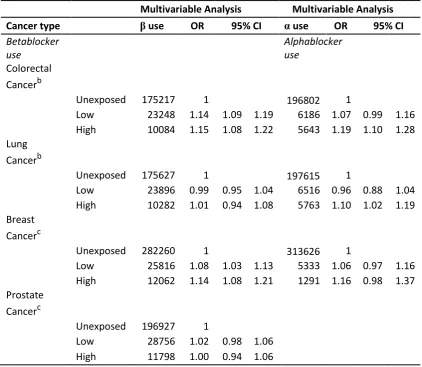
Analysis by dose
We found no clear evidence of differences in cancer risk with variations in dose. Though
point estimates did vary by dose, changes were small and confidence intervals
overlapped. Further details of adrenergic blocker use by dose are shown below (Table
3)
Analysis of duration in those with prolonged data
We found no significant effects on cancer risk from regular long-term adrenergic blocker
Discussion
In this large case-control study we found no effect of betablocker exposure in the 2 year
period prior to cancer diagnosis on the risk of lung or prostate cancer and a slight
increase on the risk of colorectal and breast cancer. Alphablocker exposure showed no
effect on the risk of breast and prostate cancer and a slight increase in the risk of
colorectal cancer. Analysis by dose and long term exposure showed no clear dose or
temporal effect for adrenergic blocker use on cancer risk.
Study strengths and limitations
This study is from a large primary care database representative of the UK population
(Herrett, Thomas et al. 2010) and as data collection within the CPRD is prospective,
information bias due to recall will be minimised. In addition, we were able to adjust for a
number of important confounders including alcohol status, smoking status, BMI,
medication use and comorbidities.
A major limitation is our inability to individually validate cancer diagnoses and a potential
therefore for misclassification. However, given the previously demonstrated high levels
of specificity for diagnoses in these data i.e 99% of neoplasms (Dregan, Moller et al.
2012) we do not believe this will have greatly influenced our study.
Our analyses confirm the presence of appreciable confounding in the relationships we
have studied, but as we lack data on some potential confounders such as family history,
diet and exercise it is likely that residual confounding will remain.
Another potential limitation is missing data for confounding factors both by over the
counter medication use (primarily NSAIDS and aspirin) and by lifestyle factors with a
smaller proportion of missing data observed for smoking, alcohol and BMI cases
compared to their respective control. It is likely that these data will not be missing at
comorbidities or the frequency of physician visits. We have attempted to minimise this
potential information bias by including missing as a separate category in the analysis for
alcohol use, smoking and BMI. The potential for some information bias and likelihood of
residual confounding remains however.
Another potential bias is the possibility that those who are prescribed anti-hypertensives,
due to their increased contact with health services, are more likely to have an early
cancer diagnosed. This bias cannot be entirely overcome, but since the same
mechanism might be expected to increase prescription of other drugs used for similar
indications we analysed calcium channel blockers. The results of the effect of calcium
blockers were similar to those of betablockers and as these have different mechanisms
of action it is unlikely the results seen in betablocker use reflect the effect of the drug but
instead suggests bias by healthcare seeking behaviour.
Our primary analysis restricted the assessment of adrenergic blocker use to the
presence of 2 prescriptions within 2 years. It is possible that these criteria did not
adequately reflect exposure as we have no data on adherence to treatment and results
could instead represent low dose of adrenergic drug use. We therefore analysed the
dose of adrenergic blocker use. Since minimal effects were seen with varying dose, we
do not think that these issues are likely to invalidate our primary analysis.
Furthermore, it is possible that the time window of 2 years represents insufficiently
prolonged exposure to see a therapeutic effect on the occurrence of cancer, and a longer
exposure period may be required. We therefore examined the effect of a longer duration
of exposure in a subset of subjects that had up to 10 years of data prior to diagnosis or
pseudo diagnosis date. These results did not alter our effect estimates and as a result
we believe that a longer duration of adrenergic blocker exposure does not have a greater
effect on the risk of cancer.
Previous studies have examined betablocker use and the incidence of colorectal
(Friedman, Udaltsova et al. 2011; Jansen, Below et al. 2012) prostate (Perron, Bairati et
al. 2004; Ronquist, Rodríguez et al. 2004; Rodriguez, Jacobs et al. 2009; Friedman,
Udaltsova et al. 2011) breast (González-Pérez, Ronquist et al. 2004; Fryzek, Poulsen
et al. 2006; Friedman, Udaltsova et al. 2011) lung (Friedman, Udaltsova et al. 2011) and
all cancers (Algazi, Plu-Bureau et al. 2006; Friedman, Udaltsova et al. 2011; Hallas,
Christensen et al. 2012).
Some studies such as the matched case-control studies by Perron et al, utilised large
clinical databases (Perron, Bairati et al. 2004) showing a reduced incidence of prostate
cancer on betablocker exposure 0.86 [0.77-0.96] but only adjusted for the confounding
factors of age, sex, aspirin use and recent medical contacts which differed from the
results of our study.
Other studies considered betablocker use and cancer risk in sub-group analyses only
and it is likely that these studies were underpowered to detect significant effects
(González-Pérez, Ronquist et al. 2004; Fryzek, Poulsen et al. 2006; Rodriguez, Jacobs
et al. 2009). For instance, a nested case-control study by Gonazalez-Perez et al on
antihypertensive use and breast cancer risk (González-Pérez, Ronquist et al. 2004)
started with 3708 cases and 20000 controls but to examine adrenergic blocker use,
duration of use was split into current use, past and no use and this resulted in a
population of cases and controls with very small numbers for some levels of drug
exposure. Results showed no statistically significant difference in breast cancer
incidence for those patients on beta and alpha blocker use and differ from the results of
our study on betablocker use (González-Pérez, Ronquist et al. 2004).
The most convincing evidence from large population based studies was a case-control
study by Ronquist et al in 2004 (Ronquist, Rodríguez et al. 2004), conducted using the
CPRD database. This examined 1013 cases of prostate cancer and 10000 controls with
Results showed no statistically significant difference between beta blocker users and
non-users with an odds ratio of 0.8 [0.6-1.0] for current use and 1.1 [0.9-1.4] for past use
compared to non-use and for alpha blocker use an odds ratio of 3.6 [2.8-4.6] for current
use and 1.1 [0.8-1.7] for past use compared to non-use. As we have used the same data
source, though a larger and more recent version of it than in this study, it is reassuring
that we find similar results. We have however expanded upon this study by including
cancers of the breast, bowel and lung and within this investigated the dose and duration
of use as well as the indication of use and can therefore provide more extensive
information on the effect of adrenergic blocker exposure on the risk of cancer.
Interpretation
In this study we find no effect in some cancers or a weakly positive association of
adrenergic blockade in others, contrary to what might be expected based on evidence
from laboratory studies. It is possible that a higher concentration of adrenergic blockers
than that prescribed for cardiovascular indications are needed to reproduce the
pro-apoptotic effects observed in these laboratory models. Also, several preclinical studies
propose that downstream beta adrenergic effects are mediated mainly by the β2 or β3
adrenergic receptors (E, M et al. 2006; Thaker, Han et al. 2006). As β1-selective beta
blockers are more commonly prescribed for cardiovascular therapy, we were unable to
look at the non-selective beta blocker subgroup for a beneficial effect. However, results
are not strongly significant in any cancer under study and it is possible that the slight
increase in cancer risk observed in some cancers and the associated small effect sizes
represent residual confounding due to the limited or lack of data on potential confounders
Conclusion
To our knowledge, this is the most comprehensive study to date of the effect of alpha
and beta blocker use on the incidence of common cancers in the UK. We found no
significant association between adrenergic blocker use and a reduced incidence of
cancer and our finding of no consistent dose-response, temporal relationship or
specificity of effect (compared to calcium channel blockers) mean we believe it more
than likely that the slight increased risk observed in some cancers is as a result of
residual confounding. However, an effect in specific beta blocker subgroups cannot be
ruled out and further epidemiological research will require even larger epidemiological
studies or pooled data to produce statistically robust results. This study using a large
population database does not provide support for the hypothesis that adrenergic blocker
Acknowledgements
TRC and KF supervised the concept, design of the project, protocol and analysis of the project, supporting the work of BN. Support for analysis was also provided by AJW. TRC and KF participated in the creation of the initial and subsequent drafts of the paper by BN. Funding for this project was obtained from the Niger Delta Development Commission (NDDC).
References
Al-Wadei, H. A. N., M. H. Al-Wadei, et al. (2009). "Prevention of pancreatic cancer by the beta-blocker propranolol." Anti-cancer drugs 20(6): 477.
Algazi, M., G. Plu-Bureau, et al. (2006). "Is beta-blocker treatment associated with a decrease in the risk of cancer." Letters in Drug Design & Discovery 3(9): 653-661.
Ali, R., H.-C. Toh, et al. (2011). "The utility of Aspirin in Dukes C and High Risk Dukes B Colorectal cancer—The ASCOLT study: Study protocol for a randomized controlled trial." Trials 12(1): 1-8.
Benning, C. M. and N. Kyprianou (2002). "Quinazoline-derived α1-Adrenoceptor Antagonists Induce Prostate Cancer Cell Apoptosis Via an α1-Adrenoceptor-independent Action." Cancer Research 62(2): 597-602.
Card, T. R., J. Siffledeen, et al. (2014). "Are IBD patients more likely to have a prior diagnosis of irritable bowel syndrome? Report of a case-control study in the General Practice Research Database." United European Gastroenterology Journal 2(6): 505-512. Chan, A. T., S. Ogino, et al. (2009). "Aspirin use and survival after diagnosis of colorectal
cancer." JAMA: the journal of the American Medical Association 302(6): 649-658. Charlson, M. E., P. Pompei, et al. (1987). "A new method of classifying prognostic comorbidity
in longitudinal studies: Development and validation." J Chronic Dis 40(5): 373-383. Dregan, A., H. Moller, et al. (2012). "Validity of cancer diagnosis in a primary care database
compared with linked cancer registrations in England. Population-based cohort study." Cancer Epidemiology 36(5): 425-429.
Drell IV, T., J. Joseph, et al. (2003). "Effects of neurotransmitters on the chemokinesis and chemotaxis of MDA-MB-468 human breast carcinoma cells." Breast Cancer Research and Treatment 80(1): 63-70.
E, L., M. M, et al. (2006). "NNK activates ERK1/2 and CREB/ATF-1 via β-1-AR and EGFR signaling in human lung adenocarcinoma and small airway epithelial cells." International Journal of Cancer 119(7): 1547-1552.
Foster, H. E., M. Yono, et al. (2004). "Effects of chronic administration of doxazosin on α< sub> 1</sub>-adrenoceptors in the rat prostate " The Journal of urology 172(6): 2465-2470. Friedman, G. D., N. Udaltsova, et al. (2011). "Norepinephrine antagonists and cancer risk."
International Journal of Cancer 128(3): 736-738.
Fryzek, J., A. Poulsen, et al. (2006). "A Cohort Study of Antihypertensive Medication Use and Breast Cancer Among Danish Women." Breast Cancer Research and Treatment 97(3): 231-236.
Fuchsmann, C., M. Quintal, et al. (2011). "Propranolol as first-line treatment of head and neck hemangiomas." Archives of Otolaryngology–Head & Neck Surgery 137(5): 471-478. González-Pérez, A., G. Ronquist, et al. (2004). "Breast cancer incidence and use of
antihypertensive medication in women." Pharmacoepidemiology and Drug Safety 13(8): 581-585.
Hallas, J., R. Christensen, et al. (2012). "Long term use of drugs affecting the renin-angiotensin system and the risk of cancer: a population-based case-control study." British Journal of Clinical Pharmacology 74(1): 180-188.
Herrett, E., S. L. Thomas, et al. (2010). "Validation and validity of diagnoses in the General Practice Research Database: a systematic review." British Journal of Clinical Pharmacology 69(1): 4-14.
Hui, H., M. A. Fernando, et al. (2008). "The α1-adrenergic receptor antagonist doxazosin inhibits EGFR and NF-κB signalling to induce breast cancer cell apoptosis." European Journal of Cancer 44(1): 160-166.
Khan, N. F., S. E. Harrison, et al. (2010). "Validity of diagnostic coding within the General Practice Research Database: a systematic review." The British Journal of General Practice 60(572): e128.
Lang, K., T. L. Drell IV, et al. (2004). "Induction of a metastatogenic tumor cell type by neurotransmitters and its pharmacological inhibition by established drugs." International Journal of Cancer 112(2): 231-238.
Masur, K., B. Niggemann, et al. (2001). "Norepinephrine-induced migration of SW 480 colon carcinoma cells is inhibited by β-blockers." Cancer Research 61(7): 2866-2869. Palm, D., K. Lang, et al. (2006). "The norepinephrine-driven metastasis development of PC-3
human prostate cancer cells in BALB/c nude mice is inhibited by β-blockers." International Journal of Cancer 118(11): 2744-2749.
Pasquier, E., N. Andre, et al. (2013). "Reply: Comment on ‘Beta-blockers increase response to chemotherapy via direct anti-tumour and anti-angiogenic mechanisms in
neuroblastoma' – β-blockers are potent anti-angiogenic and chemo-sensitising agents, rather than cytotoxic drugs." British journal of cancer 109(7): 2024-2025.
Pasquier, E., J. Ciccolini, et al. (2011). "Propranolol potentiates the anti-angiogenic effects and anti-tumor efficacy of chemotherapy agents: implication in breast cancer treatment." Oncotarget 2(10): 797.
Perron, L., I. Bairati, et al. (2004). "Antihypertensive Drug Use and The Risk of Prostate Cancer (Canada)." Cancer Causes and Control 15(6): 535-541.
Rodriguez, C., E. Jacobs, et al. (2009). "Use of blood-pressure-lowering medication and risk of prostate cancer in the Cancer Prevention Study II Nutrition Cohort." Cancer Causes and Control 20(5): 671-679.
Ronquist, G., L. A. G. Rodríguez, et al. (2004). "Association between captopril, other antihypertensive drugs and risk of prostate cancer." The Prostate 58(1): 50-56. Sakamoto, S., S. Schwarze, et al. (2011). "Anoikis Disruption of Focal Adhesion-Akt Signaling
Impairs Renal Cell Carcinoma." European Urology 59(5): 734-744.
Schuller, H. M. and B. Cole (1989). "Regulation of cell proliferation by β-adrenergjc receptors in a human lung adenocarcinoma cell line." Carcinogenesis 10(9): 1753-1755.
Sood, A. K., R. Bhatty, et al. (2006). "Stress hormone–mediated invasion of ovarian cancer cells." Clinical Cancer Research 12(2): 369-375.
Statistics, O. f. N. (2012) "Cancer Statistics Registrations, England (Series MB1) - No 42, 2011." Thaker, P. H., L. Y. Han, et al. (2006). "Chronic stress promotes tumor growth and angiogenesis
in a mouse model of ovarian carcinoma." Nature medicine 12(8): 939-944. Xu, G., R. Lv, et al. (2012). "Topical propranolol for treatment of superficial infantile
Table 1: Lifestyle factors and Indications for use of adrenergic blockers for cases and controls
Colorectalcancer Lungcancer Prostatecancer Breastcancer
Cases Controls Cases Controls Cases Controls Cases Controls N=18968 N=189667 N=19082 N=190816 N=21608 N=215959 N=29109 N=291142 Exposure % % P-value % % P-value % % P-value % % P-value Male 54.4 44.6 <0.001 57.9 45.0 <0.001
Female 45.6 55.4 42.1 55.0 Smoking status
Non-smoker 48.7 43.6 15.0 43.7 45.3 34.8 58.3 50.1
Current
smoker 14.4 13.9 <0.0001 40.7 13.8 <0.0001 12.8 15.0 <0.0001 16.3 15.7 <0.0001 Ex-smoker 32.0 22.4 41.1 22.7 37.9 30.3 20.2 16.0
missing 4.9 20.1 3.2 19.8 4.0 19.9 5.2 18.2
Alcohol status
Non-drinker 14.6 14.2 15.6 14.4 10.0 9.2 17.3 17.7
Current
drinker 68.7 56.1 <0.0001 66.3 56.4 <0.0001 75.6 60.8 <0.0001 68.0 59.1 <0.0001
Problem-drinker 2.8 1.9 5.3 1.9 2.7 2.9 1.4 0.2
missing 13.9 27.8 12.8 27.3 11.7 27.1 13.3 23.0 BMI
19-24 31.5 26.1 36.6 26.0 30.1 24.2 34.5 30.1
25-29 33.6 27.5 29.3 28.2 41.4 32.1 28.9 23.9
30-34 13.2 11.0 <0.0001 10.3 11.1 <0.0001 12.6 11.2 <0.0001 13.8 11.1 <0.0001
>35 4.8 4.4 3.6 4.5 2.7 3.0 7.3 6.4
<19 2.9 2.4 6.4 2.2 1.2 1.3 2.4 2.6
missing 14.0 28.6 13.8 28.0 12.0 28.2 13.1 25.9 Hypertension
Yes 41.5 32.1 <0.001 38.7 33.0 <0.001 41.9 32.0 <0.001 31.9 24.9 <0.001 IHD
Yes 16.4 13.4 <0.001 21.9 13.5 <0.001 19.1 18.0 <0.001 7.5 6.7 <0.001 Aspirin use
Yes 26.8 21.4 <0.001 33.1 21.7 <0.001 30.2 25.7 <0.001 14.2 11.9 <0.001 Statin use
Yes 27.7 20.1 <0.001 31.5 21.0 <0.001 31.0 24.5 <0.001 16.4 13.1 <0.001 Charlson Index
0 42.2 57.8 27.1 57.3 46.3 54.5 59.8 68.8
1 18.8 18.6 <0.0001 22.6 18.5 <0.0001 20.8 19.5 <0.0001 17.1 16.8 <0.0001 2 39.0 23.6 50.3 24.2 32.9 26.0 23.1 14.4
BPH Yes 7.9 4.8 <0.001 7.8 4.9 <0.001 30.6 11.3 <0.001
Table 2: Association of alpha and betablockers with cancer
Univariate Analysis Multivariable Analysis
Cancer type
Exposure
status Cases Controls Odds ratio 95% CI Odds ratio 95% CI
Betablocker use
n % n % Lower Upper Lower Upper
Colorectal Cancera Unexposed 15,080 79.5 160,137 84.4 1 1
Exposed 3,888 20.5 29,530 15.6 1.398 1.347 1.451 1.137 1.094 1.181
Lung Cancera Unexposed 15,551 81.5 160,076 83.9 1 1
Exposed 3,531 18.5 30,740 16.1 1.182 1.138 1.229 0.994 0.955 1.035
Prostate Cancerb Unexposed 17,237 79.8 179,690 83.2 1 1
Exposed 4,371 20.2 36,269 16.8 1.256 1.213 1.301 1.013 0.978 1.050
Breast Cancerb Unexposed 24,895 85.5 257,365 88.4 1 1
Exposed 4,214 14.5 33,777 11.6 1.290 1.246 1.335 1.097 1.059 1.137
Alphablocker use
Colorectal Cancera Unexposed 17,438 91.9 179,364 94.6 1 1
Exposed 1,530 8.1 10,303 5.4 1.527 1.444 1.615 1.129 1.067 1.196
Lung Cancerc Unexposed 17,460 91.5 180,155 94.4 1 1
Exposed 1,622 8.5 10,661 5.6 1.570 1.487 1.658 1.028 0.970 1.090
Breast Cancerd Unexposed 28,333 97.3 285,293 98.0 1 1
Exposed 776 2.7 5,849 2.0 1.336 1.238 1.441 1.080 0.999 1.167
Abbreviations: CI=confidence interval a Adjusted for gender, age and smoking bAdjusted for age and smoking
Table 3: Dose of alpha and betablocker exposurea
Multivariable Analysis Multivariable Analysis
Cancer type β use OR 95% CI α use OR 95% CI
Betablocker use Alphablocker use Colorectal Cancerb
Unexposed 175217 1 196802 1
Low 23248 1.14 1.09 1.19 6186 1.07 0.99 1.16 High 10084 1.15 1.08 1.22 5643 1.19 1.10 1.28 Lung
Cancerb
Unexposed 175627 1 197615 1
Low 23896 0.99 0.95 1.04 6516 0.96 0.88 1.04 High 10282 1.01 0.94 1.08 5763 1.10 1.02 1.19 Breast
Cancerc
Unexposed 282260 1 313626 1
Low 25816 1.08 1.03 1.13 5333 1.06 0.97 1.16 High 12062 1.14 1.08 1.21 1291 1.16 0.98 1.37 Prostate
Cancerc
Unexposed 196927 1
Low 28756 1.02 0.98 1.06
High 11798 1.00 0.94 1.06
a
Dose was missing for 0.04% of betablocker use for all cancers
Dose was missing for 0.002% of alphablocker use in colorectal and lung cancer and 0.0003% in breast cancer
b
Adjusted for gender, age and smoking c
Table 4: Long-term betablocker and alphablocker exposure
Betablocker use
Multivariable Analysis
Cancer type Exposure Cases Controls Multivariable 95% CI Breast Cancer Unexposed 7,904 63,988 1
≥10yr 536 3,512 1.101 1.000 1.211
Colorectal Cancer Unexposed 5,211 41,318 1
≥10yr 516 3,290 1.071 0.971 1.182
Lung Cancer Unexposed 5,283 41,659 1
≥10yr 449 3,456 0.860 0.771 0.959
Prostate Cancer Unexposed 6,148 48,739 1
≥10yr 602 3,955 1.011 0.924 1.107
Alphablocker use Breast Cancer Unexposed 10,310 80,906 1
≥10yr 44 218 1.390 1.003 1.925
Colorectal Cancer Unexposed 6,617 51,888 1
≥10yr 55 326 0.953 0.712 1.275
Lung Cancer Unexposed 6,636 52,505 1
Supplementary Table 1: Demographic characteristics of cancer cases and controls
Cases Controls
Cancer n % n %
Colorectal
Total 18968 189667
Age
18-39 217 1.2 2,190 1.2
40-49 756 4.0 7,571 4.0
50-59 2,323 12.2 23,217 12.2
60-69 4,722 24.9 47,190 24.9
70-79 6,317 33.3 63,167 33.3
80 and above 4,633 24.4 46,332 24.4 Lung
Total 19082 190816
Age
18-39 111 0.6 1,110 0.6
40-49 483 2.5 4,842 2.5
50-59 2,189 11.5 21,885 11.5
60-69 5,093 26.7 50,959 26.7
70-79 7,008 36.7 70,061 36.7
80 and above 4,198 22.0 41,959 22.0 Prostate
Total 21608 215959
Age
18-39 19 0.1 190 0.1
40-49 159 0.7 1,589 0.7
50-59 2,022 9.4 20,225 9.4
60-69 6,589 30.5 65,883 30.5
70-79 8,246 38.2 82,328 38.1
80 and above 4,573 21.1 45,744 21.2 Breast*
Total 29109 291142
Age
18-39 1,267 4.3 12,669 4.4
40-49 4,305 14.8 43,069 14.8
50-59 7,385 25.4 73,912 25.4
60-69 7,262 24.9 72,598 24.9
70-79 4,876 16.8 48,779 16.8
Supplementary Table 2: Association of calcium channel blockers with cancer
Univariate
Analysis
Multivariable Analysis Cancer
type Cases Controls
Odds
ratio 95% CI
Odds
ratio 95% CI
Calcium
blocker use
n % n % Lower Upper Lower Upper Colorectal
Cancera 15,230 80 161,169 85 1 1 3,738 20 28,498 15 1.388 1.336 1.442 1.107 1.065 1.151 Lung
Cancerb 14,842 78 161,184 85 1 1 4,240 22 29,632 15 1.554 1.499 1.611 1.037 0.997 1.079 Prostate
Cancerc 16,824 78 179,779 83 1 1 4,784 22 36,180 17 1.413 1.366 1.462 1.141 1.102 1.181 Breast
Cancerd 25,423 87 261,863 90 1 1 3,686 13 29,279 10 1.297 1.25 1.345 1.073 1.03 1.118 a Adjusted for gender, age and smoking
b Adjusted for gender, age, smoking and
charlsonscore
c Adjusted for age and smoking