Koutsouras, P., Martindale, S. and Crabtree, A. (2017): The Ludic Takes Work. In: Proceedings of 15th European Conference on Computer-Supported Cooperative Work - Exploratory Papers, Reports of the European Society for Socially Embedded Technologies (ISSN 2510-2591), DOI: 8
The Ludic Takes Work
Panagiotis Koutsouras
*, Sarah Martindale
†, Andy Crabtree
* * The Mixed Reality Laboratory† Horizon Digital Economy Research
{panagiotis.koutsouras; sarah.martindale; andy.crabtree}@nottingham.ac.uk
Abstract. Games that revolve around user-generated content have been explored mainly from a ludic perspective, leaving the work practices that are entailed in content production underexplored. What we argue in this paper is that there is an underlying economy in Minecraft’s community, which plays a significant role in the game’s current form. Our ethnographic fieldwork revealed the various aspects of the work of producing in-game content, by teasing out the discrete segments of the arc of work of commissioning, creating and delivering a Minecraft map. The infrastructure this work relies on is fragmented though, with the various accountability systems in place being appropriations by the players themselves. This raises a number of design implications related to how members coordinate tasks and articulate their work.
Introduction
involved is glossed over. Hence, the phenomena that comprise it are yet to be explicated.
This is the main motivation for this paper: unpacking what is it that players actually do when it comes to game content production. Our focus is mainly on the articulation process and the coordination practices that are employed by the members in doing cooperative work. Towards that end, we draw upon our longitudinal ethnographic study of Minecraft’s commissioning market. In order to reflect on the complexity of the articulation process, this paper provides a high-level overview of the key practices and activities involved in it. In doing so, we tease out the various segments of the arc of work of creating and commissioning a Minecraft map.
The main contributions of this paper constitute the accountability systems employed by individuals and teams in order to articulate the work they do in-game. Even though our focal point is indeed Minecraft, we believe that this understanding enriches our existing knowledge of the work of creating content both in Minecraft and similar platforms. In addition to that, it contributes valuable design implications regarding co-creation in distributed settings.
Related Work
A number of studies have pointed out the importance of sharing opinions and experiences as part of the process of developing content in co-creation platforms. For instance, Ames and Burrell’s micro-sociological study of play in Minecraft (2017) revealed that players exchange online resources as a means of learning how to play the game and progressing in it. These arguments are also supported by Freeman (2016), whose work explores the collaborative aspects entailed in developing independent video games via another co-creation setting; the online development platform Orange Adventure Game Maker. Their findings suggest that collaborating, in the forms of knowledge exchange between members coupled with testing each other’s games, is an integral aspect of developing games through this platform.
Parallel to that, efforts of improving collaboration in Minecraft have also been undertaken through the implementation of tools that monitor in-game actions (Müller et al. 2015) or motivating players to work together towards achieving in-game goals (Wendel et al. 2013). Interestingly, the former use a classification system for in-game collaboration in an effort to measure how often specific collaborative practices occur.
such as the importance of team management, planning, use of distributed resources, and task distribution. Along the same lines, the KidCraft project constitutes another approach to learning what these platforms can offer us in terms of design (Walsh et al. 2015). The researchers found out that being able to communicate with others was a valuable asset to the players, especially due to the distributed nature of the setting. In addition to that, a number of collaborative aspects emerged, ranging from asking technical questions regarding in-game building, to the distribution of tasks towards the completion of a common project.
The overarching theme that connects most – if not all – of these works is collaboration; content (co-)creation in collocated or distributed settings turns upon collaboration. Regardless of the fact that some key organisational matters are indeed pointed out in the literature, the work of creating UGC in Minecraft is not explicated. Whilst not everyone works at Minecraft in this way, this commissioning market plays a significant role in developing and sustaining the game and facilitates the play of many (Koutsouras et al. 2016). What we present in the following sections of this paper is an original perspective on this matter; a
Straussian analysis of the job of commissioning a Minecraft map. In doing so, we elaborate on its arc of work (and its segmentation), offering an initial understanding of what is involved in creating and commissioning in-game content in Minecraft.
Methodology
The approach adopted for addressing the research problem presented in this paper was ethnographic fieldwork, which lasted 2 years. Overall, we attended to a multitude of in-game building sessions, where we observed 12 members doing their work online. We also interviewed 16 players, enquiring about their work and how it is socially organised across the variety of groups that they are involved in. A key aspect in our fieldwork was developing vulgar competence in the work of commissioning a Minecraft map. Towards that goal, the first author formed a daily routine of visiting Minecraft fora, checking the Twitter feed of many professional Minecraft content creators and talking informally with our participants on matters relevant to commissioning and creating Minecraft content. He also spent some time playing the game and understanding its mechanisms. On top of that, he engaged in the community by attending an online Minecraft convention that was used for promotional purposes by various professional Minecraft players. Lastly, he underwent a training session by one of our participants, during which he sensitised himself to the basics of creating content in the game and using the same tools as members do.
hours) recordings; field notes of what was discussed and done by the members; pictures of resources that were used across the various practices involved in commissioning the product; and online material that members use for disseminating their work, promoting themselves, and networking with each other.
The main analytic lens this work draws upon is Strauss’ take on the division of labour (1985). Strauss proposed that the focal point of exploring a work setting should not be merely how manpower is distributed towards the completion of the work, but rather what the work is and how it is articulated. The analysis of the gathered material focused on explicating the articulation process, with our main aim being to map out the arc of work; the sequential or concurrent arrangement of all the tasks that are involved in the commission and the creation of the product (the Minecraft map – discussed below) (Strauss 1985). The arc itself comprises of discrete segments, each of which encapsulates a number of activities and tasks that are necessary for creating and delivering the product. To address that, we drew upon Crabtree et al.’s (2012) “horizontal and vertical slicing” of the data; a representation of the sequential order of the practices and activities that are being done in a setting towards the accomplishment of the work that is at play.
The analysis further focused on teasing out the bespoke accountability systems that are adopted by the members while coordinating work across the division of labour. These systems constitute the resources members use for tracking the progress of and accounting for their work to those that they cooperate with.
Introduction to the Field Site
Minecraft is a videogame, the gameplay of which revolves around the idea of mining materials from its fully-interactive game world and using said materials for crafting purposes (creating items, tools, weapons, etc.). Whilst these activities were available to the players almost from the game’s release, its most popular characteristic is its openness to be modified and offer new and unique gaming experiences. Minecraft modifications constitute alternative versions of the original game, which run on servers and constitute new games by themselves (which members refer to as “mini-games”) and have their own rules and mechanics.
mini-games they offer to their subscribers. The demand for such specialised maps was one of the factors that led to the emergence of the commissioning market.
Figure 1 An example of a Minecraft map
These characteristics (Minecraft servers’ role in the community and the product in the market) constitute the premises of the field site of this study. In the subsequent section, we provide a brief description of the work of creating and commissioning Minecraft maps.
Findings: The Arc of Work and its Segments
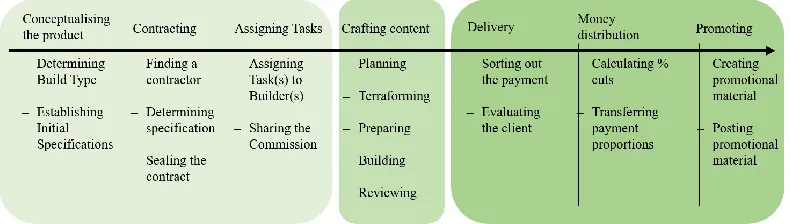
The arc of work (Figure 2) constitutes of 7 distinct segments, which are categorised into 3 groups: the practices that precede crafting; crafting in-game content; and those that succeed it. In the following sections we touch upon each one of these matters1, by elaborating on: what is it about; the activities involved in articulating the work; what is achieved in each of them; and the involved actors.
Figure 2. The arc of work of commissioning a Minecraft map.
[image:5.594.100.495.519.631.2]
Conceptualising the product
This is the first segment in the arc of work and is solely carried out by the clients. The main goal of this practice is to develop a concept that reflects what the clients want their commissioned product to be. The outcome of this conceptualisation phase is either an initial understanding of what the build should be, or a document with a variety of information related to the commission. The activities it turns upon are: determining build type and establishing initial specifications of the build.
Determining build type: Clients (server owners that run modified versions of
Minecraft) first determine what build is lacking from their servers. Depending on whether they want to update the content of existing games, or introduce new ones, clients commission the creation of relevant maps that meet the gameplay affordances of said games. This is usually done on a periodic basis, or when a new server is about to launch.
Establishing initial specifications: These details usually range from the
build’s functional characteristics (elements that relate to the gameplay affordances the build has to accommodate) to aesthetic and stylistic aspects (how the build should look). A number of resources come into play when composing the concept. One common way of accounting for the specifications is via text: clients put together a document with the build’s specific characteristics, such as its size (measured in Minecraft blocks, e.g. 150x150 blocks) and the gameplay elements that need to be incorporated (e.g. the inclusion of specified areas necessary for playing). In addition to that, clients might use referential material (images and other visual assets) in order to convey the aesthetic characteristics the build should have.
Regardless of the detail that is put into it, the concept is not conclusive. Once devised, clients further discuss it with the contractors in order to solidify the exact characteristics of the build, which is part of the subsequent segment of the arc:
contracting.
Contracting
This practice constitutes the second segment of the overall arc of work and takes place between the clients and the contractors. It is occasioned by the former, who already have an initial product concept in mind. What is accomplished through this practice is the establishment of the exact details of the build under commission and the sealing of the contract between the two involved parties.
Finding a contractor: Clients first attend to finding a contractor, which they
market; Skype. When it comes to new contractors though, clients employ a number of criteria for choosing which ones to contact: the positive feedback the latter have received from previous clients (which is posted on the dedicated forum thread each contractor has) and their portfolio (images that showcase the work they delivered in the past – usually posted by the contractors in their forum threads, or in their personal websites). Contractors who have received positive feedback and showcase a rich and high-quality portfolio are the ones that are favoured by the clients.
Determining commission details: The most crucial part of contracting is
establishing the specificationsfor the commission, which is achieved through the collaborative effort of both the clients and the contractors. Doing so turns upon them collaboratively discussing the details related to the build and trying to reach a mutual agreement about what needs to be created in the game. The matters that are discussed during this process are related to the product concept; the functional and the aesthetic details of the build; its size; the time frame in which it has to be created and delivered back to them; and its price. Information provided by the clients are typically abstract and lacking in detail, as they may not include crucial particulars regarding the construction of the build (such as its size and the exact aesthetic characteristics that need to be implemented). This occasions the contractors’ further enquiry, who prod the client to give more details towards solidifying their originally vague idea about the build they want to commission. As was the case in conceptualising the product, referential materials also come into play during contracting, as resources that convey what the clients like.
Sealing the contract: Before agreeing to undertake the commission, the
contractors attend to two distinct tasks: they ask for a down-payment (a proportion of the final payment); and they consult a record of all the clients that have scammed professional Minecraft builders in the past. This “blacklist” is a shared resource between many members of the commissioning market, which is regularly updated with the names and the Skype and Minecraft handles of clients who have refused to pay contractors upon receiving the commissioned build.
When this latter activity is completed, trust is established between the two involved parties and the contract is “sealed.” The contractors then acquire ownership of the commission and assign it to the prospective builder(s).
Assigning tasks
Upon establishing the commission’s specification and sealing the contract, contractors need to find the appropriate builder(s) to assign the job to. Therefore,
Assigning tasks to builders: In the context of a team, this activity is carried out by the team leader. The criteria for assigning a job to a builder revolve around their expertise and availability. This decision is made depending on the specifications of the commission; if the job demands a specific skillset for its accomplishment, then the team leader delegates it to an expert in working on that particular build type (e.g. trees). Keeping track of who is available or not turns upon the use of distributed resources, such as documents that are stored in online repositories and account for who is working on what. Project management tools, such as Trello2, are also used. Trello’s case is specifically interesting, as all the relevant details of a commission are uploaded on the software and are accessible to those that are assigned to it. Hence, it becomes a means not only for keeping track of the availability of the builders, but also for handing over the specifications of the commission.
Sharing the commission: Freelancers manage this job in a different manner.
Given the duality of their role (being both the contractor and potentially the builder of their own commissions), it is possible that they assign the job to themselves. In the contingent scenario of not having the relevant skillset for a job or the time to carry it out, they outsource it to another builder. This takes place either through Minecraft unions, or by scouting the creative community for expert builders in that particular type of work (a process that shares many commonalities with the scouting clients do while contracting a job). By being a member of a union, freelancers can freely publish the job and its specifications to the shared repository that is used by the union (such as a shared Trello account). Through that, all union members have access to a list of the available jobs. Any union member can then claim the job as their own and start working on it. Upon doing so, the claimant becomes responsible for building and delivering the job back to the contractor. Claiming a job takes place on a first-come-first-served basis and both the available and the claimed jobs are visible to the entirety of the union through Trello.
Crafting content
This is the actual work of creating Minecraft content that can be then played by others. The builders are the actors that are mostly involved in this practice. Occasionally, however, the contractors and the clients participate in it, especially during the reviewing stage. The activities it is comprised of are: planning; terraforming; preparing for in-game building; building; and reviewing.
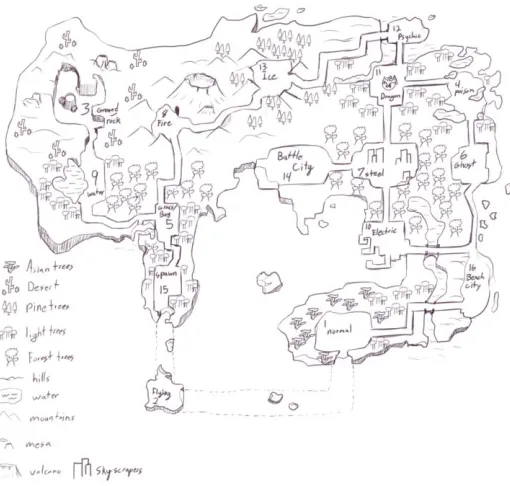
Planning: During this activity, builders flesh out a number of layouts that resemble how the build should be and what needs to be included in it (Figure 3). The production of these resources turns upon sketching through the use of physical (pen and paper) or digital (rendering software) means. Besides
accounting for the work that needs to be done, maps also act as an accountability mechanism used to showcase to the client what the plan for the project is.
Figure 3. An example of a build layout.
Terraforming: This activity only happens when the commissioned project
demands the creation of a landscape. It takes place outside of the game, through the combined use of two software tools: world machine3 and world painter4. Terraforming is usually carried out by builders who specialise in it and they perform it by making heavy use of referential material such as: real-world pictures; Minecraft creations; and YouTube tutorials of how to use the aforementioned tools. Given that these are third-party tools that are not officially supported by Minecraft, the outcome of using them needs to then be imported into the game. When it comes to projects that need it, terraforming is a vital step that has to be completed prior to in-game building. Delays in doing so might push the delivery of the entire project back.
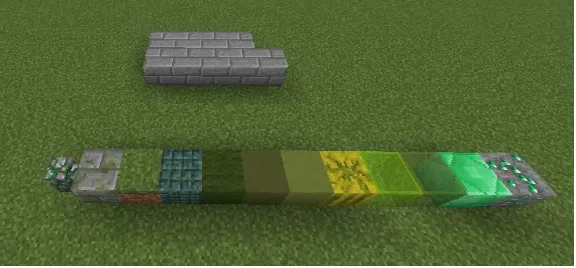
Preparing: This is the last activity before the initiation of building in-game content and it turns upon assembling in-game resources, which will be used for the work. This is the first time in the overall arc of work where the site of work becomes the game itself. These resources usually include parts of previous builds, which are re-appropriated for the needs of the ongoing commission. These parts are kept in close proximity to the building site, so that the builders have easy access to them while working on the new build. Builders also compose a material palette (Figure 4), which is comprised of the colours and the materials that they
plan on using while building. The material palette helps them in understanding whether the intended colours match with each other, but it also facilitates them having a constant reference to the materials in use during the entire building activity (which can last days or even weeks).
Figure 4 Material palette, comprised of all the green coloured blocks in the game Building: This is an iterative activity that comprises the following 4 tasks, which are performed in a sequential manner. At the end of each cycle, the piece that is produced might then become the basis for the next one. During this transition, new referential material might be introduced and incorporated into it and the material palette might be updated to match the needs of the subsequent iterations. This cycle is constantly at play during building and is repeated as many times as it takes until the final build is complete.
Although it is possible for all these activities to be successfully conducted in a sequential order, failure to accomplish the desired result in any of them might steer building towards previous steps in the overall practice.
1. Creating the skeleton of the build: The builder either creates a new piece (such as the one depicted) or they pick one out of the referential materials that were previously assembled.
2. Detailing: The builder starts working on a number of the assembled referential materials. This involves adding colour to them, combining different pieces together, and giving depth to their surfaces.
4. Integrating: The builder integrates the outcome of the previous tasks to the final build they are working on. It is also possible that they will keep a separate copy of the piece they created for future use.
[image:11.594.157.441.279.440.2]Before ending a building session, a few mechanisms for keeping track of the progress that was made and signifying future work might be employed. One such method that we became aware of was using colour-coded blocks that indicate ongoing work (Figure 5). By using this annotation system, members of the team could identify the work that was conducted during their absence and pick up from where team members had previously left off.
Figure 5. Colour-coded blocks used for indicating future work.
Reviewing: Snippets of the work are occasionally reviewed by the clients in
order to be reassured about its progress. Being a formal activity, those that usually come into contact with the clients are the owners of the commission (the contractors) instead of the builders. There are two reported methods for
reviewing; clients are either invited in the world of the game to take a look at the progress of the build, or they receive representative snapshots of the work. However, the former method is avoided when collaborating with new clients, as there is always the potential danger of them using a modification tool for downloading the build without the contractors’ consent. This constitutes an act of
scamming, as the clients acquire the work they commissioned without paying the contractors for their services.
Delivery
The tripartite practices that take place after the product is complete are initiated by delivering the commission to the client. The builder’s last responsibility is to hand the map to the contractor by exporting it from the game and saving it as a distinct digital file. This file is then relayed from the contractor to the client, only when a couple of safety measures are taken: sorting out the payment; and evaluating the client.
Sorting out the payment: Due to the possibility of scamming, payment is handled by intermediaries, such as PayPal or independent bodies that serve as an escrow-system. In the former case, the contractor sends an invoice for the services they have provided to the client and asks for the pre-specified amount of money. Upon being paid, the contractor relays the product to the client, but keeps proof of said delivery in case the latter tries to scam them by requesting a charge-back via PayPal due to unreceived services.
The escrow-system functions on a similar manner. The independent body that handles the transaction receives both the payment (from the client’s side) and the product (from the contractor’s side) and relays them to their respective receiver. That way, neither the clients nor the contractors have to worry about being scammed by each other. However, the organisation that handles the transaction keeps a small percentage fee for the services provided.
Evaluating the client: This activity takes place only when the client proves to
be malicious and scams the contractor. We already mentioned the existence of a shared blacklist. In case of being scammed, contractors update said blacklist by attaching the details relevant to the client and the scam, such as: their Skype and Minecraft handle; the pseudonyms they use in different fora; the business they are running; and a description of the scam (what happened and how it happened). Additionally, scammed contractors usually tweet about those who scammed them.
Money distribution
At this point in the arc of work, any exchange with the client is completed and what remains is for all the parties involved in content creation to acquire their share of the payment and for the contractors to update their social network profiles (as discussed below). Distributing the money depends on the type of contractor and how the assigning of tasks took place.
project. In order to keep track of the builders’ involvement in the project and divide the payment fairly, some team leaders keep records of the work that each individual builder conducted (such as, the hours they spent working on the build, the number of buildings they created for a project, etc.).
In the case where the commission is outsourced to another builder (through an intermediary organisation, such as a union, or by directly coming in contact with them via scouting), the contractor relays the amount of money that corresponds to the amount of work that the builder conducted. If, for instance, the builder undertook the entirety of the commission, then the salary they would receive at the end of the job would be the total amount of money that was initially agreed upon between the contractor and the client. On the other hand, if only parts of the commission were outsourced, then the builder would receive a reward proportionate to the work they put in.
Promoting
The last activity in the arc of work revolves around updating the resources the contractors use for promoting their services. Whilst the contractors are the main actors that partake in this activity, the job of creating promotional material might be outsourced to experts. At the end of this practice, contractors post said material on the various social networks they have a presence in.
Creating promotional material: Even though the simplest of the promotional
[image:13.594.111.484.532.713.2]materials are in-game pictures of the created builds, these resources are rarely used for promotional purposes. Instead, contractors prefer to have renders of the in-game builds made for them prior to uploading them to their websites or forum threads. These renders constitute polished up versions of the same build, with the inclusion of special effects and decorative elements (Figure 6). The creation of these resources is outsourced to members that specialise in the use of rendering software, such as Photoshop or 3D Blender.
Posting promotional material: The information that contractors include when
uploading the promotional material to their designated profiles aim at presenting the quality of the services they have provided to existing clients. As such, they attach a description of the work (pictures of the build, what it is going to be used for, what it constitutes of, etc.), who was involved in its creation (the handles of the Minecraft builders, and the name of the team that was behind it), as well as details related to the clients themselves (name and IP address of the server they are running). As such, the practice of promoting does not just benefit contractors, but also the builders (they are accredited for their work and their name is associated with high-quality builds), as well as the clients (the information that can give access to their servers – the IP address – is exhibited and made available to the players).
Discussion
What we explore in this paper is the underlying economy behind Minecraft’s content generation practices. Our main argument revolves around the fact that the
ludic aspects of the game mask the existence of a hidden economy that leads to the production of the content gameplay turns upon. Our fieldwork revealed “the work to make the Minecraft economy work”: a distributed setting, with both the actors that do the work and the systems that are employed towards its accomplishment being geographically dispersed. The spatial distribution of the work occasions the need for coordination between the actors and the activities entailed in commissioning and building a Minecraft map.
As becomes evident in our findings, this hidden economy is based on a fragmented infrastructure; even though the game platform provides the affordances for doing in-game building, it does not support a wide variety of activities and tasks that are crucial parts of the arc of work at play. To tackle this problem, members have to employ a number of bespoke accountability systems towards accomplishing the work and its articulation. Effectively, Minecraft players bootstrap the infrastructure for doing their work by appropriating existing tools or even developing their own. This is reflected on the existence of multiple sites of work, which extend the borders of the game. Minecraft is indeed one of these sites, which accommodates the conduct of the keystone activity in the arc: that of building content. The rest of the segments though are carried out in sites external to the game, such as: Trello, Skype group chats, Minecraft fora, and Google.
This opens up a variety of design implications as to what coordination turns upon in this context. Coordination tasks and the accountability systems they rely on are as follows:
Establishing specifications: All the resources that are relevant to the
amongst the parties involved. This is achieved by having them stored in online repositories (such as Dropbox and Trello) and granting access to those that are responsible for working on the commission.
Managing distribution of tasks: Knowing who is assigned to which job and
which jobs are available turns upon the use of productivity tools (such as Trello) and formal online documentation (Excel spreadsheets and Google Docs). The information stored in them accounts for the availability of the builders, as well as for the work they have conducted in big, multifaceted projects. This is in tandem with handling payments, as percentage cuts are calculated based on the builders’ involvement in each project.
Accounting for progress:Plans and pictures are the two main resources used
by the builders for providing an account of their work and their progress in a project. These resources are created by them and are shared either with their colleagues, or with the contractors they are working for.
Taking precautions against scamming: Due to the possibility of being
scammed, contractors use intermediaries for handling payments. In the process of handing the product to the clients, they keep proof of delivery (screenshots or emails of the transactions) as an evidence of the provision of service. Another accountability mechanism that comes into play here is that of a distributed blacklist, which is collaboratively maintained by a number of Minecraft content creators.
Promoting: Contractors make their professional presence visible to clients by
using pictures and renders of the commissioned product as promotional materials. These materials account for the work contractors and builders have already done, but also for the type and quality of products they are capable of delivering. Receiving feedback by other members for this material and for the services provided also accounts for their professionalism and is a resource used by the clients while scouting the community for contractors.
We believe that this level of understanding is vital when it comes to design for supporting collaboration in Minecraft or similar games, or even online co-creation platforms.
Conclusions
What is presented in this paper is a high-level overview of the arc of work of creating and commissioning a Minecraft map. Our fieldwork revealed the existence of an underlying commissioning market that is part of Minecraft’s community and plays a significant role in the game’s social organisation. It was also uncovered that the infrastructure of this market is fragmented and geographically dispersed. As such, members adopt – or even create – bespoke accountability systems for coordinating and articulating the division of labour across the arc. This fragmentation hints to a number of design considerations that revolve around the main coordination tasks that are necessary for doing the work.
Future work
Whilst we touch upon all 7 of the segments that comprise the arc of work and tease out the main accountability systems that are employed in the articulation process, what is missing is the lived work of creating and commissioning a Minecraft map. To put it in other words, we only talk about what is done, but we do not elaborate on how each of the segments of the arc are brought about. Explicating the social organisation of the entire arc of work constitutes our main goal and motivation for future research.
Acknowledgments
References
Ames, M. G. and Burrell, J. (2017): “‘Connected Learning’ and the Equity Agenda: A Microsociology of Minecraft Play,” in Computer Supported Cooperative Work (CSCW) 2017. Portland, OR, USA. doi:10.1145/2998181.2998318.
Banks, J, and Potts, J. (2010): “Co-Creating Games: A Co-Evolutionary Analysis,” New Media & Society, vol. 12, no. 2, January 28 2010, pp. 253-270.
Crabtree, A., Rouncefield, M. and Tolmie, P. (2012): Doing Design Ethnography.
Human-Computer Interaction. London: Springer.
Guo, F. (2016): “Making Games as Collaborative Social Experiences: Exploring An Online Gaming Community,” in Proceedings of the 19th ACM Conference on Computer Supported Cooperative Work and Social Computing Companion - CSCW ’16 Companion, 265–68. New York, New York, USA: ACM Press. doi:10.1145/2818052.2869076.
French, D. J., Stone, B., Nysetvold, T. T., Hepworth, A. and Red, W. E. (2016): “Collaborative Design Principles From Minecraft With Applications to Multi-User Computer-Aided Design,” Journal of Computing and Information Science in Engineering, vol. 16, no. 2, May 3 2016. doi:10.1115/1.4032667.
Koutsouras, P., Martindale, S. and Crabtree, A. (2016): “‘We Don’t Sell Blocks:’ Exploring Minecraft’s Commissioning Market,” in DiGRA & FDG First Joint International Conference 2016. Dundee.
Müller, S., Frey, S., Kapadia, M., Klingler, S., Mann, R. P., Solenthaler, B., Sumner, R. W. and Gross. M. (2015): “HEAPCRAFT: Quantifying and Predicting Collaboration in Minecraft,” in Proceedings, The Eleventh AAAI Conference on Artificial Intelligence and Interactive Digital Entertainment. Santa Cruz.
Nardi, B., Pearce, C. and Ellis, J. (2008): “Productive Play: Beyond Binaries.”
Artifact, vol. 2, no. 2, 2008, pp. 60–68.
Ross, J., Holmes, O. and Tomlinson, B. (2012): “" Playing with Genre: User-Generated Game Design in LittleBigPlanet 2.” LUCI Report 2012-003. Strauss, A. (1985): “Work and the Division of Labor.” The Sociological
Quarterly, vol. 26, no. 1, 1985, pp. 1–19.
Walsh, G., Donahue, C. and Rhodes, E. E. (2015): “KidCraft,” in Proceedings of the 33rd Annual ACM Conference Extended Abstracts on Human Factors in Computing Systems - CHI EA ’15, 1205–10. New York, New York, USA: ACM Press. doi:10.1145/2702613.2732921.
Wendel, V., Gutjahr, M. and Battenberg, P. (2013): “Designing a Collaborative Serious Game for Team Building Using Minecraft,” in Proceedings of the European Conference on Games Based Learning.