Embedding simulation technologies in business
processes.
LAU, Ruby Wai Chung.
Available from Sheffield Hallam University Research Archive (SHURA) at:
http://shura.shu.ac.uk/19944/
This document is the author deposited version. You are advised to consult the publisher's version if you wish to cite from it.
Published version
LAU, Ruby Wai Chung. (2007). Embedding simulation technologies in business processes. Masters, Sheffield Hallam University (United Kingdom)..
Copyright and re-use policy
See http://shura.shu.ac.uk/information.html
Halfam University
ffR! f itrvlces
v Campus
1 1 1WB S g S S S H H B B B i
ProQuest Number: 10697250
All rights reserved
INFORMATION TO ALL USERS
The quality of this reproduction is dependent upon the quality of the copy submitted.
In the unlikely event that the author did not send a com plete manuscript and there are missing pages, these will be noted. Also, if material had to be removed,
a note will indicate the deletion.
uest
ProQuest 10697250
Published by ProQuest LLC(2017). Copyright of the Dissertation is held by the Author.
All rights reserved.
This work is protected against unauthorized copying under Title 17, United States C ode Microform Edition © ProQuest LLC.
ProQuest LLC.
789 East Eisenhower Parkway P.O. Box 1346
Embedding Simulation Technologies in Business Processes
Ruby Wai Chung, LAU
A thesis submitted in partial fulfilment o f the requirem ents o f Sheffield Hallam University
for the degree o f M aster o f Philosophy
Abstract
The need to fully integrate simulation as a daily tool has been subject to much attention
over the past few years, however little research has previously contributed to this area.
This study examines the development of systematic guidelines to enable companies to
strategically implement simulation as a mainstream technology within their businesses.
An extensive review of the literature was conducted in order to investigate the reasons
behind the limited use of simulation and to establish the failure and success factors of
companies implementing new technology. The importance of knowledge management
in developing simulation technology was also investigated. Additionally, a
questionnaire survey was conducted to examine the ways in which simulation
technology has been used and developed within different companies. Furthermore, a
case study was conducted in order to understand and investigate the processes of
implementing simulation in a real organisation.
Subsequently, an easy-to-follow framework for enabling companies to embed
simulation technologies into their business processes was developed. This framework
comprises five key stages, namely: Foundation, Introduction, Infrastructure,
Deployment and Embedding. Each stage provides a best practice approach to guide
companies in achieving every objective of that stage. Adjustments to the framework
were made in the validation and reliability section to reduce any limitations.
In creating a relevant and workable framework, this study has contributed significantly
Acknowledgements
This work was conducted at Sheffield Hallam University in the UK, between October 2005 and July 2007. Throughout this period I have received countless support and help from many people, to all of whom I would like to express my sincere gratitude.
First of all, I would like to express special thanks to my project supervisor, Prof Terrence Perera, for his excellent supervision and continuous encouragement to develop this dissertation into its present form.
I would like to express my deepest gratitude to Mr David Hodgson and the people I met during my six-month research period at Caterpillar Peterlee Ltd. Thank you David for being always willing to help, for being so patient with me and for your advice and useful comments on my study.
I wish to also make a special mention to Mr. Edwin Valentine, for his helpful advice and information.
Contents
Page
Title Page i
Abstract ii
Acknowledgements iii
Contents iv
List of tables and figures viii
Chapter 1 INTRODUCTION 1
1.1. Introduction 1
1.2. Current status of simulation 2
1.3. Why a guideline is important 3
1.4. Purpose of the study 4
1.5. Aim and objectives 5
1.5.1. Conduct a literature survey to review current practices and to
identify success factors 5
1.5.2. Conduct a questionnaire survey and case study with analysis to identify the key reasons behind limited implementation of
simulation technology in industry 5
1.5.3. Develop a systematic approach to embed simulation in business processes by synthesizing information collated from
the above exercises 6
1.5.4. Conduct validation process to the proposed framework 6
1.5.5. Evaluate comments and suggestions from the validation 6
1.6. Thesis structure 7
Chapter 2 LITERATURE REVIEW 10
2.1. Introduction 11
2.2. Benefits of simulation technologies 12
2.3. Simulation application areas 13
2.4. Increased use of simulation but only in a piecemeal fashion 15
2.5. Embedded simulation into business processes 18
2.5.2. The changing role of simulation 19
2.6. Integrating new technologies into business processes 20
2.6.1. How companies integrated new technologies into business
processes 20
2.6.2. Main failure for integrating new technologies into business 25
2.7. Knowledge management in embedding new knowledge 27
2.7.1. How to implement KM to help embed new knowledge into 29
business processes
2.8. Framework to guide embedding simulation technologies into business
processes 29
2.8.1. Direction of the framework 29
2.9. Summary 33
Chapter 3 METHODOLOGY 34
3.1. Introduction 35
3.2. Research process 36
3.3. Research methodology 37
3.4. Research design 38
3.4.1. Quantitative - Questionnaire Survey 3 8
3.4.1.1. Layout and Sections 39
3.4.1.2. Issues considered in questionnaire design 40
3.4.1.3. Pretest of questionnaire 40
3.4.1.4. Statistical analysis 41
3.4.2. Qualitative - case study 42
Chapter 4 FINDINGS AND OUTCOMES 44
4.1. Introduction 45
4.1.1. Section 1 - Sample classification 46
4.1.2. Survey results 48
4.1.2.1. Section 2 - Introduction and exploration of potential use 48
4.1.2.2. Section 3 - Pilot project/first experience 52
4.1.2.3. Section 4 - Infrastructure and communication 56
4.2. Qualitative study 67
4.2.1. Case study introduction 67
4.2.2. Questionnaire survey with CAT 68
4.2.2.1.Survey Results and analysis 68
4.2.2.2. Summary of the survey outcomes 71
4.2.3. Work conducted in CAT 71
4.2.4. Learning outcomes 80
4.3. Summary of best practices 81
Chapter 5 PROPOSED FRAMEWORK 83
5.1. Introduction 84
5.2. Key concepts 85
5.2.1. Easy to follow 85
5.2.2. Generic and holistic 86
5.2.3. Overcome main challenges 87
5.2.4. Include best practices 87
5.3. Overview of the proposed framework 88
5.4. Stage 1 - Foundation 89
5.4.1. Input elements 89
5.4.2. Output elements 91
5.5. Stage 2 - Introduction 92
5.5.1. Input elements 92
5.5.2. Output elements 93
5.6. Stage 3- Infrastructure 95
5.6.1. Input elements 95
5.6.2. Output elements 96
5.7. Stage 4 - Deployment 97
5.7.1. Input elements 97
5.7.2. Output elements 98
5.8. Stage 5 - Embedding 100
5.8.1. Input elements 100
5.8.2. Output elements 102
Chapter 6 FRAMEWORK - Validation and best approach 106
6.1. Introduction 107
6.2. Analysis and results 107
6.3. Modification to the proposed framework 110
Chapter 7 CONCLUSIONS AND FUTURE WORK 111
7.1. Conclusions 112
7.2. Contribution to knowledge 112
7.3. Recommendations for future work 113
7.3.1. Validating the framework in a case study format 114
7.3.2. Further review of the proposed framework 114
REFERENCES 115
BIBLIOGRAPHY 121
Appendix A: Questionnaire Survey Sample 122
Appendix B: Caterpillar - Questionnaire Survey Sample 129
Appendix C: Validation Form Sample 132
Figure 1.1:
Figure 2.1:
Table 2.1:
Figure 2.2:
Figure 2.3:
Figure 2.4:
Table 2.2:
Table 2.3:
Figure 3.1:
Table 4.1:
Figure 4.1:
Figure 4.2:
Figure 4.3:
Figure 4.4:
Figure 4.5:
Figure 4.6:
Figure 4.7:
Figure 4.8:
List of Tables and Figures
Overview of thesis structure
Structure of Chapter 2
Simulation success stories summarised into six main application areas
Main steps to implement ERP in MANCO
Steps in implementing E-commerce
Key failures of integrating new technologies
Summary of three main challenges towards the integration use of simulation
Incorporation of People, Technological, and Organisational dimension with the “best practices” of the used of simulation
Overview of research process
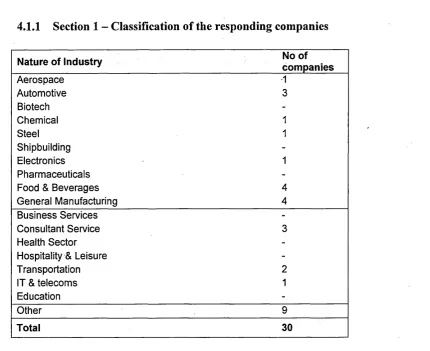
Total number of responses based on each industrial nature
Number of responding companies classified by their size and experience in simulation
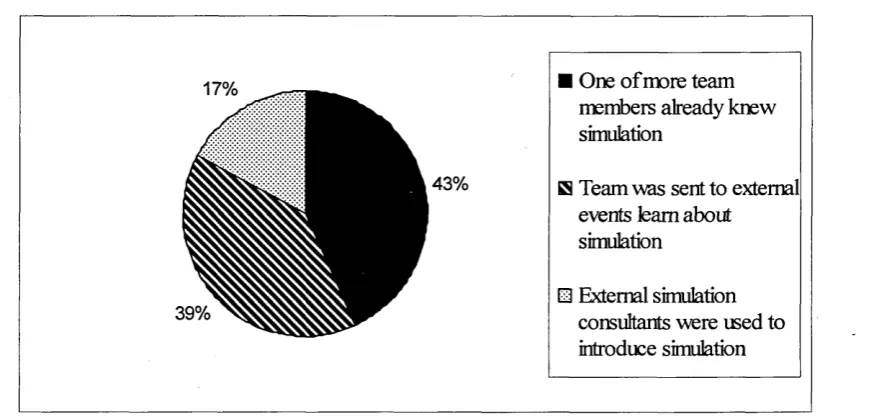
Percentage on the ways simulation introduced to responding companies
Percentage on how simulation team developed simulation knowledge
Percentage of the choice of responding companies to use either internal team or external consultants for introducing simulation
Rank of importance of the identified objectives in the introduction and exploration stage
Percentage on the actions to continue the use of simulation after the introduction stage
Scope of pilot project/first experience
Table 4.2:
Figure 4.9:
Figure 4.10:
Figure 4.11:
Figure 4.12:
Figure 4.13:
Figure 4.14:
Figure 4.15:
Figure 4.16:
Figure 4.17:
Figure 4.18:
Figure 4.19:
Figure 4.20:
Figure 4.21:
Figure 4.22:
Table 4.3:
Figure 4.23:
Figure 4.24:
Figure 4.25:
Figure 4.26:
Figure 4.27:
Figure 4.28:
Average of ranks of the challenges during the first simulation project by responding companies
Percentage of the satisfaction and related actions after pilot project/first experience
Mechanisms to spread out simulation
Acceptance from business units about simulation
Percentage on the use of internal team and external consultants on model building process
Percentage of the interactions between the team and problem owners
Figure to show the way of communication between model builders and problem owners
Percentage of training has been provided to the core simulation team
Number of simulation projects which had completed within the last 12 months
Data input methods on simulation model
Data output methods on simulation model
Companies which had developed customised simulation model templates/obj ects
The percentage of the responding companies re-utilise existing model
Ranking of simulation project information that usually documented
Statistic on responding companies to have strategy to further develop the use of simulation
Classification of the respondents
Understanding of the term “simulation”
Percentage of respondents with previous experience in simulation
Issues of simulation that respondents want to learn/know more
Rear Chassis Robot process simulation model
Customised Excel spreadsheet for model data input
Figure 4.29:
Figure 4.30:
Figure 4.31:
Figure 4.32:
Table 4.4:
Figure 5.1:
Figure 5.2:
Table 5.1:
Table 5.2:
Table 5.3:
Table 5.4:
Table 5.5:
Figure Dl:
Figure D2:
Figure D3:
Figure D4:
Table Dl:
Customised Excel spreadsheet for simulation experiment data
Customised Excel spreadsheet for model data input including shift patterns
Animation of the Tank Production Line simulation
Animation of the generation III - new assembly line
Best practices of embedding simulation technologies into business processes which identified from literature review, qualitative and quantitative studies
Comparative assessment of emphasis on the key concepts' contribution to framework development
Overview of the proposed framework
Best practices in foundation stage
Best practices in introduction stage
Best practices in infrastructure stage
Best practices in deployment stage
Best practices in embedding stage
Analysis of key concepts of proposed framework
Analysis of the proposed framework - First level
Analysis of the proposed framework - Second level: Input elements - best practices
Analysis of the proposed framework - Third level: Output elements - objectives
CHAPTER 1
INTRODUCTION
1.1 Introduction
Increasing competition, accelerating technological change and new modes of
competition are forcing manufacturing companies to change their business and
manufacturing processes in order to improve product quality, and reduce production
costs and lead times. The reality is that business and manufacturing processes rely on
complex interactions between random events, human behaviour and changing technical
resources, therefore, mathematical methods are no longer robust enough to predict and
analyse these processes.
Discrete-event simulation (hereafter referred to as "simulation”) is a superior alternative
which supports the analysis of dynamic systems through its ability to model random
activities and capture the behaviour of both human and technical resources. Additionally,
simulation models can be easily modified to. follow changes in the real system, which
can be used to understand the behaviour of a system, predict system performance, and
select the best solution from a range of alternatives.
A wide range of other sectors are increasingly using simulation for analysis of queuing
systems, such as hospital patient management systems, call centre systems and
vehicular traffic management systems. Simulation applications and its benefits are
1.2 Current status in simulation
To succeed with simulation technical skills alone are not sufficient. Sadowski and
Sturrock (2006) discuss several issues which can affect the success of a simulation
project. As business situations and problems become more complex, simulation studies
can be easily misguided by too ambitious or ill-defined objectives. Additionally,
assessing the right level of detail to support a project goal is always a challenge.
Therefore, Sadowski and Sturrock suggest keeping simulation models simple; a full
understanding of the target system/process can be critical. Furthermore, Sadowski and
Sturrock state another important issue with simulation is the “data” - either too little
data or too much data can be dangerous. McLean and Leong (2001) consider the
challenge of the data format, which can involve high costs incurred by re-entering data
or reformatting data between simulation and other manufacturing software applications.
Various authors have endeavoured to consider this area and the concept of
“standardisation” (Ingemnasson, Ylipaa and Bolmsjo, 2005; McLean et ah, 2003; Holst,
2001).
Additionally, several authors have considered the long-term benefits of implementing
simulation as a strategic tool (Murphy and Perera, 2002; Holst, 2001). However, a
review of the literature indicated that there is little evidence to support simulation as a
strategic tool. In fact, simulation is still used on a one-shot basis or as a stand-alone tool,
which is typically used to address very specific problems in isolation. In most situations
outside consultants are engaged to develop simulation-based solutions, or project teams
are disbanded after specific objectives are met, therefore this hinders the strategic use of
1.3 Why an operating guideline is important
A survey conducted by Holst (2001) recognises the need to address the problems of * 1
simulation used on a one-shot basis and suggests a guideline is essential to help
companies adopt simulation and increase their level of simulation integration. Just like
most new technologies, successful cases studies on implementing new technologies are
always followed by a strategic approach. Several benefits of adopting a strategic
approach as a guideline to implement new technologies are identified by Lientz and
Bennet (2000). These are:
• more easily understood by management;
• always linked with business goals;
• greater acceptance from staff;
1.4 Purpose of the study
If companies wish to reap the full benefit of this versatile and powerful technology, it is
vital to embed simulation technologies into their business processes. Once embedded,
the use of simulation would no longer be driven by individuals and enthusiasts. Instead,
potential deployments would be identified and directed by business processes, enabling
companies to utilise simulation as a strategic decision support tool.
However, embedding simulation into business processes should follow a systematic
approach. For example, appropriate infrastructure and internal expertise need to be built
gradually to embed simulation into the business process. The main aim of this study is
to develop a framework to embed simulation into business processes. The proposed
framework will enable companies to develop a holistic and well-structured strategy that
can assist in the adoption and implementation of simulation as a mainstream technology
^ r ' —
1.5 Aim and objectives
The aim of this study is to develop a framework to enable companies to embed simulation technologies into their business processes. This aim will be accomplished through the following five objectives:
1.5.1 Conduct a literature survey to review current practices and to identify success factors
An extensive literature survey will be conducted to identify the current practices in industry. This will attempt to identify the key drivers when companies elect to implant simulation, then how simulation solutions are developed and finally will determine the problems and difficulties companies have encountered during implementation. It will also attempt to identify why simulation projects sometimes fail and examine how companies manage the knowledge gained through simulation projects.
1.5.2 Conduct a questionnaire survey and case study with analysis to identify the key reasons behind limited implementation of simulation technology in industry
V^llUj-/ IV! X AXXVA
1.5.3 Develop a systematic approach to embed simulation in business processes by synthesizing information collated from the above exercises
Data collected from the above exercises will be used to build a systematic approach
towards embedding simulation technologies into business processes. All important
stages such as introduction, integration, deployment, embedding and knowledge
management will be covered (further stages may be identified during the research
program). Each stage will be carefully analysed to develop the best possible strategies.
It is expected that this approach can present a best framework to guide companies to
embed simulation technologies into business processes.
1.5.4 Conduct validation process to the proposed framework
Validation will be conducted with the aim of collecting comments about the validity and
reliability of the proposed framework. This validation exercise will seek comments
from academic and industrial parties who have experience in simulation. A validation
form will be designed to collect feedback from this team of experts.
1.5.5 Evaluate comments and suggestions from the validation
Comments and suggestions collected from the validation will be evaluated and
discussed. Then, necessary modifications will be made to the initial framework in order
to finalise a best framework, which can guide companies to embed simulation
1.6 Thesis Structure
This chapter places the research in context and describes the motivation for the study, it
is followed by a description of the problem area, a summary of the objectives of the
study and the structure of the thesis.
A literature review is conducted in Chapter 2, which aims to examine current practices
and problems concerning the use of simulation in various industrial sectors. The second
part of Chapter 2 provides documented evidence of the success and failure factors of
implementing new technologies into business, identifying the best approaches. In
addition, the importance of knowledge management as a success factor in embedding
simulation into business processes is discussed in the final part of the chapter.
Chapter 3 first provides an overview of the research processes then identifies and
describes the motivation and benefits of the methodology used in this study. Finally, the
design issues relating to the quantitative and qualitative research methods are discussed.
The outcome and findings of the collected data from the quantitative and qualitative
studies are presented in Chapter 4. A summary of the best approaches to embed
simulation into business processes is presented at the end of the chapter, which will
Chapter 5 develops a framework to guide companies in the embedding of simulation
into business processes. The structure of the proposed framework will be presented and
each stage of this framework will be discussed in more detail in each sub-section. Then,
this proposed framework will be presented to target populations from both academic
and industrial fields in order to collect adjustments on the validity and reliability of the
framework.
Finally, Chapter 6 will examine and discuss the results from the validation. Then,
necessary changes will be made, finalising a best practice framework, which can help
companies to embed simulation technologies into business processes through a
systematic approach.
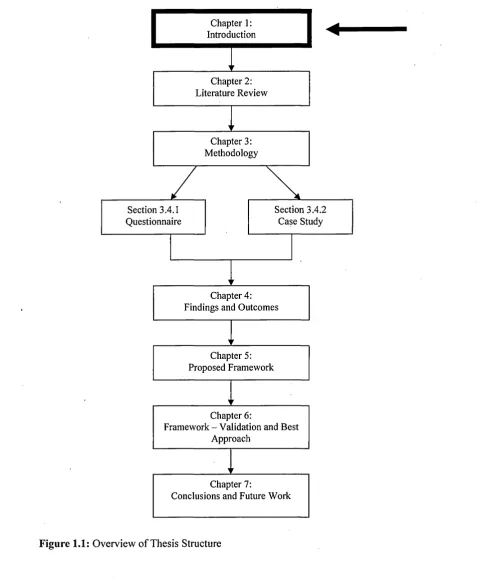
The structure of this thesis is illustrated in Figure 1. The chapters are shown in boxes,
where the chapter under review is highlighted. For example in figure 1, "Introduction"
Chapter 1: Introduction
Section 3.4.1
Questionnaire Section 3.4.2Case Study
Chapter 5: Proposed Framework
Chapter 3: Methodology
Chapter 4: Findings and Outcomes
Chapter 2: Literature Review
Chapter 6:
Framework - Validation and Best Approach
Chapter 7:
[image:22.613.59.542.62.649.2]Conclusions and Future Work
CHAPTER 2: LITERATURE REVIEW
Chapter 1 : Introduction
Chapter 2: Literature Review
Chapter 3: Methodology
Section 3.4.1 Section 3.4.2
Questionnaire Case Study
Chapter 5: Proposed Framework
Chapter 4: Findings and Outcomes
Chapter 6:
Framework - Validation and Best Approach
Chapter 7:
CHAPTER 2 LITERATURE REVIEW
2.1 Introduction
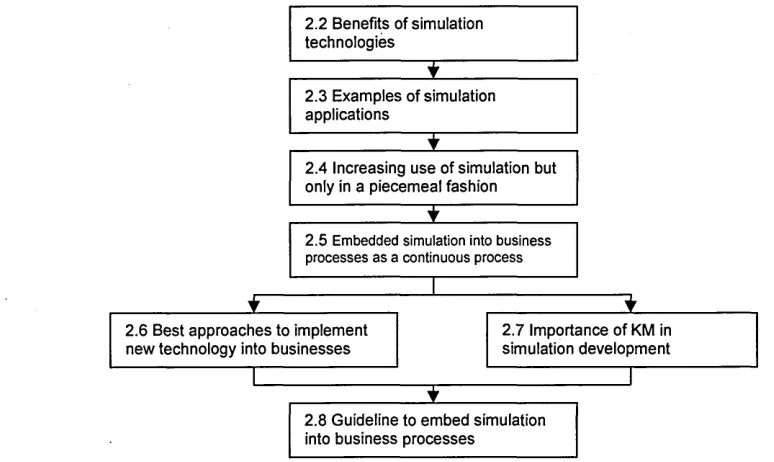
Firstly, this chapter examines the ways in which simulation has been used to address a
variety of business problems and issues, which is followed by examples of simulation
applications undertaken by different industries. Additionally, this chapter provides an
insight into the reasons behind the fact that simulation is increasingly used by industries
but only in a piecemeal fashion, which inspired the main focus of this study - companies
have to embed simulation into their business processes, in order to reap the full benefit
of this technology. A few examples of companies that have attempted to embed
simulation into their business processes are also presented.
The second part of this chapter provides case study reviews on the approaches of
implementing new technologies - some successful, some not so. Furthermore, this
chapter discusses why management of simulation knowledge is important, and
highlights the main benefit of applying Knowledge Management (KM) as a process to
maintain simulation knowledge in an organisation.
Finally, this chapter reviews relevant research regarding the integration of simulation
technologies and highlights the critical directions which need to be considered while
developing a framework to help companies embed simulation technology into business
2.7 Importance of KM in simulation developm ent 2.4 Increasing use of simulation but
only in a piecem eal fashion
2.8 Guideline to em bed simulation into business processes
2.6 Best approaches to implement new technology into businesses
2.2 Benefits of simulation technologies
2.3 Exam ples of simulation applications
[image:25.615.79.466.44.275.2]2 .5 Embedded simulation into business processes as a continuous process
Figure 2.1: Structure of Chapter 2
2.2 Benefits of simulation technologies
Simulation has the ability to capture dynamics, variability, complexity and
interconnectivity of business processes, which allows "what-if' analysis to be
performed before changing a real system, therefore, it becomes a very useful decision
making tool for industries (Robinson, 2003). Many benefits from the use of simulation
are evident from recent literature (Hlupic et dl. 2005; Holst, 2001). One of the main
benefits is the ability to simulate and analyse alternative changes in business processes
prior to implementation. Since real changes can be risky and costly for businesses, with
simulation models, effects from the changes can be tested in a more cost-effective way
(Hlupic et al. 2005). According to Holst (2001), the benefit of the use of simulation is
remarkable for manufacturing industries, such as significantly improving system
knowledge, speeding up production ramp-up time, shortening development lead time,
increasing utilisation or productivity, and supporting decision-making throughout an
_____
2.3 Simulation application areas
To understand how simulation can be used to model a wide range of business processes,
it is important to reference example applications. In fact, there are a number of potential
areas for simulation application. Kellner et al (1999) categorised them into six main
areas (i.e. strategic management; planning; control and operational management;
process improvement and technology adoption; understanding; training and learning).
Murphy and Perera (2002) investigated manufacturing processes in more detail and
defined a set of simulation application areas as follows:
• Product/assembly design;
• Physical prototyping;
• Tooling/equipment design;
• Product manufacturing;
• Product assembly;
• Human operations and tasks;
• Machine/robotic programming;
• Facility planning;
• Facility system planning;
• Training.
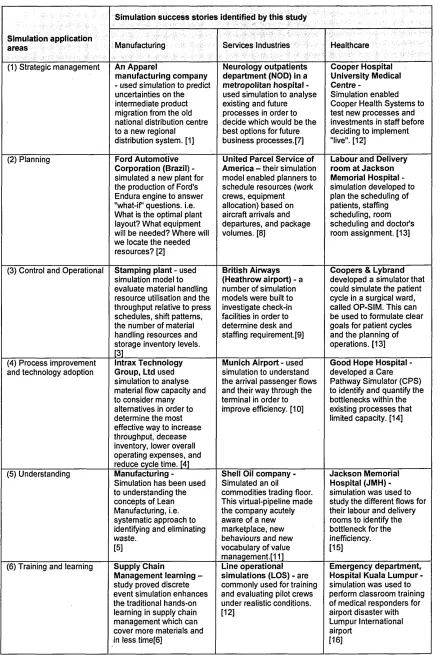
Based on the six simulation application areas categorised by Kellner et al (1999),
Table 2.1 reviews case studies about successful simulation applications and categorises
them based on each of these application areas within three main industries (i.e.
Sim ulation application a re a s
Sim ulation s u c c e s s sto rie s identified by th is stu d y
Manufacturing Services Industries Healthcare
(1) Strategic m anagem ent An A pparel
m an ufacturing com pany - used simulation to predict uncertainties on the intermediate product migration from the old national distribution centre to a new regional distribution system . [1]
N eurology o u tp atien ts d ep artm en t (NOD) in a m etropolitan h o sp ital -used simulation to analyse existing and future processes in order to decide which would be the best options for future business processes.[7]
C o o p er H ospital U niversity M edical C entre
-Simulation enabled C ooper Health System s to test new p ro cesses and investm ents in staff before deciding to implement "live". [12]
(2) Planning Ford A utom otive C orporation (Brazil) -simulated a new plant for the production of Ford's Endura engine to answ er "what-if questions, i.e. W hat is the optimal plant layout? W hat equipm ent will be needed? W here will we locate the needed resources? [2]
U nited Parcel S ervice of A m erica - their simulation model enabled planners to schedule resources (work crews, equipm ent allocation) based on aircraft arrivals and departures, and package volumes. [8]
L abour a n d Delivery room a t Ja c k so n M emorial H ospital -simulation developed to plan the scheduling of patients, staffing scheduling, room scheduling and doctor's room assignm ent. [13]
(3) Control and Operational S tam ping plant - used simulation model to evaluate material handling resource utilisation and the throughput relative to press schedules, shift patterns, the num ber of material handling resources and storage inventory levels. [3]
B ritish Airways (H eathrow airport) - a num ber of simulation m odels were built to investigate check-in facilities in order to determ ine desk and staffing requirement.[9]
C o o p ers & Lybrand developed a simulator that could sim ulate the patient cycle in a surgical ward, called OP-SIM. This can be used to formulate clear goals for patient cycles and the planning of operations. [13]
(4) Process improvement
and technology adoption Intrax T echnology G roup, Ltd used simulation to analyse material flow capacity and to consider many alternatives in order to determine the m ost effective way to increase throughput, d ecease inventory, lower overall operating expenses, and reduce cycle time. [4]
M unich A irport - used simulation to understand the arrival passenger flows and their way through the terminal in order to improve efficiency. [10]
G ood H ope H ospital -developed a Care Pathway Simulator (CPS) to identify and quantify the bottlenecks within the existing p ro cesses that limited capacity. [14]
(5) Understanding M anufacturing -Simulation has been used to understanding the concepts of Lean Manufacturing, i.e. system atic approach to identifying and eliminating waste.
[51
Shell Oil com pany -Simulated an oil
commodities trading floor. This virtual-pipeline m ade the com pany acutely aw are of a new m arketplace, new behaviours and new vocabulary of value m anagem ent.[11]
J a c k so n M em orial H ospital (JMH) -simulation w as used to study the different flows for their labour and delivery rooms to identify the bottleneck for the inefficiency. [15]
(6) Training and learning Supply C hain
M anagem ent learning -study proved discrete event simulation enhances the traditional hands-on learning in supply chain m anagem ent which can cover more materials and in less time[6]
Line o p erational sim u latio n s (LOS) - are commonly used for training and evaluating pilot crews under realistic conditions. [12]
E m ergency d ep artm en t, H ospital K uala L um pur -simulation w as used to perform classroom training of medical responders for airport disaster with Lumpur International airport
[image:27.615.95.537.35.690.2][16]
Table 2.1: Simulation success stories summarised into six main application areas
Key to references for Table 2.1:
[2] http://www.arenasimulation.com/pdf/fiesta.pdf | [3] Williams et al. (2006) [4] http://www.arenasimulation.com/pdf/INTRAX-AP001A-EN-P.pdf (2001) | [5] Schroer (2004) | [6] Adams et al. (2005)
[7] Hlupic and de Vreede (2005) |
[8] http://www.arenasimulation.com/pdf/UPSERV-AP001A-EN-P.pdf (2001) | [9] Robinson and Stanger (1998) | [10] Fomasier (Munich airport International), (2006)| [11] Schrage (2000) pp.l84-185| [12] http://www.g-forceintemational.com/pdfs/mis.pdf [13] http://www.arenasimulation.com/pdf/OPSIM_eng.PDF
[14] Br J Healthcare Comput Info Manage (2005) [15] Peters et al. (2001)
[16] Idrose et al. (2007)
2.4 Increased use of simulation but only in a piecemeal fashion
Simulation has been widely used by different industries, for example manufacturing,
healthcare and services industries (Table 2.1). During the last three decades, the
manufacturing system has become more complex which has caused a dramatic increase
in the use of simulation to design and optimise these systems (Baldwin et al., 2005).
Additionally, with customer satisfaction now a main concern in service industries such
as banks, hospital, and call centres (Chandra and Conner, 2006), the use of simulation
models for efficient staff scheduling, minimising customer waiting time, improving
quality, and dealing effectively with constant change are obviously increasing within
these industries.
Despite the obvious increase in the use of simulation, many companies have used
simulation only in exceptional situations - few have managed to fully integrate
simulation into their business processes (Robinson and Stanger, 1998; Holst, 2001;
Jagstam and Klingstam, 2002; Greasley, 2004). Below some statements which support
this view:
"Many organisations have seen the use of simulation evolve, often in something of a
IV! ..w . .
DES (referring to simulation) is used on a one-shot basis only, troubleshooting
specific problems such as bottlenecks, usually in late stages of the manufacturing
system lifecycle, or as a stand-alone tool, both of which reflects a low level of
integration." Holst, (2001)
"Few companies have managed to make simulation a corporate norm to achieve the
ongoing, long-term benefits with using the technique...." Jagstam and Klingstam, (2002)
Holst (2001) explained the reasons for this limited use of simulation.
• First of all, there is still a low level of simulation knowledge and capability in
industry, which results in poor commitment to simulation projects.
• Secondly, companies seem to focus on costs rather than benefits (i.e. simulation is
still viewed as a high-investment tool) often depending highly on external
consultants rather than providing internal training for staff to perform this task.
• Finally, ad-hoc projects often result in poor documentation, without a good
reference, the knowledge and model concept is hard to follow and redevelop. Thus,
with limited knowledge, organisations often have difficulties in using simulation
technologies to cope with these problems within their own limits.
Hlupic (2005) also states that there is no doubt that simulation is a powerful tool for
scenario testing which can be useful in testing alternative changes before
implementation. However in practice, implementation details of new management
concepts are sometimes not fully specified during the early phase. Therefore, the idea of
the use of simulation may be abandoned as these details are not ready for performing
V / 1 1 U | 7 1 V 1 ^ •
Four main reasons for the limited use of simulation are summarised:
• Low level of simulation knowledge and capability;
• Highly dependent on external consultants, thus the cost of the simulation project
becomes expensive;
• Poor documentation in ad-hoc projects which is difficult to follow and redevelop
within the company's own limits.
• No standardised format to store data which causes difficulty when developing
simulation models.
It seems that this limited use of simulation is not so much related to the technology
itself, but that companies are not well-prepared and lack knowledge of simulation,
rendering them incapable of using this technology in a structured way and with a
holistic view with regard to business processes.
Therefore, this problem leads to the following critical aim of this thesis:
To develop a framework for embedding simulation technologies into business
processes.
The following few sections will contribute towards the stated aim of this work through
2.5 Embedding simulation into business processes
The importance of simulation integration has been noted in literature for several years
(Holst, 2000; McLean and Leong, 2001; Vemadat, 1996). According to Holst (2001), the
meaning of "Simulation Integration" is to integrate simulation from functional,
structural, hierarchical, and procedural aspects into the manufacturing system
development process. This study is concerned with Embedding simulation technologies
into business processes, where the definition "embedding simulation" means simulation
will not be only an "add on" technology to the current system, rather, it will be routinely
used in the everyday work environment. Since the concept of "embedding simulation"
is absent in the literature, a detailed literature review is provided which focuses on the
area of simulation integration in the following sub-sections.
2.5.1 Simulation integration
Vemadat [1996, p. 11] states:
“ ...it must be stressed that integration is a never-ending process. First, because it is a
goal. Second, because the enterprise is in a permanent process of change."
Vemadat suggests there is a close interrelationship between "Integration" and "Change
in business process" within an organisation - changes will never stop within companies,
therefore, integration becomes a continuous process within an organisation. There is no
doubt that simulation is a powerful tool to handle alternative changes. Therefore, this is
essential for companies integrating simulation as a continuous process within
McLean and Leong (2001) share the same view on integrated simulation; that a
continuous process is beneficial. They state that "... major long-term benefits could
result from the 'widespread and pervasive' implementation of manufacturing simulation
technology...." Here they refer to the worldwide implementation of office automation
software, i.e. word processors and spreadsheets which are fitted in the characterisation
of "widespread and pervasive". However, simulation technology is still not fitted.
Therefore, in order to implement simulation as a "widespread and pervasive" tool,
McLean and Leong suggest companies have to develop simulation models of their own
operational processes and utilise these tools routinely. Additionally, companies have to
regularly include different levels of staff in simulation projects, in order to expand
simulation awareness within companies.
2.5.2 The changing role of simulation
The majority of companies are still using simulation on a one-shot basis only, or do not
use simulation at all. It is not easy to find companies which continuously use simulation
technologies in their business processes.
Some well-known companies have attempted to integrate simulation into their business
processes. For example, the big three US based companies (General Motors Corporation,
Ford Motor Company and Chrysler Corporation) require all new and modified
manufacturing system designs to be verified by simulation analysis before they can be
approved for final equipment purchases (Ulgen, 2004). From the Boeing Company, the
before actual physical assembly" (Schrage, 2000). These examples indicate that the role
of simulation is no longer seen as an ad-hoc decision-making tool, companies are
attempting to use simulation on a more regular basis.
In fact, every company can have the ability to use simulation as a long-running strategy.
The important factor is to learn the best approach for embedding this technology into
their business processes. However, research that takes a holistic and systematic view on
how this can happen is scarce, or most researchers only focus on the application side of
the use of simulation. Thus, in order to examine a good approach for embedding
simulation technologies into business processes, the next section will first look at the
important issues when companies integrate new technologies (e.g. Enterprise Resource
Planning (ERP) system, e-commerce) for references.
2.6 Integrating new technologies into business processes
2.6.1 How companies have integrated new technologies into business processes
Today, increasing competition and tougher customer demands have led companies to
reduce time-to-market, and deal with shorter product life cycles and unpredictable
changes in volume. As a result, companies have to integrate new technologies into their
workplace in order to deal with these situations. Jessup and Valacich (2006) studied a
few companies who have experience in integrating new technologies into their business
processes. Some efforts were successful, but some were not! The section below shows a
Successful case: ERP implementation at MANCO
MANCO is a company which produces and sells air purification equipment to
commercial customers. Because of increasing customer demands, the CEO realised that
there was a need to introduce a new system to remain successful. The first question was
asked; what were the objectives for introducing a new system! Based on the objectives,
the company decided to go for Enterprise Resource Planning (ERP), a package which
can support relational databases and allow everyone to access data from different
departments. However, before implementing this new system, the CEO found that some
critical organisational changes were required which accounted for the lack of
coordination and the territorial attitudes between and within each of the company’s
departments. Without commitment of departments, the new system would not be
successfully implemented. Therefore, the CEO attempted to make the change from the
top to bottom level, which included dismissal of the three vice presidents who were
harbouring the territorial attitudes and changing the culture of the company by building
the principles of quality into the employee psyche etc. Eventually, after these initial
organisational changes, the company implemented the ERP package successfully in six
stages, which included pilot implementation and training.
Step 4: Pilot implementation and training through six stages Step 3: Initial organisational changes
Step 1: Identified objectives to implement ERP
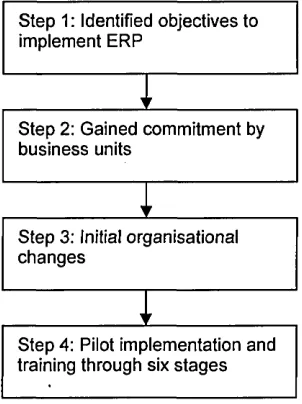
[image:34.614.218.369.489.691.2]By referring to MANCO's implementation approach, four main steps are identified in
Figure 2.2. The key success factor in this case was to define the main objective for
introducing the ERP system as a goal, then spread out and educate the organisation to fit
with this new system. Lientz and Rea (2000) also support this view, they state “it does
not make sense to implement a new technology or system and leave everything else the
same”, therefore, initial organisational change is critical in an implementation process.
However, different companies have different organisational issues, problems and
employees. The implementation plan used by MANCO may not apply to another
company. Lientz and Rea (2000) have a more holistic view on implementing new
technology and use e-commerce implementation as an example.
Step 5: Determine your technology solution
Step 7: Implement your initial e-com m erce solution Step 6: Develop your implemenation plan and budget Step 3: A ssess your business
Step 2: Form a small team
Step 8: M easure results and expand Step 1: Select a project leader
Step 4: Define your e-com m erce strategy
[image:35.615.81.402.358.611.2]Implementation plan conducted by literature
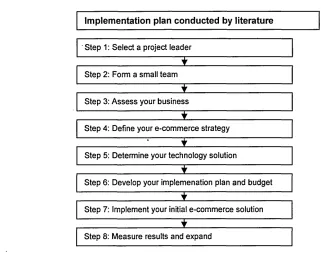
Figure 2.3 Steps in implementing E-commerce (Lientz and Rea, 2000)
Lientz and Rea (2000) state that implementing e-commerce requires a long term strategy.
They suggest an eight step plan for implementing e-commerce (Figure 2.3). Details of
• Select a project leader and form a small team
Lientz and Rea suggest that a good start is always important for implementing new
technology. They suggest that it is important to have a project leader to guide the whole
implementation process - someone who has fair knowledge of simulation technologies
and has experience of the business areas. Additionally, a team of members who can
support and provide opinions on long-term use of e-commerce is also essential - which
can include people from the IT department, marketing, other departments who may be
involved or external consultants.
• Assess your business and define your e-commerce strategy
Lientz and Rea suggest an organisation has to understand its current goal and position on
the related market then identify what competitors are offering and what leaders in
similar industries are doing. Thus, a competitive e-commerce strategy can be identified
with a right direction, scope and target.
• Determine your technology solution
Software, hardware and internet connections are important infrastructures for an e-
commerce business. Therefore, Lientz and Rea suggest reviewing and setting-up this
infrastructure at an early stage - before deploying an e-commerce system.
• Develop your implementation plan and budget
Lientz and Rea suggest an implementation plan is essential to guide the deployment
which includes different aspects - roll-out schedule, integrate e-commerce to the
business processes with necessary changes, installation and setup of the e-commerce
(2006) also support this view, they state that many companies reported that their
implementation could be more costly and time consuming than originally envisioned
due to lack of planning.
• Implement your initial e-commerce solution
Lientz and Rea explain there are few key issues to be considered during the initial roll
out, for example testing the capability of the infrastructure (i.e. load and stress testing,
monitor server response time and security), testing the web interface, modifying the
current business processes to run with e-commerce and promoting the website.
• Measure results and expand
The last step on Lientz and Rea’s implementation plan is to measure results and expand.
This is important to understand and measure the current status after the initial roll-out.
Businesses with e-commerce in particular, need to spend time to determine how
successful the website was in attracting, retaining, and growing the customer base
before further expansion so that e-commerce can be embedded into the entire business
process with more confidence.
The above implementation steps of ERP system and e-commerce are valuable
references for planning the questionnaire structure of this study which will be discussed
2.6.2 Main failure for integrating new technologies into business
Apart from the above successful plans regarding integrating new technologies, it is also
useful to look at the failure modes which have been experienced by other companies.
Figure 2.4 summarises several authors' studies on this issue (Lientz and Rea 2000, Holst
2001, Andrews and Johnson 2002, Jessup and Valacich 2006) and the fishbone diagram
is used to describe the key failures of integrating new technologies.
Failed to integrate new technologies
Relied on external consultants
Insufficient awareness of organisational issue
Failing to include the appropriate
people
Lack of training Lack of top-level
m anagem ent support
Lack of time m anagem ent Inconsistent data
formats
Failing to link IT introduction to com pany strategy
Figure 2.4. Key failures o f integrating new technologies (source: Lientz and Rea 2000, Holst 2001, Andrews and Johson 2002, Jessup and Valacich 2006)
1) Lack of top-level management support
It is critical that top-level executives understand the importance of the new technologies
or systems so that necessary resources can be supported. Otherwise, they will never
view the technologies as a priority within the organisation (Lientz and Rea 2000, Jessup
and Valacich 2006).
2) Heavily reliant on external consultants
Companies usually do not want to invest in employing specialists on-site; most of them
and the consultants are no longer there; users are often unable to deal with the system
by themselves (Andrews and Johnson 2002, Jessup and Valacich 2006).
3) Lack of training
Performance problems often arise after a new technology or system goes live, as users
do not have enough training on the new technology. Therefore, the new technology is
not able to perform effectively (Lientz and Rea 2000, Holst 2001, Jessup and Valacich
2006).
4) Failing to include the appropriate people
The end user is usually only involved in the last step of implementation; they have no
say in the whole process. Management may lose valuable opinion from this group of
users. This may also cause a problem in that users may refuse to use the new technology,
in extreme cases, this may cause conflicts and inefficiencies within the organisation
(Lientz and Rea 2000, Andrews and Johnson 2002, Jessup and Valacich 2006).
5) Inconsistent data formats
Integrated new technology can be difficult if the required data is spread in various
application systems and in inconsistent data formats (Holst 2001).
6) Lack of time management
Implementing new technology can often make a negative effect on the organisation
(rather than the intended positive effect), if the "time" is not managed well during the
implementation process. As a consequence, delay in implementation can cause a loss of
^ r
---7) Insufficient awareness of organisational issues
Business processes, individuals and departments all interact with each other within an
organisation. If they are unaware of the impact when implementing new technology, it
may affect the whole performance of an organisation (Lientz and Rea 2000).
8) Failing to link IT introduction to the company strategy
Implementing new technology without linking it to the company strategy can cause a
problem as well. Company strategy is a goal; however, new technology cannot perform
with good benefits if it does not relate to the main goal (Jessup and Valacich 2006).
2.7 Knowledge management in embedding new knowledge
When implementing Knowledge Management (KM) into new technology
implementation processes, it plays an important role in collecting new information, new
experience and new knowledge and then maintaining and sharing them within the
organisation. Liebowitz and Megbolugbe (2003) state:
"Once the critical knowledge is identified and captured, it is typically shared with
others. Those individuals then apply this knowledge and internalise it to their situation,
which in turn creates new knowledge. This 'new' knowledge is then captured, shared,
applied, and the cycle continues."
Holst (2001) states that one large Swedish manufacturer faced the problem; simulation
was introduced and began to be used by internal staff, however, once those staff left, the
company then stopped using simulation without any replacement. In addition, since
— r , —
simulation model is hard to follow and reuse. Knowledge of simulation then disappears
and awareness of simulation decreases to nothing.
Caterpillar Inc. claimed that one of the main purposes of implementing KM was to
capture the expertise of experienced workers before they left the organisation
(Ardichvili et al 2003). This reduces the risk of knowledge loss from an organisation
and keeps this "cycle" continuous. This is especially important for capturing and
maintaining knowledge from new technologies used.
2.7.1 How to implement KM to help embed new knowledge into business processes
Malhotra (2005) establishes from his studies that KM can include building databases,
measuring intellectual capital, establishing corporate libraries, building intranets,
sharing best practices, installing groupware, leading training programs, leading cultural
change and fostering collaboration by creating virtual organisations. However, it is
essential that the organisation picks the right KM tools and educates their employees in
order to be able to commit to it.
Greasley (2004) reports a company in which several stand alone simulation applications
were deployed but the company failed to utilise knowledge gained through these
projects to develop a strategic approach to implement simulation based solutions.
Therefore, if KM can implement and successfully embed, there is no doubt that it can
help the development of simulation technologies. In Chapter 5, this thesis will examine
the benefits and look at how KM can be included as one of the steps in the framework
2.8 Framework to guide embedding simulation technologies into business processes
In conclusion to the above sections, it is evident that the evolution of simulation
technologies should be changed from a one-off project fashion into a long-running
strategy approach. In order to gain the full benefits of simulation technology as
mentioned in section 2.2, the literature has shown that it is important to embed it into
business processes as a continuous strategy.
In addition, by referring to other new technologies implemented into organisations as a
long-running strategy, literature evidence was provided to support the argument that a
holistic plan is necessary to guide the implementation processes. Apart from this,
organisations have to understand and address knowledge management issues which
relate to the long-term use of simulation within an organisation.
When combining all the above critical issues from the literature, they contribute to the
objective of this study which is:
To develop a framework to embed simulation technologies into business processes.
2.8.1 Direction of the framework
Holst (2001), who has proposed a strategy for integrating simulation into the
manufacturing system development process, believes an integration plan should
emphasise two important points: (1) the view on integration as a continuous process and
(2) the need for a structured approach. According to Holst (2001), this framework for
guiding the integration has to be carefully planned and needs to be used as a continuous
This leads into a discussion on the direction of the framework. Holst (2001) examines
this point based on theoretical findings and industrial experience, then suggests three
directions:
(1) Generic as opposed to particular: the concept of simulation integration should be
applicable across a wide range of manufacturing enterprises;
(2) Holistic as opposed to reductionistic: simulation integration should consider
integration from all aspects, just as the manufacturing system and product realisation
process should be seen from all its perspectives and over its entire life cycle;
(3) Structured as opposed to ad hoc, unplanned and evolutionary courses of action:
ways of implementing simulation integration should provide stepwise, easy to
understand, easy to use, well-documented guidelines that are easily adaptable to a
specific organisation.
Jagstam and Klingstam (2000) differentiated contributory factors for embedding
simulation technologies into the business processes. They found that the main
challenges in the continuous use of simulation are technological, operational and
organisational issues. They suggest the guidelines should overcome these three main
challenges as a goal. Table 2.2 summarises the issues of the challenges in these three
main aspects.
Technological challenges • lack of simulation data ready within company
• difficult to decide whether simulation is the right tool for solving the task among management level
Operational challenges • lack of connection to the business development
processes • not easy to use
Organisational challenges • large efforts to spread simulation within the company via
education or training
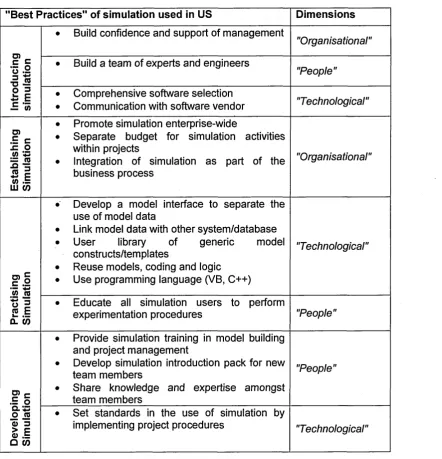
On the other hand, there are several studies suggesting best practices for the continuous
use of simulation technologies (Murphy and Perera, 2001; Williams, 2002; Holst, 2001).
Murphy and Perera (2001) examine current best practices of US companies in the use of
simulation applications. They then explain these best practices as entailing four stages:
Introducing simulation, establishing simulation, practising simulation and developing
simulation. In a study conducted by Morgan and Liker (2006) about the success of the
Toyota product development system, they built a framework with "people", "process"
and "technology" as three main elements which need to be interrelated and
interdependent, and work with organisational issues to achieve success. This interprets
the important relationship between people, process, technology and organisation.
In addition to the four stages of best practices identified by Murphy and Perera (2001);
in Table 2.3, this study will include "people dimension", "technological dimension" and
"organisational dimension" as a theoretical framework to gain a better understanding on
— - I " —
-"Best Practices" of simulation used in US Dimensions
In tr od uc in g si m ul at io n
• Build confidence and support of management
"Organisational" • Build a team of experts and engineers
"People" • Comprehensive software selection
• Communication with software vendor "Technological"
Es ta bl is hi ng Si m ul ati on
• Promote simulation enterprise-wide
• Separate budget for simulation activities within projects
• Integration of simulation as part of the business process "Organisational" Pr ac tis in g S im ul ati on i
• Develop a model interface to separate the use of model data
• Link model data with other system/database
• User library of generic model
constructs/templates
• Reuse models, coding and logic • Use programming language (VB, C++)
"Technological"
• Educate all simulation users to perform
experimentation procedures "People"
D ev el op in g S im ul ati on
• Provide simulation training in model building and project management
• Develop simulation introduction pack for new team members
• Share knowledge and expertise amongst team members
"People"
• Set standards in the use of simulation by
[image:45.614.89.532.40.500.2]implementing project procedures "Technological"
2.9 Summary
The main aim of this chapter was to review the available literature to identify the current practices of the use of simulation for only ad hoc and stand-alone projects, and to identify a need for developing a framework to overcome this situation and to embed simulation technologies into business processes as a continuous strategy. This chapter first gave an overview of the benefits on simulation, and then, through case studies, outlined successful simulation applications from manufacturing, service industries and healthcare and thereby proved the capabilities and benefits of simulation through a realistic picture. This was followed by a critical review of literature on the piecemeal fashion of simulation technologies, which concluded that it is necessary to seek to embed simulation into business processes as a continuous strategy.
By referring to the success stories of implementing other new technologies, key stages of the implementation plans were identified, which will contribute to the design of the survey's questionnaire in Chapter 3. In addition, both failure and success factors of integrating new technologies were reviewed. The literature review also considered the importance of the role of knowledge management in embedding new technology within an organisation.
CHAPTER 3: METHODOLOGY
Section 3.4.1
Questionnaire Section 3.4.2 Case Study
Chapter 1: Introduction
Chapter 2: Literature Review
Chapter 5: Proposed Framework
Chapter 4: Findings and Outcomes
Chapter 3: Methodology
Chapter 6:
Framework - Validation and Best Approach
Chapter 7:
u v i ^
CHAPTER 3 METHODOLOGY
3.1 Introduction
This chapter defines the methodology used in this study. Based on the research
objective which was identified in Chapter 2, this chapter seeks to develop and employ
the "right" research methodology so that the data collected will be "right" for
contributing to the research objective. The structure of the rest of the chapter is as
follows:
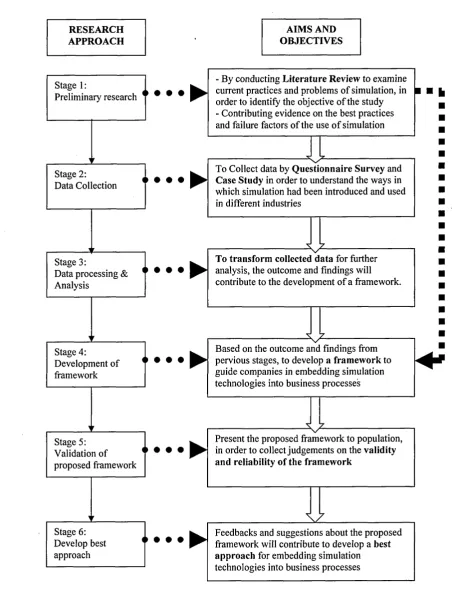
Section 3.2 - Research Process
This section describes the approach to the study and the aim and objectives of every
stage within the approach.
Section 3.3 - Research Methodology
This section defines the methodology used in the study and the motivation for the use of
a mixed methods approach.
Section 3.4 - Research Design
After identifying the reasons to use questionnaire survey and case study as the
methodology in the study, this section highlights the important issues regarding the
3.2 Research Process
RESEARCH APPROACH
Stage 6: Develop best approach Stage 1:
Preliminary research
Stage 2: Data Collection
Stage 3:
Data processing & Analysis
Stage 5: Validation of proposed framework Stage 4:
Development of framework
• • •
• • •
• • •
• • •
• • •
• •
AIMS AND OBJECTIVES
- By conducting Literature Review to examine current practices and problems of simulation, in order to identify the objective of the study - Contributing evidence on the best practices and failure factors o f the use o f simulation
■ ■ h
To Collect data by Questionnaire Survey and Case Study in order to understand the ways in which simulation had been introduced and used in different industries
Z .
To transform collected data for further analysis, the outcome and findings will contribute to the development of a framework.
Based on the outcome and findings from pervious stages, to develop a framework to guide companies in embedding simulation technologies into business processes
Present the proposed framework to population, in order to collect judgements on the validity and reliability of the framework
iz
[image:49.615.65.518.65.666.2]Feedbacks and suggestions about the proposed framework will contribute to develop a best approach for embedding simulation technologies into business processes
^ —t
---3.3 Research Methodology
Most studies are restricted to either quantitative or qualitative research method.
However this situation has changed with the emergence of the mixed methods research.
Mixed methods research is formally defined by Johnson and Onwuegbuzie (2004) as
"the class of research where the researcher mixes or combines quantitative and
qualitative research techniques, methods, approaches, concepts or language into a single
study". According to Johnson and Turner (2003), "the fundamental principle of mixed
research should collect multiple data using different strategies, approaches, and methods
in such a way that the resulting mixture or combination is likely to result in
complementary strengths and non-overlapping weaknesses." This study also intends to
collect data by mixed methods research, which includes both quantitative and
qualitative studies.
The reason for using mixed methods research in this study is to take a holistic and
systematic view to collect, identify and analyse the issues related to develop a
framework to guide companies in embedding simulation technologies into business
processes. One of the advantages of questionnaire surveys as a quantitative method is,
as Bartlett, Joe and Chadwick (2001) states, "their ability to use smaller groups of
people to make inference about larger groups that would be prohibitively expensive to
study." Therefore, questionnaire survey is identified to be the best way to collect the
majority of experiences and practices related to the introduction, development and
deployment of simulation. However, Yin (2003) comments that if "such questions deal
with operational links needing to be traced over time, rather than mere frequencies or
incidence", then qualitative methods have to be performed. Therefore, an additional
happening in a real company - decisions of why simulation was taken, how simulation was implemented and with what result.
3.4 Research design
Yin (2003, p.20) described research design with three explanations. The one that best illustrates this particular section describes research design as a "blueprint of research, dealing with at least four problems: What questions to study, what data are relevant, what data to collect, and how to analyse the results." This study uses mixed research approaches via questionnaire survey and case study to collect appropriate data to sup