NOVEL COLORIMETRIC METHOD FOR ESTIMATION OF IODATE
ION IN TABLE SALT SAMPLES
Nief Rahman Ahmed1*and Noor Mazin Ibrahim2
1
Department of Environmental Technology, College of Environmental, University of
Mosul-Iraq. 2
Department of Micro Biology, College of Science, Al-karkh University of Science, Baghdad
–Iraq.
ABSTRACT
A simple, rapid and accurate spectrophotometric method has been
developed for the determination of iodate ion using trifluoperazine.
The proposed method reports the reaction of iodate ion with
trifluoperazine in acidic medium to form a red colored product with an
absorption maximum at 500 nm. Beer’s Law was obeyed in the range
of 0.2-2.8µg/ml with molar absorptivity 4.08x10⁴ L.mol.-1. cm-1. The
relative standard deviation of the method was less than 2% and
accuracy (average recovery) was 100±1.3%. The optimum conditions
for all color development are described and the proposed method has
been successfully applied for the determination of iodate ion in table
salt samples.
KEYWORDS: Iodate, Spectrophotometric, table salt samples.
INTRODUCTION
Sodium chloride salt is expected to be one of the basic and important food materials and is an
important trace element in biology and medicine. Therefore, it is recommended to examine
the iodate content of the salt.[1] For correcting iodine deficiency. Table salts are iodized with
potassium iodate instead of potassium iodide to avoid the possible photochemical or chemical
oxidation of iodide to iodine with atmospheric oxygen (Iodate is more stable than iodide).[2]
The recommended concentration of iodine in the salt is range from 5–100 μg/g (ppm) of
iodine in salt depending on the country of manufacture and the storage conditions.[3-6] Iodine
is an essential part of the thyroid hormones that play an important role in the development of
Volume 8, Issue 4, 216-224. Research Article ISSN 2277– 7105
Article Received on 23 Jan. 2019,
Revised on 12 Feb. 2019, Accepted on 04 March 2019
DOI: 10.20959/wjpr20194-14274
*Corresponding Author
Dr. Nief Rahman Ahmed
Department of
brain function and cell growth. Iodine deficiency is one of the most commonly occurring
nutritional problems. Iodine deficiency can be caused by consumption of iodine less salt or
less iodine containing salt below the minimum.[4] Iodine deficiency can cause goitre,
cretinism, reduced of intelligence, mental retardation, brain damage, deaf-mutism, and cause
miscarriage in pregnant women. On the other hand, an excess of iodine or iodide can cause
goiter and hypothyroidism.[5,6] Therefore, determination of iodine in table salt is very
important for successful iodine supplementation. Several analytical methods, such as
spectrophotometry[7–11], indirect iodometry[12], spectrofluorometry[13,15], high performance
liquid chromatography[16–17], chemiluminescence[18], gas chromatography-mass
spectrometry[19-20], capillary zone electrophoresis[21-23], electro analytical methods[24–26], and
inductively coupled plasma mass spectrometry[27] have been reported for the determination of
iodate. In this work, we intend to develop a spectrophotometric procedure for the
determination of iodate in different table salt samples.
EXPERIMENTAL Apparatus
Spectra Uv / Visible dual beam spectrophotometer [UVS-2700, Labomed, INC] with 1.0 cm
quartz cells were used.
Reagents
All chemicals used were of analytical purity grade[Aldrich] and all solutions were prepared
in distilled water. A stock solution(100 ppm) of iodate was prepared by dissolving 0.122 g of
potassium iodate in 100 mL of water and standardized using sodium thiosulphate solution.[28]
Standard solution of iodate (10ppm). This solution was prepared by diluting 10 ml of the
stock solution to 100 ml by distilled water in a volumetric flask.
Trifluoperazine hydrochloride solution 0.1% was prepared by dissolving 0.1g of
trifluoperazine hydrochloride in 100ml distilled water in a volumetric flask.
Sulfuric acid 5M, this solution was prepared by diluting 36 ml of 18M H2SO4 solution to 100
ml by distilled water in a volumetric flask.
Recommended procedure
Aliquots of standard solution of iodate (5-70µg) were transferred into a series of 25 ml
solution, dilute the solution to the mark with distilled water. The absorbance of the
red-colored product was measured at 500 nm against a reagent blank.
Sampling Preparation
The table salt samples of different brands were purchased from local markets. 20 g of table
salt sample was transferred into a 50mL volumetric flask, and after dissolving in de ionized
water, the solution was diluted to the mark with high-purity de ionized water. and the iodate
ion content was determined as mentioned under recommended procedure.
RESULTS AND DISCUSSION
Trifluoperazine hydrochloride is oxidized in sulfuric acid medium with iodate ion solution
instantaneously at room temperature to form a red-colored product which is believed to be a
radical cation, and is irreversibly oxidized to a colorless sulfoxide with loss of electron[29], as
shown below.
The red –colored radical cat ion shows maximum absorbance at 500 nm, where the blank
Fig. (1): Absorption spectra of A- 2 µg/ ml of iodate -trifluoperazine product against blank. B-blank against distilled water.
The reaction variables were optimized by varying each variable while keeping others constant
for obtaining maximum absorbance. The oxidation reaction was found to be quantitative in
sulfuric acid medium. It was found that 0.5-3 ml of 5 M sulfuric acid solution give high
sensitivity and 1ml of this solution has been used for subsequent experiments. The effect of
the amount of trifluoperazine on the absorbance was investigated. A maximum and constant
absorbance was found with 3 to 6 ml of 0.1% trifluoperazine solution and 5 ml has been used
for subsequent experiments. The color reaction occurred at room temperature immediately
and remained stable for at least 2 hour, and a reaction time of 5 min was selected for
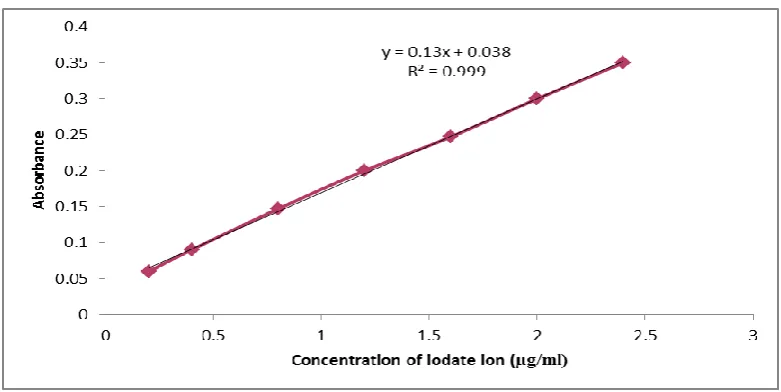
reproducible results. under the experimental conditions described, Beer 's law is obeyed over
the concentration range 0.2-2.8 µg /ml (figure 2), with correlation coefficient of 0.999,
[image:4.595.99.498.73.315.2]Fig. (2):- Calibration graph of iodate.
Molar absorptivity of the product formed and sandell s sensitivity were found to be 0 104
L.mol-1. cm-1 and 7.696 ng/cm2 respectively. Accuracy and precision of the method was
established by analyzing the standard iodate solution at three different levels. The average
recovery which is a measure of accuracy is 100 ± 1.3 revealing high accuracy of the method.
Relative standard deviation (RSD), which is an indicator of precision is better than 2%. The
results are compiled in (table 1).
Table 1: Optical characteristics and statistical data for regression equation of the proposed method.
Parameters Value
λ max (nm)
Beer´s law limit (µg. ml-1) Molar absorptivity (l.mol-1. cm-1)
Correlation coefficient (r2) Regression equation(Y= a × + b) Slope (a)
Intercept (b) Recovery %
Relative standard deviation (%)
500 0.2-2.8 4.08×10⁴
0.999
0.13 0.038 100±1.3
˂ 2%
Effect of diverse ions
The effect of various diverse ions on the determination of iodate ion by the proposed
procedure was examined. The tolerance limits of interfering species were established at the
concentration required to cause not more than ± 2% error in the recovery of iodate at 1 μg
mL-1. The tolerance limits of diverse ions are listed in (table 2). The oxidizing agents such as
[image:5.595.102.493.68.264.2]limit of iron, cerium and vanadium can be increased by the addition of appropriate (1 mL of
2% NaF) amount of sodium fluoride.[30]
Table 2: Effects of diverse ions in the determination of (1.0 μg.mL-1) of iodate.
Foreign ion Tolerance limit in μg.mL-1
Mg2+, Ca2+, Br-, Cl- 3500
NO3-, Mn2+, Zn2+ 3000
SO4, PO43-, 2500
Al3+, SCN- 1500
Fe3+
, Ce4+,VO3- ≤ 4
Masked with masking agent (NaF).
Application to real samples
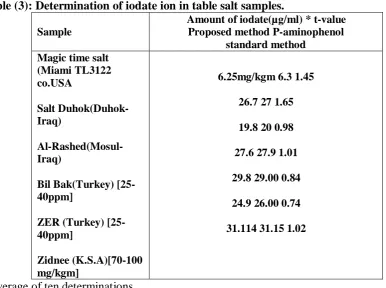
In order to evaluate the analytical applicability of the proposed method, samples of table salt
containing iodate(provided from different companies as cited in table 3) were analyzed. The
salt samples of different brands were purchased from local markets. The results were also
compared statistically by student t-test with those obtained by standard method[31] at 95%
confidence level. The calculated t- values did not exceed the theoretical values indicating that
there was no significant differences between the precision of the proposed and literature
method as cited in (table 3).
Table (3): Determination of iodate ion in table salt samples.
Sample
Amount of iodate(µg/ml) * t-value Proposed method P-aminophenol
standard method Magic time salt
(Miami TL3122 co.USA Salt Duhok(Duhok-Iraq) Al-Rashed(Mosul-Iraq)
Bil Bak(Turkey) [25-40ppm]
ZER (Turkey) [25-40ppm]
Zidnee (K.S.A)[70-100 mg/kgm]
6.25mg/kgm 6.3 1.45
26.7 27 1.65
19.8 20 0.98
27.6 27.9 1.01
29.8 29.00 0.84
24.9 26.00 0.74
31.114 31.15 1.02
*Average of ten determinations.
[image:6.595.90.477.445.733.2]CONCLUSIONS
For the first time, trifluoperazine has been used as a chromogenic reagent for the
spectrophotometric determination of iodate ion. The proposed method, which is sensitive,
accurate, simple and rapid, offers the advantages of sensitivity and wide range o f
determinations without the need for extraction or heating. The method does not involve any
stringent reaction conditions and can be compared favorably with the other methods. The
proposed method has been successfully applied to the determination of iodate ion in various
table salt samples.
REFERENCES
1. Nief Rahman Ahmad,' Ph.D Thesis, University of Mosul, 1997; P.71.
2. Kumar, S.D., B. Maiti and P.K. Mathur. Determination of iodate and sulphate in iodixed
common salt by ion chromatography with conductivity detection. Talanta., 2001; 53:
701-705.
3. Trivedi R H, Mehta S H, Bhatt S D and Choudhri B P,’ Colorimetric Determination of
Iodate in Iodated Salt Using P-Phenylenediamine. Indian. J. Technol, 1987; 25: 43-47.
4. Diosady, L.L., Alberti, J.O., Venkatesh, M.M.G. and Stone, T.,’ Stability of iodine in
iodized salt used for correction of iodine deficiency disorders II, Food and Nutrition
Bulletin, 1998; 19(3): 239-249.
5. Szybiński Z, Delange F, Lewiński A et al A programme of iodine supplementation using
only iodised household salt is efficient – the case of Poland. Eur J Endocrinol, 2001; 144:
331-40.
6. Gilman, A.G.; Goodman, L.S.; Rad, T.W.; Murad, F. The Pharmacological Basis of
Therapeutics,7th ed., Macmillan: New York, 1985; p 964.
7. Qurrata A, Hermin S and Atikah. Development of spectrophotometric method for iodide
determination based on starch-iodine complex formation with hypochlorite oxidizing
agent. Pure Application of Chemical Research, 2015; 4(2): 1-3.
8. Ajmal H., Sana K. S., Shereefabi K. and Silpaunni A. P.,’ Determination of iodine
content in different branded table salts in India, World journal of pharmacy and
pharmaceutical sciences, 2018; 7(6): 1050-1058.
9. Mary Georgea, Karachalacherevu S. Nagarajaa and Natesan Balasubramanianb
Spectrophotometric Determination of Iodine Species in Table Salt, Pharmaceutical
10.Al-Okab RA, Abdul Galil MS ,’Exploitation of Oxidative Coupling Reaction in
Spectrophotometric Determination of Iodate in Iodized Salt, Austin J Anal Pharm Chem,
2018; 5(2): 1-3.
11.Anna Dyrka, Ryszard Drożdż, Jerzy W Naskalski, Zbigniew Szybiński, Edward Franek,
Assay of iodine in edible salt using Sandell-Kolthoff catalytic method Journal of
Laboratory Diagnostics, 2011; 47(4): 425-429.
12.Rajković M.B, Determination of potassium iodide in table salt, Journal of Agricultural
Sciences, 2009; 54(2): 152-165.
13.Tang.C, Su.Z, Lin.B , “A novel method for iodate determination using cadmium sulfide
quantum dots as fluorescence probes,” Analytica Chimica Acta, 2010; 678(2): 203–207.
14.Ensafi A.A and Dehaghi G.B, “Flow-injection simultaneous determination of iodate and
periodate by spectrophotometric and spectrofluorometric detection,” Analytical Sciences,
2000; 16(1): 61–64.
15.Yehua Shen, Xiao-Feng Yang and Lihua Jin; Fluorimetric Determination of Iodate Based
on Cyclodesulfurization of Thiosemicarbazide with Incorporated Fluorescein, Chem.
Anal. (Warsaw), 2008; 53: 597.
16.Wisnu, C.; Determination of iodine species content in iodized salt and foodstuff during
cooking,International Food Research Journal, 2008; 15(3): 325-330.
17.Tao W, Weimei L, Xueliang D, Lijun G, Bing W and Dongqin Q. Determination of
iodate by HPLC-UV after on-line electrochemical reduction to iodide. Journal of
Chromatographic Science Advance Access., 2014; 6: 1-5.
18.Zui O.V and Terletskaya A.V, “Rapid chemiluminescence method for the determination
of iodate traces,” Fresenius’ Journal of Analytical Chemistry, 1995; 351(2-3): 212–215,
1995.
19.Dorman J.W and Steinberg S.M, “Analysis of iodide and iodate in Lake Mead, Nevada
using a headspace derivatization gas chromatography-mass spectrometry Environmental
Monitoring and Assessment, 2010; 161(1–4): 229– 236.
20.Reddy-Noone K, Jain A, and Verma K, “Liquid-phase microextraction-gas
chromatography-mass spectrometry for the determination of bromate, iodate, bromide
and iodide in high-chloride matrix,” Journal of Chromatography A, 2007; 1148(2):
21.Wang, Tianlin; Zhao, Shuzhen; Shen, Chanhong; Tang, Jing; Wang, Dan Determination
of iodate in table salt by transient isotachophoresis–capillary zone electrophoresis, Food
Chemistry, 2009; 112(1): 215-220.
22.Yokota K, Fukushi K, Takeda S, and Wakida S, “Simultaneous determination of iodide
and iodate in seawater by transient isotachophoresis-capillary zone electrophoresis with
artificial seawater as the background electrolyte,” Journal of Chromatography A, 2004;
1035(1): 145–150.
23.Pantůcková P, Krivánková L Fast and simple method for determination of iodide in
human urine, serum, sea water, and cooking salt by capillary zone electrophoresis.
Electrophoresis, 2004; 25: 1102-10.
24.Thangamuthu R, Yu-Ching Pan, Shen-Ming Chen,’ Iodate Sensing Electrodes Based on
Phosphotungstate- Doped-Glutaraldehyde-Cross-Linked Poly-l-lysine Coatings,
Electroanalysis, 2010; 22(16): 1812 – 1816.
25.Geovanna de O. Costa, Fernanda N. Feiteira, Hanna de M. Schuenck and Wagner F. Pacheco,’
Iodine determination in table salts by digital images analysis, Anal. Methods, 2018; 10:
4463-4470.
26.Huang X, Li Y, Chen Y, and Wang L, “Electrochemical determination of nitrite and
iodate by use of gold nanoparticles/ poly(3-methylthiophene) composites coated glassy
carbon electrode,” Sensors and Actuators B, 2008; 134(2): 780–786.
27.Chen Z,. Megharaj M, and Naidu R, “Speciation of iodate and iodide in seawater by
non-suppressed ion chromatography with inductively coupled plasma mass spectrometry,”
Talanta, 2007; 72(5): 1842–1846.
28.Kolthoff.I.M, Belcher.R, Stenger.V.A and Matsuyama.G," "Volumetric Analysis,"
Interscience publishers, New York, Volume III, 1957, P.235.
29.Nief Rahman Ahmed and Labeeb Hasoon,’Colorimetric trifluoperazine. HCL assay in
tablets and industrial wastewater, World Journal of Pharmacy and Pharmaceutical
Sciences, 2018; 7(9): 198-1205.
30.Sastri, M. N.,’ Seperation methods, 2nd ed., Himalaya Publishing House, Delhi, 1996; 33.
31.Joshua Fuchs, Ervin Jungreis, and Lina Ben-Dor; The spectrophotometric determination