Assessing the Demand for Big Data and
Analytics Skills, 2013-2020
Table of Contents
Acknowledgements 3
Introduction to the Expert Group on Future Skills Needs 4
Foreword 5
Executive Summary 6
1. Introduction and Overview 29
1.1 Background 29
1.2 Aims of the Study 29
1.3 Approach and Methodology 29
1.4 Report Structure 30
2. Big data and analytics – drivers of change 31
2.1 Overview: Defining big data and analytics 31
2.2 Deriving value from big data and analytics – key drivers 31 2.3 Patterns of adoption and the power of ‘small data’ 33
2.4 Driving Big Data and Analytics in Ireland 34
2.5 Potential constraints 35
2.6 Implications for skills 36
3. Existing employment demand in Data Analytics in Ireland 37
3.1 Approach 37
3.2 Existing employment demand - findings from the literature review 37
3.3 Deriving an estimate for Ireland 40
3.4 The sectoral spread of employment 44
3.5 Baseline demand 2013 45
4. Big Data and Analytics – findings from the consultation 46
4.1 Introduction 46
4.2 Survey interviews with employers 46
4.3 Stakeholder Workshops 60
4.4 Key informant consultation 62
4.5 Concluding comment 63
5. Future demand scenarios for Big Data and Data Analytics 64
5.1 Introduction 64
5.2 Global big data and analytics growth drivers and benchmarks 65 5.3 Big data and analytics growth scenarios for Ireland 67 5.4 Expansion, up-skilling and replacement demand scenarios 72
6.1 Overview 85 6.2 Supply of big data and analytics talent – findings from the literature 85
6.3 Skills supply in Ireland 87
6.4 Conclusions on skills supply and matching with demand 95
7. Policy measures in place – domestic and international 97
7.1 Overview 97
7.2 The race for analytics talent 97
7.3 Trends in international policy approaches 98
7.4 Initiatives in place in Ireland 100
8. Findings and Recommendations 102
8.1 Building up the supply of analytical talent : 102 8.2 Appealing to the broadest possible talent pool 106 8.3 Inspiring the next generation of analytics talent 109
8.4 Measuring Progress 110
8.5 Supporting Actions: Unlocking the potential of big data and analytics in the public sector 110
8.6 Conclusion 112
Appendix 1: Members of the Steering Group 113
Appendix 2: Terms of Reference 114
Appendix 3: Dedicated Big Data & Analytics Programmes 117
Appendix 4: Members of the Expert Group on Future Skills Needs 119
Appendix 5: Publications by the Expert Group on Future Skills Needs 2011-2014 120
Acknowledgements
Forfás would like to record its appreciation to the members of the Steering Group who oversaw the progress and the development of the report for their significant commitment and contribution – the membership is set out in Appendix 1.
Forfás would like to thank the many industry executives, academics and staff at expert
organisations and State Agencies who gave their valuable time and insights though interviews and at workshops.
Introduction to the Expert Group on Future Skills Needs
The Expert Group on Future Skills Needs (EGFSN) advises the Irish Government on current and future skills needs of the economy and on other labour market issues that impact on Ireland’s enterprise and employment growth. It has a central role in ensuring that labour market needs for skilled workers are anticipated and met.
Established in 1997, the EGFSN reports to the Minister for Education and Skills and the Minister for Jobs, Enterprise and Innovation.
Foreword
This study undertaken by Forfás and the Expert Group on Future Skills Needs is a key input to the Government’s Action Plan for Jobs 2013. Its aim is to research and identify measures to build up the big data and analytics talent pool over the period up to 2020 in line with enterprise demand. Measures required include improving domestic graduate output; continuing professional development; and where necessary attracting experienced talent from abroad-including expatriate talent.
Big data and analytics is a relatively new area of business activity
characterised by rapid growth. Globally, there is a reported shortage of data analytics talent particularly individuals with the required ‘deep analytical’ skills. At present, no one country or region stands out in the provision of data analytics services. For Ireland to become a leading country in data analytics services it is essential that our skills capability base is sufficient to drive
performance within existing enterprises, start-ups and new foreign direct investment.
To understand how data analytics skills demand may evolve, a number of scenarios were developed to depict potential future outturns. Government’s policy into the medium-term is for Ireland to become a leading country in Europe for big data and analytics. This would require achieving the scale of the ambition as set out in the high growth Scenario in this study. Under this Scenario, 21,000 potential job vacancies could arise from expansion and replacement demand in the period up to 2020 - comprising 3,630 for deep analytical roles and 17,470 for big data savvy roles. There would also be a further 8,780 potential job openings for supporting technology staff – already included within the demand forecast numbers for ICT professionals in the Forfás/EGFSN report on Addressing Future Demand for High-Level ICT Skills.
The achievement of this outcome requires an improved understanding among private and public sector senior executives, of the potential of data analytics for driving business performance - including its greater adoption in the SME sector. An enterprise-wide approach to managing data analytics capabilities is essential including defining skills needs; up-skilling of talent; providing clear career path progression and deploying analytical talent effectively to support business goals. It is also essential for career guidance professionals and enterprises to communicate and raise awareness of the range of interesting career opportunities arising within data analytic businesses to students, particularly females, and to their teachers and parents.
I would like to thank all those who contributed to the successful completion of the report. Particular thanks are due to the many enterprises and stakeholders who gave their valuable time and expertise to the study. I wish to express my thanks to Margaret Cox who chaired the Steering Group as well as to all members of the Steering Group for their full commitment and support. I would like to record my appreciation to the IDA Ireland and Enterprise Ireland for their support and sharing of expertise. Finally I would like to thank the team at Forfás for leading this project to a successful conclusion.
Una Halligan
Executive Summary
E.1 Purpose and methodology
This study, Assessing the Demand for Big Data and Analytics Skills in Ireland, 2013 - 2020, undertaken by Forfás and the Expert Group on Future Skills Needs (EGFSN) is a key input to the Government’s Action Plan for Jobs 2013. The work includes assessing the demand (both expansion and replacement) for big data and analytics roles and their related skills, competences and qualification requirements and mapping out relevant current and planned education and training output. It proposes actions to address gaps identified between supply and demand and assist in harnessing the considerable economic and social potential of this area into the medium-term. The study sets out patterns of demand in relation to three distinct categories of skills and competencies as follows:
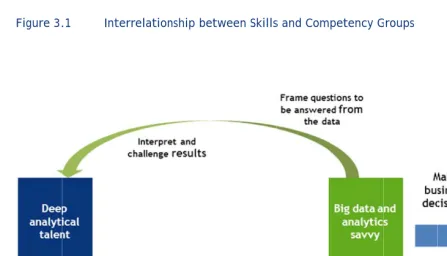
Deep analytical talent – requiring a combination of advanced statistical, analytical and machine learning skills. The shortage of deep analytical talent internationally has been identified as the most acute talent constraint on potential big data and analytics growth;
Big data and analytics savvy roles – individuals at all levels of a business or organisation with an understanding of the value and potential for the exploitation of big data and data analytics. These role-holders frame, interpret and utilise insights from data and take appropriate decisions to advance business performance; and
Supporting technology roles – personnel with the skills to develop, implement and maintain the hardware and software required to make use of big data and data analytics.
The study’s objective is to advance recommendations on measures to build up the big data and analytics talent pool through domestic graduate output, continuing professional development within industry, and, where necessary, attraction of talent from abroad including expatriate talent. The Terms of Reference for the study are set out in Appendix 2.
The research and analysis work for the study was managed by the Forfás Secretariat to the Expert Group on Future Skills Needs and its progress was overseen by a Steering Group made up of representatives from industry, education and relevant Government Departments and Agencies including the Department of Education and Skills, Higher Education Authority, IDA Ireland and Enterprise Ireland.
E.2 Background
The Government has set an ambition for Ireland to become a leading country in Europe in ‘Big Data’. It is envisaged that this will help create significant additional employment in the economy. To do this a series of actions are recommended in the Action Plan for Jobs, 2013 to create an ecosystem based on public and private collaboration which will:
Directly and indirectly create high-value jobs;
Strengthen the existing FDI proposition and attract new FDI from top global organisations;
Foster indigenous enterprise and innovation;
Attract and develop top talent in a high-value sector; and
The above actions are being driven by a joint industry–Government Big Data Taskforce.
Many of the elements of an ecosystem to support data analytics and big data are already in place in Ireland. The most important element is the existing base of active enterprises in this space. This enterprise base includes:
Multinational enterprises that are providers of services and solutions for analytics and big data;
Multinational enterprises whose businesses are built in whole or in part on the application of analytics and big data technologies; and
A growing base of indigenous companies whose business focuses on IT solutions for analytics and/or for whom analytics is central to their business offering.
This ecosystem also includes a growing base of relevant publically funded research activity
(including the Insight Centre for Data Analytics (INSIGHT) and the Centre for Applied Data Analytics Research - CeADAR). Ireland has prioritised the area of ‘Data analytics, Management, Security and Privacy’ as part of its research prioritisation1 and there are a considerable number of researchers already active in the fields of big data and analytics.
Globally, there is a reported shortage of personnel with the required ‘deep analytical’ skills and also individuals who have a combination of technological and business skills to both generate business intelligence and to take action based on the insights generated (‘data savvy’ employees). All of the above highlights the requirement for Ireland to build up a sufficient analytics talent pool in order to take advantage of the potential business and employment opportunities in this area. The value of big data and analytics is becoming apparent across countries and is resulting in a growing demand for relevant skills. At present, no one country or region stands out in the provision of related services. For Ireland to aspire to such a status, it is essential that the necessary skills capability base is developed to drive the performance of data analytics businesses and capitalise on potential growth and employment opportunities.
E.3 Defining Big Data and Data Analytics
While big data and data analytics have gained prominence in recent years, there is no single, internationally recognised definition of ‘big data’ and no operational definition that can be used to determine market or skills development.2
Although there is no uniform definition of big data activities, a degree of consensus is evident in the widespread useof the ‘3Vs’ which define big data in terms of the ‘volume, variety and velocity’ of data3:
Volume – referring to data stores of petabytes or above;
Variety – referring to diverse formats of data generation sourced from various mechanisms; and
Velocity – referring to the requirement for real time collections/analysis of data.
1
Report of the Research Prioritisation Steering Group, Forfás, March 2012. 2
e-Skills UK, (2013) Big Data Analytics - an assessment of demand for labour and skills, 2012-2017. 3
The term ‘Big Data’ has been devised to describe the exponential increase, obtainability and use of information in both structured and unstructured forms. The upsurge in big data has been driven by escalating volumes of detailed information originating from organisations, mass media and
multimedia, social networking platforms and the ‘Internet of Things’. Data analytics, the analysis of large data sets, has become a fundamental element for both private sector and public sector organisations who wish to compete through ever-evolving technology, productivity advancement, and innovation in research and development. It is also important to note the value of what can be termed ‘small data’. For some firms – in particular small businesses in more traditional sectors - the types of business data becoming available will be of smaller volume, slower velocity and narrower variety. Nonetheless, enhanced use of this data in a smart way, and application of analytical techniques can realise business value.
For the purposes of this project, data analytics is understood as the mining, analysis, interpretation and purposeful utilisation of Data, including Big Data. This process of extracting and analysing data to generate economic value has been noted as a key future requirement for enterprises and organisations across all sectors.
E4. Big Data and Analytics: Drivers of Change
With an explosion in the level of data being created, there is an increased recognition among enterprises of the potential business value that can be extracted. Advantages include:
Finding and accelerating growth opportunities — drawing on internal and external data to help model and predict business outcomes, identify the most profitable opportunities and
differentiate businesses from their rivals;
Improving business performance — enabling agile planning, more accurate forecasting, better budgeting and trusted decision-making support;
Managing risk and regulatory pressures — improving reporting processes through the exploitation of more robust data, while also identifying potential risk areas, such as compliance violations, fraud or reputational damage4; and
Exploiting emerging technologies — continually identifying new opportunities to gain insights from data.
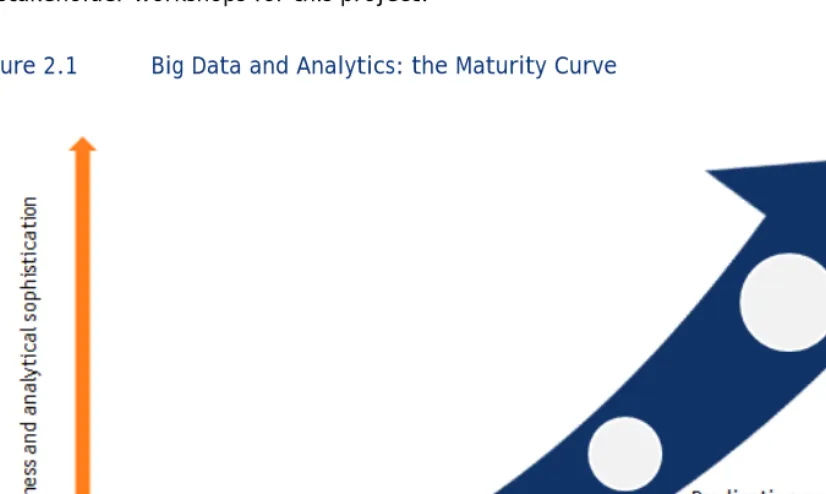
Notwithstanding these drivers, there has not been uniformity in the rate of adoption of big data and analytics across companies and industries. Some sectors and larger firms are further along the ‘maturity curve’ than others. At the same time, a number of issues are emerging globally which may act to constrain big data and analytics growth. These include some scepticism of the actual value generated, concerns over a ‘big data hype’; the need to be able to identify and process the ‘right’ data among the vast quantities of information produced; and, most pressingly, skills shortages. In Ireland, the level of adoption of analytics in the delivery of public services has been slower than leading countries (with a number of exceptions). In the medium-term, important Government initiatives include several supporting actions and investments as set out in the Action Plan for Jobs 2013. These are being built on further in the Action Plan for Jobs 2014, including the launch of an Open Data initiative which will include the establishment of an Open Data portal to act as the primary source of public sector datasets in the context of Ireland’s membership of the Open
4Big risks require big data thinking , Global Forensic Data Analytics Survey 2014 (EY 2014)
Government Partnership. Also, the further strengthening of the mechanisms for data sharing and the use of data across government by enacting the required legislation, setting up a platform to
facilitate data analytics within Government and taking steps to further strengthen Ireland’s national data infrastructure.
In business top level management support is required for placing analytics at the centre of the decision-making process as an integral part of its culture. In the absence of such commitment, there is a risk of analytics being viewed as a silo activity. Given the early stage of development of data analytics activity both in Ireland and internationally, a particular focus should be on improving senior executives’ understanding of the potential value of data analytics activities for enhancing business performance. This includes decisions on the talent and technology required and what structured data metrics to collect. This will help avoid the sense that ‘we are drowning in data – but starving of knowledge’. Success stories are crucial to encourage others to follow in the take-up of analytics. This requires increased advocacy and publicity. The key to maximising the value of analytics is for firms and organisations to take an enterprise-wide approach to managing their analytical talent, including defining needs; sourcing and nurturing talent; providing interesting and challenging work and deploying analytical talent effectively in line with strategic business needs. At present, the adoption of big data and analytics in Ireland is greatest in sectors such as ICT, financial and insurance activities, manufacturing, telecoms, utilities, retail /wholesale and to a lesser degree in healthcare, pharmaceuticals, transport and government. Companies are starting to interact directly with consumers due to increased usage of mobile devices: many sectors are beginning to behave like retail in their use of data to drive new business. The broad theme
emerging in this study is that in the future, big data and analytics activities will be relevant across all industries where data are created in significant volumes.
E.5 Baseline employment demand in Big Data and Analytics
Big data and analytics is a relatively new area of business activity characterised by rapid growth. Notwithstanding the myriad opportunities for innovation, productivity and value creation, the recent emergence of this area presents some difficulties for policy makers in understanding existing employment, definitions of roles and related issues. In the absence of an official measure of
employment demand in this area, this study considered findings from a range of sources in order to arrive at an estimate of baseline employment demand:
Research and analysis for other countries derived from a review of international literature;
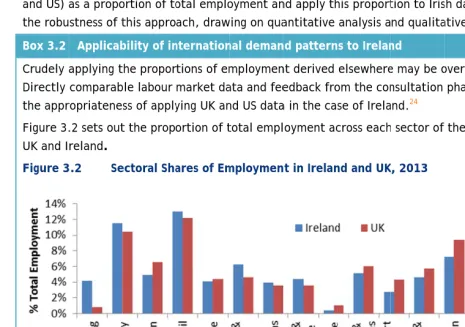
Analysis undertaken to apply estimates in an Irish context;
Insights from the qualitative research undertaken for the project; and
Analysis of available data for Ireland to assist in understanding the likely sectoral distribution of employment across industries.
Figure E.
Within th establish more typ call for a influence scientist increased Those in skills in o the analy value for an intuit availabil emerging to have t the othe Those in tools and includes Based on some adj and avai is set out
.1 Interrel
he deep an hed occupa pically invo advanced q ed by the
’ may be. d data int data savv order to fr ysis under r the comp tive feel fo ity grows g from the two differ er with the
supportin d manage the use of n a combin justments lable data t in Table
lationship
nalytical t ations req olved in de quantitativ proliferati For this re
ensiveness vy manage
rame the q rtaken. Thi pany. Peop or what th
and as mo e data. The
ent conve e board / s ng technolo
the datab f Hadoop, nation of ‘
), insight g a on the Iri
E.1 between D talent cate uiring con eriving ins ve ability, ion of data eason, app s to the en rs and ana questions t is is with a ple in thes e data is t ore busines eir commu rsations o senior man
ogy roles d ases to ec an open s top-down’ gained fro ish labour
Data Analy
egory a dis siderable sight from , the empl a to the ex plying the ntire coho alysts, role
to be answ a view to m se roles re telling the ss decision unication s n the same nagement.
develop, im conomicall
source pro ’ approach om the con market, t ytics Skills stinction is analytical big data. loyment de xtent that type of gr rt may res es require wered from
making be equire deta em. This w
ns are take skills are i
e topic – o . mplement y extract ocessing fra hes (applyi nsultation the estima
s and Comp
s made be ability, a While the emand for t “emergin rowth rate sult in an o conceptua m the data etter busin ailed doma will be part
en rapidly mportant one with th
t and main value from amework. ing interna phase wit ated baseli petency G tween two nd emergi e “establish
r these job ng” roles li es envisage
overstatem al knowled a and to in
ess decisio ain and se ticularly tr and in res as they wi hose in de
ntain the h m a wide v
ational est h compani ne employ
roups
o groups: j ng jobs in hed” analy bs is less li
ike that of ed on acco ment of sk
dge and qu nterpret an ons that w ctoral kno rue as real sponse to p
ill routine eep analyti
hardware a variety of d
timates to ies and sta yment dem
jobs in mo n analytics ytical role ikely to be f ‘data ount of kills deman uantitative nd challen will create owledge an l time data patterns ly be requ ic roles an
and softwa data. This
o Ireland, w akeholders mand in 20
Table E.1 Estimate of Baseline Employment Demand for Big Data and Analytics Skills in Ireland, 2013
Category Employment
Demand5 Employment % Total
Deep analytical talent 3,300 0.18
Of which emerging analytics roles 1,500 0.08
established analytical roles 1,800 0.10
Big data savvy 25,780 1.38
Supporting technology professionals 6,000 0.32
Total 35,080 1.88
Source: EY, Oxford Economics
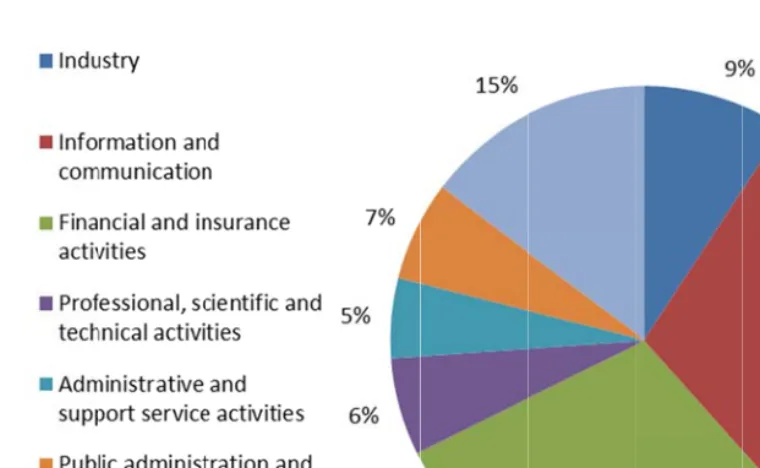
In terms of sectoral distribution of employment, replication of international analysis and an analysis of the data intensity of industry here in Ireland, points to a concentration of employment in
financial and insurance services, information and communications technology and industry.
E6. Findings from the Consultations
Capturing the views of employers in the big data and analytics sphere is critical to understanding current industry trends and anticipated future developments. To this end, a broad-based
consultation phase involving 55 companies, organisations and stakeholders was completed through a process of structured research work including:
Interviews with 35 enterprises consisting of both Irish operations of major multi-national corporations and indigenous Irish firms. Enterprises consulted included both companies operating across sectors using big data and analytics, and service providers operating in the analytics domain.
Structured interview surveys with 7 government bodies including statutory offices, government departments and state agencies.
Structured interview surveys with 3 domestic research centres which specialise in big data and analytics.
The views of a range of 10 key informants – both domestic policy influencers and international industry leaders.
A series of three sector focused workshops which heard the views of a wide range of
stakeholders in this area, from academia and industry (including specialist service providers, firms in finance and insurance, transport and logistics sectors, wholesale and retail, and manufacturing.
This process allowed the incorporation of views from industry, academia and other interested parties. The process also benefitted from inputs by members of the Government ‘Big Data’ Taskforce at presentations made to the group.
5
E7. Employer Consultations
Despite the variety of firms interviewed across sectors and of different sizes, industry and service providers, consensus emerged on a number of important themes:
Gender: Across the three categories of skills, employment is male-dominated.
Hard to fill vacancies: There are current vacancies across categories with deep analytical talent roles being hardest to fill.
Barriers to filling vacancies: Employers view an insufficient level of experience as the key barrier to filling deep analytical talent vacancies. This may be due to the early stage of data analytics business activity. Experience is also a challenge when it comes to big data savvy roles, along with insufficient skillsets. For the supporting technology group, experience levels again feature, along with insufficient technical skills of applicants.
Future demand: Private sector employers are positive about the future and, on average, anticipate a doubling of big data and analytics employment levels over the period to 2020. Public sector employers are less ambitious about their future employment levels, in part due to the current restrictions on recruitment. Part of their demand is likely to be addressed through outsourcing to the private sector.
Skills supply: Employers are less optimistic regarding skills supply, with the majority foreseeing difficulties over the period.
In-house training: Encouragingly, most firms provide in-house training and the majority also have relationships with higher education institutes to aid in sourcing talent.
E8. Key Informant Consultations
These ten interviews included some parent companies of multinational firms based in Ireland and domestic policy informants from Government Departments and State Agencies. A number of common themes were evident:
International and domestic informants were optimistic as to how Ireland can position itself to become a world leader in this area. The strengths Ireland has demonstrated in growing other sectors can again be harnessed to capitalise on opportunities in big data and analytics.
There is an active and growing research agenda in Ireland aided by the Government’s research prioritisation focus on the area of Data Analytics, Management, Security and Privacy, and significant funding from Science Foundation Ireland.
To position Ireland to become a leading country for data analytics a range of steps will be required so that as much of the potential pipeline of analytics talent will choose careers in this area. This can be done by developing attractive career paths and inspiring the next generation of analytics talent. In addition, more places in 3rd level analytics related courses are required.
It was cited that industry must drive the up-skilling of existing employees in the competencies required.
The adoption of analytics is at a slower pace of development in Ireland and a cultural change will be needed to realise the full benefits on offer.
E9. Future demand for Big Data and Data Analytics
Developing Scenarios
In order to understand how demand may evolve over the period to 2020, a number of scenarios were developed. These scenarios are designed to depict potential future outturns, rather than represent definitive forecasts. In building out the potential medium-term scenarios, the analysis draws on a range of research and data sources including:
Analysis of big data and analytics business global growth projections from a review of international literature;
Qualitative insight derived from the company consultation phase, the key informant interviews and the three workshops; and
Analysis of domestic economy sectoral employment forecasts from the EY and Oxford Economics Winter 2013 Economic Eye.6
Three scenarios are set out as follows:
Scenario 1 – a low growth scenario whereby employment in big data and analytics roles only grows in line with the forecast total employment growth rate within key data intensive sectors.
Scenario 2 – a moderate growth scenario whereby Ireland achieves a similar proportion of big data and analytics roles within total economy employment as forecast for other countries (in particular the UK).
Scenario 3 – a high growth scenario whereby Ireland achieves the vision set out in the Action Plan for Jobs 2013 of becoming ‘a leading country in Europe for big data’. This is predicated on the growth of big data and analytics employment within existing firms, new firms becoming involved and a level of foreign direct investment in big data and analytics.
The low growth Scenario 1 assumes no further policy action or specific measures aimed at increasing the level of adoption of big data and analytics across the economy. In practice, the Government has announced a range of steps to drive this area and so the prospect of the outturn in Scenario 1 materialising is low. Given the weight of policy focus afforded in this area, investment in major research infrastructure and recent announcements in relation to Open Government, it is considered far more likely that Ireland will converge with international comparators with regard to the level of adoption of big data and analytics, as in the moderate growth Scenario 2.
The medium-term policy objective, as stated in the Action Plan for Jobs 2013, is to drive Ireland beyond convergence and strive to become a leading country in Europe for big data and analytics and this would achieve the scale of the ambition set out in Scenario 3. Given Ireland’s scale, policy agility and reputation in related fields like ICT, there is a clear and realistic opportunity for Ireland to achieve convergence and over-take leading economies in Europe in this space.
6
The assumptions and outcomes of each scenario are summarised in the Table E.2. The outcomes for each scenario depend on the drivers and supporting conditions being present.
Table E.2 Summary of Scenario Assumptions, Drivers and Supporting Conditions
Scenario 1 Scenario 2 Scenario 3
Drivers
Wider economy baseline sector projections ■ ■ ■ Increase in existing firm data intensity to
forecast UK and US levels ■
Marked increase in data intensity across the whole economy, including within the public sector and a broad range of private firms
■
Expansion of existing firms’ big data activities ■ ■ New, additional greenfield mobile big data
FDI attracted to Ireland ■
Full implementation of measures relating to
Open Government ■ ■
Full implementation of measures set out in
the Action Plan for Jobs ■
Supporting conditi
ons
No special effort, public or private, to
influence the demand-side or supply-side ■
Modest boost in domestic big data talent supply and modest improvement in
environment for attracting external big data talent (e.g. employment permit eligibility)
■
Major boost in domestic big data talent supply and improvement in environment for attracting external big data talent
■
Removal of barriers to domestic big data growth such as greater access to open data
■ ■
Widespread adoption of data analytics in the
public sector ■
Significant improvement in Ireland's big data international competitiveness offering, especially versus European competitors
■
Outco
m
es
No change in economy-wide data intensity
from today's level ■
Decline in Ireland's global big data market
share ■
Ireland's global big data market share
converges with other countries ■
Exploitation of domestic big data
opportunities amongst existing organisations, public and private
■
Rise in Ireland's global big data and analytics
market share ■
Ireland becomes a leading country in Europe
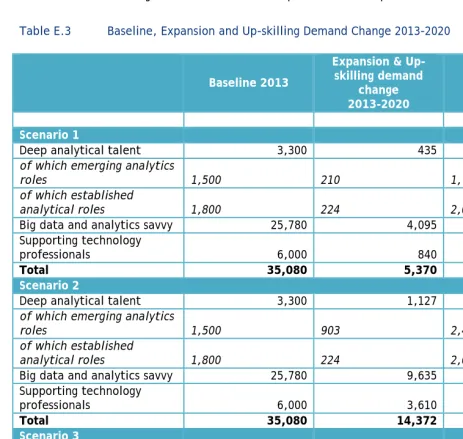
Table E.3 presents estimates of the 2013 baseline demand for the three main categories of data analytic roles, then for each scenario, the expansion and upskilling demand change anticipated over the period up to 2020; and the resultant demand level in year 2020. Expansion demand comprises the main demand component for deep analytical roles and supporting technology roles. For Big data savvy roles there is an equal balance between the expansion and upskilling demand components. Details on how these figures were arrived at are presented in Chapter 5.
Table E.3 Baseline, Expansion and Up-skilling Demand Change 2013-2020
Baseline 2013
Expansion & Up-skilling demand
change 2013-2020
Demand 2020
Scenario 1
Deep analytical talent 3,300 435 3,735
of which emerging analytics
roles 1,500 210 1,710
of which established
analytical roles 1,800 224 2,024
Big data and analytics savvy 25,780 4,095 29,875
Supporting technology
professionals 6,000 840 6,840
Total 35,080 5,370 40,450
Scenario 2
Deep analytical talent 3,300 1,127 4,427
of which emerging analytics
roles 1,500 903 2,403
of which established
analytical roles 1,800 224 2,024
Big data and analytics savvy 25,780 9,635 35,415
Supporting technology
professionals 6,000 3,610 9,610
Total 35,080 14,372 49,452
Scenario 3
Deep analytical talent 3,300 2,558 5,858
of which emerging analytics
roles 1,500 2,333 3,833
of which established
analytical roles 1,800 224 2,024
Big data and analytics savvy 25,780 16,915 42,695
Supporting technology
professionals 6,000 7,667 13,667
Total 35,080 27,140 62,220
E10. Potential Job Openings for Big Data and Data Analytics roles
In estimating total job openings for Big Data and data analytics roles that will need to be filled by new supply up to 2020, account needs to be taken of the expansion and replacement demand7. growth components (upskilling demand relates to those already in employment). Table E.4 presents the demand growth components for each scenario. In the medium-term and consistent with the Government’s Action Plan for Jobs 2013, policy aim is to drive Ireland beyond convergence and strive to become a leading country in Europe for data analytics, achieving the scale of the ambition as set out in the high growth Scenario 3. In terms of potential job openings under Scenario 3 up to 2020, there could be an estimated 29,880 job openings, comprising 3,630 for deep analytical roles; 17,470 for big data savvy roles, with a further 8,780 potential job openings for supporting
technology staff (this number is part of the job openings demand forecast for ICT professionals contained in the Forfás/EGFSN report on Addressing Future Demand for High-Level ICT Skills, 2013).
Table E.4 Summary of Future Demand Change Projections 2013 -2020
Scenario 1
(low growth)
Scenario 2 (delayed catch-up)
Scenario 3 (a leading country
in Europe)
Expansion demand
Deep analytical talent 410 1,050 2,380
of which emerging analytics roles 190 830 2,160
of which established analytical roles 220 220 220
Big data savvy roles 2,040 4,810 8,450
Supporting technology roles 780 3,340 7,100
Total Expansion demand 3,230 9,200 17,930
Replacement demand
Deep analytical talent 1,250 1,250 1,250
of which emerging analytics roles 370 370 370
of which established analytical roles 880 880 880
Big data savvy roles 9,020 9,020 9,020
Supporting technology roles 1,680 1,680 1,680
Total Replacement demand 11,950 11,950 11,950
Potential Job Openings
Deep analytical talent 1,660 2,300 3,630
of which emerging analytics roles 560 1,200 2,530
of which established analytical roles 1,100 1,100 1,100
Big data savvy roles 11,060 13,830 17,470
Supporting technology roles 2,460 5,020 8,780
Total Potential Job Openings 15,180 21,150 29,880
Up-skilling Demand
Deep analytical roles 20 70 170
Big data Savvy roles 2,050 4,820 8,460
Supporting Technology roles 60 270 570
Total Up-Skilling demand 2,130 5,160 9,200
Source: EY, Oxford Economics
7
E11. Skills, Competences and Qualifications
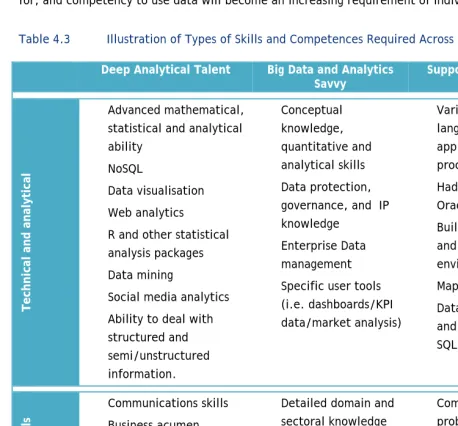
A key objective of this study is to forecast the likely future demand for big data and analytics skills, competences and qualification requirements. Table E.5 presents an outline of the types of technical and business skills, competences and qualifications in demand across three main skills categories as identified through the consultation and research process. Interdisciplinary skills are becoming increasingly important.
There are also related skill requirements arising in professional areas including finance, legal, internal audit and risk control. At a more general level, an appreciation for, and competency to use data is becoming an increasing requirement of individual’s work.
Table E.5 Illustration of Types of Skills, Competences and Qualifications Required Across Categories
Deep Analytical Talent Big Data and Analytics
Savvy Supporting Technology
Te
chnical and analytical
Advanced mathematical, statistical and analytical ability
NoSQL
Data visualisation
Web analytics
R and other statistical analysis packages
Data mining
Social media analytics
Ability to deal with structured and semi/unstructured information
Conceptual knowledge, quantitative and analytical skills
Data protection, governance, and IP knowledge
Enterprise Data management
Specific user tools, (i.e. dashboards/KPI data/market
analysis)
Various programming languages, data related applications and processes
Hadoop, Java, C++, Oracle
Building, implementing and managing Hadoop environments
Mapreduce
Database management and administration - SQL, MySQL, NoSQL
Business a
n
d soft s
kills
Communications skills
Business acumen
Problem solving, creativity , ethics and teamworking skills
Domain and sectoral knowledge
Detailed domain and sectoral knowledge
Knowledge of social media
Business Strategy
Project Management
Business intelligence
Ethics
Communications. problem solving, ethics and teamworking skills
Domain and sectoral knowledge
Social media technologies
Design / user experience skills
A firm consensus is yet to emerge among companies as to the precise level of qualifications required to fill deep analytical talent vacancies. Some firms reported that a specialist degree in analytics or management science would be an ideal qualification; other companies reported a preference for Masters’ and PhD graduates in quantitative and problem-solving areas such as engineering and maths. In either case, a considerable level of training and education specialism is required. As analytics activities develop, it is likely that more refined skill categories will emerge and with this more precise levels of qualification requirements.
Domain knowledge requirements will vary across sectors. There are also different types of firms, each of which will have differing type of balance of skills. These include:
Firms which are specialist analytics service providers;
Service providers in other areas that will increasingly be expected to have an analytics capacity in key functional areas - examples include business process outsourcing, marketing and human resources; and
Firms in industry using analytics as a management tool for the design and delivery of products and services and improving their internal financial, quality and production performance.
E12. Big Data and Analytics Skills Supply
There is agreement in the international literature and among the firms and organisations consulted that the most acute skills shortages relate to the deep analytical talent cohort. A range of academic disciplines (including business analytics, computer science, statistics, engineering, maths and physics) can provide the type of skills required. Respondents to the survey interview concurred with these sources of talent as shown in Figure E.2.
Maths, statistics and computer science disciplines are the most common anticipated sources of skills for deep analytical roles. Business and management disciplines feature prominently as a source of big data savvy roles. The computer science discipline is the most common anticipated source for supporting technology roles.
Figure E. Given th range of proportio cited ins potentia including There is and com include 1 additiona Honours recently At prese electives computin choice of In additio analysis Ther cour
In 20
The Graduate Over the output o .2 De e breadth other car on of a co sight from l analytics g investme currently plementar 15 dedicat al program Degree/N been set nt there a s in data a ng, cloud c
f modules on, a rang has review re are a ra rses. In 201 011, there correspon es of these e period 20 of 126 PhD
eep Analyt
of relevan reers. Inten untry’s an talent ma s talent ac ent bankin a range of ry disciplin ted data a mmes are p NFQ Level 8 up and jus are 18 prog analytics. T
computing or electiv ge of comp wed the nu ange of ma 13, these c
were 400 ding numb e program 015 to 201 graduates tical Talen nt disciplin nse compe alytics tal anagement ctually tak g and acad f specialis nes which
nalytics co planned fo 8 and Mast st four had grammes ( These are g, business ves. plementary umbers of aths, statis courses ha NFQ level bers for ph mes are w 9, the dat s and 126 M
nt – Future
nes, gradu etition fro lent end u t experts i ke up analy
demia. t and majo may also ourses wit or a 2014 o
ter’s Degre d recorded
with 760 s on both u s informat
y disciplin enrolmen stics and c ad 1,600 e l 9 awards hysics are well placed ta analytic MSc gradu Sources o uates from m other o p in analy ndicating ytics jobs.
or compon be suitabl h an enrol or 2015 sta ee/NFQ le d graduate students e ndergradu tion system
es can pro ts and gra combined m
nrolments s conferred 22 at NFQ d to take u c supply wi uates from
of Skills
m these dis ccupations ytics jobs. that betw The rema nent analy le pipeline lment of a art. These evel 9. Mos e numbers enrolled) w uate and p ms and oth
ovide the n aduates fro
maths / st s and there
d in engine Q Level 9 a
up careers ill be cons the Insigh
ciplines ar s means th Internatio ween 10 an ainder goe
ytics course es for analy approximat programm st of these in 2011. which have postgradua her areas w
necessary om these a tatistics /
e were 520 eering and
nd 68 at N in deep a siderably b ht Centre f
re also att hat only a onal finding
d 20 per c s into a ra
es availab ytics talen tely 500 st mes are ma e programm
e significan te degree where stud
skills avai areas as fo
computer 0 graduate d 152 at NF NFQ Level
nalytics ro bolstered b for Data A
tracted to small gs reviewe cent of ange of rol
ble in Irela nt. These tudents. F ainly at mes have nt streams es in dents have lable. The ollows: science es in 2011.
has a strong focus on industry relevance and readiness.8 A target is in place to have industry as the first destination upon graduation for some 50% of graduates.
The analysis of supply of talent undertaken for this study suggest that the approximate annual output of graduates from disciplines potentially capable of taking up roles requiring deep analytical talent is currently in the region of 2,000.9 Because the majority of such graduates chose careers paths in occupations other than analytics, it is important to focus both on attracting candidates from this pool into data analytics careers and also on increasing its overall size.
E13. Policy measures in place – Domestic and International
The race for talent and international approaches
Given the skills shortages forecast globally, it is clear that the race for analytics talent is now on. Countries are taking a range of approaches to enhancing the quantity and quality of skills being developed. A key emerging trend observed internationally is the interdisciplinary approach to big data and analytics education. This approach allows universities to re-orientate and / or leverage existing resources and collaborate across many academic departments including computing, business, statistics, marketing and economics.
Accordingly, data analytics programmes are run under the auspices of varying academic departments within third level institutes, including business, engineering, computer science, statistics, and digital media departments. In some countries – for example in the USA - the majority are run through business departments.
In the UK, the policy response has included establishing a Big Data Academy in a university setting with the support of enterprise. This collaboration is designed to help build up an adequate supply of data analytics talent to meet industry needs. Such collaboration of industry with higher education is the key trend emerging internationally. Approaches to enterprise involvement include:
Offering ‘real world’ work problems and large datasets to mine;
Providing data analytics software and hardware;
Providing relevant work experience opportunities;
Shaping specialisms or electives within programmes (including the provision of the taught modules); and
Promoting analytics as a career path for students.
Domestically, a range of steps have been taken to assist progress in this area. These include the supporting actions set out in the Government’s Action Plan for Jobs 2013 and the establishment of major data analytic research centres (INSIGHT and CeADAR) with investment from Science
Foundation Ireland, IDA Ireland and Enterprise Ireland. The roll-out of actions recently announced by the Minister for Public Expenditure and Reform in relation to Open Government and Open Data will be important.
8 The Insight Centre for Data Analytics is a joint initiative between researchers at UCC, UCD, NUI Galway, DCU and other partner institutes including Trinity College Dublin, NUI Maynooth, Royal Irish Academy and the Tyndall National Institute. It was established in 2013 by Science Foundation Ireland funding of €75m.
9
E14. Findings and Recommendations
Based on the desk-based research, in-depth consultation with employers, analysis of international literature, detailed discussion with key informants and stakeholders, and valuable input from members of the EGFSN Steering Group, this study has arrived at a set of findings across several themes as discussed below.
Building up the supply of analytics talent
In order to convince existing organisations and new inward investors that Ireland is able to meet future talent demand (while ensuring competitive wage levels and avoiding displacement of talent from existing firms) it is important that the talent supply is not only flexible but perhaps also available in advance of potential future demand. The latter point has implications for the timing for increasing the deep analytical graduate domestic output; bringing forward any necessary changes in the employment permit system; and enterprises role in the up-skilling for big data savvy roles. An improved understanding among senior executives of the potential of data and analytics for driving business performance is essential. Successful firms adopt an enterprise-wide approach to managing analytics capabilities in line with their strategic business goals. This includes defining analytical talent requirements; sourcing of new analytical talent; up-skilling analytical workforce skills; providing career progression opportunities and deploying their analytical talent effectively. The paramount policy challenge is to ensure that the right level of talent is available in the workplace. Firm consensus is yet to emerge among companies as to the precise level of
qualifications required to fill deep analytical talent vacancies. Some firms reported that a specialist degree in analytics or management science is an ideal qualification; other companies had a
preference for Masters’ and PhD graduates in quantitative and problem-solving areas such as engineering and maths.
The clear message however is that firms are experiencing constrained skills supply. Given the breadth of the potential supply pool it is not possible to directly transpose supply onto demand in order to point to a specific quantum of skills gap. That said however, the firm position emanating from the enterprise and key informant consultations is that the risk of over-supply of deep analytical graduate talent is negligible. The combined view of stakeholders and employers is that there is sufficient demand to absorb a significant increase in the level of post graduate output which has had enterprise involvement including relevant work placement. A continued focus on increasing the output of industry-ready PhDs (such as the planned pipeline through INSIGHT) is therefore justified.
Relevant findings from the consultation are as follows:
While firms surveyed are optimistic and ambitious in relation to employment opportunities, they expressed some concern in relation to talent supply. The most challenging obstacle identified by industry to future employment growth was that prospective employees lacked a sufficient level of work experience.
A further central theme to emerge from the consultation was that as technologies and
There is broad consensus in the literature - affirmed in the consultations – that the deep analytical talent pool will be most constrained and likely to suffer from supply shortages. This should not mean a sole focus on this group however and it is also important that the education system caters for the needs of industry for data users who are big data and analytics savvy.
The core channel through which the skills pool for big data and analytics savvy individuals will be delivered in the short-term is through up-skilling and retraining. Industry must drive this process.
For building up the pipeline of talent into the future, the education system should focus on enhancing numeracy and quantitative skills at all levels and as wide a variety of courses and disciplines as possible should involve teaching basic concepts in data management and analysis. A combination of new domestic graduates, continuing professional development and inward
migration - including expatriate talent should be used to enhance the talent pool.
Appealing to the widest possible talent pool
This study has shown that into the future, relevant talent must be proactively attracted into
analytics careers to meet the increasing numbers of job openings likely to arise. While talent for big data and analytics roles may be sourced from a range of disciplines, in practice analytics careers are just one potential career path for the cadre of skills emerging.
For the deep analytical talent cohort it is important that roles appeal to the broadest range of graduates. It is critical that every effort is made to enhance the appeal of big data and analytics occupations in order to maximise the potential flow of talent available.
Talent available for Big data and analytics savvy roles can be filled from a wide range of sources, including business and humanities graduates.
Inspiring the next generation of analytics talent
If Ireland is to become a leading country in Europe for big data and analytics, there is a need for a step change in the awareness and image of the business area. While this will be a multi-faceted process, appealing to a new generation of talent will be pivotal, not least in order to boost the long-term pipeline of skills supply.
Measuring progress
This report has set out the challenges inherent in measuring and forecasting big data and analytics employment. In order to monitor progress in this area in the future, robust data needs to be compiled on an ongoing basis.
Unlocking the potential of big data and analytics in the public sector
social transfers. There is substantial potential for enhanced efficiency, cost savings and improved outcomes through the deployment of analytics on a more widespread scale.
In the short-term, the introduction of post codes will build on the expanded data infrastructure achieved in recent years as will the planned introduction of personal health identifiers and moves towards company identifiers. While ongoing fiscal constraints and the public service numbers ceiling limit the capacity for investment to a degree, the Irish public administration has proved agile and responsive in the past and with a number of actions, will be able to realise gains in this area. Ireland’s full participation in the Open Government Partnership and supporting actions will assist in driving this adoption further. At a corporate level, Ireland is already home to a number of high profile enterprises – both foreign owned and indigenous – who are involved in applying cutting-edge analytical techniques. These companies could be encouraged to assist public bodies in applying similar techniques to public service challenges.
In response to the overall findings of this study, a set of recommendations is advanced across each key area. They are denoted by anticipated time period for implementation: Short-term (1-2 years), Medium-term (3-4 years) and Long–term (5 years +).
1. Boost the output and quality of Deep Analytical Talent
Enterprise and education providers should collaborate to increase the output and ensure the quality and relevance of deep analytics courses. Industry expert participation should be facilitated in course delivery. This would involve teaching modules and making datasets and other resources available which enhance the industry relevance of curricula and assignments. This could also involve delivering domain specific learning on specialist courses.
Time frame: Short to Medium-term Lead: Higher Education Institutes, Companies
Industry should work with higher education institutes to provide relevant structured work placements for students in analytics programmes and related disciplines.
Time frame: Short to Medium-term Lead: Employer Bodies, Higher Education Institutes
Enterprises in data analytic business activity should engage with the Irish Research Council’s Enterprise Partnership Scheme and Employment Based Postgraduate Programme whereby Masters and PhD candidates undertake research work of direct relevance to the firm. The value of the schemes should be marketed to prospective companies, students and graduates.
Time frame: Short-term Lead: Companies, Irish Research Council, Higher Education Institutes
Expand the provision of short courses to up-skill graduates from science and engineering disciplines. Review current post graduate data analytic course content and work with industry to ensure relevance. Thereafter, course content should be reviewed annually.10
Time frame: Short to Medium -term Lead: Higher Education Institutes, Companies
Business communication skills, critical thinking and project management skills should be taught across all STEM disciplines.
Time frame: Short to Medium-term Lead: Higher Education Institutes
10
2. Increase the output and quality of Big Data and Analytics Savvy Talent
Foundation and intermediate statistics and research methods which feature on the curricula of business and social science courses should be updated to include an introduction to emerging analytics concepts and techniques (where this has not already happened).
Time frame: Short to Medium-term Lead: Higher Education Institutes
Executive education providers should develop courses in data analytics for decision-makers.
Time frame: Short to Medium-term Lead: Business Schools, Public & Private Institutes
Handling data is becoming a core workplace skill and so foundation modules in statistical techniques and data management should be available to law and humanities students.
Time frame: Short to Medium-term Lead: Higher Education Institutes
3. Deliver relevant data analytic skills – the role of industry
Improve senior executives understanding of the potential for big data and data analytics to enhance their business performance. An annual data analytics seminar highlighting best practice should be run and company case studies written up and circulated among employers.
Time frame: Short to Medium-term Lead: Employer Bodies, IDA and Enterprise Ireland
Firms should adopt an enterprise-wide approach to managing their data analytical capabilities, including the up-skilling of staff and for data protection and governance. Enhanced talent management and retention systems should be promoted. Analytical staff should be offered experience in a range of business functions to gain greater insight of commercial objectives.
Time frame: Short to Medium-term Lead: Companies
Industry should support the establishment of an Analytics Skillnet. This should especially target
smaller firms and promote the adoption of analytics across sectors. This should be included by Skillnets in the next call for the establishment of new networks.
Time Frame: Short-term Lead: Employer Bodies, Skillnet
Expand the scale and delivery of flexible, accredited online data analytics course provision.
4. Appeal to the broadest potential pool of Deep Analytical Talent
Employers should develop and communicate appealing career paths for individuals with deep analytical talent. This should include the opportunity to progress to senior data analytics specialist positions as opposed to general management, and lead to accreditation.
Time frame: Short to Medium-term Lead: Companies, Employer Bodies
Higher education institutes should utilise all channels to inform employers of the potential skills supply available from as wide a range of disciplines as possible.11 Extensive outreach to students should be encouraged including college campus awareness campaigns and company open days.
Time frame: Short to Medium-term Lead: Higher Education Institutes, Companies
Employers and recruiters should emphasise the skills required – as opposed to preferred
disciplines - in job postings. This can facilitate qualified applicants from non-typical disciplines. Timeframe: Short to Medium-term Lead: Companies, Recruitment Agencies
Introduce targeted competitive funding available for post graduate specialist analytics programmes to reduce tuition fees, incentivise participation and increase places available.
Time frame: Short to Medium-term Lead: Higher Education Authority, Higher Education Institutes
5. Promote Ireland internationally as the centre for Analytical Talent
The employment permit process should facilitate the attraction of skills in deep analytical talent from outside the EU/EEA. These should be added to the High Skills Occupations List in relation to the Green Card Employment Permit.
Time frame: Short-term Lead: Department of Jobs, Enterprise & Innovation In addition to recommendations made in this report, policy in this area will be reinforced with the implementation of two actions proposed in the EGFSN/Forfás study on High-Level ICT skills:
Establish a single website with public and corporate involvement to proactively attract international talent.
Lead: Enterprise Ireland, IDA Ireland, Companies, Department of Social Protection (EURES)
Organise career fairs abroad to attract high-level talent from abroad including expatriate talent, with a group of companies with actual jobs to fill.
Lead: Enterprise Ireland, IDA Ireland, Department of Social Protection (EURES), Companies
11
6. Inspire the next generation of Analytics Talent
Enterprises should write up and make accessible case studies providing tangible information of career paths and interesting roles available in data analytics. Careers guidance in schools should communicate the availability of career opportunities in analytics to students (particularly females), parents and teachers. The problem–solving nature of analytics should be highlighted.
Time frame: Short to Long-term Lead: SFI Discover, IDA Ireland, Enterprise Ireland, Companies
Industry, higher education and awareness bodies should work together in collaboration with networks such as Coder Dojo to provide data analytics related project work such as the Apps4Gaps competition for young people.12
Time frame: Short to Medium-term Lead: SFI Discover, Higher Education Institutes, Companies
Existing initiatives such as the Smart Futures programme should be used to communicate and promote analytics careers information to post-primary students, teachers and parents.
Time frame: Short to Medium-term Lead: Companies, SFI Discover, Engineers Ireland
An Analytics category should be added to the four existing categories in the BT Young Scientist and Technology Exhibition.
Time frame: Short-term Lead: BT Young Scientist and Technology Exhibition
7. Measure progress in Big Data and Analytics employment
Industry and State Agencies should work with the CSO and Revenue Commissioners to explore the possibility of further developing official measures of big data and analytics employment.
Time frame: Medium to Long-term Lead: CSO, Revenue Commissioners, Forfás
12
Supporting Actions
Alongside the range of skills focused recommendations, a number of supporting actions (related to ongoing initiatives in other areas) are made in relation to unlocking the potential of big data and analytics in the public sector in Ireland
8. Unlock the potential of Big Data and Analytics in the Public Service
Government bodies should undertake a review of data sources held and make open as much data as feasible. This would also act to encourage the development of groups around the use of open source data and free technologies and stimulate interest in data analysis.
Time frame: Short to Long-term Lead: Chief Information Officer, Government Departments
Redouble efforts to build up the data infrastructure including the development of a unique business identifier.
Time frame: Short to Medium-term Lead: Central Statistics Office
Enterprises with significant data analytics capacity should be invited to assist Government bodies in carrying out demonstration projects to address specific challenges faced in the public service and illustrate the potential value of big data and analytics.
Time frame: Medium-term Lead: Chief Information Officer, Government Departments, Companies, Employer Bodies
Publish examples of successful deployment of analytics in the public services throughout the Government system in order to illustrate the potential benefits.
Time frame: Medium-term Lead: Chief Information Officer
Consider tailored recruitment to analytics jobs in the public service including academic positions specialising in teaching analytics skills, and the development of a Government Analytics Service to work on a cross-departmental basis to provide solutions to public service problems. An inventory of analytics skills and applications in the public sector should be compiled.
1. Introduction and Overview
1.1 Background
This study, Assessing the Demand for Big Data and Analytics Skills, in Ireland 2013 -2020, has been undertaken by Forfás and the Expert Group on Future Skills Needs as an important input to the Government’s Action Plan for Jobs 2013. The work assesses the demand for data analytics and related skills and proposes actions to address gaps between supply and demand and assist in harnessing the considerable economic and social potential of this area into the medium-term.
1.2 Aim of the Study
The key aim of the study is to understand the likely demand for big data and data analytics skills in Ireland in the years to 2020. More specifically, the work sets out patterns of demand in relation to three distinct categories of skills and competencies as follows:
Deep analytical talent – requiring a combination of advanced statistical, analytical and machine learning skills.
Big data and analytics savvy roles – individuals at all levels of a business or organisation with an understanding of the value and potential for exploitation of big data and data analytics.
Supporting technology roles – personnel with the skills to develop, implement and maintain the hardware and software required to make use of big data and data analytics.
The project aims to understand the types of skillsets in highest demand and understand current and planned programme provision in terms of anticipated demand.
The project’s ultimate objective is to advance recommendations on measures to build up the big data and data analytics talent pool through domestic graduate output, continuing professional development within industry, and, where necessary, attraction of talent from abroad - including expatriate talent.
1.3 Approach and Methodology
The research and analysis set out in this report draws on a wide range of analytical techniques and sources of information, both qualitative and quantitative in nature. In addition, the findings benefit from the views of a broad spectrum of stakeholders across industry, Government and academia. The analysis also takes into account discussions and inputs during several meetings from members of the Steering Group set up to oversee the progress of the study and the framing of recommendations. The components of the analysis undertaken include:
A concise literature review of relevant published material in this area.
A comprehensive stakeholder engagement including detailed interviews with 55 companies/ organisations and key informants ( both domestic and international) across industry and the public sector; and three stakeholder workshops.
Desk-based research relating to existing and planned educational output of relevance to big data and analytics.
Review of existing measures and policy approaches in this area, both domestic and international.
Scenarios development based on both quantitative analysis and informed by qualitative insight.
The work was managed by the Forfás Secretariat to the Expert Group on Future Skills Needs and its progress was overseen by a Steering Group made up of representatives from industry, education and relevant Government Departments and Agencies, including IDA Ireland and Enterprise Ireland. In support of the work, Forfás commissioned EY and Oxford Economics to carry out the stakeholder consultation, literature review, demand scenario analysis and assist in developing the report recommendations. Forfás undertook elements on current and planned provision of data analytics related education in Ireland and an international review of actions taken by a selected range of countries to develop and attract a supply of data analytical talent.
1.4 Report Structure
The structure of the report is as follows:
Section 2 explores a range of recent and emerging developments in the area of big data and analytics which will impact the business environment and resulting demand for skills in the period to 2020.
Section 3 draws on international experience and Irish-economy analysis to arrive at an estimate of the existing baseline of employment in big data and analytics related roles in 2013.
Section 4 sets out the findings of the consultation phase undertaken for the study. This includes a detailed analysis of responses to the interview-survey undertaken with 55 companies,
organisations and key informants and key themes emerging from three stakeholder workshops.
Section 5 presents scenarios in relation to future demand for analytics talent. These include low, moderate and high growth scenarios predicated on various assumptions.
Section 6 discusses the international literature in relation to big data and analytics skills supply and outlines a comprehensive inventory of domestic big data and analytics related educational programmes and current output under these courses.
Section 7 describes a range of policy measures in place internationally and domestically to assist in driving the supply of big data and analytics skills.
2. Big Data and Analytics – Drivers of Change
2.1 Overview: Defining Big Data and Analytics
The purpose of this Section is to outline observed and likely future developments in the business environment which will inform the medium-term demand for big data and analytics skills. While big data and data analytics have gained prominence in recent years, there is no single, internationally recognised definition of ‘big data’ and no operational definition that can be used to determine market or skills development.13 Although there is no uniform definition of big data activities, a degree of consensus is evident in the widespread use14 of the ‘3Vs’ which define big data in terms of the ‘volume, variety and velocity’ of data:
Volume – referring to data stores of petabytes or above;
Variety – referring to diverse formats of data generation sourced from various mechanisms; and
Velocity – referring to the requirement for real time collections/analysis of data.
The term ‘big data’ has been devised to describe the exponential increase, obtainability and use of information in both structured and unstructured forms. The upsurge in big data has been driven by escalating volumes of detailed information originating from companies and enterprises, mass media and multimedi