COMPARATIVE PHYTOCHEMICAL SCREENING OF DIFFERENT
EXTRACTION TECHNIQUE AND FORMULATION,
CHARACTERIZATION OF HERBAL LIPSTICKS CONTAINING
BETA VULGARIS LINN
Bhokare Pallavi V.*, Khadke Anand P., Gaikwad Harshada A. and Mote Shushma P.
YSPM, Yashoda Technical Campus, Satara. Maharastra. India.
ABSTRACT
The comparative study of different extraction techniques and
phytochemical screening of Beta Vulgaris performed. The objective
achieved were to use natural dyes, to prepare natural lipstick
formulation, to reduce cost of product. to avoid side effect of synthetic
dye, to avoid irritation of synthetic and chemical dyes to lip skin, to
avoid drying of lips, to use and beautification purpose or as cosmetics
which is widely used in women, to avoid hydration of lipstick, to know
different method of extraction. Extraction of plant by sonication and by
soxhlation done. Selection of lipstick ingredients and selection of
method of preparation of lipstick carried out. Selection of lipstick mold and preparation of
lipstick along with evaluation of lipstick done before filling of lipstick in the container.
KEYWORDS: Beta Vulgaris, lipstick formulation, Extraction, soxhlation.
INTRODUCTION
Lipstick is a type of cosmetics which is applied on lip to color it. It is mainly used by female;
in the early period general people did not use lipstick. Only actresses used lipstick. In 1884 a
French perfume company introduced commercial lipstick. But it took a long time to attract
the general population. By 1921 lipstick was started to be used widely in Britain. In the
united states, carmine dye was used as lipstick. But it could not give a natural look. When
carmine dye was mixed with oil and wax base in 1890s, then it was capable to make a natural
look. After that, many women started to use lipstick. The main ingredients of lipstick are
pigments, oil, waxes and emollients. These are used for color, texture and protection of the
Volume 6, Issue 6, 751-764. Research Article ISSN 2277– 7105
*Corresponding Author Bhokare Pallavi V. YSPM, Yashoda Technical
Campus, Satara. Maharastra.
India.
Article Received on 24 March. 2017,
Revised on 14 April. 2017, Accepted on 04 May. 2017
lips. In the early period, limited colors of lipstick were produced. Red was the only color of
lipstick in its verge. There were hardly some pink colored lipsticks in the market, but
nowadays, different colored lipsticks are available in the market. Red, pink, orange, violate,
wood color even black colored lipsticks are also seen. If you want to make your face
attractive, you have to put lipstick. without lipstick your make up will not be completed. but
everybody must have a good sense about choosing the color of lipstick. When you apply
lipstick, firstly you have to consider the color of your dress. you have to choose light colored
lipstick if your dress’s color is light and you have to choose dark colored lipstick if your dress’s color is dark. for this reason, you should have a good collection of different colored
light and dark lipsticks. similarly you should also consider the place where you are going on.
If you are going to a party, use dark colored lipstick and light colored lipstick suits best if you
are going to your workplace. Which types of lipstick should you chooses; matte or glossy?
you have to consider the weather of your area. Use matte lipstick when it is summer. You can
make your lipstick matte by mixing some powder with it and use glossy lipstick in winter as
our skin become dry in this season. To make your lipstick glossy you can mix some lip gel
with it. Now many women use lipstick with SPF (sun protection formula) to save their lip
from sunburn. Many women also use water proof lipstick so that their lipstick will not
bevanished even after eating. these types of lipsticks are mainly used in beauty parlor. They
use it in bridal make up.
The beet (Beta vulgaris) is a plant in the Chenopodiaceae family which is now included in
Amaranthaceae family. It is best known in its numerous cultivated varieties, the most
well-known of which is the root vegetable well-known as the beetroot or garden beet. Beetroot (Beta
vulgaris) is the main source of natural red dye, known as ―beetroot red‖. Betanine is the main
component of the red colorant extracted from Beta vulgaris. The roots are most commonly
deep red-purple in colour, but come in a wide variety of other shades, including golden
yellow and red-and-white striped. The color of red/purple beetroot is due to a variety of
betalain pigments, unlike most other red plants.
MATERIALS AND METHODS
Methods of Extraction
a) Soxhlet extraction
When a compound low solubility needs to be extracted from a solid mixture a
– between a flask and a condenser. The refluxing solvent repeatedly washes the solid
extraction the desired compound into the flask. Soxhlet extraction was carried out for
colorant identification. In this work dried plant parts were put into thistle of soxhlet extractor
and methanol was used as solvent. Temperature of the instrument was maintained well under
boiling point to the used solvent. Several cycles of solvent were run so as to extract all the
compounds from plant parts.
b) Sonication methods
Sonication is the act of applying sound energy to agitate particles in a sample, for various
purposes. Ultrasonic Frequencies (>20 kHz) are usually used, leading to the process also
being known as ultrasonication or ultra-sonication.
MATERIALS USED
Chemicals: Benzene, Chloroform, Acetone, Ethanol, Water.
Apparatus: Ultra sonication, Soxhlet apparatus, Hot air oven, Heating mantle, weighing
balance, colorimeter, pH meter.
Glass wares: RBF, Condenser, beaker, pipette, conical flask, petri dish, stirrer, test tubes.
Fig: 1 Sonication Extractions
Procedure for Sonication Extraction
100gm of beet and 10 gm of dried powder of are taken and then taken beet and it is crushed
in girder then it was taken in 250ml beaker to it add 50 ml of 1.benzene. 2.Chlorofrom.
kept in a different petriplates for evaporation in a room temperature. Then after evaporation
kept the petriplate in the refrigerator. Thenfinaly the coloured extract is taken ou
[image:4.595.182.417.146.313.2]Extract Made By Sonication Method
Fig. 2
Table 1: Percent Yield of extract by sonication
Sr no Solvent % Yield ( W/W)
1 Benzene 5.5
2 Chloroform 12.6
3 Acetone 21.86
4 Ethanol 79.4
5 Water 18.16
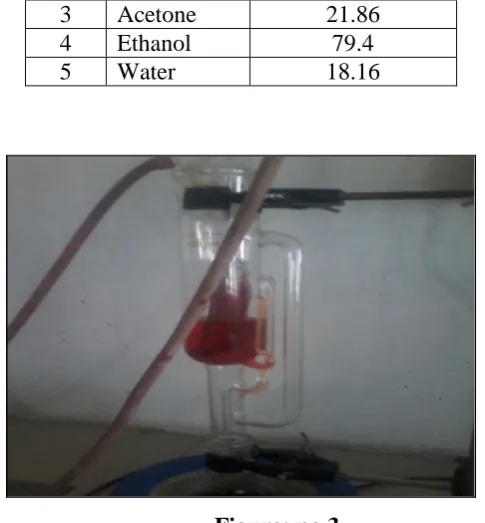
Soxhlet Apparatus
Figure: no 3
Procedure
Finely ground crude drug is placed in a porous bags or thimble made of strong filter paper
[image:4.595.177.420.413.675.2]3.acetone, 4.Ethanol.5.Water) is heated &its vapour is condensed in condenser. The
condensed extractant drips into the thimble containing crude drug. When the level of liquid in
chamber rises to the top of siphon tube, the active constituents of Chamber siphon tube into
the flask, thus emptying the body of extractor.This alternation of filling & emptying the body
of extractor goes on continuously. The soluble active constituents of a drug remain in the
flask while the solvent is repeatedly voltilised. The process of filling & emptying of the
extractor is repeated until the drug is exhausted
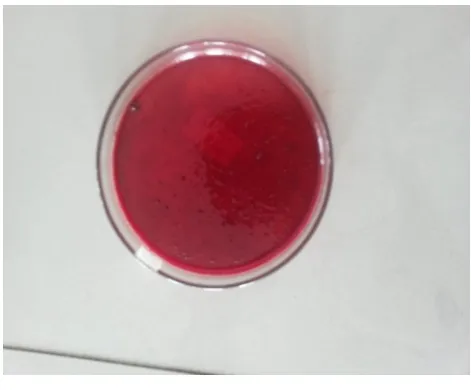
[image:5.595.179.415.249.444.2]Extract Made By Soxhlet Apparatus
Fig. 4
Table: 2 Percent Yield by Soxhlation
Sr. no Solvent % Yield
1 Benzene 4.3
2 Chloroform 7.80
3 Acetone 12
4 Ethanol 70.13
5 Water 15.8
Advantages
The main advantage of soxhlat extraction is that it is a continuous process.
Isolate desired oil when it has limited solublity in a solvent and when impurity is
insoluble in a solvent.
SELECTION OF HERBS
The various herbs used in the formulation of natural dye lipsticks wereselected on the basis of
EXTRACTION OF COLOUR PIGMENTS
The shade dried coarsely powdered seeds of Beta vulgaris (100gms) were extracted with
methanol (60-80ºC) for half hrs. After completion of extraction, the defatted extract was
filtered while hot through Whatman filter paper (No.10) to remove any impurities if present.
The extract was concentrated by vacuum distillation to reduce the volume to 1/10; the
concentrated extract was transferred to 100 ml beaker and the remaining solvent was
evaporated in petriplates. Dark reddish coloured extract was obtained. The concentrated
extract was then kept in desiccators to remove the excessive moisture. The dried extract was
packed in air tight glass container for further studies.Coloring agent betanine can be obtained
from beetroot by milling followed by pressing, filtration and evaporation of the resulted juice
FORMULATION
Wax mixture
Gloss and hardness of lipsticks are hardly depends on the characteristics and the quantity of
the waxes used. So the composition of the wax mixture is of prime importance.
Oil mixture
The oil mixture is required to blend properly with the waxes to provide a suitable film on the
applied lip. It’s also acts as a dispersing agent for insoluble pigments. Ideal mixture is one
which enables the product to spread easily.
Colour
The color of the lipstick is most important from commercial and appealing view. The color is
imparted to the lips in two ways;By straining the skin with a solution of dyestuff which can
penetrate the outer layer of the lip skin .by covering the lips with a colored layer.
Preservatives
These are used prevent growth of microorganisms.
Perfume: To mask theodor.
Table 3: Formulation Table
Sr.No Ingredient Quantity Taken Uses
1 Bees wax 14 g Glossiness
2 Whites soft paraffin 6 g Glossiness
3 Oilve oil 6 ml Blending
5 Acacia - surfactant
6 Lemon juice 1ml Anti-oxidant
7 Vitamin E 1 ml Anti-oxidant
8 Vanilla essence 1 ml Preservative
9 Perfume q.s Perfume
GENERAL MANUFACTURING PROCEDURE
First, the raw ingredients for the lipstick are melted and mixed—separately because of the
different types of ingredients used. One mixture contains the solvents, a second contains the
oils, and a third contains the fats and waxy materials. These are heated in separate stainless
steel or ceramic containers. The solvent solution and liquid oils are then mixed with the
colour pigments.
After the pigment mass is prepared, it is mixed with the hot wax. The mixture is agitated to
free it of any air bubbles. Then it is poured into tubing molds, cooled, and separated from the
moulds.
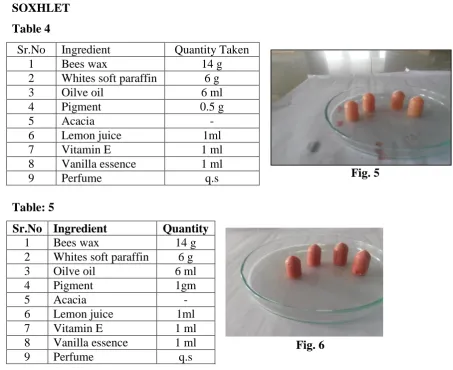
[image:7.595.60.514.371.741.2]SOXHLET
Table 4
Fig. 5
Table: 5
Fig. 6
Sr.No Ingredient Quantity Taken
1 Bees wax 14 g
2 Whites soft paraffin 6 g
3 Oilve oil 6 ml
4 Pigment 0.5 g
5 Acacia -
6 Lemon juice 1ml
7 Vitamin E 1 ml
8 Vanilla essence 1 ml
9 Perfume q.s
Sr.No Ingredient Quantity
1 Bees wax 14 g
2 Whites soft paraffin 6 g
3 Oilve oil 6 ml
4 Pigment 1gm
5 Acacia -
6 Lemon juice 1ml
7 Vitamin E 1 ml
8 Vanilla essence 1 ml
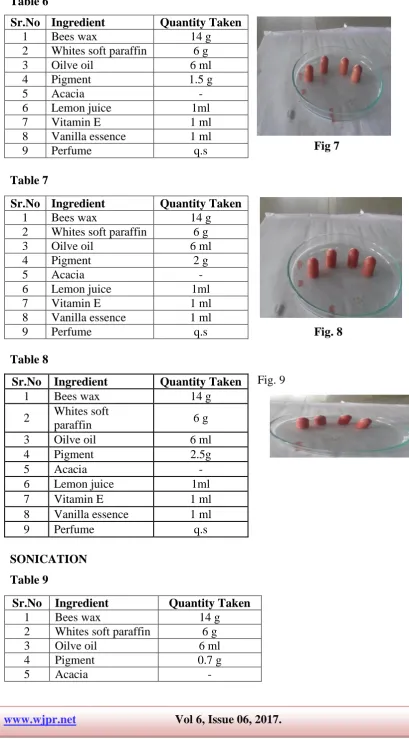
Table 6
Fig 7
Table 7
Fig. 8
Table 8
Fig. 9
SONICATION
Table 9
Sr.No Ingredient Quantity Taken
1 Bees wax 14 g
2 Whites soft paraffin 6 g
3 Oilve oil 6 ml
4 Pigment 1.5 g
5 Acacia -
6 Lemon juice 1ml
7 Vitamin E 1 ml
8 Vanilla essence 1 ml
9 Perfume q.s
Sr.No Ingredient Quantity Taken
1 Bees wax 14 g
2 Whites soft paraffin 6 g
3 Oilve oil 6 ml
4 Pigment 2 g
5 Acacia -
6 Lemon juice 1ml
7 Vitamin E 1 ml
8 Vanilla essence 1 ml
9 Perfume q.s
Sr.No Ingredient Quantity Taken
1 Bees wax 14 g
2 Whites soft
paraffin 6 g
3 Oilve oil 6 ml
4 Pigment 2.5g
5 Acacia -
6 Lemon juice 1ml
7 Vitamin E 1 ml
8 Vanilla essence 1 ml
9 Perfume q.s
Sr.No Ingredient Quantity Taken
1 Bees wax 14 g
2 Whites soft paraffin 6 g
3 Oilve oil 6 ml
4 Pigment 0.7 g
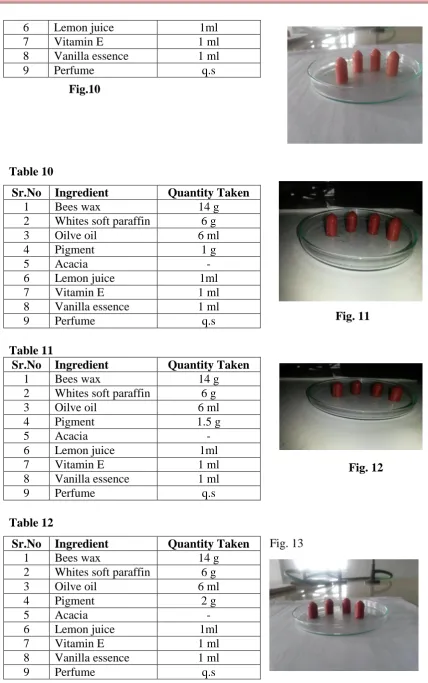
Fig.10
[image:9.595.63.492.52.736.2]
Table 10
[image:9.595.350.488.78.194.2]Fig. 11
Table 11
Fig. 12
Table 12
Fig. 13
6 Lemon juice 1ml
7 Vitamin E 1 ml
8 Vanilla essence 1 ml
9 Perfume q.s
Sr.No Ingredient Quantity Taken
1 Bees wax 14 g
2 Whites soft paraffin 6 g
3 Oilve oil 6 ml
4 Pigment 1 g
5 Acacia -
6 Lemon juice 1ml
7 Vitamin E 1 ml
8 Vanilla essence 1 ml
9 Perfume q.s
Sr.No Ingredient Quantity Taken
1 Bees wax 14 g
2 Whites soft paraffin 6 g
3 Oilve oil 6 ml
4 Pigment 1.5 g
5 Acacia -
6 Lemon juice 1ml
7 Vitamin E 1 ml
8 Vanilla essence 1 ml
9 Perfume q.s
Sr.No Ingredient Quantity Taken
1 Bees wax 14 g
2 Whites soft paraffin 6 g
3 Oilve oil 6 ml
4 Pigment 2 g
5 Acacia -
6 Lemon juice 1ml
7 Vitamin E 1 ml
8 Vanilla essence 1 ml
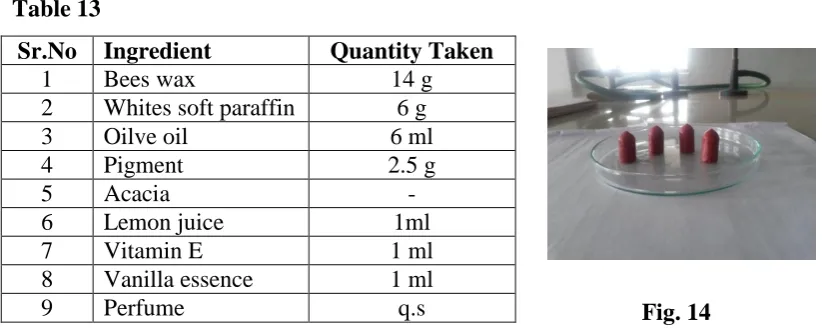
Table 13
Fig. 14
Preliminary Phytochemical Screening:
Figure: No 16
CHEMICAL TESTS
Table 14
A. Test for Alkaloids Inference
(Sonication)
Inference (Soxhlet
)
1. Mayer’s Test + +
2. Dragandroff’s Test + +
3. Wagner’s Test + +
4. Hager’s Test + +
B. Test for Tannins
1. 5% FeCl3 + +
2. Lead Acetate + +
3. Bromine water + +
C. Test for Steroids
1. Liebermann Test + +
2. Salkowaski Test + +
D. Test For Glycosides
1. Antharquinone Test _ _
Sr.No Ingredient Quantity Taken
1 Bees wax 14 g
2 Whites soft paraffin 6 g
3 Oilve oil 6 ml
4 Pigment 2.5 g
5 Acacia -
6 Lemon juice 1ml
7 Vitamin E 1 ml
8 Vanilla essence 1 ml
[image:10.595.66.484.75.240.2]2. Killer-Killani Test _ _
3. Brontrager’s Test _ _
4. Modified Brontrager’s Test _ _
5. Saponin Test _ _
EVALUATION OF TEST
Melting point
Determination of melting point is important as it is an indication of the limit of safe storage.
The melting point of formulated lipstick was determined by capillary tube method, the
capillary was filled and keep in the capillary apparatus and firstly observed the product was
slowly-slowly milted. After sometimes observed product wascompletely melted. The above
procedure was done in 3 times and the melting point ratio was observed in all formulation.
Breaking point
Breaking point was done to determine the strength of lipstick. The lipstick was held
horizontally in a socket inch away from the edge of support. The weight was gradually
increased by a specific value (10 gm) at specific interval of 30 second and weight at which
breaks was considered as the breaking point.
Force of application
It is test for comparative measurement of the force to be applied for application. A piece of
coarse brown paper kept on a shadow graph balance and lipstick was applied at 45º angle to
cover a 1 sq. Inch area until fully covered. The pressure reading is an indication of force of
application.
Surface anomalies
This was studied for the surface defects, such asno formation crystals on surfaces, no
contamination by moulds, fungi etc.
Aging stability
The products were stored in 40ºC for 1 hrs. Various parameters such as bleeding,
crystallization of on surface and ease of application were observed.
Solubility test
pH parameter
The pH of formulated herbal lipsticks were determined using pH meter.
Skin irritation test
It is carried out by applying product on the skin for 10 min.
Perfume stability
The formulated herbal lipsticks were tested after 30 days, to record fragrance.
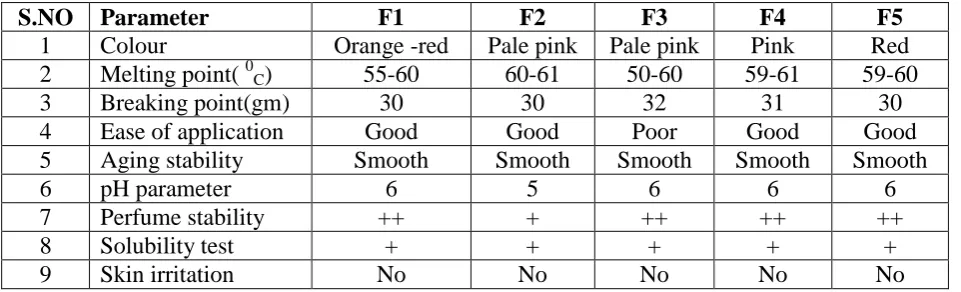
Table 15: Evaluation test results for lipstick prepared by using colour pigments
obtained by Soxhlet extract.
S.NO Parameter F1 F2 F3 F4 F5
1 Colour Orange -red Pale pink Pale pink Pink Red
2 Melting point( 0C) 55-60 60-61 50-60 59-61 59-60
3 Breaking point(gm) 30 30 32 31 30
4 Ease of application Good Good Poor Good Good
5 Aging stability Smooth Smooth Smooth Smooth Smooth
6 pH parameter 6 5 6 6 6
7 Perfume stability ++ + ++ ++ ++
8 Solubility test + + + + +
9 Skin irritation No No No No No
Table No 16: Evaluation test results for lipstick prepared by using colour pigments
obtained by Sonication extract.
[image:12.595.60.541.278.424.2]RESULT
Table 17: Percent of extract by different extraction techniques in different solvent
Sonication Soxhlation
Benzene 5.5% 4.3%
Chloroform 12.6% 7.80%
Acetone 21.86% 12%
Ethanol 79.04% 70.13%
S.NO Parameter S1 S2 S3 S4 S5
1 Colour White Pale pink Pale pink Pink Deep red
2 Melting point (0C) 55-60 60-61 50-60 59-61 62-63
3 Breaking point (gm) 30 30 32 31 30
4 Ease of application Good Good Poor Good Easy
5 Aging stability Smooth Smooth Smooth Smooth Smooth
6 pH parameter 6 5 6 6 6
7 Perfume stability ++ + ++ ++ ++
8 Solubility test + + + + +
Water 18.16% 15.8%
From the observation of the table
The sonication process was given the highest percentage yield (%) of extract as compared to
the soxhlation method as per showing above table.
By Statistical Analysis
Graph Figure No -18
From the above statistical analysis
The soxhletion method was given less percentage of extract as compared to the sonication
process as per shown.
CONCLUSION
By comparative extraction technique study we concluded that by sonication extraction
technique % yeild of extract increases presence of phytochemical contituents also maximum
in the same extract. The objectives achieved were to minimize side effects and develops a
standard formulation of lipstick, to prepare standard lipstick formulation develops new
formula for lipstick, to promote use of natural dyes and natural formulations, to increase use
of natural formulation over the synthetic, to formulate cost effective product by using natural
dyes, to utilize vast range of different natural colors and imparted better properties over
REFERENCES
1. Deshmukh Swati et. al. Formulation and evaluation of natural lipsticks prepared from
beta vulgaris root extract and their comparative study, Int J Pharm Pharm Sci., 5(4):
68-70.
2. Kruthika Swetha et. al, Formulation and Evaluation of Natural Lipstick from Coloured
Pigments of Beta vulgaris Taproot. Research and reviews: Journal of Pharmacy and
Pharmaceutical sciences, 2014; 3(3): 65-71.
3. Sahu Ghanshyam Singh et, al Formulation and characterization of herbal lipstick
containing Beta vulgaris Linn International Journal of PHARMACEUTICAL AND
BIOMEDICAL RESEARCH Received: 12 Nov 2014 / Revised: 18 Nov 2014 /
Accepted: 18 Nov 2014 / Online publication: 02 Dec 2015 , ISSN No: 0976-0350
4. Singh Bhupinder et,al, Chemical composition, functional properties and processing of
Beetroot—a review, International Journal of Scientific & Engineering Research,
January-2014; 5(1). ISSN 2229-5518.
5. Chavan, R S; Khadke, A P., Synthesis and Biological Evaluation of Novel Indolyl
Isoxazoline Derivatives as Analgesic and Anti-inflammatory Agents, Asian Journal of
Chemistry; Ghaziabad24.6 (2012): 2711-2716.
6. Khadke A P., 2D-QSAR Study of Novel Oxazoline Benzyl Ester Derivatives as