PREPARATION AND CHARACTERIZATION OF IBUPROFEN
COCRYSTALS BY USING SOLVENT DROP GRINDING METHOD
Zalte Amar Gangadhar*, Darekar Avinash Bhaskar, Gondkar Sheetal Bhaskar, Saudagar Ravindranath Bhanudas
KCT’s R. G. Sapkal College of Pharmacy, Anjaneri, Nashik, Maharashtra, India.
ABSTRACT
Ibuprofen is a non-steroidal anti-inflammatory BCS class II drug of
low solubility and high permeability. Pharmaceutical cocrystals of
Ibuprofen were prepared with cocrystal formers, such as benzoic acid,
3-aminobenzoic acid, and cinnamic acid, to improve drug
solubility.Solvent drop grinding method was successful to make
Ibuprofen cocrystals. All new crystalline forms were characterized by
IR spectroscopy, differential scanning calorimetry, and X-ray
diffraction to confirm their purity and homogeneity. Cocrystals with
benzoic acid, 3-aminobenzoic acid and cinnamic acid showed a faster
powder dissolution rate than the reference active pharmaceutical ingredient (API). Cocrystals
of Ibuprofen with benzoic acid showed the highest solubility (7 times as compared with API)
while cocrystals with Ibuprofen and 3-aminobenzoic acid and cinnamic acid showed
comparably good solubility (3 times faster than the API) up to 60 min. The study showed
cocrystals is an emerging trend to modify physicochemical properties of drug to enhance
their pharmaceutical properties.
Keywords: Cocrystals, Cocrystallization, Ibuprofen, Grinding. 1.INTRODUCTION
The improvement of the physicochemical properties, biopharmaceutical and in-vivo of active
pharmaceutical ingredients (APIs) has becomea major concern in the pharmaceutical
industry. Both branded and generic pharmaceutical companies spend considerable efforts and
resources on the discoveryofnew crystalline forms of their APIs. This intense research has
been driven by the need for improving undesirable properties of APIs witnessed in the
commercialization pipelines1,2. Pharmaceutical cocrystals is reliable method to improve drug
Volume 3, Issue 4, 1392-1402. Research Article ISSN 2277 – 7105
Article Received on 18 April 2014,
Revised on 14 May 2014, Accepted on 07 June 2014
*Author for Correspondence
Zalte Amar Gangadhar
KCT’s R. G. Sapkal College of
Pharmacy, Anjaneri, Nashik,
physicochemical and mechanical properties such as solubility, dissolution rate, stability
hygroscopisity, compressibility and in vivo performance without altering their
pharmacological behavior and, hence, are a potential new alternative in the selection of
optimal solid forms in drug product development3,4. Pharmaceutical cocrystals can be defined
as crystalline complexes of two or more neutral molecular constituents bound together in the
crystal lattice through non-covalent interactions, primarily hydrogen bonding5. The resulting
multi-component crystalline phase maintains the intrinsicactivity of the parent API.The
screening of cocrystal is based upon some traditional methods such as solvent evaporation,
crystallization from melts and grinding6,7.Cocrystals can be considered for non-ionizable
drugsfor which salts cannot be attained. Also, for ionizable drugs, the number of suitable
cocrystal ligands can exceed the number ofsuitablecounterions8.
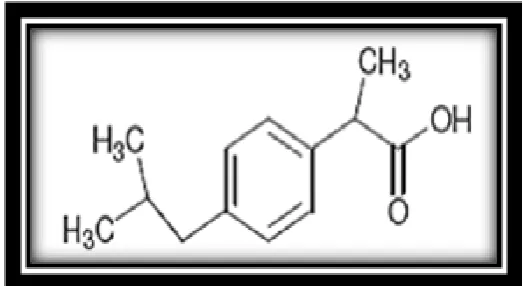
Ibuprofen [(+/ -) 2 -(p- isobutylphenilpropanoic acid (CH3)2CHCH2-C6H4CH3CHCO2H] is
well known as a non-steroidal anti- inflammatory (NSAID), analgesic and antipyretic agent.
It is a weakly acidic drug having high permeability through stomach because it remain99.9 %
unionize in stomach (pKa of Ibuprofen- 4.43, pH of gastric fluid - 1.2). Ibuprofen mostly
permeable through stomach but due to its solubility limitation it can’t enter in to systemic
circulation and gastric empting time is 30 min to 2 hr. After this time ibuprofen goes in to
small intestine where it is solubilised but can’t permeate through its membrane (Ibuprofen
having pH dependedsolubility and permeability). To improve dissolution of such drug is
challenging and rational. However, commercially available ibuprofen particles are needle like
with rough surfaces and show poor flowability, poor compaction behaviour and a tendency to
stick to the tablet punches. To overcome these problems, a suitable size and shape of
[image:2.595.166.431.575.718.2]ibuprofen crystal is desirable that could be directly compressed9.
Pharmaceutical cocrystals of Ibuprofen were prepared with cocrystal formers, such as oxalic
acid, benzoic acid, 3-aminobenzoic acid, 4-aminobenzoic acid, urea, salicylic acid, cinnamic
acid, succinic acid and citric acid, to improve drug solubility. Solvent drop grinding method
was used as it is a ecofriendly method. New crystalline forms were characterized by IR
spectroscopy, differential scanning calorimetry, and X-ray diffraction to confirm their purity
and homogeneity.
2. MATERIALS AND METHODS 2.1 Materials
Ibuprofen was received as a gift sample from the Kaytross ACG Life Sciences Ltd.,
Maharashtra, India. Other chemicals and solvents were obtained from different commercial
suppliers.
2.2 Preparation of Cocrystals
Pharmaceutical cocrystals of Ibuprofen were prepared with different cocrystal formers using
solvent drop grinding method. Ibuprofen- Benzoic acid, 3- minobenzoic acid and cinnamic
acid cocrystal was prepared by grinding 1:1 molar ratio in a pestle and mortar for 180
minutes with addition of a few drops of methanol. The solid powder wasthen scratched from
walls of mortar and stored in vial.The solid obtained in experiments were then characterized
using various analytical techniques.
3. PRELIMINARY CHARACTERIZATION 3.1 Melting point
Melting point of the sample Ibuprofen- benzoic acid, 3- aminobenzoic acid and cinnamic acid
cocrystalwere determined by open capillary method by using melting point apparatus. The
melting point was done in triplicate. (Omega Scientific Industries, India).
3.2 IR Spectroscopy
Infrared spectroscopy analysis of Ibuprofen- Benzoic acid, 3- aminobenzoic acid and
cinnamic acid cocrystal 1:1 was performed by Attenuated Total Reflectance (ATR Bruker
Alpha).
3.3 Differential scanning calorimetry
The DSC thermogram of Ibuprofen- Benzoic acid, 3- Aminobenzoic acid and cinnamic acid
data station. The DSC measurements were performed on a DSC 60, Shimadzu, Japan
instrument.Accurately weighed sample were placed in a sealed aluminium pans before
heating under nitrogen flow (20ml/min) at a scanning rate of 100c/min. An empty aluminium
pan was used as a reference. Melting point was determined for identification of API and
cocrystal former.
3.4 X-ray Diffraction
For characterization of crystalline state, the powder x-ray diffraction (XRD) pattern of
Ibuprofen- Benzoic acid, 3- Aminobenzoic acid and cinnamic acid cocrystal1:1 was
determined. Powder X-ray diffraction (XRD) was carried out using a Bruker AXS Advance
D-8 scanner with filter Ni, Cu- Kά radiation, voltage 40kV and a current 20mA. The
scanning rate employed was 10/min over the 50 to 500 diffraction angle (2Ɵ) range.
3.5 Scanning Electron Microscopy
Scanning electron microscopy of Ibuprofen- Benzoic acid, 3- Aminobenzoic acid and
cinnamic acid cocrystal1:1 was carried to determine the external morphology. The sample
was mounted directly onto the SEM sample holder using double sided sticking tape and
images were recorded at the required magnification at acceleration voltage of 10 kV using
scanning electron microscope (JSM 6930, Jeol Datum Ltd. Japan).
3.6 Phase Solubility
The phase solubility of Ibuprofen- Benzoic acid, 3- Aminobenzoic acid and cinnamic acid
cocrystal was determined. The solubility of drug and cocrystals were determined by taking an
excess amount of drug (50 mg), cocrystals(equivalent to 50 mg of drug) and added them in
10 ml of above solvent, in vials. The samples were kept at equilibrium for a period of 72
hrsin incubator at 37± 0.50C with occasional shaking. The supernatant collected from vials
was filtered through whatman filter paper and analyzed by UV-Visible spectrophotometer
(V630, Jasco) at respective wavelength.
3.7 Flow properties
Flow properties and compressibility were determined by determining bulk density, tapped
4. RESULT AND DISCUSSION 4.1 Melting point determination
Melting point of the drug sample and cocrystals were determined by open capillary method
[image:5.595.73.524.383.717.2]by using melting point apparatus and found to be shown in Table 1.
Table no. 1: Melting point of Ibuprofen, Cocrystal former and cocrystals
Sr.no. Sample Observed Melting
point (0C)
1 API Ibuprofen 74-78
2
Cocyrstal former
Benzoic acid
3-aminobenzoic acid Cinnamic acid
120-123 176-179 130-134
3
Corystals Ibuprofen- benzoic acid
Ibuprofen- 3-aminobenzoic acid Ibuprofen- Cinnamic acid
56-62 62-68 63-68
It was found that melting point of cocrystals get decreased as compared to API and cocrystal
former.
4.2 IR Spectroscopy
A B
C
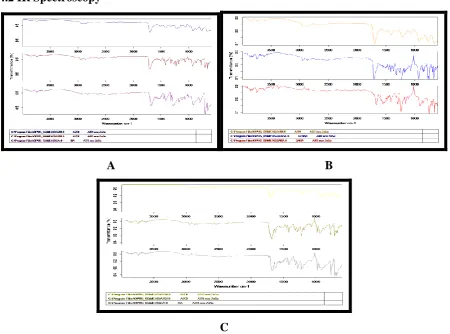
Infrared spectroscopy helps in preliminary identification of new crystalline form. From
comparison indicated shifts at peaks of functional group represents the new crystalline form.
It is confirmed from shift at –C=O stretch and also C-O stretch strongly indicate formation of
hydrogen bond in between Ibuprofen and benzoic acid, 3-aminobenzoic acid and cinnamic
acid.
4.3 Differential Scanning Calorimetry (DSC):
A B
50.00 100.00 Temp [C] -30.00 -20.00 -10.00 0.00 mW DSC
56.61x100C Onset
63.69x100C Endset
58.47x100C Peak
-656.19 x100mJ Heat
-25.48x100mW Heig ht
Thermal Analysis Result
50.00 100.00 150.00
Temp [C] -20.00 -10.00 0.00 mW DSC
63.04 x100C Onset
69.93 x100C Endset
65.63 x100C Peak
-413.67 x100mJ Heat
-16.77x100mW Heig ht
Thermal Analysis Result
50.00 100.00 150.00
Temp [C] -30.00 -20.00 -10.00 0.00 mW DSC
64.60 x100C Onset
72.47 x100C Endset
66.14 x100C Peak
-431.06x100mJ Heat
-20.81x100mW Heig ht
Thermal Analysis Result
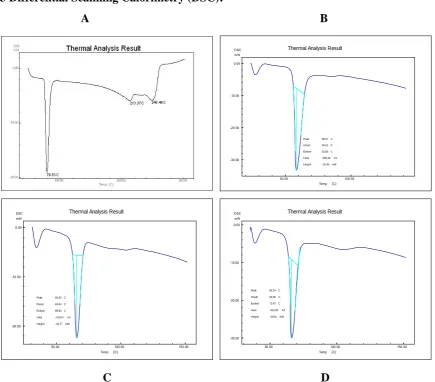
[image:6.595.81.517.199.581.2]C D Figure 3: A: DSC thermogram of Ibuprofen.
B: DSC thermogram of Ibuprofen- benzoic acid.
C:DSC Thermogram of Ibuprofen- 3- amino benzoic acid. D: DSC Thermogramof Ibuprofen-cinnamic acid.
The DSC thermogram of Ibuprofen- Benzoic acid, 3- aminobenzoic acid and cinnamic acid
cocrystals was recorded by using a differential scanning calorimeter with a computerized data
station.DSC experiment was carried out to study the thermal behaviour of the Ibuprofen-
endothermic peak maxima at 58.47, 65.63 0C and 66.140C due to melting of cocrystals. The
thermal behaviour was distinct, with a different melting transition from that seen with either
of the individual component; this suggest formation of new phase cocrystals. The melting
point of cocrystals was found to be below the melting point of both the drug and cocrystal
former.
A single endothermic transition for the cocrystals indicates the absence of any unbound or
absorbed solvent or water and also demonstrates the stability of the phase until the melting
point.
4.4 X-Ray Diffraction AZBX
Operations: Smooth 0.150 | Background 0.037,1.000 | Import
File: SAIFXR130508D-07(AZBX).raw - Step: 0.020 ° - Step time: 32.8 s - WL1: 1.5406 - kA2 Ratio: 0.514 - Generator kV: n.a. - Generator mA: n.a. - Type: 2Th/Th locked
L in (C o u n ts) 0 1000 2000 3000 4000 5000 6000 7000 8000 9000 10000 11000 12000 13000
2-Theta - Scale
3 10 20 30 40 50 60
AZABAX
Operations: Smooth 0.150 | Background 0.037,1.000 | Import
File: SAIFXR130508D-08(AZABAX).raw - Step: 0.020 ° - Step time: 32.8 s - WL1: 1.5406 - kA2 Ratio: 0.514 - Generator kV: n.a. - Generator mA: n.a. - Type: 2Th/Th locked
L in (C o u n ts) 0 1000 2000 3000 4000 5000 6000 7000 8000
2-Theta - Scale
3 10 20 30 40 50 60
A B AZDX
Operations: Smooth 0.150 | Background 0.120,1.000 | Import
File: SAIFXR130508D-06(AZDX).raw - Step: 0.020 ° - Step time: 32.8 s - WL1: 1.5406 - kA2 Ratio: 0.514 - Generator kV: n.a. - Generator mA: n.a. - Type: 2Th/Th locked
L in (C o u n ts) 0 1000 2000 3000 4000 5000 6000 7000 8000 9000 10000 11000 12000 13000 14000 15000 16000 17000 18000 19000 20000 21000 22000 23000 24000
2-Theta - Scale
3 10 20 30 40 50
AZCX
Operations: Smooth 0.150 | Background 1.000,0.000 | Import
File: SAIFXR130508D-09(AZCX).raw - Step: 0.020 ° - Step time: 32.8 s - WL1: 1.5406 - kA2 Ratio: 0.514 - Generator kV: n.a. - Generator mA: n.a. - Type: 2Th/Th locked
L in (C o u n ts) 0 1000 2000 3000 4000 5000 6000 7000 8000 9000
2-Theta - Scale
3 10 20 30 40 50 60
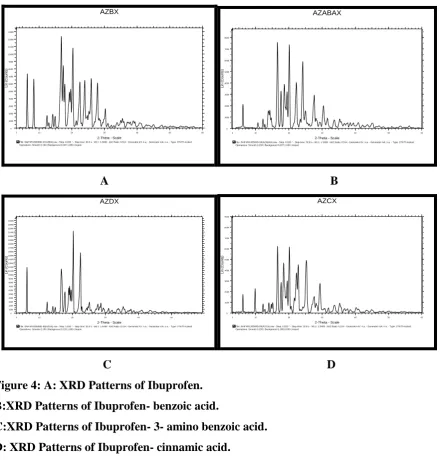
[image:7.595.78.519.272.733.2]C D Figure 4: A: XRD Patterns of Ibuprofen.
B:XRD Patterns of Ibuprofen- benzoic acid.
The pure Ibuprofen and IBU-BA exhibited intense crystalline peak between 50 to 500.
Characteristic diffraction peaks at 6.20, 16.60, 17.70, 20.20, 22.40, 25.10, 27.70and 28.60were
observed with intense peak at 20.20 indicating crystalline nature of Ibuprofen.Ibuprofen-
benzoic acid shows characteristic at 6.30, 8.30,16.70, 17.30, 20.30, 22.40, 23.90,25.90and
27.80and intense peak was observed at 16.70 indicating crystalline nature of IBU-BA. The
shift in intense peak indicate formation of new crystalline form. Ibuprofen- 3- amino benzoic
acid shows characteristic at 6.10, 14.20,16.40, 17.50, 20.10, 22.20and 24.10 and intense peak
was observed at 16.40 indicating crystalline nature of IBU-3ABA. The shift in intense peak
indicate formation of new crystalline form. Ibuprofen- cinnamic acid shows characteristic at
6.10, 9.810,16.30, 18.40, 19.40, 19.90, 22.20, 22.70,25.20and 29.30 and intense peak was
observed at 16.30 indicating crystalline nature of IBU-CA. The shift in intense peak indicate
formation of new crystalline form.
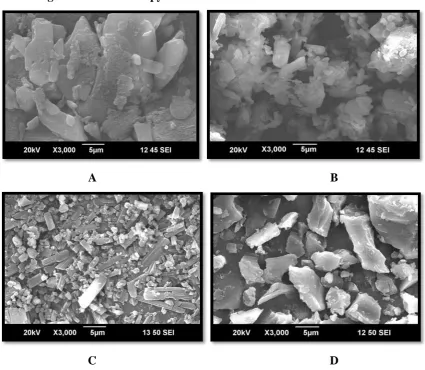
4.5 Scanning Electron Microscopy
A B
[image:8.595.84.510.346.716.2]C D Figure 5: A: Scanning Electron Microscopy of Ibuprofen.
C:Scanning Electron Microscopy of Ibuprofen. D: Scanning Electron Microscopy of Ibuprofen.
SEM of Ibuprofen indicated needle shaped fracture surface.Ibuprofen- Benzoic acid, 3-
aminobenzoic acid and cinnamic acid cocrystalsindicated change in surface morphology,
development of irregular shaped crystal were seen.
4.6 Phase solubility
Solubility studies were performed in order to analyze solubility enhancing properties of
cocrystals. Solubility studies gave the basis for selection of best ratio that is to be forwarded
for formulation. The results of the same are shown in Table 2.
Table no. 2: Phase solubility of Ibuprofen- Benzoic acid, 3- aminobenzoic acid and cinnamic acid
Sr.
No. Sample
Solubility (mg/ml)
Increase in Solubility (folds)
1 Ibuprofen 0.40 -
2 Ibuprofen-
benzoic acid 3.08 7.62
3
Ibuprofen- 3- amino benzoic
acid
1.60 3.96
4 Ibuprofen-
cinnamic acid 1.41 3.49
4.7 Flow properties
The flow properties of Ibuprofen with benzoic acid, 3-aminobenzoic acid and cinnamic
acidcocrystals have been determined and compared in Table 3shows the flowability
represented in terms of the angle of repose, Carr’s index and Hausner ratio of cocrystals were
much improved compared to those of the original drug crystals.
Table no. 3: Comparison of flow properties of Ibuprofen, Ibuprofen- Benzoic acid, 3- aminobenzoic acid and cinnamic acid
Sr. No.
Evaluation
Parameters Ibuprofen
Ibuprofen- benzoic acid
Ibuprofen- 3- amino benzoic acid
Ibuprofen- cinnamic
acid
1
Angle of
Repose 41.18 ± 0.22 24.77 ± 0.40 28.17 ± 0.17 33.17 ± 0.36
Inference Very poor Good Good Excellent
3 Tap Density 0.603 ± 0.015 0.353 ± 0.005 0.366 ± 0.015 0.370 ± 0.017
4 Carr’s index 33.33 ± 0.32 10.53 ± 0.48 12.22 ± 0.41 15.82 ± 0.19
Inference Poor Good Good Excellent
5
Hausner
Ratio 1.5 ± 0.04 1.11 ± 0.02 1.13 ± 0.02 1.18 ± 0.02 Inference Extremely
Poor Good Good Excellent
5. CONCLUSION
Ibuprofencocrystals was formed with different cocrystal formers to overcome various
problems associated with an API. Cocrystals of Ibuprofen with benzoic acid, 3-aminobenzoic
acid and cinnamic acid was prepared by using solvent drop grinding method. Cocrystals was
confirmed by melting point, ATR-IR, DSC, XRD, SEM. Cocrystals of Ibuprofen with
benzoic acid showed the highest solubility (7 times as compared with API) while cocrystals
with Ibuprofen and 3-aminobenzoic acid and cinnamic acid showed comparably good
solubility (3 times faster than the API) up to 60 min. The study successfully
demonstrateCocrystals has shown increased solubility, flow properties and compressibility.
6. REFERENCES
1. BrittainH. Polymorphism in Pharmaceutical Solids.New York: Marcel Dekker, Inc.,
1999.
2. ThayerAM. Form and function. ChemEng News2007; 85(25): 17-30.
3. Almarsson O, Zaworotko MJ. Crystal engineering of the composition of pharmaceutical
phases. Do pharmaceutical co-crystals represent a new path to improved medicines?
ChemCommun. 2004; 1889-1896.
4. Schultheiss N, Newman A. Pharmaceutical co-crystalsand their physicochemical
properties. Cryst Growth Des.2009; 9: 2950–2967.
5. Jayasankar A, Somwangthanaroj A, Shao ZJ, Rodrıguez-Hornedo N. Co-crystal
formation during cogrinding and storage is mediated by amorphous phase. Pharm Res.
2006; 23:2381-2392.
6. BasavojuS etal.Indomethacin–saccharin cocrystal: design, synthesis and preliminary
pharmaceutical characterization.Pharm Res 2008; 25(3): 530-541.
7. VishweshwarP et al. Pharmaceutical co-crystals.J Pharm Sci 2006; 95(3): 499-516.
8. Childs SL, Hardcastle KI. Cocrystals of piroxicam with carboxylic acids.Cryst Growth &
9. Patel R., Patel N., Patel N. N. and Patel M.N.(2010). A novel approach for dissolution
enhancement of Ibuprofen by preparing floating granules. Int. J. Res. Pharm. Sci., 1(1):
57- 64.
10.Pavia D.L., Lampman G.M., Kriz G.S. et.al. Spectroscopy.Ed.4, Cennage Learning
Pvt.Ltd.2007:26-107.
11.Indian Pharmacopoeia, Ed 6th, published by the Indian Pharmacopeia Commission,
Ghaziabad, (2010); 1: 111, 140, 147, 171, 175, 185-198.
12.R.C. Rowe, P.J. Sheskey, M.E. Quinn. Handbook of Pharmaceutical Excipients, 6th
edition: 404-406, 728-730, 129-133.
13.Clarke'sAnalysis of Drugs and Poisons, 3rd edition, Pharmaceutical press: 1125
14.British Pharmacopoeia 2009, Vol -I ,Department of Health London: The Stationary
Office 2009: 232, 489, 1048-1050.
15.Scott L. Childs. Metronidazole cocrystals and Imipramine cocrystals. US8163790B2.
16.N.S. Schultheiss et.al. Pterostilbene Cocrystals. US2011/0189275A1.
17.Tieh-kang Wu, Shan-Yang Lin, Hong-Liang Lin, Yu-Ting Huang. Simultaneous
DSC-FTIR microspectroscopy used to screen and detect the co-crystal formation in real time.
Bioorganic & Medicinal Chemistry Letters, 2011, 21: 3148–3151.
18.PalashSanphui, N. Rajesh Goud, U. B. RaoKhandavilli, AshwiniNangia. Fast Dissolving
Curcumin Cocrystals. Crystal Growth & Design, 2011, 11: 4135–4145.
19.J. H. ter Horst, M. A. Deij, P. W. Cains. Discovering New Co-Crystals. Crystal Growth &
Design, 2009, 9(3): 1531-1537.
20.G. Patrick Stahly. A Survey of Cocrystals Reported Prior to 2000. Crystal Growth &
Design, 2009, 9(10): 4212–4229.
21.Sreya M. Crystal engineering of Pharmaceutical Co-crystals. Theses and Dissertations,
2011, Paper 3258. http://scholarscommons.usf.edu/etd/3258.
22.Guidance for Industry .Regulatory Classification of Pharmaceutical Co-Crystals. U.S.
Department of Health and Human Services Food and Drug Administration Center for
Drug Evaluation and Research (CDER), December 2011.
http://www.fda.gov/Drugs/GuidanceComplianceRegulatoryInformation/Guidances/defaul