American
Journal of Computational Linguistics
COMPUTER
UNDERSTAND
I NG
OF
P H Y S I C S
P R O B L E M S
STATED
I N
I~ATURAL
LANGUAGE
Computer Science Department University of Texas
Austin 7 8 7 1 2
Microfiche 5 3
C o p y r i g h t @ 1976'
T h i s palltar dcsrril)es n conrpu t or program, r i ~ lled ISAA(:. \\*hi~-h ($;In rc!:~(i, underst a n d , s o l w , nntl d r a w pic~.t-iil.cs 01' pl~ysicss p s ~ h l c n ~ s stnt ocl ita 1S1lglish. l'he program has solsrd t ~vi'nty problems. most of tvhic.11 wcrll' t alicb11 unedit rtl fsonl high
school and collihge physics t tlxts. Those p r o h l c ~ n s i~lvol\.e taigicl hod icis in st at ic.
equilibrium, a n d i n c l ~ i d t ~ 411cbh objec'ts .as Icv~1,s. pivots, ivrights, ~*ol,cs, anti s1)rings in
various configurations. An exanlpltl of the r.l;tss of' p1.c)t)lems sol\?ecl is the follo\ving (from Scilcru nl ',s Out l i r ~ of C O I I C ~ C J /,'/l?si~*s ):
The foot of n ladtlcr rrsts i t n vcrtic*nl i and o n :I t ~ o ~ , i x o ~ ~ t a t
floor. T h c top of' the l;\clcltlr is s t l p p t n . ~ ~ d f'ronl t l l t l \vall t)y n hot%izotlt;\l
rope 3 0 ft long. l'hc 1;idtlcl is 50 St 10111, \veighs 100 11) \ ( i t \ ) its c,entriS of
gravity 20 ft fl*om thv foot. ancl a 150 111 marl is 10 1'1 fro111 the to\).
Deternlinu the tension in the i s o l ~ t ~ .
In order. to understancl allti sol\.t. such a pi.oblu~n, it is necessar_v to build a n itltrrnal model of the problelli ill ivtlic11 the various objt'cts and the11 i~lter~*elationsllips are adequately represented. Milny of the ~ . t s l i l t ionships ;I n d feat ulwrs o f the ohjerts a r e not
specified explicitly in the problein st;ltc~nrnt hut m u s t be infe~*re(l by usi~lg conlnloll serlse kno\vlccige of what is usual. I n the al)o\v esamplc, we ;*sume that .the m a r is
standing or1 tlie ladtlcr, i~lth(,ugh this is not esl)licitly stittetl. T t l u s , the untle~*st;ln(ling of
a physics psobletn is a n acti\tPpl-ocess in \Chic11 the Cet~tences of' the prol~lenl statement a r e used to guide the construction of a model which roprt.sants the relationships ant!
features of objects with ~ n u c h , greater . detail a n d spcciticity t'halt they a r e specif'iec! in t l ~ c
original probletn sta t e m e ~ t .
I n this l)npf?)., ive in\.estigate ways in which tllr m e a n i t ~ g ~ of pl1rasc.s anti
sentences m a y be unclerst~oorl a n d related t o a developing n1otle.l of the problem. usltlg common sense knowledge (represet~tod .,1 com!rutes progrilrns) t o aid t h e un~lel-stand in^
process. \Va_vs of representing ot~jects a n d rileir relationships tire developecl. These representations, which a r e originally sreated in rehponse to the sentences in t h e problem statement, a r e further elal)ol*atcd by proc:esses which c0nstruct.n ~eonletricl 11lc,dei ot' the
problem, associate c a ~ l o n i c n l objerts (such a5.a point mass) 1~ir11 physical objects r s ~ l c . ! ~
a s a person), ~ v r i t e aild solve equations which tiescribe the inte1.actio11s of the objects a n d construct a diagram of the problenl,
This paper is a slightly etlitcd vel-sio1l i,f tlie ar1tllnr.s Ph.'I). disse!.t a1 ion. I
TABLE OF CON'I'ENrl'S
Page
LIST OF FIGURES
1. INTROI)T_JCTION AND O V E I i V I E W
1.1 Introduction
1.2 Ovcr\?iew of the Program
2. REVIEW
OF
PREVIOUS WORK2.1 Natural Language Problem Solvers
2.1.1 Bobrow's STUDENT
2.1.2 C h a r t ~ i a k ' s CARPS 2.1.3 Gelb's HAPPINESS
2.1.4 Heidorn's Sirnulation Programmi tlg System
2.2 Natural Language Processing
2.2.1 Woods' Augmented Transition Networks 2.2.2 Winograd's SHRDLU
2.2.3 Wilks' Prefere~ltial Semantics
2.2,4 Simmons' Senlantic Networks 2.2.5 Schank's Conceptual Dependmcy
2.3 Minsky's Fratlle System Theory
3. PARSING
3.1 Introduction
3.2 Control Structure of *he Parser
3.3 D a t a Structures Produced During Parsing
3.4 Noun Phrase Parsing
3.4.1 Basic Noun Phrase
3.4.2 Noun Phrase Co~npou%ds and Modifiers
3.4.3 Noun Phrase Variants
3.5 Verb Phrase Parsing
3.5.1 Basic Verb Group
3.5.2 Verb Phrase
3.7 Clause Parsing
3.8 Cor~clusion
4. SEMANTICS
4.1 Introduction
4.2 Preliminary Modifier Procwssing 4.3 Preposition Semantics
4.3:l Semantic's of t h e Preposition "OF"
4.3.2 Semantics of Other I'reposi tio~us
4
.
3 . 3 Ilefinition and Translatiotl of P r ~ p o s i t i o n s 4.4 Referent Identification4.4.1 Identifying 13hysic;~l Entity Referents
4.4.2 Identifying Location Ii~furtlnts
4.4.3 Attachnuent Identification
4.5 Modifier Senla t ~ t ics
4.6 Verb Semantics
4.6.1 Semantics o f the Verb "BE"
4.6.2 Selnantics of the Verb "SUPPORT"
4.6.3 Semantics of 0 t l ~ e r Verbs
4.7 Question Semantics
5. CONSTRUCTION OF OBJECT FRAkIES AXI> THE GEOMETRIC MODEI,
5 .?1 Introductioh 56
5.3 Making Canonical Object Frames 57
5.3 Geometric hlodel Co~lstruction 59
5.4 Frame Completion (3 2
5.5 Conclusioi~ 6 3
6. PROBLEM SOLVING
6.1 Generation of Equations 6.2 Equation Solviilg
6.3 Answer Generation
7. PICTURE CONSTRUCTION
7.1 Constructing the PiEture PvIodel
7.2 Drawing t h e Diagram
8. CONCLUSION
8.1 Methodology
1. Introduct,iol~ i ~ i l d Overview
'1 ,I Introduct ion
This paper describes a computer pl'ogram, called ISAAC, which is able t o read and understand physics problems stated in English, write equations for the problems and solve them, and draw diagrams showing the objects irl the problr~;ls ~ i n d their spatial relntiot~ships. The pro~~ilt11 has*solverl twenty problems. \\*hirh wertr taken
essentially ulledited born physics textbooks: some iample problems are shown, with the drawings and answers generated by the program, in Appcntiis A.
While the diagram and answer to a problem are the most e a s ~ l y observable outputs of the program, another significant output is its robust intel-11al inodel of the objects in the problem a n d their relationships. It is this model which makes possible the generation of the diagram and the answer to the problem. T h e internal nlodel is robust
in the sense t h a t it represents, in a n explicit and readily accessible form, n o s t of the inrorn~ation which a competent h u ~ n i i n reader might be expected to derive from the English problem statement. I n addition to the ways in which it is currently used, the model could be used for answering questions about the objects a n d their relationships,
or. fbr generating a description of the problem in English or in another language. or for generating other types of diagrams (such as a force diagram). Since it makes all of the
features and relationships of the objects explicit, the internal model is ma 11y t inles
larger t h a n the original problem statement. which specifies only the major features and leaves many details to be filled in by the' reader.
1.2 Overview of the Program
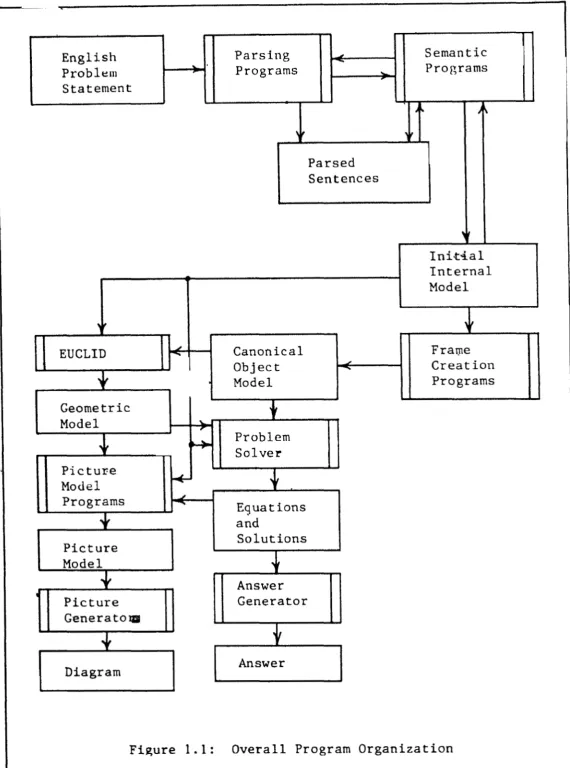
T h e overall organization of the progratn and Its data elements is shown in
Figure 1.1; programs a r e represented by boxes with double lines, and data structures by
plain boxes. I n this section, we present a n overview of the functions performed by each group of programs and a n overview of the types of information represented in the data structures.
T h e process of u n d e r s t a ~ ~ d i n g and solving a physics problem occurs in
several distinct steps. First, the problem statement is translated fro111 E tlglish into a
F i g u r e 1 . 1 : O v e r a l l Program O r g a n i z a t i o n
1
b
f
E n g l i s h Problein S t a t e m e n t
A .,
!
L .
-I
I c
A
4 L F
.
r Y)
'
Y-S e m a n t i c P r o g r a m s P a r s i n g
P r o g r a m s
P a r s e d S e n t e n c e s
> I
T
' I n i t J a l I n t e r n a l Model
Y
-
-
C a n o n i c a l
O b j e c t
1 .
EUCLf D Frame
-
1 C r e a t i o n ModelA
4
P r o g r a m s
..
-
G e o m e t r i c
Model ?
t
P r o b l e m S o l v e r P i c t u r e
Model P r o g r a m s
I
+ E q u a t i o n s
Ad r
S o l u t i o n s
P i c t u r e d
Model
.
< - i
Answer G e n e r a t o r
..
vPicture
G e n e r a t o m
_1 ,
I
*
Diagram Answer
4 A
-
[image:7.727.74.645.137.906.2]8
interactions of the objects a.ccolbding to physical laws are written a n d solved, a n d answers are generated from the solutions. Finally, a pictu1.e model is coustruc~tc~d ant1 used to guide the draw.ing of a diagram of t h e problem. 'T'hese processes arc dt.scribed below in somewhat grcatel8 dctail.
The parsing prograals transform each sentence from a linear starill:: of' words into a more structured form in whicli the relationships of words and phrases t o enoh other are clearly defined. Each type of phrnse is parsed by a specialist i)rogram which implements the grammar of the phrase a s a11 augmented transition network. The
grammar programs call the semantic programs both t o interpret the sel~lalltic network structure produced Bs a result of the parsing and to guide the parsing process itself, Whether a particular modifier can be used t o rnotiify a noun phrase, For example, may
depend on the actual relatio~lships l~etwern objects in the model of the problen~. After each clause has been parsed, the semant io lqout ine associated with the mni 11 \terb is
called to cotnplete the setnantic processi~lg of the clause. This 3et11antic processing transfers the illformation provided by the sentence to' a growing model o f the objects in
the proble~rl and their relationshiljs. Once t h e se~narltic processing is colnpleted. the semantic netxark s t r ~ l c t u r e s produced by the parser a r e no longer used. All of the sentences ill the problem statement are parsed and processed semantically before the remaining parts of the program are executed.
T h e routines grouped under the heading of "Semantic Programs" perform a variety of tasks. Semantic routines a r e associated with verbs a n d prepositions, a n d 111
some cases with other words. Preposition senl~antic routines must deternline the appropriate sense-nleaning of the preposition (using n decision net work based or1 rough
semantic classifications of the nlodif'ied phrase and the object of the prepositic,~) anri then make the, appropriate changes 111 the semantic network token of the modified phrase. Verb semantic: ruUMnes typically act to tr:~nsft.r inforrn;~tion from the semant ir
network ta the internal mtrdul. or dtll'itle relationshil~s anlong objects i11 the model;
determinatioll of the proper dense-meaning o f the verb is often uileded as well. Another major semautic task is the identification of the referent of a noun phrase. Given a n o u ~ l phrase which denotes a n object or a location, it is necessary to de.c~de whether the
phrase refers to a n object or location wlilch already exists in t h e nlodel (and if' there are
several possibilities, which one it refers t.01, or whether a new object or location must he
created as the referent of.the phrase ancl axlded to the model.
After all the sen'tences of the problem statement have been read, the frame creation programs are called t o assign to each object a ca~lonical object type (s~icll a:: a
point mass or a n "ideal" spring) which represents thr behavior of the ohject a s ~t
Pppears in the problem. The same t>-pe of actual ntlject nnay hr represented 1 ) ~ clifk~.etlt
canonical objects. depenciing o n its contest in the pr,obietn. Thus, a ;~ei.son .n::i be
represented as a pivot wheir carryllg a plank, o r a s n point moss ~ v h e n standing on ,x:e.
r C
-
22 -4 Pa
-
-
-
=L.
.
4--
+ +-r 3 4 S n 4 L' 's 3 ZC
-
+ I: 0 2. . A 3 3
2
'r,2
C
-fi
-37
3
-L'
-
4-
2
'I; . .-.
r.
-
d*
-
+ -d 5 .C? s n 4 2 C 2 5 3 'I? P C P-
--
u2.
Review of Previous WorkThis review
of
previous work, is grouped illto three sections: progriims which solve proble~ns stated ill natural lnngunge, natural langui~a processing, allti thcoreticol work.2.1 Natural Language Problem Solvers
2.1.1 Bobrow's
SfI'UI)I.:NT
The
first natural language problem-sol~ing progmm \r7ns theSTUDENT
system of Bobrow [Robrow 681 for solving algebra story problems. The natural language processing
of
this program is based on pattern matchillg around key words and phrases. T h e phrases around the key words become the "variables" in the equations which a r e constructed from the sentences. Thus. in one of Bobrow's examples,If
the number of customers Tom gets is twice the squirre of 2 0 percent of the number of advertisements he runs, and the number of advertisementshe runs is 45, what is the number of custom el*^ Tom gets?
the two phrases "the number of customers Tom gets" and "the number of
advertisements he runs" are treated a s variables. This problem is thus treated as if it
were stated
If
xis
twice the square of20
percent of y, and y is 45, what isx ?
The pattern-matching rules break the input sentences into
a possibly embedded set of "kernel sentences", in an order determined by priority values assigned to the keywords. I n the above example, since "percent" has the highest priority, it would be processed first. There is a fairly direct transformation from English sentences into equations: In fact, the transformatio~ls are made upon the input sentences themselves until the sentences become the equations used in solving the problem. Large segments of theoriginal sentences remain a s "variables" in the equations.
When the equations constructed from the input are insufficient to find a solution, other equations can be retrieved (based on words in common with "variable" phrases) expressing general relationships, such as
(EQUAL (DISTANCE) (TIMES (SPEED)
(TIME))).
can be matched properly, and the key words must, not be used in multiple ways which might confuse the pattern matcher. These limitations make it difficult to extend the techniques Bobrow used to more.cotnplex problem areas.
2.1.2 Charniak's
CARPS
Charhiak's CARPS program [Charniak 681 is a program for solving calculus rate problems. In many ways, it is an extension of Bobrow's
STUDENT
program. T h e analysis of the English input sentences is done by pattern matching which is slightly more sophisticated than that ofSTUDENT. The
type of' rate problem (distance or volume) is determined by the occurrence o f certain key words in the problem statement. Two sets of patterns are used to analyze the sentences appearing in the two types of problems. Many of the patterns used are very ad hoc.The CARPS program builds a structure (generally a single tree) containing the information derived from the problem statement. This structure is used to generate the equations required to solve the problem. Additional equations may be derived from "world knowledge", but this is again very ad hoc. Thus. while the problems solved by
CARPS
appear very impressive, the program is tailored so closely to this specific set of problems that it would be difficult to extend it to additional problems or problem areas.2.1.3 Gelb's HAPPINESS
HAPPINESS [Gelb 711 is a program which solves basic probability problems stated in English. This program seems much like Charniak's: it build's a single tree structure representing a single problem. and selects a solution method based on the occurrence of keywords in the problem statement. T h e input sentences are broken into simple clauses and phrases by pattern matching. These simple clauses are then analyzed by a context-free grammar to extract t h e canonical verb and its voice. subject.
and predicate.
If
certain key words (e.g., those referring to dice and coins) are found, a special search for possible modifiers of these words is made.This program, like Charniak's. is tailored very closely to a small set of specific problem types. It wobld be difficult to extend a program using these techniques to handle a new problem area.
2.1.4 Heidorn's Simulation Programming System
The NLPQ system of Heidorn [Heidorn 7'21 aqcepts a n English statement of a queueing simulation problem, and produces from it a program in the GPSS simulation language which will simulate the problem. The system is interactive: it requests additional information from the user when the problem statement is incomplete. allows
problem description in English from its internal model.
English sentences are parsed a n d gei~erated frotn two interpreted phrase
structure grammars augmentetl by some semantic programs. These grammars go down
to t h e character level, a n d handle English morphology as well us phrase structtire. 'l'he grammar is based in part on the theory o f stratificatio~lal linguistics. T h e basic unit of storage in the internal tnodel is the "record", which is komputationally equivalent to a
LISP atom with its property list.
This program represents a n advance over those considered previously in this
section. It uses a legitilnate grammar to parse the inpup sentences, and can constrtict a mpdel which expresses relationships among a number of ot)jjects. The grammar is specialized for simulation problems, a n d would have to be modified to extend the program t o other areas. However, the performance of this system is quite impressive.
2.2 Natural Language Processing
2.2.1 Woods' Augmented Transition Networks
Thc Augmented Transition Network (ATN) of Woods [Woods 501 is a
powerful formalisnl for representing grammars. The grammar of ISAAC, while written
in "pure" LISP, is equivalent to a n ATN grammar. A transition network consists of a set of nodes (representing states) and a set of directed arcs between the nodes which specify transitions between states based upon the input string being scanned. An ATN is
augmented in several respects. The test associated with a state transition may be arbitrarily complex, depending on the previously parsed structure a s well a s the input. T h e test may be the name of another transition network, in which case control is given to t h a t network a t a lower level, effecting a "subroutine call" to the subordinate network. These calls may be recursive. Transition arcs may also be augmented by
arbitrarily complex strhcture-building actions: T h e structures so built a r e passed among network levels in designated registers. If a n attempted parsing of a subnet fails, the ATN interpreter automatically handles backup from the failure point and tries another possible transition. T h e automatic backup and clearly defined interface (via named registers) between network levels make the ATN a very "clean" formalism for writing grammars.
2.2.2 Winograd's SHRDLU
Winograd's widely known SHRDLU program [Winograd 721 allows a person
its motivatiolls for performing particular actions. The system employs a large grammar, based on Halliday's theory of Systemic Grammar. Much of the knowledge in t hc system is represented in the form of MICRO-PLANNER theorems. This miikes it easy for programs to be generated to find the answers to questions about the world model, and allows a number of logical forms such as conjunction. disjunction, a n d qu:\ntification to be handled naturally. T h e theorem prover base is a source of c o n s i d e r ~ ~ b l e power for certain types of semantic operations. T h e semantics is made much easier hv the small. finite world of very simple objects (colored blocks). Still, the SHRDLU svstpm remains one of the largest and most powerful natural language systems produced to date, anti its
fame is well deserved.
2.2.3 Wilks' Preferential Semantics
T h e work of Wilks [Wilks 751 is unique among "artificial intelligbnce" approaches t o natural language processing in t h a t Wilks is interested primarily in machine translation, rather t h a n in deep understanding of natural I anquage by
computer. However, there is a n interesting parallel between the semantic templates used by Wilks a n d some of the semantic processing done in ISAAC. which is of course concerned with deep understanding.
In Wilks' system, a sense meaning of a n English word is represented by a
formula, which is a list of element names. T h e elements are approximately 70 s e m a n t ~ c classes which roughly classify the entities, qualities. actions, etc. which occur in English sentences. Examples of such elements are M A N (human being), STUFF (substances),
KIND
(qualities), and CAUSE (cause to happen). These elements may be combined intoa formula to represent a word meaning, a s in (FLOW
STUFF)
for the word "liquid". 4sentence is analyzed by trying t o fit a template (whicliis a list of element types) to some
of the possible sense meanings of the words occurring in the s e ~ t e n c e . T h e templates a r e intended to represent the basic types of "messages" that people wish to convev in language. For example, the template MAN BE KIND would represent the class &
messages in which the sentence "My sister is pretty" is included.
After (possibly several) templates have been fitted 3 a piece of text,
"preferences" of parts of each template are examined to
s e e
if they are satisfied. A verb. for example, may prefer a n animate subject. T h e template for which the greatest number of preferences are fulfilled will be chosen a s the intended meaning; however, possible fillers for the template slots will be accepted even though they do not meet the preferences, provided t h a t the template a s a whole is the best match.seinantic classes to distinguish between sense mea~lings of worcls, which w e follt~tl-to he particularly useful for determining pr.cl~osition meanings. Othurs hove rev-tninljt uxrtl rough seninntic classes tn distinguish srllse melulings in sporial applichtions: \Yilksl
work is valuable for investigating this techllicluu over a large subset of3Rnglish.
A second parallel lies in the ncreptnnce of 11 tvord (or lr~rger u n i t ) which t'ails
to meet the preferences of the template which rovers it. 111 the ISAAC system, this acceptance is an active process in which a11 acceptable it~terpretntion n u s t hr
constructed fro111 the given unit. These proccssrb ilre ciiscussed in more drtclil 111ter.
2.2.4 Sinlmons' Senlt~ntio Nettvorks
The Semantic Network formnlism of S i o ~ m o n s [Simmons 7:l: S i m m c ~ ~ s and Bruce i l l provides
n
po\verful and convenient method for representing the elements of asentence and the semantic relations (deri\-ed from a variety of syl~tactir forms) \ ~ h i r h
hold between them. 111 effect, it prodL~ces at1 ordei Tng of the argulhents o f L a ~ t ; . l ~ l a t ~ t l ~ ' grouping (guch as a verb a n d its case arguments, modality, and optional modlfieraj
which is invariant cnrer the various syntactic orderings which express the same relationships. Thus.
John gave Mary the book. John gave the book t o hIary.
T h e book was given t o hlary by John.
would all generate the s a m e semnntir netv-ork structure. The semantic netwo1.k
formalism has beell used for language gene]-ation [Simmons and Slot~~1111 721 A S \v(3ll 3s parsing. [Simmons and Bennett-Novak 751 shows how these structures may he usetl to
produce a small natural language understanding system with a minimum of effort.
T h e structures used by ISAAC in understanding sentenc'rs are , a n a t u r a l extension of Semantic Networks as used by Simmons, I n order to handle unultiple s ~ n t e n c e discourse, links are made from tokens in individuai senterlces to the refel-mts of the tokens in the problem model which is being co~lstructed. Semantic interpretations are placed on some tokens as their meani~lgs are determined: Particular semantic
interpretitions may be specified based on information from many different sources.
Making a n interpretation of a token may cause links to be made from that token to
objects not mentioned in the sentence and may generate additional inferences about t h e
relationships
of
the objects involved. These processes are discussed in derail in later chapters.2.2.5 Schank's Conceptual Dependency
" w
transmitted in natural language can be reyri?setlted as col-11plex structures bnsecl on a small number of primitive actions. The primitive actions are linketl by named links t o
their case arguments (some of which are other primitive action groups) and to other groups to which they are related, e.g.; causally. Some case arguments we m a l ~ d a t o r y , so
that ih "John hit Mary" we must infer a n instrument in this case John's Ililnd) used i n
performing the action.
While the structures and actions used by S c h ~ n k are not very useful for physics problems, some of the concepts he uses (such as inferring a required semantic object when it is u nspecifird) are basic t o almost any language u nclerst antler.
&hank's work is also importfa nt because l ~ e has defined a set of' primitive concepts and actions which can be used to express a fairly wide r m g e (though certainiy 11ot all) of
natural language sentences.
2.3 Minsky's Frame System Theory
Minsky's frame system theory [Minsky 741 pi-oposes that knowledge i s
9
organized (in humans and, potentially. in computers) in terms of interconnected elements called Frames.
A frame is a data-structure for representing a stereotyped situation, like
being in a certain kind of living room, or going to a child's birthday party. Attached to each frame are several kinds of information. Some of this
information is about how to use the frame. Some is abgut what one can
expect to happen next. Some is about what to do if these expectations are not confirmed.
A frame may have "slots" which can be filled by the particular "arguments" invc~lved in a n instantiation of the frame. There may be procedures associated with n frame to
determine the suitability of proposed arguments a n d to infer values for those which are unspecified.
Minsky also makes some general comments about how frames may be used
in computational linguistics.
. . .
in understanding a discourse, the synthesis of a verb-structure with itscase-assignments may be a necessary but transient phase. As sentences
are understood, the resulting substructures must be transferred to a
growing "scene-frame" to build u p the larger picture.
Minsky's frame system theory has been immensely popular-so popular that
many people are claiming thatframes are exactly what they bave been doing all along.
There are many similarities between the processes and data structures used by ISA.4C and the frame systems described by Minsky, and the term "frame" will be used in describing some of them. T h e interpretations given will of course be those of the author.
The idea of frames is a powerful one. but the mechanics or their implementation
3. Parsing
3.1 Introductiol~
Parsing,
as used in this chapter., means the process of assigning a structure t othe linear string &of words rotnprising a sentence so that the syntactic relationships among the words and phrases in' the sentence are tnade explicit. T h e processes of relating the structures in t h e sentence' to parts of the developing model of the problem and
of
determining the meaning of the structures will be treated in the chapter 011Semantics. Obvionsly, there is
no
clear division hetween what is syntas and what is semantics; many constructions could be claimed to be either. In the sentence processingdone by
ISAAC,
syntactic and se111~1ltic processing are frequently intermixed. We shall describe the two parts separately to make them easier to understand, while trying toindicate
the points a t which they interact.How
to best organize th8 interactions of syntactic and semantic processes in a language understanding program remains a n unsolved problem.Although the parsing programs in
ISAAC
are written in "pure" LISP, their structure is strongly influenced by the Augmented Transition Network ( A T N )formalism of Woods [Woods 701. An A T N grammar allows sub-grammars for phrases to be called (recursively) as subroutines by other grammars. A grammar program may build structures which are passed back to the program which calls it. I n case an attempted subgramrnar fails. the grammar interpreter automatically backs u p from the
failure p o i ~ t and tries the next possible alterllative which is specified. These features of
ATN
grammars are also present in the parsing programs of ISAAC. The grammar programs are organized a s a set of parsing functions, most of which parse a single functionalunit, such as
a noun phrase. This orga~lization in terms of functional units seems natural because it allows the grammar functions to communicate with each other by passing pointers to complete, well-defined functional structures. A noun phrase, forexample, causes the production of a noun phrase token structure which has a standard form, independent of the function of the noun phrase in the sentence. Grammar functions which parse larger syntactic units, such a s a clause, connect the smaller structures, such as noun phrase and verb phrase tokens, by means of named links which specify the relationships of the phrases in the sentence.
The
structures which are produced by the parsing programs bear a strongresemblance, to the semantic networks of Simmons [Simmons '731. The grammar
and readily accessible form. Other grammar functions, such a s those which parse prepositio~lal phrases and other modifiers, may make changes anti a d d information to the modified token structures rather than creating new structures themselves. T h e links between token structures may specify semantic relationships (for example, that one
noun phrase namesea location on the object referred to by another noun phrase) as well a s syntactic relationships. I n some cases (e.g., w i t h prepositional phrase modifiers), the
semantics may be done at onct, so that semantic links among the tokens are not needed.
A s semantic processing proceeds, the token network structure is elaborated by adding
semantic intelbpretations to some tokens a ~ l d . by creating links between some tokens a n d the objects to which they refer in the program's model of the kvorld. These semantic processes may render a toke11 unnecessary and leave it unlinketl to thL: rest of t h e
structure. After all the semantic processing has been done, the information in the sentence has been transferred to the world nlodel, and the network of toker~s is no longer needed.
3.2 Control Structure of the Parser
T h e parsing programs a r e written a s LISP functions. without using a n additional interpreter as a Woods system does. A u t o m a t ~ c backup and control of the scanner which points t q the current position in the sentence being parsed a r e accomplished bv
-
a set of small functions which are called from within the individual parsing programs. These functions set the system registers (global variables) appropriately for the current state of the parser.A
sentence is represented internally as an ordered list of ~vords. A s the sentence is scanned from left to right, the global variable SENT is set to point to the current position in the sentence. T h e current word (or multi-word unit) being scanned is put info the*
register. Thus, a grammar program could test whether the word currently under the scanner is "and" by using the LISP code (EQ*
"AND), where the quotation marks are a n abbreviarion for the function QUOTE. T h e parsing of a sentence is initiated by setting SENT to the sentence and calling the function S E T V o set the :':register. When a grammar program wishes to move the scanner one position to the right. it does so by calling the function (
=>
). T h e next word to the right and the second word t o t h e right may be gotten by using the functions(NEXT)
and (NEXTS), respectively, without affecting the position of the scanner. The function CAT (category) is frequentlyused to test whether the word currently under the scanner is in a particular category, as
defined in t h e lexicon. Thus,
(CAT "ADJ)
may be used to test whether the current word is a n adjective.scanner
from its initial position. Forexample,
in
parsing the sentence"To
err is human",the parser might first a t , t e ~ i ~ p t
to pilrse a prepositional phrase. The prepositionwould
be found, and the noun phrase parsel would be cnlled after nroving the scanner.The
noun pllrnse parser woulcl finti the verb "err", and so, it a n d the prepositionalphrase parser wnuld
fail. I n order to handle such
cases, it is necessary to l ~ e able to save the current y ~ s i t i o n in the sentence so that t h e purser can bark up a n d try somethingelse
when a n attempted parsing fails. This is nccornplishetl by calling three smitll functions,SAVE,
SIJCCESS.
ant1FAIL,
within each parsing function. Nornmally, nparsit~g
Rulctiun
i l l
esecute
(SAVE)
ils itsfirsl.action
and
esecutc either \FhII.)
or(SUCCEBS),
as appropriate, immedintely before it esits.
SAVE
s:nPes the poil~tcrs t o thecurrent
point
in the sentence on a push-down stark.I n
atitfition, it saves the current pointin
the
listof
generated atqms, so that ntly atoms g e n e ~ a t e dby
a ftlnction ahich
later fails can be deleted. SUCCESS removes one set of pointers from the stack: since the attempted parsing was successful, these pointers are no longer needed.FAIL
restores the pointers to the sentence to their original position, and calls SET to restol-r the*
register. In addition. it releases any atoms which may have bee11 generated by the function which failed.In order to illustrate how
the parsing functions are actually written, a simple function to parse a noun phrase (using the same conventions as the parsing programs ofISAAC)
isshown
below.This
program parses asimple
noun pht-afe consisting of a n optional determiner, zero or more adjectives, and a noun. The program s~lcceeds a n dreturns
True
if it finds such a p h ~ + a s e :
otherwise, it restores the pointers uslngFAIL and
returnsNIL. No
structures are built by this program, but it is easy to see how structure- building code Could be added.(NP (LAMBDA
( )(PROG
( 7(SAVE)
(COND ((CAT WET)
(=> ) ) )A
(COND
((CAT "ADJ)
(=>
) (GO A ) )((CAT
"NOUN)
(=> )(RETURN
(SUCCESS)))
(T
(RETURN (FAIL))))
1))
Using the Woods ATN formalism, such a program could be written a s followkr
(NP/ (CAT DET
T
(TO
NP1))
(TST
T
T
(JUMP
NP-1 ))I
(NP1
(CATADJ T (TO
NPI
) )(CAT NOUN
T
(TO NP2)))
(NP2
(POP
T T))
Our method of writing pnrsing-functions requires t h ~ writing of slightly more
code
than is required for a Woods interpreter system, but s i t avoids the overhead of interpretive execution.T h e functibn
SET*,
which
sets thevalue
of the 'X register, checks formaltiple-word units, and replaces them with single words in the
*
register. "As much6 6
as",
"center of gravity", cross section". "point of application", and "so that" are recognized as multiple-word units. These gl-oupiqgs could have been lrandled by othermethods, but replacing themby
a
single "constructed" word is a convenient way to do it. A large parsing system wpuld need to be able to back up ?n case the multiple-word interpretation was incorrect; in our limited field of physics problems no suchambiguities accurred. Becker [Becker 751 has argued that such groupings play a major
role in language.
Values are passed between levels of the grammar using the normal LISP conventions of function arguments and returned values. A returned value of NIL always indicates failure of a grammar program. A grammar program which succeeds may return a generated token atom (as in the case of a Noun Phrase), or it may attach its results to existing atoms and simply return True ( a s in the case of a Prepositional
Phrase). Some grammar functions have
no
arguments. but others(such as the Verb
Phrase) have quite a few.3.3 Data Structures Produced During Parsing
As a sentence is parsed, the grammar programs create a set of intertinked
nodes representing the major phrases (primarily Noun Phrases and Verb Phrases) of
asentence. These networks initially bear a strong resemblance to the Semantic Networks
of Simmons [Simmons 731. As semantic pmc:essing of the sentence progresses, modifiers
of the nodes are removed or changed in form, semantic interpretations are added, and
links are made from the nodes to objects and relations in the developing model of the problem. Finally, after execution of the verb semantics, the network is discarded.
2 0
under the indicatcjr LFRAME (Linguistic Frame); the poltsible types o f LFRAMEs a r*r NP ( N o ~ i n E)hrase), VP (Verb Phrase), QNP (Q\iestio~z N o ~ i n I'l~rase), and IIEIINP (Relative Noun E'hrase). The noun phrase "each end'' in P;3", for ~ x a r ~ i p l e , w o ~ i l d
generate the f o l l o w i ~ ~ g token:
TOK89
TOK
END
LFHAME
NI1NBR
(Ns)
MODS ((,QNTFIZ EACH))
SFRAME LOCPARrr
SEMOBJ (SCAFI+'OIJD85)
RFNT (LOG91 L0C:lo)
The first four items 011 the property list o f the token,are cre:~trd by the
parsing program. NRR.is the Nuntbur ( N o u n Singulm),.nntl h1OI)S is n list of modifiei*?;, in this case the quantifier EACH. 'I'he~emnining property list items are ~tl(lrti tluring semantic processing: S FRAME (Semantic Frame) is LOCat ion PART; .$E:hlO BJ
(Semantic Object) is a link to the object in t h e problenl ~llotlel which the location refvrs to, in this case the scaffold SC'AFF0LYH;'r. RFN'I' (Referent) is a list o f painters t o the items in the problemmodel to which the phrase refers: t h e locarions LOC91 and LOC!)O.
When the semantic function for the verb is exec~ited. it will dehl tllrcctly with the
Referents of the phrase, independent of the syntactic construction in the original sentence which caused those referents to be selected.
:3.4 Noun Phrase Pmsing
In this section w e will esalnine in some detail the parsing of the noun phrase anci its modifiers.
3.4.1 Basic Noun Phrase
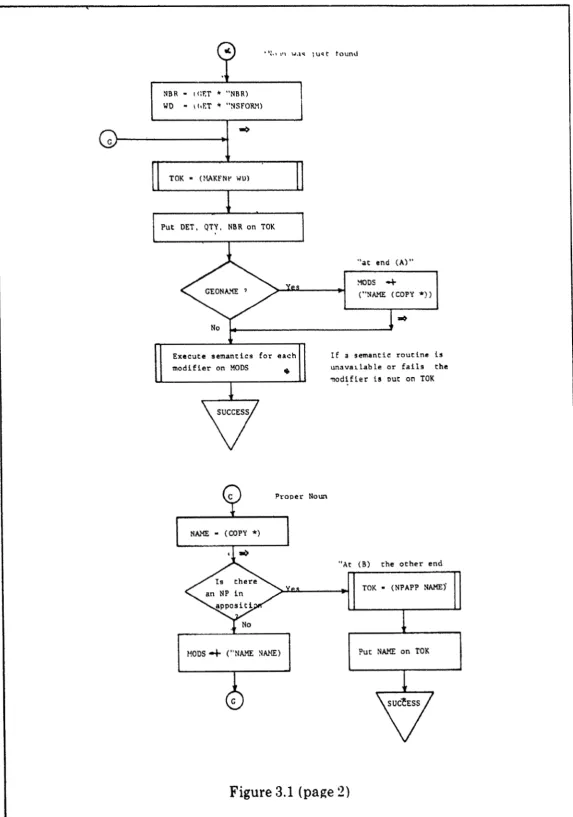
A flowchart of t h e NP parsing program is shown in Figure 3.1. A flo6chart is
used to describe the program because a transition nkt of this size would be unlvieldy. a n d because a flowchart can mare closely folloiv the actual program structure. ti few
nonstandard conventions a r e used in the parser flowcharts in *this chapter. A test consisting of a word in capital letters indicates a test of whether the word currently
under the scanner (the word in the '$ register) is in t h a t category. (NEXT) indicates the
next word t o the right, a n d (NEXT" indicates the second word to the 1-ight. The symbol
=>
appearing next to a line indicates t h a t tohe scanner is moved to the right along that control path. The symbol+-
indicates t h a t t h e right part is appended to the lett:*
References t o the example problems a r e denoted by the letter P f o l l o ~ ~ e dProper Noun
" A t (B) che ocher end
Y P TOK
-
(NPAPP NIVIEYP
I
HODS 4 ("NAME NMLE)
[image:22.727.74.648.114.932.2]1
Figure 3.1 (page 2 )
Put NAME on TOK
generally, A +t- B is implemented ss
(SETQ A
(NCQNC A
(LIST B))).Phrases in quotes next to corltrol paths are examples of phrases which would follow the indicated paths.
The initial tests in the flow diagram tgst for proper nouns, geometric names, and pronouns, which are handled separately. [Geometric names, as in "AT END (A)", are represented in LISP as lists containing the names; in the original sources from which the problems were taken, such names were written as italic capitnls.] The determiner, if present, is saved. A series of tests separates the use of a measurement (e.g., "10 ft") a s a noun phrase by itself or as a modifier ("a 10 f~ pole"), while prohibiting it if it precedes a relative preposition (as in " 10 f t from
.
.
.") since this formis more easily handled a s part of the prepositional phrase. Adjectives which are marked
NULLADJ
are ignored. Thus, "a tapering wooden telegraph pole" ( P I 1) is treated the same a s "a pole". This is one of the few cases in the parser where information from the problem stqtement is ignored. Possessive pronouns are rewritten a t once; the referent of the corresponding root pronouh is found, and a modifier of the form (POSSBY referent) is constructed. This modifier retains the ambiguity of the type of possession. Not surprisingly, there is considerable similarity between the semantics of POSSBY and some of the sense meanings of OF. Thus, for example, "its end" and "the end of the lever" will be reduced to a n identical form when processed semantically.When the noun is found, a token atom is created for the noun p h r a ~ e , usually using the singular form of the noun a s the token name. In some cases, however, a n expanded definition is used, resulting in the use of a different token name and the
generation of additional modifiers. Thus, PAUL becomes PERSON, (SEX MALE),
(NAME PAUL) and BOY becomes PERSON, (SEX MALE), (AGE YOUNG). This
expansion eases the identification of the same object when it is referred to by different words; the identification of these two tokens will result in the inference that Paul is young. The modeling of words as carriers of modifiers to be applied to their root concepts is a n interesting area of research; [Simmons and Amsler 751 are investigating this type of modeling for verbs of 'motion and communication.
After the noun token is made, a n attempt is made to execute the semantics of each of the modifiers which have been found. Some modifiers will make changes directly to the NP token; others will create new modifiers which are saved for later processing.
9 1
"Both",-for example, will create modifiers equivalent to "Each of the two
. .
.
.
of problems. I n general, finding pronoun referents can be very difficult. [Charniak 721 considers this problem in some detail.
3.4.2 Noun Phrase Compounds and Modifiers
Conjunctions and modifying phrases int ~ o d u c e many potential ambiguities into the parsing of a sentence. I n a noun phrase containing two prepositional phrases,
for example, the second prepositional phrase
(Pp)
might modify either the top-level noun phrase or the noun phrase in the firstPI?. A
conjunction het*ween two noun phrqses might join them into a compound noun phrase, or it might connect two top?level clauses containing the noun phrases. Although syntactic constraints' may select the correct interpretation in some cases, in many other cases the choice cambe made only on semantic grounds. For example, inLowering the level of the lake allows city officials to kill weeds and residents to repair their docks.
we must use semantic interpretations to reject the possibility that "weeds and residents" is a compound noun phrase. People seem to make these choices easily and correctly the first time they read or hear a sentence; only rarely do they have to back up
and re-parse a sentence in order to interpret it correctly. The parsing programs of
ISAAC rely heavily on,semantic tests to reject incorrect combinations of phrases.
A noun phrase may be' modified by a prepositional phrase,, an adjective
phrase, or a dependent clause. In each case, the parser for the modifying phrase is called with the
NF
token a s an argument. The modifying phrase parser may reject the combination on semantic grounds even though the appropriate syntactic constituent is found. This is especially important in the case of prepositional phrases. Compound modifiers, as in "a uniform scaffold 12 ft long and weighing 100 lb"(P5),
are permitted. Conjoined noun phrases are required to all be members of the same semanticclass, which may be one of the set PERSON,
PHYSOB
(physical object), LOCNAME(location name),
ATTRNAME
(attribute name), or MEASU (measurement unit).Pronouns are prohibited as members of dompound noun phrases. These tests handled
almost all cases which OCCUII-ed in the set of test problems. One pathological sentence required additional treatment:
If it is placed on the edge of a block 1.5 m from the light end and a weight
of 750 nt added to the light end, it will be balanced.
.
0'14)Since
the auxiliary "is" is omitted in the second clause, "added. . ."
could be considered a dependent clause modifying "weight", and "blork" and "weight" could becombined as a compound noun phrase under the above rules. This problem was solved
accept "edge of a block" a s a well-formed unit before reaching the secuand clause, and thus do not consider combining "block" a n d "weight". The depth-first operation of this
parser
allows it to go fairlyfar
afield in such cases; additional semantic tests to allow some constituents to be combined earlier would be a desirable, but difficult, improvement.3.4.3 Noun Phrase Variants
There are three *small parsing programs which accept variants of noun
,
9phrases. THERENP accepts "there" as a tloun phrase in cases such a s "there is
.
.
. .
9 Y
QNP accepts a noun phrase beginning with a question word, as in "what force
.
. .
,RELNP
parses a "relative noun phrase" containing "as much as", as in "the man supports twice as much a s the boy" (P7). T h e multiplicatioll factor is saved, and a linkis made to the noun phrase involved in the comparison.
3.5 Verb Phrase Parsing
3.5.1 Basic Verb Group
The verb group, which is parsed by the program
VG,
consists of a set of auxiliary verbs, a main verb, and optional adverbs. The flowchart of VG is shown in Figure 3.2. Since tense and modality are not needed for our type of physics problems, the auxiliary verbs are ignored except for determining whether the verb group is active or passive. Other authors (for example, [Winograd 721 ) have given procedures for determining verb tense f r o qthe
auxiliary verbs.The program
VG
has six arguments.NPHD
is a noun phrase token which isthe syntactic subject of the verb. VPHD (if specified) is a verb phrase token which is either the first part of a compound verb phrase or the initial auxiliary verb which is separated from the rest of the verb group in a question. CMPND is a flap which is true if the verb group is part of a compound verb phrase. DCLF is true if the verb group is part of a dependent clause; DCLP is true if the dependent clause construction is passive.
QFLG
is true if the verb group is a top-level verb group in a question.The flowchart of VG is fairly straightforward. If a previous verb phrase is available from a separated verb group in a question, it is deleted and incorporated into the main verb group. T h e syntactic subject is attached to the verb phrase a s subject or object depending on whether the verb is active or passive. This transformation frees the verb semantic programs from-having to concern t h e ~ s e l v e s with the voice of the verb.
I n a compound verb phrase without a subject (object if passive), the corresponding
phrase from the first verb phrase is used. Thus, in "John was tarred and feathered",
3.5.2
Verb
PhraseA flowchart of tlre verb phrnse parsing program, Q1', is shown in Figure :I.:).
VP
first parses n verb group by calling VG, then i*ollcrts tllt.' rennt~inillp prt1dic;ltc.phrases and modifiers and attaches them to the verb phmsu loken. These phrnses include tho syntactic object noun phrase oradjeciive phrase, an i~lfiniti\+e verb phl*nse
object (as in "they wlui~t to go
.
.
."), and prepositiollnl p11r~ses o r adverbs modifying the verb,After parsing a verb group, VP calls V P M O D S t o collect \*erb modifiers (adverbs and prepo~it~ional phrases). A n infinitive verb phrnse objort is r0llt3rted if present and attached to the \perb phrase token under the indicator INFOBJ. If a
question
is
being parsed, t h e subjecb and the remainder of t h e separated group arecollected. A prepositional phrase on
HOLD
(that is, one which occurred a t the st art of the sentence and could not be attached to anything, e.g. "At(B),
the other end of thepole, there is , ,
."
(P15) is attached to the verb phrase if possible. T h e predicate nounphrase or adjective phrase is collected, along with a n y remaining modifiers. If the verb
phrase is part of a dependetlt clause, it is required t o contain more than just a verb. A
dependent clause (DCLAUSE) is attached to the t o k k of the phrase it modifies.
3.6 Prepositional Phrase Parsing
T h e structure of the prepositional phrase is fairly simple. I n addition t o the usual PP consisting of a preposition and noun phrase, the PP parser accepts a phrase involving a measurement and a preposition and noun phrase (as i n "10 ft from one
end") a s a single prepositional phrase. Hoth t - y e s may involve question phrases, a s in "at what ppint" (P7) a n d "how far from the center" (P20).
T h e PP parser behaves differently from the other parsing programs in t h a t it saves a well-formed result which cannot be attached to the head token which was specified, due to semantic constraints. If t h e PP parser is called again to reparse the
same phrase ( a s it surely will be), it applies the semantic tests to its previous result and the new head token. This not only saves the work of reparslng a n identical phrase twice,
but more importantly, it prevents side effects which occur during the parsing from being repeated. These side effects (such a s the creation of a new object in the model of the problem) violate the restriction on a pure Woods net parser t h a t all results be passed
between programs in designated registers; hence, the effects are not undone when
backup is made from a failing parse attempt. We could make all such actions reversible, as in CONNIVER [McDermott and Sussman 721, but such arl approach exacts a high penalty in computational overhead. Our approach is probably safe for prepositional phrases, which cannot in general be parsed a s anything else. The pure Woods net
needed on ways to intermix the two and still be able to bnck up when necessary, without incurring too much overhead.
Preposition semantics are executed, when possible, as soon a s the
prepositional phrase has been parsed.
In some rases, the
se~nontic routine will electlodelay the s e m ~ n t i c processing. In these cases, the PP is saved on the head token under the indicator' PPS for la&r processing.
3.7 Clause Parsing
The clause parsing programs,
CLAUSE
and QCLAUSE. are relati\?elysimple programs which accept the several for~ns of declarative, ia~perative, u i ~ d
question clauses. An iuitial prepositio~~nl phrase, if present, i s placed on n HOI,D list for
later
processing.A
noun phrase or question phrase is parsed and then used as all argument for calling the verb phrase parser. The result of parsing a clause is the verb phrase token, which contains pointers to its various arguments. This verb phrase tokenis passed as an argument to the verb serna~ltics driver, EXVBSEM, which completes semantic processing of the sentence.
Figure 3.4 shows the structure formed after parsing and seniantic processing of a complete sentence. Much of the information iri the structure is produced by the semantic programs after parsing, but we will describe it briefly as an introduction to the
semantic processes. The root of the parse tree (the value returned by the
SEWTENCE
parsing function) is TOK185, the verb phrase token for the main verb of the sentence.
The
objectof
the verb is TOKltll, which was the syntactic subject (since the verb phraseis passive); the subject (agent) of the verb is TOK186, which was intl~oduced by the
preposition "by". The semantic routine for "by" sinlply attached its object phrase token,
TOK186;
to the verb phrase token as the subject of the verb; hence, there is no need for "by" to appear anywhere in the structure) T O K l 8 l is the noun phrase tokenproduced from the initial noun phrase of the sentence; it is a TOKen of the word SCAFFOLD, is a Linguistic FRAME of t-ype NP (Noun Phrase) has a n INDEFinite DETerminer, and has a NBR (number) of NS (Noun Singular). The modifier "12 f t long" has been converted to the form (LENGTH 12 FT); the same modifier form would
be produced for the phrase "a 12 f t scaffold". TOK181 is the syntactic subject of a
DCLAUSE (Dependent CLAUSE) whose verb token is TOK182. The SFRAjWE
(Semantic FRAME) interpretation of TOK181 is PHYSENT (PHYSical ENTity), and
its RFNT (Referent) is SCAFFOLD184, which is a n object in the model of the problem.
The remaining tokens shown in the figure have a similar structure. The modifier "vertical" of TOK186 has been converted to the form (ROTN 90); this token has two
referent objects. The modifier*"its" of
TOK188
was converted to a modifier of the formLOCPART (LOCationlPAIiT) SFRAME whwe SEMOBJ (SEMantic ODJect) is
SCAFFOLD1 84; idelltif'ication of the location referents of TOK 188 yieldad the two
locations LOC190 and LOC189, which are locations on SCAFFOLD184 in the model of the problem. Since TOKIBN was the object of a preposition, semantic processilig of the prepositional phrase transferred its referents to a modifier of the verb phrase TOK187; this left
TOK188
unconnected to the rest of the structure.3.8 Conclusion
The computer time required for parsing and semantic processing averages about one second per sentence, running on a CDC 6600 and using interpreted LISP. The parsing programs constitute only about 15% of the total; the semantic programs are twice a s large. Syntactic processing is thus a -relatively small part o f the complete process of language understanding. On the other hand, this program has convinced the author thax even in so constrained and well-defined an area a s physics problems, syntactic processing cannot reasonably be isolated and done without recourse to
"A uniform scaffold 13 ft long and weighing 100 lb is supported horizontally by two
vertical ropes hung from its ends."
TOK181 TOK182
TOK SCAFFOLD
TOK
WEIGHLFRAME N P LFRAME VP
DET INDEF MAINVB WEIGHING
NBR (NS) DCLAUSE ?'T*
MODS (UNIFORM (LENGTH 12 FT)) INTRANS *T*
DCLAUSE (TOK182) ACT *T*
SFRAME PHYSENT SUBJ TOIC181
RFNT
(SCAFFOLDl84) COMP TOK183TOK183
TOK LB
LFRAME N P
QTY 100
TOK185
TOK SUPPORT
LFRAME V P
MAINVB SUPPORTED
AUX
(1s)
TRANS *T*
P A S V
q*
OBJ TOK181
SUBJ rOK186
TOK187
TOK HANG
LFRAWE V P
MAINVB HUNG
DCLAUSE
*T*
INTRANS *T*
PASV
*T*
OBJ TOK186
MODS (LOC FROM (LOCI90 LOC189))
TOK186
TOK ROPE
LFRAME NP
QTY
2NBR (NPL)
MODS ((ROTN 90))
DCLAUSE (TOK187)
SFRAME PHYSENT
RFNT (ROPE192 ROPE191)
TOK188
TOK END
LFRAME NP
NBR (NIX,)
SFRAME LOCPART
SEMOBJ (SCAFFOLD184)
RFNT (LOCI90 LOC189)
It
may be helpf'ul a t this stage to realize that the primary form of mathematical communication is not description, but injunction, i n this reppectit
is comparable with practicalart forms
like cookery, in whichthe taste of a cake, although literally indescribable, can be conveyect to a reader in the form of a set of i~~junctions called a recipe.
-G. Spencer Brown
4. Semantics
4.1 Introduction
Semantics, for our purposes, is the procr.ss of constructing the meaning of a
sentence: the process of relating the objects in the sent.cnce to objects in the world model of the reader, and of updating the world model to reflect the meaning of the sentence.
The
sentence itself is not a description of the meaning, but rather a set of injunctions, a recipe which can be followed to construct the meaning from what the reader already knows.As the above definition implies, the way in which a sentence is interpreted depends strongly on the knowledge, intelligence, and inclinations of the reader. A s is
well
known, different readers will interpret the same text (even in physics problems) in different ways. A semantic interpretation of a sentence may, be viewed a s satisfactory or unsatisfactory for a particular purpose, but it would be difficult to judge it as "right" or1 4
wrong."
Updating the world model to reflect the meaning of a sentence can be a very
involved process, since the meaning of a single sentence call have many consequences.
I n
our physics problems, these deductions do not propagate very far beyond the immediate understanding of a sentence during the time when the sentences are being read.In
this chapter, then, we will primarily discuss "linguistic semantics," which wemay define a s the semantic processing up to the point a t which the parsing of a sentence
may be discarded. This distinction is well defiried within the computer program. Under this heading there are a number of distinct semantic processes: determining the meaning of ambiguous words and phrases; finding anaphoric referents (such a s pronoun referents) and elliptical referents (such a s the physical object referred to when a location is named alone a s in ('one end"); determining the meaning of groups of words whose meaning in combination is more than a combination of tkeir individual meanings; determining the meanings of modifiers of nouns and verbs and saving the meanings so that they can be effective a t the proper place in the processing; determining whether a n object or location mentioned in a sentence is a new one, or whether it refers
updating existing ones to reflect new information; expanding the model of a11 object
so
that its subparts may be referenced; testsing n modifier to determine whether it can reasonably 111odify a given phrase (which may require reasoning based
on
the particulars of the world nlodel); interpreting all object of a given type as a11 obdect of adesired type (for exa~nple, interpreting an object as a locnt.ion or vice versa), All of these processes will be discussed in this chapter,
4.2 Preliminary Modifier Processing
Adjective and adverb modifiers of noun and verb phrases frequentlv have their effects a t a relatively late stage of semantic processing: the idulltification of the referent of a noun phrase, or the execution of verb semantics. These modifiers must therefore be saved for later reference. I n some cases, a semantic routine will be associated with the modifier itself; ill other cases. it is more convenient for a larger routine to look for the existence of certain modifiers to guide its processing. Preliminary modifier processing puts modifiers of certain classes into a standard form so that they
will be easy to identifv or so that a single semantic routine can be used for the whole class. I n some cases, different meanings for a modifier may be selected depending on the modified phrase.
Adjectives such as "one", "other", "first", and "second" are put directly on the noun phrase token under the indicator DET2. These modifiers are referenced in determining the referent of the noun phrase. Adjectives such a s "heavy", "left", and
"upper" are converted to modifiers of the form (SELECT adj); they are used in
selecting a particular referent from several possible ones. Quaritifiers such as "each" become modifiers of the form (QNTFR adj). Adjectives such as "horizontal", "vertical", and "upward" are converted to rotation modifiers of the form (ROTN ang), where "ang" is the appropriate angle.
Adjective phrases indicating measurement (as in "a 10 ft pole" or "a pole 10
f t long") are converted to modifiers where the measured quantity is made explicit, e.g.,
(LENGTH 10 FT). When the referent of the noun phrase is found, the modifier is transferred to the property list of the referent. In the case of unspecified force measurements, tests are made on the modlfied noun phrase to determine the rrleasured quantity. Thus, a 150 lb man is a man whose weight is 150 lb, while a 150 lb force is a force vector whose magnitude is 150 lb.
4.3 Preposition Semantics
Preposition semantics is an interesting area. A single preposition can have a