Autonomous Car
Aniket Naik1, Devesh Nimkar2, Sagar Kadam3, Amar Palwankar4
1, 2, 3, 4
Department of Information Technology, University of Mumbai
Abstract: Autonomous car is a rapidly evolving technology, and today many auto makers and other technical companies are experimenting with autonomous cars. An autonomous car’s overall functional cycle falls into the following abstract categories: situational awareness, planning, control, and actuation. Car following and decision making are critical to complete driving mission for autonomous vehicles under complex and dynamic urban environment. The recognition unit includes the lane detection, obstacle or pedestrian avoidance and traffic sign recognition. Decision making unit is responsible for carrying out global and local path planning. The actuation unit consists of steering wheel, brake system and accelerator system are. This paper describes the important parameters in the design of the autonomous car driving system.
Keywords: Autonomous car, decision making, Obstacle avoidance, Deep learning, Tensor Flow
I. INTRODUCTION
Autonomous cars have been a topic of increasing interest in recent years as many companies are actively developing related hardware and software technologies toward fully autonomous driving capability with no human intervention. In recent years, Deep neural networks have successfully been applied in various perception and control tasks. They are the important workloads for autonomous vehicles too. For example, Tesla Model S was known to use a specialized chip (Mobile Eye EyeO), which used a vision-based real-time obstacle detection system based on a DNN.
First, many AI workloads, especially those in vehicles, are computationally demanding and have strict real-time requirements. It requires a high computing capacity as well as the means to guaranteeing the timings. On the other hand, the computing hardware platform must also satisfy cost, size, weight, and power constraints, which require a highly efficient computing platform. These two conflicting requirements complicate the platform selection process.
An autonomous car’s overall functional cycle falls into the following abstract categories: situational awareness, planning, control, and actuation. The major benefits of autonomous cars include, but not limited to, improving safety for both passengers and outsiders (pedestrians and other vehicles), new business opportunities, ease of use and convenience for people who cannot or do not want to drive, improved traffic conditions, and creating a consumer-centric experience.
II. LITERATUREREVIEW
The autonomous car has received a lot of attention during the past decade and prototype versions have been developed by different vendors. At the very basic level, the autonomous car is equipped with a myriad of sensors and actuators that generate a lot of data in real time that must be processed and analysed for timely decisions to be made. Therefore, the design of autonomous car must consider the volume, speed, quality, heterogeneity, and real-time nature of data.
For an autonomous car to move from point A to point B, it needs to perform a series of steps: the car needs to perceive and make itself aware of the surrounding environment, plan the trip, navigate, and make controlled movements on the road. The primary steps responsible for executing the aforementioned tasks in an autonomous car include:
1) Obstacle Avoidance
2) Navigation and path planning 3) Manoeuvre control.
A. Obstacle Avoidance
The first and foremost important step for autonomous cars is neighbourhood awareness, which includes object tracking, self -positioning, and lane spotting. Pedestrians or falling objects can often be appeared in the path. In this case, already generated path should be modified in order to avoid hurdle.
LIDAR sensor is used for this purpose: LIDAR sensor emits laser light to obstacle and receive reflected one repeatedly to scan entire range. By analysing this data obstacle can be detected and distance between car and obstacle can be estimated. If we know the position of obstacle, new path avoiding obstacle can be generated based on this information [3].
Fig.1 Pedestrian detection algorithm As in Fig. 1, HOG filter is used to compute gradient of object boundaries in the image.
HOG descriptor [15] has advantage because it is robust to change of lighting. HOG descriptor divides a region of interest on the image into block. Block is again divided into cells. In the cell orientation is evaluated using edge detector, finally made to orientation histogram.
Then binning of orientation detected is taken to select candidate of boundaries of pedestrians or objects.
B. Traffic Sign Detection
Traffic sign recognition is important in that it commands the car next action that should be followed. Computer vision system should be used as it embeds picture or character-based information.
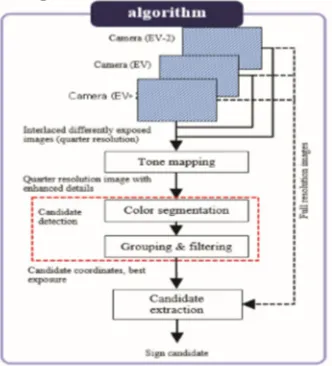
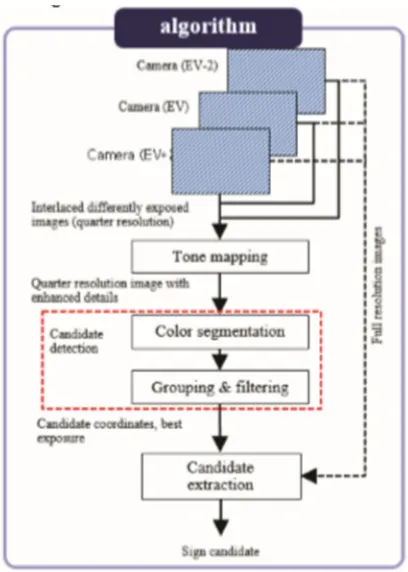
Fig 2 Traffic sign detection algorithm
The above figure Fig. 2 shows how the overall algorithm works.
Tone mapping [16] is applied to the image captured by the cameras. Then colour segmentation algorithm is applied and grouping is made and filtered. Candidates are extracted from the group to finally recognize symbol of sign.
C. Navigation and Path Planning
Navigation or guidance is of paramount importance in an autonomous car, because its primary function is to enable the car to travel on the desired path. When the autonomous car is aware of its environment then it needs to plan its path based on the destination. With the help of navigation hardware such as the well-known global positioning system (GPS) module, the car generates a path between the current position and destination as a function of time. Road networks are physically pre-defined and the autonomous
car’s guidance system regularly checks the car’s movement against the calculated path [2]. The car’s navigation system must be robust to handle sudden and subsequent changes in the path by adjusting the already pre-computed route. Road networks are physically pre-defined and the autonomous car’s guidance system regularly checks the car’s movement against the calculated path.
It is worth pointing out that although a GPS-based solution provides a rich set of functionalities in guidance and navigation, in certain scenarios, GPS on its own is not sufficient. Since GPS is based on signals from in-orbit satellites, the signals may sometimes get blocked or deteriorated due to natural or artificial phenomena, such as underground roads and tunnels. In such cases, other means of inertial guidance and navigation are needed [2].
Gradient
computation
Orientation Binning
Cell descriptor computation
[image:2.612.231.397.310.493.2]D. Manoeuvre Control
After the autonomous car perceives its surroundings, and using this information along with its destination information, then it starts its journey. Different manoeuvres should be carefully controlled for a smooth, safe (or at least failsafe) commute along the road. During the course of its journey, the autonomous car must maintain different kinds of manoeuvres such as lane keeping, bumper-to-bumper distance, sudden brakes, overtaking, and stopping at traffic lights.
E. Machine and Deep Learning in Autonomous Cars
Recently, Deep Learning has shown great success in supervised learning in diverse areas such as image recognition, speech recognition, and robot navigation [11]. Machine learning, deep learning, and artificial intelligence-based techniques are indispensable for autonomous cars. The main reason for the significance of these technologies is the unpredictable environment and behaviour of the surrounding objects. In traditional software, the operational logic is written manually and tested over a series of test cases whereas in Deep Neural Network (DNN) based software, the software learns and adapts with the help of large data sets. The popular deep learning models used in autonomous car technology to achieve the aforementioned goals include end-to-end learning, CNN, deep CNN, Fully Convolutional Network (FCN), DNN, belief networks, Deep Reinforcement Learning (DRL), Deep Boltzmann Machines (DBM), and deep autoencoders [2].
F. OPEN CV
Computer Vision is the science of programming a computer to process and ultimately understand images and video, or simply saying making a computer see. Open Source Computer Vision i.e. OpenCV is a library of programming functions mainly aimed at real-time computer vision. Open CV is written in C++ and its primary interface is in C++, but it still retains a less comprehensive though extensive older C interface. There are bindings in Python, Java and MATLAB/OCTAVE. The online documentation consists of API for these interfaces. Wrappers in other languages such as C#, Perl, Ch, Haskell and Ruby have been developed in order to encourage adoption by a wider audience. The image is processed by using OpenCV module which uses a set of trained classifiers for different traffic signs. Image acquisition is done by using the web camera which is connected to Raspberry Pi through USB 2 connector. So, data is acquired using serial communication. The image received has BGR format (Blue, Green, Red) – specific to Bitmap format. Further processing is carried out by transferring the image to OpenCV. Other works related to OpenCV can be found at [9] and [10].
III.MACHINEANDDEEPLEARNINGINAUTONOMOUSCARS
Recently, Deep Learning has shown great success in supervised learning in diverse areas such as image recognition, speech recognition, and robot navigation [11]. Machine learning, deep learning, and artificial intelligence-based techniques are indispensable for autonomous cars. The main reason for the significance of these technologies is the unpredictable environment and behaviour of the surrounding objects. In traditional software, the operational logic is written manually and tested over a series of test cases whereas in Deep Neural Network (DNN) based software, the software learns and adapts with the help of large data sets. The popular deep learning models used in autonomous car technology to achieve the aforementioned goals include end-to-end learning, CNN, deep CNN, Fully Convolutional Network (FCN), DNN, belief networks, Deep Reinforcement Learning (DRL), Deep Boltzmann Machines (DBM), and deep autoencoders [2].
A. End-to-End Deep Learning for Autonomous Vehicles
To solve the problem of autonomous driving, a standard approach has been decomposing the problem into multiple subproblems, such as lane marking detection, path planning, and low-level control, which together form a processing pipeline [13]. Recently, researchers have begun exploring another approach that dramatically simplifies the standard control pipeline by applying deep
neural networks to directly produce control outputs from sensor inputs [11].
The use of neural networks for end-to-end control of autonomous cars was first demonstrated in the late 1980s [14], using small 3-layer fully connected neural network; and subsequently in a DARPA Autonomous Vehicle (DAVE) project in early 2000s [12], using a 6 layer convolutional neural network (CNN); and most recently in NVIDIA’s DAVE-2 project [13],
Using deep neural networks involves two distinct phases [14]. The first phase is training, during which the weights of the network
are incrementally updated by backpropagating errors it sees from the training examples. Once the network is trained—i.e., the weights of the network minimize errors in the training examples—the next phase is inferencing, during which unseen data is fed to the network as input to produce predicted output (e.g., predicted image classification). The training phase is more computationally intensive and requires high throughput, which is generally not available on embedded platforms. On the other hand, the inferencing phase is relatively less computationally intensive and latency becomes as important, if not more so, as computational throughput, because many use cases have strict real-time requirements.
IV.AUTONOMICCARS’MAJORBENEFITS
The concept of the autonomous car, despite its complexity, opens up new innovative applications and presents consumers with safety, ease-of-use, comfort, and value-added services. In this section, we discuss some of the major benefits of autonomous cars
and future autonomous car applications.
A. Improved Safety
Safety is a multidimensional feature in the automotive domain, where human lives take the highest priority when it comes to driving. In the case of autonomous cars, one of the most important applications is safe driving for its occupants.
Human errors are caused by various factors, including distraction, aggressiveness, carelessness, intoxication, and disabilities. Furthermore, such errors also cost about US$190 billion in health costs and damages caused by these accidents. Based on these alarming statistics, an alternative driving mechanism is essential to save lives. In light of the aforementioned fatalities’ statistics with human-driven cars, an autonomous car can be a safer alternative with a lower number of human drivers behind the wheel.
B. Ease of Use and Convenience
Another benefit of autonomous cars is ease of use and convenience. Sometimes people are unable to drive a car because of
medical/disability conditions or intoxication.
Furthermore, the autonomous car can also be a suitable mode of transportation for elderly people, young adults without a driver’s license, and people who cannot afford to own a car. In such cases, the autonomous car can provide a safe, cost effective way to increase citizens’ mobility.
C. Improving Traffic Conditions
Improving traffic conditions is another major benefit of autonomous cars. Autonomous cars will increase per-vehicle occupancy and decrease the number of vehicles on the road, thereby improving traffic conditions. Furthermore, with human drivers, inter -vehicle distance is a strict parameter to maintain for safe driving. However, with autonomous cars, this distance will potentially decrease, thereby providing more space on the road. autonomous cars will at least eliminate the likelihood of human errors that account for 94% of traffic accidents.
V. CONCLUSIONS
REFERENCES
[1] Traffic Road Sign Detection and Recognition for Automotive Vehicles, International Journal of Computer Applications (0975 – 8887) Volume 120 – No.24, June 2015
[2] Autonomous Cars: Research Results, Issues and Future Challenges, Rasheed Hussain, and Sherali Zeadally, IEEE COMMUNICATIONS SURVEYS AND TUTORIALS
[3] Study on Development of Autonomous Vehicle Using Embedded Control Board, Tae Un Kim University of Ulan, IFOST-2016: Applied Engineering [4] Driverless Car: Autonomous Driving Using Deep Reinforcement Learning In Urban Environment 2018 15th International Conference on Ubiquitous Robots
(UR) Hawaii Convention Center, Hawai'i, USA, June 27-30, 2018
[5] Autonomous Driving System based on Deep Q Learnig, 2018 International Conference on Intelligent Autonomous Systems
[6] Driving Decision-making Analysis Of Car-following For Autonomous Vehicle Under Complex Urban Environment, 2016 9th International Symposium on Computational Intelligence and Design
[7] DeepPicar: A Low-cost Deep Neural Network-based Autonomous Car, 2018 IEEE 24th International Conference on Embedded and Real-Time Computing Systems and Applications (RTCSA)
[8] Controlled Parking for Self-Driving Cars, 2016 IEEE International Conference on Systems, Man, and Cybernetics • SMC 2016 | October 9-12, 2016 • Budapest, Hungary
[9] ] A. Lorsakul, and J. Suthakorn, “Trafdic Sign Recognition for Intelligent Vehicle/Driver Assistance System Using Neural Network on OpenCV”, The 4th International Conference on Ubiquitous Robots and Ambient Intelligence, 2007
[10] ] N Radhakrishnan, and S Maruthi, “Real-time indian traffic sign detection using Raspberry Pi and Open CV”, International Journal of Advance Research in Science and Engineering, Vol. 06 Issue no. 11, 2017.
[11] S. Levine, C. Finn, T. Darrell, and P. Abbeel. End-to-end training of deep visuomotor policies, Journal of Machine Learning Research, 2016.
[12] Y. Lecun, E. Cosatto, J. Ben, U. Muller, and B. Flepp. DAVE: Autonomous off-road vehicle control using end-to-end learning. Technical Report DARPA-IPTO Final Report, 2004.
[13] M. Bojarski et al. End-to-End Learning for Self-Driving Cars. arXiv:1604, 2016.
[14] D. a. Pomerleau. ALVINN: An autonomous land vehicle in a neural network. In Advances in Neural Information Processing Systems (NIPS), 1989.
[15] Dalal, Navneet, and Bill Triggs. "Histograms of oriented gradients for human detection." Computer Vision and Pattern Recognition, 2005. CVPR 2005. IEEE Computer Society Conference on. Vol. 1. IEEE, 2005.