Original Article
Threshold effects between plasma total cholesterol
level and the risk of sudden sensorineural hearing loss
Sai-Bin Wang1, Qian Ye2, Yi-Bin Pan3
Departments of 1Respiratory Medicine, 2Medical Records Quality Management, 3Cardiovascular Medicine, Jinhua Municipal Central Hospital, Jinhua, Zhejiang Province, PR China
Received June 17, 2019; Accepted September 5, 2019; Epub October 15, 2019; Published October 30, 2019
Abstract: Elevated serum total cholesterol (TC) level has been suggested to be a significant risk factor associated with the incidence of sudden sensorineural hearing loss (SSHL); however, the specific association between the two remains elusive. We aimed to investigate the specific association of serum TC levels with SSHL incidence. The present study was a secondary analysis of a large-scale matched case-control study, which was conducted in Ko -rea between 2009 and 2012 using matched participants according to their propensity scores. Participants were
divided into the SSHL group and the non-SSHL group, and their blood lipid profiles and clinical characteristics were recorded. The association between serum TC level and SSHL was evaluated using multiple logistic regression analy
-sis, piecewise linear regression analy-sis, smooth curve fitting, and threshold effect analysis adjusted for potential confounders. We found that the serum TC concentration was significantly higher in the SSHL group compared with the non-SSHL group (P<0.05). The risk of developing SSHL increased significantly with increasing concentration of serum TC; however, this association could only be observed in the range of the TC concentration between 139 mg/ dl and 280 mg/dl after adjusting for potential confounders. A steady incidence of SSHL was observed at TC level ranges below ≤139 mg/dl or over ≥280 mg/dl. In conclusion, we suggest that there is significant threshold effects between serum TC level and SSHL incidence. Lower serum TC levels may help reduce SSHL incidence; however, the individuals may not receive the further benefit of low serum TC in reducing the risk of SSHL if the TC levels are already below the threshold level of ≤139 mg/dl.
Keywords: Total cholesterol, sudden sensorineural hearing loss, threshold effect, lipid
Introduction
Sudden sensorineural hearing loss (SSHL) is a
rapid decline in hearing, an audiologic emer-gency disease with an estimated incidence between 5 and 30 cases per 100,000 people
each year [1-3]. SSHL significantly affects the patient’s quality of life, and psychosocial-voca
-tional activities. However, there is still a lack of an effective treatment regimen for the majority of patients with SSHL. Although about 30-60% of patients with SSHL exhibit spontaneous recovery within two weeks [4, 5], approximately 13% of these patients will eventually experi
-ence recurrent episodes of SSHL [6, 7]. Nevertheless, the underlying pathogenesis of SSHL remains elusive. Several etiological risk factors have been associated with the develop
-ment of SSHL including blood vessel disorders,
autoimmune diseases, and viral infections [2, 8-11]; however, the majority of patients with SSHL are categorized as idiopathic due to the unknown etiology. Recently, an association between blood lipids and SSHL has received
increasing attention. Notably, elevated total cholesterol (TC), triglycerides, and low-density
lipoprotein cholesterol (LDL-C) levels have also been significantly associated with SSHL [1, 12, 13]. Among the various causes responsible for SSHL, common hypotheses include the “lipids
hypothesis”. According to this hypothesis, ele-vated blood lipid levels may increase blood
vis-cosity and contribute to atherosclerosis of the
vessels supplying the cochlea, which is sup-plied by one to several terminal arteries with no
collateral circulation, and lack of flow may pro -mote hearing impairment [14]. Furthermore,
than those with normal levels of TC [1]. However,
whether there is a concentration-dependent
effect or threshold effect of TC levels, on the incidence of SSHL remains obscure.
Since adjusted TC levels may help reduce SSHL incidence, the hypothesis of this study was that there were concentration-dependent effects and threshold effects between plasma TC lev
-els and SSHL incidence. Therefore, the present study aimed to investigate the association of plasma TC levels with the incidence of SSHL.
Materials and methods
Patient population
The present study was a secondary analysis of
a large-scale matched case-control study,
which was conducted in Korea between 2009 and 2012 [1]. A total of 324 consecutive patients diagnosed with unilateral SSHL at a University-affiliated hospital in Korea were
selected. For each case, 3 subjects were matched as control subjects according to their
propensity score. Thus, a total of 972 matched controls were included from the Korea National Health and Nutrition Examination Survey (KNHANES) between 2009 and 2010 [1]. The Institutional Review Board of Hallym University Sacred Heart Hospital approved the study. As
participants were anonymous, the requirement
of informed consent was therefore waived.
Patient demographic and clinicopathologic characteristics, including gender, age, body mass index (BMI), coexisting hypertension,
dia-betes, stroke, coronary heart disease (CHD), chronic renal failure (CRF) and dyslipidemia were carefully recorded. Blood lipid profiles
included TC, triglycerides, high-density
lipopro-tein cholesterol (HDL-C) and LDL-C. Blood tests were performed between 6-8 a.m. in all the patients after an overnight fast [1]. For the study, the audiometric criterion of SSHL includ -ed a rapid unilateral sensorineural hearing loss
of ≥30 dB over at least three contiguous fre -quencies occurring within 3 days. Pure tone
thresholds were recorded at four pure tone frequencies.
Statistical analysis
Descriptive statistics were used to summarize
patient demographic and clinicopathologic
characteristics. Categorical variables were expressed as a number (percentage). For con-tinuous variables, data were indicated as medi-an (interquartile rmedi-ange). Unpaired t-test or
Kruskal-Wallis rank sum test, Pearson
chi-squared test or the Fisher’s exact test, was
per-formed between two groups comparison, as
appropriate. Multiple logistic regression analy-sis was used to evaluate the association
between plasma TC levels and the incidence of SSHL, with or without an adjustment for poten
-tial confounders. Adjusted criteria were the fol -lowing: the criteria I adjusted variables
produc-ing a change in the regression coefficient ≥10% after introducting them into the basic model or removing them from the completed model; the
criteria II adjusted variables including criteria I and variables yielding P-value <0.1 in univari -ate analysis as well as variables that were
judged by clinical significance [16, 17].
Piecewise linear regression was applied to the
test threshold effect of the TC on SSHL inci
-dence with smooth curve fitting. The turning
points were determined using trial and error, and then the optimal threshold that yielded the
maximum model likelihood was selected. All statistical analyses were performed with R software (version 3.5.1). P values <0.05 were considered statistically significant.
Results
A total of 324 patients with SSHL and 972
matched control subjects with normal hearing
from the KNHANES data were included in the
present study (Table 1). No significant differ -ence in patient demographics and clinicopatho-logical characteristics were observed between
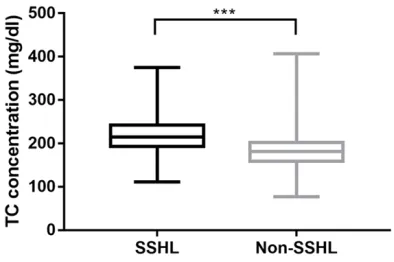
the SSHL group and the non-SSHL group. However, the plasma TC concentration was sig
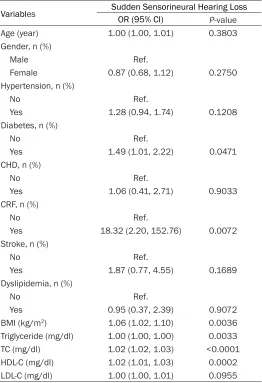
-nificantly higher in the SSHL group than in the non-SSHL group (Figure 1, P<0.001). Moreover, diabetes, CRF, BMI, HDL-C, and triglycerides were found to be significantly positively corre
-lated with SSHL as assessed by univariate
analysis (Table 2).
In piecewise linear regression analysis (Table 3) and smooth curve fitting (Figure 2), signifi
-dence interval [CI], 1.05-1.08; P<0.0001).
The second threshold point was recorded
at TC concentration of 280 mg/dl, after which no statistically significant difference
was observed between increasing TC
con-centration and SSHL incidence (OR, 1.04; 95% CI, 0.99-1.09; P>0.05).
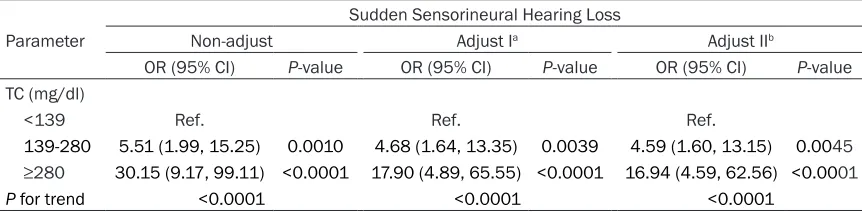
A significant positive correlation was found between plasma TC level and the risks of SSHL without adjusting for potential con
-founding factors. Moreover, after adjusting for the variables according to adjustment I (BMI, CRF, diabetes, HDL-C, triglycerides and LDL-C) or adjustment II (gender, age, HDL-C, triglycerides, LDL-C, BMI, CRF and diabetes), the strength of this association
did not change (Table 4). Higher levels of
TC (139-280 mg/dl and >280 mg/dl) were
significantly associated with higher risk of SSHL when compared to lower levels of TC (<139 mg/dl) with the OR and 95% CI of 4.59 (1.60-13.15) and 16.94 (4.59, 62.56), respectively (P for trend <0.0001).
Discussion
The present study indicated that plasma
TC level was significantly associated with the risk of SSHL, with threshold effects. In order to prevent the incidence of SSHL, it
may be appropriate to maintain plasma TC concentrations at lower levels, and the optimal control threshold could be achieved at 139 mg/dl.
SSHL, is an intriguing clinical emergency
with a rapid decline in hearing and is
defined as sudden hearing loss of ≥30 dB measured over at least three consecutive fre
-quencies of pure tone audiometry and for at
least 72 hours according to clinical practice guidelines [18]. Primarily, the condition is uni-lateral; however, bilateral cases are less than
1.7% of reported cases [19]. It can affect any -one at any age; however it predominantly occurs among elderly people. Although the
spe-cific etiology of SSHL remains to be completely
elucidated, immunological disorders and viral
infections have been considered as an underly
-ing mechanism of pathogenesis for most cases with SSHL [2, 8]. Additionally, perilymph fistula
may also play an etiological role in some cases
of pancochlear hearing loss [20, 21]. Based on
[image:3.612.92.321.99.480.2]the theory that the cochlea is supplied only by the labyrinthine artery and is more susceptible Table 1. Baseline characteristics and serum lipid
pro-files of the study participants
Characteristics Sudden Sensorineural Hearing Loss
No (n=972) Yes (n=324)
Age (year) 50 (38-60) 51 (39-60)
Gender, n (%)
Female 520 (53.5) 162 (50.0)
Man 452 (46.5) 162 (50.0)
Hypertension, n (%)
No 797 (82.00) 253 (78.09)
Yes 175 (18.00) 71 (21.91)
Diabetes, n (%)
No 886 (91.15) 283 (87.35)
Yes 86 (8.85) 41 (12.65)
CHD, n (%)
No 955 (98.25) 318 (98.15)
Yes 17 (1.75) 6 (1.85)
CRF, n (%)
No 971 (99.90) 318 (98.15)
Yes 1 (0.10) 6 (1.85)
Stroke, n (%)
No 959 (98.66) 316 (97.53)
Yes 13 (1.34) 8 (2.47)
Dyslipidemia, n (%)
No 953 (98.05) 318 (98.15)
Yes 19 (1.95) 6 (1.85)
BMI (kg/m2) 23.2 (21.1-25.2) 23.7 (21.6-26.2)
Triglyceride (mg/dl) 94 (66-131) 100 (69-156)
TC (mg/dl) 181 (159-202) 215 (194-241)
HDL-C (mg/dl) 53 (44-63) 55 (47-67) LDL-C (mg/dl) 106 (86-123) 108 (87-132)
CHD, coronary heart disease; CRF, chronic renal failure; BMI, body mass index; TC, total cholesterol; HDL-C, high-density lipoprotein cholesterol; LDL-C, low-density lipoprotein cholesterol.
Figure 1. Comparison of plasma TC levels between the SSHL and the non-SSHL groups. Mean TC level was significantly higher in the SSHL group compared to that in the non-SSHL group. ***P<0.001. TC = to
-tal cholesterol level; SSHL = sudden sensorineural
[image:3.612.90.287.533.664.2]to hypoxic stress [14], previous studies have indicated that elevat-ed blood lipids may prevent the blood supply to the cochlea due to increased plasma viscosity, which
consequently leads to SSHL [1, 22].
Furthermore, Ballesteros et al. [13]
found that lipid profile exhibited positive trends for the development of SSHL in a small study cohort of 99 patients with SSHL. Aimoni et al. [2] further reported hypercholester
-olemia as a crucial risk factor for developing SSHL in a case-control study with 141 patients with SSHL and 271 controls. Similarly, Lee et al. [1] also found a significant posi
-tive correlation of increased TC with the incidence of SSHL. However, all these studies failed to further reveal the association between dif
-ferent levels of TC and the risk of SSHL.
Therefore, in the present study, to prevent the risk of developing SSHL
and to accurately evaluate the
impact of the TC level on SSNL and the optimal control threshold of TC for individuals, a secondary analy -sis was conducted based on a pre-vious study [1]. This prepre-vious study included a well-matched
case-con-trol study using the method of pro -pensity score matching to reduce the selection bias. The plasma TC
level remains statistically signifi -cantly associated with the
inci-dence of SSHL after adjustment for the potential confounding risk fac -tors in this study. Not only a TC
con-centration-dependent effect was found (TC concentration from 139
mg/dl to 280 mg/dl), but also two
threshold effects were observed in
this study. The most important
ben-efit of identifying the threshold effect is that it can assist in lipid
control. Notably, by maintaining plasma TC at lower levels, the
[image:4.612.92.354.96.479.2]risk of developing SSHL could be prevented. However, if the TC con -centration is already below 139 mg/dl, this study indicated that Table 2. Univariate analysis of possible influencing factors of
the risk of sudden sensorineural hearing loss
Variables Sudden Sensorineural Hearing LossOR (95% CI) P-value
Age (year) 1.00 (1.00, 1.01) 0.3803
Gender, n (%)
Male Ref.
Female 0.87 (0.68, 1.12) 0.2750
Hypertension, n (%)
No Ref.
Yes 1.28 (0.94, 1.74) 0.1208
Diabetes, n (%)
No Ref.
Yes 1.49 (1.01, 2.22) 0.0471
CHD, n (%)
No Ref.
Yes 1.06 (0.41, 2.71) 0.9033
CRF, n (%)
No Ref.
Yes 18.32 (2.20, 152.76) 0.0072
Stroke, n (%)
No Ref.
Yes 1.87 (0.77, 4.55) 0.1689 Dyslipidemia, n (%)
No Ref.
Yes 0.95 (0.37, 2.39) 0.9072
BMI (kg/m2) 1.06 (1.02, 1.10) 0.0036
Triglyceride (mg/dl) 1.00 (1.00, 1.00) 0.0033 TC (mg/dl) 1.02 (1.02, 1.03) <0.0001
HDL-C (mg/dl) 1.02 (1.01, 1.03) 0.0002
LDL-C (mg/dl) 1.00 (1.00, 1.01) 0.0955
CHD, coronary heart disease; CRF, chronic renal failure; BMI, body mass in -dex; TC, total cholesterol; HDL-C, high-density lipoprotein cholesterol; LDL-C, low-density lipoprotein cholesterol.
Table 3. Threshold effect analysis of plasma TC on sudden
sensorineural hearing loss using two-piecewise linear regres-sion
Inflection point of TC (mg/dl) Sudden Sensorineural Hearing LossOR (95% CI) P-value a
Inflection point I
<139 1.02 (0.96, 1.07) 0.5713
>139 1.07 (1.05, 1.08) <0.0001
Inflection point II
<280 1.07 (1.05, 1.09) <0.0001
>280 1.04 (0.99, 1.09) 0.0875
[image:4.612.90.354.573.676.2]there was no need to pursue an even lower TC level. Since TC concentration between 139 and 280 mg/dl have been associated with a rapid
increase in the risk of SSHL (Figure 2B, 2C), people who are within this TC level could obtain
a higher “cost-benefit ratio” from TC control. To the best of our knowledge, the present study is the first to reveal the association between different plasma TC levels and the risk of SSHL.
The present study does have its own strengths
and limitations. Strengths of this study include the large sample size of consecutive patients with SSHL and well-matched covariates be-tween the patients and the control. However,
several limitations are worth noting. First, the
study participants were recruited from a single center in East Asia, thus whether the results of this study apply to other regions needs further evaluation. Secondly, some potential confound
-ers such as smoking, patient occupation and
lipid-lowering drugs use were not included in
this study, as these variables were not available
from the data.
Conclusions
The findings of the present study indicated a significant association of increased plasma TC level with an increased risk of developing SSHL. Furthermore, two significant threshold effects
at 139 mg/dl and 280 mg/dl, respectively were
observed. Consequently, for reducing the risk of SSHL, it may be crucial to control the concen
-tration of plasma TC below 139 mg/dl; howev -er, individuals with plasma TC level between
139 and 280 mg/dl can still significantly bene
-fit from TC control for reducing the risk of SSHL.
Acknowledgements
We appreciate all the participants involved in
[image:5.612.95.520.73.207.2]the study. This work was supported by the Medical and Health Science and Technology
Figure 2. The smooth curve fitting shows the association between the risk of SSHL and plasma TC concentrations in the crude (A), model I (adjusted for BMI, diabetes, CRF, triglyceride, HDL-C and LDL-C) (B), and model II (adjusted for HDL-C, triglycerides, LDL-C, BMI, CRF, diabetes, gender and age) (C). The fitting curves of model I and model II are similar. Dotted lines represented the upper and lower 95% confidence intervals. SSHL = sudden sensorineural hearing loss; TC = total cholesterol level; HDL-C = high-density lipoprotein cholesterol; LDL-C = low-density lipoprotein cholesterol; BMI = body mass index; CRF = chronic renal failure.
Table 4. Multivariate regression analysis of plasma TC with the risk of sudden sensorineural hearing
loss
Parameter
Sudden Sensorineural Hearing Loss
Non-adjust Adjust Ia Adjust IIb
OR (95% CI) P-value OR (95% CI) P-value OR (95% CI) P-value
TC (mg/dl)
<139 Ref. Ref. Ref.
139-280 5.51 (1.99, 15.25) 0.0010 4.68 (1.64, 13.35) 0.0039 4.59 (1.60, 13.15) 0.0045
≥280 30.15 (9.17, 99.11) <0.0001 17.90 (4.89, 65.55) <0.0001 16.94 (4.59, 62.56) <0.0001
P for trend <0.0001 <0.0001 <0.0001
[image:5.612.90.521.323.429.2]lar neural pathway related to the progression
of labyrinthine infarction in patient with an an
-terior inferior cerebellar artery infarction. Otol Neurotol 2011; 32: 1596-1599.
[9] Nakashima T, Itoh A, Misawa H and Ohno Y. Clinicoepidemiological features of sudden deafness diagnosed and treated at university hospitals in Japan. Otolaryngol Head Neck
Surg 2000; 123: 593-597.
[10] Rudack C, Langer C, Stoll W, Rust S and Walter M. Vascular risk factors in sudden hearing loss. Thromb Haemost 2006; 95: 454-561.
[11] Chau JK, Lin JR, Atashband S, Irvine RA and Westerberg BD. Systematic review of the evi
-dence for the etiology of adult sudden sensori
-neural hearing loss. Laryngoscope 2010; 120:
1011-1021.
[12] Ciccone MM, Cortese F, Pinto M, Di Teo C, For
-narelli F, Gesualdo M, Mezzina A, Sabatelli E,
Scicchitano P and Quaranta N. Endothelial
function and cardiovascular risk in patients
with idiopathic sudden sensorineural hearing
loss. Atherosclerosis 2012; 225: 511-516.
[13] Ballesteros F, Alobid I, Tassies D, Reverter JC, Scharf RE, Guilemany JM and Bernal-Sprekelsen M. Is there an overlap between
sudden neurosensorial hearing loss and
car-diovascular risk factors? Audiol Neurootol
2009; 14: 139-145.
[14] Yavuz E, Morawski K, Telischi FF, Ozdamar O, Delgado RE, Manns F and Parel JM. Simultane
-ous measurement of electrocochleography and cochlear blood flow during cochlear hy -poxia in rabbits. J Neurosci Methods 2005;
147: 55-64.
[15] US Department of Health & Human Services. Office of Extramural Research. Available on -line: http://grants.nih.gov/grants/policy/hs/ hs_policies.htm.
[16] Wang S, Ye Q and Lu X. Plasma apolipoprotein E level is associated with the risk of endobron -chial biopsy-induced bleeding in patients with
lung cancer. Lipids Health Dis 2018; 17: 166.
[17] Wang S, Zhang J and Lu X. Non-linear associa
-tion of plasma level of high-density lipoprotein
cholesterol with endobronchial biopsy
bleed-ing in patients with lung cancer. Lipids Health Dis 2019; 18: 17.
[18] Stachler RJ, Chandrasekhar SS, Archer SM, Rosenfeld RM, Schwartz SR, Barrs DM, Brown SR, Fife TD, Ford P, Ganiats TG, Hollingsworth DB, Lewandowski CA, Montano JJ, Saunders JE, Tucci DL, Valente M, Warren BE, Yaremchuk KL and Robertson PJ; American Academy of Otolaryngology-Head and Neck Surgery. Clini -cal practice guideline: sudden hearing loss.
Otolaryngol Head Neck Surg 2012; 146:
S1-S35.
[19] Oh JH, Park K, Lee SJ, Shin YR and Choung YH.
Bilateral versus unilateral sudden
sensorineu-Plan Project of Zhejiang Province (No. 2018-RC079, 2018KY861), the Science and Tech-nology Project of Jinhua City (No. 20164024),
and the Chinese Medicine Science and Tech-
nology project of Jinhua City (2017jzk05).
Disclosure of conflict of interest
None.
Address correspondence to: Dr. Qian Ye, Depart-ment of Medical Records Quality ManageDepart-ment, Jinhua Municipal Central Hospital, Jinhua 321000, Zhejiang Province, PR China. Tel: +86-5798-255-2636; +86-13867968156; Fax: +86-5798-25527-11; E-mail: [email protected]; Dr. Yi-Bin Pan, De-partment of Cardiovascular Medicine, Jinhua Muni-cipal Central Hospital, Jinhua 321000, Zhejiang Province, PR China. Tel: 5798-2552926; +86-13568982160; Fax: +86-5798-2552927; E-mail: [email protected]
References
[1] Lee JS, Kim DH, Lee HJ, Kim HJ, Koo JW, Choi HG, Park B and Hong SK. Lipid profiles and obesity as potential risk factors of sudden sensorineural hearing loss. PLoS One 2015; 10: e0122496.
[2] Aimoni C, Bianchini C, Borin M, Ciorba A, Fellin
R, Martini A, Scanelli G and Volpato S. Diabe
-tes, cardiovascular risk factors and idiopathic
sudden sensorineural hearing loss: a case-control study. Audiol Neurootol 2010; 15: 111-115.
[3] Cadoni G, Scorpecci A, Cianfrone F, Giannanto
-nio S, Paludetti G and Lippa S. Serum fatty ac
-ids and cardiovascular risk factors in sudden
sensorineural hearing loss: a case-control
study. Ann Otol Rhinol Laryngol 2010; 119:
82-88.
[4] Heiden C, Porzsolt F, Biesinger E and Hoing R. Spontaneous remission of sudden deafness. HNO 2000; 48: 621-623.
[5] Finger RP and Gostian AO. Idiopathic sudden hearing loss: contradictory clinical evidence,
placebo effects and high spontaneous recov -ery rate-where do we stand in assessing
treat-ment outcomes? Acta Otolaryngol 2006; 126:
1124-1127.
[6] Park IS, Kim YB, Choi SH and Hong SM. Clinical analysis of recurrent sudden sensorineural hearing loss. ORL J Otorhinolaryngol Relat
Spec 2013; 75: 245-249.
[7] Byl FM. Sudden hearing loss: eight years’
expe-rience and suggested prognostic table. Laryn
-goscope 1984; 94: 647-661.
-ral hearing loss. Otolaryngol Head Neck Surg 2007; 136: 87-91.
[20] Weiss D, Böcker AJ, Koopmann M, Savvas E, Borowski M and Rudack C. Predictors of hear -ing recovery in patients with severe sudden sensorineural hearing loss. J Otolaryngol Head Neck Surg 2017; 46: 27.
[21] Althaus SR. Perilymph fistulas. Laryngoscope 1981; 91: 538-562.
[22] Ohinata Y, Makimoto K, Kawakami M, Hagino
-mori S, Araki M and Takahashi H. Blood viscos -ity and plasma viscos-ity in patients with