Door Lock System using Facial Recognition
Omkar Pawar1, Prathamesh Lonkar2, Randhir Singh3, Vivek Salunke4, Prof. D.M. Ujlambkar5
1,2, 3, 4,5
Department of Computer Engineering, Savitribai Phule Pune University, AISSMS College of Engineering, Pune
Abstract: The idea of Internet of things is getting a great pace in the real world that many of us are already surrounded by this technology even without knowing it actually. This concept can be taken around in any field out there to make life of humans easier and smarter. Same can be done in our security system of houses where it will become easy to handle the safety with easy to access Smart Door Locks. This project sheds light on building a door locking system that can recognize the face of the owner of the house and family members who will have access to pass through the door in the house. It can be done by using face recognition algorithms which are gaining much importance in this era of Artificial Intelligence. The strength offered by this system is it can send alerts and notifications to the remotely located authorized user to his mobile phone if any threat of someone breaking into the house rises.
Keywords: IoT, Face recognition, Face Unlock, Home Automation, Smart Door Lock
I.INTRODUCTION
The field of internet of things is gaining pace with the growing technology and innovations in hardware and software components. Facial recognition technology, when coupled with IoT, can be used to provide a better security option with a user friendly and hassle-free access. The advantage of using face recognition over other identification features such as RFID or Passcode is because it is less intrusive. There is plethora of methods for face detection and recognition, in this paper face detection is done based on haar features and face recognition is done based on local binary pattern histogram using OpenCV library.
A. Detecting Faces
Face detection is used nowadays in many kinds of applications like smartphone cameras, human computer interaction, social media and surveillance. It can be done using various pre-trained models which can do the heavy lifting for us to detect faces. OpenCV has various cascade classifiers which can detect faces with their different aspects like eye, nose and lips location. They are saved in a XML file which we can access easily. There are line features, edge features and rectangle features in these models.
B. Recognize Face
Recognizing a face is a crucial part in any algorithm, this consist of basically three phases which are watch, identification, and verification. In these three parts verifications i.e. validating a face from the dataset is the most imperative part of an algorithm. If the verification stage returns a positive result, only then access is granted to the user otherwise it is denied. Identification is also an important part of an algorithm, which can be done by various methods such as Eigen Face, Fisher Face, LBPH methods end etc.
II. STUDIES AND FINDINGS
A lot of research is currently carried out by experts of computational field. The previous works that we found were using template matching algorithms to recognize face of the user. Various algorithms such Eigen Faces or Fischer Faces face recognizer were deployed in those systems. Some systems were light dependent and some were light independent. Author Harnani Hasan has used Eigen Faces algorithm to train his facial recognition model [1]. In this system, they developed a Magnetic Door Lock System using face recognition. On contrary, authors Ratnawati Ibrahim and Zalhan Mohd Zin published their work on the similar topic [2]. In their work, the used Principal Component Analysis and Template Matching to recognize face. In the similar vein, authors Hteik Htar Lwin, Aung Soe Khaing and Hla Myo Tun published their work in 2015 on facial recognition for door lock system [3]. In their paper, under the head “Automatic Door Access System Using Face Recognition” the also deployed Principal Component Analysis and Template Matching. Another paper that describes about kNN image classifier was published by Giuseppe Amato and Fabrizio Falchi in 2010[4].
III. PROPOSED SYSTEM
We propose Smart Door Lock System to overcome the present obstacles in door locks. The system replaces traditional door locks which uses mechanical key or RFID cards. These traditional ways can be threatening if the keys or card is misplaced. Hence to avoid such incidents, we use face recognition technology to give access of the house to the person who is trying to enter the house. Everyone has a unique face and the chances that some other twin can open the door is very less.
Also, we implement intrusion detection in our door locks. If someone tries to enter the house in unauthorized way, owner of the house will be notified and he can make necessary actions against it.
We choose face as our key because it is more reliable and hassle-free way to open the door. The system is user friendly and more secure in terms of intrusion.
IV. OBJECTIVES
The main objectives are:
1) Implement a more reliable way in door lock system.
2) Eliminate intrusion threats by making the user aware about them.
3) Hassle-free and user-friendly way to access the door. Technologies Used
A. Local Binary Pattern Histogram
All the face recognition algorithms require a substantial computation time and enormous amount of storage. There various algorithms which are used for face recognition such as Eigen Faces and Fisher Faces, both of these algorithms are comprehensive Techniques but have various drawbacks. In both of these techniques the face recognition can be affected by the external factors, which in turn decreases the accuracy of the algorithms. LBPH is one of the methods which is preferred nowadays for facial recognition applications. It is used in computer vision, image processing, and pattern recognition. As it describes the texture and structure of the image it is used for feature extraction. LBPH can be applied to represent a face image and reduce the face dimensions.
The original LBP operator works on the 8- neighbors of a pixel.
The image is divided into small regions called cells. Each pixel in the cell is compared with each of its eight neighbors. The center pixel value will be used as the threshold value . The eight-neighbors-pixel will be set to one if its value is equal to or greater than the center pixel; otherwise, the value is set to zero. Accordingly, the LBP code for the center pixel is generated by concatenating the eight neighbor pixel values (ones or zeroes) into a binary code, which is converted to a 256-dimensional decimal for convenience as a texture descriptor of the center pixel.
The mathematical formulation of LBP operator is given by:
We used a modified LBP operator called uniform pattern. The pattern is the number of bitwise transitions from 1 to 0 or vice versa. The LBP is called uniform if its uniformity measure is at most 2. For example, the patterns 11111111 (0 transitions), 01111100 (2 transitions) and 11000111 (2 transitions) are uniform, while the patterns 10001000 (3 transitions) and 11010011 (4 transitions) are not. For dimension reduction, we used the histogram to reduce the image features from a 256-dimensional decimal to a 59- dimensional histogram, which contains information about the local patterns. The histogram uses a separate bin for each uniform pattern, and one separate bin for all nonuniform patterns. In the 8-bit binary number, we have 58 uniform patterns; therefore, we used 58 bins for them and one bin for all non-uniform patterns. The global description of the face image is obtained by concatenating all regional histograms. The overall value of LBPH can be represented in a histogram as follows:
where P is the sampling point and R is the radius.
B. KNN
The K-Nearest-Neighbors (KNN) is one of the methods used in computer vision. It is a classification algorithm which is used to basically classify images based upon their size and shape. kNN is categorized as a lazy learner. It measures the similarities between the objects present in each class by calculating their distance from each other. Most of the KNN use Euclidean distances for this purpose. To compute the distance between two samples “a” and “b” we use the following expression.
The Manhattan distance method is another method to measure the distance between two vectors and is introduced as follows
C. Classical Face Recognition System
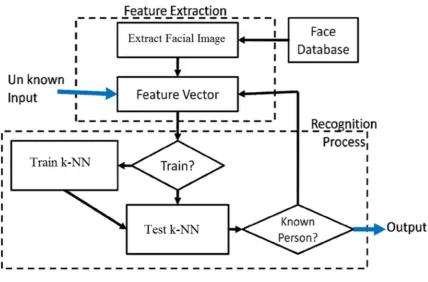
We will implement a classical face recognition system using LBPH in our OpenCV library. The process will be carried out in three phases as shown below.
detected part of the image will be cropped and saved in the data folder. Also, care has to be taken to align the images if they are shot from a different angle.
2) Phase 2: Feature Extraction: Once we have got the images for training, we can use our LBPH algorithm to learn on this dataset. Depending on the size of data samples, the accuracy of the classifier will vary. In this phase, we will generate local binary patterns as we discussed earlier in the paper. We applied the LBP method on image pixels by thresholding the 3 × 3 neighbourhood of each pixel with the centre value and considering the result as a binary number. Finally, we applied the histogram method to concatenate the new cells description and obtain a new representation for each training image, which helps to reduce the computation time.
3) Phase 3: Classification: This phase is nothing but the testing of our face recognizer. We will do a real time video check to verify the correctness of the trained model. Whenever a new face is as a input to our model, it will first extract its features and generate binary patterns same as we did for the training images. After its completion, the input is given to the trained recognizer to classify the image according to its training. This phase exploits the powerfulness of the classifier.
D. Hardware Assembling
The hardware components that we need in this project are as mentioned below.
1) Raspberry Pi
2) Magnetic Door Lock
3) Camera module
4) LCD Screen
5) WIFI Connection
These components are interconnected to each other as shown in the following diagram.
The users face is scanned through a camera located at the door. This data is passed on to the Raspberry Pi for verification. The algorithm that runs behind the scenes is explained in the implementation part below [VII]. If the user is authorized, the magnetic lock is trigged to open and user gets access to enter. If this condition is not satisfied and if user is unauthorized in the system, the access is denied and the owner of the system is notified about this practice of intrusion.
V. SYSTEM IMPLEMENTATION
The implementation of this project is pretty straightforward. Initially, the code for face recognition and creating a database will be developed in python. The data needs to be saved on cloud for computing and scaling purposes. After the successful completion of face recognition, the program needs to be deployed in Raspberry Pi. The system will save faces using Raspberry Pi camera and feature extraction will be done. The k-NN model will be trained on this collected data. When a user stands in front of the system, it will feed the facial image to the trained model. The model will give the confidence of the input image i.e whether it is present in database or not. If confidence is greater than the prescribed threshold value, the access to the user will be granted or else, denied. Machine Learning will be used in developing the training model and Internet of Things domain will be deployed by using Raspberry Pi.
Figure 1. System archicture
VI. CONCLUSION
We have proposed an advance system for door lock which is using face recognition to provide access to the user for entering into the house. Face is a unique identifier for humans and is intrusion free. Also, the user will not have to worry about losing keys or password into the wrong hands. The classifier that we used has provided us acceptable accuracy and this technology can be used in areas which are less vulnerable. We have not applied modern NN to prove that we can achieve higher accuracy even with traditional features extraction and domain reduction methods using a correlated training dataset between images. However, in future work we plan to use different feature extraction methods such as convolutional NN and compare them to the current results.
VII. ACKNOWLEDGMENT
We express our sincere thanks to Prof. D.M. Ujalambkar, Department of Computer Engineering, AISSMS COE, PUNE for their valuable guidance.
Finally, at the outset, we would like to thank all those who have directly or indirectly helped us to accomplish the project successfully.
REFERENCES
[1] Harnani Hassan, Raudah Abu Bakar and Ahmad Thaqib Fawwaz Mokhtar, Face Recognition Based on Auto-Switching Magnetic Door Lock System Using Microcontroller, published in 2012 International Conference on System Engineering and Technology September 11-12, 2012, Bandung, Indonesia..
[2] Ratnawati Ibrahim and Zalhan Mohd Zin, Study of Automated Face Recognition System for Office Door Access Control Application, Published in 2011
[3] Hteik Htar Lwin, Aung Soe Khaing, Hla Myo Tun, Automatic Door Access System Using Face Recognition, Published in INTERNATIONAL JOURNAL OF SCIENTIFIC & TECHNOLOGY RESEARCH VOLUME 4, ISSUE 06, JUNE 2015
[4] Giuseppe Amato and Fabrizio Falchi, kNN based image classification relying on local feature similarity.
[5] MOHANNAD A. ABUZNEID , (Member, IEEE), AND AUSIF MAHMOOD, (Senior Member, IEEE), Enhanced Human Face Recognition Using LBPH Descriptor, Multi-KNN, and Back-Propagation Neural Network.
[6] Chakka Mounica and Venugopal P, FACE DETECTION AND RECOGNITION USING LBPH, Published in 2002, IEEE TRANSACTIONS ON SPEECH AND AUDIO PROCESSING, VOL. 10, NO. 7.