Design & Development of Jumbo Unloading
Machine for Material Handling System
Mr. Waybase Akshay1, Mr. Purane Amol2, Mr. Khot Shubham3, Ms. Kakade Renuka4, Mr. Choudhari Vinay5, Prof. Mohnesh Mandhare6
1, 2, 3, 4, 5, 6
Students of G. H. Raisoni College of Engineering & Management, Ahmednagar
Abstract: Materials handling is the movement and storage of materials at the lowest possible cost through the use of proper methods and equipment.The principle motivation behind utilizing a material handling of framework is to guarantee that the texture inside the right amount is cautiously conveyed to the predefined goal at the opportune time at least cost. Material handling of framework can be characterized as development, taking care of, capacity and controlling of materials all through the assembling procedure. Helical compression springs are commonly used to ingest the vitality due to the effects and to shape an adaptable connection which diverts under stacking and re-establish the items to the ordinary position where the irritating powers are expelled. Material dealing with includes "short-separate development that typically happens inside the limits of a structure, for example, a plant or a stockroom and between a structure and a transportation organization." It can be utilized to make time and spot utility through the taking care of, capacity, and control of material, as unmistakable from assembling (for example manufacture and get together tasks), which makes structure utility by changing the shape structure and cosmetics of material.
Keywords: Capacity, unit load, structure, helical compression, jumbo unloading.
I. INTRODUCTION
The Unloading process of a container in industry is a very complicated, time consuming and costly process.Manual unloading requires more man power ,labour cost and time. So there is a need to develop certain mechanism which is useful in this unloading process, which will requires less manpower, time saving and at the end saves the valuable money of organization.The developing such mechanism which makes the unloading process fast and easy.
Which save money and time of the company in the unloading process, and to Minimize cost of material handling and also Minimize delays and interruptions by making available the materials at the point of use at right quantity and at right time. Material handling of framework develops development of texture, machine from one spot to an alternate. it's system wont to convey the correct item securely, to the best possible spot and time and at the right esteem.
Consolidating the taking care of strategy implies carryout elective cost including forms like Inspection, painting, purifying though material is moving. A decent material taking care of framework seems to understand the gainful item on the grounds that with respect to eightieth of all out cost of item is developed in development of texture and exclusively two hundredth of cost is engaged with shutting real procedure of product.Various material handling of Equipment should be well placed in and referenced for wash and ceaseless stream of texture.
II. LITERATURESURVEY
The authors Nandkumar Patil & Madane Saurabh [1] implemented material handling system is to ensure that the material in the right amount is carefully delivered to the desired destination at the right time at minimum cost. Helical compression springs are generally used to absorb the energy due to the impacts and to form a flexible link which deflects under loading and restore the objects to the normal position where the disturbing forces are removed. The main objective of that system is to design the helical spring, chain drive and rack-pinion as per the proposed design. After this work complete the literature review about material handling equipment, chain drive and rack-pinion.
Chain conveyors are ideally suited for cycled transport of products. Available with different drive variants, they are often used for setting up complex interlinked solutions. Typical applications were transfer of pallets in two-strand applications for high loads at moderate speeds. For high speeds or positioning tasks, low maintenance, and low noise timing belt conveyors were used. Various chains, in conjunction with there robust and solidly designed wear strips, permit an optimally matched sustainable function. Chain conveyors were extremely robust and low maintenance. [3]
This researcher was established the fact that a MHS consists of three main pillars; design principles and physical elements, information and software, human and management, which are equally important in order to achieve a well-functioning MHS on a manufacturing shop floor.[4] In the process or manufacturing industry, raw materials need to be transported from one manufacturing stage to another. Material handling equipment are designed such that they facilitate easy, cheap, fast and safe loading and unloading with least human interference.The authors were discussed about the design calculations and considerations of belt conveyor system for biomass wood using 3 rolls idlers, in terms of size, length, capacity and speed, roller diameter, power and tension, idler spacing, type of drive unit, diameter, location and arrangement of pulley, angle and axis of rotation, control mode, intended application, product to be handled as well as its maximum loading capacity in order ensure fast, continuous and efficient movement of crushed biomass wood while avoiding fatalities during loading and unloading. The successful completion of there research work had generated design data for industrial uses in the development of an automated belt conveyor system which is fast, safe and efficient.[5]
The authors were studied about the ginning machine of manufacturing company. There work were to located and identified the wasteful activities regarding the material handling, and to streamline the activities to reached a minimum of material handling. They were concluded that the materials handling systems plays a vital role in a manufacturing industries. [6] The elimination of non value added activities in these material handling system reduced the production cost and improves the productivity of an organization.[7]. The authors were applies weighted utility additive (WUTA) method to solve an MH equipment selection problem. The ranking obtained using the WUTA method were compared with that derived by the past researchers which proves its potentiality, applicability, and accuracy to solve complex decision-making problems.
III.CONVENTIONALMETHODS
Conventional ways In typical technique material is transferred by tramcar, tray, Pallets, Lift, trucks, roller
conveners , transportable hand hoist, pulley. During this style of equipment it needs additional helper (manpower) a lot of efforts and time overwhelming with risk of injury of material and health. once development it's done by AGV, robots, cranes, elevators, trackless truck, power power-assisted hoists. thus ancient technique of plantation is time overwhelming moreover because it is expensive.
IV.METHODOLOGY
In order to attain style issues, according to projected style and demand one would follow a qualitative approach. The main objective of this project is to style the spiral spring, chain drive and rack-pinion as per the proposed style. After this work complete the literature review regarding material handling instrumentation, chain drive and rack-pinion. a trial has been made to the issues that area unit coming back under consideration during its functioning. After then complete choice of element like sprocket, base wheel, frame etc. Then complete the producing and fabrication of corresponding element. when then complete testing on the premise of trial and error.
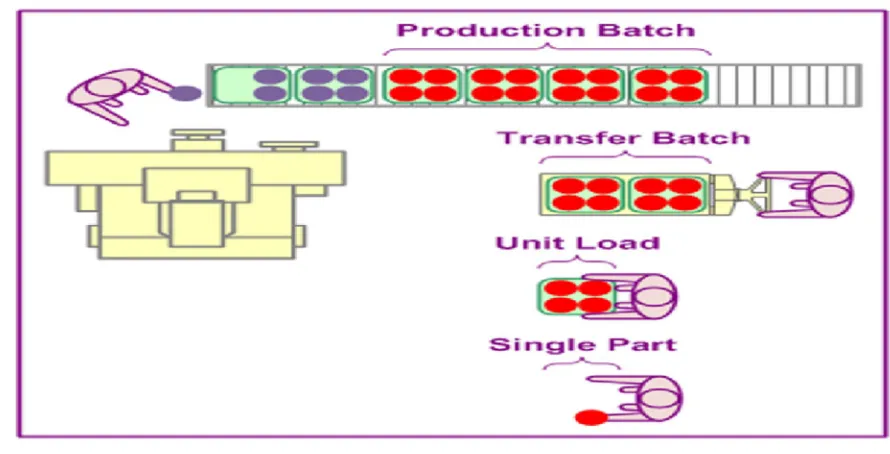
Materials handling is the movement and storage of materials at the lowest possible cost through the use of proper methods and equipment. The different types of material handling equipment are classified into four categories. i. Positioning equipment ii. Unit load formation equipment iii. Transport equipment iv. Storage equipment. The Unit load formation equipment when multiple units of material are combined into a single transfer batch in order to reduce the number of trips required for transport.A unit load is either a single unit of an item, or multiple units so arranged or restricted that they can be handled as a single unit and maintain their integrity.
Fig1: Unit Load Formation
V. MATERIALHANDINGEQUIPMENT’S
Comprehensively material taking care of hardware's can be grouped into two classes, to be specific:
1) Fixed Path Equipment: Which move in a fixed path. Conveyors, monorail devices, chutes and pulley drive equipment’s belong to this category. A slight variation in this category is provided by the overhead crane, which though restricted, can move materials in any manner within a restricted area by virtue of its design.
2) Variable Path Equipment: Variable path equipment have no restrictions in the direction of movement although their size is a factor to be given due consideration trucks, forklifts mobile cranes and industrial tractors belong to this category.
VI.RESULTANDDISCUSSION
Following are the design procedure for the jumbo unloading machine: A. Base
[image:3.612.76.521.76.303.2]Material= Mild steel (Square Pipe 50mm×50mm) Dimensions= 3000mm×2000mm×800mm
B. Shaft
1) Material: Mild steel 2) Dimensions
a) Diameter of shaft=60mm.
b) Total length of shaft=1200mm.
[image:4.612.128.501.157.309.2]Types of fit used during assembly=Transition fit
Fig.Manufacturing of shaft on centre lathe C. Sprocket
1) Material: Cast iron
a) Design of larger sprocket
i) Pitch circle diameter(D)=
( )
= 240.316mm
ii) Roller diameter(d1)= 10.16mm
iii) Width between inner plate(b1)=9.4mm
iv) Outer diameter (D0)=D+1.25p-d1=249.995mm.
b) Design of smaller sprocket:-
i) Pitch circle diameter(D)=
( )
= 123.31mm
ii) Roller diameter(d1)=10.16mm
iii) Width between inner plate(b1)=9.4mm
iv) Outer diameter(D0)=D+1.25p-d1=132.9995mm.
c) Larger sprocket groove=15mm
d) Smaller sprocket groove=15mm
[image:4.612.111.524.561.722.2]e) Thickness of both sprocket=8mm
D. Clutch Plate
1) Material: Mild steel
2) Dimensions: Diameter=160mm , Width=60mm
Fig. clutch plate
E. Bearing
i) Types of Bearing Used: The self-aligned spherical roller bearing having standard-22213 CKW33.
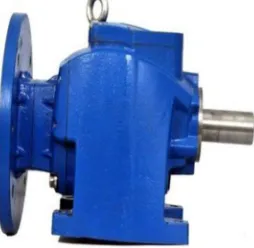
F. Standard Gearbox
[image:6.612.256.383.111.235.2]Specifications: Type=HR60P112 , Power Rating=3.715Kw ,Speed ratio=20:1 , Output Speed=72rpm
Fig.Helical gear box
G. Power Screw 1) Material: Mild Steel
[image:6.612.86.512.289.486.2]2) Dimension: Pitch=8mm , Inner diameter=72mm,Threaded length=300mm
Fig.: CATIA model of power screw
H. Polyester Duplex Slings 1) Material: Polyester
2) Specification: Length=16 meter , Width=50mm , Safe working load= 2 ton, Proof working load= 4 ton, Breaking load= 10 ton.
[image:6.612.50.536.535.721.2]VII. CONCLUSION
Regarding on various theories and empirical review, we conclude that Materials handling today are lifeblood of any industry and no government industry or organization or private organization operates without them.So material handling increase the efficiency and effectiveness of manufacturing organization since it have many significant contribution which is finally results the reduction of production costs. By utilizing this material dealing with framework we can exchange material starting with one spot then onto the next spot without outside power. This material taking care of gear can spare time, cash and work cost. The cost of this material dealing with gear is similarly less. So it is appropriate for little too bigger scale ventures.
REFERENCES
[1] Nandkumar Patil Madane Saurabh, Ghadge Sourabh, Kadam Sanket, Bhise Amit, Thorat Amarjeet “Design and Development of Material Handling Equipment: A Review” Imperial Journal of interdisciplinary Reserch ( IJIR )
[2] Waghmare Santosh R.1, Tolmare Ashish M.2, Praveen K Mali3 “Design and analysis of Matarial Handling System” International Research Journal of Engineering and Technology (IRJET) Volume: 03 Issue: 05 | May-2016
[3] Aniket A Jagtap et all “ DESIGN OF MATERIAL HANDLING EQUIPMENT:BELT CONVEYOR SYSTEM FOR CRUSHEDBIOMASS WOOD USING V MERGE CONVEYINGSYSTEM
[4] Praveen K. Mali et all “Design and analysis of material handling system” International Journal of Mechanical Engineering and Robotics ResearchISSN 2278 – 0149 www.ijmerr.comVol. 4, No. 2, April 2015
[5] Waghmare Santosh R.1, Tolmare Ashish M.2, Praveen K Mali3 “Design and analysis of Matarial Handling System” International Research Journal of Engineering and Technology (IRJET)
[6] P. SunderamE.Viswanathan “ Development of Material Handling System in a Manufacturing Company” International Journal of Innovative Research in Science, Engineering and Technology
[7] Prasad Karande et all. “Material Handling Equipment Selection Using Weighted Utility Additive Theory” Journal of Industrial Engineering Volume 2012, Article ID 268708.
[8] P. Sunderam,et all. “Development of Material Handling System in a Manufacturing Company” Vol. 3, Issue 1, January 2014 ISSN: 2319-8753.
[9] Aniket A Jagtap, et all. “Design of Material Handling Equipment by Belt Conveyor System For Crushed Biomass Wood Using V Merge Conveying System” ISSN 2278 – 0149 www.ijmerr.com Vol. 4, No. 2, April 2015.
[10] Surinder Kumar et all. “Selection of Material Handling Equipment for Flexible Manufacturing System Using FAHP” Vol.5, No.1, February 2016. [11] D. Nandkumar Patilet.al. “Design and Development of Material Handling Equipment” Vol-3, Issue-10, and 2017 ISSN: 2454-1362.