©IJRASET: All Rights are Reserved
449
Studying the Variations of surface Roughness
Parameters of Nitronic-60 to Extrusion Honing
Process
H P Raju1, Abhijith K. S2 1
Professor, 2PG. Scholar, Department of Mechanical Engineering, P.E.S.C.E, Mandya-571401, Karnataka state, India.
Abstract: Extrusion Honing (EH) is also known as Abrasive Flow Machining (AFM) deburrs, polishes and radiuses surface and edges by flowing an abrasive media over these areas. The process is particularly used on internal shapes which are difficult to process by other machining techniques. The machine controls the extrusion pressure and the flow volume and speed. Since abrasive action occurs only in areas where the flow is most restricted, tooling is often used to direct the media to the appropriate areas. A variety of finishing results can be achieved with different abrasive types, sizes, concentrations and media viscosities. In the extrusion honing is a process in which a tool of abrasive laden putty which is to some extent a firm consistency; semi-solid state, is made to flow across or through the work piece in a constant pressure to carry out the process like cleaning, polishing, remove recast layers etc. In this work the experimental process is conducted using one-way extrusion honing machine and the process is carried out on Nictronic-60, one of the super alloys having high hardness and high strength properties which is machined to get good surface finishing.
Keywords: Deburrs, Extrusion Honing, abrasive, media viscosity, Nitronic 60, surface finish
I. INTRODUCTION
Extrusion Honing (EH) is also known as Abrasive flow machining (AFM) was developed by the Extrude Hone Corporation, USA in 1960s as a method to deburr and polish difficult-to-reach surfaces and edges by flowing abrasive laden polymer with special rheological properties [1]. EH can be applied to an impressive range of finishing operations, providing uniform repeatable and predictable results. Experimental investigations have been carried out by various researchers to investigate the effects of process parameters like extrusion pressure, number of cycles, viscosity, abrasive concentration and grain size on the output responses namely, surface finish and material removal during EH.
Jain and Adsul [2] reported that softer material has higher material removal and more improvement in surface finish (ΔRa)
compared to harder material.
Gorana et al. [3] reported that extrusion pressure, abrasive concentration and grain size affect the cutting forces, active grain density and finally reduction in surface roughness (Ra value).
In Extrusion Honing (EH), abrasive concentration, abrasive grit size, viscosity of the abrasive media, extrusion pressure, geometry of machining surface, are the factors which influence on material removal and surface roughness. Material properties like hardness and ductility also influence upon material removal and improvement in surface roughness. Abrasives with higher grit size give better surface finish with lower
Raju et.al [4] have reported that extrude honing of SG iron (600 grade) has been performed hydraulically actuated extrude honing set-up using a select grade of polymer as abrasive carrier medium. SiC grit of 36 mesh size is used as abrasive. The surface finish parameters were measured at two locations on entry side and exit side of the abrasive media. The results obtained show that extrusion honing process in 10 bar range shows good improvement in surface finish parameters is seen till seventh pass, beyond which the surface starts deteriorating. The extrusion honing process in the lower pressure range yields good results in finishing SG Cast Iron (600 grade). Out of roundness of extrude honed surface is improved, and Surface in the middle zone is better than the entry/exit zone due to better contact with the abrasive medium.
©IJRASET: All Rights are Reserved
450
work piece. While extruded through the passage which is formed by the work piece and tooling, this medium tries to finish the work piece surface selectively. Here in the process tooling plays the important role. So, the design of the fixture or tooling should be done carefully. One of property of the polymer is that the polymer chain holds the abrasive particle flexibly and movies them around in the direction of the extrusion pressure. Thus, the medium is used as a multi-point tool cutter which starts abrading the work piece surface. Extrusion process is one the most extended process used in wide range of industrial applications in the field of manufacturing which have different approaches of extrusion process. This finishing technique also reduces the human effort and provides the high-quality surface finish
II. EXPERMENTAL DETAILS
Experiment conducted on one-way Extrusion honing machine built in Laboratory and surface parameters are evaluated for each trial. Surface roughness parameters measurements were taken at entry and exit positions for ϕ6mm, ϕ8mm and ϕ10mm. Finally, SEM images of work pieces before and after the 10 EH passes were taken.
A. Work Material Details
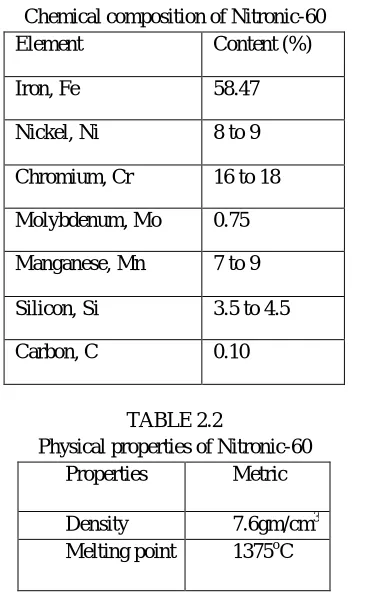
Super alloy Nitronic-60 is an iron-based high temperature and high strength alloy. The following datasheet provides an overview of super alloy Nitronic-60.
1) Applications of Nitronic-60
a) Automotive valves - can withstand gas temperatures of upto 1500°F for a minimum of 50,000 miles.
b) Fastener galling - capable of frequent assembly and disassembly, allowing more use of the fastener before the threads are torn up, also helps to
c) Eliminate corroded or frozen fasteners.
d) Pins - Used in roller prosthetics & chains to ensure a better fit of parts (closer tolerance, non-lubricated) and longer lasting.
e) Marine shafts - better corrosion than types 304 and 316, with double the yield strength.
[image:2.612.219.402.428.726.2]f) Pin and hanger expansion joints for bridges - better corrosion, galling-resistance, low temperature toughness, & high charpoy values at sub-zero temps compared to the A36 and A588 carbon steels commonly used.
TABLE 2.1
Chemical composition of Nitronic-60
Element Content (%)
Iron, Fe 58.47
Nickel, Ni 8 to 9
Chromium, Cr 16 to 18
Molybdenum, Mo 0.75
Manganese, Mn 7 to 9
Silicon, Si 3.5 to 4.5
Carbon, C 0.10
TABLE 2.2
Physical properties of Nitronic-60
Properties Metric
Density 7.6gm/cm3
©IJRASET: All Rights are Reserved
451
TABLE 2.3
Mechanical properties of Nitronic-60
Properties Metric
Tensile strength 724MPa
Yield strength 379MPa
Elongation at break 35%
Reduction of area 55%
Hardness, Brinell 205
Hardness, Knoop 330
Hardness, Rockwell C 33
Hardness, Vickers 318
B. Specimen Preparation
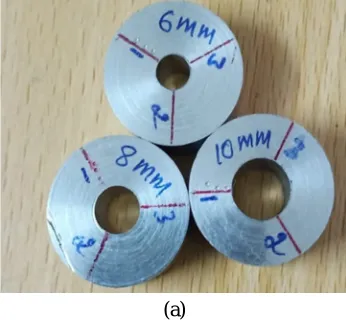
Nitronic-60 specimens of 25 mm diameter and length 12 mm with hole diameter of 6, 8 and 10 mm. The specimens were initially drilled using carbide drill bits and thoroughly washed with acetone to remove the clogged particles. Surface roughness parameters were measured using a surface roughness measuring instrument (Surfcom 130A) before conducting the experiment.
(a)
C. Preparation of Abrasive media
Abrasive media is prepared by thoroughly mixing Silicone carbide abrasives with silicone polymer using abrasive mixer. The volume fraction of Silicone carbide abrasives with silicone polymer used is 35%
[image:3.612.134.480.524.719.2]
(b) (c)
©IJRASET: All Rights are Reserved
452
D. Experimental Procedure
[image:4.612.100.547.152.516.2]Initially the extrusion honing machine is switched “on”, the actuation of directional control valve in forward direction results in abrasive media to extrude through the specimen from one side and exits out at the other. After each trails the test specimens were thoroughly cleaned with acetone solution to remove clogged polymer and other dust particles and surface roughness parameter were measured at 2 locations (drill entry side and drill exit side) each at 3 position (120oC apart). This procedure is repeated for 10 passes and results were tabulated.
[image:4.612.168.448.157.305.2] [image:4.612.111.531.332.499.2]Fig 2.2: Extrusion honing machine
Fig 2.3: Extrusion honing process Fig 2.4: Surface roughness measuring instrument (Surfcom 130A)
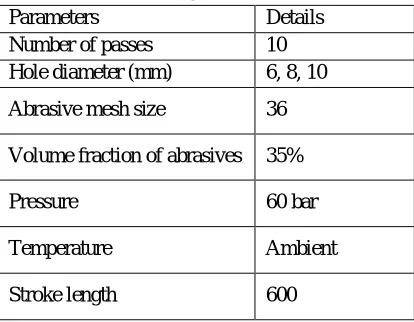
TABLE 2.4
Extrusion Honing Process Parameters
Parameters Details
Number of passes 10
Hole diameter (mm) 6, 8, 10
Abrasive mesh size 36
Volume fraction of abrasives 35%
Pressure 60 bar
Temperature Ambient
[image:4.612.203.410.551.712.2]©IJRASET: All Rights are Reserved
453
III. RESULTS AND DISCUSSION
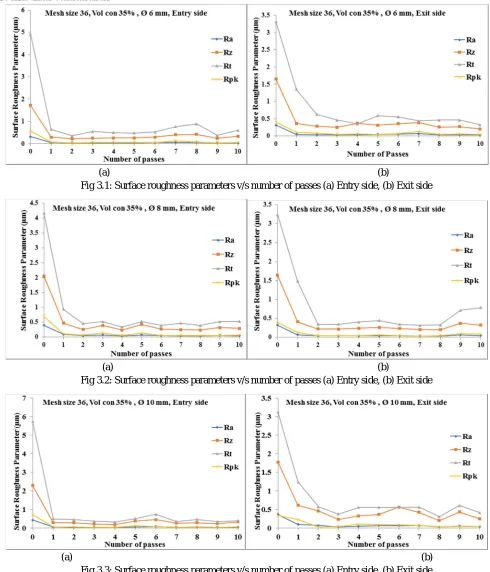
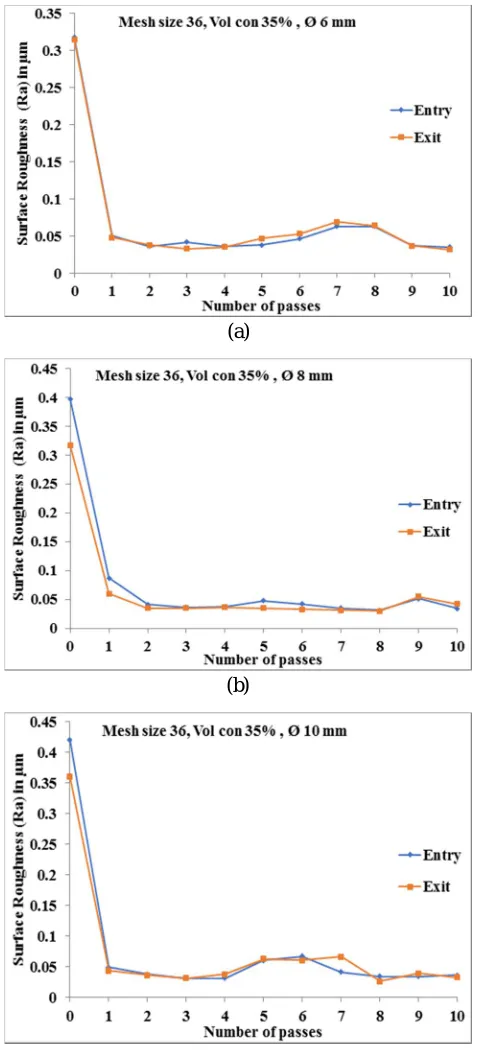
The main aim of the present work is to remove roughness and to attain a fine surface finish by applying extrusion honing process on Nitronic 60. After each finishing cycle, the finished surface of specimens was evaluated for its surface finish parameters (Ra, Rt, Rz and Rpk). Graphs were plotted for the parameters obtained after each experimental for all specimens of diameter of 6 mm, 8 mm and 10 mm under consideration.
(a) (b)
Fig 3.1: Surface roughness parameters v/s number of passes (a) Entry side, (b) Exit side
(a) (b)
Fig 3.2: Surface roughness parameters v/s number of passes (a) Entry side, (b) Exit side
[image:5.612.59.549.139.711.2](a) (b)
©IJRASET: All Rights are Reserved
454
(a)
(b)
[image:6.612.187.428.75.600.2](c)
Fig 3.4: Surface roughness (Ra) at Entry and Exit side v/s number of passes; (a) Ø 6 mm, (b) Ø 8 mm and (c) Ø 10 mm
©IJRASET: All Rights are Reserved
455
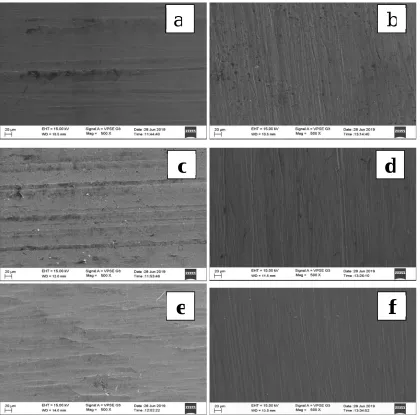
Fig 3.5: SEM images for 500 magnification; (a) 6 mm, Zero pass (b) 6 mm, Ten Passes (c) 8 mm, Zero pass (d) 8 mm, Ten Passes (e) 10 mm, Zero pass (f) 10 mm, Ten Passes
From the above SEM images (fig: 3.5), it can be seen that the uneven initial tool feed marks and macro surface irregularities of drilling operation have been effectively removed and replaced with a fine surface having a uniform lay.
IV. CONCLUSION
In
the present study, Extrusion Honing of Nitronic 60 was done using a working medium developed using a select grade siliconepolymer and silicon carbide (SiC) abrasive particles. The Extrusion Honed surface of each specimens were evaluated at three different points on both entry and exit side of the specimen with respect to medium entry. From the present study, following conclusion could be drawn,
A. The present study shows that, working medium made of silicone polymer and SiC abrasives was able to produce a good surface
finish on Nitronic 60.
B. Surface finish increases greatly after first pass followed by a progressive improvement and once the surface attains core roughness, deterioration of surface sets in.
C. Surface finish of specimen along exit side is better than the entry side.
D. The uneven Surface irregularities and lay pattern have been effectively replaced with fine surface having a uniform lay.
a
b
c
d
©IJRASET: All Rights are Reserved
456
V. ACKNOWLEDGEMENT
The authors would like to thank AICTE, New Delhi India, for their financial support to the project “Micro Finishing of Internal Primitives through Extrusion Honing Process” No.8023/BOS/RPS-123/2006-07. Authors also would like to thank Mr.N L Murali Krishna, professor, Department of Industrial and Production Engineering, PESCE Mandya for kind help during experimentation.
REFERENCES
[1] Lawrwnce J. Rhodes and Hilary A. Clouser, Abrasive Flow Machining, ASM Handbook, Volume 16: Machining, p 514 – 519.
[2] Jain V. K. and S. G. Adsul, Experimental investigations into abrasive flow machining (AFM), International Journal of Machine Tools & Manufacture 40 (2000) 1003–1021.
[3] Gorana V. K., V. K. Jain and G. K. Lal, Experimental investigation into cutting forces and active grain density during abrasive flow machining, International Journal of Machine Tools & Manufacture 44 (2004) 201–211.
[4] Raju H P, Devadath V R, Murali Krishna N L, “Extrusion Honed Surface Characteristics of Inconel 600”, International Journal of Engineering Research and Applications, Vol. 3, Issue 6 (Nov-Dec 2013), pp.1338-1343.
[5] Manjunath L Naduvinamani and Raju H P, “Study of Surface Parameters of Inconel 600 by Extrusion Honing Process”, Int. Journal of Research, e-ISSN: 2348-6848, p-ISSN: 2348-795X, Vol. 4, Issue 9, August 2017.