Analysis of Heart Disease Prediction System using
Data Mining Techniques
Mrs. K. Pushpalatha1, Dr. S. Gunasekaran2, Mr. U. Rahulnath3, Mr. M. Saravanan4, Mr. B. Sriharri5, Mr. S. Ajeeth Kumar6
1
Assistant Professor, 2Professor, 3, 4, 5, 6Department of CSE, Coimbatore Institute of Engineering and Technology , Coimbatore, India
Abstract: Heart Disease is considered as one of the predominant reason of death all through the arena. We are living in an “information age” and Terabytes of data are produced every day. The health care enterprise generates a massive amount of statistics day by day. However, maximum of it is not successfully used. Hence, it is crucial to have a frame work that may effectually recognize the prevalence of heart disease in thousands of samples instantly. Heart disease can be predicted using various factors which incorporates circle of relatives records, cholesterol, diabetes, exercise and so on. The aim of the paper is to discuss the recent research on prediction of heart diseases using data mining techniques. We have investigated and analyzed the heart disease prediction system by using data mining techniques like SVM, KNN, Random tree and K star algorithms. The experimental result shows that the SVM produces optimum performance than the other techniques.
Keywords: Data mining, Heart Disease, Weka, SVM, Kstar, Random Tree
I. INTRODUCTION
Data mining is defined as a way of extracting necessary and hidden predictive data from the large amount of database [1]. Data mining classifiers are used to find wide application in medical advancement for diverse diagnosis of different data mining techniques are used for prediction and decision making for different kinds of disease like cancer, heart disease, diabetes etc [2]. There are many types of data mining classifier algorithms like SVM (Support Vector Machine), KNN (K Nearest Neighbours), Random forest, K star algorithm can be applied to predict the disease.
Now day’s Heart disease is main reason for death in the world. Heart disease is leading cause of death in the world [3]. Some of the major reason for heart diseases are blood pressure, cholesterol, pulse rate. More common type of heart disease that makes the heart works abnormally are congenital heart disease, heart failure, hypertensive heart disease, cardiomyopathy, heart murmurs, rheumatic heart disease, pulmonary stenosis and coronary artery disease. Heart can be attacked by various diseases that leads the heart to not work properly. The World Health Organization (WHO) has estimated that 12 million deaths around the world occurs each year from heart disease. In 2008, 17.3 million people died from heart disease. "Death rate increases by 80% in the world due to heart disease" The World Health Organization (WHO) estimates that by 2030, 23.6 million people worldwide will die from heart disease [4]. When the prediction of heart disease is getting accurate, then the specific patient can take preventive measures so that heart disease as the number one killer in the world can be reduced. The aim of the paper is to study the various data mining techniques using different tools. The algorithms are selected based on the accuracy. The risk level is classified by using SVM, KNN, Random forest and K star algorithms. This paper helps to understand the methodologies in the recent literature for predicting the heart disease using data mining techniques.
The rest of the paper is organised as follows. Section 2 describes the related works in the literature. Section 3 describes various data mining techniques; Section 4 describes the system architecture; Section 5 describes methodologies used for analysis and lastly the results are discussed in section 6.
II. RELATED WORKS
Sarath Babu and et. al. [6] discussed the Heart disease diagnosis system using data mining techniques.They have used three different classification techniques such as K-means classification, Decision tree and MAFIA(A Maximal Frequent Item set) algorithm for early detection of heart disease and its diagnosis correctly on time and providing treatment with affordable cost. M. Akhil jabbar et al. [7] presented an effective classification technique based genetic algorithm is used for heart disease prediction. The scope of using genetic algorithm to predict the disease from large dataset is that the actual size of data is to get best attribute set. There is certain limitation in the prediction of heart disease using data mining approach. By reducing the set of attributes we can make it less complex and better accurate. Eman AbuKhousa, Piers Campbell [8] have implemented the Naïve Bayes technique to build the predictive model. RaghunathNambiar, and AdhiraajSethi et al [9] evaluated the data mining techniques such as CART (Classification and Regression Tree), ID3 (Iterative Dichotomized 3) and Decision Table (DT). Different classifiers and research are conducted to find the best classifier for calculating the patients Diagnosis. Among the entire algorithm CART gives more accuracy.
III. DATAMINING
Data mining is simply explained as the "knowledge discovery in databases" process, or KDD. Data mining is the process of extracting hidden pattern in the huge amount of data sets. Data mining is used in various fields like telecommunication industry, Retail industry, biological data analysis, and Intrusion detection etc., Use of data mining techniques in the medical field causes high impact on diagnosing, predicting and understanding of healthcare data. The patient’s informations are maintained in the database. With the help of the data mining techniques, cardiologist can get the valuable information from the datasets [10].
A. Classification
Classification is a supervised technique which assigns items in the collection to target category or classes. Classification is one popular technique under data mining techniques. The aim of classification technique is used to predict the target class for each case in the data. Classes and groups are classified from data or objects[11]. Classification is the process of learning a function that data objects to a subset of a given class set. This task take X as input component and takes Y as the outcome of X, i.e.
C(X) ∈ Y
Where, X represents feature vector, Y represents response taking values in the set C, C(X) defines the values in the set C.
B. Clustering
Clustering is the process of grouping of a particular set of objects based on their characteristics, aggregating them according to their similarities. It is the process of dividing or partitioning a set of data or objects into a set of meaningful sub-classes. Thus formed sub-groups are called clusters. Each and every near object is neighborhood object. For example, this process is used to obtain the group having the same risk factor.
C. Association
Association is a data mining function that discovers the probability of the co-occurrence of items in a collection. The relationships between the co-occurring items are expressed as association rules. This is used to describe the relationship of one item on other items in the same operation. Here, this is used to express the relationship of attributed used for analysis.
D. Feature Extraction
Feature selection is the process of reducing the inputs data for processing and for analyzing or finding the most meaningful inputs from the given sections. It can be also called as variable selection, attribute selection and variable subset selection in this process of selecting a subset of relevant features for use in model construction.
IV. ANALYSIS OF HEART DISEASE PREDICTION SYSTEM
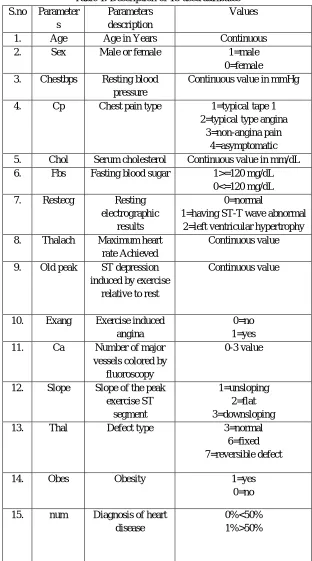
The Prediction of the heart disease is carried out using the data mining techniques is illustrated in Figure 1 [12]. The system is evaluated with four different data mining techniques namely SVM, K-star, Random Tree and KNN. Here, we have collected datasets from the data repository. It contains 274 records of 15 attributes shown in (Table 1) where some records where some are for non-heart disease patients and some are for patients with heart disease.
Fig. 1. System Architecture
V. IMPLEMENTATION
A. Support Vector Machine
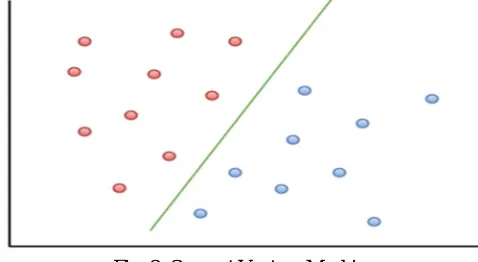
A Support Vector Machine (SVM) [14] is a supervised learning classifier characterized by a separating hyperplane. The hyperplane is a line that partitions a plane in two sections where each class lay in either side. There are 2 sorts of SVM classifiers:
1) Linear SVM Classifier 2) Non-Linear SVM Classifier
Fig. 2. Support Vectors Machine
[image:3.612.184.423.543.674.2]support vectors are used as the base data for machine model. SVM algorithm is not sensitive to other data. The objective of SVM is to find the best data boundary with the largest possible distance from all classes.
B. Kstar
Kstar [14] is a lazy learner , an instance-based classifier that is the class of a test instance is based upon the class of those training instances similar to it, as determined by some similarity function. It differs from other instance-based learners in that it uses an entropy-based distance function. It uses information theory to calculate the distance between two instances with K star function denoted as
∗ =− P *( )
Where P (c/a) denotes the summation probability of an example of being in category C.
C. Random Tree
Random Tree [16] is a supervised Classifier; it is a concert learning algorithm that generates many individual learners. It employs a gear idea to yield a random set of data for constructing a decision tree. In standard tree each node is divide using the best split among all variables. It can deal with both classification and regression problems. The classifier gets the input feature vector and classifies it with every tree in the forest. In regression, the classifier reply is the average of responses over all the trees. It can be described by the following equation.
=1 ℎ
D. K Nearest Neighbour
K Nearest Neighbor[17] (also known as Collaborative Filtering or detail-based Learning) is a convenient data mining technique that grant you to use your past data instances, with known output values, to predict an unknown output value of a new data instances. It is a non-parametric method used for both classification and regression. The Euclidean distance method is used to calculate the distance between samples. For example if a is the first sample denoted by (a1, a2, a3….an) and b is the second sample which is denoted by (b1, b2…bn), the distance is calculated by using the following formula.
= ( 1− 1) + ( 2− 2) +⋯( − )
VI. DISCUSSONS AND RESULTS
In order to predict the probability of patients having heart disease and people who have no heart disease, a confusion matrix was created, where A indicate patients with heart disease, and B indicate patients with no heart disease
A B
A (TP) (FN)
B (FP) (TN)
TP - Represents the people with Heart Disease.
TN - Represents the people who doesn’t have Heart Disease.
A confusion matrix contains report about real and predicted classifications fixed by an allotted system. The data in the matrix are check to know the performance of such systems.
The confusion matrix contains the following four entries:
FN (false negative): The number of records classified as false while they were actually true. TN (true negative): The number of records classified as false while they were actually false
Table 1. Description of 15 used attributes S.no Parameter
s
Parameters description
Values
1. Age Age in Years Continuous 2. Sex Male or female 1=male
0=female 3. Chestbps Resting blood
pressure
Continuous value in mmHg
4. Cp Chest pain type 1=typical tape 1 2=typical type angina
3=non-angina pain 4=asymptomatic 5. Chol Serum cholesterol Continuous value in mm/dL 6. Fbs Fasting blood sugar 1>=120 mg/dL
0<=120 mg/dL 7. Restecg Resting
electrographic results
0=normal
1=having ST-T wave abnormal 2=left ventricular hypertrophy 8. Thalach Maximum heart
rate Achieved
Continuous value
9. Old peak ST depression induced by exercise
relative to rest
Continuous value
10. Exang Exercise induced angina
0=no 1=yes 11. Ca Number of major
vessels colored by fluoroscopy
0-3 value
12. Slope Slope of the peak exercise ST
segment
1=unsloping 2=flat 3=downsloping 13. Thal Defect type 3=normal
6=fixed 7=reversible defect
14. Obes Obesity 1=yes
0=no
15. num Diagnosis of heart disease
0%<50% 1%>50%
Ʃ Total population
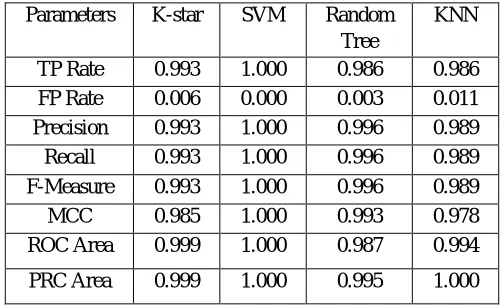
[image:6.612.180.432.150.304.2]Table. 2 shows the accuracy parameters of the inspected four classifiers namely (SVM, Kstar, Random Tree and K nearest neighbour).
Table. 2. Shows Accuracy parameters of Classifiers Parameters K-star SVM Random
Tree
KNN
TP Rate 0.993 1.000 0.986 0.986 FP Rate 0.006 0.000 0.003 0.011 Precision 0.993 1.000 0.996 0.989 Recall 0.993 1.000 0.996 0.989 F-Measure 0.993 1.000 0.996 0.989 MCC 0.985 1.000 0.993 0.978 ROC Area 0.999 1.000 0.987 0.994
[image:6.612.176.409.333.488.2]PRC Area 0.999 1.000 0.995 1.000
Fig. 3. Comparative study of accuracy measures for our data set
From Table 2 and Fig. 3, the basic overall accuracy of SVM is better than the other three algorithms namely Kstar, Random Tree, KNN.
Accuracy does not always gives true performance measure of the investigated algorithm. For this reason the classifier performance is usually expressed in terms of Receiver Operating Characteristic (ROC) curve [10].
To evaluate the performance of each classifier we have calculated the area under ROC curve (AUC) with their respective classifier.
Fig. 4. ROC curves for the given data mining techniques
90 100
K
s
tar
S
V
M
R
an
d
om
Tr
ee
K
N
N
A
cc
u
ra
cy
%
In the above Fig. 4, it demonstrates that performance of SVM under ROC curve is better when comparing with other three algorithms.
VII. CONCLUSION
The overall objective of our work is to predict more accurately the presence of heart disease in human body. Heart disease is one of the most dangerous disease that causes millions of death in the World. This paper involves prediction of heart disease based upon the given attributes. The heart disease becomes a multitude throughout the world. It is a difficult task to predict, which requires higher knowledge for prediction. Data Mining plays an important role in decision making which extracts hidden information.Four data mining classification techniques were applied namely SVM, Kstar, Random Forest and KNN. From results it has been seen that SVM provides better accurate results as comparing with other three techniques.This paper uses data mining techniques to find out the accurate prediction for heart disease. Heart Disease can be caused by several factors such as blood pressure, cholesterol, age, gender, blood sugar, chest pain type etc. It has proven that classification based techniques contribute high effectiveness and obtain high accuracy compare than the previous method.
REFERENCES [1] Micheline Kaber and Jian Pei Jiawei Han, Data Mining Concepts and Techniques, 3rd ed., 2012.
[2] Mohammed Abdul Khaled, Sateesh Kumar Pradhan and G.N Dash, “A survey of data mining techniques on medical techniques on medical data for finding locally frequent disease”, International Journal of Advanced Research in Computer Science and Software Engineering, vol. 3, pp. 149-153, August 2013. [3] C.Sowmiya and Dr. P. Sumitra,”Analytical Study of Heart Disease Diagnosis Using Classification Techniques”, 2016 International Conference on Circuit,
Power and Computing Technologies [ICCPCT].
[4] Miss. Chaitrali S. Dangare, Dr. Mrs. Sulabha S. Apte. (2012). A Data Mining Approach For Prediction of Heart Disease Using Neural Networks. International Journal of Computer Engineering & Technology (IJCET), 30-40.
[5] Salha M. Alzahani, Afnan Althopity, Ashwag Alghamdi, Boushra Alshehri, and Suheer Aljuaid, “An Overview of Data Mining Techniques Applied for Heart Disease Diagnosis and Prediction”, Lecture Notes on Information Theory Vol. 2, No.4, December 2014, PP 310-315.
[6] Sarath Babu, Vivek EM, Famina KP, Fida K, Aswathi P, Shanid M, Hena M, “Heart Disease Diagnosis Using Data Mining Technique”, International Conference on Electronics, Communication and Aerospace Technology, ICECA 2017.International Conference on Electronics, Communication and Aerospace Technology, ICECA 2017.
[7] M.Akhil jabbar, Dr.Priti Chandra, Dr.B.L Deekshatulu “ Heart Disease Prediction System using Associative Classification and Genetic Algorithm”, ICECIT, 2012.
[8] Swati Shilaskaret al, Feature selection for medical diagnosis: Evaluation for cardiovascular diseases”, Journal of Expert System with Application, Vol.40, pp 4146-4153, 2013
[9] RaghunathNambiar, AdhiraajSethi, RuchieBhardwaj, Rajesh Vargheese,” A Look at Challenges and Opportunities of Big Data Analytics in Healthcare”, 2013 IEEE International Conference on Big Data.
[10] Helma C, Gottmann E, Kramer S (2000) Knowledge discovery and data mining in toxicology. Statistical Methods in Medical Research 9: 329-358.
[11] Marjia Sultana*, Afrin Haider and Mohammad Shorif Uddin,” Analysis of data Mining Techniques for Heart Disease Prediction”, ICECIT, 2016.
[12] Abhishek Rairikar, Vedant Kulkarni, Vikas Sabale, Harshavardhan Kale, “Heart Disease Prediction using data mining techniques”, 2017 International Conference on Intelligent Computing and Control (I2C2).
[13] Xindong Wu, Vipin Kumar, J Ross Quinlan, Joydeep Ghosh, Qiang Yang, Hiroshi Motoda, Geoffrey J McLachlan, Angus Ng, Bing Liu, S Yu Philip, et al. Top 10 algorithms in data mining. Knowledge and Information Systems, 14(1):1–37, 2008.
[14] J.G. Cleary and L.E. Trigg. K*: An instance based learner using an entropic distance measure. In In Proceedings of the 12th International Conference on Machine Learning, pages 108–114, 1995.
[15] Wikipedia contributors, ―Random tree, ǁ Wikipedia, The Free Encyclopedia. Wikimedia Foundation, 13-Jul- 2014.
[16] Thomas Cover and Peter Hart. Nearest neighbor pattern classification. Information Theory, IEEE Transactions on, 13(1):21–27, 1967. 95 96 97 98 99 100
K star SVM Random