Weighted Deductive Parsing and Knuth’s
Algorithm
Mark-Jan Nederhof
∗ University of GroningenWe discuss weighted deductive parsing and consider the problem of finding the derivation with the lowest weight. We show that Knuth’s generalization of Dijkstra’s algorithm for the shortest-path problem offers a general method to solve this problem. Our approach is modular in the sense that Knuth’s algorithm is formulated independently from the weighted deduction system.
1. Introduction
As for algorithms in general, there are significant advantages to specifying parsing algorithms in a modular way (i.e., as the combination of subalgorithms). First, modular specifications often allow simpler implementations. Secondly, if otherwise seemingly distinct types of parser are described in a modular way, the common parts can often be more readily identified, which helps to classify and analyze parsing algorithms.
In this article we discuss a modular design for weighted deductive parsing by distinguishing between a weighted deduction system, on the one hand, which per-tains to the choice of grammatical formalism and parsing strategy, and the algorithm that finds the derivation with the lowest weight, on the other. The latter is Dijkstra’s algorithm for the shortest-path problem (Dijkstra 1959) as generalized by Knuth (1977) for a problem on grammars. It has been argued by, for example, Backhouse (2001), that this algorithm can be used to solve a wide range of problems on context-free grammars. A brief presentation of a very similar algorithm for weighted deductive parsing has been given before by Eisner (2000, Figure 3.5e).
Our presentation contrasts with that of Klein and Manning (2001), who offer an in-divisible specification for a small collection of parsing strategies for weighted context-free grammars only, referring to a generalization of Dijkstra’s algorithm to hypergraphs by Gallo et al. (1993). This article also addresses the efficiency of Knuth’s algorithm for weighted deductive parsing, relative to the more commonly used algorithm by Viterbi.
2. Weighted Deductive Parsing
The use of deduction systems for specifying parsers has been proposed by Shieber, Schabes, and Pereira (1995) and Sikkel (1997). As already remarked by Goodman (1999), deduction systems can also be extended to manipulate weights.1 Here we
de-∗Faculty of Arts, Humanities Computing, University of Groningen, P.O. Box 716, NL-9700 AS
Groningen, The Netherlands. E-mail: [email protected]. Secondary affiliation is the German Research Center for Artificial Intelligence (DFKI).
Initializer:
y:[B→ •γ,j,j]
(y:B→γ)∈P 0≤j≤n
Scanner: x1 :[A→α•aβ,i,j] x1 :[A→αa•β,i,j+1]
(y1:A→αaβ)∈P
0≤i≤j<n aj+1=a
Completer:
x1 :[A→α•Bβ,i,j]
x2 :[B→γ•,j,k]
x1+x2 :[A→αB•β,i,k]
(y1:A→αBβ)∈P
(y2:B→γ)∈P
0≤i≤j≤k≤n
[image:2.612.103.375.85.211.2]Goal items:[S→γ•, 0,n]for any (y:S→γ)∈P, whereS is the start symbol
Figure 1
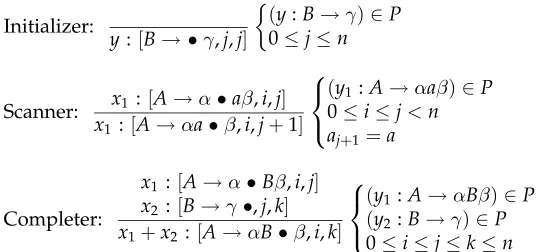
Weighted deduction system for bottom-up parsing.
fine such a weighted deduction system for parsing as consisting of a finite set of inference rules of the form:
x1:I1
x2:I2
.. . xm:Im
f(x1,x2,. . .,xm):I0
c1
.. . cp
where m ≥ 0 and p ≥ 0, and I0,I1,. . .,Im are items, of which I0 is the consequent
and I1,. . .,Im are the antecedents, and c1,. . .,cp is a list of side conditions linking
the inference rule to the grammar and the input string.2 We assign unique variables
x1,. . .,xmto each of the antecedents, and aweight functionf, withx1,. . .,xmas
argu-ments, to the consequent. This allows us to assign a weight to each occurrence of an (instantiated) item that we derive by an inference rule, by means of a function on the weights of the (instantiated) antecedents of that rule.
A weighted deduction system furthermore contains a set of goal items; like the inference rules, this set is parameterized by the grammar and the input. The objective of weighted deductive parsing is to find the derivation of a goal item with the lowest weight. In this article we assume that, for a given grammar and input string, each inference rule can be instantiated in a finite number of ways, which ensures that this problem can be solved under the constraints on the weight functions to be discussed in Sections 4 and 5.
Our examples will be restricted to context-free parsing and include the deduction system for weighted bottom-up parsing in Figure 1 and that for weighted top-down parsing in Figure 2. The latter is very close to an extension of Earley’s algorithm described by Lyon (1974). The side conditions refer to an input stringw=a1· · ·anand
to a weighted context-free grammar with a set of productionsP, each of which has the form (y: A→ α), wherey is a non-negative real-valued weight, Ais a nonterminal,
Starter:
y:[S→ •γ, 0, 0]
(y:S→γ)∈P, whereSis the start symbol
Predictor: x1 :[A→α•Bβ,i,j] y2 :[B→ •γ,j,j]
(y1 :A→αBβ)∈P
(y2 :B→γ)∈P
0≤i≤j≤n
[image:3.612.103.420.242.401.2]Scanner, completer and set of goal items are as in Figure 1.
Figure 2
Weighted deduction system for top-down parsing.
Starter:
(y,y):[S→ •γ, 0, 0]
(y:S→γ)∈P, whereSis the start symbol
Scanner: (z1,x1):[A→α•aβ,i,j] (z1,x1):[A→αa•β,i,j+1]
(y1:A→αaβ)∈P
0≤i≤j<n aj+1=a
Predictor: (z1,x1):[A→α•Bβ,i,j] (z1+y2,y2):[B→ •γ,j,j]
(y1:A→αBβ)∈P
(y2:B→γ)∈P
0≤i≤j≤n
Completer:
(z1,x1):[A→α•Bβ,i,j]
(z2,x2):[B→γ•,j,k]
(z1+x2,x1+x2):[A→αB•β,i,k]
(y1 :A→αBβ)∈P
(y2 :B→γ)∈P
0≤i≤j≤k≤n
Set of goal items is as in Figure 1.
Figure 3
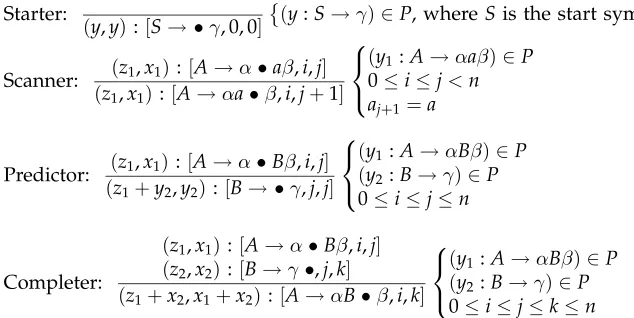
Alternative weighted deduction system for top-down parsing.
and α is a list of zero or more terminals or nonterminals. We assume the weight of a grammar derivation is given by the sum of the weights of the occurrences of productions therein.
Weights may be atomic entities, as in the deduction systems discussed above, where they are real-valued, but they may also be composed entities. For example, Figure 3 presents an alternative form of weighted top-down parsing using pairs of values, following Stolcke (1995). The first value is theforwardweight, that is, the sum of weights of all productions that were encountered in the lowest-weighted derivation in the deduction system of an item [A→α• β,i,j]. The second is theinnerweight; that is, it considers the weight only of the current productionA→αβplus the weights of productions in lowest-weighted grammar derivations for nonterminals inα. These inner weights are the same values as the weights in Figures 1 and 2. In fact, if we omit the forward weights, we obtain the deduction system in Figure 2.
only if z1 <z2 or z1 =z2∧x1 <x2. (Tendeau [1997] has shown the general idea can
also be applied to left-corner parsing.)
In order to link (weighted) deduction systems to literature to be discussed in Section 3, we point out that a deduction system having a grammar G in a certain formalismFand input stringwin the side conditions can be seen as a constructioncof a context-free grammarc(G,w)out of grammarGand inputw. The set of productions of c(G,w) is obtained by instantiating the inference rules in all possible ways using productions from G and input positions pertaining to w. The consequent of such an instantiated inference rule then acts as the left-hand side of a production, and the (possibly empty) list of antecedents acts as its right-hand side. In the case of a weighted deduction system, the productions are associated with weight functions computing the weight of the left-hand side from the weights of the right-hand side nonterminals.
For example, if the input is w =a1a2a3, and if there are two productions in the
weighted context-free grammar G of the form (y1: A → C B D),(y2: B → E) ∈ P,
then from the completer in Figure 1 we may obtain, among others, a production [A→C B•D, 0, 2]→[A→C•B D, 0, 1] [B→E•, 1, 2], with associated weight function f(x1,x2) =x1+x2, which states that if the production is used in a derivation, then the
weights of the two subderivations should be added. The number of productions in c(G,w)is determined by the number of ways we can instantiate inference rules, which in the case of Figure 1 is O(|G|2·n3), where |G|is the size ofG in terms of the total
number of occurrences of terminals and nonterminals in productions.
If we assume, without loss of generality, that there is only one goal item, then this goal item becomes the start symbol ofc(G,w).3Since there are no terminals inc(G,w),
either the grammar generates the language{}, containing only the empty string, or it generates the empty language; in the latter case, this indicates that wis not in the language generated byG.
Note that for all three examples above, the derivation with the lowest weight allowed by c(G,w) encodes the derivation with the lowest weight allowed by G for w. Together with the dynamic programming algorithm to be discussed in the next section that finds the derivation with the lowest weight on the basis of c(G,w), we obtain a modular approach to describing weighted parsers: One part of the description specifies how to construct grammar c(G,w)out of grammar Gand inputw, and the second part specifies the dynamic programming algorithm to investigatec(G,w).
Such a modular way of describing parsers in the unweighted case has already been fully developed in work by Lang (1974) and Billot and Lang (1989). Instead of a deduction system, they use a pushdown transducer to express a parsing strat-egy such as top-down parsing, left-corner parsing or LR parsing. Such a pushdown transducer can in the context of their work be regarded as specifying a context-free grammar c(G,w), given a context-free grammar Gand an input stringw. The second part of the description of the parser is a dynamic programming algorithm for actually constructing c(G,w)in polynomial time in the length ofw.
This modular approach to describing parsing algorithms is also applicable to for-malisms F other than context-free grammars. For example, it was shown by Vijay-Shanker and Weir (1993) that tree-adjoining parsing can be realized by constructing a context-free grammar c(G,w) out of a tree-adjoining grammar Gand an input string w. This can straightforwardly be generalized to weighted (in particular, stochastic) tree-adjoining grammars (Schabes 1992).
It was shown by Boullier (2000) thatFmay furthermore be the formalism of range concatenation grammars. Since the class of range concatenation grammars generates exactly PTIME, this demonstrates the generality of the approach.4
Instead of string input, one may also consider input consisting of a finite au-tomaton, along the lines of Bar-Hillel, Perles, and Shamir (1964); this can be trivially extended to the weighted case. That we restrict ourselves to string input in this article is motivated by presentational considerations.
3. Knuth’s Algorithm
The algorithm by Dijkstra (1959) effectively finds the shortest path from a distin-guished source node in a weighted, directed graph to a distindistin-guished target node. The underlying idea of the algorithm is that it suffices to investigate only the shortest paths from the source node to other nodes, since longer paths can never be extended to become shorter paths (weights of edges are assumed to be non-negative).
Knuth (1977) generalizes this algorithm to the problem of finding lowest-weighted derivations allowed by a context-free grammar with weight functions, similar to those we have seen in the previous section. (The restrictions Knuth imposes on the weight functions will be discussed in the next section.) Again, the underlying idea of the algorithm is that it suffices to investigate only the lowest-weighted derivations of nonterminals.
The algorithm by Knuth is presented in Figure 4. We have taken the liberty of making some small changes to Knuth’s formulation. The largest difference between Knuth’s formulation and ours is that we have assumed that the context-free grammar with weight functions on which the algorithm is applied has the formc(G,w), obtained by instantiating the inference rules of a weighted deduction system for given grammar G and input w. Note, however, that c(G,w) is not fully constructed before applying Knuth’s algorithm, and the algorithm accesses only as much of it as is needed in its search for the lowest-weighted goal item.
In the algorithm, the set Dcontains items I for which the lowest overall weight has been found; this weight is given by µ(I). The set Econtains itemsI0 that can be
derived in one step from items inD, but for which the lowest weightν(I0)found thus
far may still exceed the lowest overall weight forI0. In each iteration, it is established
that the lowest weightν(I)for an itemIinEis the lowest overall weight forI, which justifies transferring I to D. The algorithm can be extended to output the derivation corresponding to the goal item with the lowest weight; this is fairly trivial and will not be discussed here.
A few remarks about the implementation of Knuth’s algorithm are in order. First, instead of constructing E and ν anew at step 2 for each iteration, it may be more efficient to construct them only once and revise them every time a new itemIis added toD. This revision consists in removingIfromEand combining it with existing items in D, as antecedents of inference rules, in order to find new items to be added to E and/or to update ν to assign lower values to items in E. Typically, E would be organized as a priority queue.
Second, practical implementations would maintain appropriate tables for indexing the items in such a way that when a new itemIis added toD, the lists of existing items inDtogether with which it matches the lists of antecedents of inference rules can be
1. LetDbe the empty set∅.
2. Determine the setEand the function ν as follows:
• Eis the set of itemsI0∈/Dsuch that there is at least one
inference rule from the deduction system that can be
instantiated to a production of the formI0→I1· · ·Im, for some
m≥0, with weight functionf, whereI1,. . .,Im∈D.
• For each suchI0∈E, letν(I0)be the minimal weight
f(µ(I1),. . .,µ(Im))for all such instantiated inference rules.
3. IfEis empty, then report failure and halt.
4. Choose an itemI∈Esuch thatν(I)is minimal. 5. AddItoD, and letµ(I) =ν(I).
6. IfIis a goal item, then outputµ(I)and halt. 7. Repeat from step 2.
Figure 4
Knuth’s generalization of Dijkstra’s algorithm. Implicit are a weighted deduction system, a grammarGand an inputw. For conditions on correctness, see Section 4.
efficiently found. Since techniques for such kinds of indexing are well-established in the computer science literature, no further discussion is warranted here.
4. Conditions on the Weight Functions
A sufficient condition for Knuth’s algorithm to correctly compute the derivations with the lowest weights is that the weight functionsf are allsuperior, which means that they are monotone nondecreasing in each variable and thatf(x1,. . .,xm)≥max(x1,. . .,xm)
for all possible values of x1,. . .,xm. For this case, Knuth (1977) provides a short and
elegant proof of correctness. Note that the weight functions in Figure 1 are all superior, so that correctness is guaranteed.
In the case of the top-down strategy from Figure 2, however, the weight functions are not all superior, since we have constant weight functions for the predictor, which may yield weights that are less than their arguments. It is not difficult, however, to show that Knuth’s algorithm still correctly computes the derivations with the lowest weights, given that we have already established the correctness for the bottom-up case.
For the alternative top-down strategy from Figure 3, the proof of correctness is similar, but now the proof depends for a large part on the additional forward weights, the first values in the pairs (z,x); note that the second values are the inner weights (i.e., the weights we already considered in Figures 1 and 2). An important observation is that if there are two derivations for the same item with weights(z1,x1)and(z2,x2),
respectively, such thatz1<z2andx1>x2, then there must be a third derivation of that
item with weight (z1,x2). This shows that no relevant inner weights are overlooked
because of the ordering we imposed on pairs(z,x).
Since Figures 1 through 3 are merely examples to illustrate the possibilities of deduction systems and Knuth’s algorithm, we do not provide full proofs of correctness.
5. Viterbi’s Algorithm
This section places Knuth’s algorithm in the context of a more commonly used alter-native. This algorithm is applicable on a weighted deduction system if a simple partial order on items exists that is such that the antecedents of an inference rule are always strictly smaller than the consequent. When this is the case, we may treat items from small to large to compute their lowest weights. There are no constraints on the weight functions other than that they should be monotone nondecreasing.
The algorithm by Viterbi (1967) may be the earliest that operates according to this principle. The partial order is based on the linear order given by a string of input symbols. In this article we will let the term “Viterbi’s algorithm” refer to the general type of algorithm to search for the derivation with the lowest weight given a deduction system, a grammar, an input string, and a partial order on items consistent with the inference rules in the sense given above.5
Another example of an algorithm that can be seen as an instance of Viterbi’s algo-rithm was presented by Jelinek, Lafferty, and Mercer (1992). This algoalgo-rithm is essen-tially CYK parsing (Aho and Ullman 1972) extended to handle weights (in particular, probabilities). The partial order on items is based on the sizes of their spans (i.e., the number of input symbols that the items cover). Weights of items with smaller spans are computed before the weights of those with larger spans. In cases in which a simple a priori order on items is not available but derivations are guaranteed to be acyclic, one may first determine a topological sorting of the complete set of derivable items and then compute the weights based on that order, following Martelli and Montanari (1978).
A special situation arises when a deduction system is such that inference rules allow cyclic dependencies within certain subsets of items, but dependencies between these subsets represent a partial order. One may then combine the two algorithms: Knuth’s (or Dijkstra’s) algorithm is used within each subset and Viterbi’s algorithm is used to relate items in distinct subsets. This is exemplified by Bouloutas, Hart, and Schwartz (1991).
In cases in which both Knuth’s algorithm and Viterbi’s algorithm are applicable, the main difference between the two is that Knuth’s algorithm may halt as soon as the lowest weight for a goal item is found, and no items with larger weights than that goal item need to be treated, whereas Viterbi’s algorithm treatsallderivable items. This suggests that Knuth’s algorithm may be more efficient than Viterbi’s. The worst-case time complexity of Knuth’s algorithm, however, involves an additional factor because
of the maintenance of the priority queue. Following Cormen, Leiserson, and Rivest (1990), this factor isO(log(c(G,w))), wherec(G,w)is the number of nonterminals inc(G,w), which is an upper bound on the number of elements on the priority queue at any given time. Furthermore, there are observations by, for example, Chitrao and Grishman (1990), Tjong Kim Sang (1998, Sections 3.1 and 3.4), and van Noord et al. (1999, Section 3.9), that suggest that the apparent advantage of Knuth’s algorithm does not necessarily lead to significantly lower time costs in practice.
In particular, consider deduction systems with items associated with spans like, for example, that in Figure 1, in which the span of the consequent of an inference rule is the concatenation of the spans of the antecedents. If weights of individual productions inGdiffer only slightly, as is often the case in practice, then different derivations for an item have only slightly different weights, and the lowest such weight for a certain item is roughly proportional to the size of its span. This suggests that Knuth’s algorithm treats most items with smaller spans before any item with a larger span is treated, and since goal items typically have the maximal span, covering the complete input, there are few derivable items at all that are not treated before any goal item is found.
6. Conclusions
We have shown how a general weighted parser can be specified in two parts, the first being a weighted deduction system, and the second being Knuth’s algorithm (or possibly Viterbi’s algorithm, where applicable). Such modular specifications have clear theoretical and practical advantages over indivisible specifications. For example, we may identify common aspects of otherwise seemingly distinct types of parser. Further-more, modular specifications allow simpler implementations. We have also identified close connections between our approach to specifying weighted parsers and well-established theory of grammars and parsing. How the efficiency of Knuth’s algorithm relates to that of Viterbi’s algorithm in a practical setting is still to be investigated.
Acknowledgments
The author is supported by the Royal Netherlands Academy of Arts and Sciences. I am grateful to Gertjan van Noord, Giorgio Satta, Khalil Sima’an, Frederic Tendeau, and the anonymous referees for valuable comments.
References
Aho, Alfred V. and Jeffrey D. Ullman. 1972.
Parsing, volume 1 ofThe Theory of Parsing, Translation and Compiling. Prentice-Hall, Englewood Cliffs, New Jersey.
Backhouse, Roland. 2001. Fusion on languages. In10th European Symposium on Programming, volume 2028 ofLecture Notes in Computer Science, pages 107–121. Springer-Verlag, Berlin, April. Bar-Hillel, Y., M. Perles, and E. Shamir.
1964. On formal properties of simple phrase structure grammars. In Y. Bar-Hillel, editor,Language and Information: Selected Essays on Their Theory and Application. Addison-Wesley, Reading, Massachusetts, pages 116–150.
Billot, Sylvie and Bernard Lang. 1989. The structure of shared forests in ambiguous parsing. In27th Annual Meeting of the Association for Computational Linguistics, Proceedings of the Conference,
pages 143–151, Vancouver, British Columbia, Canada, June.
Boullier, Pierre. 2000. Range concatenation grammars. InProceedings of the Sixth International Workshop on Parsing Technologies, pages 53–64, Trento, Italy, February.
Bouloutas, A., G. W. Hart, and M. Schwartz. 1991. Two extensions of the Viterbi algorithm.IEEE Transactions on Information Theory, 37(2):430–436.
Chitrao, Mahesh V. and Ralph Grishman. 1990. Statistical parsing of messages. In
Speech and Natural Language Proceedings, pages 263–266, Hidden Valley,
Pennsylvania, June.
problems in connexion with graphs.
Numerische Mathematik, 1:269–271. Eisner, Jason. 2000. Bilexical grammars and
their cubic-time parsing algorithms. In H. Bunt and A. Nijholt, editors,Advances in Probabilistic and Other Parsing
Technologies. Kluwer Academic Publishers, Dordrecht, The Netherlands, pages 29–61. Frisch, Alan M. and Peter Haddawy. 1994.
Anytime deduction for probabilistic logic.
Artificial Intelligence, 69:93–122. Gallo, Giorgio, Giustino Longo, Stefano
Pallottino, and Sang Nguyen. 1993. Directed hypergraphs and applications.
Discrete Applied Mathematics, 42:177–201. Goodman, Joshua. 1999. Semiring parsing.
Computational Linguistics, 25(4):573–605. Jelinek, F., J. D. Lafferty, and R. L. Mercer.
1992. Basic methods of probabilistic context free grammars. In P. Laface and R. De Mori, editors,Speech Recognition and Understanding—Recent Advances, Trends and Applications. Springer-Verlag, Berlin, pages 345–360.
Klein, Dan and Christopher D. Manning. 2001. Parsing and hypergraphs. In
Proceedings of the Seventh International Workshop on Parsing Technologies, pages 123–134, Beijing, October.
Knuth, Donald E. 1977. A generalization of Dijkstra’s algorithm.Information Processing Letters, 6(1):1–5.
Lang, Bernard. 1974. Deterministic
techniques for efficient non-deterministic parsers. InAutomata, Languages and Programming, 2nd Colloquium, volume 14 ofLecture Notes in Computer Science, pages 255–269, Saarbr ¨ucken. Springer-Verlag, Berlin.
Lyon, Gordon. 1974. Syntax-directed least-errors analysis for context-free languages: A practical approach.
Communications of the ACM, 17(1):3–14. Martelli, Alberto and Ugo Montanari. 1978.
Optimizing decision trees through heuristically guided search.
Communications of the ACM, 21(12):1025–1039.
Schabes, Yves. 1992. Stochastic lexicalized tree-adjoining grammars. InProceedings of the 15th International Conference on
Computational Linguistics, volume 2, pages 426–432, Nantes, August. Shieber, Stuart M., Yves Schabes, and
Fernando C. N. Pereira. 1995. Principles and implementation of deductive parsing.
Journal of Logic Programming, 24:3–36. Sikkel, Klaas. 1997.Parsing Schemata.
Springer-Verlag, Berlin.
Stolcke, Andreas. 1995. An efficient probabilistic context-free parsing algorithm that computes prefix probabilities.Computational Linguistics, 21(2):167–201.
Tendeau, Fr´ed´eric. 1997.Analyse syntaxique et s´emantique avec ´evaluation d’attributs dans un demi-anneau. Ph.D. thesis, University of Orl´eans.
Tjong Kim Sang, Erik F. 1998.Machine Learning of Phonotactics. Ph.D. thesis, University of Groningen.
van Noord, Gertjan, Gosse Bouma, Rob Koeling, and Mark-Jan Nederhof. 1999. Robust grammatical analysis for spoken dialogue systems.Natural Language Engineering, 5(1):45–93.
Vijay-Shanker, K. and David J. Weir. 1993. The use of shared forests in tree adjoining grammar parsing. InSixth Conference of the European Chapter of the Association for Computational Linguistics, Proceedings of the Conference, pages 384–393, Utrecht, The Netherlands, April.
Viterbi, Andrew J. 1967. Error bounds for convolutional codes and an