A Knowledge Representation Approach
to Understanding Metaphors
E. J u d i t h W e i n e r
C o m p u t e r and I n f o r m a t i o n S c i e n c e s C o m p u t e r A c t i v i t y Building
T e m p l e U n i v e r s i t y Philadelphia, P A 19122
This study represents an exploration of the phenomenon of non-literal language ("metaphors") and an approach that lends itself to computational modeling. Ortony's theories of the way in which salience and asymmetry function in human metaphor process- ing are explored and expanded on the basis of numerous examples. A number of factors appear to be interacting in the metaphor comprehension process. In addition to salience and asymmetry, of major importance are incongruity, hyperbolicity, inexpressibility, prototypicality, and probable value range. Central to the model is a knowledge representa- tion system incorporating these factors and allowing for the manner in which they interact. A version of KL-ONE (with small revisions) is used for this purpose.
1. Introduction
One can hardly fail to notice the flurry of intellectual activity that currently surrounds the understanding of the use of figurative language. The interest is multi- disciplinary - linguistics, psychology, philosophy, edu- cation, to name a few of the more active disciplines. The reason, which a n y o n e writing on the subject has- tens to point out, is that the observation of natural speech demonstrates clearly that it is rarely confined to the strictly literal. Figurative language is n o t mere- ly an o r n a m e n t of the poet but abounds in the every- day speech of e v e r y d a y people and as such is a legiti- mate area of inquiry for researchers - in any discipline - who are c o n c e r n e d with understanding natural lan- guage. The interest in m e t a p h o r in c o m p u t e r under- standing of natural languages stems f r o m this same source. It is well u n d e r s t o o d that people, when con- versing with machines, can no more be constrained to literal language than they can be expected to be long contented, within the confines of a synthetic language.
2. Scope of
the Study
The heading "figurative l a n g u a g e " comprises the tradi- tional figures of speech k n o w as synechdoche, m e t o n y - my, hyperbole, personification, irony, etc., as well as the more c o m m o n m e t a p h o r and simile. I am going to focus here on these latter two in order to narrow my
view in the hope of achieving some d e p t h and also because of a belief that the other figures m a y operate under similar principles. E x c e p t where noted, I will use the term " m e t a p h o r " in referring to b o t h similes and metaphors. Please note that this does not imply that I am taking the position that m e t a p h o r s and sim- iles are the same; in fact, there is some evidence that they function differently from one another. At the least, it seems possible that the distinction b e t w e e n these two is more than the traditional one of implicit- ness versus explicitness since there are instances of m e t a p h o r s that s o u n d strange w h e n " t r a n s f o r m e d " into similes and vice versa. I therefore am using the term " m e t a p h o r " in a very loose way to cover the area m e t a p h o r s and similes have in c o m m o n (for example, the similarity in the figurative reads of J o h n is an a n i m a l and John is like an a n i m a l ) , without pausing at this time to delve into its exact nature and ignoring for the m o m e n t the apparent differences.
To start, I will work only with isolated sentences of the form
(1) A is (like) B.
In sentences of this form, A is c o m m o n l y referred to as the " t o p i c " , the B term as the " v e h i c l e " . T h a t which they have in c o m m o n is called the " g r o u n d " . In a sentence like
Copyright 1984 by the Association for Computational Linguistics. Permission to copy without fee all or part of this material is granted provided that the copies are not made for direct commercial advantage and the CL reference and this copyright notice are included on the first page. To copy otherwise, or to republish, requires a fee and/or specific permission.
0 3 6 2 - 6 1 3 X / 8 4 / 0 1 0 0 0 1 - 14503.00
E. J u d i t h W e i n e r A Knowledge Representation Approach to Understanding Metaphors
(2) Billboards are like warts
then, the topic is billboards, the vehicle warts and the
ground ugliness and (perhaps) prominence.
In restricting this study to sentences of the form (1), my motives here again are to constrain the un-
wieldiness of the subject. Of course this rules out a
large b o d y of possible metaphorical utterances of o t h e r
forms. M a n y of these, however, if c o n f i n e d to one
sentence, could be restated in the form of (1) with no
significant loss of meaning. I will not discuss them
here. I will, h o w e v e r , have something to say later
a b o u t the larger linguistic c o n t e x t (discourse.)
T h e t y p e d word, the p r e s u m e d f o r m of input of natural language to a c o m p u t e r until such time as actu- al speech understanding systems develop sufficiently, imposes limitations of its o w n on the scope of any language processing system. The most obvious is, of course, that variation in i n t o n a t i o n of the input is lim- ited to its most " n e u t r a l " p a t t e r n ; p r o s o d i c f e a t u r e s must largely be ignored. (A certain a m o u n t of e m p h a - sis or contrastive stress m a y be o b t a i n e d b y underlin- ing, but the study of this should be considered sepa- rately.) A n o t h e r , perhaps more relevant consideration, is the use of a space to separate parts of what must be
considered a single lexical item, e.g., blind alley. His-
torically, this was u n d o u b t e d l y a m e t a p h o r (and a c a n d i d a t e f o r this study); t o d a y it is most p r o b a b l y
i n t e r p r e t e d as a single unit. A l t h o u g h most native
speakers of English would classify it as an idiom through an awareness of the written f o r m and the fact that even in the spoken version the c o m p o n e n t parts are clearly recognized, there should be no a t t e m p t to componentially process such forms.
3. Salience
One of the most useful notions for modeling m e t a - phoric u n d e r s t a n d i n g is that of salience ( O r t o n y 1979a), which O r t o n y takes to m e a n an estimation of " p r o m i n e n c e of a particular attribute with r e s p e c t to a c o n c e p t to which it does or could apply." (p. 162.) H e later speaks of " p r e d i c a t e s " rather than a t t r i b u t e s " (1979b, p. 191): " A predicate can be attributed to, or predicated of, something. It can represent knowledge, a belief, or an attitude a b o u t or t o w a r d s o m e t h i n g . " I too p r e f e r the flexibility of " p r e d i c a t e " and shall fol- low O r t o n y in the use of this term.
The notion of salience makes use of the a p p a r e n t fact that metaphorical statements are asymmetric:
(2) Billboards are like warts
means something different f r o m
(3) Warts are like billboards
O r t o n y ' s explanation is that in isolated sentences of the form
(1) A is (like) B
those predicates that have high salience in B and low salience in A are the ones being c o n s i d e r e d in the metaphor. 1 The e f f e c t is one of raising the salience of these predicates in A. Thus, sentence (2) is generally u n d e r s t o o d as meaning that billboards are ugly, where- as in (3), those predicates that have high salience for billboards (but low salience in warts) - for example, p r o m i n e n c e - are attributed to warts (that is, the sali-
ence is raised). A n additional r e q u i r e m e n t is that
there be high salient predicates of B that c a n n o t apply to A. 2
M y working definition of salience includes the as- sumption of a t a x o n o m i c s t r u c t u r e of c o n c e p t s with the most general at the top and the most specific at
the b o t t o m . Figure 1 provides an illustration of a
simple taxonomy.
I define a salient predicate of a c o n c e p t as one that implies inherent p r o m i n e n c e (for example, saturation of color, largeness of size, etc.) or else is definitional in that it entails a c o n c e p t ' s separation f r o m others in the hierarchy (for example, the dog's domesticity sepa- rates it from the wolf). M y n o t i o n of salience paral- lels that of T v e r s k y ( 1 9 7 7 ) in that intensity and diag- nosticity are the critical factors, but it makes the addi-
tion of hierarchical o r g a n i z a t i o n to facilitate
diagnosticity. 3 C o n t e x t , b o t h linguistic and extralin- guistic, is of course a m a j o r contributing f a c t o r too, but it is outside the scope of this study. T h e way in which these factors interrelate is a fertile area for psy- chological research.
4. Prototypicality
A n o t h e r valuable c o n t r i b u t i o n coming out of cognitive p s y c h o l o g y is p r o t o t y p e t h e o r y ( R o s c h 1973, R o s c h and Mervis 1975), which holds that a c o n c e p t m a y belong to a category even if it is somewhat atypical in terms of the predicates usually (typically) associated
with m e m b e r s of that category. A chicken is a bird
even though it c a n ' t really fly. H e r e , bird refers to
some p r o t o t y p e f r o m which chicken represents a de- parture.
In terms of metaphors, there is much value in in- eluding p r o t o t y p e t h e o r y in any model. F o r example,
(4) M a r y ' s cheeks are like apples
1 0 r t o n y a c k n o w l e d g e s t h a t the a t t . ! b u t e s m a y be similar, n o t identical, in the vehicle a n d topic ( 1 9 7 9 a , p. 167). W h i l e I am in a g r e e m e n t with O r t o n y , I will, for the p u r p o s e s of this paper, m a k e the a s s u m p t i o n of predicate identity.
2 In t e s t i n g this h y p o t h e s i s e x p e r i m e n t a l l y , G e n t n e r ( 1 9 8 0 ) s h o w e d that salience did n o t a p p e a r to be a r e l e v a n t m e c h a n i s m in m e t a p h o r processing. T h i s s e e m s to me, h o w e v e r , to be partially a result of h o w s a l i e n c e w a s m e a s u r e d a n d t h e n e e d for a c l e a r e r a n a l y s i s of h o w m e t a p h o r i c i n t e r p r e t a t i o n p r o c e e d s . Salience, properly defined, m a y provide a n e c e s s a r y b u t n o t s u f f i c i e n t expla- nation.
3 C o n k l i n and M c D o n a l d ( 1 9 8 2 ) h a v e u s e d salience as a m e a n s of s o l v i n g t h e s e l e c t i o n p r o b l e m in n a t u r a l l a n g u a g e g e n e r a t i o n u s i n g K L - O N E as the r e p r e s e n t a t i o n language.
E. Judith Weiner A Knowledge Representation Approach to Understanding Metaphors
Figure I.
would p r o b a b l y m e a n to m o s t p e o p l e t h a t M a r y ' s
cheeks are r o u n d and red. A different i n t e r p r e t a t i o n
would be o b t a i n e d if the c o n c e p t of round, red apple were replaced b y a withered, r o t t e n one or even, for that m a t t e r , b y a green one. F o r c o m m u n i c a t i o n to take place a m o n g people in a speech c o m m u n i t y , s o m e sort of p r o t o t y p i c a l i t y considerations are essential.
T h e r e is a n o t h e r w a y in which p r o t o t y p i c a l i t y might figure in a discussion of m e t a p h o r s . It seems p r o b a b l e that the B t e r m in
(1) A is like B
represents the
epitome
of the predicate(s) that are trueof A and of interest in a given utterance, that is, B is the p r o t o t y p i c a l r e p r e s e n t a t i v e of these p r e d i c a t e s . ( T v e r s k y (1977) o b s e r v e d that the B t e r m is the m o r e
p r o t o t y p i c a l of the two in literal sentences.) If the
s e n t e n c e reverses A and B, t h e n A b e c o m e s the p r o t o - type of ( p r o b a b l y ) different predicates. T h e vehicle of choice should be one in which the cluster of predicates is (ideally) uniquely a p p r o p r i a t e , p r o t o t y p i c a l , a n d t h e r e f o r e also salient. F o r example,
(5) A hose is like a snake
Snakes are typically, e v e n classically, the ultimate in long, narrow, coiledness; these characteristics can be t h o u g h t of as distinguishing snakes f r o m o t h e r m e m -
bers of the c a t e g o r y ANIMALS. Sentence (5) draws
the r e a d e r ' s a t t e n t i o n to these ( p e r h a p s ) slightly less salient qualities of a hose.
I h a v e i n t e n t i o n a l l y limited m y s e l f to s e n t e n c e s t a k e n out of the discourse context. O n e of the b e n e - fits of doing this is that there is considerable c o n t e x t
within the s e n t e n c e itself t h a t can influence its inter- pretation. C o n s i d e r the following pair of sentences
(6) M y cat's tail is like a c a r r o t
(7) J o h n ' s hair is like a c a r r o t
Without adding a n y context, it is unlikely that a per- son would miss the fact that the r e l e v a n t salient predi- cate of (6) is shape (and p e r h a p s color) and that of (7) is color. O u r k n o w l e d g e of p r o t o t y p i c a l cats with p r o t o t y p i c a l cat tail shapes and colors and p r o t o t y p i c a l hair shapes and colors leads us to the right conclusion. If no additional i n f o r m a t i o n is available, t h e n it w o u l d n ' t be likely that J o h n was wearing a p o n y tail. O n the o t h e r hand
(8) J o h n ' s nose is like a c a r r o t
again, t a k e n out of context, would indicate a c o m m e n t a b o u t shape. F r o m these e x a m p l e s it should be clear that p r o t o t y p i c a l i t y considerations are relevant to b o t h topic and vehicle.
5. Prototypicality and Possibility
H o w then, does this relate to p r o t o t y p e t h e o r y ? T h e
relationship a p p e a r s to be that, in the
prototypical
tail,nose, or hair, certain predicates are p r o b a b l e . T h e s e
are the ones m o s t likely to m a t c h those salient in B. Thus in o r d e r to process m e t a p h o r s , it is n e c e s s a r y to k n o w , in addition to the n a t u r e of the p r o t o t y p e , a
range of p r o b a b l e values f o r a given predicate. This
would facilitate O r t o n y ' s d e t e r m i n a t i o n ( 1 9 7 9 a , p. 173) of " w h e t h e r a n y gross i n c o m p a t i b i l i t y w o u l d result b y a p p l y i n g the p r e d i c a t e in q u e s t i o n to the
E. J u d i t h W e i n e r A Knowledge Representation Approach to Understanding Metaphors
c o n c e p t . " This range can help d e t e r m i n e w h e t h e r the s t a t e m e n t is literally true or not. F o r example,
(9) J o h n ' s hands are like ice.
If a range of possible t e m p e r a t u r e s were built into the r e p r e s e n t a t i o n f o r h u m a n h a n d s , it would be k n o w n t h a t J o h n ' s h a n d s could n o t p o s s i b l y be literally as cold as ice (there could not be an actual equivalence of t e m p e r a t u r e in hands and in ice). 4 T h e figurative i n t e r p r e t a t i o n would thus prevail.
P r o t o t y p i c a l i t y and range of possible values a p p e a r to o p e r a t e t h r o u g h o u t language as a whole; they are
not c o n f i n e d to figurative usage. L a b o v (1973) re-
p o r t e d on an e x p e r i m e n t on the d e n o t a t i o n of the
word cup. H e gave subjects pictures of cuplike objects
to identify and o b s e r v e d differing p e r c e n t a g e s of the use of cup as f o r m and f u n c t i o n were varied. H e c o n -
cluded the e x i s t e n c e of an i n v a r i a n t core
( c o r r e s p o n d i n g to m y use of p r o t o t y p e ) as well as a r a n g e of d e v i a t i o n s t h r o u g h which r e c o g n i t i o n still occurred, albeit at lower p e r c e n t a g e s . T h e inclusion of these e l e m e n t s in the k n o w l e d g e r e p r e s e n t a t i o n of a s y s t e m for u n d e r s t a n d i n g natural language is t h e r e f o r e b r o a d l y m o t i v a t e d .
6. Metaphors as Hyperboles
All m e t a p h o r s are h y p e r b o l i c in a sense. T h e y s e e m to say: the predicates A shares with B are in A so ex- t r e m e that they can only be e x p r e s s e d b y relating t h e m to some o b j e c t in which they are epitomized, that is,
B. In
(9) J o h n ' s hands are like ice,
the e x a g g e r a t i o n is a p p a r e n t . This is evident b e c a u s e of the range of possible t e m p e r a t u r e values k n o w n to be actually a t t r i b u t a b l e to h u m a n hands. T h e s e n t e n c e
(7) J o h n ' s hair is like a carrot.
is less m e t a p h o r i c ( c o n s e q u e n t l y m o r e literal) in this
sense. It is possible that hair could be the same color
as the p r o t o t y p i c a l carrot, but the p r o b a b i l i t y is low. C o n s e q u e n t l y , the following s e q u e n c e does not s e e m absurd:
(10) J o h n ' s hair is like a carrot. Is it really t h a t color?
w h e r e a s
(11) J o h n ' s hands are like ice.
A r e they really that cold?
would lead one to think the r e s p o n s e peculiar at the
least. On s o m e scale of m e t a p h o r i c i t y then, (10) is
less m e t a p h o r i c t h a n (11). Since a hose m a y in fact
be as long, n a r r o w , coiled as a snake,
4 If J o h n is a s s u m e d to be living a n d c o n t e x t d o e s not indi- cate the p o s s i b i l i t y of f r o s t b i t e c o n d i t i o n s .
(5) A hose is like a snake
is the least m e t a p h o r i c of the e x a m p l e s given. This
s u p p o r t s O r t o n y ' s claim that high salient predicates of A m a t c h e d with high salient predicates of B m a k e for a literal s t a t e m e n t . A r e s p o n s e of Is it really that long, narrow, coiled? could easily b e followed b y an unquali- fied r e s p o n s e of "'Yes. '"
O r t o n y (1975) denies the possibility of the ground
consisting m e r e l y of a single predicate. " P e o p l e sim-
ply do not use m e t a p h o r s to t r a n s f e r one characteristic, e v e n if it is a distinctive one, w h e n there is a r e a d y literal w a y of m a k i n g the p o i n t . " (p. 50.) S e n t e n c e (9), h o w e v e r , p r o v i d e s a fairly g o o d c o u n t e r e x a m p l e to this claim. H e r e , the h y p e r b o l i c n a t u r e of the m e t a - p h o r r a t h e r t h a n the size of the g r o u n d p r o v i d e s the incentive for its use.
7. Taxonomic Structure and Incongruity
T h e conclusion which should be d r a w n f r o m this dis- cussion is that all of the a b o v e f a c t o r s m u s t be b r o u g h t to b e a r in an analysis of m e t a p h o r understanding. T h e result of using these m e a s u r e s will be an isolation of those predicates of B t h a t are true of A and the e s t a b - lishment of a relative degree of m e t a p h o r i c i t y within the s e n t e n c e context.
G i v e n a corpus of sentences of the f o r m
(1) A is (like) B,
s o m e will a p p e a r to be literal similarity s t a t e m e n t s ; others will a p p e a r to be m e t a p h o r s .
(12) J o h n is like his father.
(13) J o h n is like a snake.
(14) J o h n is like a black box.
In (12), the s e n t e n c e a p p e a r s to be a literal c o m p a r i -
son. J o h n shares certain characteristics with his fa-
ther. J o h n and his f a t h e r are a l r e a d y k n o w n to be similar on the basis of the fact that t h e y are m e m b e r s of the s a m e s u p e r o r d i n a t e c a t e g o r y ( m a l e s ) or are already k n o w n to p a r t i c i p a t e in a relationship to one a n o t h e r ( f a t h e r - s o n ) . T h e r e is no e l e m e n t of surprise or i n c o n g r u e n c y in s t a t e m e n t (12). As O r t o n y has p r o p o s e d , high salient p r e d i c a t e s of B are also high salient predicates of A. This is O r t o n y ' s criterion f o r a literal similarity s t a t e m e n t as o p p o s e d to a m e t a p h o r . I think, h o w e v e r , that viewing this p h e n o m e n o n f r o m the p e r s p e c t i v e of c a t e g o r y m e m b e r s h i p , r e l a t i o n s h i p and c o n s e q u e n t incongruity will shed m o r e light on its c o m p u t a t i o n r e p r e s e n t a t i o n .
T h e r e do s e e m to be m e t a p h o r i c a l s t a t e m e n t s in which there is m a t c h i n g of high salient p r e d i c a t e s in
both the vehicle and the topic. If s e n t e n c e
(8) J o h n ' s nose is like a c a r r o t
were u t t e r e d b y o n e of J o h n ' s friends to a n o t h e r , it would not r e p r e s e n t new i n f o r m a t i o n . It would p r o b a -
E. J u d i t h W e i n e r A K n o w l e d g e R e p r e s e n t a t i o n A p p r o a c h to Understanding Metaphors
bly produce laughter because of the hierarchical incon- gruity but b e y o n d this should have no more of an ef- fect than a literal paraphrase of the same sentence. In terms of those predicates that can be shared, those peculiar to the vehicle's hierarchical position - for example, in (8), a carrot's being a root crop - seem the least likely candidates.
The position in a taxonomic hierarchy is important in a n o t h e r way. Consider
(15) Penguins are like wolves.
(16) Dogs are like wolves.
(16) is a similarity statement; (15), assuming an inter- pretation can be found, is a metaphor. Figure 1 pro- vides a possible explanation: In terms of this diagram, dogs and wolves are siblings but penguins and wolves
are not. The latter relationship is more distant, the
sentence more metaphorical. Although distance met-
rics are notoriously difficult to pin down, fairly clear cases like this one indicate that members of categories at a level of abstraction close to that of Rosch's basic level categories (1973) and with a shared superordi- nate can be considered in some way closer than those
without a shared one. Empirical r e s e a r c h on o t h e r
categorical relationships may provide additional sup- port for this approach. Although less is k n o w n about the relationships in the examples that follow, since they no longer deal with a basic level category and its immediate superordinate, f u t u r e research m a y shed some light on this p h e n o m e n o n as well.
F o r example, that incongruity may be a f a c t o r of " g o o d n e s s " of m e t a p h o r seems to be illustrated by (13) and (14). M e t a p h o r s may be judged by the ap-
parent unlikeliness of an A B juxtaposition. This of
course is u n d e r the provision that the m e t a p h o r is
understandable to the hearer. Thus (14), if under-
stood to mean that John is s o m e h o w unknowable, is b e t t e r than (13) in which J o h n is t h o u g h t to be sneaky. T h e difference m a y be that in (13) A and B are of a shared s u p e r o r d i n a t e c a t e g o r y (ANIMALS), whereas in (14) they are categorically more remote.
Incongruity appears to be the reason that the best metaphors o f t e n p r o d u c e a smile by the hearer as they are c o m p r e h e n d e d . ( " H o w unlikely yet how a p t " m a y
be the a t t e n d a n t thought.) So there is a c o n n e c t i o n
b e t w e e n m e t a p h o r and humor, or the intelligence and wit of the speaker who first utters a good, novel meta- phor.
8. N u m b e r of Shared Predicates
In addition to incongruity, a n o t h e r attribute of meta- phoric quality is the n u m b e r of shared characteristics under incongruous circumstances. The more the b e t t e r so long as incongruity is maintained:
(17) Jane's eyes are like stars
Although (17) is somewhat h a c k n e y e d , its survival and wide use may be a result of the fact that it is good in the sense just described, that is, incongruity plus mul- tiplicity of shared predicates (twinkliness, brightness, beauty, clarity, etc.).
Some writers have talked of the magic of m e t a - phors, the idea that the whole is equal to more than
the sum of its parts (Verbrugge 1980). While there
may be o t h e r factors involved than those I have men- tioned above, I believe ultimately that metaphors can at least theoretically be a c c o u n t e d for formally and without appeal to the supernatural.
Figure 1.
E. Judith Weiner A Knowledge Representation Approach to Understanding Metaphors
9. E x p r e s s i n g t h e I n e x p r e s s i b l e
W h y do p e o p l e use m e t a p h o r s ? I n e x p r e s s i b i l i t y in literal t e r m s s e e m s to p r o v i d e p a r t of the answer. 5 H y p e r b o l e as discussed a b o v e is one w a y t h a t this is o v e r c o m e . W h e n an e x t r e m e in terms of predicates is unavailable to the speaker, he or she m a y search other domains (categories) for s o m e t h i n g that epitomizes the
desired quality. M e t a p h o r m a k e s the difficult to ex-
press possible to express.
This provides an e x p l a n a t i o n of the fact that h u m a n e m o t i o n s (love, hate, etc.) are o f t e n described m e t a - phorically, that is, the less w e l l - u n d e r s t o o d in t e r m s of the m o r e t h o r o u g h l y u n d e r s t o o d . It also helps explain the o b s e r v a t i o n t h a t m o r e a b s t r a c t c o n c e p t s with few if a n y high salient p r e d i c a t e s are used f o r A while m o r e c o n c r e t e c o n c e p t s (with predicates of high sali-
ence) are used for B. T h e r e are m a n y e x a m p l e s of
m e t a p h o r s f o r love, friendship, etc. in which B is a c o n c r e t e c o n c e p t having usable salient predicates.
M e t a p h o r s a p p e a r c o m m o n l y with regard to p e o p l e to express s o m e t h i n g a b o u t their m o r e a b s t r a c t p e r s o n - al characteristics (personality, character, value) r a t h e r t h a n the m o r e easily stated physical attributes. 6 Thus, w h e n searching f o r the m e a n i n g of such m e t a p h o r s , all o t h e r things being equal, one should generally e x h a u s t those first. W h e n one says,
(18) Y o u are m y sunshine,
one is not attributing yellowness to the a d d r e s s e e but r a t h e r those characteristics that are b o t h m o r e a b s t r a c t and possible to attribute to a h u m a n - t h a t is, w a r m t h , b r i g h t n e s s , c h e e r f u l n e s s , etc. If such c h a r a c t e r i s t i c s are unavailable or not salient in the B term, t h e n o t h - er, physical ones are used in the i n t e r p r e t a t i o n .
(19) J a n e is a string bean,
for example, m a k e s a s t a t e m e n t a b o u t J a n e ' s shape. It should be n o t e d at this point that I am not m a k - ing any claims a b o u t the historical p r i m a c y of physical o v e r m o r e a b s t r a c t predicates (as do L a k o f f and J o h n -
son 1980). I a m not assuming ( n o r a m I c o n t r a d i c t -
ing) the possibility that this is true. T h e process b y
which it c a m e to pass that we can n o w say " J o h n is a bright p e r s o n " or " T h a t is a bright light" is n o t the issue. It does s e e m r e a s o n a b l e that the a b s t r a c t was at one time a m e t a p h o r b a s e d on the physical, but I d o n ' t
k n o w w h a t the historical e v i d e n c e is for this. M y
analysis of m e t a p h o r is strictly a synchronic one. I am
50rtony's inexpressibility thesis (1975) deals with transfer- ring from vehicle to topic "characteristics which are unnameable."
6 Carbonell (1981) has proposed an invariance hierarchy for explaining this phenomenon in which physical descriptors occupy a relatively low position. An interpretation is obtained by searching downward through the hierarchy and stopping When knowledge common to A and B is encountered.
saying that this is h o w the language at a n y given his- torical stage can be p e r c e i v e d as operating.
10. A W o r d a b o u t C o n t e x t
In extending the c o n t e x t of a m e t a p h o r i c a l s e n t e n c e to include the s u r r o u n d i n g linguistic e n v i r o n m e n t , O r t o n y ( 1 9 7 9 a ) has suggested that the e f f e c t of the linguistic e n v i r o n m e n t is to raise the salience of certain predi-
cates. To a n a l y z e this notion, consider the following
pair:
(20a) L o o k h o w the h i g h w a y curves
( 2 0 b ) I t ' s just like a snake.
(20a) c a n be t h o u g h t of as raising the salience of cur- viness in that sentence. C o m p a r e this pair to
(21) This highway is like a snake,
that is, the isolated sentence. T h e difference b e t w e e n (20) and (21) is that in (20) the discourse p h e n o m e - n o n of focus ( G r o s z 1977, 1981) is operating. A t t e n - tion is f o c u s e d (and salience c o n s e q u e n t l y raised) to the snakelike curviness of the highway. N o t e h o w e v e r that the o t h e r attributes t h a t h a v e high salience in (20) can also be applied m e t a p h o r i c a l l y . It is just t h a t o n e p a r t i c u l a r l y snakelike a t t r i b u t e is h i g h l i g h t e d in the pair.
T h e following linguistic e n v i r o n m e n t is also of im- p o r t a n c e and
(22) L o o k at h o w he eats. I s n ' t J o h n a pig!
(23) I s n ' t J o h n a pig! L o o k at h o w he eats.
M e t a p h o r s in literature, especially p o e t r y , r e p r e s e n t a possible limit to which a c o m p u t a t i o n a l m o d e l might aspire since p o e t s are e x p e r t s in the novel use of lan- guage and in explicating h u m a n experiences. But it is true t h a t these sources should n o t be o v e r l o o k e d just b e c a u s e t h e y s e e m to p r e s e n t difficult p r o b l e m s ; a language u n d e r s t a n d e r should at least theoretically be able to u n d e r s t a n d poetic m e t a p h o r s . This p o e m b y Emily Bront~ 7 is m e t a p h o r i c a l l y fairly s t r a i g h t f o r w a r d as p o e m s go and a good illustration of h o w m e t a p h o r s in c o n t e x t can function.
L o v e and Friendship
L o v e is like the wild r o s e - b r i a r , F r i e n d s h i p like the holly t r e e -
T h e holly is d a r k w h e n the r o s e - b r i a r b l o o m s But which will b l o o m m o s t c o n s t a n t l y ?
T h e wild r o s e - b r i a r is sweet in spring, Its s u m m e r b l o s s o m s scent the air; Yet wait till winter c o m e s again
7 The Mentor Book o f Major British Poets, edited by Oscar Williams, 1963.
E. J u d i t h W e i n e r A Knowledge Representation Approach to Understanding Metaphors
A n d w h o will call the wild-briar fair?
T h e n scorn the silly r o s e - w r e a t h n o w A n d d e c k thee with the holly's sheen, T h a t w h e n D e c e m b e r blights they b r o w H e still m a y leave thy garland green.
The first two lines r e p r e s e n t two similes of the sort that I have b e e n discussing; in e a c h case an a b s t r a c t c o n c e p t is j u x t a p o s e d with a c o n c r e t e one. T h e re- m a i n d e r of the p o e m p r o c e e d s to describe the ground of the similes. Certainly the ground consists of s o m e of the low salient predicates of wild r o s e - b r i a r s and
holly bushes. This seems to e x p a n d O r t o n y ' s thesis
that high salient predicates of B are the only ones to be considered. T h o s e of low salience are also eligible. Including these predicates in the c o n t e x t of the p o e m serves to raise the salience of s o m e p r e d i c a t e s the r e a d e r m a y not have e v e n had in h i s / h e r c o n c e p t u a l
r e p r e s e n t a t i o n prior to reading the poem. L o v e and
wild r o s e - b r i a r s do m a k e an incongruous t w o s o m e as do friendship and holly trees. T h e success of the m e t - a p h o r rests on this and on the size of the ground. T h e best m e t a p h o r s are those p r e s e n t e d b y the b e s t poets, those in which a v a g u e l y u n d e r s t o o d e x p e r i e n c e is clarified t h r o u g h the predicates, salient or otherwise, of the B terms. O r t o n y ' s c o m p a c t n e s s thesis (1975), which allows m e t a p h o r s to cause the t r a n s f e r of fea- tures or characteristics as a " c h u n k " f r o m vehicle to topic, does n o t a c c o u n t f o r this t y p e of m e t a p h o r i c discourse.
11. The Semantic Net Approach
F r o m the a b o v e discussion it is obvious t h a t s o m e sort of c o n c e p t u a l r e p r e s e n t a t i o n underlies h u m a n m e t a - p h o r u n d e r s t a n d i n g ; at s o m e level p e o p l e k n o w the p r e d i c a t e s of c o n c e p t s and p r e s u m a b l y s o m e t h i n g a b o u t their o r g a n i z a t i o n in t e r m s of a generality hier- archy. O u r " k n o w l e d g e " u n d o u b t e d l y includes, in addition to w h a t might be labeled general knowledge, the values and beliefs of our speech c o m m u n i t y . Al- t h o u g h the c o m p u t a t i o n a l r e p r e s e n t a t i o n of such a base is a f o r m i d a b l e task, the p u r p o s e of this p a p e r is
to delineate its nature and boundaries. It is a s s u m e d
that the i m p l e m e n t a t i o n of a base, in actuality, is a s e p a r a b l e task.
KL-ONE is o n e of a n u m b e r of extant k n o w l e d g e r e p r e s e n t a t i o n l a n g u a g e s t h a t allow C o n c e p t s to be a r r a n g e d in a generality h i e r a r c h y with the characteris- tic that properties of the m o r e general C o n c e p t s are
inheritable b y the m o r e specific ones. It f u r t h e r m o r e
provides for the C o n c e p t to be r e p r e s e n t e d as a struc- tured object, allowing one, in effect, to get inside the C o n c e p t and to see its relationship to other C o n c e p t s . In this discussion, I will assume that the f e a t u r e s of KL-ONE are available for use in m e t a p h o r processing.
The KL-ONE entities m o s t r e l e v a n t to this study are C o n c e p t s ( d i a g r a m m a t i c a l l y r e p r e s e n t e d b y ellipses)
and Roles ( r e p r e s e n t e d b y encircled squares). 8 T h e
s t r u c t u r e d C o n c e p t is the p r i m a r y r e p r e s e n t a t i o n a l
entity. A Role is internal to a C o n c e p t ; it c a n be a
p a r t (for example, a h a n d is a Role of the C o n c e p t BODY) or w h a t is c o m m o n l y called an attribute (for example, a PERSON - the C o n c e p t - has habits - a Role). I will use Roles to r e p r e s e n t predicates as they h a v e b e e n described above. The hierarchical classifi- c a t i o n a s p e c t of KL-ONE allows lower, less general, C o n c e p t s to inherit structured description f r o m those in an ancestral relationship to them.
At the t o p m o s t level are the m o s t g e n e r a l C o n -
cepts, called G e n e r i c C o n c e p t s (GCs). As o n e p r o -
ceeds d o w n w a r d t h r o u g h the n e t w o r k , o n e e n c o u n t e r s
m o r e and m o r e specific GCs. At the lowest level is
k n o w l e d g e a b o u t an individual, called an Individual
C o n c e p t (IC) (see Figure 2). ANIMAL (a GC of a
higher level) passes d o w n to PERSON (a GC of a low- er level) all of its R o l e s a n d the i n t e r r e l a t i o n s h i p s
a m o n g them. So if ANIMALS have noses t h e n so do
PEOPLE. PERSON in t u r n passes to JOHN ( a n IC,
s h a d e d in Figure 2) t h o s e R o l e s PERSON got f r o m ANIMAL as well as those unique to PERSON. 9 T h e Value a n d Satisfies links indicate the relationship b e - t w e e n a Role of an IC (called an IRole) and its p a r e n t role.
Since the kind of k n o w l e d g e n e c e s s a r y for m e t a - p h o r processing m u s t include the beliefs and cultural values of the m e m b e r s of the c o m m u n i t y for which the s y s t e m is b e i n g designed, in the r e p r e s e n t a t i o n of a p r o t o t y p e , s o m e s t e r e o t y p i n g is inevitable. T h a t snakes are frightening a n d p e r h a p s evil creatures is a c o m m o n l y held opinion, although of course this is not true of all snakes. M e t a p h o r s s e e m to tap these kinds of g e n e r a l i z a t i o n s in their insistence on p r o t o t y p e s , and they do s e e m necessary for u n d e r s t a n d i n g to take place.
(24) T h e whip lay coiled on the ground like a
snake. 10
8 The local internal structure of every Conoept is made up of Roles and RoleSet Relations (RSRs). This discussion will not describe the functioning of RSRs but will focus on Roles since they are adequate to s u p p o r t this theory at its present stage of develop- ment. F u r t h e r m o r e , RSRs are less clearly u n d e r s t o o d at the current state of K L - O N E ' s design than are Roles. (I use the term " R o l e s " instead of " R o l e S e t s " for discursive simplicity.) T h o s e readers who have an interest in a more detailed description of the knowledge representation language K L - O N E should consult B r a c h m a n (1978, 1979) and Schmolze and B r a c h m a n (1982).
9 A C o n c e p t description in K L - O N E r e p r e s e n t s the intension of the C o n c e p t and there is a clear distinction d r a w n b e t w e e n the intension and its extension (the C o n c e p t in the real world). There is also a distinction d r a w n between definitions and assertions. My examples will deal only with definitions. I will not discuss issues related to the definability of C o n c e p t s here. F o r a t r e a t m e n t of this, see C o h e n (1982b).
~0 My t h a n k s to David Weiner ( p e r s o n a l c o m m u n i c a t i o n ) for this example.
E. J u d i t h W e i n e r A Knowledge Representation Approach to Understanding Metaphors
ANIMAL NOSE
NAME
DOG PERSON
NAME SPEECH
O0
~ - - - ~ V A L U E
ENGLISH
Figure 2.
T h a t the m o r e a f f e c t i v e (here, n e g a t i v e ) a s p e c t s of p e o p l e s ' impressions of snakes are of i m p o r t a n c e , and not simply shape or the m o r e physical characteristics, seems evident b y m a k i n g a c o m p a r i s o n
(25) T h e whip lay coiled on the ground like a strand of spaghetti.
T h e fact that a s n a k e might strike and inflict h a r m f r o m a coiled p o s i t i o n ( e v e n t h o u g h m a n y t y p e s of snakes would not) shows h o w generalizations s e e m to
o p e r a t e . T h e m e n a c i n g nature of the whip is high-
lighted in (24), b u t in (25) t h a t a s p e c t of whips is m u c h less i m p o r t a n t . In fact, it c a n be considered to be " n e g a t e d " b y (25).
It should be n o t e d at this point that one n e t w o r k alone m a y not suffice in processing m e t a p h o r s or, for that m a t t e r , in processing o t h e r language p h e n o m e n a . T h e e x i s t e n c e of s u b l a n g u a g e s is generally a c c e p t e d within the field of linguistics: there are technical sub- languages for technical fields, for example. T h e r e p r e - s e n t a t i o n m u s t parallel and s u p p o r t this p h e n o m e n o n . An individual's style of speech also changes according to the social setting; a p e r s o n surely has m o r e t h a n
one style. At the least, there is careful speech and
casual speech. In lecturing to a class, one would use a m o r e careful v a r i e t y t h a n in c h a t t i n g with o n e ' s friends. I p r o p o s e that there also exist s u b - k n o w l e d g e n e t w o r k s to s u p p o r t different styles of speech. Again, at the least there would be a careful and a casual vari- ety. F o r m a l situations would f a v o r the careful; infor-
mal situations the casual. T h e o t h e r could t h e n be a
r e a s o n a b l e s e c o n d choice.
As an example, a v e t e r i n a r i a n would h a v e one r e p - r e s e n t a t i o n of the animal k i n g d o m f o r use on the j o b
and one for h o m e use. T h e careful (or m o r e techni-
cal) one m i g h t l o o k like an e x p a n d e d a n d d e t a i l e d version of Figure 2. T h e s e n t e n c e J o h n is an a n i m a l
might r e c e i v e o n e i n t e r p r e t a t i o n (the literal o n e ) at w o r k where, due to the nature of the r e p r e s e n t a t i o n (and of course the c o n t e x t ) , the m e t a p h o r i c a l interpre- tation is less likely. A t h o m e , the m e t a p h o r i c a l o n e might prevail. U n d e r l y i n g it could be a r e p r e s e n t a t i o n like Figure 3. (Notice that in addition to the NAME of the Role (of no c o m p u t a t i o n a l interest) there is the p o i n t e r labeled V / R This stands f o r V a l u e / R e s t r i c t i o n and provides i n f o r m a t i o n a b o u t the fillers of a Role.
V / R s must be o t h e r C o n c e p t s . NAME and V / R are
two f a c e t s that Roles can be t h o u g h t of as having.) T h e c o m m o n p e r s o n m a y well consider him or herself
to be d i f f e r e n t f r o m the a n i m a l s (witness the
c r e a t i o n i s t - e v o l u t i o n i s t d e b a t e s ) . T h e n J o h n is an a n i m a l would no longer fall into a generality, specifici- ty situation and, although PEOPLE a n d ANIMALS are in a sibling relationship to o n e a n o t h e r , the relation- ship is b e t w e e n m e m b e r s of categories f a r m o r e a b - stract t h a n basic level categories. Thus, the incongrui- ty w o u l d m a k e the m e t a p h o r i c a l i n t e r p r e t a t i o n m o r e likely. 11
11 1 a m g r a t e f u l t o R o b e r t D i e t z a n d L o r e t t a H i r s c h ( p e r s o n a l c o m m u n i c a t i o n ) f o r t h e e x a m p l e t h a t l e d m e t o t h i s r e f i n e m e n t .
E. Judith Weiner A Knowledge Representation Approach to Understanding Metaphors
WILD
ANIMATE LIVING THINGS
RATIONAL
B E H A V I O R | N ~
NAME ANIMALS
PEOPLE ~ NAME
BEHAVIOR
JOHN
Figure 3.
With metaphors as with other forms of user input, c o n t r a d i c t i o n s with the k n o w l e d g e base m a y occur. The idea of a user contradicting the knowledge of the system raises the issue of the relationship b e t w e e n these two. The core of knowledge originally stored in the base should be t h o u g h t of as having been created by an expert to be used by a layman. Consequently, information supplied by the user should have a differ- ent status f r o m that of the original designer of the system. H o w e v e r , for c o m m u n i c a t i o n with the system to take place, discourse elements must at least tempo- rarily be integrated into the knowledge base. 12
The kind of contradictions most c o m m o n in meta- phors will be those involving a change in salience. F o r example, the system m a y k n o w that J o h n is an attrac- tive guy with sloppy eating habits. B o t h m a y be con- sidered of equal salience in this case. If the user ut- ters
(27) J o h n is a pig,
then the salience of his eating habits for this user has been elevated b e y o n d that of his otherwise pleasant demeanor. (This is referred to as predicate p r o m o t i o n in O r t o n y 1979b.) On the other hand,
12 Others have provided for discourse phenomena in repre- senting knowledge. For example, see sections on semantic knowl- edge and discourse knowledge in Walker (1978) for a discussion of the discourse component of the SRI speech understanding system. The relationship of context to non-literal language is explored in Ortony, Schallert, Reynolds, and Antos (1978).
(28) J o h n is a doll
would have the opposite effect. J o h n ' s being an at- tractive guy is a more important characteristic of J o h n for this user. In the s o m e w h a t unlikely event that both (27) and (28) were uttered by the same user, the salience of both would be elevated.
H o w then can a representation system like KL-ONE be used? It should first be n o t e d that in the interest of prototypicality considerations I will follow C o h e n ( 1 9 8 2 b ) in allowing V / R s on Roles of a C o n c e p t to include an exclusive disjunction of possible values, weighted by typicality. The lower C o n c e p t s can then restrict these to the appropriate ones. These C o n c e p t s can in turn also be ordered by typicality. In Figure 4 then, RED is a more typical color for an APPLE than GREEN and a DELICIOUS apple is a more typical ap- ple than a GRANNY SMITH. These rankings are indi- cated b y the symbol " > " . This r e p r e s e n t a t i o n of APPLE, having as it does only one Role, is of course highly simplified. Here, color is restricted to RED or GREEN, where RED and GREEN are other C o n c e p t s in the network.
If the sentence
(29) J a n e ' s cheeks are like apples
is to be understood, it is necessary to have a C o n c e p t of the prototypical apple. A m o n g the members of the c o m m u n i t y that would u n d e r s t a n d this, surely the col- or of prototypical apples is red (see Figure 4 - RED > GREEN and DELICIOUS > GRANNY SMITH).
E. Judith Weiner A Knowledge Representation Approach to Understanding Metaphors
( 3 0 ) J a n e ' s c h e e k s are like G r a n n y Smith apples
w o u l d c e r t a i n l y h a v e a d i f f e r e n t i n t e r p r e t a t i o n .
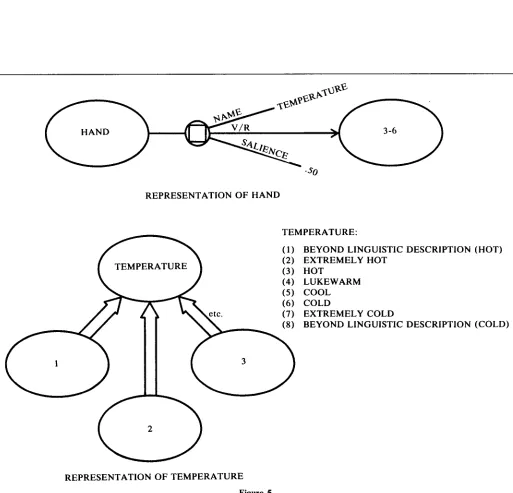
I n F i g u r e 5, n o t i c e t h a t f o r t h e c o n c e p t H A N D , t e m p e r a t u r e is n o t terribly salient. 13 I h a v e also i n t r o - d u c e d a r a n g e o f values as a possible value restriction, h e r e 3-6. So this m e a n s t h a t h a n d s p r o t o t y p i c a l i t y r a n g e f r o m h o t to cold. I n c o n s i d e r i n g t h e C o n c e p t I C E ( F i g u r e 6), n o t i c e t h a t it has a t e m p e r a t u r e o f 7, t h a t is, e x t r e m e l y cold. T e m p e r a t u r e is h i g h l y salient f o r I C E ( = 1).
F i g u r e 6 also illustrates the r e l a t i o n s h i p b e t w e e n a h i g h e r C o n c e p t , SOLIDS, a n d a l o w e r o n e , ICE. T h e R o l e s o f SOLIDS are i n h e r i t e d b y ICE. I n s o m e r e p r e - s e n t a t i o n s t h e y are i n h e r i t e d intact, b u t h e r e t h e R e - stricts link c a u s e s a r e s t r i c t i o n o f the fillers o f the R o l e in q u e s t i o n . T h u s , T E M P E R A T U R E is r e s t r i c t e d to 7; T E X T U R E is r e s t r i c t e d to H A R D / S M O O T H .
13 I have provided for salience to assume values between zero (least. salient) and one (most salient). The algorithm for the com- putation of these values awaits further empirical results. At pres- ent, they represent an estimate based on my intuitions.
.So
R E P R E S E N T A T I O N OF H A N D
(1)
[
T,~,,~,~TIIP~ ~
(2)
. . . i (3)
\
/
(4)
/ / ,
,,
. ~
-Vtc.
(7)
C_D
T E M P E R A T U R E :
BEYOND L I N G U I S T I C DESCRIPTION (HOT) E X T R E M E L Y HOT
H O T
L U K E W A R M C O O L C O L D
E X T R E M E L Y C O L D
BEYOND L I N G U I S T I C D E S C R I P T I O N (COLD)
R E P R E S E N T A T I O N OF T E M P E R A T U R E
Figure 5.
[image:10.612.52.565.220.713.2]E. Judith Weiner A Knowledge Representation Approach to Understanding Metaphors
RED
APPLE
GREEN
GRANNY
SMITH DELICIOUS
V / R
[image:11.612.48.559.58.737.2]Figure 4.
INORGANIC SUBSTANCES
TEMPERATURE TEXTURE
TEMPERATURE
SOLIDS NAME
TEXTURE
7 ~ 1 Ig----4 ICE H A R D / S M O O T H
1.0
Figure 6. .85
E. Judith Weiner A Knowledge Representation Approach to Understanding Metaphors
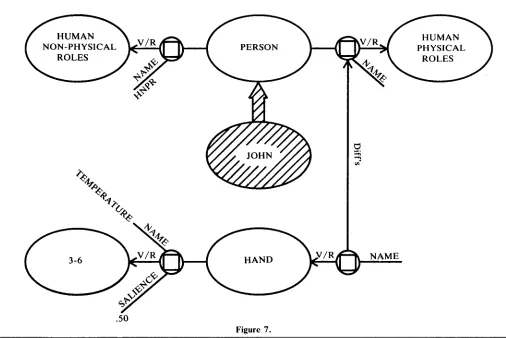
W h a t t h e n would be the result of the user input
(9) J o h n ' s hands are like ice.
L o o k i n g at a p o r t i o n of J o h n ' s n e t w o r k integrated with the one f o r HAND (Figure 7), s e n t e n c e (9) would cause one to look at the Roles for J o h n ' s hands, see t h a t t h e y do not R e s t r i c t the R o l e s of the G e n e r i c C o n c e p t HAND. T h e r e f o r e , they are t h o u g h t b y the s y s t e m to be p r o t o t y p i c a l hands. T e m p e r a t u r e is the m o s t salient f e a t u r e of ICE for which J o h n has a Role. This must be the Role indicated b y (9). T h e user has m a d e a hyperbolic s t a t e m e n t . H e or she has said that J o h n ' s h a n d t e m p e r a t u r e is inexpressible b y r e f e r e n c e to n o r m a l h a n d t e m p e r a t u r e s . Thus, to u n d e r s t a n d the s e n t e n c e , it is n e c e s s a r y to o b s e r v e t h a t ICE has a m u c h m o r e e x t r e m e value for t e m p e r a t u r e and it is of the highest salience ( = 1). As a result, f o r the p u r p o s - es of this discourse, the salience of J o h n ' s hand t e m p - e r a t u r e is given the value of 1, implying that for the s p e a k e r J o h n ' s hands are o n e of his m o s t salient f e a -
tures. This i n f o r m a t i o n m a y be useful in interpreting
the discourse that follows the sentence.
T h e incongruity that m u s t be p r e s e n t for m e t a p h o r s to w o r k can also be seen by referring to these dia- grams, p a r t i c u l a r l y with r e g a r d to their h i e r a r c h i c a l nature. It is clear t h a t a m e t a p h o r i c a l s t a t e m e n t is
possible b e t w e e n m e m b e r s of an inheritance relation- ship
(31) J o h n i s a p e r s o n
(32) Ice is a solid
since these are actual s t a t e m e n t s of that relationship. A d e e p e r analysis of h u m a n c l a s s i f i c a t i o n devices p r o m i s e s to yield f u r t h e r c o n s t r a i n t s on pairs t h a t can relate m e t a p h o r i c a l l y to o n e another. F o r e x a m p l e , looking b a c k at
(12) J o h n is like his father,
since b o t h J o h n and his f a t h e r share the s a m e i m m e d i - ate s u p e r o r d i n a t e c a t e g o r y , m a l e , (12) c a n n o t b e m e t a p h o r i c . This m a y also explain w h y
(33) E n c y c l o p e d i a s are like gold mines
is m e t a p h o r i c a l but
(34) E n c y c l o p e d i a s are like dictionaries
seems to be a similarity s t a t e m e n t . ( E x a m p l e s f r o m O r t o n y , R e y n o l d s , a n d A r t e r 1978.)
T h e a l g o r i t h m implied h e r e c a n b e e x p r e s s e d as follows:
1. If the topic is an individual c o n s t a n t (IC), establish restrictions (using the Restricts link), if any, on the Role in question (for e x a m p l e , J O H N ' s HANDS). If
%
[image:12.612.57.563.400.738.2].50
Figure 7.
NAME
E. Judith Weiner A Knowledge Representation Approach to Understanding Metaphors
there are restrictions, n o t e these; otherwide, n o t e inherited V/Rs.
2. Establish those salient predicates for the vehicle for which the topic also has a R o l e ( f o r e x a m p l e , TEMPERATURE for ICE and J O H N ' s HANDS). 3. If the V / R s for these Roles are e x t r e m e in the vehi-
cle but not in the topic, the u t t e r a n c e is hyperbolic. If, in addition, the vehicle a n d topic are in the p r o p e r relationship to one a n o t h e r with r e s p e c t to the t a x o n o m y , the u t t e r a n c e is metaphorical. G i v - en that these conditions hold, raise the salience of the r e l e v a n t Roles of the topic.
We h a v e b e g u n the c o m p u t e r i m p l e m e n t a t i o n of
this algorithm using NIL on a VAX 11/780. We have
i m p l e m e n t e d e n o u g h of the f e a t u r e s of KL-ONE to allow us to build a p r o t o t y p e k n o w l e d g e b a s e (in prog- ress) that will be rich enough to permit e x p e r i m e n t a -
tion using input consisting of novel m e t a p h o r s . We
intend to exercise the s y s t e m with the goal of e s t a b - lishing the correctness or need for r e f i n e m e n t of the algorithm.
12. C o n c l u s i o n s
T o s u m m a r i z e , I h a v e d e m o n s t r a t e d h o w m e t a p h o r c o m p r e h e n s i o n can p r o c e e d on the f o u n d a t i o n of sali- ence, with the following modifications to the theories of O r t o n y : High salient predicates of the A t e r m can be those at issue in a m e t a p h o r i c a l (as o p p o s e d to strictly literal) i n t e r p r e t a t i o n and low salient f e a t u r e s
of the B t e r m likewise are of concern. Because of
o t h e r f a c t o r s that serve to m o t i v a t e the use of m e t a - phors (incongruity, h y p e r b o l e , inexpressibility), m e t a - phors are not always c o m p a c t , n o r are they prohibited f r o m being used for a single predicate.
P r o t o t y p e t h e o r y applies in t w o ways: the B t e r m is generally chosen as p r o t o t y p i c a l of certain predicates; the real-world r e p r e s e n t a t i v e of the B t e r m is a p r o t o - typical m e m b e r of its class.
In m y utilization of KL-ONE, I h a v e allowed for a range of possible values in the value restriction facet
and introduced salience as a role facet. I h a v e also
d e m o n s t r a t e d the need for s u b - k n o w l e d g e n e t w o r k s in dealing with m e t a p h o r s and o t h e r n a t u r a l l a n g u a g e issues.
13. T h e Large S c o p e of T h i n g s
A l t h o u g h this a p p r o a c h to n a t u r a l l a n g u a g e a n d k n o w l e d g e r e p r e s e n t a t i o n has b e e n f r o m the point of view of m e t a p h o r s , it seems clear that at least some of the factors operating in m e t a p h o r u n d e r s t a n d i n g o p e r - ate in literal language as well. T h e r e is u n d o u b t e d l y a relationship b e t w e e n salience raising in m e t a p h o r s and the resultant effect on discourse and focus of a t t e n - tion. In fact, salience raising u n d o u b t e d l y c o n t r i b u t e s
to focusing. I have only dealt lightly with discourse
p r o b l e m s and recognize these as crucial to all language
understanding, w h e t h e r the language be literal or fig- urative.
It should be n o t e d that the a p p r o a c h I have t a k e n ignores the possibility of c o n s i d e r i n g m e t a p h o r s as
analogies. Since m a n y are not analogies, I will save
that for future work. T h a t t h e y exist is clear:
(35) G i r a f f e s are like s k y s c r a p e r s
is s o m e w h a t m o r e c o m p l i c a t e d to u n d e r s t a n d ( c o m p u t a t i o n a l l y speaking) t h a n m a n y of the ones I have used in this discussion b e c a u s e it involves rela-
tionships a m o n g R o l e s and not Roles simply.
( G i r a f f e s are the tallest animals, s k y s c r a p e r s are the
tallest buildings.) Also, clearly, s o m e analogies and
s o m e m e t a p h o r s are instructional ( O r t o n y 1975).
(37) T h e structure of an a t o m is like the structure of the solar system.
These a p p e a r to be used in building the r e p r e s e n t a t i o n of a n e w c o n c e p t (here, a t o m s ) . I h a v e dealt here only with r e p r e s e n t a t i o n s of existing concepts. 14
In addition, I h a v e c h o s e n to d e v e l o p a m e t h o d that could be applied to handling novel m e t a p h o r s as op- p o s e d to those r e c o g n i z e d b y L a k o f f a n d J o h n s o n ( 1 9 8 0 ) as g e n e r a l m e t a p h o r s . A s y s t e m could be m a d e m o r e efficient b y utilizing a technique such as C a r b o n e l l ( 1 9 8 1 ) has d e s c r i b e d f o r r e c o g n i z i n g the latter w h e n e v e r they occur and i n c o r p o r a t i n g m y p r o - posals elsewhere.
Finally, as in the case of literal language, it is es- sential to s t u d y r e c o r d i n g s of n a t u r a l s p e e c h to see w h a t people a c t u a l l y say. In m e t a p h o r s as elsewhere, there will be m a n y surprises.
A c k n o w l e d g m e n t s
I ' d like to t h a n k R a l p h Weischedel, Michael F r e e m a n , a n d G e n e v i e v e B e r r y - R o g g h e f o r r e a d i n g and c o m - m e n t i n g on an earlier draft of this paper.
R e f e r e n c e s
Anderson, R.C. and Ortony, A. 1975 On Putting Applies into
Bottles - A Problem of Polysemy. Cognitive Psychology 7:
167-180.
Brachman, R.J. 1977 A Structural Paradigm for Representing Knowledge. Ph.D. thesis. Harvard University, Cambridge, Massachusetts.
Brachman, R.J. 1978 Theoretical Studies in Natural Language
Understanding. Annual Report, 1 May 1977 to 30 April 1978; BBN Report No. 3888 (September). Bolt Beranek and New- man, Inc., Cambridge, Massachusetts.
Brachman, R.J. 1979 On the Epistemological Status of Semantic
Networks. In: Findler, N.V., Ed., Associative Networks: Repre-
sentation and Use of Knowledge by Computers. Academic Press, New York, New York: 3-50.
Carbonell, J.G. 1980 Metaphor - a Key to Extensible Semantic
Analysis. In Proceedings of the 18th Annual Meeting for the
Association for Computational Linguistics and Parasession on
14 Ortony (1979b, p. 199) recognizes the distinction in terms of "predicate promotion" versus "predicate introduction".
E. Judith Weiner A Knowledge Representation Approach to Understanding Metaphors
Topics in Interactive Discourse, June 19-22, 1980. University of Pennsylvania, Philadelphia, Pennsylvania: 17-21.
Carbonell, J.G. 1982 Metaphor: An Inescapable Phenomenon in Natural Language Comprehension. In: Lehnert, W. and Ringle, U., Eds., Strategies for Natural Language Processing. Lawrence Erlbaum Associates, Hillsdale, New Jersey: 415-434.
Cohen, B. 1982a A Knowledge Representation Model of Proto- type Theory. In: Schmolze, J.G. and Brachman, R.J., Eds.,
Proceedings o f the 1981 K L - O N E Workshop. BBN Report No. 4842 (June). Bolt Beranek and Newman, Inc., Cambridge, Massachusetts: 124-127.
Cohen, B. 1982b Understanding Natural Kinds. Ph.D. Thesis. Stanford University, Stanford, California.
Conklin, E.J. and McDonald, D.D. 1982 Salience: The Key to the Selection Problem in Natural Language Generation. In Proceed- ings o f the 20th Annual Meeting o f the Association for Computa- tional Linguistics, 16-18 June 1982. University of Toronto, Toronto, Canada: 129-135.
Gentner, D. 1980 Studies of Metaphor and Complex Analogies. Paper presented at the APA Symposium on Metaphor as Proc- ess.
Gentner, D. 1981 Are Scientific Analogies Metaphors? In: Miall, D.S., Ed., Metaphor: Problems and Perspectives. Harvester Press, Ltd., Brighton, Sussex, England.
Grosz, B.J. 1977 The Representation and Use of Focus in Dialog Understanding. Ph.D. dissertation. University of California at Berkeley, Berkeley, California.
Grosz, B.J. 1981 Focusing and Description in Natural Language Dialogues. In: Joshi, A.; Webber, B.; and Sag, I., Eds., Ele- ments o f Discourse Understanding. Cambridge University Press, New York, New York.
Haynes, F. 1975 Metaphor as Interactive. Educational Theory
25(3): 272-277.
Labov, W. 1973 The Boundaries of Words and their Meanings. In: Bailey, C.J.N. and Shuy, R.W., Eds., New Ways o f Analyzing Variation in English. Georgetown University Press, Washington, D.C.: 340-373.
Lakoff, G. and Johnson, M. 1980 Metaphors We Live By. Universi- ty of Chicago Press, Chicago, Illinois.
Ortony, A. 1975 Why Metaphors Are Necessary and Not Just Nice. Educational Theory 25(1): 45-53.
Ortony, A. 1979a Beyond Literal Similarity. Psychological Review
86(3): 161-179.
Ortony, A. 1979b The Role of Similarity in Similes and Meta- phors. In: Ortony, A., Ed., Metaphor and Thought. Cambridge University Press, New York, New York.
Ortony, A.; Reynolds, R.E.; and Arter, J.A. 1978 Metaphor: Theoretical and Empirical Research. Psychological Bulletin
(September) :919-943.
Ortony, A.; Schallert, D.L.; Reynolds, R.E.; and Antos, S.J. 1978 Interpreting Metaphors and Idioms: Some Effects of Context on Comprehension. Journal o f Verbal Learning and Verbal Behavior
17: 465-477.
Rosch, E.H. 1973 On the Internal Structure of Perceptual and Semantic Categories. In: Moore, T.E., Ed., Cognitive Develop- ment and the Acquisition o f Language. Academic Press, New York, New York: 111-144.
Rosch, E. and Mervis, C.B. 1975 Family Resemblances: Studies in the Internal Structure of Categories. Cognitive Psychology 7: 573-605.
Rumelhart, D.E. and Ortony, A. 1977 The Representation of Knowledge in Memory. In: Anderson, R.C.; Spiro, R.J.; and Montague, W.E., Eds., Schooling and the Acquisition o f Knowledge. Lawrence Erlbaum Associates, Hillsdale, New Jersey: 99-135.
Schomlze, J.G. and Brachman, R.J. 1982 Summary of the KL- ONE Language. In: Schmolze, J.G. and Brachman, R.J., Eds.,
Proceedings o f the 1981 K L - O N E Workshop. BBN Report No. 4842 (June). Bolt Beranek and Newman, Inc., Cambridge, Massachusetts: 233-260.
Tversky, A. 1977 Features of Similarity. Psychological Review
84(4) 327-352.
Verbrugge, R.R. 1980 Transformations in Knowing: A Realist View of Metaphor. In: Honeck, R.P. and Hoffman, R.R., Eds.,
Cognition and Figurative Language. Lawrence Erlbaum Associ- ates, Hillsdale, New Jersey: 87-125.
Walker, D.E., Ed. 1978 Understanding Spoken Language. Elsevier North-Holland, Inc., New York, New York.
Weiner, E.J. 1982 Using KL-ONE to Understand Metaphors. In: Schmolze, J.G. and Brachman, R.J., Eds., Proceedings o f the 1981 KL-ONE Workshop. BBN Report No. 4842 (June). Bolt Beranek and Newman, Inc., Cambridge, Massachusetts: 194- 197.
Weiner, E.J. 1983 The Role of the Knowledge Network in the Computational Processing of Non-literal Language. In Proceed- ings o f the International Conference on Data Bases in the Humani- ties and Social Sciences. (in press)
Williams, O., Ed. 1963 The Mentor Book o f Major British Poets.
The New American Library, Inc., New York, New York.