Analyzing Optimization for Statistical Machine Translation:
MERT Learns Verbosity, PRO Learns Length
Francisco Guzm´an Preslav Nakov and Stephan Vogel
ALT Research Group
Qatar Computing Research Institute, HBKU
{fguzman,pnakov,svogel}@qf.org.qa
Abstract
We study the impact of source length and verbosity of the tuning dataset on the per-formance of parameter optimizers such as MERT and PRO for statistical machine translation. In particular, we test whether the verbosity of the resulting translations can be modified by varying the length or the verbosity of the tuning sentences. We find that MERT learns the tuning set verbosity very well, while PRO is sensi-tive to both the verbosity and the length of the source sentences in the tuning set; yet, overall PRO learns best from high-verbosity tuning datasets.
Given these dependencies, and potentially some other such as amount of reorder-ing, number of unknown words, syntac-tic complexity, and evaluation measure, to mention just a few, we argue for the need of controlled evaluation scenarios, so that the selection of tuning set and optimiza-tion strategy does not overshadow scien-tific advances in modeling or decoding. In the mean time, until we develop such controlled scenarios, we recommend us-ing PRO with a large verbosity tunus-ing set, which, in our experiments, yields highest BLEU across datasets and language pairs.
1 Introduction
Statistical machine translation (SMT) systems nowadays are complex and consist of many com-ponents such as a translation model, a reorder-ing model, a language model, etc., each of which could have several sub-components. All compo-nents and their elements work together to score full and partial hypotheses proposed by the SMT system’s search algorithms.
Thus, putting them together requires assigning them relative weights, e.g., how much weight we should give to the translation model vs. the lan-guage model vs. the reordering table. These rela-tive weights are typically learned discriminarela-tively in a log-linear framework, and their values are op-timized to maximize some automatic metric, typi-cally BLEU, on a tuning dataset.
Given this setup, it is clear that the choice of a tuning set and its characteristics, can have signif-icant impact on the SMT system’s performance: if the experimental framework (training data, tun-ing set, and test set) is highly consistent, i.e., there is close similarity in terms of genre, domain and verbosity,1then translation quality can be
im-proved by careful selection of tuning sentences that exhibit high degree of similarity to the test set (Zheng et al., 2010; Li et al., 2010).
In our recent work (Nakov et al., 2012), we have studied the relationship between optimizers such as MERT, PRO and MIRA, and we have pointed out that PRO tends to generate relatively shorter translations, which could lead to lower BLEU scores on testing. Our solution there was to fix the objective function being optimized: PRO uses sentence-level smoothed BLEU+1, as opposed to the standard dataset-level BLEU.
Here we are interested in a related but dif-ferent question: the relationship between prop-erties of the tuning dataset and the optimizer’s performance. More specifically, we study how the verbosity, i.e., the average target/source sen-tence length ratio, learned by optimizers such as MERT and PRO depends on the nature of the tun-ing dataset. This could potentially allow us to ma-nipulate theverbosityof the translation hypotheses generated at test time by changing some character-istics of the tuning dataset.
1Verbosity also depends on the translator; it is often a
stylistic choice. and not necessarily related to fluency or ade-quacy. This aspect is beyond the scope of the present work.
2 Related Work
Tuning the parameters of a log-linear model for statistical machine translation is an active area of research. The standard approach is to use mini-mum error rate training, or MERT, (Och, 2003), which optimizes BLEU directly.
Recently, there has been a surge in new opti-mization techniques for SMT. Two parameter op-timizers that have recently become popular in-clude the margin-infused relaxed algorithm or MIRA (Watanabe et al., 2007; Chiang et al., 2008; Chiang et al., 2009), which is an on-line sentence-level perceptron-like passive-aggressive optimizer, and pairwise ranking optimization or PRO (Hopkins and May, 2011), which operates in batch mode and sees tuning as ranking.
A number of improved versions thereof have been proposed in the literature including a batch version of MIRA (Cherry and Foster, 2012), with local updates (Liu et al., 2012), a linear regression version of PRO (Bazrafshan et al., 2012), and a non-sampling version of PRO (Dreyer and Dong, 2015); another example is Rampeon (Gimpel and Smith, 2012). We refer the interested reader to three recent overviews on parameter optimization for SMT: (McAllester and Keshet, 2011; Cherry and Foster, 2012; Gimpel and Smith, 2012).
Still, MERT remains the de-facto standard in the statistical machine translation community. Its stability has been of concern, and is widely stud-ied. Suggestions to improve it include using regularization (Cer et al., 2008), random restarts (Moore and Quirk, 2008), multiple replications (Clark et al., 2011), and parameter aggregation (Cettolo et al., 2011).
With the emergence of new optimization tech-niques there have been also studies that compare stability between MIRA–MERT (Chiang et al., 2008; Chiang et al., 2009; Cherry and Foster, 2012), PRO–MERT (Hopkins and May, 2011), MIRA–PRO–MERT (Cherry and Foster, 2012; Gimpel and Smith, 2012; Nakov et al., 2012). Pathological verbosity was reported when using MERT on recall-oriented metrics such as ME-TEOR (Lavie and Denkowski, 2009; Denkowski and Lavie, 2011), as well as large variance with MIRA (Simianer et al., 2012). However, we are not aware of any previous studies of the impact of sentence length and dataset verbosity across opti-mizers.
3 Method
For the following analysis, we need to define the following four quantities:
• source-side length: the number of words in the source sentence;
• length ratio: the ratio of the number of words in the output hypothesis to those in the refer-ence;2
• verbosity: the ratio of the number of words in the reference to those in the source;3
• hypothesis verbosity: the ratio of the num-ber of words in the hypothesis to those in the source.
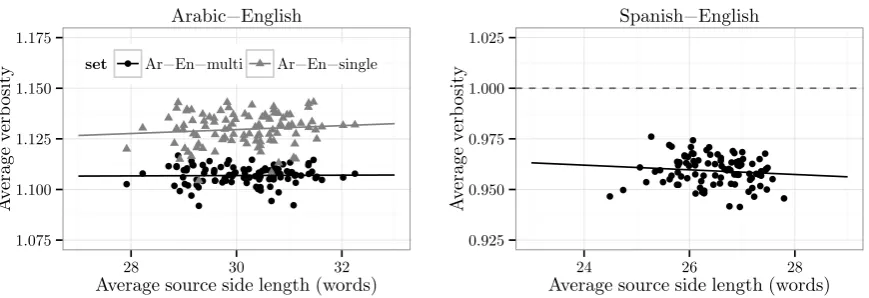
Naturally, the verbosity varies across differ-ent tuning/testing datasets, e.g., because of style, translator choice, etc. Interestingly, verbosity can also differ across sentences with different source lengths drawn fromthe samedataset. This is illus-trated in Figure 1, which plots the average sam-ple source length vs. the average verbosity for 100 samples, each containing 500 randomly se-lected sentence pairs, drawn from the concatena-tion of the MT04, MT05, MT06, MT09 datasets for Arabic-English and of newstest2008-2011 for Spanish-English.4
We can see that for Arabic-English, the English translations are longer than the Arabic source sen-tences, i.e., theverbosityis greater than one. This relationship is accentuated by length:verbosity in-creases with sentence length: see the slightly pos-itive slope of the regression line. Note that the increasing verbosity can be observed in single-reference sets (we used the first single-reference), and to a lesser extent in multiple-reference sets (five ref-erences for MT04 and MT05, and four for MT06 and MT09). For Spanish-English, the story is different: here the English sentences tend to be shorter than the Spanish ones, and the verbosity
decreases as the sentence length increases. Over-all, in all three cases, theverbosity appears to be length-dependent.
2For multi-reference sets, we use the length of the
refer-ence that is closest to the length of the hypothesis. This is thebest match lengthfrom the original paper on BLEU (Pap-ineni et al., 2002); it is default in the NIST scoring tool v13a, which we use in our experiments.
3When dealing with multi-reference sets, we use the
aver-age reference length.
4The datasets we experiment with are described in more
● ●
● ●
●
● ●
● ●
● ●
● ●
● ● ●
● ●●
● ● ● ●
● ● ●
● ●
●
● ●
●
● ●
●
● ●
●
● ●
●
● ●
● ●
● ●
●
● ●
●
● ●
● ● ●
● ●
●
● ●
● ●
● ●
● ● ● ●
● ● ●
● ● ●●
●
● ●
● ●
● ●
● ● ●
●
● ● ●
● ●
● ●
● ●
●
● ●
●
1.075 1.100 1.125 1.150 1.175
28 30 32
Average source side length (words)
A
verage v
erb
osity
set ● Ar−En−multi Ar−En−single Arabic−English
● ● ● ●
● ● ●
●
● ● ●
● ●
● ● ●
● ●
● ●
● ●
● ●●
●
●● ● ●●
● ●
● ●
●
● ● ●
●
● ●
●● ● ●
● ●
● ●
● ●
● ● ●
● ●
●
● ● ●
● ●
● ●
● ●
●
● ● ●
● ●
●●
● ● ●
●
● ●
●● ●
●
● ● ●
● ● ● ●
● ●
● ● ●
●
● ●
0.925 0.950 0.975 1.000 1.025
24 26 28
Average source side length (words)
A
verage v
erb
osity
[image:3.595.82.517.79.228.2]Spanish−English Source length vs. avg. verbosity
Figure 1: Average source sentence length (xaxis) vs. average verbosity (yaxis) for 100 random samples, each with 500 sentence pairs extracted from NIST (Left: Arabic-English, multi- and single-reference) and from WMT (Right: Spanish-English, single-reference) data.
The main research question we are interested in, and which we will explore in this paper, is whether the SMT parameter optimizers are able to learn the verbosity from the tuning set. We are also interested in the question of how the hy-pothesis verbosity learned by optimizers such as MERT and PRO depends on the nature of the tun-ing dataset, i.e., itsverbosity. Understanding this could potentially allow us to manipulate the hy-pothesis verbosityof the translations generated at test time simply by changing the characteristics of the tuning dataset in a systematic and controlled way. While controlling the verbosity of a tuning set might be an appealing idea, this is unrealistic in practice, given that the verbosity of a test set is always unknown. However, the results in Figure 1 suggest that it is possible to manipulateverbosity
by controlling the average source sentence length of the dataset (and thesource-sidelength is always known for any test set). Thus, in our study, we use the source-side sentence length as a data selection criterion; still, we also report results for selection based on verbosity.
In order to shed some light on our initial ques-tion (whether the SMT parameter optimizers are able to learn theverbosityfrom the tuning dataset), we contrast theverbosity that two different opti-mizers, MERT and PRO, learn as a function of the average length of the sentences in the tuning dataset.5
5In this work, we consider both optimizers, MERT and
PRO, as black-boxes. For a detailed analysis of how their inner workings can affect optimization, see our earlier work (Nakov et al., 2012).
4 Experiments and Evaluation
We experimented with single-reference and multi-reference tuning and testing datasets for two language pairs: Spanish-English and Arabic-English. For Spanish-English, we used the single-reference datasets newstest2008, new-stest2009, newstest2010, and newstest2011 from the WMT 2012, Workshop on Machine Transla-tion EvaluaTransla-tion.6 For Arabic-English, we used
the multi-reference datasets MT04, MT05, MT06, and MT09 from the NIST 2012 OpenMT Eval-uation;7 we further experimented with
single-reference versions of the MT0x datasets, using the first reference only.
In addition to the above datasets, we con-structed tuning sets of different source-side sen-tence lengths: short, middleand long. Given an original tuning dataset, we selected 50% of its sen-tence pairs:shortest50%,middle50%, orlongest
50%. This yielded tuning datasets with the same number of sentence pairs but with different num-ber of words, e.g., for our Arabic-English datasets,
longest has about twice as many English words as middle, and about four times as many words asshortest. Constructing tuning datasets with the same number of sentences instead of the same number of tokens is intentional as we wanted to ensure that in each of the conditions, the SMT pa-rameter optimizers learn on the same number of training examples.
6www.statmt.org/wmt12/
4.1 Experimental Setup
We experimented with the phrase-based SMT model (Koehn et al., 2003) as implemented in Moses (Koehn et al., 2007). For Arabic-English, we trained on all data that was allowed for use in the NIST 2012 except for the UN corpus. For Spanish-English, we used all WMT12 data, again except for the UN data.
We tokenized and truecased the English and the Spanish side of all bi-texts and also the monolin-gual data for language modeling using the stan-dard tokenizer of Moses. We segmented the words on the Arabic side using the MADA ATB segmen-tation scheme (Roth et al., 2008). We built our phrase tables using the Moses pipeline with max-phrase-length 7 and Kneser-Ney smoothing. We also built a lexicalized reordering model (Koehn et al., 2005): msd-bidirectional-fe. We used a 5-gram language model trained on GigaWord v.5 with Kneser-Ney smoothing using KenLM (Heafield, 2011).
On tuning and testing, we dropped the unknown words for Arabic-English, and we used monotone-at-punctuation decoding for Spanish-English. We tuned using MERT and PRO. We used the standard implementation of MERT from the Moses toolkit, and a fixed version of PRO, as we recommended in (Nakov et al., 2013), which solves instability issues when tuning on thelongsentences; we will discuss our PRO fix and the reasons it is needed in Section 5 below. In order to ensure convergence, we allowed both MERT and PRO to run for up to 25 iterations (default: 16); we further used 1000-best lists (default: 100).
In our experiments below, we perform three re-runs of parameter optimization, tuning on each of the twelve tuning datasets; in the figures, we plot the results of the three reruns, while in the tables, we report BLEU averaged over the three reruns, as suggested by Clark et al. (2011).
4.2 Learning Verbosity
We performed parameter optimization using MERT and PRO on each dataset, and we used the resulting parameters to translate the same dataset. The purpose of this experiment was to study the ability of the optimizers to learn theverbosity of the tuning sets. Getting the hypothesis verbosity
right means that it is highly correlated with the tuning setverbosity, which in turn is determined by the dataset source length.
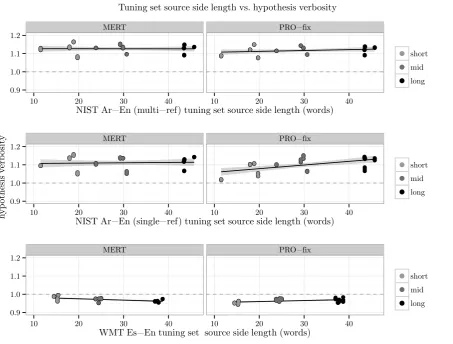
The results are shown in Figure 2. In each graph, there are 36 points (many of them very close and overlapping) since we performed three reruns with our twelve tuning datasets (three length-based subsets for each of the four original tuning datasets). There are several observations that we can make:
(1) MERT is fairly stable with respect to the length of the input tuning sentences. Note how the MERT regression lines imitate those in Fig-ure 1. In fact, the correlation between theverbosity
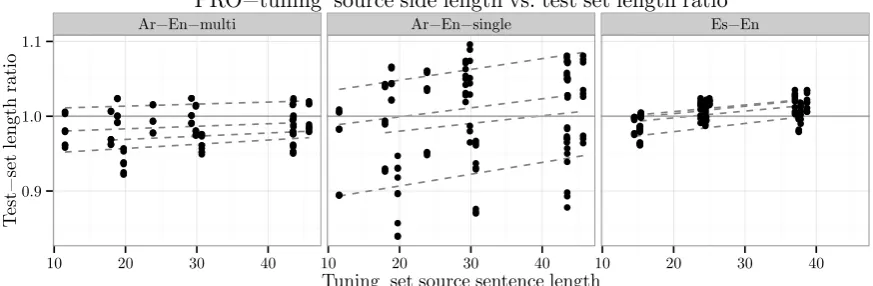
and thehypothesis verbosityfor MERT isr=0.980. PRO, on the other hand, has harder time learning the tuning set verbosity, and the correlation with thehypothesis verbosityis only r=0.44. Interest-ingly, its length ratiois more sensitive to the in-put length (r=0.67): onshort sentences, it learns to output translations that are slightly shorter than the reference, while on long sentences, it yields increasingly longer translations. The dependence of PRO on source length can be explained by the sentence-level smoothing in BLEU+1 and the bro-ken balance between BLEU’s precision compo-nent and BP (Nakov et al., 2012). The problem is bigger for short sentences since there +1 is added to smaller counts; this results in preference for shorter translations.
(2) Looking at the results for Arabic-English, we observe that having multiple references makes both MERT and PRO appear more stable, allowing them to generate hypotheses that are less spread, and closer to 1. This can be attributed to thebest match reference length, which naturally dampens the effect of verbosity during optimization by se-lecting the reference that is closest to the respec-tive hypothesis.
Overall, we can conclude that MERT learns the tuning set’s verbositymore accurately than PRO. PRO learns verbosity that is more dependent on thesource side lengthof the sentences in the tun-ing dataset.
4.3 Performance on the Test Dataset
MERT PRO−fix ● ● ● ● ● ● ● ● ● ● ● ● ● ● ● ●● ● ● ● ● ● ● ● ● ● ● ● ● ● ● ● ● ● ●● ● ● ● ● ● ● ● ● ● ● ● ● ● ● ● ●● ● ● ● ● ● ● ● ● ● ● ● ● ● ● ● ● ● ● ● ● ● ● ● ● ● ● ● ●● ● ● ● ● ● ● ● ● ● ● ● ● ● ● ● ● ● ● ● ●● ● ●●● ● ● ● ● ● ● ● ● ● ● ● ● ● ● ● ● ● ● ● ● ● ● ● ● ● ● ● ● ● ● ●● ● ●● ● ● 0.9 1.0 1.1 1.2
10 20 30 40 10 20 30 40
NIST Ar−En (multi−ref) tuning set source side length (words)
● ● ● short mid long MERT PRO−fix ● ● ● ● ● ● ● ● ● ● ● ●● ● ● ● ● ● ● ● ● ● ● ● ● ● ● ● ●● ● ● ● ● ● ● ● ● ● ● ● ● ● ● ● ● ● ●● ● ● ● ● ● ● ● ● ● ● ● ● ● ● ● ●● ● ● ● ● ● ● ● ● ● ● ● ● ● ● ● ● ● ●● ● ● ● ● ● ● ● ● ● ●● ● ● ● ● ● ● ● ● ● ● ● ● ● ● ● ● ● ● ● ● ● ● ● ●● ● ● ● ● ● ● ● ● ● ●● ● ● ● ● ● ● ● ● ● ● ● ● 0.9 1.0 1.1 1.2
10 20 30 40 10 20 30 40
NIST Ar−En (single−ref) tuning set source side length (words)
● ● ● short mid long MERT PRO−fix ● ● ● ● ● ● ●● ● ● ● ● ● ●●●●●● ●●● ●● ● ●● ●● ● ●● ● ● ● ● ● ● ● ● ● ● ●● ● ● ● ● ● ●●●●●● ●●● ●● ● ●● ●● ● ●● ● ● ● ● ●●●●●● ●●●● ●●●●● ● ● ● ●● ● ● ● ● ● ● ● ●● ●● ●● ●● ●●● ● ● ● ●● ●●●● ●●●● ● ● ● ●● ● ● ● ● ● ● ● ●● ●● ●● ●● ● 0.9 1.0 1.1 1.2
10 20 30 40 10 20 30 40
WMT Es−En tuning set source side length (words)
● ● ● short mid long Tuning set source side length vs. hypothesis verbosity
hyp
othesis v
erb
[image:5.595.74.528.59.403.2]osity
Figure 2: Source-side length vs. hypothesis verbosityfor the tuning dataset. There are 36 points per language pair: four tuning sets, each split into three datasets (short,middle, andlong) times three reruns.
For this purpose, we perform a grid comparison of tuning and testing on all our datasets: we tune on eachshort/middle/longdataset, and we test on the remainingshort/middle/longdatasets.
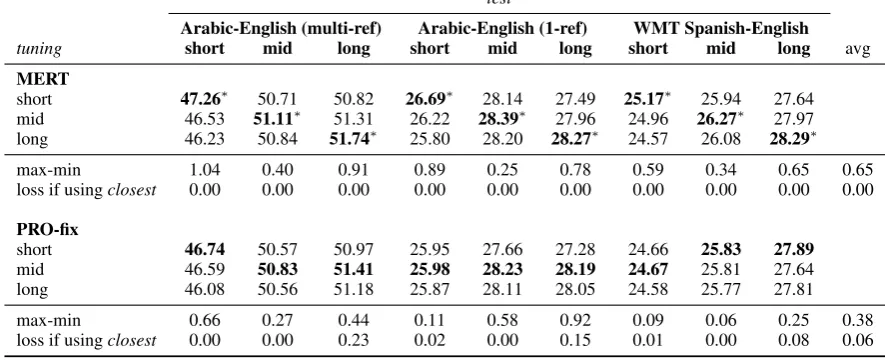
The results are shown in Table 1, where each cell is an average over 36 BLEU scores: four tuning sets times three test sets times three re-runs. For example, 49.63 in row 1 (tune: short), column 2 (test: middle), corresponds to the av-erage over three reruns of (i) tune on MT04-short and test on MT05-middle, MT06-middle, and MT09-middle, (ii) tune on MT05-short and test on MT04-middle, MT06-middle, and MT09-middle, (iii) tune on MT06-short and test on MT04-middle, MT05-middle, and MT09-middle, and (iv) tune on MT09-short and test on MT04-middle, MT05-MT04-middle, and MT06-middle. We further include two statistics: (1) the range of values (max-min), measuring test BLEU variance depending on the tuning set, and (2) the loss in BLEU when tuning on closest instead of on the best-performing dataset.
There are several interesting observations: (1) PRO and MERT behave quite differently with respect to the input tuning set. For MERT, tuning on a specific length condition yields the best results when testing on a similar condition, i.e.,zero-loss. This is a satisfactory result since it confirms the common wisdom that tuning datasets should be as similar as possible to test-time input in terms of source side length. In contrast, PRO behaves better when tuning on mid-length tuning sets. However, the averagelossincurred by apply-ing thecloseststrategy with PRO is rather small, and in practice, choosing a tuning set based on test set’s average length is a good strategy.
test
Arabic-English (multi-ref) Arabic-English (1-ref) WMT Spanish-English
tuning short mid long short mid long short mid long avg
MERT
short 47.26∗ 50.71 50.82 26.69∗ 28.14 27.49 25.17∗ 25.94 27.64
mid 46.53 51.11∗ 51.31 26.22 28.39∗ 27.96 24.96 26.27∗ 27.97
long 46.23 50.84 51.74∗ 25.80 28.20 28.27∗ 24.57 26.08 28.29∗
max-min 1.04 0.40 0.91 0.89 0.25 0.78 0.59 0.34 0.65 0.65
loss if usingclosest 0.00 0.00 0.00 0.00 0.00 0.00 0.00 0.00 0.00 0.00
PRO-fix
short 46.74 50.57 50.97 25.95 27.66 27.28 24.66 25.83 27.89
mid 46.59 50.83 51.41 25.98 28.23 28.19 24.67 25.81 27.64
long 46.08 50.56 51.18 25.87 28.11 28.05 24.58 25.77 27.81
max-min 0.66 0.27 0.44 0.11 0.58 0.92 0.09 0.06 0.25 0.38
[image:6.595.76.519.72.252.2]loss if usingclosest 0.00 0.00 0.23 0.02 0.00 0.15 0.01 0.00 0.08 0.06
Table 1: Average test BLEU when tuning on eachshort/mid/longdataset, and testing on the remaining
short/mid/longdatasets. Each cell represents the average over 36 scores (see the text). The best score for either MERT or PRO is bold; the best overall score is marked with a∗.
4.3.1 Performance vs. Length and Verbosity
The above results give rise to some interesting questions: What if we do not know the source-side length of the test set? What if we can choose a tuning set based on its verbosity? Would it then be better to choose based on length or based on verbosity?
To answer these questions, we analyzed the av-erage results according to two orthogonal views: one based on the tuning set length (using the above 50% length-based subsets of tuning: short, mid,
long), and another one based on the tuning set verbosity (using new 50% subsets verbosity-based subsets of tuning: low-verb,mid-verb,high-verb). This time, we translated the full test datasets (e.g., MT06, MT09); the results are shown in Table 2. We can make the following observations:
(1) The best results for PRO are better than the best results for MERT, in all conditions.
(2) Length-based tuning subsets: With a sin-gle reference, PRO performs best when tuning on short sentences, but with multiple references, it works best with mid-length sentences. MERT, on the other hand, prefers tuning on long sentences for all testing datasets.
(3) Verbosity-based tuning subsets: PRO yields best results when the tuning sets have high ver-bosity; in fact, the best verbosity-based results in the table are obtained with this setting. With mul-tiple references, MERT performs best when tuning on high-verbosity datasets; however, with a single reference, it prefers mid-verbosity.
Based on the above results, we recommend that, whenever we have no access to the input side of the testing dataset beforehand, we should tune on datasets with high verbosity.
4.4 Test vs. Tuning Verbosity and Source Length
In the previous subsection, we have seen that MERT and PRO perform differently in terms of BLEU, depending on the characteristics of the tun-ing dataset. Here, we study a different aspect: i.e. how they behave with respect toverbosityand
source side length.
We have seen that MERT and PRO perform dif-ferently in terms of BLEU depending on the char-acteristics of the tuning dataset. Below we study how other characteristics of the output of PRO and MERT are affected by tuning set verbosity and
source side length.
4.4.1 MERT – Sensitive to Verbosity
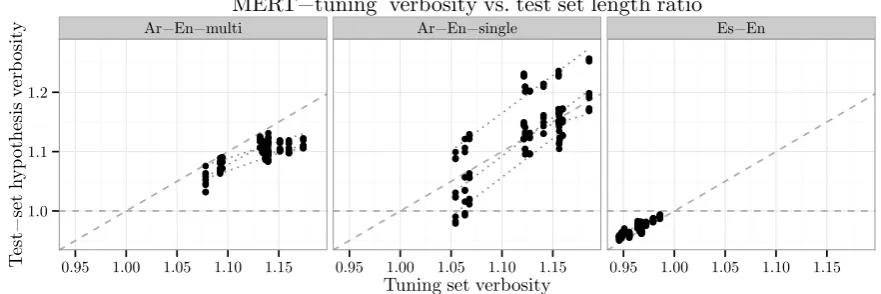
Figure 3 shows a scatter plot of tuningverbosity
vs. test hypothesis verbosity when using MERT to tune under different conditions, and testing on each of the unseen full datasets. We test on full datasets to avoid theverbositybias that might oc-cur for specific conditions (see Section 3).
test
Arabic-English (multi-ref) Arabic-English (1-ref) WMT Spanish-English
tuning MERT PRO-fix MERT PRO-fix MERT PRO-fix
length
short 48.71 49.12 26.74 27.35 26.79 27.07
mid 49.27 49.59 26.97 27.23 26.99 26.88
long 49.35 49.20 27.23 27.28 27.02 26.84
verbosity
low-verb 47.90 47.60 25.89 25.88 26.70 26.61
mid-verb 49.16 49.52 27.69 27.95 27.09 26.81
[image:7.595.121.478.70.190.2]high-verb 50.28 50.79∗ 27.36 28.03∗ 27.01 27.38∗
Table 2: Average test BLEU scores when tuning on different length- and verbosity-based datasets, and testing on the remainingfulldatasets. Each cell represents the average over 36 scores. The best score for either MERT or PRO is bold; the best overall score is marked with a∗.
Ar−En−multi Ar−En−single Es−En
● ● ●● ● ● ● ● ● ● ● ●● ● ● ● ● ● ● ● ● ● ● ● ● ● ● ● ● ● ● ● ● ● ● ●●● ● ● ● ●● ● ● ● ● ● ● ● ●● ●● ● ● ● ● ● ● ● ● ● ● ● ● ● ● ● ● ● ● ● ● ● ● ● ● ● ● ● ● ● ● ● ● ● ● ●● ● ● ● ● ● ● ● ● ● ● ● ● ● ● ● ● ● ● ● ● ● ● ● ● ● ● ● ● ● ● ● ● ● ● ● ● ● ● ● ● ● ● ● ● ● ● ● ● ● ● ● ● ● ● ● ●● ● ● ● ● ● ● ●● ● ● ● ●● ●● ● ● ● ● ● ● ● ● ● ● ● ● ● ● ● ● ● ● ● ● ● ● ● ● ● ● ● ● ● ● ● ● ●● ● ● ● ● ● ● ● ● ● ● ● ● ● ● ● ● ● ● ● ● ● ● ●●●● ● ●●● ● ●● ●● ● ● ● ●● ● ● ● ● ●●●●●●●● ● ● ● ● ●● ● ● ● ● ● ● ● ● ● ● ●● ●● ●●● ● ● ● ● ● ●● ● ● ●● ● ● ● ● ● ● ● ● ●● ● ● ● ● ● ●● ● ●● ●● ● ● ● ● ● ● ●●● ● ● ● ● ● ●● ●● ● ● 1.0 1.1 1.2
0.95 1.00 1.05 1.10 1.15 0.95 1.00 1.05 1.10 1.15 0.95 1.00 1.05 1.10 1.15 Tuning set verbosity
T est−set h yp othesis v erb osity
MERT−tuning verbosity vs. test set length ratio
Figure 3: Tuning setverbosityvs. testhypothesis verbositywhen using MERT. Each point represents the result for an unseen testing dataset, given a specific tuning condition. The linear regressions show the tendencies for each of the test datasets (note that they all overlap for Es-En and look like a single line).
These are very strong positive correlations and they show that MERT tends to learn SMT pa-rameters that yield translations preserving the ver-bosity, e.g., lowerverbosity on the tuning dataset will yield test-time translations that are less ver-bose, while higherverbosityon the tuning dataset will yield test-time translations that are more ver-bose. In other words, MERT learns to generate a fixed number of words per input word. This can be explained by the fact that MERT optimizes BLEU score directly, and thus learns to output the “right”verbosityon the tuning dataset (in contrast, PRO optimizes sentence-level BLEU+1, which is an approximation to BLEU, but it is not the actual BLEU). This explains why MERT performs best when the tuning conditions and the testing condi-tions are in sync. Yet, this makes it dependent on a parameter that we do not necessarily control or have access to beforehand: the length of the test
references.
4.4.2 PRO – Sensitive to Source Length
[image:7.595.76.517.265.412.2]Ar−En−multi Ar−En−single Es−En ● ● ● ● ● ● ● ● ● ● ● ● ● ● ● ● ● ● ●● ●● ● ● ● ● ● ● ● ● ● ● ● ● ● ● ● ● ● ● ● ● ● ● ● ● ● ● ● ● ● ●● ● ● ● ● ● ● ● ● ● ● ● ● ● ● ● ● ● ● ● ● ● ● ● ● ● ● ●● ● ● ● ● ● ● ● ● ● ● ● ● ● ● ● ● ● ● ● ● ● ● ● ● ● ● ● ● ● ● ● ● ● ● ● ● ● ● ● ● ● ● ● ● ● ●● ●● ● ● ● ● ● ● ● ● ● ● ● ● ● ● ● ● ● ● ● ● ● ● ● ● ● ● ● ● ● ●● ● ● ● ● ● ● ● ● ● ● ● ● ● ● ● ● ● ● ● ● ● ● ● ● ● ● ●● ● ● ● ● ● ● ● ● ● ● ● ● ● ● ● ● ● ● ● ● ● ● ● ● ● ● ● ● ● ● ● ● ● ● ● ● ● ● ● ● ● ● ● ● ● ● ● ● ● ● ● ● ● ● ● ● ● ● ● ● ● ● ● ● ● ● ● ● ● ● ● ● ● ● ● ● ● ● ● ● ● ● ● ● ● ● ● ● ● ● ● ● ● ● ● ● ● ● ● ● ● ● ●● ● ● ● ● ● ● ● ● ● ● ● ● ● ● ● ● ● ● ● ● ● ● ● ● ● ● ● ● ● ● ● ● ● ● ● ● ● ● ● ● ● ● ● ● ● ● ● ● ● ● ● ● ● ● ● ● ● ● ● ● ● ● ● ● ● ● ● ● ● ● ● ● ● ● ● ● ● ● ● ● ● ● ● ● ● ● ● ● ● ● ● ● ● ● ● ● ● ● ● ● ● ● ● ● ● ● ●● ● ● ● ● ● ● ● ● ● ● ● ● ● ● ● ● ● ● ● ● ● ● ● ● ● ● ● ● ● ● ● ● ● ● ● ● ●● ● ● ● ● ● ● ● ● ● ● ● ● ● ● ● ● ● ● ● ● ● ● ● ● ● ● ● ● ● ● ● ● ● ● ● ● ● ● ● ● ● ● ● ● ●●● ● ● ● ● ● ● ● ●● ● ●● ● ● ● ● ● ● ●● ●●● ● ● ● ● ● ● ● ● ● ● ● ● ● ● ● ● ● ● ● ● ● ● ● ● ● ●●● ● ● ●● ● ● ● ● ● ●● ● ● ● ● ● ● ● ● ● ● ● ● ● ● ● ● ● ● ● ● ● ● ● ● ● ● ● ● ● ● ● ● ● ● ● ● ● ● ● ● ● ● ● ●●● ● ● ● ● ● ● ● ●● ● ●● ● ● ● ● ● ● ●● ●● ● ● ● ● ● ● ● ● ● ● ● ● ● ● ● ● ● ● ● ● ● ● ● ● ● ● ●●● ● ● ● 0.9 1.0 1.1
10 20 30 40 10 20 30 40 10 20 30 40
Tuning set source sentence length
T
est−set length ratio
[image:8.595.79.516.81.224.2]PRO−tuning source side length vs. test set length ratio
Figure 4: Tuning set average source lengthvs. test hypothesis/reference length ratio for PRO. Each point represents the result for an unseen testing dataset, given a specific tuning condition. The linear regressions shows the tendencies across each of the testing datasets.
Finally, note the “stratification” effect for the Arabic-English single-reference data. We attribute it to the differences across test datasets. These differences are attenuated with multiple references due to theclosest-match reference length.
5 Discussion
We have observed that high-verbosity tuning sets yield better results with PRO. We have further seen that we can manipulate verbosity by adjusting the average length of the tuning dataset. This leads to the natural question: can this yield better BLEU? It turns out that the answer is “yes”. Below, we present an example that makes this evident.
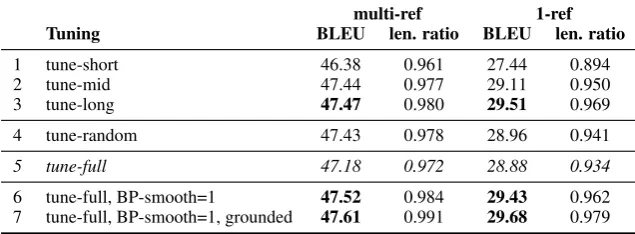
[image:8.595.313.517.582.711.2]First, recall that for Arabic-English longer tun-ing datasets have higher verbosity. Moreover, our previous findings suggest that for PRO, higher-verbosity tuning datasets will perform better in this situation. Therefore, we should expect that longer tuning datasets could yield better BLEU. Table 3 presents the results for PRO with Arabic-English when tuning on MT06, or subsets thereof, and testing on MT09. The table shows the re-sults for both multi- and single-reference experi-ments; naturally, manipulating the tuning set has stronger effect with a single reference. Lines 1-3 show that as the average length of the tuning dataset increases, so does the length ratio, which means better brevity penalty for BLEU and thus higher BLEU score. Line 4 shows that selecting a random-50% subset (included here to show the effect of using mixed-length sentences) yields re-sults that are very close to those formiddle.
Comparing line 3 to lines 4 and 5, we can see that tuning onlongyields longer translations and also higher BLEU, compared to tuning on the full dataset or onrandom.
Next, lines 6 and 7 show the results when apply-ing our smoothapply-ing fix for sentence-level BLEU+1 (Nakov et al., 2012), which prevents translations from becoming too short; we can see that long
yields very comparable results. Yet, manipulat-ing the tunmanipulat-ing dataset might be preferable since it allows (i) faster tuning, by using part of the tun-ing dataset, (ii) flexibility in the selection of the desired verbosity, and (iii) applicability to other MT evaluation measures. Point (ii) is illustrated on Figure 5, which shows that there is direct pos-itive correlation between verbosity, length ratio, and BLEU; note that the tuning set size does not matter much: in fact, better results are obtained when using less tuning data.
28.5 29.0 29.5 30.0
all top90 top80 top70 top60 top50
BLEU BLEU BP 0.91 0.93 0.95 0.97 0.99 BP
Figure 5: PRO, Arabic-English, 1-ref: tune on
multi-ref 1-ref
Tuning BLEU len. ratio BLEU len. ratio
1 tune-short 46.38 0.961 27.44 0.894
2 tune-mid 47.44 0.977 29.11 0.950
3 tune-long 47.47 0.980 29.51 0.969
4 tune-random 47.43 0.978 28.96 0.941
5 tune-full 47.18 0.972 28.88 0.934
[image:9.595.139.457.64.181.2]6 tune-full, BP-smooth=1 47.52 0.984 29.43 0.962 7 tune-full, BP-smooth=1, grounded 47.61 0.991 29.68 0.979
Table 3: PRO, Arabic-English: tuning on MT06, or subsets thereof, and testing on MT09. Statistically significant improvements overtune-fullare in bold: using the sign test (Collins et al., 2005),p <0.05.
6 Conclusion and Future Work
Machine translation has, and continues to, benefit immensely from automatic evaluation measures. However, we frequently observe delicate depen-dencies between the evaluation metric, the system optimization strategy, and the pairing of tuning and test datasets. This leaves us with the situation thatgetting luckyin the selection of tuning datasets and optimization strategy overshadows scientific advances in modeling or decoding. Understand-ing these dependencies in detail puts us in a bet-ter position to construct tuning sets that match the test datasets in such a way that improvements in models, training, and decoding algorithms can be measured more reliably.
To this end, we have studied the impact that source-side length and verbosity of tuning sets have on the performance of the translation system when tuning the system with different optimizers such as MERT and PRO. We observed that MERT learns the verbosity of the tuning dataset very well, but this can be a disadvantage because we do not know the verbosity of unseen test sentences. In contrast, PRO is affected by both the verbosity and the source-side length of the tuning dataset.
There may be other characteristics of test datasets, e.g., amount of reordering, number of unknown words, complexity of the sentences in terms of syntactic structure, etc. that could have similar effects of creating good or bad luck when deciding how to tune an SMT system. Until we have such controlled evaluation scenarios, our short-term recommendations are as follows:
• Know your tuning datasets: Different lan-guage pairs and translation directions may have differentsource-side length–verbosity
dependencies.
• When optimizing with PRO: select or con-struct a high-verbosity dataset as this could potentially compensate for PROs tendency to yield too short translations. Note that for Arabic-English, higher verbosity means longer tuning sentences, while for Spanish-English, it means shorter ones; translation di-rection might matter too.
• When optimizing with MERT: If you know beforehand the test set, select theclosest tun-ing set. Otherwise, tune on longer sentences. We plan to extend this study in a number of di-rections. First, we would like to include other pa-rameter optimizers such as Rampeon (Gimpel and Smith, 2012) and MIRA. Second, we want to ex-periment with other metrics, such as TER (Snover et al., 2006), which typically yields short trans-lations, and METEOR (Lavie and Denkowski, 2009), which yields too long translations. Third, we would like to explore other SMT models such as hierarchical (Chiang, 2005) and syntax-based (Galley et al., 2004; Quirk et al., 2005), and other decoders such as cdec (Dyer et al., 2010), Joshua (Li et al., 2009), and Jane (Vilar et al., 2010).
A long-term objective would be to design a met-ric that measures the closeness between tuning and test datasets, which includes the different char-acteristics, such as length distribution, verbosity distribution, syntactic complexity, etc., to guaran-tee a more stable evaluation situations, but which would also allow to systematically test the robust-ness of translation systems, when deviating from the matching conditions.
Acknowledgments
References
Marzieh Bazrafshan, Tagyoung Chung, and Daniel Gildea. 2012. Tuning as linear regression. In Proceedings of the 2012 Annual Conference of the North American Chapter of the Association for Computational Linguistics: Human Language Technologies, NAACL-HLT ’12, pages 543–547, Montr´eal, Canada.
Daniel Cer, Daniel Jurafsky, and Christopher D Man-ning. 2008. Regularization and search for
min-imum error rate training. In Proceedings of the
Third Workshop on Statistical Machine Translation, WMT ’08, pages 26–34, Columbus, Ohio, USA.
Mauro Cettolo, Nicola Bertoldi, and Marcello Fed-erico. 2011. Methods for smoothing the optimizer
instability in SMT. In Proceedings of the
Thir-teenth Machine Translation Summit, MT Summit XIII, pages 32–39, Xiamen, China.
Colin Cherry and George Foster. 2012. Batch
tuning strategies for statistical machine translation. In Proceedings of the 2012 Annual Conference of the North American Chapter of the Association for Computational Linguistics: Human Language Technologies, NAACL-HLT ’12, pages 427–436, Montr´eal, Canada.
David Chiang, Yuval Marton, and Philip Resnik. 2008. Online large-margin training of syntactic and
struc-tural translation features. In Proceedings of the
2008 Conference on Empirical Methods in Natural Language Processing, EMNLP ’08, pages 224–233, Honolulu, Hawaii, USA.
David Chiang, Kevin Knight, and Wei Wang. 2009. 11,001 new features for statistical machine
transla-tion. In Proceedings of the 2009 Annual
Confer-ence of the North American Chapter of the Associ-ation for ComputAssoci-ational Linguistics: Human Lan-guage Technologies, NAACL-HLT ’09, pages 218– 226, Boulder, Colorado, USA.
David Chiang. 2005. A hierarchical phrase-based
model for statistical machine translation. In
Pro-ceedings of the 43rd Annual Meeting of the Associa-tion for ComputaAssocia-tional Linguistics, ACL ’05, pages 263–270, Ann Arbor, Michigan, USA.
Jonathan H. Clark, Chris Dyer, Alon Lavie, and Noah A. Smith. 2011. Better hypothesis testing for statistical machine translation: Controlling for
op-timizer instability. InProceedings of the 49th
An-nual Meeting of the Association for Computational Linguistics: Human Language Technologies, ACL-HLT ’11, pages 176–181, Portland, Oregon, USA. Michael Collins, Philipp Koehn, and Ivona Kuˇcerov´a.
2005. Clause restructuring for statistical machine
translation. In Proceedings of the 43rd Annual
Meeting on Association for Computational
Linguis-tics, ACL ’05, pages 531–540, Ann Arbor,
Michi-gan.
Michael Denkowski and Alon Lavie. 2011. Meteor-tuned phrase-based SMT: CMU French-English and Haitian-English systems for WMT 2011. Techni-cal report, TechniTechni-cal Report CMU-LTI-11-011, Lan-guage Technologies Institute, Carnegie Mellon Uni-versity.
Markus Dreyer and Yuanzhe Dong. 2015. APRO: All-pairs ranking optimization for MT tuning. In Proceedings of the 2015 Conference of the North American Chapter of the Association for Computa-tional Linguistics: Human Language Technologies, NAACL-HLT ’15, pages 1018–1023, Denver, Col-orado, USA.
Chris Dyer, Adam Lopez, Juri Ganitkevitch, Jonathan Weese, Ferhan Ture, Phil Blunsom, Hendra Seti-awan, Vladimir Eidelman, and Philip Resnik. 2010. cdec: A decoder, alignment, and learning framework for finite-state and context-free translation models. InProceedings of the ACL 2010 System Demonstra-tions, ACL ’10, pages 7–12, Uppsala, Sweden. Michel Galley, Mark Hopkins, Kevin Knight, and
Daniel Marcu. 2004. What’s in a translation
rule? In Proceedings of the 2004 Annual
Confer-ence of the North American Chapter of the Associ-ation for ComputAssoci-ational Linguistics: Human Lan-guage Technologies, NAACL-HLT ’04, pages 273– 280, Boston, Massachusetts, USA.
Kevin Gimpel and Noah A. Smith. 2012. Struc-tured ramp loss minimization for machine
transla-tion. In Proceedings of the 2012 Annual
Confer-ence of the North American Chapter of the Associ-ation for ComputAssoci-ational Linguistics: Human Lan-guage Technologies, NAACL-HLT ’12, pages 221– 231, Montr´eal, Canada.
Kenneth Heafield. 2011. KenLM: Faster and smaller
language model queries. In Proceedings of the
Sixth Workshop on Statistical Machine Translation, WMT ’11, Edinburgh, United Kingdom.
Mark Hopkins and Jonathan May. 2011. Tuning as
ranking. In Proceedings of the 2011 Conference
on Empirical Methods in Natural Language Pro-cessing, EMNLP ’11, pages 1352–1362, Edinburgh, Scotland, United Kingdom.
Philipp Koehn, Franz Josef Och, and Daniel Marcu.
2003. Statistical phrase-based translation. In
Pro-ceedings of the 2003 Conference of the North Amer-ican Chapter of the Association for Computational Linguistics on Human Language Technology (Vol-ume 1), HLT-NAACL ’03, pages 48–54, Edmonton, Canada.
Philipp Koehn, Amittai Axelrod, Alexandra Birch Mayne, Chris Callison-Burch, Miles Osborne, and David Talbot. 2005. Edinburgh system descrip-tion for the 2005 IWSLT speech transladescrip-tion
evalu-ation. InProceedings of the International Workshop
Philipp Koehn, Hieu Hoang, Alexandra Birch, Chris Callison-Burch, Marcello Federico, Nicola Bertoldi, Brooke Cowan, Wade Shen, Christine Moran, Richard Zens, Chris Dyer, Ondrej Bojar, Alexandra Constantin, and Evan Herbst. 2007. Moses: Open source toolkit for statistical machine translation. In Proceedings of the 45th Annual Meeting of the Asso-ciation for Computational Linguistics (Demonstra-tion session)., ACL ’07, pages 177–180, Prague, Czech Republic.
Alon Lavie and Michael J. Denkowski. 2009. The ME-TEOR metric for automatic evaluation of machine
translation. Machine Translation, 23:105–115.
Zhifei Li, Chris Callison-Burch, Chris Dyer, San-jeev Khudanpur, Lane Schwartz, Wren Thornton, Jonathan Weese, and Omar Zaidan. 2009. Joshua: An open source toolkit for parsing-based machine
translation. InProceedings of the Fourth Workshop
on Statistical Machine Translation, WMT ’09, pages 135–139, Athens, Greece.
Mu Li, Yinggong Zhao, Dongdong Zhang, and Ming Zhou. 2010. Adaptive development data selec-tion for log-linear model in statistical machine
trans-lation. In Proceedings of the 23rd International
Conference on Computational Linguistics, COL-ING ’10, pages 662–670, Beijing, China.
Lemao Liu, Hailong Cao, Taro Watanabe, Tiejun Zhao, Mo Yu, and Conghui Zhu. 2012. Locally
train-ing the log-linear model for SMT. InProceedings
of the 2012 Joint Conference on Empirical Methods in Natural Language Processing and Computational Natural Language Learning, EMNLP-CoNLL ’12, pages 402–411, Jeju Island, Korea.
David McAllester and Joseph Keshet. 2011. Gen-eralization bounds and consistency for latent struc-tural probit and ramp loss. In J. Shawe-Taylor, R.S. Zemel, P. Bartlett, F.C.N. Pereira, and K.Q.
Weinberger, editors, Advances in Neural
Informa-tion Processing Systems 24, NIPS ’11, pages 2205– 2212, Granada, Spain.
Robert C Moore and Chris Quirk. 2008. Random restarts in minimum error rate training for
statis-tical machine translation. In Proceedings of the
22nd International Conference on Computational Linguistics-Volume 1, COLING ’08, pages 585–592, Manchester, United Kingdom.
Preslav Nakov, Francisco Guzm´an, and Stephan Vo-gel. 2012. Optimizing for sentence-level BLEU+1
yields short translations. In Proceedings of the
24th International Conference on Computational Linguistics, COLING ’12, pages 1979–1994, Mum-bai, India.
Preslav Nakov, Francisco Guzm´an, and Stephan Vogel.
2013. A tale about PRO and monsters. In
Proceed-ings of the 51st Annual Meeting of the Association for Computational Linguistics (Volume 2: Short Pa-pers), ACL ’13, pages 12–17, Sofia, Bulgaria.
Franz Josef Och. 2003. Minimum error rate training in
statistical machine translation. InProceedings of the
41st Annual Meeting of the Association for Compu-tational Linguistics, ACL ’03, pages 160–167, Sap-poro, Japan.
Kishore Papineni, Salim Roukos, Todd Ward, and Wei-Jing Zhu. 2002. BLEU: a method for automatic
evaluation of machine translation. In Proceedings
of the 40th Annual Meeting of the Association for Computational Linguistics, ACL ’02, pages 311– 318, Philadelphia, Pennsylvania, USA.
Chris Quirk, Arul Menezes, and Colin Cherry. 2005. Dependency treelet translation: Syntactically
in-formed phrasal smt. In Proceedings of the 43rd
Annual Meeting on Association for Computational Linguistics, ACL ’05, pages 271–279, Ann Arbor, Michigan, USA.
Ryan Roth, Owen Rambow, Nizar Habash, Mona Diab, and Cynthia Rudin. 2008. Arabic morphological tagging, diacritization, and lemmatization using
lex-eme models and feature ranking. InProceedings of
the 46th Annual Meeting of the Association for Com-putational Linguistics: Human Language
Technolo-gies, ACL ’08, pages 117–120, Columbus, Ohio,
USA.
Patrick Simianer, Stefan Riezler, and Chris Dyer. 2012. Joint feature selection in distributed stochastic learn-ing for large-scale discriminative trainlearn-ing in SMT. InProceedings of the 50th Annual Meeting of the As-sociation for Computational Linguistics: Long Pa-pers - Volume 1, ACL ’12, pages 11–21, Jeju Island, Korea.
Matthew Snover, Bonnie Dorr, Richard Schwartz, Lin-nea Micciulla, and John Makhoul. 2006. A study of translation edit rate with targeted human annotation. InProceedings of the 7th Biennial Conference of the Association for Machine Translation in the
Ameri-cas, AMTA ’06, pages 223–231, Cambridge,
Mas-sachusetts, USA.
David Vilar, Daniel Stein, Matthias Huck, and Her-mann Ney. 2010. Jane: Open source hierarchi-cal translation, extended with reordering and
lexi-con models. InProceedings of the 5th Workshop on
Statistical Machine Translation and MetricsMATR, WMT ’10, pages 262–270, Uppsala, Sweden. Taro Watanabe, Jun Suzuki, Hajime Tsukada, and
Hideki Isozaki. 2007. Online large-margin training
for statistical machine translation. In Proceedings
of the 2007 Joint Conference on Empirical Methods in Natural Language Processing and Computational Natural Language Learning, EMNLP-CoNLL ’07, pages 764–773, Prague, Czech Republic.