Title: Post-exit loyalty:
Exploring the phenomenon, scale developing & testing its predictive value
Author: Jessica Santee-Eekhuis
Student number: s0031011
University: Universiteit Twente
Faculty: Faculty of Behavioural Sciences
Study: Educational Science and Technology
Specialisation: Human Resource Development
Supervisors: Dr. Q. Zhou
Universiteit Twente
Dr. H. Yang
Universiteit Twente
Drs. L. Bibo
EMC Leren in bedrijf
No man is an island, entire of it self; every man is a piece of the continent, a part of the main……
-John Donne, Meditation XVII From: Devotions upon emergent occasions
Will: [thinking] Every man is an island. I stand by that. But clearly, some men are island CHAINS. Underneath, they are connected... Marcus: [thinking] I used to think two was not enough. But now things are great; there are loads of people... I don't know what Will was so pissed about. I don't think couples are the future. The way I see it now, we both got back-up now. It's like that thing Jon Bon Jovi said: 'No man is an island.'
Acknowledgement
Writing this thesis, conducting this research, attending this university; it has been quite a journey. Even though the final product is here in front of me (and in front of you); I can still hardly believe that the final destination has arrived.
During this past seven years, this study was a constant factor in my live. I enjoyed going to the university once a week, away from normal working live (in jeans and sneakers) absorbing and exchanging knowledge and ideas with others. I started seven years ago, with the idea that I wanted to find out if what I had been doing in my work so far, was the right way to go. I soon learned that there is no such thing as “the right way” or a “single everlasting truth”. My most valuable lesson is simple: different approaches may lead to different results; both can be just as valuable and both views together may bring us a little closer to understanding.
Many people have helped me along the way. First, I would like to thank my first supervisor, Dr. Qin Zhou. I am impressed and inspired by her ability to understand exactly what I needed and when I needed it. Because of that, I was able to make maximum progress, learn and enjoy. I would like to thank Dr. Huadong Yang, my second supervisor, for his clear and constructive feedback in creating this final product.
Furthermore, I would like to thank the participants of this research, the (ex-) employees of six Dutch consultancy and training organizations, for sharing their thoughts and stories with me. Special thanks to the directors and managers of these participating organizations, for their kind cooperation: Joep Straathof (Bureau Zuidema), Jan Litjens (Gooiconsult advies en training), Harm Jan Bouwknegt (Vergouwen Overduin), Ria van ‘t Klooster (Schoevers bedrijfsopleidingen) and Chris Baelemans (Dukers & Baelemans). Special thanks to Jolanda Botke, Desirée Hartong, Sharon van Heijningen-Rutte, Fabienne Soer and Angelique van Bemmel, for their perfect assistance in the coordination.
Thanks to all of my colleagues of EMC Leren in bedrijf, for their support and understanding. Special thanks, for EMC’s director Leontine Bibo, for facilitating me, especially when combining work, study and a private life was sometimes tough.
Many thanks to my family and friends, for never getting tired of asking how things were going, and how I was doing. I am very grateful for these caring people in my life. I owe you all lots of dinner parties! Finally, I thank Lonel, for always helping me to put things in perspective and his unconditional support along the way.
Summary
Alvesson (2000) described people who still feel attached to their former employer even after leaving. He labelled this phenomenon post-exit loyalty. This phenomenon is believed to have significant implications for the knowledge intensive industry in which networks and inter-organizational linkages are crucial (Alvesson, 2000). So far prior research lacks empirical evidence of this phenomenon. There is no clear definition of the construct and no measurement is available.
This study offered a first approach to explore phenomenon of post-exit loyalty. This research was divided in two studies: study 1, qualitative and study 2, quantitative. The purpose of these studies was to explore the post-exit relations between ex-employers and their ex-organizations.
The objectives of the first study were: what is going on in this post-exit relationship and what are the affects of ex-employees towards their former organization. In order to reach these objectives, this study followed a qualitative approach, designed with multiple focus groups using an online electronic chat tool, MSN Web Messenger. 19 ex-employees of 7 organizations voluntarily participated in 7 chatsessions. Of these 7 sessions, 5 were based on a predetermined similar characteristic: tenure (short and long period), time-elapse after exit (short and long period) and the current position of the freelancer, and 2 “mixed” chats. Also (limited) data as collected from management perspective (2 managers from 2 organizations).
Out of the qualitative analysis, two general categories of affects were identified: positive and negative affects towards former employer, and a more instrumental attachment to the former employer. Furthermore, the analysis revealed ex-employees benefiting the former employer from a mutual perspective: ex-employees should also benefit. Results also revealed a change over time: affects neutralize.
The second study followed a quantitative approach. The purpose of this study was to develop a measure for the post-exit loyalty construct, validate it and to explore its consequences. The objectives of this study were: how can post-exit loyalty be measured and how predictive are its consequences. To reach these objectives, this second study included an online survey with a sample of 153 respondents of six Dutch consultancy organizations.
The attitude-behaviour model by Eagly and Chaiken (1993) was introduced as a theoretical basis for understanding the post-exit loyalty construct. Using this model, implicates that more constructs are involved, not just one. Based on this model and the results of the qualitative study, the following scales were developed: post-exit positive affects, post-exit negative affects, post-exit instrumental attachment, intention to benefit and beneficial behaviour.
Table of content
1. Introduction ... 7
1.1 Prior research: Organizational loyalty... 7
1.2 Prior research: Loyalty versus social identity & commitment ... 8
1.3 Towards the research questions... 9
1.4 Theoretical implications ... 10
1.5 Practical relevance... 11
1.6 Overview of this thesis ... 11
2. Post-exit loyalty: Exploring the phenomenon ... 12
2.1 Introduction ... 12
2.2 Theoretical discussion ... 12
2.2.1 Tenure... 12
2.2.2 Time elapse... 12
2.2.3 Current employment context: Freelancer ... 13
2.3 Method ... 13
2.3.1 Research design... 13
2.3.2 Sample ... 14
2.3.3 Data collection... 15
2.3.4 Coding procedures... 16
2.4 Findings... 17
2.4.1 Nature of post-exit contact: Business, professional or pleasure ... 17
2.4.2 Positive and negative affects ... 17
2.4.3 Affects develop over time ... 19
2.4.4 Instrumental attachment ... 20
2.4.5 Benefiting the ex-organization ... 21
2.5 Discussion ... 23
3. Post-exit loyalty: Scale developing and testing its predicative value... 25
3.1 Introduction ... 25
3.2 Theoretical discussion: Applying attitude-behaviour model & hypotheses ... 25
3.2.1 Control variables ... 27
3.3 Method ... 28
3.3.1 Research design... 28
3.3.2 Item generation... 28
3.3.2.1 Post-exit positive and negative affects measures: content adequacy ... 28
3.3.2.2 Post-exit instrumental attachment... 29
3.3.2.3 Beneficial behaviour towards ex-organization ... 29
3.3.2.4 Intention to benefit... 29
3.3.3 Control variables ... 29
3.3.4 Sample & procedure... 30
3.4 Results ... 31
3.4.1 Initial analysis of affects... 31
3.4.2 Exploratory factor analysis... 31
3.4.3 Confirmative factor analysis... 32
3.4.4 Descriptive statistics and correlations ... 33
3.4.5 Hypothesis testing ... 34
4. General discussion... 37
5. Conclusion... 40
References ... 41
Appendix 1. Interview guide for online focus groups: professionals ... 45
Appendix 2. Interview guide for online focus groups: manager... 46
Appendix 3. Chat procedure and pre-information for participants (in Dutch)... 47
Appendix 4. Measures in Dutch and English... 48
1. Introduction
Alvesson (2000) described people who still feel attached to their former employer even after leaving. He labelled this phenomenon post-exit loyalty. This phenomenon is believed to have significant implications for the knowledge intensive industry in which networks and inter-organizational linkages are crucial (Alvesson, 2000). Yet, we know little about post-exit loyalty.
Maintaining positive relationships with former employees might be beneficial and valuable for both the ex-employee and their organization. From an employer’s positive point of view this former employee may become a present or a future client, may be re-employed in the future (Rousseau, 1998) or may become a kind of ‘ambassador’ for the company, who will positively promote inter-organizational linkages between the former employer and his or her new working environment. From a contemporary management point of view, inter-organizational linkage might even be crucial to keep ahead with the competition in the knowledge intensive industries. Gibbons et al. (1994) argue that, intensifying over the late 20th century, there has been a fundamental shift in knowledge relationships. They argue that in contemporary society the key repositories of knowledge and capabilities are distributed across conventional disciplinary and organizational boundaries. In fields where the core capabilities of organizations are based increasingly on knowledge seeking and knowledge-creation, competition is best regarded as a learning race (Powell, 1998). The ability to learn about new opportunities requires participation in them, thus a wide range of inter-organizational linkages is critical to knowledge diffusion, learning, and development.
Ex-employees could have a huge potential in terms of valuable linkage with other organizations. After all, these persons were once part of this organization. They know the organization from within and therefore might be able to point out which linkages will benefit the organization the most. If ex-employees have positive feelings towards their ex-employers, they might be willing to entrust their most valuable new contacts to their former employers, creating valuable (new) networks for their ex-organizations.
So far, prior research lacks empirical evidence of this post-exit phenomenon. There is no clear definition of the construct of post-exit loyalty and no measurement is available. In order to understand more about this proposed post-exit loyalty construct, I therefore first draw upon the body of knowledge of the potentially related constructs: loyalty, social identity, and organizational commitment.
1.1 Prior research: Organizational loyalty
Organization loyalty has been subject of study in many fields. Several definitions of loyalty are present in the fields of management studies (e.g. Hirschman, 1970; Alvesson, 2000), organizational psychology (e.g. Scott, 1965; James & Cropanzano, 1994) and social psychology (e.g. Zdaniuk & Levine, 2001; Van Vugt & Hart, 2004). One way to look at loyalty is that loyalty is regarded as the absence of exit (Hirschman, 1970; Alvesson, 2000). Other representations in this view are inertia, non-exit, compliance or continuation of employment (Alvesson, 2000). These definitions and representations suggest that loyalty is only about continuation or discontinuation of the employment relationship. Zdaniuk & Levine (2001) talk about leaving or staying as manifestations of loyalty. Instead, they define loyalty in terms of group welfare versus personal or individual welfare. Loyalty is defined as helping the group while harming oneself, whereas disloyalty is defined as harming the group while helping oneself (Zdaniuk & Levine, 2001, p. 502). For these authors lack of concern for personal welfare is a necessary part of loyalty. This is also part of Alvesson’s (2000) definition of loyalty as “being altruistic and prepared to make sacrifices in favour of the organization” (Alvesson, 2000, p. 1107).
Within the field of social psychology, Van Vugt and Hart (2004) define loyalty as a “complex, multifaceted construct, consisting of emotive, cognitive, as well as behavioural elements” (p. 586). For example, loyalty may be manifested through the experience of strong, positive emotions (happiness, joy, empathy) associated with group membership. Cognitively, loyalty may be manifested via depersonalized trust in other members, and optimism about the group’s future. And, behaviourally, loyalty may be evidenced in the sacrifices that people make to help their group, including staying when it is personally costly” (Levine & Moreland, 2002; Van Vugt & Hart, 2004, p. 585).
1.2 Prior research: Loyalty versus social identity & commitment
Within the general category of loyalty, Alvesson (2000) distinguishes instrumental loyalty and identification-based loyalty. Typical means of reassuring instrumental loyalty are legal agreements and money, as well as other compensations (Alvesson, 2000). Pure forms of identification based-loyalty do not primarily involve money or contracts, but are a matter of perceived similarities, shared positive emotions and social bonds. On a cognitive level, the self-definition is then defined in social identity terms as part of how one conceives one’s self, rather than as affiliation with and attractiveness felt for a group of people (Turner, 1984).
Identity provides answers to the question: “who am I?”(Asforth & Mael, 1989). The basic idea behind social identification is that in certain circumstances individuals can perceive themselves in terms of their membership to social groups, social identity, rather than in terms of personal attributes, personal identity (e.g. Asforth & Mael, 1989; Riketta, 2005). Social identity theory originated from the studies of Tajfel and Turner (1979) regarding the psychological basis of intergroup relations. According to this perspective, in certain circumstances, people’s sense of who they are is defined in terms of “we” (member of a collective) rather than “I” (individual) and that is a sufficient condition to feel and act as group (e.g. Tajfel & Turner, 1979; Tajfel et al, 1971; Haslam, 2004).
It is important to consider why social identities develop. At a fundamental level, individuals’ social identities are meant to satisfy important needs and values, including self-esteem, security, and belongingness (Pratt, 1998; Tajfel, 1978). That is, individuals want to feel good about them selves, and one way many people attempt to do this is to associate with collectives that are held in high regard by themselves and/or others (Meyer et al., 2006). Human beings also value a sense of security against threats to their interests and well-being. This security can often be provided by associating with others who share their interests and care about their well-being. Finally, many people have a strong need to relate to, and be accepted by, others (Meyer et al., 2006; Baumeister & Leary, 1995). For such individuals, identifying with a collective can help to provide a sense of belongingness.
Comparing the concept of loyalty with the concept of commitment in literature reveals several similarities. Both concepts are complex multifaceted concepts linking the individual to a collective and having implications for behaviour of relevance towards that collective. Opposite from social identity, which has to do with social foci (other people, groups and larger collectives) only, both commitment and loyalty could have social and non-social foci. One might be committed to a job or loyal to a cause. Especially the empathy element of the loyalty, overlaps to some extent with the notion of affective commitment (Allen & Meyer, 1990) defined as ‘emotional attachment to the organization’ (see also Olson-Buchanan & Boswell, 2002).
According to Chisalita (2008) evidence from social psychology field shows that (cognitive) identification is an antecedent for affective commitment (e.g. Bergami & Bargozzi, 2000; Foreman & Whetten, 2002) and for loyalty to the group (Ellemers, Spears & Doosje, 1997; Zdaniuk & Levine, 2001; Van Vugt & Hart, 2004; Iyer et al., 1997; Ashfort & Mael, 1989). Besides the similarities between loyalty and commitment, there seems to be a difference in core essence of these concepts. Commitment is about binding of a person to a target and course of action. Loyalty is more than that: it is about a person (emotionally) having positive emotions and empathy associated with the target and (behaviourally) working hard for the benefit of the target and even (sometimes) making sacrifices on behalf of the target.
1.3 Towards the research questions
Many researchers theorised that the identification process might go further than the employment contract. Individuals’ desire to maintain the continuity of their self-concept over time and across situations provides a theoretical explanation for ex-employees’ continued identification with (and predisposition to benefit) their past employer (Iyer et al., 1997). In addition, Rousseau (2004) refers to the post-exit phenomenon as “the aftermath of employment”. Rousseau (2004) and Meyer et al. (2006) suggest that when deep structured identification (opposite from situated identification) is strong, attachment to an organization could continue even after employment ends. Some companies even try to institutionalize this post-employment identity. For example, the soon-to-be-ex-employees of Arthur Andersen went through an informational process that reinforced a positive disposition towards the firm. The result was a network of loyal ‘alumni’, many placed in firms that were present and future clients of Arthur Andersen (Rousseau, 2004).
However, what are “loyal alumni” in a contemporary management point of view? For many authors, personal sacrifice is an essential element of loyalty within the organizational context. In my opinion, this may not be applicable for the post-exit situation. In a preliminary interview with a Dutch consultant, he told me this story:
….After terminating my employment, I started working for a large Dutch temporary employment agency which was an important potential client for my former organization. I took the initiative of introducing my former organization to my new employer. I wanted to give my former organization a chance to get in touch with my management, who were key persons in the organization. Although I was convinced that my present organization could also benefit from the relations between the two organizations, I hesitated at first. I felt that I was taking a risk: My former organization did have some quality issues when I left it. I felt a risk that the connection between the two organizations would prove to be unsuccessful and this would harm me in any way. They could blame me for the failure or accuse me of preferential treatment to my ex-organisation. After all, I was the one who promoted my ex-organization….
Is this consultant an example of a “loyal alumnus”? Alternatively, could this consultant be considered altruistic as he considered the welfare of his former organization and not just his own and new organization’s welfare? It is doubtful whether a pure form of personal sacrifice without in anyway considering your own or your new environment’s welfare would be likely in the post-exit situation. It might be more likely that the ex-employee will try to consider both organizations and/or his/her own welfare and strive for a win-win situation in the end, instead of a loss – gain situation. A strive for this win situation might also be the most sustainable and enduring approach, considering a today’s knowledge intensive industries, where today’s suppliers or competitors may be the employers, partners or clients of tomorrow.
However, is it all just sunshine in the post-exit situation? Probably not. Alvesson (2000) argues that exit of an employee may be led and/or accompanied by a wide spectrum of sentiments in terms of loyalty to the former employer. Beside loyalty levels that can be related to a positive relation with the organisation, also non-loyalty (no positive feelings related to group membership) and dis-loyalty (negative feelings to the group, harmful behaviour) are mentioned. Alvesson (2000) proposes that low level of loyalty may easily turn into non-loyalty, which is defined by indifference and goes further, distinguishing loyalty from dis-loyalty (hostility and antagonism). According to Turner (1982), behaviour could be represented in terms of a bipolar continuum. Prior research documented negative effects of staff turnover as well (Iyer et al., 2007).
play a major role within the organizational context. I propose that these “feelings” or “affects” play a major role, beyond this organizational context, in the post-exit situation.
Prior research shows variability in terminology on workplace affect (James, et al, 2004). The term ‘‘affect’’ represents a broad category of affective processes, including emotional experiences, moods, and trait or dispositional affect (Anderson & Thompson, 2004). Emotions are brief states that involve cognitive, physiological, and behavioural processes that help individuals quickly respond to threats or opportunities; they are relatively short (in duration) and are directed at specific events or stimuli (Ekman, 1994; Frijda, 1994). Moods, in contrast, have a longer duration, lasting hours or days, and are less directly focused on anything specific (Ekman, 1994; Frijda, 1994). Trait or dispositional affect reflects stable individual differences in the tendency to experience and express certain emotions and moods (Watson et al, 1988).
In this study, affects towards the ex-organization are considered as the tendency to experience and express certain emotions and moods directed at the ex-organization. Baas et al. (2008) mention several dimensions of emotions. One of these dimensions is the activation level. This refers to the intensity associated to the experience of each emotion. Some emotions are positive and deactivating (e.g. relaxed), whereas others are positive and activating (e.g. happy). Likewise, some emotions are negative and deactivating (e.g. sad), whereas others are negative and activating (e.g. anger). For this study, the more activating emotions seem to be most crucial, as that they may activate people to benefit (or harm) the ex-organization.
This study is a first approach to explore the post-exit phenomenon within Dutch knowledge intensive companies from the perspective of the ex-employee. It aims to lay necessary conceptual and empirical groundwork that might advance the knowledge about post-exit loyalty.
The research questions of this study are:
RQ 1: What is going on in the post-exit relations between ex-employees and their ex-organizations? Specifically: What are the affects of ex-employees towards their ex-organisations?
RQ 2: How can post-exit loyalty be measured and how predictive are its consequences?
1.4 Theoretical implications
This research is of academic interest because of several reasons. First, not many researchers on loyalty and related constructs, like identity and commitment, expand their research beyond the organizational context after employees leave; the post-exit situation. There is only limited empirical research on the antecedents and outcomes of identification of ex-employee (alumni) with their former firm leading to intention to benefit this firm (Iyer et al., 2007) and there is (to my best knowledge) no empirical research on loyalty of the ex-employee with their former organization. This study proposes a first approach to explore the issue loyalty in post-exit situation in knowledge intensive companies in the Dutch context.
Secondly, in this study, it is the aim to set the first steps in constructing a scale for the post-exit phenomenon, as no existing measure is available for the post-post-exit loyalty construct. A primary goal of scale development is to create a valid measure of an underlying construct (Clark & Watson, 1995). Building a quality measure first is crucial for any quantitative study (Hinkin, 2005. Problems with reliability and validity of measures used on questionnaires have often lead to difficulties in interpreting the results of field research (e.g. Bryman, 1989; Hinkin, 1995, 2005. This study aims to lay the necessary conceptual and empirical groundwork that might help future research on antecedents and effects.
Thirdly, prior research also focuses on documenting the negative effects of staff turnover, and understanding the cause of the high turnover in order to reduce its dysfunctional consequences (e.g. Griffeth et al., 2000). Little research has been conducted on favourable outcomes of alumni for the companies like former employees becoming potential clients, and the relationship between the former employee and the firm becoming a valuable marketing (Iyer et al., 2007), information and learning resource (Powell, 1989) for the company. This study aims to describe the phenomenon in its full dimensions.
1.5 Practical relevance
The context of this study is of Dutch consultancy organizations. These organizations are usually referred to as knowledge intensive companies. Typical other examples of companies in this knowledge-intensive category are law and accounting firms, management, engineering and computer consultancy companies (Alvesson, 2000). Consultants, engineers and scientists belong to occupations involved in knowledge intensive work. Although there is debate about the definition of the concept of knowledge intensive companies (Alvesson, 1993; 2000; 2004), the category normally refers to companies where most work can be said to be of an intellectual nature and where well-educated, qualified employees form the major part of the work force (Alvesson, 1993; 2000). In this sense, knowledge intensive companies are very much depended on their employees’ knowledge, because this represents “the most significant resource of the company” (p. 1103).
Issues of loyalty and identity are of crucial interest in knowledge intensive companies due to the presence of multiple and possible competing identities and the space for employees to act based on their own understanding (Alvesson, 2000). It is assumed if people exit the organization the ones who strongly identify with the ex-employer will cause less harm for the organization as they will still show loyalty and will not take the clients with them (Chisalita, 2008).
Knowledge intensive companies have typically been characterized by high levels of turnover. For example, Iyer et al. (1997) report 40-50% of staff of large public accounting firms typically departing within three years. Over time, these high turnover levels result in relatively large databases of ex-employees for these organizations. Potentially creating large intertwined valuable new networks. Insight in what makes (or prevents) these ex-employees benefiting their ex-organizations, would give organizations implications on how to manage their ex-employees’ loyalty, even after employment.
1.6 Overview of this thesis
The major goal of this study is to describe the phenomenon and develop a measure for post-exit loyalty and to test its predictive value. Given the nature of this research topic and as little conceptual and empirical information is available on this possible post-exit phenomenon, it will not be appropriate to rely on a deductive approach only. This study therefore combines an inductive and deductive approach. Many researchers emphasised the advantages of combining the two approaches given this type of research topic (e.g. Saunders et al, 2000; Hinkin, 2005. As result of this approach, this research contains two studies: a qualitative study (Study 1) and a quantitative study (Study 2).
In chapter 2, the first qualitative study is presented. After the introduction, this chapter continues with a theoretical discussion. In this discussion, related literature is reviewed leading towards identifying characteristics of interest for selecting respondents (paragraph 2.2). The research method including research design, sample and procedures is described in paragraph 2.3. The following paragraph (2.4) contains the findings of the online focus groups. This chapter ends with a brief discussion and summary of this first study and an introduction to the next chapter (paragraph 2.5).
In chapter 3, the second quantitative study is presented. This chapter, again, starts with an introduction, followed by a theoretical discussion (paragraph 3.2). In this discussion, the attitude-behaviour model is introduced as a basis to understand the post-exit loyalty phenomenon and hypotheses were made on the relationships between constructs involved. In paragraph 3.3, the method is described including the procedure of item generation, the sample and procedure for the survey and the preliminary analysis of the measures. The next paragraph contains the analyses and its results (paragraph 3.4).
2. Post-exit loyalty: Exploring the phenomenon
2.1 Introduction
In this chapter, the first study is presented. The purpose of this study was to explore the post-exit phenomenon, as little is known about post-post-exit loyalty. The objective of this study was to find out what was going on within the relationship between ex-employees and their ex-organizations. Specifically I aimed to identify what the affects were of ex-employees towards their ex-organizations. This first study forms the basis for the following, second, quantitative, study, presented in chapter 3.
After this brief introduction, this chapter continues first with a theoretical discussion (paragraph 2.2). This discussion contains a review of prior literature in order to identify important characteristics that were worth to take into account in this study. Based on these characteristics, the respondents were chosen. Secondly, the method is described (paragraph 2.3): research design, sample and procedures. This paragraph includes a description of the procedure for the chat sessions and the construction of an online interview protocol, specifically designed for this study. The following paragraph (2.4) contains the findings of the chat sessions. This chapter ends with brief discussion and summary of this first study (paragraph 2.5) and a preview of the next chapter.
2.2 Theoretical discussion
In chapter 1 of this thesis, I introduced the (possible) related constructs of (organizational) loyalty, social identity, and organizational commitment, as a starting point to understand more about post-exit loyalty. The review of this literature, gives some direction in identifying factors that may be relevant in terms of post-exit loyalty. The following sub-paragraphs contain the results of this review. Successively, the factors: tenure, post-exit period, and freelancer will be discussed.
2.2.1 Tenure
Rousseau (1998) identifies two levels of cognitive identification: situated and deep-structured identification. Situated identification is an elementary form of identification, is a perception of a discrete work setting, created by situational cues signalling shared interests, and maintains as long as the cues persist (Rousseau, 1998; Meyer et al., 2006). Deep structure identification refers to the cognitive schema formed in work settings across roles, over time, and across situations that leads to congruence between self-at work and one's broader self-concept (Turner, 1978). Such organizational identification can form part of an individual's self-concept by altering individuals' mental models of self in enduring ways (e.g. as United Parcel Service employees say they 'bleed brown' out of a sense of attachment to the company, symbolized by the brown uniforms they wear) (Rousseau, 1998). According to Rousseau (1998), situated identification is a necessary but not sufficient condition for deep structured identification.
Once developed, deep structured identities tend to be more enduring and less cue dependable (Meyer et al., 2006). Rousseau (2004) and Meyer et al. (2006) suggest that when deep structured identification (opposite from situated identification) is strong, attachment to an organization could continue even after employment ends. Therefore, I propose that deep structured identity to be most beneficial in the post-exit situation, as it less cue dependable.
Alvesson (2000) also reports on this “endurance-time issue” associated with the loyalty-concept: He argues that consultants could show loyalty problems towards their organizations when they worked intensively on the workplace of their client for an entire year or more. As deep structured identity is developed over time, tenure is an important factor to consider in this study. It is plausible
that the longer the employee worked for the ex-organization, the more or deeper he identifies with this organization. As stated before, the consultancy industry is characterized by the relatively high turnover rate: Half of the population, typically leaving within three years. Therefore, it seems important for this study to consider differences in tenure, in particular before and beyond this three years “boundary”.
2.2.2 Time elapse
Time is also an important factor in an alternative way. Time elapse is about how long ago an
in multiple social groups; it is likely that the salience of the social group based on the individuals’ more distant employment, declines with the passage of time, because other social groups are likely to become more prominent. According to Mael and Ashforth (1992, p. 108) in their study on college alumni “the sense of shared destiny and belongingness would be expected to fade somewhat [as time passes].” However, the empirical evidence involving college alumni offers mixed results (see also Iyer et al., 1997). Nevertheless, this factor will be considered in this study.
2.2.3 Current employment context: Freelancer
Alvesson (2000) argued that loyalty problems could arise because of conflicting or competing identities. Different current employment contexts of the ex-employees may influence their post-exit loyalty. It seems plausible that it “easier” to stay loyal with an ex-organization, which is in a very different line of business or a (potential) client than an ex-organization which is a (potential) strong competitor. On one hand, it seems therefore important to differentiate for example in the contexts of (potential) client organizations and (potential) competing organizations. One the other hand, this may not be fruitful: Practically, it may become a challenge to define the categories exhaustively, because the possible employment contexts may be numerous. However, an argument even more important is that this view presumes a rigid view of inter-organizational relationships. I believe that considering another organization just as a competitor (or just a potential client), is a too limited view in a growing knowledge intensive network economy. As mentioned before, competitors might as well be the partners or clients of the future or the other way around. However, it is important to realize that people might not have this (longer-term) flexible view in their daily practice (yet) and therefore we must still be aware of any loyalty related issues directly originated from the more competitive relationship.
Yet, a specific group of ex-employees may be important to identify Freelancers. In today’s consultancy business, it is quite common practice that consultants, who leave, start working as a freelancer and stay involved with the ex-organizations. Many freelancers depend on consultancy organization for their assignments, especially when they just started their own business. However, there could be more than just an economical explanation. As many freelancers work alone, they may be more loyal to their former employers (in comparison an ex-employee who is working in an organization with more than one person) due to the fundamental human need to belong to others (Pratt, 1998; Taijfel, 1979). As a conclusion, these freelancers are of special interest in this study.
2.3 Method
In this paragraph, the method of this study is presented. Successively, the research design, sample, data collection and coding procedures, are described.
2.3.1 Research design
This first study followed an exploratory strategy in the spirit of the grounded theory (Glaser & Strauss, 1967). This grounded approach is manifested is this study, by starting the data collection without a formation of an elaborative theoretical framework first. It is also manifest in the analysis, where categories of coding information were generated by engaging in ongoing comparisons between the data and literature (Saunders et al., 2000).
In an inductive approach, multiple focus group sessions were organized to explore the post-exit phenomenon. A focus group, originally designed as a marketing research tool, is defined as a “carefully planned series of discussions designed to obtain perceptions on a defined area of interest in a permissive, non-threatening environment” (Krueger & Casey, 2000, p.5). According to Krueger and Casey (2000), focus groups can provide trustworthy naturalistic data that also lead to important insights about human behaviour. Multiple focus groups sessions were organized, as the data of a single focus group may not be reliable (Krueger & Casey, 2001).
The specific features of a focus group discussion are: a clear plan for a controlled process and environment in which interactions among participants take place, the use of a structured process to collect and interpret data and participants selected based on characteristics they share, as opposed to differences among them (Krueger & Casey, 2000). Normally, focus groups are executed as “live” discussion in which participants meet each other physically.
concern in the amount of time of their employees these focus groups would take, in relation to their high workload and priorities due to the current economic situation (recession). Many authors report on the difficulty of getting access to respondents as one of the major problems in organizational research (e.g. Bryman, 1989). In order to deal with this access issue for these focus group discussions, I decided to use an online electronic chat tool: MSN Web messenger. By using this online tool, I was able to reduce the time investment of the participants and enabled us to gather information within a relatively short timeframe. To my best knowledge, using this type of tool is still uncommon in the research practice. Anandarajan & Anandarajan (2009) do report the unprecedented growth of social networking tools such as MySpace, Facebook and LinkedIn, primarily designed for social purposes. These authors report that only in the last year they have begun to see the emergence of research-based social networking tools. Because of this still being quite an experimental process, much effort has been done in creating a procedure that would be suitable for the chat sessions.
2.3.2 Sample
Participants for these online focus groups were selected based on meeting with one particular predetermined similar characteristic. The types of characteristics were based on the above review of prior research on loyalty and identity (paragraph). The chosen characteristics for the focus groups were: tenure, time elapse and freelancers. In addition, a specific focus group for managers was
formed.
Tenure refers to the total time span an employee worked for the ex-organization. Based on
Alvesson (2000), I decided to choose participants how worked at least one year for an organization. It would have been interesting to create focus groups with participants from several different tenure periods. Because of the (limited) timeframe of this research, I decided to limit the number of groups to two: one to three years and four to six years. Based on Iyer et al. (2001), I propose there might be significant difference between people who have stayed beyond the three years and people who left before that time; therefore, it seems worth to interview both groups. We limit the second focus group to a maximum of six years not to create too much differentiation within the focus group ((Krueger & Casey, 2000). It would have been interesting as well to investigate employee who stayed more than six years (e.g. 7 – 9 years). Due to the limited time span of this research and the assumption that consultants who stayed that many years are more difficult to be find, this group is not included in this part of the study.
Time elapse refers to the period between the current date and the date of exit. Based on the
above-mentioned argumentation for “tenure”, also two focus groups of similar time elapses will be formed: 1≤ 3 years and 4 ≤ 6 years.
Although it would be interesting to distinguish many different employment contexts, we chose to limit the different contexts to one context: freelancer. I propose that the relationship between the
freelancer and employing organization differs substantively from the relationship between the ex-employee who joins another organization and the ex-employing organization. We will also include respondents of both types of organizations (competing and client organization) to our other focus groups and will be aware of any signs of specific differences in their responses.
The last focus group is with managers who maintain contacts with ex-employees. As
managers are supposed to be in contact with several ex-employees, they might be able to point out some relevant similarities and differences between them. The view of the managers might lead to new insights of the post-exit phenomenon.
Access to the participants for the focus groups was gained through personal contacts with the directors of six Dutch consultancy organizations. Although all of the organizations were willing to contribute to this research, two directors were reluctant to offer access to potential focus group participants. Mentioned reasons were high workload of employees, different priorities due to current economic situation (recession), and other current research initiatives within these organizations.
The (ex-) employees were told that they would participate in an one-hour chat session concerning their relationship with their ex-employment organization. Most participants were volunteers recruited by aimed personal contact and e-mails, a few applied voluntary after reading the general call for participants. For every focus group, three possible dates for the sessions were set and published on a website. It was communicated that when a session was fully booked (three participants, see also 2.3.3 Data collection), it was made definite and these participants got their confirmation (any others got, in close consultation with them, a cancellation or new invitation for an extra “mixed” session, with specific no specific leading characteristic).
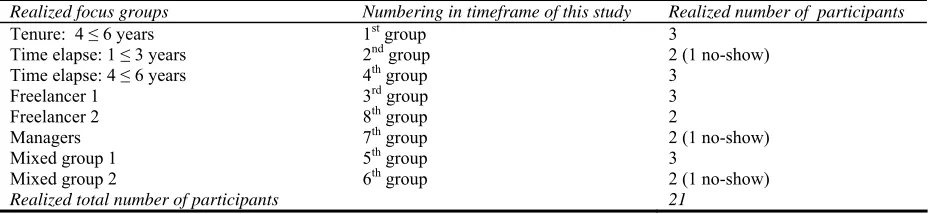
[image:15.595.66.531.349.456.2]In total 143 persons were approached1. Of these 143 persons were 119 participants (ex-) employees of organization A, 10 of organization B, 6 of organization C and 8 from other different organizations. Of the 143 persons in total 40 persons (17 wrong email-addresses; 86 no response) offered to participate, and after definite planning in total 24 participants2 could be planned in eight chat sessions. Of these 8 sessions, 5 sessions were based on a predetermined similar characteristic: tenure (1 session: 4 ≤ 6 years), time-elapse after exit (2 sessions: 1 ≤ 3 and 4 ≤ 6 years) and their current employment of the freelancer (2 sessions). Of these 8 sessions, 2 were “mixed” chats (no specific characteristic) and 1 session provided with data from management perspective (1 session with 2 managers of 2 different organizations). There were in total three last-minute cancellations (no-shows), bringing the total realized sample up to 21 participants. Of these 21 participants, 14 were females and 7 were males. They all had an academic and/or higher educational background. The following table gives an overview the realized focus groups and their characteristics.
Table 1 Realized focus groups
Realized focus groups Numbering in timeframe of this study Realized number of participants
Tenure: 4 ≤ 6 years 1st group 3
Time elapse: 1 ≤ 3 years 2nd group 2 (1 no-show)
Time elapse: 4 ≤ 6 years 4th group 3
Freelancer 1 3rd group 3
Freelancer 2 8th group 2
Managers 7th group 2 (1 no-show)
Mixed group 1 5th group 3
Mixed group 2 6th group 2 (1 no-show)
Realized total number of participants 21
2.3.3 Data collection
A balanced interview guide balances the need for natural features of conversation and the need for a focused discussion in a focus group (Krueger & Casey, 2000). An initial interview protocol was designed based on the research questions and two explorative interviews with two ex-employees.
The group interview was a semi-structured one hour online chat session based on a set of required questions (for comparison) with opportunities for probing responses (for tailoring to individual respondents). An initial chat procedure was designed, based on the technical characteristics of the chat program MSN Messenger and theory of conducting focus groups (Krueger & Casey, 2000) and group-interviews (Saunders et al., 2000). Prior to finalizing the interview protocol, we conducted a pilot chat session with four consultants to assess whether of not the interview questions were understandable and evocative, and to assess the procedure of the chat.
1 Five organizations were asked to look in their existing register of employees and ex-employees which persons
potentially met the criteria. Only one organization had a (almost) complete overview of their ex-employees, next to their current employees (organization A). Only organization A submitted to whole list to the research so that every potential participant could be invited personally by the researcher. The other four organizations had incomplete overviews of ex-employees. Of these four, one organization withdraw because of the impact of the economic crisis on their business, another organization did offer access in approaching their employees and ex-employees by sending through an email with notice of this research, but nobody responded to this call. Another organization offered access to some specific ex-employees, but this was not possible within the existing timeframe.
2 During this planning organization C (6 person) withdraw completely due to priority reasons of the management
Because of the conclusions of this pilot test, the total number of questions was decreased, the optimal number of participants was set on three participants and the procedure of the chat session was standardized. Ultimately, the definite interview protocol included four open questions and several matching questions to probe more in-depth individual information (see Appendix 1 Interview guide for online focus groups: professionals). The interview protocol for the managers chat was derived from the professionals’ interview questions (see Appendix 2 Interview guide for online focus groups: manager).
Three days before the chat session, every participant received an email with information on the chat procedure and the structure of the session (see Appendix 3 Chat procedure and pre-information for participants). As using a chat tool was still uncommon form of data collection, specific attention was given to technical use of the tool (e.g. information on how to log on to MNS messenger) and the impact of tool on the interview procedure (e.g. managing the participants’ expectations for waiting time).
The eight chat sessions were conducted within a three-week timeframe. Beside the advantages of limited time investment of participants and the relatively short timeframe of the data collection, another major advantage of using the online method is that the results did not have to be transcript afterwards. The results were immediately transcript during the interview by the participants and interviewer. These transcripts were all saved immediately after every chat session.
2.3.4 Coding procedures
The interview transcripts contained an average of 2455 words (range: 2079-2826 words). To start of the analysis a holistic general summary was made of each chat session and interesting quotes were translated in English. This allowed for general themes to emerge and a first comparison between the focus groups.
The raw material of the transcripts was than coded following an inductive approach in the spirit of the grounded theory (Glaser & Strauss, 1967; Saunders et al., 2000). First, an “open coding” strategy was used, allowing for deriving meaning from the subjects being studied without an explicit basis in existing theory (Saunders et al., 2000). After this first stage, an “axial coding” strategy was used, allowing for categories and relationships to emerge (Saunders et al., 2000). The following list gives an overview of the stages in this coding procedure:
1. Deleting non-information and deleting person/org-specific information (replacing it with anonym information: e.g. the name of organizations, persons or programs).
2. Splitting up the remaining data into fragments containing only one subject. 3. Numbering the fragments with a unique number.
4. Coding the numbered fragments: the label was close to the content of the fragment. 5. Building an initial coding book.
6. Reviewing and adjusting the initial coding book: related or almost corresponding codes were changed into broader labels.
7. Rearranging the fragments(in total 95 fragments) in five main themes that were emerging : a. What does the post-exit contact consists of?
b. What are their feelings towards their ex- organization now?
c. What are they planning to do or doing now, in terms of benefiting their
ex-organization
d. What happened in the past (during employment and at and/or before exit)? e. What is happing now in their current employment (employment after exit)?
8. Remaining other fragments, which could not be placed into these categories, were deleted. The items that were deleted, were not relevant in terms of the research questions. For example, the following item was deleted: [2.8]…I can image that is difficult to deal with an awkward situation like that: do you break off totally or not? In this fragment, the respondent is reflecting on a statement of another respondent and is not referring to her own situation.
2.4 Findings
In this paragraph, the findings of the coding procedure are presented. Successively, the following results are described: The nature of post-exit contact, (positive & negative) affect and instrumental attachment towards the organization, beneficial behaviour or attitudes towards the ex-organization, the quality of the employment relationship and the exit process.
2.4.1 Nature of post-exit contact: Business, professional or pleasure
Results reveal three types of post-exit contact: business-, professional- and friendship-based. Business orientated contact is about approaching the ex-organization as (potential) client or supplier, or run into the ex-organization as a competitor in an acquisition process. Freelancers talk about earning (part of) their income thought their contact with their ex-organization. Professional contact is about contacting the ex-organization for professional support: meeting the ex-organization at professional associations, attending professional meetings and conferences or consultation with ex-colleagues or ex-managers. Friendships with ex-colleagues continue after exit. These three types of contact, can be, but do not have to be separate. In the following example, the respondent seems to combine friendship with professional support. A respondent states that:
[3.3]3…. I notice that I do not talk about work to “other” friends. That is much easier with old-colleague-friends”.
Although the impact of friendships with specific ex-colleagues should not be underestimated in light of the post-exit phenomenon, this aspect will not be the focus in the rest of this study. One reason is of substantive nature: the proposed “post-exit loyalty” based on friendship with a specific former colleague, may be more vulnerable or less durable, seen from the organization’s perspective. When this former colleague leaves the organization, it seems unlikely that their loyalty will “transfer” to the successor of this former colleague or to the rest of the organization. In social identity terms: The collective identity orientation (Brickson, 2000) is less person dependant and therefore seems to be more “resistant” to exit of former colleagues. Another reason is more ethical. In this research, the focus is on aspects that can be influenced by organizations. Do organizations play a role in friendships of their employees? Although many friendships (even love affairs) start in the workplace; and probably work-related benefits as well as problems could arise from these (that may be of concern of the organization); it is my opinion that is should not be the main concern of work-related organizations. Therefore, there will only be reference to friends in this study in terms of them being potential employees, clients, competitors, etc., for the ex-organization.
2.4.2 Positive and negative affects
Further analysing of the items initially categorized in the category b. (What are they feeling now?), revealed a distinction between positive and negative affects, and a more instrumental form of attachment towards the ex-organization. The positive and negative affects will be described in this paragraph, the instrumental attachment in paragraph 2.4.4.
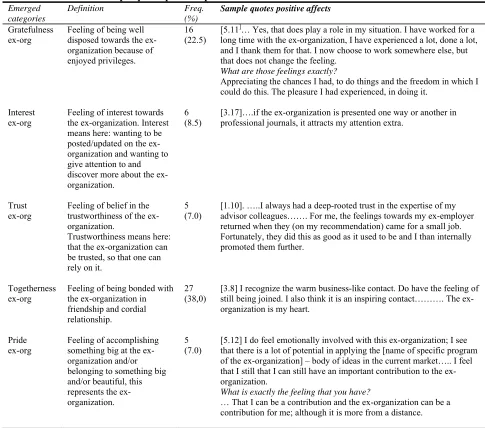
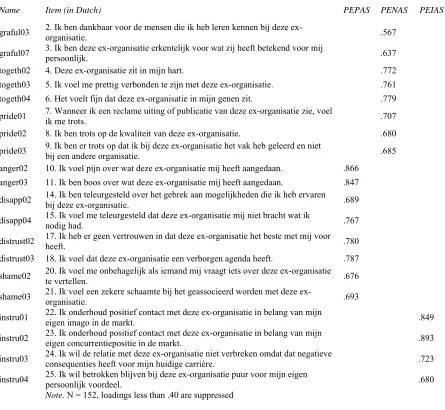
In the category post-exit positive affects, nine initial sub-categories were identified (gratefulness, happiness, interest, trust, sympathy, togetherness, equity, pride, respect). For this study, the more activating emotions (Baas et al., 2008) seems to be most crucial, for I proposed that they activate people to benefit (or harm) the ex-organization. In order to create a final list post-exit positive affects, the sub-categories were reviewed on their “activating potential”. Considered the most “activating” were gratefulness, interest, trust, togetherness, pride and happiness. Considered less “activating” were sympathy, equity and respect. The following table (Table 2 Definitions & sample quotes post-exit positive affects) gives an overview the emerged categories, their definitions, the frequency (number of fragment and percentage of the total amount of affect fragments) and sample quotes. In this table, only the categories are presented that were used in the second, quantitative study:
3 The numbering of the quotes in this paper refer to the numbering of the focus groups mentioned in Table 1
4 of the 9 initial categories (happiness, sympathy, equity and respect) were deleted, during the item generation process (see also paragraph 3.3.2.1).
Table 2 Definitions & sample quotes post-exit positive affects
Emerged categories
Definition Freq.
(%)
Sample quotes positive affects
Gratefulness ex-org
Feeling of being well disposed towards the ex-organization because of enjoyed privileges.
16 (22.5)
[5.11]… Yes, that does play a role in my situation. I have worked for a long time with the ex-organization, I have experienced a lot, done a lot, and I thank them for that. I now choose to work somewhere else, but that does not change the feeling.
What are those feelings exactly?
Appreciating the chances I had, to do things and the freedom in which I could do this. The pleasure I had experienced, in doing it.
Interest ex-org
Feeling of interest towards the ex-organization. Interest means here: wanting to be posted/updated on the ex-organization and wanting to give attention to and discover more about the ex-organization.
6 (8.5)
[3.17]….if the ex-organization is presented one way or another in professional journals, it attracts my attention extra.
Trust ex-org
Feeling of belief in the trustworthiness of the ex-organization.
Trustworthiness means here: that the ex-organization can be trusted, so that one can rely on it.
5 (7.0)
[1.10]. …..I always had a deep-rooted trust in the expertise of my advisor colleagues……. For me, the feelings towards my ex-employer returned when they (on my recommendation) came for a small job. Fortunately, they did this as good as it used to be and I than internally promoted them further.
Togetherness ex-org
Feeling of being bonded with the ex-organization in friendship and cordial relationship.
27 (38,0)
[3.8] I recognize the warm business-like contact. Do have the feeling of still being joined. I also think it is an inspiring contact………. The ex-organization is my heart.
Pride
ex-org Feeling of accomplishing something big at the ex-organization and/or belonging to something big and/or beautiful, this represents the ex-organization.
5
(7.0) [5.12] I do feel emotionally involved with this ex-organization; I see that there is a lot of potential in applying the [name of specific program of the ex-organization] – body of ideas in the current market….. I feel that I still that I can still have an important contribution to the ex-organization.
What is exactly the feeling that you have?
… That I can be a contribution and the ex-organization can be a contribution for me; although it is more from a distance.
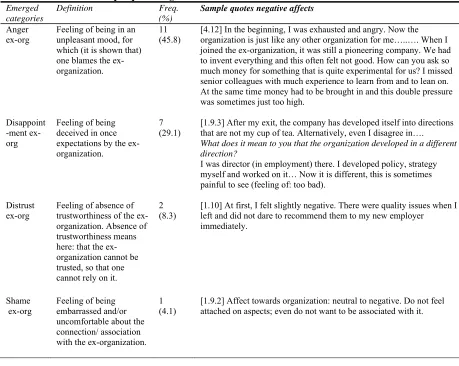
The following table (Table 3) gives an overview the emerged categories, their definitions, the frequency (number of fragment and percentage of the total amount of affect fragments) and sample quotes. In this table, again, only the categories that were used in the following quantitative study are presented: 2 of the 6 initial categories (unease and regret) were deleted during the item generation process (see also paragraph 3.3.2.1).
Table 3 Definition & sample quotes negative affects
Emerged categories
Definition Freq.
(%)
Sample quotes negative affects
Anger ex-org
Feeling of being in an unpleasant mood, for which (it is shown that) one blames the ex-organization.
11 (45.8)
[4.12] In the beginning, I was exhausted and angry. Now the organization is just like any other organization for me…..…. When I joined the ex-organization, it was still a pioneering company. We had to invent everything and this often felt not good. How can you ask so much money for something that is quite experimental for us? I missed senior colleagues with much experience to learn from and to lean on. At the same time money had to be brought in and this double pressure was sometimes just too high.
Disappoint -ment ex-org
Feeling of being deceived in once expectations by the ex-organization.
7 (29.1)
[1.9.3] After my exit, the company has developed itself into directions that are not my cup of tea. Alternatively, even I disagree in….
What does it mean to you that the organization developed in a different direction?
I was director (in employment) there. I developed policy, strategy myself and worked on it… Now it is different, this is sometimes painful to see (feeling of: too bad).
Distrust ex-org
Feeling of absence of trustworthiness of the ex-organization. Absence of trustworthiness means here: that the ex-organization cannot be trusted, so that one cannot rely on it.
2 (8.3)
[1.10] At first, I felt slightly negative. There were quality issues when I left and did not dare to recommend them to my new employer
immediately.
Shame ex-org
Feeling of being embarrassed and/or uncomfortable about the connection/ association with the ex-organization.
1 (4.1)
[1.9.2] Affect towards organization: neutral to negative. Do not feel attached on aspects; even do not want to be associated with it.
2.4.3 Affects develop over time
Table 4 Sample quotes: Affects neutralizing of time (in order of increasing emotional tone).
In addition, results from management perspective show this neutralizing effect. One manager explain that she experienced more than once that a young (report) ex-employee (junior) who left the company reported back to her that seeing it “afterwards”: “things were not that bad”[7.15]. These junior employees did feel that way when they just left their first job at this organization. The other manager had similar experiences with ex-employees. He stated that:
[7.14]… “With a new frame of reference (working at other employers) they often come to the conclusion that [name organization] was a special company with its own atmosphere and lots of room for taking own responsibility, lots of freedom”…
2.4.4 Instrumental attachment
Results show that ex-employees keep good relations with their ex-employer for their own personal benefit. Respondents refer to having no obligations in the new relationship with the employer and foremost being able to make their own decisions based on their own conditions [3.7]. With instrumental attachment, there is some reference of attachment towards the ex-organization but mainly based on mainly personal economic needs, like the need for (continuity in) income [8.4], position or status in the market [2.6][2.12]. The contact with the ex-employer is described as being more strategically [5.7]. Examples quotes of the instrumental form of attachment are presented in following table (Table 5 Sample quotes instrumental attachment towards ex-org).
Sample quotes: affects developing over time
[4.10]…. For me, some did change: more distance makes you look differently towards the organization…..… If you are part of an organization, you do adopt the culture in the organization and you become part of it. Once you become part of another culture, than you see the blind spot of the (ex) culture in the organization. I guess that is not that exceptional, in my opinion everybody has that with every organization.
… Contact is fine and the relationship also, there is just some more distance.
[4.7]…..The relationship is good. I do notice that through the years that I do look differently at the ex organization from a business perspective. When I just left, I still considered the ex-organization the best in market. I do not think that anymore. I have become very critical towards the quality being delivered and the cooperation. I also work with many competitors of the ex-organization and they have to prove themselves just as much as the other suppliers in the market do.
[5.5] …. I recognize it from the period when I just left. However, it was a difficult construction then. You still work as an employee, when it is actually not like that. Now there is more balance.
[5.6] What is exactly difficult?
.. You broke the contract, not just formally but also mentally. After that, there is a new situation, to which you both have to get used to. When you come back as a freelancer, it looks the same as before. Maybe on an operational level it is the same, but it does feel differently for both parties.
[4.19] B: The working method of the company has been in my genes immensely, nearly indoctrination. When I was gone and joined another company, I really had to kick the habit. I did not work there a long time, because I did not fit into that new culture. I was still to fanatic, although they were very positive on my expertise.
How do you explain this?
Just….. Had to kick the habit, was not totally myself… Yes, how they do that, I really do not know. I mean: that you start to work so hard there, do you utmost best, and become so good.
Table 5 Sample quotes instrumental attachment towards ex-org
These results are in line with Alvesson (2000)’s instrumental loyalty, distinct from the other category of loyalty, identification-based loyalty. According to Alvesson (2000), typical means of reassuring instrumental loyalty are legal agreements and money, as well as other compensations. Pure forms of identification based-loyalty do not primarily involve money or contracts, but are a matter of perceived similarities, shared positive emotions and social bonds (Alvesson, 2000).
2.4.5 Benefiting the ex-organization
Results show ex-employees to benefit the ex-organization in different ways (Table 6): They vary from willingness to promote the ex-organization to their business and professional relations [4.5] [4.11], to doing in them a favour above other organizations [6.16] and grant them business on regular basis [1.13]. The degree in activeness of the employees varies; some talk about “keeping the organization in the back of their mind" [4.5] which refers to a more passive way of benefiting the ex-organization; other take an active role in this process: “bringing the knowhow of the ex-organization to the attention of others on regular basis” [1.13].
In addition, there seems to be a difference in an intention to benefit and actually benefiting the ex-organization: respondents report on what they would do if there would be an opportunity [4.5], and on what they do or did (e.g. favouring the ex-organization by not raising their hourly rate [6.16]).
Table 6 Sample quotes benefiting the ex-organization
Sample quotes instrumental attachment
[2.6]… I do not want a fight and conflicts because we are in a competitive position, do not need any negative stories… [2.12] Even when one does not leave positively, one tries to keep the relationship positive. I have been out to dinner with my ex-manager, the director of this company, I was glad (and the director, too) that it was a pleasant dinner. In some way, I foremost want to remain of speaking terms, without interfering in each other’s network.
[3.7] ….. It feels like an equal contact. If I say no, there is nothing attached. Concrete example: In an acquisition process, I had no click with the client. Did not accept the assignment. With good argumentation, this is accepted and even respected. This does not come back in (for example) an assessment interview.
……I am freelancer under my own conditions. Of cause, I am looking for a match and therefore have the necessary flexibility. However, I decide on my own boundaries and not the organization or in consultation with the organization….
[5.7] …. What applies to me as well is that I have chosen a different substantive road, what makes that we are not in each other’s way and openly can share what we are doing…..
…… if you leave, but you are still fishing in the same pond, or you have the idea that you are. The contact gets more strategically than personally. This is understandable, but still I did not enjoy this. Whenever you have the feeling that you are doing dissimilar things, that do tough each other, than you do not have communicate that strategically…..
[8.4] … some aspects of being an employee bothered me. Now, as a freelancer within this organization, I do have the
advantages, but not the burden as before….
I am paid for my efforts. That is pleasant. Income is an important aspect of work. Next to my personal development this is important to me: that I do now on my own account, just like the acquisition of new projects. The work of the ex-organization does offer some continuity. …
Sample quotes: Benefit the ex-organization
[4.5] I do keep the ex-organization in the back of my mind. If I, in my practice as a career counsellor, for example would run into someone who would fit there, I would send somebody there.
[4.11]I do recommend the ex-organization to trainees who drown in my current big organization.
[6.16] The ex-organization gave me a good start, therefore I want to return a favour. E.g., I do not raise my hourly rate as I do for others. Perhaps it sounds silly, but it is purely because we had a win-win situation this fall and the fact that I also want to make a gesture to the ex-organization…..
[1.13] I granted my ex-organization turnover and interesting jobs. At first, I recommended them with caution. I wanted to prevent that the job was not executed well. When that was ok, I regularly brought the knowhow of the ex-organization to the attention of colleagues of my new employer. Concrete it was their request for a new kind of commercial
Results also reveal intentions towards the ex-organization that could be harmful, or at least can be seen as non-beneficial. Three respondents talk about not wanting to be involved and benefit the organization in anyway. These three respondents all express strong negative affects towards the ex-organization and express no or very limited positive affects and instrumental attachment. The following fragment illustrates this non-beneficial behaviour.
[1.12]… I do not keep a relationship with my ex-employer (except from a few colleagues), I do feel somewhat emotionally involved, but more from a negative side. If I talk about my ex-organization with others, I stay neutral or tell honestly were I disagree with my ex-organization… I do not recommend the ex-organization to my own network, even if the issues would be suitable for what they do now…
The results of the (rest) employees, who were willing (in different degree) to benefit the ex-organization, showed more variation. Some of them show mainly positive affects, others show also some instrumental attachment and negative affects: they have more “mixed feelings”. The following fragment illustrated the “mixed feelings”.
[4.15] … I have transferred to non-profit and there I ended up in a warm bath. However, I did not want to have missed my ex-organization. It does feel like grateful…
For what exactly are you grateful?
…For the things I have learned, in skills and work attitude. Recently my ex-boss said: we have also made good money on you, and that felt partly as recognition, but partly as being “used”.
Although finding show variation, the above findings indicate a possible relation between the intensity of the affects and the willingness of people to benefit the ex-organization. More (quantitative) research is necessary to see whether this relation is significantly there (see 3.2).
For many researchers on loyalty, personal sacrifice is an essential element of loyalty within the organizational context. Results suggest that this may not be applicable for the post-exit situation. Some respondents do show signs of sacrificing, for example accepting a lower hourly rate [6.16] (see Table 6) or taking some risk in recommending the ex-organization in their new working environment. But also in that case ex-employees still express the importance of mutual benefit and their striving for win-win situations (see Table 7 Sample quotes: Mutual benefit). This seems especially important in when an ex-employee continues his/her career in the same business (competing) [8.16] [5.4]. If the relationship is out of balance, ex-employees want that situation to be improved [5.4].
Table 7 Sample quotes: Mutual benefit
The above sample quotes also reveal a distinction, which can be found in more interview results. There seems to be a difference in core essences of this “mutuality”. There is mutual benefit, in economical terms: money and jobs or assignments [8.16], which is probably more related to instrumental attachment. There is also mutual benefit on more emotional level “being equal partners” [5.9], which is probably related to positive affects. This result in inline with earlier results that (positive) affects and distinct from a more instrumental form of attachment. To illustrate this partnership:
Sample quotes: mutual benefit
[8.16] I have experienced that we do grant each other a proper amount and regularly scratches each other’s backs. This mutuality is good. For example, I give a lead for an assignment that I cannot execute myself and I get assignments for them to execute myself….
[5.4] The organization is a partner, with a lot of one-way traffic, the organization determines…. The ex-organization is leading in what is being asked to be done…..
Moreover, what does that mean to you?
That I am going to take the initiative to come up with ideas and projects so that the cooperation is more in balance.
What is your reason for doing this?
[5.6] …..when I just left, I really wanted to come loose, to put it very crudely: loose from the “power” of the employer. Doing my own things. In my opinion, this just takes time. This does improve, after a while not having worked as an employee-employer relationship, this gets much better. It feels more equa