[ i 8 6 ]
SOME ASPECTS OF THE RESPIRATION OF SIX
SPECIES OF FISH FROM UGANDA
BY G. R. FISH
East African Fisheries Research Organization, Jinja, Uganda
{Received 5 September 1955)
The present study is an attempt to correlate ecological data with certain aspects of the respiration of six species of fish typical of local waters. The species of fish examined were:
Lates albertianus Worthington Bagrus docmac Forsk. Tilapia esculenta Graham Clarias mossambicus Peters Mormyrus kannume Forsk. Protopterus aethiopicus Heck.
METHODS
The fish were collected from gillnets or seine nets and usually taken alive to the biological laboratory at Makerere College. Here blood samples were taken which, if not used immediately, were stored below 0° C. In some cases the fish were bled when they were caught and the blood stored in a vacuum flask containing an ice-salt mixture. The blood was collected from an afferent vessel in the gill arch or from the caudal artery. In the case of Clarias and Protopterus, the blood was taken from the ventricle of the heart. Specimen tubes of 1 or 5 ml. capacity were cleansed and, before sterilization by dry heat, suitable quantities of Wintrobe's solution (an anticoagulant containing oxalate) were added .The blood from the fish flowed directly into these tubes and, when the required quantity had been collected, the tube was stoppered, shaken vigorously to dissolve the oxalate crystals and stored. Any tubes in which the blood had clotted were discarded. (It was noted that the blood of
Tilapia clotted more readily than that of other fish examined. Several specimens
often had to be used before a satisfactory sample was obtained.)
Respiration of six species of fish from Uganda 187
The gas mixture was flushed through the tonometer which was then rotated slowly for 20 min. to allow time for equilibration at room temperature. This varied between 23 and 240 C. The spectrum of the solution, seen through a Zeiss micro-spectroscope, was then compared with that of human blood at varying degrees of oxygenation (R. Hill, quoted by Fox, 1945). A 'Crista' comparator was modified so that the spectrum of the standard blood at any degree of oxygenation could be observed in the same field of view as that of the experimental solution of haemoglobin. The haemoglobin content of the fish blood was estimated in a 'Beckman' haemo-globinometer.Data from five specimens of Tilapia, three of Mormyrus and two of Lates were used in the construction of dissociation curves. The other curves are from measure-ments using blood from single specimens.
RESULTS Lates albertiamis
Members of this species, which is endemic to Lake Albert, are amongst the largest fresh-water fish. It may be seen from the graphs in Fig. 1 that the presence of carbon dioxide considerably reduces the capacity of the haemoglobin for combining with oxygen. The haemoglobin is 50% saturated at a pressure of 17 mm. oxygen, but in the presence of 25 mm. carbon dioxide, the oxygen pressure has to be doubled in order to reach the same saturation figure. It is clear that this fish requires water with a high dissolved oxygen and low carbon dioxide content. A comparison with the dissociation curves obtained from other fish (Figs. 2-6) shows that the haemoglobin in Lates blood has the lowest affinity for oxygen. These data show that, in the absence of carbon dioxide, the haemoglobin cannot be fully saturated unless the lake water in contact with the gills contains at least 5 p.p.m. dissolved oxygen. Such requirements are reflected in its distribution. The waters of Lake Albert are clear, well stirred by the wind and have a very small biological oxygen demand. Dissolved oxygen is likely to be always near saturation point and the carbon dioxide content low. Similarly, other species of this genus are found in waters where the oxygen concentration is unlikely to fall or that of carbon dioxide to rise to toxic levels.
This physiological dependence on well-aerated water may offer an explanation for the occasional heavy mortalities, limited to this species, which are reported from Lake Albert (see also Worthington, 1929).
An extensive mortality occurred in November 1951, and dead Lates were washed ashore in large numbers. Samples were carefully examined, and the avail-able evidence indicated that the most likely cause of death was asphyxiation. The hydrological data below provides a possible explanation.
substances. Data collected by the Hydrological Survey Department (1951) show that, during August 1951, the tributaries supplied an exceptionally high proportion of the total discharge of the Semliii River into the lake. For this short period there-fore, the inflowing water, being cooler than the lake water, would tend to flow along the floor of the lake and remain a disparate layer until a sudden storm caused mixing. Gill-breathing fish in these areas would then be adversely affected by the rapid, though probably short-lived, reduction in dissolved oxygen and increase in carbon dioxide.
10 15 20 25 30 35 40 45 Oxygen (mm.)
50
Fig. 1. Oxygen dissociation curves for haemoglobin solutions prepared from the blood of Latet
albertiamu. The average haemoglobin content of the blood used in these estimations was
9-1 g./ioo ml.
It was remarkable that over 70% of the dead fish were over 50 lb. in weight, many over 200 lb. and only about 1 % were less than 10 lb. in weight. It seems likely that the larger fish were more closely dependent on optimum conditions of aeration than the smaller specimens.
L. albertianus has been found in the Victoria Nile as far upstream as Fajao and in
Respiration of six species of fish from Uganda
Tilapia esculenta
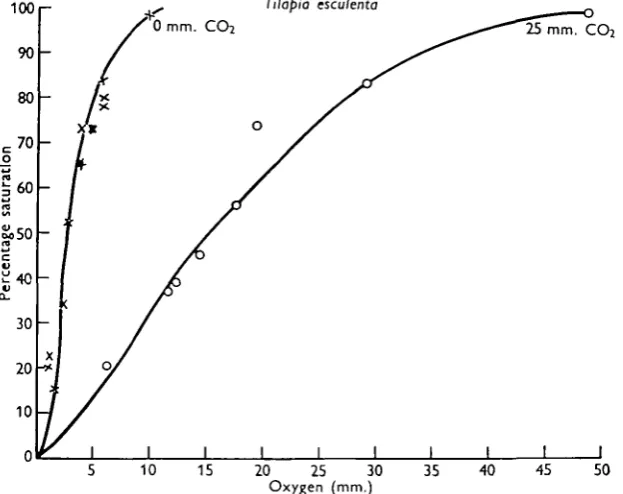
From a commercial point of view, this is the most important fish in Uganda and large numbers are caught annually in Lake Victoria. Tilapia esculenta is found in shallow waters which support a good growth of plankton. Dissolved oxygen con-centrations are usually high, but may drop to about 50 % saturation. These coastal waters are frequently bounded by swamps and have a soft muddy bottom. Carbon dioxide in solution is often present, especially after heavy rain when swamp water may be flushed out by inflows into the lake water. The dissociation curve in the
100
90
80
0 n 56 0
«50 Z ti £40
30
20
10
0
-/
- J
-o/
1/
If 1
. Tilapia esculenta
f 0 mm. CCh
O /
/
/
/ /
/
1 1 1 1 1 1
n ^^*"^z5 mm. CO2
1 1 1
10 15 20 25 30
Oxygen (mm.) 35
[image:4.595.145.457.284.531.2]40 45 50
Fig. 2. Oxygen dissociation curves for haemoglobin solutions prepared from the blood of Tilapia
esculenta. The average haemoglobin content of the blood used in these estimations was 7-5 g./
100 ml.
absence of carbon dioxide (Fig. 2) has a steeper slope than that of Lates. The haemoglobin is fully oxygenated at tensions which would barely oxygenate that of
hates to a value of 30%. Tilapia is unlikely, therefore, to suffer from anoxia under
conditions which would cause Lates severe respiratory distress.
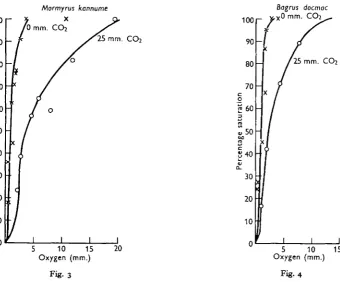
exceptionally strong offshore wind at Entebbe. Such a wind would cause a movement of surface water away from the shore and there would be a corresponding movement inshore of water from the deeper layers in the lake. Temperature records for July show that the density differences between surface and bottom waters in the lake a few miles offshore were small and so relatively little energy would be required to cause a movement of large amplitude of the water strata within the lake. The avail-able data indicate that the cause of this mortality was asphyxiation due to a limited upwelling of poorly aerated water. The difference in slope of the dissociation curves shows that Mormyrus and Bagrus are not as sensitive to poor aeration as Tilapia. This may explain why no members of these genera were found amongst those affected by this mortality.
Samples of the haemoglobin of Tilapia esculenta and of Mormyrus kannume were exposed experimentally to tensions of 50 and 250 mm. Hg of carbon dioxide. No oxyhaemoglobin could be detected in such solutions at oxygen tensions of up to 30 mm. Hg. It may be significant that the haemoglobin of Tilapia and Mormyrus, after exposure to these tensions of carbon dioxide, behaved abnormally when tested subsequently in oxygen mixtures containing no carbon dioxide. The carbon dioxide gas mixture was flushed out of the tonometer containing the haemoglobin solution by a stream of air, but subsequent observations showed that oxyhaemoglobin, if formed at all, was rapidly broken down again. Powers et at. (1932) found a similar inactivation effect when working on the blood of Cycleptus elongatus (Le Sueur) and of Stizostedion vitreum (Mitchell). This phenomenon may provide an explana-tion for the observaexplana-tion that, during a mortality, the affected fish are dying even when they have drifted into well-aerated water where others of the same species are suffering no ill-effects.
Mormyrus kannume
Respiration of six species offish from Uganda
191Bagrus docmac
This fish is found throughout the Nile system. Graham (1929) found that, in Lake Victoria, it attained its largest size in the deeper waters but was by no means limited to any particular depth, being caught from 14 to 130 ft. The slope of the dissociation curve (Fig. 4) shows that Bagrus can successfully withstand conditions
Mormyrus kannume
mm. CO2
5 10 15 Oxygen (mm.)
Fig. 3
100r
901
80
70
60
50
3
40
30
20
10
o'
Bagrus — ^ x ^ m m
"f /
- r
X /7
[
i 5 Oxygendocmac
mm. CO2
1 1 10 15 (mm.)
Fig. 4
Fig. 3. Oxygen dissociation curves for haemoglobin solutions prepared from the blood of Mormynu
kannume. The average haemoglobin content of the blood used in these estimations was 11 -7 g7
100 ml.
Fig. 4. Oxygen dissociation curves for haemoglobin solutions prepared from the blood of Bagrus
docmac. The average haemoglobin content of the blood used in these estimations was 6-o g./ 100 ml.
[image:6.595.135.476.257.539.2]Clarias mossambicus
This fish is found in many of the African lakes and swamps and is common in Lake Victoria. It is found at all depths from swamps to over 200 ft. of water, and has been seen moving through damp grassland, although it is not possible to say whether these terrestrial excursions are primarily for food or migrations from one locality to another (Welman, 1948). This wide range of habitat is only possible to the fish by virtue of its unusual respiratory mechanism. It depends largely on the
Clarias mossambicus
100
90
80
c7 0 o
§60 n
S,50
3 c
£ 40
V
Q_
30 20 10
250 m m . CO?
10 15 20 25 Oxygen (mm.)
30 35
Fig. 5. Oxygen dissociation curves for haemoglobin solutions prepared from the blood of Clarias
mouambictu. The average haemoglobin content of the blood used in these estimations was
i3-3g./iooml.
oxygen in the air for its respiration and can be asphyxiated if access to air is pre-vented. The dissociation curve (Fig. 5) in the absence of carbon dioxide is much steeper than that for a fish limited to the open water, such as hates. Such a curve is advantageous, for Clarias, when leading a purely aquatic life, can only take in a limited volume of air at relatively infrequent intervals.
Respiration of six species offish from Uganda
193Protopterus aethiopicus
This lungfish is common in the Upper Nile Region and Lake Victoria. It is found in shallow water and swamps and breathing is effected by means of lungs. The dissociation curve (Fig. 6) is similar to that obtained for Clarias in having the same tolerance to very high carbon dioxide tensions. The main difference between the two curves, according to the present data, is that a steeper slope is found in the
case of Clarias.
100
90
80
70 c o
C 60
40 30 20 10
Protopterus aethiopicus
mm. COj
10 15 20 25 30
Oxygen (mm.) 35
[image:8.595.138.459.259.511.2]40 45 50
Fig. 6. Oxygen dissociation curves for haemoglobin solutions prepared from the blood of Protopterus
aethiopicus. The average haemoglobin content of the blood used in these estimations was not
determined.
DISCUSSION
It is not unexpected, in view of the variability of aquatic habitats in Uganda, to find large differences in the shape and slope of the dissociation curves for these species of fish. However, Willmer (1934), working with the whole blood of fish in British Guiana, found that the curves, in the absence of carbon dioxide, were similar in all the fish he examined although they came from habitats differing widely in condi-tions of aeration. The blood from these fish differed widely in response to carbon dioxide, and this response was correlated with habitat. The largest Bohr effect was found in the open-water type of fish, e.g. the paku (Myleus setiger, Mull & Troschel) and the smallest in the air-breathing swamp fish, e.g. the electric eel (Electrophorus
electricus) and the hassa (Hoplosternum littorale Hancock). He found no evidence to
suggest that the blood of those fish living in swamps was adapted for complete saturation at low oxygen tensions, although such adaptation had been found in carp, pike and eel (Krogh & Leitch, 1919).
It must be remembered, however, that these air-breathing fish live in shallow water and are therefore unlikely to be exposed to low oxygen tensions. The fish investigated in this paper are found frequently in deep water and are all lake fish or potentially so. Easy access to the air may not, therefore, always be possible, and their blood may often be exposed to low oxygen tensions. Willmer also noted that fish blood in British Guiana is subjected to tropical temperature (280 C.) and suggested that, under similar conditions, such blood might easily behave like carp blood if subjected to the lower temperature (150 C). The difference between whole blood and haemoglobin solutions was investigated by Root, Irving & Black (1939), who found that the response to carbon dioxide of whole and haemolysed blood from the same individual fish could be quite different, although the degree of difference varied between species. Bearing these limitations in mind, certain broad conclusions may be drawn relating the dissociation curves for the fish selected here to their ecology.
The haemoglobin from the blood of Lates has a slight affinity for oxygen and shows a considerable Bohr effect in contrast to that of the other species examined. The competence of the haemoglobin as an oxygen collector is low, but as a result, the gas is more readily released in the body. This makes for the efficient cellular metabolism essential for such a fast and powerful predator, but the respiratory surfaces must be bathed in water containing high tensions of dissolved oxygen and negligible carbon dioxide for the haemoglobin to be fully saturated. The haemo-globin of Mormyrus and Bagrus is saturated at low oxygen tensions and therefore takes up oxygen as efficiently in poorly as in well-aerated water. The range of such fish is greatly extended as a result. A high sustained level of activity may not, how-ever, be possible, because the tension of oxygen within the tissues must be compara-tively low in order to affect transfer from the haemoglobin. The adverse effect of this oxygen tension in the tissues is often modified in various ways. It is of interest in this connexion to note that, of the fish examined here, those with the steeper curves have the higher haemoglobin contents in the blood.
Carter (1955) has shown that there are large bodies of water in Uganda which are impossible habitats for gill-breathing fish owing to the low dissolved oxygen and the high carbon dioxide concentration present. Certain species of fish are known to survive under such conditions by utilizing the oxygen dissolved in the surface layers of water (G. E. Hutchinson, unpublished material quoted by Allee, Emerson, Park, Park & Schmidt, 1950; Carter & Beadle, 1931). Apart from such fish, only those able to utilize the oxygen in the air are found in these poorly aerated waters, namely, Clarias and Protopterus. The very small Bohr effect shown in the dissocia-tion curves of both these fish is necessary for respiradissocia-tion in air-breathing organs which always contain carbon dioxide (Carter, 1931).
Respiration of six species of fish from Uganda 195
American catfish has been found to be able to endure tensions of carbon dioxide of the order of 400-500 mm. Hg for long periods. Black (1940) has also found that the blood of Ameiurus nebulosus (Le Sultar) combines a high affinity for oxygen with a low sensitivity to the presence of carbon dioxide.SUMMARY
The oxygen dissociation curves of the haemoglobin of six species of fish from Uganda, and the effect of 25 mm. Hg of carbon dioxide on them are presented graphically. The fish were selected from habitats varying widely in contents of dissolved oxygen and carbon dioxide. The ecology of these species is correlated with differences in the shape and slope of the curve. Records of fish mortalities in Lakes Albert and Victoria are examined in the light of the new data available and suggestions as to the causes are put forward.
This work would not have been possible without the assistance of Prof. L. C. Beadle, Makerere College, Kampala, Uganda. He constructed the apparatus used, made all the estimations of haemoglobin of fish blood, and freely placed his wide knowledge and experience at my disposal. I am grateful, also, to the staff of the Fisheries section of the Game and Fisheries Department of Uganda and that of the East African Research Organization, in particular Mr P. H. Greenwood, for dis-cussion and help in collecting and identifying fish samples. Water samples from the Semliki River were collected by the Department of Hydrological Survey, Uganda.
REFERENCES
AT Tire, W. C , EMERSON, A. E., PARK, O., PARK, T. & SCHMIDT, K. P. (1950). Principle! of Animal
Ecology. Philadelphia and London: W. B. Saunders Co.
BLACK, E. C. (1940). Oxygen transport by blood of freshwater fish. Biol. Bull., Woods Hole,79,215-29. CARTER, G. S. (1931). Aquatic and aerial respiration in animals. Biol. Rev. 6, 1.
CARTER, G. S. (1955). The Papyrus swamps of Uganda. Unpublished.
CARTER, G. S. & BEADLE, L. C. (193 I ) . The fauna of the swamps of the Paraguayan Chaco in relation to its environment. II. Respiratory adaptations in the fishes. J. Linn. Soc. (Zool.), 37, 327-68. FISH, G. R. (1955). The effect of a seiche on the hydrology of Lake Victoria. Unpublished.
Fox, H. M. (1945).The orygen affinities of certain invertebrate haemoglobins. J.Exp.Biol. a i , 161-5. GRAHAM, M. (1929). Fishing Survey of Lake Victoria. London: H.M.S.O.
HYDROBIOLOGICAL RESEARCH UNIT (1954). Ann. Rep. University College of Khartoum. HYDROLOGICAL SURVEY DEPARTMENT (1951). Ann. Rep. Uganda: Government Printer.
KROGH, A. &LEITCH, 1.(1919). The respiratory function of the blood in fishes. J. Physiol. 5a, 288-300. LAKE VICTORIA FISHERIES SERVICE. (1953) Ann. Rep. Nairobi: Government Printer.
POWERS, E. B. et al. (1932). The relation of respiration of fishes to environment. Ecol. Monogr. 2,
385-473-PROSSER, C. L., BISHOP, D. W., BROWN, Sr, F. A., JOHN, T. L. & WULFF, V. J. (1952). Comparative
Animal Physiology. Philadelphia and London: W. B. Saundere & Co.
ROOT, R. W., IRVTNG, L. & BLACK, E. C. (1939). The effect of hemolysis upon the combination of oxygen with the blood of some marine fishes. J. Cell. Comp. Physiol. 13, 303-13.
WELMAN, T . B. (1948). Preliminary Survey of the Freshwater Fisheries of Nigeria. Lagos: Govern-ment Printer.
WILLMER, E. N. (1934). Some observations of the respiration of certain tropical freshwater fishes.
J. Exp. Biol. 9, 283-306.
WORTHINGTON, E. B. (1929). A Survey of the Fisheries of Lakes Kioga and Albert. London: H.M.S.O.