[ 6i3 ]
EXPERIMENTS ON THE SELECTION OF ALGAL
SUBSTRATES BY POLYZOAN LARVAE
BY J. S. RYLAND
Marine Biology Station, Menai Bridge, Anglesey (Received 23 May 1959)
(With Plate 12)
INTRODUCTION
Polyzoa in the British Isles are found growing on a number of substrates: algae, wooden piles, stones, shells, hydroids, tunicates and other polyzoans. Although complete exclusiveness is rare, many species seem normally to prefer one sort of substrate. A number of species grow on algae, ranging from Electra pilosa (L.), an abundant species found on all types of substrate including many species of alga, to others such as Membranipora membranacea (L.) and Amathia lendigera (L.) which are found only on one or two algae.
T h e number of species of Polyzoa found in the intertidal zone is rather small, although some of them, such as Flustrellidra hispida (Fabricius), may be abundant. Most of these species grow as tufts or incrustations on the commoner algae, and the following associations are characteristic of British shores:
Crisia eburnea (L.): often quite abundant in the infra-littoral fringe (Stephenson &
Stephenson, 1949) on small red algae, notably Phyllophora membramfolia. (The nomen-clature of algae follows the list given by Parke (1953).)
Membranipora membranacea: typical of the infra-littoral fringe on the fronds of Lami-naria digitata and L. hyperborea, occasionally on L. saccharina, Saccorhiza polysMdes and Fucus serratus.
Celleporella hyalina (L.): on more exposed shores found in small amounts on a number
of algae, especially in Laminaria holdfasts, but in certain sheltered localities it forms heavy incrustations on the fronds of L. saccharina.
Alcyonidittm polyoum (Hassall), A. Mrsutum (Fleming) and Flustrellidra hispida: all
three species are found abundantly only on Fucus serratus.
Bowerbankia imbricata (Adams): an abundant species on Ascophyllum nodosum. Amathia lendigera: abundant on Halidrys siliquosa.
Valkeria uva (L.): the small creeping variety (f. uva) grows on a number of substrates,
but the luxuriant tufts of f. cuscuta have only been found on Halidrys siliquosa. There has been no major study of the association between Polyzoa and algae in the British Isles comparable with that of Rogick & Croasdale (1949) for the Woods Hole region. However, some information is given by Hincks (1880), and the data of Joliet (1877), Prenant & Teissier (1924), Prenant (1927, 1932), and Bock (1950) are relevant.
the lowest regions of the shore; moreover, when they are found principally on one alga it is usually the dominant species. This is true of Fhistrellidra and Alcyonidium spp. which incrust the thallus of F. serratus, which, on a rocky shore, is usually the dominant species in the lowest part of the mid-littoral zone. Similarly, in sheltered areas of the Menai Straits where CeUeporeUa, Amathia and Valkeria are common, the two dominant algae are L. saccharina and Halidrys siliquosa—the species on which they are found. The question is therefore posed as to whether the association of Polyzoa with algae is largely fortuitous—whether they occur most commonly on the dominant alga in that region of the shore which, because of a variety of other environmental factors, is most suited to their establishment, survival and growth— or whether the position on the shore is determined partly or largely by preferential settlement by the larvae on one particular algal species.
Polyzoan larvae belong to one or other of two basic types. In species like Electra
pilosa and Membram'pora membranacea there is a Cyphonautes larva with a
plankto-trophic pelagic phase of up to several weeks. The majority of species, however, have a lecithotrophic larva which settles shortly after liberation. The latter type was considered more suitable for experiments, and Celleporella hyalina, Alcyonidium
polyoum, A. Hrsutum and FlustrelUdra Mspida, all readily obtainable species, were
investigated to discover the settlement preferences of the larvae.
METHODS
Experimental design
The first experiments were conducted with larvae of Alcyomdivm Hrsutum. As this species is found most commonly on Fucus serratus, this alga was used as a standard and, in each experiment, the larvae were offered a choice between it and one other species. This method, however, required a steady supply of large numbers of larvae, and was slow to produce results. Further, the most rigid precautions had to be taken to counteract any possible inequalities in other environmental factors such as lighting, which might have affected the choice of algae by influencing the behaviour of the larvae. Similar arguments apply to the 'American tournament' method used by Gross & Knight-Jones (1957), in which a number of pairs of algae were tested against each other in turn. Here again it is difficult to maintain suffi-ciently rigidly controlled conditions, while an unnecessarily large number of experiments have to be set up to yield a given amount of information.
Selection of algal substrates by polyzoan larvae 615
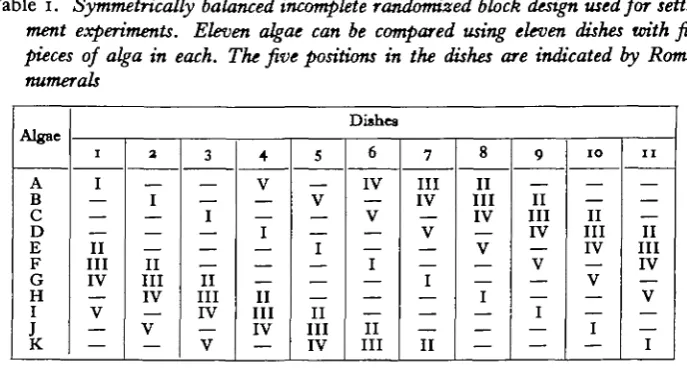
The particular design chosen as most suitable for such experiments with marine larvae is shown in Table 1. The following notation has been employed:
A, B, C, ..., K = treatments (i.e. species of alga being offered for larval settle-ment).
t = number of treatments (i.e. total number of algal species offered).
b [ = trjk = N/k] = number of blocks of treatments (i.e. total number of dishes
used in the experiment).
k = number of treatments per block (i.e. pieces of alga in each dish).
r = number of replications of each treatment (i.e. number of times each algal
species is offered with others in the experiment).
N [ = tr] = total number of observations (i.e. total number of pieces of alga of
all species used in the experiment).
A [= r(k— i)l(t — 1)] = number of blocks (dishes) in which any two given treat-ments (algae) occur together.
[image:3.451.52.396.299.485.2]I, II,..., V = positions in the block. These positions were allocated in relation to the orientation of the dish to the laboratory bench.
Table 1. Symmetrically balanced incomplete randomized block design used for
settle-ment experisettle-ments. Eleven algae can be compared using eleven dishes with five pieces of alga in each. The five positions in the dishes are indicated by Roman
numerals
Algae
A B C D E F G H I
K
Dishes
1
I
II III IV
V
3
I
II III IV
V
3
I
II III
rv V
4
V
1
11 in IV
5
V
I
II III
rv
6
IV
V
I
II
HI 7
III IV
V
I
II 8
II III
IV
V
I
9
II III
rv
V
1
1 0
11 in
rv V
1
1 1
11 in
rv V
1
The design shown in Table 1 is more than just an incomplete randomized block design: it is a Youden Square (Davies, 1954). A Youden Square has the following important characteristics:
(i) The design is balanced in respect of treatments, any given pair occurring together the same number of times as any other pair. This is clearly important in choice experiments where all comparisons between any two algae are equally important. This balancing allows the calculation of treatment effects corrected for any differences between blocks.
(ii) The design is balanced with respect to blocks as well as treatments. It is then said to be symmetrical and the necessary condition is that b = t, and
sequently k = r. Only if the design is symmetrical is it possible to calculate block effects corrected for differences between treatments.
(iii) Any symmetrically balanced incomplete block design will become a Youden Square provided that each treatment occurs once, and once only, in each position. This is particularly important since treatment and block effects are then indepen-dent of any position effects.
The use of an experimental design which is a Youden Square therefore brings a number of advantages, notably that the effects due to treatments, blocks and positions can be evaluated separately. In settlement experiments it is especially important that the effects due to the algae are not influenced by variations due to position, such as might be caused through uneven illumination. The number of designs fulfilling these conditions is very limited, but suitable ones exist for testing seven or eleven treatments simultaneously. In the design chosen eleven algae could be tested in eleven blocks (glass dishes), with five positions in each dish. Further particulars of incomplete randomized block designs are given by Davies
(1954)-General experimental technique
Weed bearing breeding polyzoan colonies was collected at low tide, or else by grappling from a dinghy. Celleporella and Flustrellidra are summer breeders, while the Alcyonidium spp. breed in the autumn. The collected material was kept in large tanks, and was found not to deteriorate over a period of several days; but the larvae were never used after the adult colonies had been in aquaria for more than 3 days. The tanks were kept in the dark, with good aeration and a generous flow of sea water. In the mornings the dark covers were removed and the water circu-lation stopped. Within a couple of hours hundreds of larvae had been liberated in response to light, and these were gently pipetted out into experimental dishes.
The algae used in the choice experiments were collected from rather exposed shores. In this way clean material could be obtained which was not already colonized by polyzoans. Although settled larvae of Celleporella and A. fursutum did not appear to have any influence on further settlement, it seemed advisable, because of gre-garious tendencies in some other settling larvae, to use perfectly clean weed. Freshly collected non-fruiting fronds only were used in the experiments.
Each experiment was set up as follows: eleven glass finger-bowls, 12 cm. in diameter, were scrupulously cleaned and rinsed, and placed on the wet bench of a basement aquarium. In this room the temperature during the summer remains in the range of i4-5-iy5° C , and is virtually constant throughout the day. Light was provided mainly by a fluorescent strip directly over the dishes.
It is important that variables under the experimenter's control should be randomized. Consequently, using tables of random numbers, the dishes were numbered, the positions decided, and the algae to be tested were allocated letters. Pieces of thallus were cut from the algae, each being of comparable area to the tip of a Fucus serratus frond about 2 cm. long. In the case of branching species like
Chondrus and Furcellaria this could not be very accurately judged, but the effect of
Selection of algal substrates by polyzoan larvae 617
with a small number of larvae per dish and ample settlement space on all the pieces of weed offered, it is highly unlikely that even considerable inequalities in size would add significantly to the inevitable random variation due to small numbers settling. The pieces of alga were cut the evening before the experiment and the amount of cut edge was kept to a minimum; they were then thoroughly washed the following morning. These precautions were taken to reduce exudation of mucus in which the larvae might be trapped.
The pieces of alga were placed in the finger bowls of sea water, according to the pattern indicated by Table 1, and roughly positioned. Twenty-five larvae were gently placed in each dish using a moderately wide-mouthed pipette, and the algae finally positioned with a glass rod. After preparing all the dishes the experiment was left undisturbed for 24 hr.; then the settlement on each piece of alga was recorded. An example of the method of analysis of the results is givenJ>elow.
Analysis of results
In one experiment using twenty-five larvae of A. Jursutum per dish, the algae were randomly designated the following letters:
A B C D E
Fucus spiralis Fitrcellaria fastigiata Pelvetia canaticulata Polyides caprmus Fucus vesiculosus
F G H I
J
Chondrus crispus Ulva lactuca Lanrinaria digitata Fucus serratus Gigartina stellata
K Ascopkylhtm nodosum
Text-fig. 1. Layout of algal choice experiment in accordance with a Youden Square design (see text).
The dishes were arranged on the bench and randomly numbered. The algae were then placed in them in accordance with Text-fig. 1, Table 1 and the letters desig-nated above. The results are recorded in Table 2, which shows the manner in which all the data were entered.
Table 2. Settlement recorded on eleven algal substrates in a choice experiment in
which twenty-five Alcyonidium hirsutum larvae were added to each dish
Dishes I 2 3 4 5 6 7 8 9 I O I I Position total* (L) Positions I F. spiralis 4 Furcellaria o Pelvetia 3 Polyides o F. vesiculosus o Chondrus 5 Ulva o L. digitata o F. serratus 1 4 Gigartina 4 AscophyUum 0 3 0 II F. vesiculosus 6 Chondrus 0 Ulva 0 L. digitata 0 F. serratus 2 0 Gigartina 7 AscophyUum 0 F . spiralis
9 FurceUaria 0 Pelvetia 4 Polyides 0 46 III Chondrus 1 C/toa 0 L. digitata 0 F. serratus 7 Gigartina 4 AscophyUum 2 F. spiralis 13 Furcellaria 0 Pelvetia 8 Polyides 0 F. vesiculosus 9 44 IV Ulva 0 L. digitata 0 F. serratus 13 Gigartina 5 AscophyUum 0 F. spiralis 8 Furcellaria 1 Pelvetia 2 Polyides 0 F . vesiculosus
0 Chondrus 1 3 0 V F. serratus 6 Gigartina 6 AscophyUum 0 F. spiralis 7 FurceUaria 0 Pelvetia 0 Polyides 0 F . vesiculosus
0 Chondrus 3 0 L. digitata 0 2 2 Dish totals 17 6 16 19 »4 22 14 I I 25 8 1 0 17a
The settlement figures were later re-tabulated in the form shown in Table 3, and the corrected values for the means calculated. The numerical values were as follows:
* (the number of algae being tested) = 11,
k (the number of algae per dish) = 5, r (the number of replicates) (= k) = 5, N (the total number of observations) = 55, b (the number of dishes) ( = t) = 11.
Also:
G = the total number of larvae settled,
TA, TB, ..., TK = number of larvae settled on the algae A, B, ..., K,
Bly Bt, ..., Bn = number of larvae settled in the dishes 1, 2, ..., 11,
Lj, LJX, ..., Ly = number of larvae settled in the positions I, II, ..., V. As any one of the algae, A, B, ..., K, is present in only r of the b dishes, the settlement totals, TA, TB, etc., are influenced by random differences in the dishes
and are not entirely indicative of true differences in favourability of the algae to the larvae under consideration. But analysis can separate block (dish) and treat-ment (algal) effects. Since the design is balanced and symmetrical it is possible to estimate the treatment effects free from block effects, and vice versa (Davies, 1954): (i) For each alga calculate the value of QA, QB, etc., where QA = ATA-(sum
Tabl e 3 . The results shovm in Table 2 for the settlement of Alcyonidiu m hirsutu m larvae on eleven algal substrates re-tabulated for analysis (see text) Alga e A (F. spiralis) B (FurceUaria) C (Pelvetia) D (Polyides) E (F. vaiadosus) F (Chondrus) G (Ulva) H (L . digitata) I (F. serratus) J
(Gigartina) K (AscopkyUum) Total
s (B ) 0 ' Correcte d bloc k mean s
1 4 — — 6 1 0 — 6 — — 17
-4 1 -i-8 6 1-2 9
a 0 — — — 0 0 0 — 6 — 6
-7 -0-3 2 2-8 3
3 — — 3 — — — 0 0 13 — 0 16 1 0-0
4
31
9
4 7 — — 0 — — — 0 7 5 — 19
-3 2 -1-4 5 1-7 0
5 0 — — 0 — — —
2
0 4 0 24
1 6 o-7 3 3-8 8 Dishe s
6 8 — 0 — — S — — — 7 a aa 14 0-6
4
37
9
7 13 1 — 0 — — 0 — — — 0 14
2 6 I-I 8 4 -3 3
8 9 0 a — 0 — — 0 — — —
1 1 -1 9 -08 6 a-2 9
9 0 8 0 — 3 — — 14 —
as 37 i-6
8
4-8
3
1
0
— 4 0 0 — 0 — — 4 8
-1 8 -o-8 a a-3 3 1 1
— — 0 9 1 — 0 — — 0 10 33 1
0 4 4-1 9 Total s
(T) 4i 1 17 0 IS 10 0 0 60 26 2 G 172 0 0 —
Q ia a -7 5 3 -7 6 5 -3 o -6 1 -6 2 19 9 5 i -7 6 0 GIN 3'i 5 — — P 5-5 4 -3-4 i 0-1 4 -3-4 6 0-2 3 -13 6 -27 7 -a-8 a 90 s a-3 a -3-4 6
0 — — —
(ii) Obtain the value of PA, PB, etc. by dividing the appropriate Q value by N(k—i)l(t- i). The sums of both the Q'& and P's should be zero. The corrected
treatment means—estimates of the settlement that would have taken place if all the algae were present in every dish—are obtained by adding PA, PB, ..., PK in
turn to the grand mean G/N.
The block effects can be similarly calculated:
(iii) Q'x = rBx — (sum of the totals of all the treatments occurring in dish i):
and so on.
(iv) Obtain the value of Pi by dividing Q[ by N(r— i)l(b — i): and so on. Since in this design r = k and b = t the divisors for obtaining P's (ii) and P"s (iv) are identical.
In comparing the favourability of the different algae it is the corrected treatment means that are used (Text-figs. 2-5), but the P's and P"s are required for the analysis of variance. These values are shown in Table 3.
The analysis of variance is based on the assumption that the number of larvae settled on any given piece of alga can be represented by
where Yifk, the number settling on the alga i in position k in dish j , will be a
constant M, plus a factor Ti depending on the quality of the alga, plus a dish factor
Bj, plus a position factor Lk, plus a random (error) term ei]k (Davies, 1959). The
main purpose of the analysis of variance is to obtain an estimate of the error eiik.
Using this estimate the magnitude and significance of each Ti, each Bt and each
Lk can be assessed. The analysis of variance table provides a convenient way of
assessing whether the Bfa or Lk's as a whole add significantly to the variation. The
analysis of variance—summarized in Table 4—using the data from Tables 2 and 3 is conducted as follows (Davies, 1954):
(v) Find the correction due to the mean = G*jN = 172^55 = 537-9. This will be used in later calculations.
(vi) Calculate the total sum of squares of all N observations about the grand mean, i.e. 2** — GijN = 1622 — 537-9 = 1084-1.
(vii) Calculate the sum of squares due to the corrected treatment totals, i.e. 2£)A
a
, QB a
, etc. divided by Nk(k-i)j(t- 1) = 82762/110 = 752-4.
(viii) Calculate the sum of squares due to the actual block totals. This is the sum of squares of BX,B2, etc. divided by k, minus the correction due to the mean,
i.e. XB*lk-G*IN = 3108/5-537-9 = 837.
(ix) Calculate the sum of squares due to the corrected block totals, i.e. Ejji2, QL1,
etc. divided by Nr(r-i)l(b-i) = 6466/110 = 58-8. (Since r = k and b = t, the divisors in (vii) and (ix) are identical.)
(x) Calculate the sum of squares due to the actual treatment totals. This is the sum of squares of TA, TB, etc. divided by r, minus the correction due to the mean,
i.e. XT*lr-G*IN = 6576/5-537-9 = 777-3.
Selection of algal substrates by polyzoan larvae 621
squares of the position totals Lj, ..., Ly divided by b, minus the correction due to the mean, i.e. UL'/b — C/N = 6336/11 —537*9 =
37'9-Table 4. Analysis of variance on the data given in Source of variation
Tests for treatments (algae):
(vii) between algae, adjusting for blocks (dishes)
(viii) between dishes, ignoring treatments (algae)
Tests for blocks (dishes): (ix) between dishes,
adjusting for treat-ments (algae) (x) between algae,
ig-noring blocks (dishes)
(xi) between positions
Remainder =• interaction between treatments, blocks and positions = error variance, t* Total
Sum of squares
(t-0 ™,
NMk—i)
(SB1/* — G*IN) Total
Nr(r— 1)
Total
(2L«/6-G»/JV)
752-4
83-7
8361
588
777-3
8361 3 7 9 Total -[(vii)*- (viii) + (xi)] 210-1
or
Total-[(ix) + (x) + (xi)]
1084-1
Tables 2 and 3(also see text)
Degrees of freedom
t - i 6 - 1
6 - 1
t— 1
k-i
N-t-b-k + t
N-i
1 0
1 0
2 0
1 0
1 0 2 0
4
3 0
54
Mean square
75-24
(Discard)
588
(Discard)
9-475
7 0 0
These data may then be presented as in Table 4. Totals (vii) + (viii) = (ix) + (x), and this common figure + (xi) subtracted from the total sum of squares (vi) gives the remainder or error variance. The mean squares are then found by dividing the sums of squares by the appropriate number of degrees of freedom. However, the mean squares of (viii) and (x), as shown in Table 4, are discarded since these have been derived on the assumption that there are no treatment differences in (viii) or block differences in (x). The sums of squares were required to arrive at the error variance, but the mean squares themselves would have no value.
An indication of significance is obtained by comparing the ratio of the treatment (or block, or position) mean square to the error mean square with the appropriate F-value. Thus the ratios of the mean squares are:
(a) Treatment: 10-75. T he F-value for 10 and 30 degrees of freedom is 2-16 at the 5 % level. The treatment value of 10-75 i8 dearly highly significant.
(Jb) Block: 0-84. Obviously the block effects are not significant.
(c) Position: 1-35. The F-value for 4 and 30 degrees of freedom is 2-69 at the 5 % level. The position value of 1-35 is not significant.
where s1 is the error mean square. Using the above figures
, o
V3-i8 = 178.
220
The difference required for significance between treatment means is 1-78 X2-O4 = 3-63,
where 2-04 is the 5 % value of t for 30 degrees of freedom. It can be seen that some of the differences between the corrected treatment means (Table 3) are highly significant.
RESULTS AND DISCUSSION OF CHOICE EXPERIMENTS
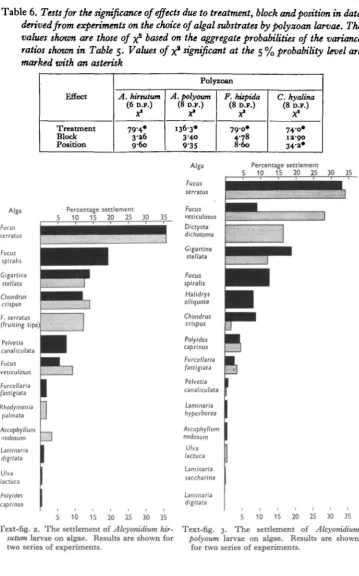
Four species of Polyzoa have been tested by offering larvae a choice between dif-ferent species of alga. In each case two series of experiments have been conducted using a slightly different range of algae in each series. In this way the larvae of each polyzoan have been offered a choice of fourteen or fifteen different algae on which to settle. The results—the corrected algal means—converted to percentage figures to allow comparison between experiments are given in Table 5. The figures for series II of Alcyomdium Mrsutum were not obtained by the method previously described, but are based on a number of separate comparisons between Fucus
serratus and any one other species. These results are also expressed as percentages
and may thus be compared with those of series I.
The variance ratios for treatment, block and position effects are also shown in Table 5, those values significant at the 5 % probability level being marked with an asterisk. When, as in this case, a number of independent tests of significance have been made, it is possible to obtain a single test of the significance of the aggregate. The method (Fisher, 1950, p. 99) is based on the product of the probabilities of the individual values. By taking the natural logarithm of the probability, doubling it and changing the sign, the equivalent value of x2 f°r 2 degrees of freedom is obtained. Any number m of such values of x2 may be added together and tested for significance on the basis of zm degrees of freedom.
This method has been applied in Table 6 to the variance ratios shown in Table 5. From Table 5 it will be seen that the treatment effects are generally highly signifi-cant, but that one of the values for C. hyalina is not so. But the combined prob-abilities give a x8 value of 74-0 for 8 degrees of freedom. For this species, therefore, as in the others, the overall treatment effect is extremely significant (Table 6).
The low F and x2 values due to block effects show that the experiments have not been influenced by differences in the blocks themselves. Position effects, however, are more important. The x* values of the aggregates in A. Mrsutum, A. polyoum and F. hispida, while fairly high, are not in fact significant; that for C. hyalina on the other hand shows a high degree of significance. This means that another factor— presumably light—has affected the settlement behaviour of these larvae. It is certainly true that larvae of this species swim more actively than those of the
Tabl e 5 . Results of settlement experiments in which polyzoan larvae were offered a choice of algal substrates. The figures shown are the corrected means (see text) expressed as percentages. The variance ratios that are significant at the 5 % probability level are marked with an asterisk Ai m A UQ U Atcopkyllum nodotum Chondnu critpw Dictyota dichotoma Fucus terratut (fruitin g tips ) F. serratus (non-fruitin g tips ) F. spiralit F. vaiculosui Furcellaria jastigiata Gigartina sttllata HaHdrys tiliouota Larrdnaria dtgitata L. hyperborca L. taccharina Pelvetia canaliculata Polyides eaprinus Rhodymema palmata Ulva lactuca Amoun t b y whic h mean s mus t diffe r t o b e significan t a t 5 % probabilit y leve l Varianc e ratios : treatmen t : remainde r (5 % F-valu e = 3-16 ) DIOC K . rcmainue r (5 % F-valu e 3-16 ) positio n : remainde r (5 % lvalu e 3-69 ) No . o f larva e use d i n experimen t Actua l no . o f larva e whic h settle d Alcyomdium fartutum I A -O-2 22-0 36-3 I2' O 3' 0 6-2 8-i — 3-0
— —
9-3 -o-i — -0-3 14 6 4-91 * 0-4 3 0-5 3 37 5 19 3 I B -o-6 9-3 — 37-5 31-8 3 9 o-i 19-0 — -0-7 — 3-9 3-3 1-3 IO' 3 I2'O * I-2 O 4-83 * 27 5 19 5 I c -c-9 4 9
— 33-6 23-9 9-3
-0-7 15 0 0 9
— 9-1
-0-9 I-I 9-9 10-75 * 0-8 4 !'3 5 27 5 17 2
II 33 14-0 — I2'2
35-8
— 9-2 —
13-2
— — — — — —
i-8 — — — — 176 1 120 7 Alcyomdium polyoum I
A o-3 8-4
35-8
n
3 7 i8-8 IO-O — o-i — o-o 3 6— 8-2 13-38
* 05 9 10 4 27 5 18 9 IB I-S 9-3 — 3O-4 15* 3 9-3 i-8 19 0 6-i — i* 4
— 0-9 4-9 —
IO-2 6-85 * o-6 8 1-1 3 27 5 17 5 II A
— 0-3 25-1 39-6 —
»3-5 3-2 12-1 — -0-3 o-i I-I 4 9 o-i 9 9 II-2O * 0-4 5 I-2 I 27 5 17 9 II B — 3-4 7-7 38-7 — 32-3 4-1 n-8 — -0-3 o-5
0 4'4
-1-6 8-3 23-0 * 1-2 2 I-I O 27 5 20 8 FlustrelUdra hiipida I
A 07 2-4 —
44-5 21-4 10 7 1-2 8-3 0-4 — — -0-5 2-4 8-5 — 15-5 6-31 * 05 3 03 8 27 5 8 1 IB 4-0 2-7
— 305
25-2 i8-8 1-4 11-9 — 5 4
— —
I-I 0-9 - 1-9 — 12-5 6-51 * 1-2 7 0-7 1 27 5 10 3 II A
— 8-3
2O-6 24 0 — 13-8 2-5 12-8 -0-3 4-6 2-8 9 9 I'S I3' 3 352 * 0-5 8 0-4 2 22
0 87
II B — 19-6 19-7 — 30 8 1-4 17-1 — O-2 — 0-3 o-8 13-6 - i-8 10-9 8-91 * 1 0 3 3-oo * n
o 7i
I
A 3-o
39-2 — 16-0 io-o -0-3 - 1-2 13-5 — i-o 5 7 17 7 8-o
— 8-o 11-58
* 18 2 5-00 * 55 0 37 4 CelUporella hyalina
IB I-O
30-3 3' 8 1 7 o-8 4-5 13-3 5-4 26 2 2I-O 3' 4 10 4 6-so * 0-3 6 2-69 * 27 5 21 1 II A — 34-4 3 9 31' 3 I4-I 7-0 II" 3 — I' D 3-4 9-3 3-1 6-3 13-0 4-08 * o-3 5 4-08 * 37 5 24 3 II B • — 11 7 7' 9 IO-I 8-2 15 0 — 13 7 -i-8 4 1 7-1 6-3
— 8-9 12-2 I-8
influenced by light. This result also serves to stress that comparisons of treatments must be carried out in such a way as to be independent of possible positional effects. The broad trend of the results can best be seen in Text-figs. 2-5, which show the average settlement values for each of the two series for the polyzoans investigated. These histograms show two general patterns. In Flustrellidra and the species of
Alcyonidium there is a sharp falling away from one very favourable species, but in Celleporella several species are moderately favourable and the falling off is much
more gradual.
In Alcyonidium Mrsutum, A. polyoum and Flustrellidra Mspida, the three truly littoral species investigated, settlement was highest on Fucus serratus—about 35 % (Text-figs. 2-4). All three polyzoans are, in fact, normally found on F. serratus. Text-fig. 2 shows that A. kirsutum larvae greatly preferred non-fruiting tips to fertile ones, and this is no doubt true for the other species. Probably this is due to the exudation of mucus from the conceptacles.
For A. Mrsutum three other algae were moderately favourable for settlement:
F..spiralis, Gigartina stellata and Chondrus crispus. Dictyota was not tested. There is
little doubt that F. spiraUs occurs too high on the shore for the survival of A.
kir-sutum : possibly desiccation would be too great, or the time available for feeding too
short. On sheltered shores, such as those in the Menai Straits, where Chondrus and Gigartina are scarce, A. Mrsutum is found almost exclusively on F. serratus; but on more exposed coasts where red algae are numerous small colonies are found abundantly on Gigartina and Chondrus as well as on F. serratus.
The position is similar with regard to A. polyoum (Text-fig. 3). In series II
F. vesiculosus proved very favourable for settlement, but was much less so in series I.
Although F. vesiculosus occurs lower than F. spiralis, its greatest abundance being in the middle of the intertidal zone, this level may still be too high for successful colonization by the larvae. Gigartina also was fairly favourable for settlement, a fact which accords well with observations on more exposed shores. Gross & Knight-Jones (1957) found that Dictyota was favourable for settlement by Spirorbis boreaUs larvae, and the same holds true for the polyzoan larvae investigated. But Dictyota is never sufficiently abundant to provide an important substrate for polyzoan zoaria; it is primarily an infra-littoral form, although sometimes occurring in pools on the shore. Also, the fronds are very shortlived.
Larvae of Flustrellidra Mspida show similar preferences to those of A. polyoum (Text-fig. 4). Similar reasons may be offered for its absence under natural condi-tions from the apparently favourable algae F. spiralis, F. vesiculosus and Dictyota. As with the species of Alcyonidium, on sheltered shores Flustrellidra is virtually confined to F. serratus, but where exposure is greater and Gigartina is present zoaria may be found on both species.
Selection of algal substrates by polyzoan larvae
625
Table 6. Tests for the significance of effects due to treatment, block and position in data
derived from experiments on the choice of algal substrates by polyzoan larvae. The values shown are those of x2 based on the aggregate probabilities of the variance ratios shown in Table 5. Values of x* significant at the 5 % probability level are marked with an asterisk
Effect
Treatment Block Position
Polyzoan A. hirrutum
(6 D.F.) X1 79-4*
3 , 6 9-60
A. polyoum (8 D.F.)
X* 136-3* 3-4O 935
F. hispida (8 D.F.)
X1 7 9 0 *
4-78 8-6o
C. kyalina (8 D.F.)
X1 74-o* 13-90 34-a*
Alga Fucus serraius Fucus
spiralis
Gigartina steflata
Chondrus crispus
Polyides caprtnus
Percentage settlement
5 10 15 20 25 30 35
Alga
Fucus serraius
Fucus
vesiculosus Dictyota dichotomy
G/gart/na
stellati
Fucus spiralis
Halidrys siliquosa
Chondrus crispus
5 10 15 20 25 30 35 Text-fig. 2. The settlement of Alcyonidium
hir-sutum larvae on algae. Results are shown for two series of experiments.
Percentage settlement
5 10 15 20 25 30 35
Ulva lactuca
Laminaria saccharlna
Lamfnan'a
digitata
Text-fig. 3. The settlement of Alcyonidium polyoum larvae on algae. Results are shown
determining the distribution of the polyzoans on the shore, although the moderate favourability of F. vesiculosus and F. spiraUs indicates that other factors must also operate.
Alga Percentage settlement 10 15 20 25 30 35
Fucus serratus
fucus spiraUs
10 15 20 25 30 35 Text-fig. 4. T h e settlement of Flustrdlidra hispida
larvae on algae. Results are shown for two series of experiments.
Alga
Chondrus crispus
Fucus serratus
Gigartina ste/lata
Laminaria
saccharin*
Pelvetia canalicutata
Fucus spiralis
Ulva lactuca
Dictyota dichotoma
Rhodymenia palmata
Fucus vesiculosus
Laminaria digitals
Ascophyltum nodosum
Furcellaria fastigiau
Halidrys siliquosa
Percentage settlement 5 10 15 20 25 30
10 15 20 25 30 Text-fig. 5. The settlement of CtlleporcUa
hyalina larvae on algae. Results are shown for two series of experiments. In the case of Celleporella hyalina the position is less clear (Text-fig. 5). The results do not show such clearly defined preferences as was the case with the other species. Settlement on the most favourable species was only about 20%, and several other algae were nearly as suitable. On rocky shores with moderate exposure
CelleporeUa is found in small amounts on a number of algae, and most zoaria are
found on the rhizoids of Laminaria digitata and L. hyperborea: it is not especially characteristic of Chondrus crispus. Possibly this preference is explicable in terms of shelter from wave exposure rather than in those of a most suitable surface.
Selection of algal substrates by polyzoan larvae 627
extensive encrustations over the thallus. While the choice experiments did not show that Celleporella selected L. saccharina in preference to others, it was, nevertheless, a favourable species. This forms a significant contrast with FlustrelUdra and the
Alcyortidium spp. In the Menai Straits the locally abundant L. saccharina is found
with Halidrys at just below low-water mark of ordinary spring tides. No larvae settled on Halidrys. Inasmuch as under these conditions the Celleporella is found on the Lammaria, the experiments again indicate that the larvae are making a definite choice. On more exposed shores, where many more species of alga are present, it seems that the distribution of Celleporella cannot be explained by this mechanism.
FACTORS INFLUENCING CHOICE OF ALGAL SUBSTRATE
Some experiments have been carried out to investigate certain of the factors thought to influence settlement on algal substrates.
Surface contour
Pelvetia and Gigartina, two of the algae used in the choice experiments, have
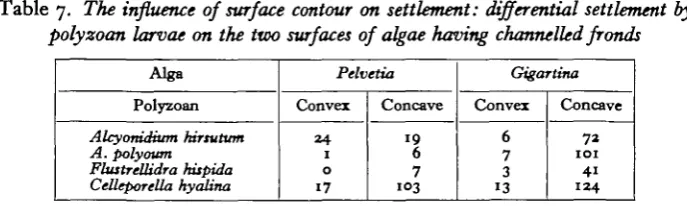
fronds that are channelled. Settlement on the two surfaces of these species was recorded separately (Table 7). With the sole exception of the settlement of
A. fursutum on Pelvetia, the difference between the numbers of larvae settling on
[image:15.451.53.397.354.457.2]the two surfaces was very striking. The concave surface is obviously greatly preferred.
Table 7. The influence of surf ace contour on settlement: differential settlement by
polyzoan larvae on the two surfaces of algae having channelled fronds Alga
Polyzoan
Alcyonidium hirsutum A. poly own
FlmtreUidra kiipida Celleporella kyalina
Pelvetia
Convex
24 1 0
17
Concave
19 6 7 103
Gigartina
Convex
6 7 3
13
Concave
72 IOI
4i 124
lower (80) surfaces of the frond was roughly equal. Clearly gravity cannot be the causal factor in the selection of concavities by the larvae: the behaviour would seem to be a direct response to the shape of the surface.
Table 8. The influence of surface contour on settlement: selection by Celleporella hyalina larvae of concavities of Laminaria saccharina frond
Part of frond Centre area
(concavities) Flat wing area Centre area
(convexities)
Area (cm.1)
35 108 35
No. set
87 60 7
Density (no. per cm.1)
a-49 0-56
0'2O
A L
WOft cm, I i } 4 5
IE
JE j o
IE
• I E
Jo
3!
3!
C L
Text-fig. 6. Surface contour and larval settlement. (.4) Larva of CeUeporella hyalina. (B) Longi-tudinal profiles of the crinkled area of the two pieces of Laminaria saccharina used in the experiments on which Table 8 is based. (C) Enlarged sections through two concavities of the L. saccharina frond shown in (B), with CeUeporella larvae indicated to scale.
Selection of algal substrates by polyzoan larvae
629
summarized in Table 8. The size of the larva is indicated relative to that of the concavities in Fig. 6C: it seems remarkable that in perfectly still water the larva can detect the relatively slight curvature of the surface.
While the mechanism of site selection is not clear, definite advantages would seem to be obtained by settlement in concavities or in the channelled surface of a frond. The newly settled larva would receive protection from rubbing against rocks and other algae and from abrasion by sand. The latter factor may be important in the case of Celleporella, for L. saccharina may be found attached to stones on an otherwise sandy shore. Similar behaviour has been recorded during the settlement of other invertebrate larvae, such as barnacle cyprids (Crisp & Barnes, 1954) where it was also shown to be a direct tactile response to the shape of the surface.
It was previously suggested (Ryland, 1959) that in choice experiments settlement on L. saccharina would be higher if crinkled rather than flat pieces of frond were used. Later experiments have not supported this view: they suggest rather that contour is of subsidiary importance to surface texture. It seems probable that not all pieces of thallus of any given alga are equally favourable for settlement, and that certain discrepancies between experiments on the choice of algae are to be explained in this way. Providing that the texture is suitable, the larva will explore to find a groove or depression for permanent attachment.
Age of the frond
[image:17.451.73.375.426.524.2]Larvae of A. polyoum and FlustrelUdra were offered pieces of F. serratus thallus of equal area cut from four different regions. These were frond tips, the region just below the tips ('sub-tips'), and pieces from the centre and the base of the frond, the latter being largely composed of stipe. The pieces of thallus were regularly spaced out in glass finger-bowls, and the dishes arranged in a regular block. Twenty-five larvae were added to each dish and the settlement noted after 24 hr. (Table 9).
Table 9. The influence of frond age on the settlement of polyzoan larvae on Fucus serratus
Polyioan
Alcyonidium polyoum FlustrelUdra kxipida
Region of F. serratus frond (pieces of equivalent area)
Tip 177
52
Sub-tip
133 45
Centre 88 64
Base 38 26
used, except with the species of Laminaria which have an intercalary growing zone at the base of the thallus; in this case pieces were again cut from the youngest part.
Mucus
Mucus probably plays an important part in determining settlement preferences. Cut surfaces of thick, older Laminaria fronds exude large quantities of mucus, but the exudation is much less from young, thin fronds. This was another reason for using the latter in the choice experiments. It seemed important, however, to make sure that settlement, particularly that of Celleporella larvae on L. saccharina, was not being adversely influenced by the presence of cut edges. Two pieces of thallus, each about 10 cm. long, were cut from young L. saccharina fronds. Transverse cuts reaching to the middle were made at intervals of 1 cm. along one side. After thorough washing the two pieces were placed in glass finger-bowls and Celleporella larvae were added. In the two experiments the number of larvae that settled was 55 and 145 on the uncut halves and 69 and 49 on the cut halves. Thus on the second piece settle-ment appeared to be reduced by the cuts, but not on the first. The effect could be due to the interruption of the exploratory behaviour of the larvae by the cuts as well as to the exudation of mucus; the figures indicate that in the choice experiments there may possibly have been a slight adverse effect on settlement on pieces of Laminaria. It has been suggested that in the brackish waters of the Baltic the heavy settlement of epiphytic animals—polyzoans, serpulids and tunicates—on the
Laminaria fronds is partly due to a reduced mucus content in the thalli (Bock, 1954).
The preference of Alcyonidium Ursutum larvae for non-fruiting rather than fertile frond tips of F. serratus was mentioned earlier. As tufts of paraphyses may be present on non-fruiting fronds, where they do not depress settlement, as well as on fruiting tips, it seems most likely that it is the mucus produced by the conceptacles which accounts for the reduced favourability of fruiting tips.
SUMMARY
1. Many species of Polyzoa show marked specificity with regard to the substrate on which they occur. Epiphytic forms are often found mainly on one species of alga. 2. Experiments were performed in which a number of algal species were offered to polyzoan larvae as substrates for settlement. The disposition of algae, and the dishes containing them, was such that the layout conformed to a Youden Square design. This not only achieved economy of materials, but ensured a balanced experiment, made possible a statistical analysis of the results, and eliminated any possible effects of extraneous environmental factors.
3. The larvae showed marked substrate preferences when settling. In the littoral forms Alcyonidium hirsutum, A. polyoum and Flustrellidra hispida, the selection of algae accorded closely with their observed natural distributions: in each case highest settlement took place on Fucus serratus. It seems probable that positive selection plays an important role in determining the distribution of these species on the shore.
Celleporella hyalina larvae were also selective, but the preferences were less clearly
PLATE 12
RYLAND—EXPERIMENTS ON THE SELECTION OF ALGAL SUBSTRATES BY POLYZOAN LARVAE
Selection of algal substrates by polyzoan larvae 631
4. Surface texture appears more important than contour as a factor influencing the choice made by larvae between algal substrates, although the physical and/or chemical factors responsible for the observed differences in attractiveness of algae are largely unknown. However, it is evident that the nature of the surface alters with age, and that this influences favourability. The presence of mucus has an adverse effect on settlement. Once the actual substrate has been chosen, the larvae respond to surface contour and, if possible, select a groove or concavity as a site for fixation. I should like warmly to thank Dr O. L. Davies of Imperial Chemical Industries Ltd for valuable communications relating to the method of analysis of variance employed in this paper; Dr D. J. Crisp for his interest in this work and particularly for advice on statistical procedure and for reading and criticizing the manuscript; and Mr A. P. Austin for information on algal ecology. I am indebted to the Development Commission for a research grant.
REFERENCES
BARROIS, J. (1877). Mimoire sur Vembryologit des Bryozoaires. Lille.
BOCK, K. J. (1950). Ober die Bryozoen und Kamptozoen der Kieler Bucht. Kieler Meeresforsch. 7, 161-6.
BOCK, K. J. (1954). Einige Zahlen zur Bewuchsdichte von Epizoen auf Laminarien aus der ostlichen Kieler Bucht. VerSff. Inst. Meeresf. Bremerhaven, 3, 42-5.
CALVET, L. (1900). Contributions a l'histoire naturelle des Bryozoaires ectoproctes marins. Trav. Inst. Zool. Univ. Montpellier (1), 8, 1-488.
CRISP, D. J. & BARNES, H. (1954). The orientation and distribution of barnacles at settlement with particular reference to surface contour. J. Amm. Ecol. 33, 142-62.
DAVIES, O. L. (1954). Design and Analysis of Industrial Experiments. London and Edinburgh. Oliver and Boyd.
DAVIES, O. L. (1959). Personal communication.
FISHER, R A. (1950). Statistical Methods for Research Workers, ed. 11. London and Edinburgh. Oliver and Boyd.
GROSS, J. & KNIGHT-JONES, E. W. (1957). The settlement of Sptrorbis borealis on algae. Challenger Society Annual Report (3), 9, 18.
HINCKS, T. (1880). A History of the British Marine Polyzoa. London. Van Voorst.
JOLIET, L. (1877). Contributions a l'histoire naturelle des Bryozoaires des cdtes de France. Arch. Zool. exp. gen. 6, 193-304.
PARKE, M. (19s 3). A preliminary check-list of British marine algae. J. Mar. Biol. Ass. U.K. 3a, 497-520.
PRENANT, M. (1927). Notes e^hologiques sur la faune marine sessile des environs de Roscoff, II. Trav. Sta. biol. Roscoff, 6, 5-58.
PRENANT, M. (1932). fitudes de bionomie intercotidiale. La baie et la pointe de Quiberon. Trav. Sta. biol. Roscoff, 10, 37-103.
PRENANT, M. & TEISSIER, G. (1924). Notes e'thologiques sur la faune marine sessile des environs de Roscoff. Trav. Sta. bioL Roscoff, a, 3-49.
ROGICK, M. D. & CROASDALE, H. (1949). Studies on marine Bryozoa, III. Woods Hole region Bryozoa associated with algae. Biol. Bull., Woods Hole, 96, 32—69.
RYLAND, J. S. (1959). The settlement of Polyzoa larvae on algae. Proc. 15th Int. Congr. Zool. 236-9. STEPHENSON, T. A. & STEPHHNSON, A. (1949). The universal features of zonation between tidemarks
on rocky shores. J. Ecol. 37, 289-305.
EXPLANATION OF PLATE
The influence of surface contour on the settlement of the polyzoan CeUeporella hyalma on the frond of Laminaria saccharina. One-half natural size. (A) Frond of L. saccharina showing the mainly flat margins and the strongly crinkled central area—a depression on one side will correspond to a convexity on the other. (B) Young colonies of CeUeporella grouped in the concavities of a frond of L. saccharina.