A Study on Comparison of Plastic Bitumen and
Crumb Rubber Bitumen
Abdul Manan1, Sandeep Singla2, Manish Kaushal3
1
Civil Engineering Department, RIMT university, Mandi Gobindgarh, Punjab
Abstract: Plastic and Rubber is user friendly as they are non-biodegradable. Generally these are disposed by way of filling or burning of material which are hazardous. The better binding property of plastics in its molten state has helped in finding out a method of safe disposal of waste plastics, by using them in road laying. Now-a-days it is been observed that due to raise in axel load and traffic intensity the efficiency of the bituminous binders is been reduced causing bleeding in hot conditions, cracks in cold climate, rutting and pot holes. This makes significance in conversion of bitumen binder to meet the increasing demand of axel loads and traffic strength. Waste plastic and Crumb rubber are becoming more and more important in the construction of flexible road surfaces. This not only allows us to collect modifier at low cost, but also provides a solution towards ecological menace posed by increased use of plastic. In this study, attempts have been made to use Disposal of a variety of Waste Plastic &Crumb Rubber wastes in an eco-friendly way. In this research both waste plastic and crumb rubber was mixed with the two different grades of Bitumen 60/70 and grade 80/100 to find out which of the material is having better property to improve the quality of binder bitumen when it is imposed in it. Several properties of bitumen mix were used to make comparison between Plastic Bitumen and Crumb Rubber Bitumen usually Penetration, Softening, Flash and Fire point, and Ductility Test was performed.
Keywords: Crumb Rubber, Waste Plastic, Penetration, Ductility, Softening, Bitumen.
I. INTRODUCTION
Plastic waste accounts for a large portion of the total amount of Municipal Solid Waste (MSW) produced in India. It is estimated that approximately 9 percentage of the MSW is produced per day. Their visibility is considered a serious problem and makes plastic a target for solid waste management. Plastic is not biodegradable. They also have a long service life, and burning plastic waste under uncontrolled conditions can also result in the production of many Harmful Air Pollutants (HAP) .However the scrap plastic can be recycled to the second life application, but after each heat treatment the degradation of the plastic occurs to some extent. Crumb Rubber derived from used vehicle tires has been used in various industrial applications. In the early 1960s, pavement engineers in the United States began experimenting with granular rubber as a modifier for asphalt cement in pavement applications. Crumb Rubber Modifiers (CRM) is incorporated into road paving materials using different methods. The wet process involves dispersing CRM particles into bituminous cement to produce a so- called bituminous rubber.
In order to solve the problem of plastic waste disposal, attempts have been made to describe the possibility of reusing plastic waste in road construction. However, the discovery of the binding property of plastic in its molten state which can be used in road laying has helped to well manage this waste plastic. The recycled products are more environmentally harmful than the first time manufactured ones because every time plastic is recycled it is subject to high intensity heat. This can make it to deteriorate and lead to environmental pollution. That is why, it is necessary to determine the effective way to deal with this non-biodegradable waste. The use of plastic waste in road construction can be one of the solutions. This type of construction gives benefit to environment because it uses plastics that would otherwise be disposed through environmentally harmful means. Based on this, the objective is to investigate the effect of using different percentages of plastic waste on the properties of bitumen.
II. LITERATURE REVIEW
Various researches have been conducted on properties of modified bitumen and a significant change in properties of bitumen was noted with the addition of Waste Plastic and Crumb rubber to the bitumen. The major studies carried out by different researchers are as follows:
Delhi). Road life improves through improved tackiness and viscosity of the bituminous mix, thereby binding the stones more firmly together and improving the water-resistance of the mix to rain etc.
Justo et al (2002), at the Centre for Transportation Engineering of Bangalore University on the possible use of the processed plastic bags as an additive in bituminous concrete mixes. The properties of the modified bitumen were compared with ordinary bitumen. It was observed that the penetration and ductility values of the modified bitumen decreased with the increase in proportion of the plastic additive.
Therefore the life of the pavement surfacing course using the modified bitumen is also expected to increase substantially in comparison to the use of ordinary bitumen.
Shankar et al (2009), Crumb Rubber Modified Bitumen (CRMB 55) was blended at specified temperatures. Marshall’s mix design was carried out by changing the modified bitumen content at constant optimum rubber content and subsequent tests have been performed to determine the different mix design characteristics and for conventional bitumen (60/70) also. This has resulted in much improved characteristics when compared with straight bitumen.
Ms.Apurva Chavan (2013) says that using plastic waste in mix will help reduction in need of bitumen by around 10%, increase the strength and performance of road, avoid use of anti-stripping agent, avoid disposal of plastic waste by incineration and land filling and ultimately develop a technology, which is ecofriendly.
III. MATERIALS AND METHODS
The main aim of this study is to obtain an eco-friendly Bitumen Mix (Waste Plastic -Crumb Rubber Modified Bitumen Mix). This section explains the methodology undertaken to compute the research work. The basic materials used are; Bitumen, Waste plastic and Crumb Rubber. The bitumen used was 60/70 grade and 80/100 grade and was obtained from a local contractor in Kashmir. The plastic used was waste plastic bottles, bags, wrappers etc. collected from local waste centers and from residential areas. Crumb Rubber Was buyed from tyre shops at Srinagar.
A. Preparation of Crumb Rubber and Bitumen
The Bitumen is heated up to temperature approx. 170 degrees and then the Crumb Rubber granules are added into the Bitumen and are mixed well.
Crumb Rubber Modified Bitumen (CRMB) is produced by the so-called wet process in which crumb rubber is added to hot bitumen and the mixture is agitated mechanically until there is a reaction between the bitumen and crumb rubber. The reaction is not a chemical process but rather a diffusion process that includes the physical absorption of aromatic oils from the bitumen into the polymer chain of the rubber. The rubber particles swell as they absorb oils, which cause the viscosity of the CRMB to increase during the first hour or so. After the reaction and associated swelling is over, the viscosity of the blend levels off.
If the CRMB is maintained at high temperature for a prolonged period of time (as little as 6 hours), the crumb rubber begins to degrade (devulcanize and depolymerize) causing the CRMB viscosity to decrease from its plateau level (also called the target viscosity) and rubber modified bitumen are mixed together to prepare a design mix.
B. Preparation of Waste plastic and Bitumen
The wet process was employed. Samples were prepared using melt blending technique. Bitumen was heated till fluid condition and waste plastic has been added slowly. The modified bitumen was then placed in containers accordingly for further testing.
C. Experimental Program
The following tests were conducted to study the properties of both Waste Plastic and Crumb Rubber when mixed with bitumen grade 60/70 and 80/100:
1) Penetration test as per IS: 1203 – 1978 2) Softening test as per IS: 1205-1978
3) Flash and Fire Point Test as per IS: 1209 – 1978
4) Ductility Test as per IS: 1208 – 1978
IV. RESULTS AND DISCUSSIONS
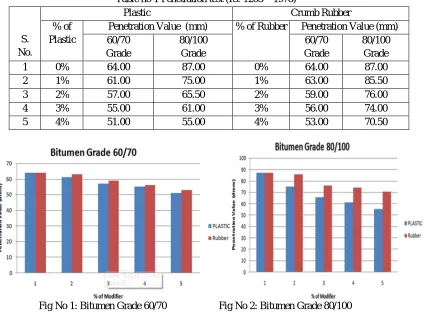
Table no 1 Penetration test (IS: 1203 – 1978)
S. No.
Plastic Crumb Rubber
% of Plastic
Penetration Value (mm) % of Rubber Penetration Value (mm)
60/70 Grade
80/100 Grade
60/70 Grade
80/100 Grade
1 0% 64.00 87.00 0% 64.00 87.00
2 1% 61.00 75.00 1% 63.00 85.50
3 2% 57.00 65.50 2% 59.00 76.00
4 3% 55.00 61.00 3% 56.00 74.00
5 4% 51.00 55.00 4% 53.00 70.50
Fig No 1: Bitumen Grade 60/70 Fig No 2: Bitumen Grade 80/100
Table 1 describes the results of penetration test performed on plastic and rubber mixed with bitumen grade (60/70) and 80/100 respectively. For Plastic, the average value for Penetration Value of bitumen grade (60/70) is 57.6 and Penetration Value of bitumen grade (80/100) is 68.7. For Crumb Rubber, the average value for Penetration Value for bitumen grade (60/70) is 59 and Penetration Value for bitumen grade (80/100) is 78.6.
[image:3.612.90.515.521.729.2]Figure 1 and Figure 2 shows that the penetration values are decreasing significantly when bitumen is mixed with the modifier. Thus, there is significant decrease in penetration value for modified blends, indicating the improvement in their temperature susceptibility resistant characteristics.
Table no 2 Softening test (IS: 1205-1978)
S
No.
PLASTIC RUBBER
% of Plastic
Softening Value (0C)
% of Crumb Rubber
Softening Value (0C) 60/70
Grade
80/100 Grade
60/70 Grade
80/100 Grade
1 0% 45.00 48.00 0% 45.00 48.00
2 1% 47.00 55.50 1% 48.50 50.30
3 2% 48.00 57.30 2% 51.00 53.00
4 3% 52.00 61.40 3% 54.00 57.50
[image:3.612.105.512.522.729.2]Fig No 3: Bitumen Grade 60/70 Fig No 4: Bitumen Grade 80/100
[image:4.612.80.534.323.708.2]Table 2defines the softening test performed on rubber and plastic. For plastic, the average Softening Value for bitumen grade (60/70) is 49.4 and for Bitumen grade (80/100) is 57.48. For rubber, the average Softening Value for bitumen grade (60/70) is 50.9 and for Bitumen grade (80/100) is 53.76. Figure 3 and Figure 4 shows that the softening point increase with increase in percentage of modifier and this is so because the bitumen becomes increasingly viscous.
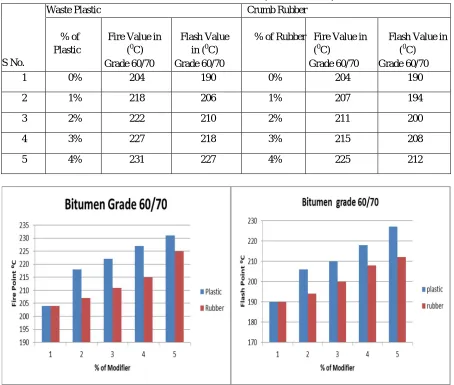
Table no 3 Flash and Fire Point Test(IS: 1209 – 1978)
S No.
Waste Plastic Crumb Rubber
% of Plastic
Fire Value in (0C) Grade 60/70
Flash Value in (0C) Grade 60/70
% of Rubber Fire Value in
(0C) Grade 60/70
Flash Value in (0C) Grade 60/70
1 0% 204 190 0% 204 190
2 1% 218 206 1% 207 194
3 2% 222 210 2% 211 200
4 3% 227 218 3% 215 208
5 4% 231 227 4% 225 212
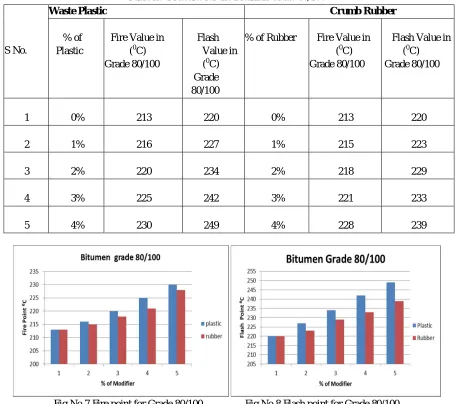
Table no 4 Results for the Bitumen Grade 80/100
S No.
Waste Plastic Crumb Rubber
% of Plastic
Fire Value in (0C) Grade 80/100
Flash Value in (0C) Grade 80/100
% of Rubber Fire Value in
(0C) Grade 80/100
Flash Value in (0C) Grade 80/100
1 0% 213 220 0% 213 220
2 1% 216 227 1% 215 223
3 2% 220 234 2% 218 229
4 3% 225 242 3% 221 233
5 4% 230 249 4% 228 239
Fig No 7 Fire point for Grade 80/100 Fig No 8 Flash point for Grade 80/100
[image:5.612.69.545.581.728.2]Table 3 and Table 4defines the results of flash and fire point test for 60/70 grade and 80/100 grade respectively. For plastic, the average Fire Value in 0C for Bitumen Grade 60/70 is 220.4 and Average Flash Value in 0C for Bitumen Grade 60/70 is 210.2 and for bitumen grade 80/100 the average fire value in0Cis 220.8 and average Flash value is 234.4. For Crumb Rubber, the average Fire Value in 0C for Grade 60/70 is 212.4 and average Flash value is 200.8 and for bitumen grade 80/100, the average fire value is 219 and average Flash Value is 228.8
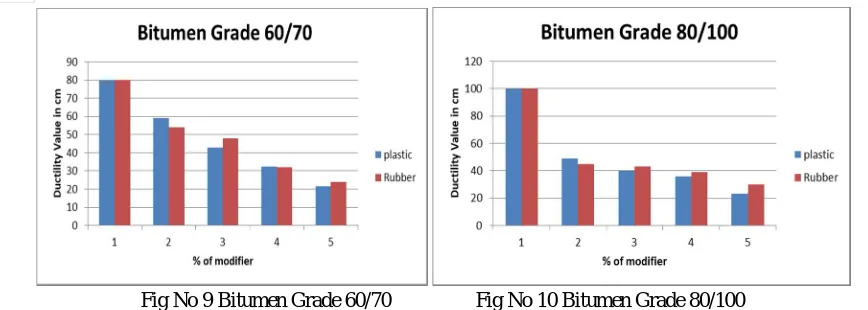
Table no 5 Ductility Test (IS: 1208 – 1978)
S No.
Waste Plastic Crumb Rubber
% of plastic Ductility
Value (cm) grade 60/70
Ductility Value (cm) grade 80/100
% of rubber Ductility Value
(cm) grade60/70
Ductility Value (cm)
grade 80/100
1 0% 80.00 100.00 0% 80.00 100.00
2 1% 59.00 49.00 1% 54.00 45.00
3 2% 43.00 40.00 2% 48.00 43.00
4 3% 32.50 36.00 3% 32.00 39.00
5 4% 21.50 23.50 4% 24.00 30.00
Fig No 9 Bitumen Grade 60/70 Fig No 10 Bitumen Grade 80/100
Table 5 defines the results of Ductility test performed on Waste Plastic and Rubber. In case of plastic modified bitumen, the average value for the Ductility Value in cm for Bitumen Grade 60/70 is 47.2 and Ductility Value in cm for bitumen grade 80/100 is 49.7. For crumb rubber the average value for the Ductility Value in cm for bitumen grade 60/70 is 47 and for bitumen Grade 80/100 is 51.4.
V. CONCLUSION
It was observed in both the grades that the penetration test value of Plastic Bitumen decreases more significantly than CRMB hence plastic Bitumen is more suitable at higher temperature roads than Crumb rubber Bitumen. The study shows that for 4% modifier the softening point increased by 4% and 5% for Waste Plastic modified bitumen and CRMB respectively. In the observations plastic proves to be better than rubber as in the grade 80/100 it was proved that plastic bitumen can bear more temperature and hence is more viscous. Fire Point and Flash point values increase more in case of Plastic bitumen than Crumb rubber Bitumen. Hence it shows that the addition of plastic in plain bitumen may work efficiently to resist burning hazards. It was observed that plastic bitumen possess high Ductility thus will have good cementing qualities than Crumb Rubber bitumen and hence proved to be better when used in pavements. From the above study it can be stated that with the use of Plastic modified bitumen and CRMB the bitumen becomes better than the ordinary bitumen. However the Plastic bitumen is more resistant to temperature susceptibility becomes more viscous and thus prevents the roads from the formation of Pits, holes and Cracks than the CRMB.
REFERENCES
[1] Airey, G. D. (2003). Rheological properties of styrene butadiene styrene polymer modified road bitumen’s. Fuel, 82(14),1709-1719. [2] Lu, X., &Isacsson, U. (2000). Modification of road bitumens with thermoplastic polymers. Polymer testing, 20(1),77-86.
[3] Sengoz, B., &Isikyakar, G. (2008). Evaluation of the properties and microstructure of SBS and EVA polymer modified bitumen. Construction and Building Materials, 22(9),1897-1905.
[4] Sengoz, B., &Isikyakar, G. (2008). Analysis of styrene-butadiene-styrene polymer modified bitumen using fluorescent microscopy and conventional test methods. Journal of Hazardous Materials, 150(2), 424-432.
[5] Airey, G. D. (2004). Styrene butadiene styrene polymer modification of road bitumens. Journal of Materials Science, 39(3),951-959
[6] Tang, N., Huang, W., Hu, J., & Xiao, F. (2018). Rheological characterisation of terminal blend rubberised asphalt binder containing polymeric additive and sulphur. Road Materials and Pavement Design, 19(6),1288-1300.
[7] Arabani, M., Tahami, S. A., &Hamedi, G. H. (2018). Performance evaluation of dry process crumb rubber-modified asphalt mixtures with nanomaterial. Road Materials and Pavement Design, 19(5),1241-1258.
[8] Yan, C., Huang, W., Xiao, F., &Lv, Q. (2018). Influence of polymer and sulphur dosages on attenuated total reflection Fourier transform infrared upon Styrene–Butadiene–Styrene-modified asphalt. Road Materials and Pavement Design,1-15.
[9] Saboo, N., Kumar, R., Kumar, P., & Gupta, A. (2018). Ranking the Rheological Response of SBS-and EVA-Modified Bitumen Using MSCR and LAS Tests. Journal of Materials in Civil Engineering, 30(8), 04018165.
[10] turRasool, R., Song, P., & Wang, S. (2018). Thermal analysis on the interactions among asphalt modified with SBS and different degraded tire rubber. Construction and Building Materials, 182,134-143.
[11] Zhang, J., Yao, Z., Yu, T., Liu, S., & Jiang, H. (2018). Experimental evaluation of crumb rubber and polyethylene integrated modified asphalt mixture upon related properties. Road Materials and Pavement Design,1-16.