Multimodal Problems, Premature Convergence
versus Computation Effort in Dynamic Design
Optimization
Abstract— Dynamic Design Optimization (DDO) of various engineering problems exhibit multiple optima in the feasible domain. Such problems can be posed as complex multimodal optimization problems. Application of traditional optimization techniques to such problems is computationally expensive with a high risk of getting trapped into a local optimum. Similarly, Genetic Algorithms (GA) suffer from premature convergence and weak exploitation capabilities. In this paper, a Niche Hybrid Genetic Algorithm (NHGA) is proposed for optimizing continuous multimodal models. This architecture of Hybrid Algorithms (HAs) organically merges Niche Techniques and Nelder-Mead’s Simplex Method into GA. The NHGA is executed in the global exploitation and local exploration. In the former, a simplex search is performed in the potential niches for a quick evaluation of the promising search zones following the generation of dynamic niche sets by a Clearing Method (CM). A further simplex search (SS) is subsequently executed in the exploitation phase for a quick location of a global optimum in the located most promising zone and an inverse operator introduced to maintain population diversity. The proposed technique effectively alleviates premature convergence and improves the weak exploitation capacity of GAs. To emphasize the application of the algorithm, numerous multi-modal functions have been experimented with, and a 5-degree of freedom vehicle suspension system optimized. Analytical results indicate the potential of the approach in DDO of mechanical systems.
Keywords- Design, Optimization, Convergence, Computation
I.
I
NTRODUCTIONDemand for higher dynamic performance from complex mechanical and structural systems [1, 2] is of significant interest in dynamic design. Dynamic design aims at obtaining desired dynamic system characteristics and specifies the right shapes, sizes, configurations, materials and manufacturing steps of elements. Desired dynamic characteristics include vibration reduction, noise level reduction, shifting of natural frequencies, elimination of resonance, higher dynamic stability and required mode shapes or vibration patterns. (DDO) rationalizes design of mechanical systems by methods that accommodate the desired trade-offs of systems’ characteristics.
Manuscript received March 28, 2011; revised April 09, 2011. This work was supported in part by the Department of Mechanical Engineering, Vaal University of Technology.
A. A. Alugongo is with the Department of Mechanical Engineering, Vaal University of Technology, Vanderbijlpark, 1900 RSA, phone: +27169509302; fax: +27169509797; e-mail: alfayoa@ vut.c.za
DDO of complex systems is computationally difficult to achieve due to the following factors: It is often a highly constrained, non-linear problem, whose objective function and constraint functions are often implicit, discontinuous or not differentiable, non-convex and multi-modal [1, 2, 3]. Hence a successful dynamic sensitivity analysis takes a large computational effort and is often unachievable [1, 2, 3, 4, 5].
Traditional optimization methods are principally
gradient-based and deterministic, with a high risk of getting
trapped into a local optimum. The methods need complex
dynamic sensitivity analysis to guide the search direction in
every iterative cycle [2]. It is computationally difficult for
traditional methods to achieve a global optimum in DDO
problems in mechanical design practice when the objective
function is complex. A pressing need for wieldy, universal
and cost-effective global optimization methods, for reliable
solutions to DDO problems exist.
GAs provide a general architecture for solving complex
optimization problems [3]. GAs only need fitness function
value to guide the search direction and does not need
gradient information and this alleviates computation expense
and complex sensitivity analysis steps. Nonetheless, few
works deal with application of GAs to dynamic design
optimization of mechanical systems. The works related to
the subject are Li [4], Keane [5] and Baumal et al [6].
GAs usually suffer premature convergence and weak exploitation capabilities [3, 7]. From this perspective, its application in computation is limited. Premature convergence often leads to a non-optimal solution whereas weak exploitation capabilities cause slow convergence prior to attaining an accurate solution. Premature convergence in GAs is caused by loss of population diversity. An effective way to solve the problem is to maintain the population diversity while continuously exploring new search domain during the evolution process. To improve the exploitation capabilities of GAs and speed up the convergence process, a common strategy in literature has been to combine a GA with a complementary local search technique to develop a Hybrid Algorithm (HA) [3, 8, 9]. In HA, the GAs with good exploration capacities are often used to locate promising zones within the solution space, while the local optimization methods exploit the located promising zones in order to achieve the best solution quickly and accurately. The hybrid strategy is an effective method of improving the performance of GAs for solving complex optimization problems [8]. However, the sustenance of population diversity and enhancement of exploitation often conflict. GAs have to maintain a great population diversity in order to attain a global optimum, while enhancement of exploitation capabilities of GAs will drive the individuals more towards the optimal individual and inevitably decrease the population diversity.
This paper proposes a niche hybrid genetic algorithm (NHGA) for a robust global optimization of DDO of mechanical systems. The objective of NHGA is to enhance the exploitation capacities without sacrificing the global convergence by simultaneously
maintaining population diversity. The approach utilizes niche techniques [10-12] to maintain the population diversity. In the NHGA, a simplex search is initially performed in the potential niches likely containing a global optimum in order to speed up the convergence process and reliably locate the promising zones within the search space. Subsequently a further simplex search is applied for a quick detection of a global optimum in the located promising zones and an inverse operator [3] introduced to maintain further population diversity.
The Niche Techniques [10-12] are effective in maintaining population diversity to enhance the exploration of new search domain. The Niche Techniques aim at gathering the individuals on several peaks of fitness function in the population according to genetic likeness and then enable GAs to investigate the peaks in parallel. The niche method adopted in the presented NHGA is the Clearing Method [11], and has been used to classify the population into various niches based on the specified distance between individuals. The basic clearing algorithm is used to preserve the fitness of dominant individual in a niche while it reset the fitness of all the other individuals of the same niche to zero. Compared with other Niche Techniques; Speciation Tree [12] and Sharing Fitness Methods [10], it maintains the population diversity effectively in a lower population size and is relatively simpler to implement.
To enable quick exploitation of the local information, Nelder-Mead‘s Simplex Algorithm [13] has been merged with GAs. The Simplex Method does not exhibit features that require derivatives of objective function, which is an advantage in an event of an ill-conditioned problem [9]. Consequently, the hybrid strategy with Simplex Method has no effect on the generality of GAs, is robust, fast and easy to program.
II.
A
BRIEF
DESCRIPTION
OF
THE
NHGA
The NHGA consists of exploration and exploitation in the search for optima. Exploration aims at locating promising zones within the search space and exploitation discovers the optimum in the detected promising zones. The purpose of NHGA is to enhance the exploitation capacities while effectively maintaining the population diversity based on an established compromise between exploration and exploitation.In exploration the NHGA first performs basic genetic operations including selection, crossover, mutation and inverse operation. The whole population is then classified to form the dynamic niche set based on the distance between individuals. Within a certain probability, the simplex search is applied on the potential niches which gather more than two individuals to move the dynamic peak of every potential niche towards the local optimum quickly in the niche. Thus the promising zones can be found more quickly and reliably. Subsequently, the exploitation phase is initiated to discover the found most promising zone within a certain probability. A further simplex search is performed for a quick exploitation of the neighborhood of previously found best point for achieving a global optimum. The previously found best point is chosen as the origin of the initial simplex. The whole procedure is iterated until a stopping criterion is met.
[image:2.595.328.524.61.419.2]The NHGA maintain population diversity through the niche techniques and inverse operation. However, slower convergence often occurs due to the greater population diversity. The simplex search in the niches is applied to speed up convergence process and to locate the promising zones quickly. Only potential niches are chosen for the simplex search. The blindness of search can be avoided while the efficiency can be improved in the NHGA. Another simplex search is to speed up locating the global optimum in the most promising zone. The simplex search further enhances the exploitation capacities of NHGA. The probability settings of simplex search are used to coordinate the balance between exploration and exploitation. Figure 1 is the architecture of NHGA. The operations inside the dashed rectangles happen in a certain probability. The niche generation operation in the squares is to refresh dynamic niche sets in the population after the simplex search has been executed.
Figure 1. The architecture of NHGA
III.
IMPLEMENTATION
OF
NHGA
Based on the ideas above, the procedure of implementing NHGA case is given below.
(1) Initializing population. Let the counter t to be 1. The n-dimension individuals are encoded in float-point parameter between 0 and 1. The initial population P(t) with M individuals is generated at random. Then the fitness evaluation of all individuals is performed. Maximal number of evolution generations T is also set. (2) Saving the first N individuals after sorting the
population by fitness value in descending order, (N<M) (3) Selection operation. The stochastic tournament
selection is used to select the individuals from population P(t) and then generates a new population
) (t P .
(4) Crossover operation. Arithmetic crossover operation [7] is performed in the population P(t) with the probability of crossover Pc. If the two individuals chosen for crossover are same, one of them is performed non-uniform mutation [7]. Thus a new population P(t) is generated.
(5) Mutation operation. Non-uniform mutation operation [7] is performed in the population P(t) with the probability of mutation Pm, and a new population
) (t
P is generated.
chosen and inverse the genes between the two loci to generate a new population
P
(
t
)
.(7) Niche generation operation by clearing method. First, a new population with M+N individuals is generated by putting N saved individuals and P(t) together. Then the normalized Euclidean distance between n -dimension individuals in the new population has to be calculated by the following expression (3).
n k jk ik ji x x
n X X 1 2 ) ( 1 N M i j N M i , , 1 1 , , 2 , 1
(3)
When XiXj D (D, namely niche radius) is true, the Xi is
compared with X j by the fitness value. The individual with lower fitness value is punished with formula (4) to reduce its fitness value sharply.
0
) , min(XiXj
F (4)
After those operations above, a new population Pniche(t) with various niches is generated. Obviously, the number of niches in the new populationPniche(t) is the number of those individuals with non-zero fitness value. Let the current population Pcurr(t) be
) (t
Pniche , namely, Pcurr(t)Pniche(t).
(8) Performing local simplex search in the potential niches with probability Ps1. First, the niche number of population Pcurr(t) and the individual number in every niche are calculated. Then the simplex search is performed S1 times in every potential niche, which has more than two individuals. The initial simplex consists of the fittest individual in the potential niche and two individuals generated at random. The best vertex in the final simplex is used to replace the worst individual in the niche. Finally, the niche generation operation by step (7) is performed to generate a new population
) (
1 t
Psim . Let the current population Pcurr(t) be
) (
1 t
Psim , namely, Pcurr(t)Psim1(t).
(9) Performing simplex search in probability Ps2 within the found most promising zone. First, initial simplex consists of the best individual in the population Pcurr(t)
and other two individuals generated at random. Then simplex search was run S2 times. The final simplex vertexes are used to replace the inferior individuals in the population Pcurr(t) . Finally, niche generation operation by step (7) is performed to get the new populationPsim2(t). Let the current population Pcurr(t)
be Psim2(t), namely, Pcurr(t)Psim2(t).
(10)Sorting Pcurr(t) with M+N individuals by new fitness value in descending order. The first N individuals are saved.
(11)Termination of the algorithm. If tT, then t=t+1, the first M individuals generated by step (10) is regarded as next population P(t); then go to (3). If t>T or the best individual is not improved during a given generations, then the algorithm is terminated.
When Ps1 = 0 and Ps2= 0, the NHGA degenerates into a general GAs with a niche. Moreover, Smith proved that the simplex method is computationally stable regardless of the number, and positioning of the vertices of the initial simplex
[14]. Therefore it is reliable to use an initial simplex with three vertexes for a simplex search in the NHGA. The vertices generated randomly in initial simplex provide a certain exploration capability for simplex search, as will be shown later in this paper by numerical experiments. Clearing method is more effective in the GAs with elitist strategy [11] when the clearing capacity is set to 1. Hence the clearing capacity is set to 1 in the NHGA. Furthermore, the fitness function value should not be less than 0 in the NHGA.
IV.
SETTING
THE
NHGA
PARAMETERS
Some parameters introduced in the NHGA have to be set and tuned to NHGA for effective performance. Based on a number of test runs, those parameter settings are given as follows:
Based on experiments, reasonable settings are, Ps1is between 0.6 and 1.0 while Ps2 is generally between 0.3 and 0.5, S1=20~50 and S2=50~100. The S1and S2 may increase accordingly as the complexity and dimensions of optimization problems increase. New individuals are generated more frequently because of inverse operation and the mutation in crossover operation in the NHGA. The dynamic niche set in the population keeps varying. Hence Ps1 should be relatively large. The simplex search with relatively small running times S1 helps to speed up the convergence rate while preventing the premature convergence. The simplex search in the most promising zone is performed only when some promising niches including likely global optimum are survived and other inferior niches are eliminated. Therefore Ps2 should be relatively small and simplex search times S2 should be relatively large.
The M and T are generally problem dependent. The increase of M and T improves the performance of NHGA as the complexity and dimension of optimization problems are increase. However, M may be between 10 and 30 for problems with less than 100 dimensions because of enhancement measures of population diversity in the NHGA. The number of saved individuals N is set to 20% ~ 30% of M. The niche radius D is also problem-dependent and may be between 0.005 and 0.5.
V.
EXPERIMENTS
WITH BENCHMARK FUNCTIONSThe NHGA was applied to the set of typical multimodal functions with high dimensions listed below.
(1) Generalized Schwefel’s function
500
500
)
|
|
sin(
)
(
11
i
n
i i i
i
x
x
x
x
f
(2) Generalized Rastrigin’s function
10cos(2 ) 10
, 5.12 5.121 2
2
in
i xi xi x
f
(3) Ackley’s function
1 2 1 23(x) exp 0.2 xi xi 3cos2xi sin2xi f
(4) Generalized Penalized’s function
a x a x k a x a a x a x k m k a x u x x y x u y y y y n x f i i i i m i i i i i n i i ni i i
n ) ( , 0 , ) ( ) , , , ( 50 50 ) 1 ( 4 1 1 ) 4 , 100 , 10 , ( )] ( sin 10 1 [ ) 1 ( ) 1 ( ) ( sin 10 ) ( 1 1 1 2 2 2 1 2 4
(5) Generalized Griewank’s function
n i n i i i i x i x x x f 1 1 2 5 600 600 1 ) cos( 4000 1 ) (10
10
|
|
|
|
)
(
1 16
i n i i n i
i
x
x
x
x
f
[image:4.595.64.284.196.457.2]The number of local minima in
f
1~f
5increases
exponentially with the problem dimension [15]. They
appear to be the most difficult class of problems for many
optimization algorithms (including EAs) [15].
f
2~f
6possess
one global optimum 0, while the global optimum of
f
1is
12569.5. The dimensions of test functions were all set to 30
in this experiment. The NHGA ran 100 times for every test
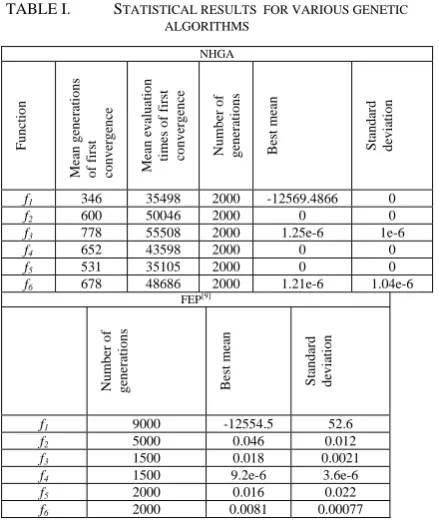
function. Table 1 summarizes the results of NHGA. The
results from FEP in [15] are also listed in Table 1.
TABLE I. STATISTICAL RESULTS FOR VARIOUS GENETIC ALGORITHMS NHGA Fu nctio n Mean ge nera ti o n s
of first co
n v er g en ce Mean e v al uat ion tim es of fi rs t co n v er g en ce Nu mb er of ge nera ti o n s Best mea n Sta nda rd de via tio n
f1 346 35498 2000 -12569.4866 0
f2 600 50046 2000 0 0
f3 778 55508 2000 1.25e-6 1e-6
f4 652 43598 2000 0 0
f5 531 35105 2000 0 0
f6 678 48686 2000 1.21e-6 1.04e-6
FEP[9] Nu mb er of ge nera ti o n s Best mea n Sta nda rd de via tio n
f1 9000 -12554.5 52.6
f2 5000 0.046 0.012
f3 1500 0.018 0.0021
f4 1500 9.2e-6 3.6e-6
f5 2000 0.016 0.022
f6 2000 0.0081 0.00077 It is observed that NHGA performs consistently significantly better than FEP for the functions. From table 1 it was possible to note that NHGA efficiently and reliably yields more accurate global optimum for the complex and high-dimension multimodal problems. It is also noted that the NHGA leads to a good reliability with a small population size as is the case of this experiment. Due to application of a clearing method and inverse operation, the mutation in crossover
and random individuals in the initial simplex play important roles in maintaining the population diversity just as large population size does.
[image:4.595.312.548.516.668.2]Table 2 shows the effect of the main components of NHGA on performance of NHGA through optimizing function f5. The NHGA ran 100 times for every case in Table 2. For the simplex search in the potential niches, the search in the most promising zone and inverse operation play important roles in improving the performance of NHGA.
TABLE II. STATISTICAL RESULTS OF OPTIMIZING FUNCTIONS WITH VARIOUS COMPONENTS OF NHGA
1 . 0 ; 50 ; 20 2000; T ; 3 . 0 ; 10 ; 1 . 0 ; 85 .
0 1 2
P M N M S S D
Pc m
Pa1=0
Pa2=0
No Inverse Operator Pa1=0 Pa2=0.3 Inverse Operator
Pa1=0.8
Pa2=0
Inverse Operator
Pa1=0.8
Pa2=0.3
No Inverse Operator
Pa1=0.8
Pa2=0.3
Inverse Operator
Best mean
0.16348 0.00142 0.0234 0.0395 0
Standard deviation
0.078 0.008 0.008 0.03 0
VI.
DDO OF A5-
DOF VEHICLE SUSPENSION SYSTEM NHGAThe vehicle suspension system in [1] is employed treated by the proposed NHGA. Fig.2 illustrates the dynamic system considered for optimal design. The objective of the DDO is to minimize the magnitude of seat acceleration under the required vehicle speed and road profiles in the specified time range. For brevity the problem is posed as follows:
0 0508 . 0 ) ( ) ( 0 0508 . 0 ) ( ) ( 0 127 . 0 ) ( 3 2 ) ( ) ( 0 127 . 0 ) ( 3 ) ( ) ( 0 0508 . 0 ) ( ) ( 12 ) ( . . ) ( max min 2 5 5 1 4 4 1 2 5 3 3 2 4 2 1 3 2 1 1 0 0 t f t z g t f t z g t z t z t z g t z L t z t z g t z t z L t z g t s t z f b find
t
(5)
where z1(t),z2(t),z3(t),z4(t),z5(t) are the independent generalized coordinates, representing the suspension system‘s five degrees of freedom, b is the design variable vector [k ,k2,k3,c1,c2,c3]T; f1(t) and f2(t) are vertical displacement functions of two wheels related to the road conditions; t[0,
] is the time range in which the constraints must hold. The b is related to) ( ), ( ), ( ), ( ),
( 2 3 4 5
1 t z t z t z t z t
z by equations of motion, similar to
equation (2). A detailed description of the optimization model can be seen in [1]. The parameter values of the suspension system in the numerical example are given as follows: the seat mass m1=131.63kg, the car-body mass m2=2042.541kg and its moment
of inertia I=4632.355kg.m2 the wheel mass m4=m5=43.846kg, the
wheel stiffness k4=k5=262689N/m, the wheel damping
c4=c5=875.63 N. s/m, the wheelbase L=3.04m, vehicle velocity
V=11.43m/s. The bounds of design variables are shown in table 3. The road condition is shown in figure 3.
Figure 3. The road surface profile
The NHGA was implemented in MATLAB and the NEWMARK method numerically used to solve the equations of motion. The main parameter values for running NHGA in this example are given as follows: Pc=0.85, Pm=0.1, D=0.1; N=5; Ps1=0.8; S1=20; Ps2=0.3;S2=50 and the fitness function in [8] is
adopted as below:
00001 . 0 , 0 max 1000000
1
5
1 0
i
i g f
F
(6)
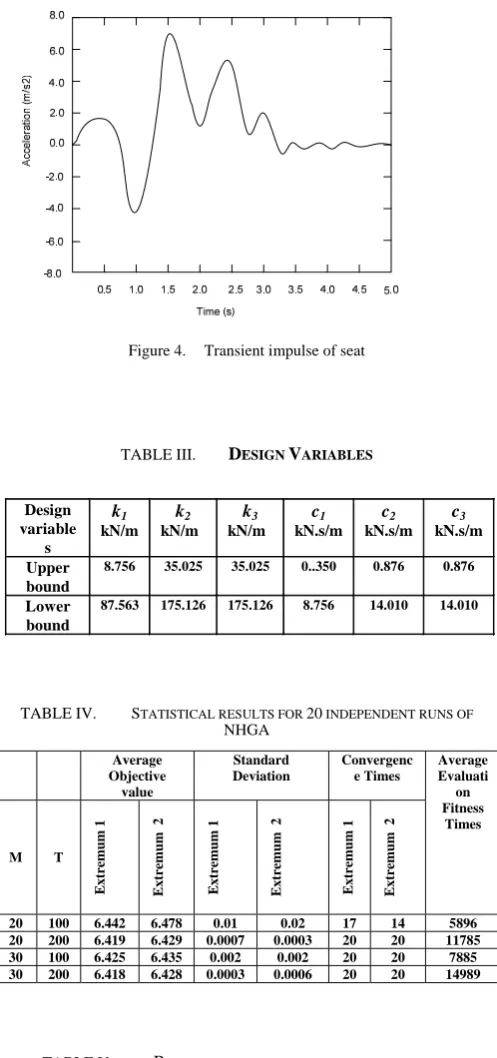
Table 4 shows the statistical results for 20 independent runs of NHGA with different population sizes M and maximal iteration number T. Table 5 shows the results obtained by NHGA, Gradient Projection Method [1] and complex GA [5]. The complex GA uses an additional complex operator, which consists of reflection, contraction and rotation, to improve the worst individuals before crossover operation.
Table 3 shows that good reliability and high-quality solutions are achievable by NHGA. It is noted that the average of total fitness evaluation number is acceptable with a small population size. This is implicit that NHGA achieves good reliability and high-quality solutions without sacrificing the efficiency of the algorithm. Table 4 also suggests that two extrema can be found simultaneously. Based on table 4, the two extrema are better than the results from the other two methods.
Figure 4 illustrates the transient impulse response of the vehicle seat with the optimal parameters of extremum 1 in Table 5. It is evident that, NHGA exhibits the capacities of locating multiple extrema simultaneously with a high probability. It is very helpful for engineers to choose other optima when the global optimal design is expensive or even impossible to manufacture in a practical project. As mentioned above, the NHGA, which is designed to solve the dynamic design optimization problems, shows the following characteristics:
(1) locates a global optimum robustly and quickly with small population;
(2) Good adaptability and availability without complex sensitivity analysis;
(3) Searches multiple peaks in parallel with a small
population.
Figure 4. Transient impulse of seat
TABLE III. DESIGN VARIABLES
Design variable
s
k1
kN/m
k2
kN/m
k3
kN/m
c1
kN.s/m
c2
kN.s/m
c3
kN.s/m
Upper bound
8.756 35.025 35.025 0..350 0.876 0.876
Lower bound
87.563 175.126 175.126 8.756 14.010 14.010
TABLE IV. STATISTICAL RESULTS FOR 20 INDEPENDENT RUNS OF
NHGA
Average Objective
value
Standard Deviation
Convergenc e Times
Average Evaluati
on Fitness
Times
M T
Extremum 1 Extremum
2
Extremum 1 Extremum
2
Extremum 1 Extremum
2
[image:5.595.55.263.57.138.2]20 100 6.442 6.478 0.01 0.02 17 14 5896 20 200 6.419 6.429 0.0007 0.0003 20 20 11785 30 100 6.425 6.435 0.002 0.002 20 20 7885 30 200 6.418 6.428 0.0003 0.0006 20 20 14989
TABLE V. RESULTS OBTAINED BY VARIOUS METHODS
Design Variables k1
kN/m
k2
kN/m
k3
kN/m
c1
kN.s/m Gradient Projection Method 8.756 30.025 42.205 2.257 Complex GA 8.750 34.000 41.000 1.750 Extremum 1 8.756 35.025 163.338 3.422
NHGA Extremum 2 8.756 35.025 35.025 3.660
Design variables c2
kN.s/m
c3
kN.s/m
f0
m/s2 Gradient Projection Method 13.575 14.010 6.532 Complex GA 14.000 14.000 6.675 Extremum 1 13.430 10.678 6.417
[image:5.595.308.564.608.734.2]VII.
CONCLUSION
The NHGA effectively reduced premature convergence and improved weak exploitation capacities of GA. The proposed NHGA, is wieldy, cost-effective for global optimization method, alleviates dynamic sensitivity analysis in the DDO of problems considered. A significant improvement of the weak exploitation capacity of genetic algorithms is evident. The NHGA has been successfully applied to dynamic design optimization of a vehicle suspension system. The results show that NHGA may achieve reliable and accurate global optimum within an acceptable computational effort for the a mechanical system. The architecture is potential and can be used to generate more cost-effective hybrid algorithms.
Although NHGA is implemented with a clearing method and simplex method, other niche techniques and local search methods could be used under the proposed architecture to generate a more potential hybrid algorithm. The NHGA is simpler than other methods.
A
CKNOWLEDGMENTThe author greatly acknowledges the Department of
Mechanical, VUT for supporting this research.
R
EFERENCES[1] E.J.Haug, J.S.Arora. Applied Optimal Design: Mechanical and Structural Systems [M]. New York: John Wiley and Sons, 1979. [2] Grandhi R. Structural optimization with frequency constraint--a
review [J]. Journal AIAA, 1993, 31(12) 2296~2303.
[3] Goldberg, D.E. Genetic Algorithm in Search, Optimization and Machine Learning. New York: Addison-Wesley, 1989
[4] Li Qiang, Zhou Ji. Complex Genetic Algorithm for Mechanical Dynamic Optimization Design [J]. Chinese Journal of Mechanical Engineering, 1999, 35(5): 27~30
[5] A.J.Keane. Passive vibration control via unusual geometries: the application of genetic algorithm optimization to structural design [J]. Journal of Sound and Vibration, 1995,185(3): 441-453
[6] A.E.Baumal, J.J.McPhee,P.H.Calamai. Application of genetic algorithms to the design optimization of an active vehicle suspension system [J]. Comput. Methods Appl. Mech. Engrg. 1998,163: 87-94 [7] Z. Michalewicz, Genetic algorithms + Data Structures = Evolution
Programs, Springer-Verlag, Heidelberg, 1996
[8] Ph. Preuxa, E.-G. Talbi, Towards hybrid evolutionary algorithms, International Transactions in Operational Research,6(1999):557-570 [9] Rachid Chelouah, Patrick Siarry. Genetic and Nelder–Mead
algorithms hybridized for a more accurate global optimization of continuous multiminima functions. European Journal of Operational Research ,2003,148: 335–348
[10] Chyi-Yeu Lin, Wen-Hong Wu. Niche identification techniques in multimodal genetic search with sharing scheme. Advances in Engineering Software, 33 (2002) 779–79
[11] A. P´etrowski, A clearing procedure as a niching method for genetic algorithms. In Proc. 1996 IEEE Int. Conf. Evolutionary Computation, Nagoya, Japan, 1996: 798–803.
[12] Pétrowski A, Girod Genet M. A classification tree for speciation, Congress on Evolutionary Computation (CEC99), Proceedings. IEEE, 1999:204-211
[13] J.A. Nelder, R. Mead. A simplex method for function minimization, The Computer Journal, 1965:308-313
[14] Smith S. The Simplex method and evolutionary algorithms In Proceedings of the 1998 IEEE International Conference on Evolutionary Computation, Pricataway, 1998:799-804
[15] Yao X, Liu Y, Lin G. Evolutionary programming made faster [J]. IEEE Trans Evolutionary Computation, 1999, 3(2): 82-102
[16] Lingyun Wei and Mei Zhao, A niche hybrid genetic algorithm for global optimization of continuous multimodal functions Applied Mathematics and Computation 2005, Vol. 160(3), 3649-661 [17] A A Alugongo, J L Munda, Optimization of Multimodal Models in