677
Investigating Entity Knowledge in BERT with Simple Neural End-To-End
Entity Linking
Samuel Broscheit
Data and Web Science Group, University of Mannheim, Germany
Abstract
A typical architecture for end-to-end entity linking systems consists of three steps: mtion detecmtion, candidate generamtion and en-tity disambiguation. In this study we inves-tigate the following questions: (a) Can all those steps be learned jointly with a model for contextualized text-representations, i.e. BERT (Devlin et al., 2019)? (b) How much entity knowledge is already contained in pretrained BERT? (c) Does additional entity knowledge improve BERT’s performance in downstream tasks? To this end, we propose an extreme simplification of the entity linking setup that works surprisingly well: simply cast it as a per token classification over the entire entity vocabulary (over 700K classes in our case). We show on an entity linking benchmark that (i) this model improves the entity representa-tions over plain BERT, (ii) that it outperforms entity linking architectures that optimize the tasks separately and (iii) that it only comes second to the current state-of-the-art that does mention detection and entity disambiguation jointly. Additionally, we investigate the use-fulness of entity-aware token-representations in the text-understanding benchmark GLUE, as well as the question answering benchmarks SQUAD V2 and SWAG and also the EN-DE WMT14 machine translation benchmark. To our surprise, we find that most of those bench-marks do not benefit from additional entity knowledge, except for a task with very small training data, the RTE task in GLUE, which improves by 2%.
1 Introduction
The goal of entity linking is, given a knowledge base (KB) and unstructured data, e.g. text, to detect mentions of the KB’s entities in the unstructured data and link them to the correct KB entry. The entity linking task is typically implemented by the following steps:
• Mention detection (MD): text spans of poten-tial entity mentions are identified,
• Candidate generation (CG): entity candidates for each mention are retrieved from the KB,
• Entity disambiguation (ED): (typically) a mix of useful coreference and coherence features together with a classifier determine the entity link.
Durrett and Klein(2014) were the first to propose jointly modelling MD, CG and ED in a graphical model and could show that each of those steps are interdependent and benefit from a joint objective. Other approaches only model MD and ED jointly (Nguyen et al., 2016;Kolitsas et al.,2018), thus these architectures depend on a CG step after men-tion detecmen-tion. Hachey et al. (2013); Guo et al. (2013);Durrett and Klein(2014) showed the influ-ence of CG on entity linking, because it can be the coverage bottleneck, when the correct entity is not contained in the candidates for ED.Yamada et al. (2016,2017) use a precomputed set of entity candi-dates published byPershina et al.(2015) for their experiments on the CoNLL03/AIDA benchmark dataset (Hoffart et al.,2011), and due to this their experiments are comparable across studies with regards to the CG step. MD has a similar impact on entity linking performance, as it determines the upper bound of linkable mentions.
i.e. a stack of increasingly higher level linguistic functions. Zhang et al.(2019) investigated inject-ing entity knowledge from noisy1automatic entity linking into the pretraining of BERT and they could show that this improves relation extraction.
In this study we investigate the following ques-tions:
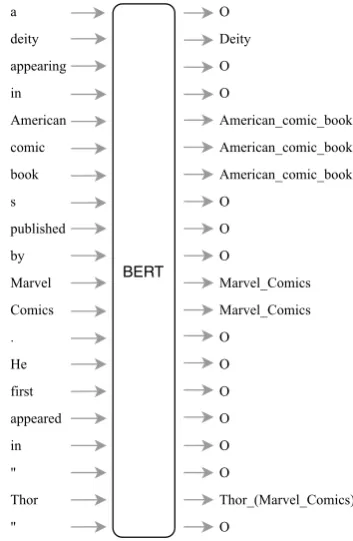
(a) Can BERT’s architecture learn all entity linking steps jointly? We propose an extreme simplification of entity linking and cast it as a per token classification over the entire entity vo-cabulary, thus solving MD, CG and ED simulta-neously (see Fig. 1). The entity vocabulary is based on the700K top most frequent entities in English Wikipedia and the training data was de-rived from English Wikipedia texts. We first trained BERT-base-uncased on English Wikipedia (dubbed BERT+Entity) and then fine-tuned and evaluated it on an entity linking benchmark. We found that this worked surprisingly well for entity linking, even if we do not have any supervision on mention-spans, i.e. BIO tags. An error analysis with validation data revealed that only 3% of errors are purely due to span errors, while most errors are due to wrong
Nilpredictions which often coincided with entities being infrequent.
(b) How much entity knowledge is already con-tained in pretrained BERT? To investigate this question, we froze BERT and only trained the entity classifier of BERT+Entity on Wikipedia (dubbed Frozen-BERT+Entity), i.e. the resulting entity clas-sifier is adjusted for entity mentions for which plain BERT already does assign distinct token repre-sentations, such that correct entity classification is possible. Then we fine-tuned and evaluated Frozen-BERT+Entity on an entity linking bench-mark. We find that the performance of Frozen-BERT+Entity is 6% below Frozen-BERT+Entity, show-ing that BERT+Entity has learned additional entity knowledge.
(c) Does additional entity knowledge improve BERT’s performance in downstream tasks? Due to training BERT+Entity with a per token classification, the model is forced to assign dis-tinct entity specific features to each token of an entity mention. Downstream tasks could exploit this, if additional entity information is necessary for them. We evaluated BERT+Entity in the natural
1TagMe’s performance on various benchmark datasets
ranges from 37% to 72%. F1 (Kolitsas et al.,2018)
O
Deity O O
American_comic_book American_comic_book American_comic_book
O O
O
Marvel_Comics Marvel_Comics
O O O
O O
O
Thor_(Marvel_Comics) O
a
deity appearing in
American comic book
s published
by Marvel Comics
. He first
appeared in
" Thor "
[image:2.595.322.499.67.338.2]BERT
Figure 1: Illustrating the simple neural end-to-end en-tity linking setup. BERT+Enen-tity predicts enen-tity links per token, where ”O” denotes aNilprediction. The ex-ample shows how context can help to link“Thor”to
Thor (Marvel Comics).
language understanding benchmark GLUE (Wang et al.,2018), the question answering (QA) bench-marks SQUAD V2 (Rajpurkar et al., 2018) and SWAG (Zellers et al.,2018), and the machine trans-lation benchmark EN-DE WMT14. We confirm the finding fromZhang et al.(2019) that additional entity knowledge is not beneficial for the GLUE benchmark. To our surprise, we also find that ad-ditional entity knowledge is neither helpful for the two QA datasets nor for machine translation. The only exception is the RTE task in GLUE in which BERT+Entity improves 2%. This dataset has just 0.5-2% of the training data of the two larger natural language inference datasets in GLUE.
2 Related Work
Entity Linking Durrett and Klein(2014) is the work that is closest to our approach, although not neural. In their approach they model interactions between the MD, CG and ED tasks jointly. They find that the joint objective is beneficial, such that each task improves. They also note that there is no natural order of the tasks and they should in-teract freely. Their approach to CG is to learn to generate queries to the KB.Nguyen et al.(2016) also propose jointly modelling MD and ED with a graphical model and show that it improves ED performance and is more robust. Kolitsas et al. (2018) recently published their study in which they propose the first neural model to learn MD and ED jointly. Their proposed method is to overgenerate mentions and prune them with a mention-entity dictionary. The ED step reasons over the remain-ing mentions if and to what they link to. However, modern approaches for solving natural language tasks operate on neural text-representations, and the approaches discussed so far only yield entity-links. Yamada et al.(2016,2017) was the first to investigate neural text representations and entity linking, but their approach is limited to ED.
Pretrained Language Models
ULM-FIT (Howard and Ruder, 2018), ELMO (Peters et al., 2018), BERT (Devlin et al., 2019) and GPT-2 (Radford et al.,2019) are modern language models that are very deep and wide (for NLP) and are pretrained on large amounts of data. They provide very rich text representations that have shown to improve many NLP tasks by just replacing the static word embeddings with deep contextualized word embeddings. As Peters et al. (2019) show, further training the deep language models alongside the model that uses the embeddings as input can be helpful, for which the term “finetuning” is used. The current trend in research is to investigate all aspects of these language models, seeking insights in their inner workings (Tenney et al.,2019), or their application to various domains (Beltagy et al.,2019;Lee et al., 2019). In this study, we investigate the factual information in form of entities that is contained in BERT, seeking to understand to what degree this information is already identifiable in BERT and if the entity knowledge can be improved.
3 End-To-End Neural Entity-Linking
In this section we describe the BERT+Entity, which is a is straightforward extension of BERT, however, as with the original BERT, the main challenge lies in designing the training scheme, i.e. in our case the creation of the training data. Our goal for the experiments is to evaluate, if we can learn candi-date generation, thus a desiderata is to make the entity vocabulary as large as possible to be compa-rable to other studies. The text data and the entity linking annotations are derived from Wikipedia by exploiting intra-Wikipedia links. This yields the challenge that the annotations for entity links from Wikipedia are assumed to be incomplete, i.e. not every entity mention in Wikipedia is linked, which we hypothesize can be detrimental during training.
3.1 Model
Our model is based on BERT, which is a deep self-attention-based architecture (Vaswani et al., 2017) that was trained on large amounts of text. Its training objective is two-fold: (a.) predict missing tokens from sentences, and (b.) classify if a second sentence was an adjacent sentence. The input and output token vocabulary are sub-words, i.e. the vocabulary is computed from the training data by determining the30K most frequent character se-quences, excluding spaces. Devlin et al. (2019) made several pretrained BERT models publicly available. They differ in size — i.e. token em-bedding size and self-attention layer depth — and whether the token vocabulary is cased or uncased. BERT+Entity is a straightforward extension on top of BERT, i.e. we initialize BERT with the publicly available weights from the BERT-base-uncased model and add an output classification layer on top of the architecture. Given a contextualized to-ken, the classifier computes the probability of an entity link for each entry in the entity vocabulary. Formally, letdbe BERT’s token embedding size, andE ∈ R|KB|×d the entity classification layer, with|KB|being the number of entities in the KB,
V is the sub-word vocabulary,ci =BERT(h)[i]
is thei-th contextualized token computed by BERT from contexth= [v1, v2, ..., vi−1, vi, vi+1, ..., vm]
with each v ∈ V. Consequently, the probability
p(j|v, h)of wordv — which is thei-th token in context h — linking to entity j is computed by
3.2 Training Data
The entity vocabulary and training data are de-rived from English Wikipedia texts2. We used an extended version of WikiExtractor3to extract the text spans that are associated with an inter-nal Wikipedia link to use as annotation, e.g. in the sentence“The first Thor was all about intro-ducing Asgard”, the text span “Thor” links to
https://en.wikipedia.org/wiki/Thor (film). BERT is originally trained with sentences. However, for entity linking, a larger context can help to disam-biguate entity mentions, which is why we select text fragments of such a length, that they span mul-tiple sentences. For later use we collect(m, e) tu-ples of entitieseand their mentionm. This yields a setMof potentially linkable strings and also lets us compute the conditional probabilityp(e|m)based on the#(m, e)counts.
Handling incomplete annotation A challenge in using the Wikipedia links as annotation is that most entities do not have all their mentions an-notated, i.e. often only the first appearance in an article is linked. We hypothesize that learn-ing a classifier on such skewed data would yield a skewed model. Our approach to counter miss-ing annotations is two-fold: (i) We only select text fragments that contain a minimum count of anno-tated Wikipedia links. (ii) To account for unlinked mentions in the fragments we use a Trie-based matcher4 to annotate all occurrences of linkable
strings that we collected inM. As entity links we annotate all possible entities this mention could link to but only with the conditional probability
p(e|m), with the goal that the model remembers a context independent entity prior. One issue is that due to the incomplete annotation, the#(e, m)
counts yieldp(N il|“United States”)>0, i.e. the mention“United States”has a large non-zero prob-ability to link to nothing. Based on the assump-tion that the menassump-tions of the most popular entities should always link to something, we compute the average of the probability of linking toNilfor the
k= 1000most frequent entities
¯ pN il =
1 k
X
j
#(mj, N il) #mi
.
2
From a enwiki Wikipedia dump from 20.06.2017. 3
https://github.com/samuelbroscheit/wikiextractor-wikimentions
4https://github.com/vi3k6i5/flashtext
and use #(mi, N il) − (1−p¯N ilp¯N il) ∗ #(mi, e∗) to discount #(mi, N il) such that p(N il|“United States”) ≈ 0, i.e. the model should always link “United States” and men-tions of less frequent entities get an increase in probability to link to something.
4 Entity Linking Experiments
In the experiments we want to investigate how the simple neural end-to-end entity linking model BERT+Entity performs, i.e. if it learns something additional on-top of BERT. Additionally, we inves-tigated if the entity-aware token-representations are useful for downstream tasks. We also discuss the main engineering challenges training with such a large entity vocabulary.
4.1 Data
Wikipedia We report two settings which differ in size of the entity vocabulary, size of the fragments and minimum number of entities per fragments. The first setting was the initial study, and the sec-ond one is a follow up study in which we changed settings that potentially could improve entity link-ing performance.
Setting I: We keep the700Ktop most frequent entities from the ≈ 6M entities in Wikipedia, i.e. we chose the entity vocabulary as large as it was technically feasible with regards to mem-ory and training speed. To put it into context, the CoNLL03/AIDA entity linking benchmark con-tains23,5K entities in1300documents. We are missing30entities from CoNLL03/AIDA that only appear less than10times in the Wikipedia training data. We chunk the Wikipedia texts into fragments with a length of110tokens and an overlap of20
tokens with the previous and following fragment. We only keep fragments that contain at least1 in-frequent linked entity or at least3frequent ones. This yields8,8M training instances from which we take1000each for validation and testing.
Setting II: We keep the500Ktop most frequent entities, which is comparable to the entity vocab-ulary ofKolitsas et al.(2018) and we have to add
≈1000entities from CoNLL03/AIDA to the entity vocabulary to be able to evaluate our model on that benchmark. We increase the fragment size to250
tokens and keep fragments that contain at least1
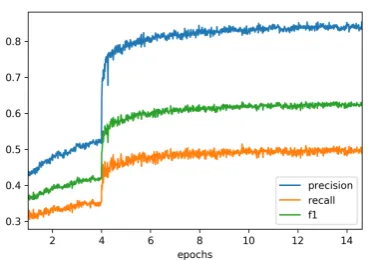
Figure 2: Per token classification InKB scores on the validation data during training on the Wikipedia dataset in Setting II for 40 days. The jump at the4-th epoch happens when we switch from training Frozen-BERT+Entity to Frozen-BERT+Entity, i.e. when we start fine-tuning BERT.
Entity Linking Benchmark To evaluate on
a commonly used benchmark dataset we use CoNLL03/AIDA. It is the biggest manually an-notated ED dataset. It contains 946 documents in training, 216 in validation (testa/AIDA-VALID) and 231 in test (testb/AIDA-TEST).
4.2 Training
We use a multi-class classification over the entity vocabulary, i.e. the labelyvector for one tokenvi
is defined by
yij =p(j|vi), forj∈ {1, ..,||KB||}.
However, computing the loss over the whole entity vocabulary would be infeasible, because the entity mention vocabulary is very large and the gradi-ents for the entity classifier would exceed our GPU memory. Thus, to improve memory efficiency and increase convergence speed, we use negative sam-pling. After sampling text fragments for a batch
b, we collected the setN+b of all true entities —
according to the annotations discussed in Sec.3.2 — that occurred in those text fragments. Ideally we would update the representations of those en-tities that do not occur in the setN+b which the
model is erroneously the most confident about. To achieve this, we first performed a prediction for the text fragments in the current batch and collected for each token the topkpredicted entities. We ag-gregated the entities’ logits over the whole batch and sorted the entities by their aggregated logits into the listNb−and removed from it any entity
contained inNb+. We join Nb = Nb+∪Nb−
and truncate Nb− such that|Nb|equals a given
maximum size. Each label vectoryi for tokenci
from fragmentCin batchbwas now defined over the entities inNb. Thus, we only predict over the
corresponding subset of the entity embedding table, i.e. Eˆ =E(Nb). The loss for one fragmentCin batchbwas computed by
L= 1
|Nb| ∗ |C| |C| X
i |Nb| X
j
−[yij ·logσ( ˆEjci)
+(1−yij)·log(1−σ( ˆEjci))].
For training on Wikipedia we used Adam (Kingma and Ba,2015) with mini batch size 10, gradient accumulation over4batches, maximum label size10240, the learning rate for BERT was
5e-5and for the entity classifier0.01. In Setting I we train the model for 4 epochs, one epoch took five days with two TitanXp/1080Ti. In the first 1.5 epochs we train Frozen-BERT+Entity and then BERT+Entity. In Setting II we train the model for 14 epochs and one epoch took three days. In the first 3 epochs we train Frozen-BERT+Entity and then BERT+Entity.
For training on CoNLL03/AIDA we used Adam (Kingma and Ba,2015) with mini batch size 10, gradient accumulation over4batches, maximum label size 1024, learning rates for BERT 5e-5, dropout in BERT 0.2, and we freeze the token embeddings, the first two layers of BERT and the entity classifier. We train the remaining pa-rameters for up to 30 epochs and perform early stopping according to strong match (see next Sec-tion). One epoch took seven minutes with one TITAN Xp/1080 Ti.
4.3 Performance Metrics
[image:5.595.89.275.61.191.2]AIDA/testa AIDA/testb
strong F1 weak F1 ED strong F1 weak F1 ED
Kolitsas et al.(2018) indep. baseline 75.7 76.0 - 73.3 73.9
-Kolitsas et al.(2018) 86.6 87.2 92.4 82.6 83.2 89.1
BERT 63.3 66.6 67.6 49.6 52.4 52.8
Setting I Frozen-BERT+Entity 76.8 79.6 80.6 64.7 68.0 68.6
BERT+Entity 82.8 84.4 86.6 74.8 76.5 78.8
Setting II Frozen-BERT+Entity 76.5 80.1 79.6 67.8 71.9 67.8
[image:6.595.85.514.63.219.2]BERT+Entity 86.0 87.3 92.3 79.3 81.1 87.9
Table 1: Comparing entity linking results on CoNLL03/AIDA.strong F1andweak F1denote InKB F1 scores.ED
is Precision@1 for InKB.Kolitsas et al.(2018) also study a neural model, however, they only model MD and ED. The independent baseline shows how their model performs when they use mentions detected by Stanford NLP. In Frozen-BERT+Entity BERT is not trained and only the entity classifier on-top is trained.
4.3.1 Results
In Table1we compare our results to the most re-cent results byKolitsas et al.(2018) who studied a neural approach that does joint modelling of MD and ED, but not CG. They also provide a baseline in which they show how their classifier performs when MD and ED are independent, i.e. linking mentions detected by Stanford NLP.
For the reported results denoted only with BERT, the entity classifier is trained from scratch on CoNLL03/AIDA and BERT is finetuned. This shows the lower bound on this dataset, i.e. the amount of information that we can learn with BERT only from the CoNLL03/AIDA training data. Note, that this cannot generalize to entities that are not contained in training. The difference between BERT and Frozen-BERT+Entity shows the amount of entity knowledge that plain BERT already had, which it transferred in the entity classifier during training on Wikipedia. Finally, BERT+Entity is the proposed model, in which both BERT and the entity classifier have been trained on Wikipedia.
4.3.2 Discussion
Comparing BERT+Entity and
Frozen-BERT+Entity we see that there is a significant amount of entity knowledge that BERT+Entity learns additionally to Frozen-BERT+Entity, i.e. training BERT+Entity increases the scores between 6%-10% depending on the score and dataset. However, it should also be noted that Frozen-BERT+Entity already shows an increase of 13%-16% over BERT, thus it already learns for many entities distinct features that enable the
Reason for error #
no prediction 57
different than gold annotation
no obvious reason 13
semantic close 4
lexical overlap 5
nested entity 5
gold annotation wrong 12
span error 3
unclear 1
100
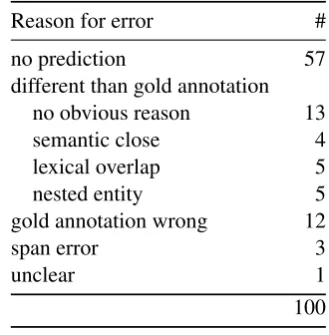
Table 2: Investigating the types of strong preci-sion errors of BERT+Entity trained in Setting I on CoNLL03/AIDA (testa) on 100 randomly sampled strong precision errors from the validation dataset.
[image:6.595.332.497.296.464.2]Task Metric BERT-BERT-Ensemble BERT+Entity-Ensemble
CoLA Matthew’s corr. 59.92 59.97
SST-2 accuracy 92.73 92.43
MRPC F1/accuracy 89.16 90.13
STS-B Pearson/Spearman corr. 89.90 89.60
QQP accuracy 91.64 91.21
MNLI matched acc./mismatched acc. 84.96 84.78
QNLI accuracy 91.21 91.15
RTE accuracy 71.48 73.64
WNLI accuracy 56.33 56.33
SQUAD V2 matched/mismatched 76.89/73.83 76.36/73.46
SWAG accurracy 80.70 80.76
[image:7.595.79.522.64.268.2]WMT14 EN-DE BLEU 22.51 22.20
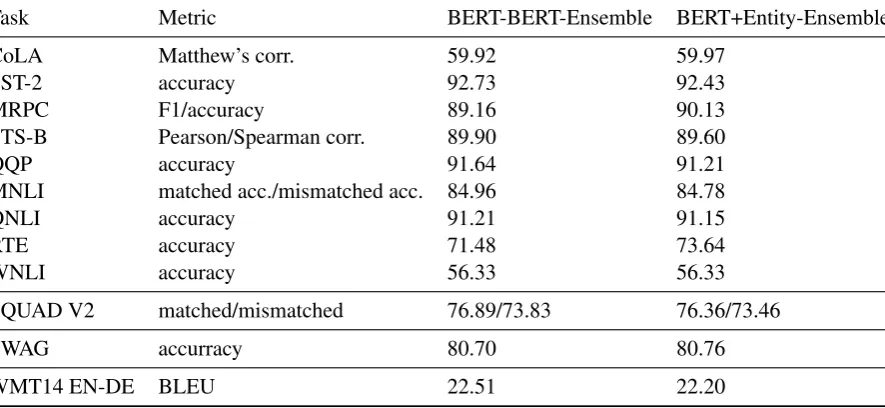
Table 3: Experiments on downstream tasks with BERT+Entity trained in Setting I. The first group are the GLUE tasks, then followed by SQUAD V2 and SWAG (for which only the dev set results are reported), and the results for machine translation WMT14 EN-DE.
When we compare BERT+Entity with the two results from Kolitsas et al. (2018), we observe that BERT+Entity improves over the baseline that models MD, CG and ED independently, and that BERT+Entity comes second to the current state-of-the-art in end-to-end entity linking. What can also be observed is that the performance of all mod-els drops from AIDA/testa to AIDA/testb. For BERT+Entity, however, the drop is more severe, obviously the model overfits to some patterns in the training data that are present in the validation data, but not in the test data. We hypothesize that this might be due to some sport specific documents that make roughly1/4of the dataset’s mentions. However, without spoiling the test-set we cannot know for sure.
In Table2 we performed an error analysis for the experiments for Setting I to learn what kind of strong precision errors are responsible for the performance of BERT+Entity. The largest source of errors was that BERT+Entity did predictNil in-stead of an entity. We hypothesized that most of theno predictionerrors are because those entities have only a low frequency in the training data, i.e. this could be solved by increasing the model size and improving the training time. Another source of error we observed was that the context size was too small due to the fragment size. A surprisingly positive result from the error analysis was that in only 3% a wrong span caused the error. Motivated by the observations we devised the follow-up
ex-periment Setting II (see Section4.1) in which we changed some of the settings to potentially solve the observed issues.
5 Downstream Tasks Experiments
In this section we discuss the downstream task re-sults. We performed evaluations on the natural lan-guage understand task GLUE, the question answer-ing tasks SQUAD V2 and SWAG and the machine translation benchmark EN-DE WMT14. We found that only in one of the subtasks of GLUE —the nat-ural language inference tasks RTE— BERT+Entity performs better than BERT, for all other we can observe no such effect. The reported results are for Setting I, however, we repeated the experiments with Setting II and observed the same outcomes.
5.1 Model
For the tasks GLUE, SQUAD V2 and SWAG we extend hugginface’s implementation5and
con-catenate the outputs of BERT and BERT+Entity (dubbed BERT+Entity-Ensemble) or two BERTs (dubbed BERT-BERT-Ensemble). For EN-DE WMT14 we use BERT (dubbed BERT-2Seq) or BERT+Entity (dubbed BERT+Entity-2Seq) as en-coder and use a Transformer deen-coder by adapting fairseqs Pytorch Seq2Seq Transformer implemen-tation (Ott et al.,2019).
5
5.2 Training
For the GLUE benchmark, SQUAD and SWAG we train the BERT+Entity-Ensemble and BERT-BERT-Ensemble for 3 epochs and use the default hyper-parameters from the implementation. The models BERT-2Seq and BERT+Entity-2Seq we train for 4 epochs, with Adam as optimizer and learning rate5e-5, max1000tokens per batch, clip gradient norm0.1, dropout0.2, label smoothing0.1, and we keep the encoders BERT and BERT+Entity fixed for the first epoch and then train it together with the decoder.
5.3 Results
We find that the additional entity knowledge is not helpful in the evaluated tasks. The results in Table 3show that, except for RTE, there seems to be no advantage in having additional entity knowledge. The question is, if this is (a) due to the entity over-lap in training and testing such that also an entity unaware model can learn the necessary model, or (b) the entities are too scarce in the training data to make a difference, or (c) the tasks themselves do not require entity knowledge, i.e. other textual cues are enough. We leave those questions for future research.
6 Conclusion
In this study we investigated an extremely sim-plified approach to entity linking that worked sur-prisingly well and allowed us to investigate entity knowledge in BERT. Even when there is a gap to the current state-of-the-art in entity linking, we hy-pothesize that this gap can be closed with larger hardware capacity to scale up the model size and effective training time. Apart from that, the model is the first that performs entity linking without any pipeline or any heuristics, compared to all prior approaches. We found that with our approach we can learn additional entity knowledge in BERT that helps in entity linking. However, we also found that almost none of the downstream tasks really required entity knowledge, which is an interest-ing observation and an open question for future research.
Acknowledgments
The author would like to gratefully thank the NVIDIA corporation for the donation of a TITAN Xp GPU that was used in this research.
References
Iz Beltagy, Arman Cohan, and Kyle Lo. 2019. Scibert: Pretrained contextualized embeddings for scientific text. CoRR, abs/1903.10676.
Jacob Devlin, Ming-Wei Chang, Kenton Lee, and Kristina Toutanova. 2019. BERT: pre-training of deep bidirectional transformers for language under-standing. InProceedings of the 2019 Conference of the North American Chapter of the Association for Computational Linguistics: Human Language Technologies, NAACL-HLT 2019, Minneapolis, MN, USA, June 2-7, 2019, Volume 1 (Long and Short Pa-pers), pages 4171–4186.
Greg Durrett and Dan Klein. 2014. A joint model for entity analysis: Coreference, typing, and linking.
TACL, 2:477–490.
Yuhang Guo, Bing Qin, Yuqin Li, Ting Liu, and Sheng Li. 2013. Improving candidate generation for entity linking. In Natural Language Processing and In-formation Systems - 18th International Conference on Applications of Natural Language to Informa-tion Systems, NLDB 2013, Salford, UK, June 19-21, 2013. Proceedings, pages 225–236.
Ben Hachey, Will Radford, Joel Nothman, Matthew Honnibal, and James R. Curran. 2013. Evaluating entity linking with wikipedia.Artif. Intell., 194:130– 150.
Johannes Hoffart, Mohamed Amir Yosef, Ilaria Bor-dino, Hagen F¨urstenau, Manfred Pinkal, Marc Span-iol, Bilyana Taneva, Stefan Thater, and Gerhard Weikum. 2011.Robust disambiguation of named en-tities in text. InProceedings of the 2011 Conference on Empirical Methods in Natural Language Process-ing, EMNLP 2011, 27-31 July 2011, John McIntyre Conference Centre, Edinburgh, UK, A meeting of SIGDAT, a Special Interest Group of the ACL, pages 782–792.
Jeremy Howard and Sebastian Ruder. 2018. Universal language model fine-tuning for text classification. In
Proceedings of the 56th Annual Meeting of the As-sociation for Computational Linguistics, ACL 2018, Melbourne, Australia, July 15-20, 2018, Volume 1: Long Papers, pages 328–339.
Diederik P. Kingma and Jimmy Ba. 2015. Adam: A method for stochastic optimization. In 3rd Inter-national Conference on Learning Representations, ICLR 2015, San Diego, CA, USA, May 7-9, 2015, Conference Track Proceedings.
Nikolaos Kolitsas, Octavian-Eugen Ganea, and Thomas Hofmann. 2018. End-to-end neural entity linking. In Proceedings of the 22nd Conference on Computational Natural Language Learning, pages 519–529, Brussels, Belgium. Association for Computational Linguistics.
and Jaewoo Kang. 2019. Biobert: a pre-trained biomedical language representation model for biomedical text mining.CoRR, abs/1901.08746.
Dat Ba Nguyen, Martin Theobald, and Gerhard Weikum. 2016.J-NERD: joint named entity recogni-tion and disambiguarecogni-tion with rich linguistic features.
TACL, 4:215–229.
Myle Ott, Sergey Edunov, Alexei Baevski, Angela Fan, Sam Gross, Nathan Ng, David Grangier, and Michael Auli. 2019. fairseq: A fast, extensible toolkit for sequence modeling. In Proceedings of NAACL-HLT 2019: Demonstrations.
Maria Pershina, Yifan He, and Ralph Grishman. 2015. Personalized page rank for named entity disambigua-tion. InNAACL HLT 2015, The 2015 Conference of the North American Chapter of the Association for Computational Linguistics: Human Language Tech-nologies, Denver, Colorado, USA, May 31 - June 5, 2015, pages 238–243.
Matthew E. Peters, Mark Neumann, Mohit Iyyer, Matt Gardner, Christopher Clark, Kenton Lee, and Luke Zettlemoyer. 2018. Deep contextualized word rep-resentations. In Proceedings of the 2018 Confer-ence of the North American Chapter of the Associ-ation for ComputAssoci-ational Linguistics: Human Lan-guage Technologies, NAACL-HLT 2018, New Or-leans, Louisiana, USA, June 1-6, 2018, Volume 1 (Long Papers), pages 2227–2237.
Matthew E. Peters, Sebastian Ruder, and Noah A. Smith. 2019. To tune or not to tune? adapting pre-trained representations to diverse tasks. In Proceed-ings of the 4th Workshop on Representation Learn-ing for NLP, RepL4NLP@ACL 2019, Florence, Italy, August 2, 2019., pages 7–14.
Alec Radford, Jeff Wu, Rewon Child, David Luan, Dario Amodei, and Ilya Sutskever. 2019. Language models are unsupervised multitask learners.
Pranav Rajpurkar, Robin Jia, and Percy Liang. 2018. Know what you don’t know: Unanswerable ques-tions for squad. InProceedings of the 56th Annual Meeting of the Association for Computational Lin-guistics, ACL 2018, Melbourne, Australia, July 15-20, 2018, Volume 2: Short Papers, pages 784–789.
Ian Tenney, Dipanjan Das, and Ellie Pavlick. 2019. BERT rediscovers the classical NLP pipeline. In
Proceedings of the 57th Conference of the Associ-ation for ComputAssoci-ational Linguistics, ACL 2019, Flo-rence, Italy, July 28- August 2, 2019, Volume 1: Long Papers, pages 4593–4601.
Ashish Vaswani, Noam Shazeer, Niki Parmar, Jakob Uszkoreit, Llion Jones, Aidan N. Gomez, Lukasz Kaiser, and Illia Polosukhin. 2017. Attention is all you need. InAdvances in Neural Information Pro-cessing Systems 30: Annual Conference on Neural Information Processing Systems 2017, 4-9 Decem-ber 2017, Long Beach, CA, USA, pages 6000–6010.
Alex Wang, Amanpreet Singh, Julian Michael, Fe-lix Hill, Omer Levy, and Samuel R. Bowman. 2018. GLUE: A multi-task benchmark and anal-ysis platform for natural language understand-ing. In Proceedings of the Workshop: Analyzing and Interpreting Neural Networks for NLP, Black-boxNLP@EMNLP 2018, Brussels, Belgium, Novem-ber 1, 2018, pages 353–355.
Ikuya Yamada, Hiroyuki Shindo, Hideaki Takeda, and Yoshiyasu Takefuji. 2016. Joint learning of the em-bedding of words and entities for named entity dis-ambiguation. InProceedings of the 20th SIGNLL Conference on Computational Natural Language Learning, CoNLL 2016, Berlin, Germany, August 11-12, 2016, pages 250–259.
Ikuya Yamada, Hiroyuki Shindo, Hideaki Takeda, and Yoshiyasu Takefuji. 2017. Learning distributed rep-resentations of texts and entities from knowledge base.TACL, 5:397–411.
Rowan Zellers, Yonatan Bisk, Roy Schwartz, and Yejin Choi. 2018. SWAG: A large-scale adversar-ial dataset for grounded commonsense inference. In
Proceedings of the 2018 Conference on Empirical Methods in Natural Language Processing, Brussels, Belgium, October 31 - November 4, 2018, pages 93– 104.