A Study on Initial Public Offering
Mankali Nirmala
Anurag Group of Institutions, India
Abstract: This report aims at knowing the pricing process and performance of Initial public offering for short period. In this project the process of valuation of initial public offering (pricing) and various kinds of issues are studied. It aims at finding out the performance of the Indian Ipo's for short period, i.e. from the date of offer to the public to the date of their first day of trading after listing on stock exchange. The sample size is seven. The data was collected from various sources available like NSE, BSE, SEBI and magazines. Collections of data were analyzed and tabulated in a sequential manner and the interpretations are given. The conclusion and suggestions are also given in this report for clear understanding of the performance of the Ipo's.
I. INTRODUCTION A. Initial Public Offering
A corporate may raise capital in the primary market by way of an initial public offering, rights issue or private placement. An Initial Public provide (IPO) is that the commerce of securities to the general public within the primary market. It is the most important supply of funds with long or indefinite maturity for the corporate. Requirement of funds so as to finance the business activities motivates tiny entrepreneurs to approach the new issue market. IPO may be a route for a corporation to boost capital from investors to satisfy the expenses for its comes and to urge a worldwide exposure by listed within the stock market. An IPO is the selling of securities to the public in the primary stock market. Company raising cash through commercialism is additionally referred to as as company ‘going public'.
From an investor’s point of view, IPO gives chance to buy shares of a company, directly from the company at the price of their choice Many a times there is a massive distinction between value|the worth|the value} at that corporations decides for his or her shares and also the price on that capitalist square measure willing to shop for shares which provides smart listing gain for shares allotted to the capitalist in commercialism. From a company’s perspective, IPO’s help them to identify their real value which is decided by millions of investors once their shares are listed on stock exchanges. IPO's also provide funds for their future growth or for paying their previous borrowings.
“An initial public offering , referred to simply as an "offering" or "flotation", is when a company (called the issuer) issues common stock or shares to the public for the first time.”
IPOs are often issued by smaller, younger companies seeking capital to expand, but can also be done by large privately owned companies looking to become publicly traded. When a company lists its securities on a public exchange, the money paid by investors for the newly- issued shares goes directly to the company. An IPO, therefore, allows a company to tap a wide pool of investors to provide it with capital for future growth, repayment of debt or working capital. IPO can be used as both a financing strategy and an exit strategy. In a financing strategy the main purpose of the IPO is to raise funds for the company. In an exit strategy for existing investors, IPOs may be used to offload equity holdings to the public through a public issue. A company selling common shares is never required to repay the capital to investors. Once a company is listed, it is able to issue additional common shares via a secondary offering, thereby again providing itself with capital for expansion without incurring any debt. This ability to quickly raise large amounts of capital from the market is a key reason many companies seek to go public.
1) Raising funds to the finance capital expenditure programs like the expansion, modernization, diversification, etc;
2) Debt financing
3) Financing of the increased working capital requirements;
[image:1.612.51.565.661.732.2]4) Financing acquisitions like the brand acquisitions, manufacturing unit, tender offers for shares of another firm, etc; 5) Exit route for the exiting investors.
Table No 1: Advantages and Disadvantages of IPO
advantages disadvantages
1.Fund raising 2.Exitopportunity 3.Publicity&credibility
4.Reduced overall cost of capital
1.Potential loss of control 2.Transaction costs
B. These are the Applicable Laws
A Company is required to the comply with the following laws in connection with a public issue
1) Provisions of “The Companies Act, 1956.”
2) Securities Contracts (Regulations) Act, 1956
3) SEBI Regulations & Rules
4) Compliance to the Listing Agreement with the concerned stock exchanges after the listing of securities. 5) RBI regulations in case of foreign.
C. Offer Documents
1) ‘Offer document’ is a document which contains all the relevant information about the company, the promoters, projects, financial details, objects of raising the money, terms of the issue etc and is used for inviting subscription to the issue being made by the issuer. ‘Offer Document’ is called “Prospectus” in case of a public issue or offer for sale and “Letter of Offer” in case of a rights issue. Terms used for offer documents vary depending upon the stage or type of the issue where the document is used. The terms used for offer documents are defined below:
2) Draft offer Document: It is an offer document filed with SEBI for specifying changes, if any, in it, before it is filed with the Registrar of companies (ROCs). Draft offer document is made available in public domain including SEBI website, for enabling public to give comments, if any, on the draft offer document.
3) Red Herring Prospectus: It is an offer document used in case of a book built public issue. It contains all the relevant details except that of price or number of shares being offered. It is filed with Registrar of Companies before the issue opens.
4) Prospectus: It is an offer document in case of a public issue, which has all relevant details including price and number of shares being offered. This document is registered with Registrar of Companies before the issue opens in case of a fixed price issue and after the closure of the issue in case of a book built issue.
5) Letter of Offer: It is an offer document in case of a Rights issue and is filed with Stock exchanges before the issue opens. 6) Abridged Prospectus: It is an abridged version of offer document in public issue and is issued along with the application form
of a public issue. It contains all the salient features of a prospectus. Abridged letter of offer is an abridged version of the letter of offer. It is sent to all the shareholders along with the application form.
7) Shelf Prospectus: It is a prospectus which enables an issuer to make a series of issues within a period of 1 year without the need of filing a fresh prospectus every time. This facility is available to public sector banks /Public Financial Institutions.
8) Placement Document: It is an offer document for the purpose of Qualified Institutional Placement and contains all the relevant and material disclosures
D. Primary Criteria for IPO 1) SEBI Guidelines
a) Net tangible assets of a minimum of Rs.3crore in every of the preceding 3 full years. b) Distributable profits for a minimum of 3 out of the straight off preceding 5 years. c) Net price of a minimum of Rs.1 crore in each of the preceding three full years d) Issue size shouldn't exceed five times the pre- issue net price.
e) If there has been a modification within the company’s name, at least 50% of the revenue for preceding one year should be from
the new activity denoted by the new name.
2) Alternative Route for Companies which don’t Comply with SEBI Guidelines a) Alternative 1
i) Issue shall be through book building route, with at least 50% to be mandatory allotted to the Qualified Institutional Buyers (QIBs)
ii) The minimum post-issue face worth capital shall be Rs.10 crore or there shall be a compulsory market-making for at least 2
years b) Alternative 2
ii) The minimum post-issue face worth capital shall be Rs.10 crore or there shall be a compulsory market-making for at least 2 years. In addition to satisfying the same eligibility norms, the company shall also satisfy the criteria of having at least 1000 prospective allottees in its issue.
iii) Certain class of entities that are exempted from the said entry norms, are as under:
1. Private Sector Banks
2. Public sector banks
3. An infrastructure company whose project has been appraised by a Public Financial Institution or IDFC or IL&FS or a bank which was earlier a PFI and not less than five percent of the project cost is financed by any of these institution.
E. Scope of the study
1) Analysis of 7 IPOs from the year 2018.
2) Measurement of performance with the average return with the first day (1month, 3month, 6month, 12month).
3) The study has been gone for the assessing value execution of Indian IPOs and to judge the degree of underpricing and overpricing
F. Need
IPO is one of the financing means which is widely used by the corporate world all over, for meeting the financing needs of the new as well as ongoing companies. “To study the awareness level of IPO among investors. And the returns/profits and risks involved in the IPO
G. Objectives
1) To analyse and understand the returns of the 7 companies i.e daily basis, monthly basis
2) To find out the factors contributing to the underpricing or over pricing of IPO.
H. Limitations
1) The work is totally based on secondary data and it can be inaccurate. 2) Errors due to misinterpretation.
3) The analysis is totally depends upon the reliability of the data sources.
I. Research Methodology
The analysis of the study is done on the basis of:
1) The present study was taken from the secondary data. The secondary data was collected from the various sources available like
websites mainly RBI, SEBI, NSE and BSE, magazines, journals, books, articles.
2) The sample design of these companies are randomly choosen and these are listed on the Stock Exchanges.
3) Sample collection of an information have consistently been available. NSE was selected as the Market Index for the study.NSE
of India is the oldest stock exchange and most of IPOs were listed in the stock exchange.
II. REVIEW OF LITERATURE
A. Allen and Faulhaber (1989), find that in some circumstances good firms want to "signal" to their investors about their good future prospects and therefore underprice their IPOs. that IPOs area unit underpriced thus on leave an honest style within the investors' mouths so future seasoned equities may be priced higher.
B. Gadesurendar and Dr.S.Kamaleshwari Rao(2011) The companies can raise in the primary market with the help of initial public
offerings, rights issue. An IPO is one through which an unlisted company makes either for the first time to be public or both a fresh issue of securities of an offer for sale of its existing securities. IPO has deepen the market to diversify the investor portfolio, reduce volatility in the stock prices can bring investor money into the market.
C. S.S.S. Kumar (2010), stated that the performance issued through the book building process in India over the period 1999-2006.the sample comprises 156 firms that upon listening the IPO’s on an average offered positive returns up till 24 months but subsequently they underperform the market.
D. Aditya Adthikari (2010), stated that companies with unique business models got listed in the year 2009-2010 and made their
E. Benveniste and Spindt (1989), predicts that underpricing can be reduced if the investors that provide more information to the issuing firm can be awarded with more shares.
[image:4.612.67.536.149.265.2]III. DATA ANALYSIS AND INTREPRETATION Table No 2: Closing price of IPO:
1) Method for short- term Performance of IPOs: The methodology used by Aggarwal, Leal and Hernandez (1993) to measure the short-run performance for each IPO and for groups of IPOs. The total return for stock “i” at end of the primary trading day is calculated as:
Ri1= (Pi1/Pi0) -1 (1)
Where Pil is the closing price of the stock i at the first trading day, and Pi0 is its offering price and Ril is the total first-day return on the stock. The return on the market index during the same time period is:
R m1 = (P m1/ P m0) – 1 (2)
where P m1is the closing market index value at the first trading d ay and P m0 is the closing market index value on the offering day of the appropriate stock, while R m1 is the first day’s comparable market return.
Using these 2 returns, the market-adjusted abnormal return for each IPO on the first day of trading is computed as: MAARi1= 100 (1+ Ri1/ 1+ R m1-1) (3)
2) Method for long- term Performance of IPOs: The Long Term Performance Is Based on the CAAR Model it means Cumulative Average Abnormal Return:
Average CAR=1/N ∑ εit
where the abnormal return in month t after the Initial Public Offer for the firm I is given by εit and N is the no of firms in the sample.
3) Short- run Return of IPOs
Table No 3: calculation of One Day Return of 7 companies
S.no Name of the IPO
Offer price
One day One month
Three Month
Six month
One year
1 Hindustan Aeronautics Ltd 1,215 675.95 715.60 677.70 713.18 761.12
2 Karda Construction Ltd 180 191.15 205.85 176.50 194.60 172.65
3 Mishra Dhatu Nigam Ltd 90 117.3 125.40 133.55 119.73 141.34
4 ICICI Securities Ltd 520 224.55 212.72 222.81 196.26 295.15
5 IndoStar Capital Finance Ltd 572 313.65 365.15 398.60 325.75 457.06
6 RITES Ltd 185 302.55 286.89 239.06 229.80 208.39
7 Varroc Engineering Ltd 967 434.7 473.05 566.35 643.50 974.80
One Day Return of 7 companies
Name of the IPO Offer
price
First
day Ril
nifty
open nifty close Rm1 MAAR
Hindustan Aeronautics Ltd 1,215 675.95 -0.44 8940.2 8912.1 -0.003 -44.19
Karda Construction Ltd 180 191.15 0.06 296.5 296.4 0 6.21
Mishra Dhatu Nigam Ltd 90 117.3 0.3 3575 3468.4 -0.03 34.34
ICICI Securities Ltd 520 224.55 -0.57 10317.7 10169.3 -0.014 -56.19
IndoStar Capital Finance Ltd 572 313.65 -0.45 10381.1 10693.7 0.03 -46.77
RITES Ltd 185 302.55 0.64 3126.6 3063.7 -0.02 66.9
Varroc Engineering Ltd 967 434.7 -0.55 10928.4 11067.9 0.013 -55.61
Total -95.31
[image:4.612.68.543.540.709.2]Fig No 1: Graphical representation of First Day Return of 7 company
a) Interpretation: In the graph X-axis represents name of the companies and Y-axis represents short run returns i.e for 1 day. The average first day returns for the entire sample of 7 selected companies. Figure-1: shows the frequency of the market-adjusted initial returns of the IPOs. The Average MAAR is found to -13.61%.so Average MAAR has a lesser return in a first day. And it is a less profit potential in a first day of initial public i.e.-13.61%. return on the first day. And it is negative for the investor.
[image:5.612.125.486.88.215.2]4) Long-run return of IPOS
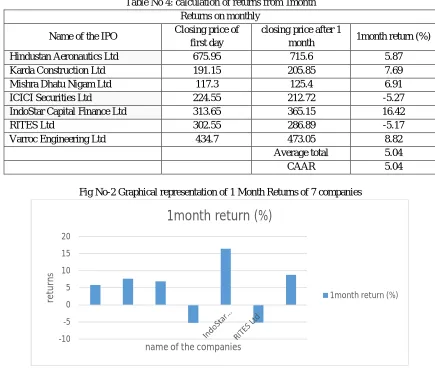
Table No 4: calculation of returns from 1month Returns on monthly
Name of the IPO Closing price of
first day
closing price after 1
month 1month return (%)
Hindustan Aeronautics Ltd 675.95 715.6 5.87
Karda Construction Ltd 191.15 205.85 7.69
Mishra Dhatu Nigam Ltd 117.3 125.4 6.91
ICICI Securities Ltd 224.55 212.72 -5.27
IndoStar Capital Finance Ltd 313.65 365.15 16.42
RITES Ltd 302.55 286.89 -5.17
Varroc Engineering Ltd 434.7 473.05 8.82
Average total 5.04
CAAR 5.04
Fig No-2 Graphical representation of 1 Month Returns of 7 companies
a) Interpretation: In the graph X-axis represents name of the companies and Y-axis represents long run returns for the one month. The Average CAAR for monthly is 5.04. So it is a positive for the company & the investor. Also company takes a return for IPOs. And more profit potential of IPOs after the long period i.e. monthly for investor.
-100 -50 0 50 100
Hindustan Aeronautics Ltdretu Karda Construction LtdMishra Dhatu Nigam LtdICICI Securities LtdIndoStar Capital Finance LtdVarroc Engineering LtdRITES Ltd
rn
s
name of the companies
MAAR
MAAR
-10 -5 0 5 10 15 20
re
tu
rn
s
name of the companies
1month return (%)
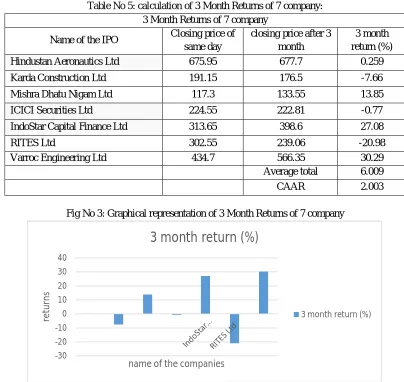
[image:5.612.86.521.310.678.2]Table No 5: calculation of 3 Month Returns of 7 company: 3 Month Returns of 7 company
Name of the IPO Closing price of
same day
closing price after 3 month
3 month return (%)
Hindustan Aeronautics Ltd 675.95 677.7 0.259
Karda Construction Ltd 191.15 176.5 -7.66
Mishra Dhatu Nigam Ltd 117.3 133.55 13.85
ICICI Securities Ltd 224.55 222.81 -0.77
IndoStar Capital Finance Ltd 313.65 398.6 27.08
RITES Ltd 302.55 239.06 -20.98
Varroc Engineering Ltd 434.7 566.35 30.29
Average total 6.009
CAAR 2.003
Fig No 3: Graphical representation of 3 Month Returns of 7 company
[image:6.612.100.509.90.274.2]a) Interpretation: In the graph X-axis represents name of the companies and Y-axis represents longrun returns for the 3 month. The Average CAAR for Quarterly is 2.003. So it is a Positive for the company & the investor. Also company takes a return for IPOs. And profit potential of IPOs after long period i.e. quarterly return for investor. As compare to monthly return it is a more risk for each 7 companies & investor.
Table No 6: calculation of 6 Month returns of 7 company:
6 Month returns of 7 company
Name of the IPO Closing price of
first day
closing price after 6 month
6 month return (%)
Hindustan Aeronautics Ltd 675.95 713.18 5.51
Karda Construction Ltd 191.15 194.6 1.8
Mishra Dhatu Nigam Ltd 117.3 119.73 2.07
ICICI Securities Ltd 224.55 196.26 -12.6
IndoStar Capital Finance Ltd 313.65 325.75 3.86
RITES Ltd 302.55 229.8 -24.05
Varroc Engineering Ltd 434.7 643.5 48.03
Average total 3.52
CAAR 0.58
-30 -20 -10 0 10 20 30 40
re
tu
rn
s
name of the companies
3 month return (%)
[image:6.612.94.518.551.727.2]Fig No 4: Graphical representation of 6 Month returns of 7 company
[image:7.612.101.511.89.214.2]a) Interpretation: In the graph X-axis represents name of the companies and Y-axis represents longrun returns for the 6 months. The Average CAAR for haft yearly is 0.58. So it is a positive for the company & the investor. Also company takes a less risk for IPOs. And more profit potential of IPOs after the long period i.e. haft yearly return for investor. As compare monthly return it is a more risky but quarterly return less risky for each 7companies & investor.
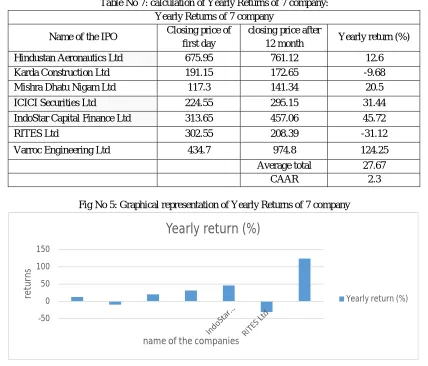
Table No 7: calculation of Yearly Returns of 7 company: Yearly Returns of 7 company
Name of the IPO Closing price of
first day
closing price after
12 month Yearly return (%)
Hindustan Aeronautics Ltd 675.95 761.12 12.6
Karda Construction Ltd 191.15 172.65 -9.68
Mishra Dhatu Nigam Ltd 117.3 141.34 20.5
ICICI Securities Ltd 224.55 295.15 31.44
IndoStar Capital Finance Ltd 313.65 457.06 45.72
RITES Ltd 302.55 208.39 -31.12
Varroc Engineering Ltd 434.7 974.8 124.25
Average total 27.67
[image:7.612.92.520.298.664.2]CAAR 2.3
Fig No 5: Graphical representation of Yearly Returns of 7 company
a) Interpretation: In the graph X-axis represents name of the companies and Y-axis represents longrun returns for the year. The Average CAAR is 2.30. So it is a positive for the company & the investor. Also company takes a risk for IPOs. And more profit potential of IPOs after long period i.e. Yearly return for investor. As compare to monthly return it is a less risky but quarterly return & haft yearly return less risky for each 7 companies & investor.
-50 0 50 100
Hindustan Aeronautics Ltdre Karda Construction LtdMishra Dhatu Nigam LtdICICI Securities LtdIndoStar Capital Finance LtdVarroc Engineering LtdRITES Ltd
tu
rn
s
name of the companies
6 month return (%)
6 month return (%)
-50 0 50 100 150
re
tu
rn
s
name of the companies
Yearly return (%)
Table No 8: Common table for long-term returns of IPOS
S.no Name of the IPO
Return after
1 month 3 month 6 month 12 month
1 Hindustan Aeronautics Ltd 5.87 0.259 5.51 12.6
2 Karda Construction Ltd 7.69 -7.66 1.8 -9.68
3 Mishra Dhatu Nigam Ltd 6.91 13.85 2.07 20.5
4 ICICI Securities Ltd -5.27 -0.77 -12.6 31.44
5 IndoStar Capital Finance Ltd 16.42 27.08 3.86 45.72
6 RITES Ltd -5.17 -20.98 -24.05 -31.12
7 Varroc Engineering Ltd 8.82 30.29 48.03 124.25
AVG. TOTAL 5.04 6.009 3.52 27.67
CAAR 5.04 2.003 0.58 2.3
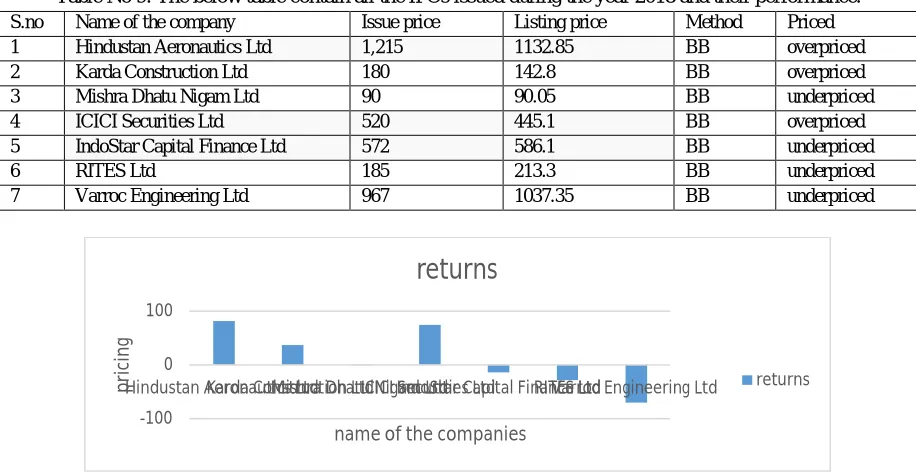
Table No 9: The below table contain all the IPOs issued during the year 2018 and their performance.
S.no Name of the company Issue price Listing price Method Priced
1 Hindustan Aeronautics Ltd 1,215 1132.85 BB overpriced
2 Karda Construction Ltd 180 142.8 BB overpriced
3 Mishra Dhatu Nigam Ltd 90 90.05 BB underpriced
4 ICICI Securities Ltd 520 445.1 BB overpriced
5 IndoStar Capital Finance Ltd 572 586.1 BB underpriced
6 RITES Ltd 185 213.3 BB underpriced
7 Varroc Engineering Ltd 967 1037.35 BB underpriced
5) Underpricing: The pricing of an IPO below its market price, when the issue price is lesser than the price of the first trade, the stock is considered to be underpriced. A stock is usually only underpriced temporarily because the laws of demand and supply will eventually drive it toward its intrinsic value.
6) Overpricing: Overpricing is measured as the difference between the offer or opening price for the IPO’s stock & its closing price after the first day of trading scaled by the offer price. When the gap value exceeds the close price, the IPO is said to be overpriced.
IPO underpricing continues to be a world phenomenon despite a huge quantity of analysis that attempts to explain it. Theories based on information asymmetry suggest that high-quality issuers deliberately underpriced their IPOs to signal their quality to outside investors, hoping that it will be too costly for low-quality issuers to mimic. Underpricing also helps to overcome adverse selection problems. Since uninformed investors tend to get a higher allocation of overpriced shares, they're going to stop taking part in IPOs if issues aren't, on average, underpriced. In the book-building framework, the idea of partial adjustment suggests that investment banks only part regulate initial public offering offer costs upward once they receive positive data regarding the value of the difficulty. They purposely leave money on the table to reward investors who honestly reveal their data regarding the issue and threaten access to future deals for those who don't. Some studies recommend that investment banks underprice IPOs to safeguard their reputation. When new issues are priced below they must be, investment bankers cut back their legal liability by lowering the chance of price declines. There is also evidence that greater underpricing results in a lot of aftermarket trading volume, which increases the revenue of investment bankers once they later become the market-makers for these initial offering companies.
-100 0 100
Hindustan Aeronautics Ltdpri Karda Construction LtdMishra Dhatu Nigam LtdICICI Securities LtdIndoStar Capital Finance LtdRITES LtdVarroc Engineering Ltd
ci
n
g
name of the companies
returns
[image:8.612.77.535.247.483.2]Investment bankers additionally enjoy underpricing as a result of it permits them to court favour with their clients in exchange for his or her loyalty and continued business. These explanations do not make it clear why provision companies approve underpricing because it only advantages the investment banks. There are explanations of underpricing that are supported data production and ownership dispersion which will benefit the issuing firms. If issuing firms want to have a more distributed possession, they need to underprice their IPOs so that more investors will be induced to provide data regarding the difficulty and later purchase the shares. Dispersed ownership will increase liquidity and aftermarket trading, and also helps existing owners to retain control of their firms. These explanations predict a positive relationship between underpricing and aftermarket liquidity. However, there's additionally a proof that predicts an inverse relationship between these two variables. When aftermarket trading for an IPO is expected to be thin, investors face higher aftermarket trading prices related to asymmetric information; so, they demand a higher level of underpricing to compensate them for the liquidity risk.
It has additionally been argued that underpricing may be a substitute for promoting expenditure. Hugely underpriced IPOs tend to receive a disproportionate amount of media attention and publicity. Research shows that an additional dollar left on the table reduces alternative promoting expenditure by about the same amount. Higher underpricing additionally attracts additional analyst coverage post initial offering.
IV. FACTORS FOR THE UNDERPRICING AND OVERPRICING OF IPO’S
1) Underpricing: The empirical literature is currently fairly mature in claiming adequate proof for the underpricing of IPOs. Broadly speaking, some sort of underpricing for IPOs is reported in every capital market globally. The remarkable empirical regularity inspired large sections of theoretical literature to explore the underlying rationality behind sell. Studies on IPO underprice will be classified beneath four completely different broad headings: (a) information asymmetry;(b) Institutional reasons;(c) control considerations; and (d) behavioural approaches
2) Information Asymmetry: This model argues that investors within the new issue market are vertically split into 2 classes, i.e., informed and uninformed. Informed investors place in an exceedingly sizable amount of applications for underpriced problems, while uninformed investors apply indiscriminately. As a result, uninformed investors have lesser chance of obtaining an allotment in profitable IPOs as a result of their demand is partially packed out by informed investors. Thus, ignorant investors are cursed by obtaining optimum allocation in an unsuccessful initial offering and thus are losing their interest within the market. To attract the uninformed investors to the initial offering market, the issues must be underpriced to some extent so that an assured return can be made. The additional the magnitude of knowledge friction, the more likely the difficulty are underpriced owing to uncertainty close the initial offering.
3) Institutional Explanations: Deliberately sell the IPOs to avoid potential lawsuit threats from disappointed investors. Underpricing is used to safeguard the possible lawsuit threat. Other studies supporting institutional approach for IPO underprice include, price stabilization theory and tax arguments Ownership and management Consideration: provision equity through initial offering route eventually leads to separation of ownership and control. Underpricing induced ownership dispersion as a large and various cluster of investors bid for the IPOs. Managers then strategically allocate the IPOs to protect their private benefits. Other studies found evidence in support of the ownership and control consideration as motivation for underprice. 4) Allocating shares to large outside investors is worth enhancing, as a result of these investors will result strict direction and
managerial control on the IPO firm.
5) Behavioral Explanations: Behavioural theories notice that investors bid IPOs without reasoning. Overenthusiastic investors bet the price of IPO shares beyond their true fundamental value. Investors take the IPOs by consecutive learning from the response of the sooner investors. as an alternative, latter investors base their investment call on the initial investors’ information and discount their private information.
6) Risk, Uncertainty, and Divergence of Opinion: Information plays a crucial role in just about all models of initial underpricing. In these models, some type of asymmetrically control information is employed to inspire the required discounting of the offer price to beat one or additional of the following: agency issues, adverse selection, moral hazard, and signaling, herding and/or irrational behavior.
A. Findings
1) Investors more crazy about the new issues or IPO.
2) It may be useful for the issuer companies to decide the issue size of IPOs for more underpricing.
3) This study results may be helpful for the SEBI authorized rating agencies who assigned the rating grades to the IPO companies
to protect the investors from losses and helpful in making investment decisions rather than suggested the buy, hold and sell decision for IPO.
4) The results may be helpful for the government and SEBI who make policies and issued the guidelines for the IPO companies in
future.
5) In the short run performance i.e for the same day the total returns and MAAR both are showing negative results.
6) For the long run performance i.e for the 1 month the ICICI securities ltd and RITES ltd are having negative returns and remaining companies are positive from the IPO.
7) For the long run performance i.e for the 3 month the Karda construction ltd, ICICI securities ltd and RITES ltd are having negative returns and remaining companies are positive from the IPO.
8) For the long run performance i.e for the 6 month the ICICI securities ltd and RITES ltd are having negative returns and remaining companies are positive from the IPO.
9) For the long run performance i.e for the 12 month the RITES ltd are having negative returns and remaining companies are positive from the IPO.
B. Suggestions
1) The returns of IPO’s are higher when compare to benchmark portfolio of Nifty. So an investor can invest in IPO’s for better
returns.
2) Investor need to develop a long term investment mindset rather than short term investment to get more returns or for achieving financial goals
3) A good investor should diversified and the reduces his risk by investing in different securities which contained different risks and returns in order to the achieve his goals.
4) An easy solution to investor is to invest in to mutual fund schemes through a systematic investment plan the mutual fund gives you a well diversified, professionally managed portfolio at low cost
5) Investor need to aware of new information, which reflects the wider changes in the share prices.
C. Conclusion
1) It can be observed that it is safe for the general public to invest in the different sectors of the primary market in present than in the past because SEBI has been introduced and it controls the operations and working of the new issue market.
2) Primary market returns are very attractive in the short period especially on the day of listing. But investors in IPO’s should take wise decision in choosing the best company.
3) The short-term performance of these companies shows that investment in Indian IPOs provides negative abnormal return by the
end of the first trading day. And the higher chance to earn profit in the long term IPOs for the Indian investors.
4) This study shows that investment in IPOs generally negative benefit to Indian investor in short term IPOs. And positive for long term IPOs.
BIBLIOGRAPHY [1] https://www.nseindia.com/products/content/equities/ipos/ipos.htm
[2] http://www.chittorgarh.com/ipo/ipo_list.asp
[3] https://www.sebi.gov.in/sebiweb/home/HomeAction.do?doListing=yes&sid=3&ssid=15&smid=10 [4] https://www.bseindia.com/markets/PublicIssues/IPOIssues_new.aspx?expandable=3&id=2&Type=P