87
©IJRASET: All Rights are Reserved
MAC Layer Evaluation using IEEE 802.15.4
Ashok Kumar Yadav1, Sukhvinder S Bamber2, Prof (Dr.) A. K. Solanki3
1
Research Scholar, Computer Science and Engineering, Bhagwant University, Ajmer Rajasthan
2
Assisant Professor, Computer Science and Engineering, U.I.E.T. PUSSGRC, Hoshiarpur
3
Professor, Computer Science and Engineering, B.I.E.T., Jhansi, Uttar Pradesh
Abstract: In the present era, a well-regulated web server comes with all new solutions to all new bulky heap of requests of daily users. As there is a rapid change in technology, the average number of requests on the web server is increasing rapidly. Moreover, WSNs (Wireless Sensor Networks) has proved to be a revolutionary technology for monitoring the physical and environmental state of a machine.
This manuscript targets to evaluate the performance of a web server based upon modern day protocol IEEE 802.15.4 for WSNs using different scenarios (with GTS (Guaranteed Time Slot), Mixed, & Without GTS). Depending upon the evaluation performed, it can be concluded that the performance of the web server can be enhanced by trading-off in the use of the GTS mechanism in IEEE 802.15.4 for WSNs.
Keywords:Web Server, IEEE 802.15.4, GTS, MAC Layer, WSN
I. INTRODUCTION
Web servers are defined as the program that employs HTTP which passes files that help in the creation of webpages to the users in the response of their requests, which are sent using the HTTP connection of their systems. Any device that shares the XML document with another device can be recognized as a web server.
Moreover, it can also be defined as an Internet Server whose main aim is to respond back to the HTTP request and deliver the required content or services. Load on a Web Server may be defined as sending a large amount of request to the server for retrieving the required content using HTTP connection. Load on a Web Server definitely reduces the performance of the server i.e. slows down the response time of server for particular request [1].
IEEE 802.15.4 protocol works to specify the physical and MAC sub-layer of LR-WPAN (Low Rate Wireless Personal Area Network) [2]. Although this is the standard protocol that was initially not developed for usage in WSNs, it provides enough flexibility that suits the requirements of WSNs by tuning its parameters as per requirement. In fact, low-rate, low-power consumption and low-cost wireless networking are the key features of the IEEE 802.15.4 protocol [3], which fulfills the basic requirements of WSNs. In this protocol, the physical layer is developed low data-rates, energy efficiency, and robustness, whereas, MAC layer which contains the superframes structure, provides the flexibility to meet the requirements of the other applications. The IEEE 802.15.4 protocol has attracted several recent research works.
Jurcik[4] addresses the performance evaluation of IEEE 802.15.4 GTS (Guaranteed Time Slot) mechanism, and it is a research effort aiming at assessing IEEE 802.15.4/ZigBee protocol as a candidate technology within the ART-Wise framework. Koubaa [5] provides a methodology, based on the network calculus formalism, for evaluating the performance of real-time applications using the GTS mechanism in one IEEE 802.15.4 cluster. Gholamzadeh [6] has discussed certain techniques that result in decreasing the power consumed by WSNs.
This manuscript specifically targets to give a brief introduction to IEEE 802.15.4 used for the research and literature survey for the performance analysis/enhancements in IEEE 802.15.4 WSNs. Section 2 provides the detailed system description which is further moved on by evaluating the appropriate values for attribute settings in section 3. Section 4 describes the results and comparisons of three different scenarios: With GTS (all GTS enabled nodes), Without GTS (All non GTS nodes) and Mixed (GTS & non GTS nodes). Finally, section 5 concludes the manuscript.
II. SYSTEMDESCRIPTION
88
©IJRASET: All Rights are Reserved
A. Scenarios
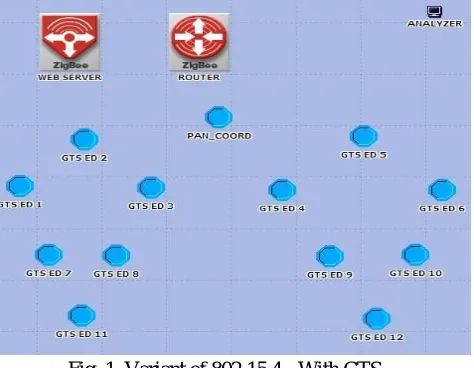
[image:2.612.194.431.118.302.2]Figure 1 shows the With GTS scenario which contains one Web Server, one Router, one PAN Coordinator, one Analyzer and twelve end devices (all GTS enabled).
Fig. 1. Variant of 802.15.4 - With GTS
[image:2.612.193.429.344.520.2]Figure 2 shows a Mixed scenario which contains one Web Server, one Router, one PAN Coordinator, one Analyzer and twelve end devices (six GTS enabled and six non GTS).
Fig. 2. Variant of 802.15.4 – With and Without GTS
Figure 3 shows the Without GTS scenario which contains one Web Server, one Router, one PAN Coordinator, one analyzer and twelve end devices (all non GTS).
[image:2.612.194.429.560.718.2]89
©IJRASET: All Rights are Reserved
B. The Superframe Structure
Superframe structure is defined as a beacon-enabled structure which comprises of the time-interval present in between the two beacon frames, in which, one represents the beginning and the other represents the end [8]. Beacon frames are dispatched periodically by the PAN coordinator to synchronize nodes that are associated with it and to identify its PAN [9]. The time instant between two consecutive beacon frames is called the Beacon Interval which includes the active period and, optionally, the inactive period. The active period, which also called superframe, is divided into 16 equally-sized time slots, and this is the time during which frame transmissions are allowed[10][11]. During the inactive period (if it exists), all nodes may enter in a sleep mode and save energy.
C. Attribute Settings
Web Server’s Performance is based upon IEEE 802.15.4 for WSNs with an appropriate value to the attributes which belong to different types of devices, is relied on the suitable selection of a GTS mechanism. The attributes which can significantly affect the performance of IEEE 802.15.4 protocol for WSNs are acknowledged traffic, unacknowledged traffic, GTS traffic, CSMA/CA, WPAN settings, etc.
III.RESULTSANDDISCUSSION
Simulation is carried out for three different scenarios of IEEE 802.15.4 protocol for WSNs: With GTS, Mixed (With & without GTS nodes) and Without GTS. In this section, the results are presented and discussed for the performance at the MAC layer of web server based on IEEE 802.15.4 WSNs for different types of devices.
A. Media Access Delay
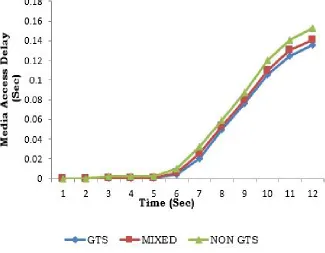
[image:3.612.147.472.388.641.2]MAC Media Access Delay is the time taken while trying to get the access of the channel on which the data is to be transmitted either to the physical layer or the layer from the MAC layer i.e. the extra time taken for getting the access to the channel in excess to the normal time.
Fig. 4. Media Access Delay at MAC Layer of Web Server
90
©IJRASET: All Rights are Reserved
B. Queueing Delay
[image:4.612.188.426.115.291.2]Amount of time spent in the queue at the MAC layer while trying to get access to the channel for transmission or reception.
Fig. 5. Queuing Delay at MAC Layer of Web Server
Figure 5 depicts that the queuing delay at the MAC layer of the web server in case of GTS, MIXED and NON GTS scenarios is: 0.075019371544, 0.092288731474 and 0.086080669394 sec respectively. It is clearly observable that the Queuing delay is Maximum in the case of mixed nodes because it is a combination of GTS and Non GTS nodes because of which more number of collisions, delays, etc. Also, it is observed that queuing delay is minimum in the case of all GTS nodes, as all the required resources are reserved in advance, which results in minimum delays, collisions, etc. Therefore, it is concluded that if the queuing delay at the MAC layer of the web server is to be considered then all nodes connected to the web server must be GTS enabled.
C. Throughput
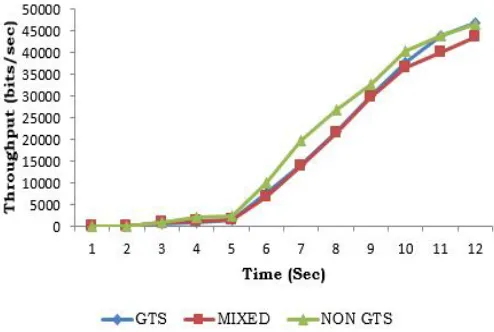
[image:4.612.186.433.463.629.2]The average number of packets (bits) successfully transmitted/received from the MAC layer from the physical or network layer per unit time.
Fig. 6. Throughput at MAC Layer of Web Server
91
©IJRASET: All Rights are Reserved
IV.CONCLUSIONS
In this manuscript, there is research performed for evaluating the performance of a web server based upon the IEEE 802.15.4 protocol for WSNs. Depending upon the different scenarios (With GTS, Mixed & without GTS), a particular type of system is employed. After the system selection, required attributes are selected on the bases of which the required graphs can be prepared. After that, graphs are prepared for the required attributes for making an easy comparison between the different scenarios. After interpreting the graphs quoted in the manuscript, it has been concluded that the GTS mechanism at the end devices in the network provides GoS to the data using the superframe structure but only at the cost of significant performance metrics at the web server. Proving that, there is trade-off in the use of GTS mechanism in IEEE 802.15.4 for WSNs if the performance of the web server is to be enhanced. Few significant conclusions have been reached (explained as follows):
A. If the Media Access Delay at the MAC layer of the web server is to be considered then all nodes should be GTS enabled. B. If the queuing delay at the MAC layer of the web server is to be considered then all nodes connected to the web server must be
GTS enabled.
C. If the throughput at the MAC layer of the web server is to be taken into consideration then all the nodes connected to the web server should be GTS enabled.
REFERENCES
[1] Slothouber, Louis P. "A model of web server performance." Proceedings of the fifth international world wide web conference. 1996.
[2] Howitt, Ivan, and Jore A. Gutierrez. "IEEE 802.15. 4 low rate-wireless personal area network coexistence issues." 2003 IEEE Wireless Communications and
Networking, 2003. WCNC 2003.. Vol. 3. IEEE, 2003.
[3] Petrova, Marina, et al. "Performance study of IEEE 802.15. 4 using measurements and simulations." IEEE Wireless Communications and Networking
Conference, 2006. WCNC 2006.. Vol. 1. IEEE, 2006.
[4] JurcAk, P., et al. "A simulation model for the IEEE 802.15. 4 protocol: delay/throughput evaluation of the GTS mechanism." 2007 15th International Symposium on Modeling, Analysis, and Simulation of Computer and Telecommunication Systems. IEEE, 2007.
[5] Koubaa, Anis, Mário Alves, and Eduardo Tovar. "GTS allocation analysis in IEEE 802.15. 4 for real-time wireless sensor networks." Proceedings 20th IEEE
International Parallel & Distributed Processing Symposium. IEEE, 2006.
[6] Gholamzadeh, Bahareh, and Hooman Nabovati. "Concepts for designing low power wireless sensor network." World Academy of Science, Engineering and
Technology 45 (2008): 559-565.
[7] Lu, Zheng, and Hongji Yang. Unlocking the power of OPNET modeler. Cambridge University Press, 2012.
[8] Wang, Jianfeng, Dave AT Cavalcanti, and Kiran S. Challapali. "Flexible MAC superframe structure and beaconing method." U.S. Patent No. 8,467,357. 18
Jun. 2013.
[9] Kim, Jungsook, et al. "RRMAC: A sensor network MAC for real time and reliable packet transmission." 2008 IEEE International Symposium on Consumer
Electronics. IEEE, 2008.
[10] Yoo, Seong-eun, et al. "Guaranteeing real-time services for industrial wireless sensor networks with IEEE 802.15. 4." IEEE Transactions on Industrial Electronics 57.11 (2010): 3868-3876.
[11] Koubaa, Anis, Mário Alves, and Eduardo Tovar. "GTS allocation analysis in IEEE 802.15. 4 for real-time wireless sensor networks." Proceedings 20th IEEE