430
©IJRASET: All Rights are Reserved
Experimental Optimization of Process Parameters
with Wire-EDM on Inconel 625
Anoop Kumar1, U Ashok Kumar2, P. Laxminarayana3 1, 2, 3
Department of Mechanical Engineering, University College of Engineering, Osmania University, Hyderabad
Abstract:Inconel 625 Alloy was developed as a nickel-chromium alloy solid solution strengthened by its content of molybdenum and niobium. The alloy had two main areas of application like resistance to aqueous corrosion at ambient to slightly elevated temperatures and for high strength and resistance to creep, rupture, and corrosion at high temperatures, therefore had been widely used for more than five decades in the marine and petroleum industries for applications requiring high strength, fracture toughness, fabric-ability and resistance to corrosion. Inconel 625 is one such super alloy which has very good mechanical and thermal properties, and it is difficult to machine with traditional machining processes due to the high melting point and hardness. So, Wire EDM is a non - conventional machining process which is mainly used to machine hard and tough materials like Inconel 625. Design of experiment for three-level on six parameters i.e. peak current, pulse on time, pulse off time, wire feed rate, servo voltage and flushing pressure has obtained using MINITAB 18. Taguchi L27 orthogonal array along with ANOVA is used for optimizing the different parameters such to get maximum material removal rate and maximum hardness is obtained and confirmation test has been done for HV as Taguchi combination is not according to the design of experiments.
Keywords: Inconel 625, Taguchi L27, Material Removal Rate (MRR), Hardness(HV), Analysis Of Variance(ANOVA).
I. INTRODUCTION
Inconel 625 is superalloy of nickel and chromium which is mainly used in marine, petroleum, chemical industries due to its superiority mechanical, chemical and thermal properties [1]. These superalloys are very difficulties to machine with conventional machining methods such as turning, milling or grinding due to its very high hardness. To machining these superalloys non-convectional machining such as electrochemical machining, electric discharge machining, ultrasonic machining etc. are used because these are capable of machining with high accuracy and excellent finishing. Wire EDM is the advancement of EDM, electrothermal machining in which a series of spark is produced between the electrode (wire) and workpiece which is submerged in the dielectric fluid. During the pulse-on time or discharge period, work material is rapidly melted and vaporized to form a cut on the work-piece which is flashed by the dielectric fluid. Dielectric is used to cool the cutting zone and to remove the debris from the cutting zone to ready for the next cycle of discharge. Electrode wire is made of brass, copper or zinc-coated which have good electrical conductivity with a diameter of range 0.1, 0.15, 0.20, 0.25mm etc. depending on the type of application it is used for.
431
©IJRASET: All Rights are Reserved
II. EXPERIMENTPROCEDURE
A. Abbreviations and Acronyms
Design of experiment (DOE), Material removal rate (MRR) and Micro-hardness (Hardness Vickers) HV
B. Experimental Material
Superalloy Inconel 625 can be manufactured these days in vacuum induction melted, controlled chemical composition, a fine-grain product that exhibits greatly improved toughness, hardness and thermal stability [1].
Table- I Chemical composition of Inconel 625. S.
No.
Chemical composition of Inconel 625 Element Percentage % 1 Nickel (Ni) 61.56
2 Chromium (Cr) 21.47
3 Molybdenum (Mo) 8.10
4 Niobium (Nb) 2.53
5 Titanium (Ti) 0.15
6 Iron (Fe) 4.10
7 Aluminium (Al) 1.86
8 Silicon (Si) 2.26
Table- II Mechanical properties of Inconel 625
S. No. Mechanical properties of Inconel 625 Properties Value
1 Density (g/cm3) 8.44
2 Elastic modulus (GPa (at 21 °C)) 207.5
3 Thermal conductivity (W/m °C (20–100 °C)) 10.8
4 Electrical resistivity (μΩ-cm (20–100 °C)) 132
5 Yield strength (MPa) 414–655
6 Tensile strength (MPa) 827–1034
7 Hardness (HB) 145–220
8 Melting point (°C) 1290–1350
The chemical composition and mechanical properties are as follows in table 1 and table 2[2].
C. Experimental Methodology
432
[image:3.612.189.427.85.228.2]©IJRASET: All Rights are Reserved
Fig.2.Electronica Sprint wire-cut EDM machine specification has been shown in the cause-effect diagram along with the tool, workpiece and Dielectric fluid to get outcomes as MRR and Micro-hardness HV [3].
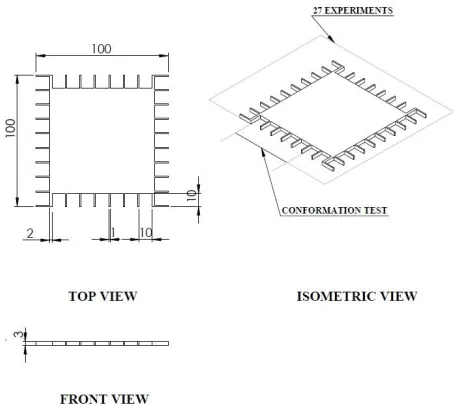
[image:3.612.197.426.510.712.2]Part design for cutting of plate has been done in solid works 2015, drawing sheet has been provided to the machining facility to cut small 27 pieces of size 10*10*3 mm from the plate using DOE.
Fig. 3 Part modelling of Inconel 625 plate in solid works.
433
©IJRASET: All Rights are Reserved
D. Experimental Outcomes
1) Material Removal Rate (MRR): The material removal rate is the amount of the material removed per minute. The material removal rate is calculated by using the formula and its unit is g/min.
KW
D
T
V
=
MRR
c
Vc= cutting speed (mm/min) T = Thickness (mm) D = Density
KW = Kerf (Td + 2 x Gs) Td = Dia. of wire tool (0.25mm)
Gs = gap between workpiece and wire in mm
2) Micro-hardness i.e. Hardness Vickers (HV): Microhardness tester Fm-300e has been obtained precise Vickers (HV) and capability to get other values also like Knoop (HK) / Brinell (HB) /Fracture Toughness (Kc) measurements quick and easy.
Table- III
Shows the experimented values of Taguchi L-27 orthogonal array Matrix i.e Peak current, pulse-ON, pulse-OFF, wire feed rate, servo voltage, flushing pressure.
EXPT.NO Peak Current Pulse-ON Pulse-OFF Wire Feed Rate Servo Voltage Flushing Pressure
1 100 110 50 1 20 5
2 100 110 50 1 30 10
3 100 110 50 1 40 15
4 100 115 55 2 20 5
5 100 115 55 2 30 10
6 100 115 55 2 40 15
7 100 120 60 3 20 5
8 100 120 60 3 30 10
9 100 120 60 3 40 15
10 110 110 55 3 20 10
11 110 110 55 3 30 15
12 110 110 55 3 40 5
13 110 115 60 1 20 10
14 110 115 60 1 30 15
15 110 115 60 1 40 5
16 110 120 50 2 20 10
17 110 120 50 2 30 15
18 110 120 50 2 40 5
19 120 110 60 2 20 15
20 120 110 60 2 30 5
21 120 110 60 2 40 10
22 120 115 50 3 20 15
23 120 115 50 3 30 5
24 120 115 50 3 40 10
25 120 120 55 1 20 15
26 120 120 55 1 30 5
434
©IJRASET: All Rights are Reserved
III.RESULTS&DISCUSSIONS
Table- IV Experiment results of Inconel 625 by WEDM
S. No Outcome Results
Material removal rate (MRR) Hardness Vickers (HV)
1 0.025 175.0
2 0.041 183.0
3 0.040 185.0
4 0.033 176.0
5 0.045 172.0
6 0.044 175.0
7 0.039 171.0
8 0.069 174.0
9 0.054 177.0
10 0.035 180.0
11 0.034 182.0
12 0.033 182.0
13 0.046 184.0
14 0.044 188.0
15 0.040 185.0
16 0.040 169.0
17 0.033 170.0
18 0.045 174.0
19 0.031 192.0
20 0.030 185.0
21 0.025 187.0
22 0.032 184.0
23 0.037 188.0
24 0.046 189.0
25 0.036 194.0
26 0.047 174.0
27 0.049 184.0
Mean 0.040 180.7
A. Analysis of MRR
1) Signal to Noise Ratios for Material Removal Rate of Inconel 625 by wire EDM Process.
Table- V: Response Table for Signal to Noise Ratios for MRR for Larger is better.
Level Peak
Current Pulse-ON Pulse-OFF
Wire Feed Rate
Servo Voltage
Flushing Pressure
1 44.93 45.27 45.08 45.27 45.12 45.05
2 45.07 45.21 45.09 44.99 45.08 45.11
3 45.40 44.92 45.22 45.14 45.20 45.24
Delta 0.47 0.35 0.14 0.28 0.12 0.19
435
©IJRASET: All Rights are Reserved
120 110 100 -27.0 -27.5 -28.0 -28.5 -29.0 -29.5 -30.0 120 115
110 50 55 60 1 2 3 20 30 40 5 10 15
Peak Current M e a n o f S N r a ti o s
Pulse-ON Pulse-OFF Wire Feed Rate Servo Voltage Flushing Pressure
Main Effects Plot for SN ratios
Data Means
Signal-to-noise: Larger is better
Fig.5. S/N Ratio of MRR graph and the combination levels A1 B3 C3 D3 E2 F2[4].
From figure 5, it has been observed that the combination for MRR is A1 B3 C3 D3 E2 F2 i.e. peak current (100), pulse on time (120), pulse off time (60), wire feed rate (3), servo voltage (30) and flushing pressure (15) has been identified as the optimum value of process parameters.
[image:6.612.54.566.78.273.2]2) ANOVA analysis of variance for MRR
Table- VI Response Table for Analysis of variance for MRR.
Source DF Adj SS Adj MS F-Value P-Value % Contributions
Peak Current (A) 2 0.000198 0.000099 2.99 0.083 8.80
Pulse-ON (μm) 2 0.000779 0.00039 11.73 0.001 34.62 Pulse-OFF (μm) 2 0.000082 0.000041 1.24 0.32 3.64
Wire Feed Rate (m/min) 2 0.000178 0.000089 2.67 0.104 7.91
Servo Voltage (V) 2 0.000269 0.000134 4.05 0.041 11.96 Flushing Pressure (kg/square cm ) 2 0.000279 0.00014 4.2 0.037 12.40
Error 14 0.000465 0.000033 20.67
26 0.00225 100.000
Pulse-ON is the most influential factor among the other input parameter and contribution is 34.62%.
B. Analysis of Hardness Vicker
1) Signal to Noise Ratios for Hardness Vickers of Inconel 625 by wire EDM Process
Table VII Response Table for Signal to Noise Ratios Hardness Vickers (HV) for Larger is better
Level Peak Current (A) Pulse-ON (μm) Pulse-OFF (μm) Wire Feed Rate (m/min) Servo Voltage (V) Flushing Pressure (kg/square cm )
1 44.93 45.27 45.08 45.27 45.12 45.05
2 45.07 45.21 45.09 44.99 45.08 45.11
3 45.40 44.92 45.22 45.14 45.20 45.24
Delta 0.47 0.35 0.14 0.28 0.12 0.19
[image:6.612.50.559.376.528.2] [image:6.612.53.559.615.743.2]436
©IJRASET: All Rights are Reserved
120 110 100 45.4
45.3
45.2
45.1
45.0
44.9
120 115
110 50 55 60 1 2 3 20 30 40 5 10 15
Peak Current
M
e
a
n
o
f
S
N
r
a
ti
o
s
Pulse-ON Pulse-OFF Wire Feed Rate Servo Voltage Flushing Pressure
Main Effects Plot for SN ratios
Data Means
Signal-to-noise: Larger is better
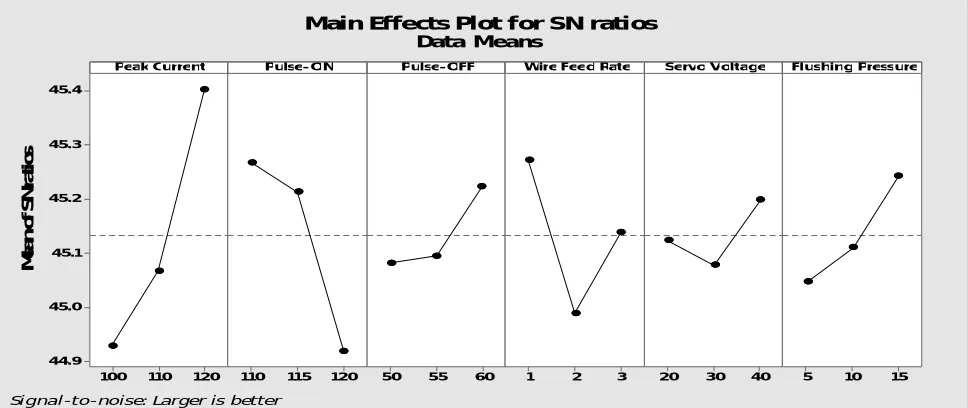
Fig.6. S/N Ratio of Hardness Vickers graph and the combination levels A3 B1 C3 D1 E3 F3
From figure 6, it has been observed that the combination for HV is A3 B1 C3 D1 E3 F3i.e. peak current (120), pulse on time (110), pulse off time (60), wire feed rate (1), servo voltage (40) and flushing pressure (15) has been identified as the optimum value of process parameters but this doesn’t satisfy the L -27 orthogonal array such, we have to perform the confirmation test for the Hardness Vickers but we have seen a drastic decline in HV from average 396.9 HV of pre-machining condition to approximately average 180.7 HV of after machining condition.
2) The confirmation test for Hardness Vickers: As the confirmation test has been done for HV as Taguchi combination is not according to the design of experiments [5].
Table VIII Response Table for Mean of Hardness Vickers (HV)
Level
Peak Current
(A)
Pulse-ON
(μm)
Pulse-OFF
(μm)
Wire Feed Rate (m/min)
Servo Voltage
(V)
Flushing Pressure (kg/square cm )
1 176.4 183.4 179.7 183.6 180.6 178.9
2 179.3 182.3 179.9 177.8 179.6 180.2
3 186.3 176.3 182.6 180.8 182.0 183.0
Delta 9.9 7.1 2.9 5.8 2.4 4.1
[image:7.612.67.551.80.284.2]Rank 1 2 5 3 6 4
Table IX Response Table for confirmation test of Hardness Vickers (HV)
Source Parameters Combination Mean Value
Peak Current (A) 120 A3 186.3
Pulse-ON (μm) 110 B1 183.4
Pulse-OFF (μm) 60 C3 182.6
Wire Feed Rate (m/min) 1 D1 183.6
Servo Voltage (V) 40 E3 182.0
[image:7.612.40.580.593.718.2]437
©IJRASET: All Rights are Reserved
M(mean) = Total of all values/ No. of values and values should take from the table (Table IV). Values for the combination taken from the mean table (Table IX).
Formula for conformation test = M + (A-M) + (B-M) + (C-M) + (D-M) + (E-M) + (F-M) Conformation value = M + (A3-M) + (B1-M) + (C3-M) + (D1-M) + (E3-M) + (F3-M)
= 180.7 + (186.3-180.7) + (183.4-180.7) + (182.6-180.7) + (183.6-180.7) + (182.0-180.7) +(183.0-180.7)
=197.4
0924
.
0
7
.
180
7
.
180
4
.
197
Error
[image:8.612.35.572.227.368.2]3) ANOVA analysis of variance for Hardness Vickers.
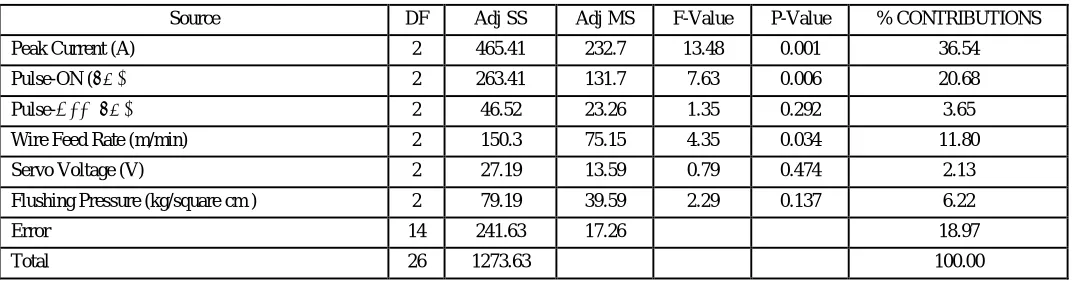
Table X: Response Table for Analysis of variance for Hardness Vickers.
Source DF Adj SS Adj MS F-Value P-Value % CONTRIBUTIONS
Peak Current (A) 2 465.41 232.7 13.48 0.001 36.54
Pulse-ON (μm) 2 263.41 131.7 7.63 0.006 20.68
Pulse-OFF (μm) 2 46.52 23.26 1.35 0.292 3.65
Wire Feed Rate (m/min) 2 150.3 75.15 4.35 0.034 11.80
Servo Voltage (V) 2 27.19 13.59 0.79 0.474 2.13
Flushing Pressure (kg/square cm ) 2 79.19 39.59 2.29 0.137 6.22
Error 14 241.63 17.26 18.97
Total 26 1273.63 100.00
Peak Current is the most influential factor among the other input parameter and contribution is 36.54%.
IV.CONCLUSION
The presents study deals with the optimization of the process parameters on Wire EDM machining for Inconel 625 alloy material by taking Material removable rate (MRR) and Microhardness (HV) as responses. After successful completion of all experimental analysis on Inconel, the following conclusions were drafted
1) For MRR, the optimization combination is A1 B3 C3 D3 E2 F2 0.69 g/min.
2) For MRR pulse-ON is the most influential factor among the other input parameter and contribution is 34.62%.
3) For Micro Hardness(HV) the optimization combination is A3 B1 C3 D1 E3 F3 with 197.4HV.
4) For Microhardness, the peak Current is the most influential factor among the other input parameter and contribution is 36.54%and confirmation test has been done for HV as Taguchi combination is not according to the design of experiments.
5) We could see the steep decline in Microhardness from average 396.9 HV of pre-machining condition to approximately average 180.7 HV of after machining condition.
V. ACKNOWLEDGEMENT
I owe a deep sense of gratitude to my Father Mr Omkar Singh, Mother Dr Rekha for their understanding, affection and financial support for this work. And I would like to thank Mr D. Sampath Kumar (Metallurgist), Mr Shamba Shiva, (Metallurgist), Virtue Meta-Sol. Material Solution, Balanagar, Hyderabad for Microhardness testing at their facility.
REFERENCES
[1] Lewis E. Shoemaker, “Alloys 625 and 725: trends in properties and applications”, TMS (The Minerals, Metals & Materials Society), 2005.
[2] Rahul et.al, “Machining performance optimization for electro‑discharge machining of Inconel 601, 625, 718 and 825: an integrated optimization route combining satisfaction function, fuzzy inference system and Taguchi approach” J Braz. Soc. Mech. Sci. Eng. 2016. DOI 10.1007/s40430-016-0659-7. [3] M Sreenivasa Rao et.al “Experimental investigations on surface integrity issues of Inconel-690 during wire-cut electrical discharge machining Process”, J
Engineering Manufacture 1–11, IMechE 2016. DOI: 10.1177/0954405416654092
[4] G. Archana, “Study on Machining Response in Wire EDM OF Inconel 625”, International Journal of Applied Engineering Research ISSN 0973-4562 Volume 13, Number 21 (2018) pp. 15270-15277.
[5] R. K. Thakur et .al, “A Comparative Optimization of Process Parameters of Wire Electrical Discharge Machining of Inconel-690 using Taguchi Method”, IJRMET Vol. 7, Issue 2, May-Oct 2017.
![Fig.5. S/N Ratio of MRR graph and the combination levels A1 B3 C3 D3 E2 F2[4].](https://thumb-us.123doks.com/thumbv2/123dok_us/1232916.648675/6.612.53.559.615.743/fig-s-n-ratio-mrr-graph-combination-levels.webp)