Estimating Lexical Priors for
Low-Frequency Morphologically
Ambiguous Forms
Harald Baayen*
Max Planck Institute for PsycholinguisticsRichard Sproat*
Bell LaboratoriesGiven a form that is previously unseen in a sufficiently large training corpus, and that is mor- phologically n-ways ambiguous (serves n different lexical functions) what is the best estimator for the lexical prior probabilities for the various functions of the form? We argue that the best estimator is provided by computing the relative frequencies of the various functions among the hapax legomena--the forms that occur exactly once in a corpus; in particular, a hapax-based estimator is better than one based on the proportion of the various functions among words of all frequency ranges. As we shall argue, this is because when one computes an overall measure, one is including high-frequency words, and high-frequency words tend to have idiosyncratic properties that are not at all representative of the much larger mass of(productively formed) low-frequency words. This result has potential importance for various kinds of applications requiring lexical disambiguation, including, in particular, stochastic taggers. This is especially true when some initial hand-tagging of a corpus is required:for predicting lexical priors for very low-frequer~cy morphologically ambiguous types (most of which would not occur in any given corpus), one should concentrate on tagging a good representative sample of the hapax legomena, rather than extensively tagging words of all frequency ranges.
1. Introduction
As a number of writers on morphology have noted (most recently and notably Beard [1995]), it is common to find that a particular affix or other morphological marker serves more than one function in a language. For example, in m a n y morphologically complex languages it is often the case that several slots in a paradigm are filled with the same form; put in another way, it is common to find that a particular morphologi- cal form is in fact ambiguous between several distinct functions. This p h e n o m e n o n - - which in the domain of inflectional morphology is termed syncretism---can be illus- trated by a Dutch example such as lopen 'walk', which can either be the infinitive form ('to walk') or the finite plural (present tense) form ('we, you, or they walk'). In some cases, syncretism is completely systematic: for example the case cited in Dutch, where the -en suffix can always function in the two ways cited; or in Latin, where the plural dative and ablative forms of nouns and adjectives are always identical, no matter what paradigm the noun belongs to. In other cases, a particular instance of syncretism may be displayed only in some paradigms: for example, Russian feminine norms, such as loshad' 'horse' (Cyrillic aoma~b), have the same form for both the genitive singular
Computational Linguistics Volume 22, Number 2
--
loshadi (Cyrillic aoma~i4) - - and the nominative plural, whereas masculine nouns
typically distinguish these forms. In still other cases, the syncretism may be partial in that two forms may be identical at one level of representation - - say, orthography - - but not another - - say, pronunciation. For example the written formgoroda in
Rus- sian (Cyrillic ropo~a) may either be the nominative plural or the genitive singular of 'city'. In the genitive singular, the stress is on the first syllable (/g%rodA/), whereas in the nominative plural the stress resides on the final syllable (/gorAd~a/); note that the difference in stress results in very different vowel qualities for the two forms, as indicated in the phonetic transcriptions.Syncretism and related morphological ambiguities present a problem for many NL applications where lexical disambiguation is important; cases where the ortho- graphic form is identical but the pronunciations of the various functions differ are particularly important for speech applications, such as text-to-speech, since appro- priate word pronunciations must be computed from orthographic forms that under- specify the necessary information. Ideally one would like to build models that use contextual information to perform lexical disambiguation (Yarowsky 1992, 1994), but such models must be trained on specialized tagged corpora (either hand-generated or semi-automatically generated) and such training corpora are often not available, at least in the early phases of constructing a particular application. Lacking good contex- tual models, one is forced to fall back on estimates of the lexical prior probabilities for the various functions of a form. Following standard terminology, a lexical prior can be defined as follows: Imagine that a given form is n-ways ambiguous; the lexical prior probability of sense i of this form is simply the probability of sense i independent of the context in which the particular instantiation of the form occurs. Assuming one has a tagged corpus, one can usually get reasonable estimates of the lexical priors for the frequent forms (such as Dutch
lopen 'walk') b y simply counting the number
of times the form occurs in each of its various functions and dividing by the total number of instances of the form (in any function). This yields the Maximum Like- lihood Estimate (MLE) for the lexical prior probability. But for infrequent or unseen forms, it is less clear h o w to compute the estimate. Consider another Dutch example likeaanlokken 'entice, appeal'. This form occurs only once, as an infinitive, in the Uit
den Boogaart (henceforth UdB) corpus (Uit den Boogaart 1975); in other words it is ahapax legomenon (< Greek hapax 'once',
legomenon 'said') in this corpus. Obviously
the lexical prior probability of this form expressing the finite plural is not zero, the MLE is a poor estimate in such cases. When one considers forms that do not occur in the training corpus (e.g.,
bedraden 'to wire') the situation is even worse. The prob-
lem, then, is to provide a more reasonable estimate of the relative probabilities of the various potential functions of such forms. 12. Estimating the Lexical Priors for Rare Forms
For a common form such as
lopen 'walk' a reasonable estimate of the lexical prior
probabilities is the MLE, computed over all occurrences of this form. So, in the UdB corpus,lopen
occurs 92 times as an infinitive and 43 times as a finite plural, so the MLEBaayen and Sproat Lexical Priors for Low-Frequency Forms
t o
.>
"8
Figure 1
I I I I
0 2 4 6
log frequency class
Relative frequency of Dutch infinitives versus finite plurals in the Uit den Boogaart corpus, as a function of the (natural) log of the frequency of the word forms. The horizontal solid line represents the overall MLE, the relative frequency of the infinitive as computed over all tokens; the horizontal dashed line represents the relative frequency of the infinitive among the hapax legomena. The solid curve represents a locally weighted regression smoothing
(Cleveland 1979).
estimate of the probability of the infinitive is 0.68. For low-frequency forms such as aanlokken or bedraden, one might consider basing the MLE on the aggregate counts of all ambiguous forms in the corpus. In the UdB corpus, there are 21,703 infinitive tokens, and 9,922 finite plural tokens, so the MLE for aanlokken being an infinitive would be 0.69. Note, however, that the application of this overall MLE presupposes that the relative frequencies of the various functions of a particular form are independent of the frequency of the form itself. For the Dutch example at hand, this presupposition predicts that if we were to classify -en forms according to their frequency, and then for each frequency class thus defined, plot the relative frequency of infinitives and finite plurals, the regression line should have a slope of approximately zero.
2.1 D u t c h Verb F o r m s in -en
[image:3.468.111.336.54.351.2]Computational Linguistics Volume 22, Number 2
higher-frequency words. This trend is captured by the solid nonparametric regression line; an explanation for this trend will be forthcoming in Section 3. (It will be noted that in Figure 1 the variance is fairly small for the lower-frequency ranges, higher for the middle ranges, and then small again for the high-frequency ranges; anticipating some- what, we note the same trends in Figures 2 and 3. This variance pattern follows from the high variability in the absolute numbers of types realized, especially in the middle log-frequency classes, in combination with the assumption that for any log-frequency class, the proportion for that class is itself a random variable.) The solid horizontal line represents the proportion of infinitives calculated over
all
frequency classes, and the dashed horizontal line represents the proportion of infinitives calculated over just the hapax legomena. The two horizontal lines can be interpreted as MLEs for the proba- bility of an-en
form being an infinitive: the solid line or overall MLE clearly provides an estimate based on the whole population, whereas the dashed line or hapax-based MLE provides an estimate for the hapaxes. The overall MLE computes a lower rel- ative frequency for the infinitives, compared to the hapax-based MLE. The question, then, is: Which of these MLEs provides a better estimate for low-frequency types? In particular, for types that have not been seen in the training corpus, and for which we therefore have no direct estimate of the word-specific prior probabilities, we would like to know whether the hapax-based or overall MLE provides a better estimate.To answer this question we compared the accuracy of the overall and hapax-based MLEs using tenfold cross-validation. We first randomized the list of
-en
tokens from the UdB corpus, then divided the randomized list into ten equal-sized parts. Each of the ten parts was held out as the test set, and the remaining nine-tenths was used as the training set over which the two MLE estimates were computed. The results are shown in Table 1. In this table,No(inf)
andNo(pl)
represent the observed number of tokens of infinitives and plurals in the held-out portion of the data, representing types that had not been seen in the training data. The final four rows compare the estimates for these numbers of tokens given the overall MLE(EoINo(infl]
andEo[No(pl)]),
versus the hapax-based MLE(Eh[No(inf)]
andEh[No(pl)]).
For all ten runs, the hapax-based MLE is clearly a far better predictor than the overall MLE. 22.2 English Verb Forms in
-ed
The pattern that we have observed for the Dutch infinitive-plural ambiguity can be replicated for other cases of morphological ambiguity. Consider the case of English verbs ending in
-ed,
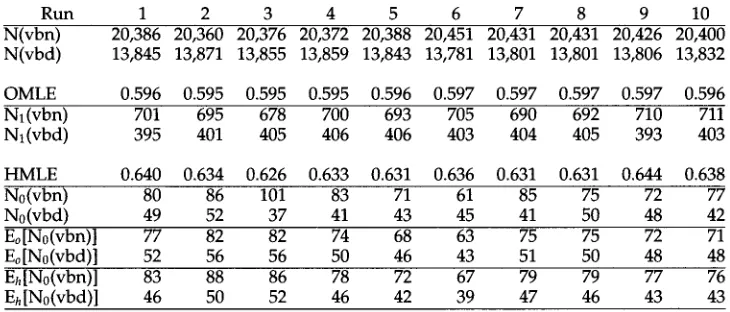
which are systematically ambiguous between being simple past tenses and past participles. The upper panel of Figure 2 shows the distribution of the relative frequencies of the two functions, plotted against the natural log of the frequency for the Brown corpus (Francis and Kucera 1982). (All lines, including the nonparametric regression line are interpretable as in Figure 1.) Results of a tenfold cross-validation are shown in Table 2. Clearly, in this case the magnitude of the dif- ference between the overall MLE and the hapax-based MLE is smaller than in the previous example: indeed in cross validations 6, 8, and 9, the overall MLE is superior. Nonetheless, the hapax-based MLE remains a significantly better predictor overall. 32 A p a i r e d t-test o n the ratios No(inf)/No(pl) v e r s u s Eo[No(inf)]/Eo[No(pl)] reveals a h i g h l y significant difference (t9 = 13.4, p < 0.001 ); c o n v e r s e l y a c o m p a r i s o n of No (inf)/No (pl) a n d E h [No (inf)]/Eh [No (pl)] reveals n o difference (t9 = 0.96,p > 0.10).
3 A paired t-test o n t h e ratios No(vbn)/No(vbd) v e r s u s Eo[No(vbn)]/Eo[No(vbd)] reveals a significant difference (t9 -~ 2.47,p < 0.05); c o n v e r s e l y a c o m p a r i s o n of No(vbn)/No(vbd ) and
Baayen and Sproat Lexical Priors for Low-Frequency Forms
Table 1
Results of tenfold cross-validation for Dutch
-en
verb forms from the Uit den Boogaart corpus. Columns represent different cross-validation runs.N(inf)
andN(pl)
are the number of tokens of the infinitives and finite plurals, respectively, in the training set.N1 (in J9
andN1 (pl)
are the number of tokens of the infinitives and finite plurals, respectively, among the hapaxes in the training set. OMLE and HMLE are, respectively, the overall and hapax-based MLEs.No(inf)
and
No(pl)
denote the number of tokens in the held-out portion that havenot
been observed in the training set. The expected numbers of tokens of infinitives and plurals for types unseen in the training set, using the overall MLE are denoted asEo[No(inf)]
andEo[No(pl)];
thecorresponding estimates using the hapax-based MLE are denoted as
Eh
[No(irlf)]
andEh [No(pl)].
Run 1 2 3 4 5 6 7 8 9 10
N(inf)
19,509 19,527 19,536 19,526 19,507 19,511 19,533 19,524 19,569 19,585N(pl)
8,953 8 , 9 3 5 8 , 9 2 6 8 , 9 3 6 8 , 9 5 5 8 , 9 5 2 8 , 9 3 0 8 , 9 3 9 8 , 8 9 4 8,878 OMLE 0.685 0 . 6 8 6 0 . 6 8 6 0 . 6 8 6 0 . 6 8 5 0 . 6 8 5 0 . 6 8 6 0 . 6 8 6 0 . 6 8 8 0.688Nl(inf)
1,075 1 , 0 8 6 1 , 0 6 6 1 , 0 6 8 1,092 1,091 1 , 0 9 8 1 , 0 6 6 1 , 0 9 4 1,079Nl(pl)
185 184 180 182 179 185 184 178 179 180 HMLE 0.853 0 . 8 5 5 0 . 8 5 6 0 . 8 5 4 0.859 0 . 8 5 5 0 . 8 5 6 0 . 8 5 7 0 . 8 5 9 0.857No(inf)
120 114 133 125 133 123 102 118 121 127No(pl)
24 19 20 18 18 16 15 23 23 21Eo[No(inf)]
99 91 105 98 103 95 80 97 99 102Eo[No(pl)]
45 42 48 45 48 44 37 44 45 46Eh
[No(inf)]
123 114 131 122 130 119 100 121 124 127Eh[No(pl)]
21 19 22 21 21 20 17 20 20 212.3 D u t c h W o r d s in - e n : A M o r e G e n e r a l P r o b l e m
In the t w o examples w e h a v e just considered, the h a p a x - b a s e d MLE, while being a better predictor of the a priori lexical probability for u n s e e n cases than the overall MLE, does n o t actually yield a different prediction as to w h i c h function of a f o r m is m o r e likely. This does n o t h o l d generally, however, a n d the b o t t o m panel of Figure 2 presents a case w h e r e the h a p a x - b a s e d MLE does yield a different prediction as to w h i c h function is m o r e likely. In this plot w e consider D u t c h w o r d forms from the UdB c o r p u s e n d i n g in
-en.
As w e h a v e seen, D u t c h-en
is used as a verb marker: it m a r k s the infinitive, present plural, a n d for strong verbs, also the past plural; it is also u s e d as a m a r k e r of n o u n plurals. The case of n o u n plurals is s o m e w h a t different from the p r e c e d i n g t w o cases since it is not, strictly speaking, a case of m o r p h o l o g i c a l syncretism. H o w e v e r , it is a potential source of a m b i g u i t y in text analysis, since a l o w frequency f o r m in-en,
w h e r e one m a y n o t h a v e seen the stem of the w o r d , could potentially be either a n o u n or a verb. Also, systematic a m b i g u i t y exists a m o n g cases of n o u n - v e r b conversion: forexamplefluiten
is either a n o u n m e a n i n g 'flutes' or a verb m e a n i n g 'to p l a y the flute';spelden
m e a n s either ' p i n s ' or 'to pin'; a n dploegen
m e a n s either ' p l o u g h s ' or 'to p l o u g h ' . Results for a tenfold cross-validation for these data are s h o w n in Table 3 . 4 Lrl this case, the overall MLE w o u l d lead one to predict that foran u n s e e n f o r m in
-en,
the verbal function w o u l d be m o r e likely. Contrariwise, the h a p a x - b a s e d MLE predicts that the n o m i n a l function w o u l d be m o r e likely. Again, it is the h a p a x - b a s e d MLE that p r o v e s to be superior.4 A paired t-test on the ratios
No(v)/No(n)
versusEo[No(v)]/Eo[No(n)]
reveals a highly significant difference (t9 = 95.95,p <~ 0.001); conversely a comparison ofNo(v)/No(n)
andEh[No(v)]/Eh[No(n)]
[image:5.468.49.401.160.315.2]C o m p u t a t i o n a l Linguistics Volume 22, N u m b e r 2
English -ed
z
>
0
0
e q
,¢-
O
o.
O
O
o.
O
.°.
, ' . . - , - .
• . ° " . • .• " . ' ; . . . "
--- .. . . -- .. . . . , ; . - . - - ; - - - = ~ - z , - ~ - - - . - . . .
•
= i i i i i a
0 1 2 3 4 5 6
log frequency class
Dutch verbs and nouns in -en
q
0
>
c-
.o d
0
2 d
0
q
0
"'. • . ' ~ . . .
. - L . . . • 0
0 2 4 6
log frequency class
Figure 2
[image:6.468.77.417.97.556.2]Baayen and Sproat Lexical Priors for Low-Frequency Forms
Table 2
Cross-validation statistics for English past participles versus simple past tense verbs.
Run 1 2 3 4 5 6 7 8 9 10
N(vbn) 20,386 20,360 20,376 20,372 20,388 20,451 20,431 20,431 20,426 20,400 N(vbd) 13,845 13,871 13,855 13,859 13,843 13,781 13,801 13,801 13,806 13,832
OMLE 0.596 0 . 5 9 5 0 . 5 9 5 0 . 5 9 5 0 . 5 9 6 0.597 0 . 5 9 7 0.597 0.597 0.596 Nl(vbn) 701 695 678 700 693 705 690 692 710 711 N1 (vbd) 395 401 405 406 406 403 404 405 393 403
HMLE 0.640 0 . 6 3 4 0 . 6 2 6 0 . 6 3 3 0.631 0 . 6 3 6 0 . 6 3 1 0.631 0 . 6 4 4 0.638
N0(vbn) 80 86 101 83 71 61 85 75 72 77
N0(vbd) 49 52 37 41 43 45 41 50 48 42
Eo[N0(vbn)] 77 82 82 74 68 63 75 75 72 71
Eo[N0(vbd)] 52 56 56 50 46 43 51 50 48 48
Eh [N0(vbn)] 83 88 86 78 72 67 79 79 77 76
Eh[N0(vbd)] 46 50 52 46 42 39 47 46 43 43
Table 3
Cross-validation statistics for Dutch verbs in -en versus plural nouns in -en.
Run 1 2 3 4 5 6 7 8 9 10
N(v) 25,237 25,283 25,267 25,245 25,292 25,267 25,205 25,207 25,261 25,294 N(n) 18,306 18,260 18,277 18,299 18,252 18,277 18,339 18,337 18,283 18,250
OMLE 0.580 0.581 0 . 5 8 0 0 . 5 8 0 0.581 0 . 5 8 0 0 . 5 7 9 0 . 5 7 9 0 . 5 8 0 0.581 Nl(v) 1,312 1 , 2 9 5 1 , 2 8 7 1 , 3 1 7 1 , 2 8 4 1 , 2 9 8 1 , 2 9 8 1 , 2 9 7 1 , 2 9 2 1,298 Nl(n) 2,913 2 , 9 1 0 2 , 9 3 9 2 , 9 4 2 2 , 9 0 1 2 , 9 2 2 2 , 9 7 9 2 , 9 6 9 2 , 9 3 6 2,931
HMLE 0.311 0 . 3 0 8 0 . 3 0 5 0 . 3 0 9 0 . 3 0 7 0 . 3 0 8 0 . 3 0 3 0 . 3 0 4 0 . 3 0 6 0.307 N0(v) 124 131 154 142 148 143 148 156 153 139 N0(n) 325 344 327 334 352 335 289 301 327 319 Eo[N0(v)] 260 276 279 276 290 277 253 265 278 266 Eo[N0(n)] 189 199 202 200 210 201 184 192 202 192 Eh[N0(v)] 139 146 146 147 153 147 133 139 147 141 Eh[N0(n)] 310 329 335 329 347 331 304 318 333 317
2.4 D i s y l l a b i c D u t c h Words E n d i n g in -er
One final e x a m p l e - - a l s o n o t a case of s y n c r e t i s m - - c o n c e r n s the a m b i g u i t y of the sequence -er in Dutch, w h i c h occurs word-finally in m o n o m o r p h e m i c n o u n s (moeder, ' m o t h e r ' ) , adjectives (donker, 'dark'), a n d p r o p e r n a m e s (Pieter, 'Peter'), b u t w h i c h is also u s e d as a suffix to f o r m c o m p a r a t i v e s (sneller, 'faster') a n d " a g e n t i v e " n o u n s (schrijver, 'writer'). Since m o n o m o r p h e m i c n o u n s a n d adjectives in this class are m o s t l y disyllabic, w e will restrict o u r attention to the disyllabic instances of w o r d s e n d i n g in -er. A g a i n w e find that the h a p a x - b a s e d MLE is superior to the overall MLE for predicting to w h i c h of these five categories an u n s e e n disyllabic w o r d belongs.
[image:7.468.42.407.82.238.2] [image:7.468.50.401.286.443.2]Computational Linguistics Volume 22, Number 2
Table 4
Results of tenfold cross-validation for Dutch disyllabic - e r words. N and N1 are the number of
tokens and number of hapax legomena in the Uit den Boogaart corpus for simplex and complex adjectives and nouns, and proper names. OMLE and HMLE are, respectively, the overall and hapax-based MLEs based on N and N1. For each category, the columns headed by X2(OMLE) and X2(HMLE) list the summed contribution to the X2-measures over ten
cross-validation runs for the overall and hapax-based estimates.
String type N N1 OMLE H M L E X2(OMLE) X2(HMLE)
Simplex noun in - e r 2,157 43 0.438 0.206 46.52 1.63
Derived noun in - e r 581 51 0.118 0.244 32.02 1.94
Simplex adjective in - e r 486 6 0.099 0.029 18.22 14.90
Derived adjective in - e r 1,409 41 0.286 0.196 14.97 9.05
Proper name in - e r 291 68 0.059 0.325 361.22 5.98
4,924 209 1.000 1.000 462.97 33.50
h a p a x - b a s e d MLE are s u p e r i o r to those b a s e d on the overall M L E (X~36) = 462.97, p < .001 for the overall MLE, X 2 (36) = 33.50, p > .5 for the h a p a x - b a s e d MLE). In particular, p r o p e r n a m e s in - e r h a v e a m u c h h i g h e r probability of occurrence t h a n the overall
MLE w o u l d suggest. Of course, in o r t h o g r a p h y - b a s e d applications, o n e can rely to some extent o n capitalization to indicate p r o p e r names, so one m i g h t w a n t to eliminate those from consideration here o n this basis. R e m o v i n g the category of p r o p e r n a m e s f r o m the analysis, a cross-validation test again reveals significantly better predictions for the h a p a x - b a s e d MLE (X~27) = 43.61, p = .023) than for the overall MLE (X~27) = 120.03,p < .001).
2.5 S u m m a r y
We h a v e d e m o n s t r a t e d w i t h four separate examples that the h a p a x - b a s e d MLE is su- perior to the overall MLE in predicting the p r o p o r t i o n s , a m o n g u n s e e n forms, of the various functions of m o r p h o l o g i c a l l y a m b i g u o u s categories. C o u l d an e v e n better es- timator be o b t a i n e d b y taking not o n l y the p r o p o r t i o n for the h a p a x l e g o m e n a into account b u t also the p r o p o r t i o n s for o t h e r l o w - l o g - f r e q u e n c y classes? To a n s w e r this question, note that the scatterplot in the b o t t o m p a n e l of Figure 2 reveals a d o w n - w a r d c u r v a t u r e at the v e r y left-hand side: e v e n for the lowest-log-frequency classes, the likelihood of a w o r d being a verb decreases w i t h decreasing log-frequency. This suggests that for this particular e x a m p l e the h a p a x l e g o m e n a alone s h o u l d be u s e d to estimate the probability that an u n s e e n w o r d is a n o u n or verb, r a t h e r than the h a p a x l e g o m e n a in c o m b i n a t i o n w i t h other l o w - f r e q u e n c y classes (the w o r d s occurring twice, three times, etc.). Interestingly, the top p a n e l of Figure 2 does not reveal e v e n a hint of a t r e n d a m o n g the lowest-log-frequency classes, a n d in Figure 1 the o b s e r v e d p r o p o r - tions for log-frequency less than 2 also do not reveal a clear pattern. For Figure 3, clear trends for the lower-log-frequency classes seem to obtain in all cases except the plot s h o w i n g the p r o p o r t i o n of simplex adjectives. Taken jointly, these observations suggest informally that an MLE b a s e d on the h a p a x l e g o m e n a will n e v e r be inferior to MLEs that take additional l o g - f r e q u e n c y classes at the l o w e r e n d of the log-frequency r a n g e into account. At the same time, the e x a m p l e of D u t c h verb a n d n o u n f o r m s in - e n
Baayen and Sproat Lexical Priors for Low-Frequency Forms
t o
O 0 • ° ° ° * °
oo
0 1 2 3 4 5 6
log frequency class log frequency class
r -
~.~×°=~
~ I
" " "
. . . .oEd . .
i~.OI
~
~
0 " ~ . . . . "*" .. . . ; ' g . . .
O • t ~ _ ~ ,-~t,-~ ~ ..~
-5- ° 0 1 2 3 4 5 6
0 1 2 3 4 5 6
log frequency class log frequency class
u )
S-d 0 1 2 3 4 5 6
u )
5.d ...
5_Q ~ -
log frequency class
Figure 3
The distribution in the Uit den Boogaart corpus of the relative frequencies of disyllabic words
i n -er, plotted against log-frequency. Five types of words are distinguished: monomorphemic
words in -er (moeder, 'mother'); bimorphemic nouns in -er (schrijver, 'writer'); monomorphemic adjectives in -er (donker, 'dark'); bimorphemic adjectives in -er (groter, 'greater'); and proper names in -er (Pieter, 'Peter'). Lines are interpreted as in Figure 1.
3. D i s c u s s i o n
As w e h a v e seen in the four examples discussed above, the MLE c o m p u t e d o v e r h a p a x l e g o m e n a yields a better prediction of lexical prior probabilities for u n s e e n cases than does an MLE c o m p u t e d over the entire training corpus. We n o w h a v e to consider w h y this result holds. As we shall see, the reasons are different from case to case, b u t nonetheless share a commonality: in all four cases, idiosyncratic lexical p r o p e r t i e s of h i g h - f r e q u e n c y w o r d s d o m i n a t e the statistical p r o p e r t i e s of the h i g h - f r e q u e n c y ranges, thus m a k i n g the overall MLE a less reliable predictor of the properties of the low- f r e q u e n c y and u n s e e n cases.
First let us discuss the final case, that of -er a m b i g u i t y in Dutch, b e g i n n i n g w i t h the d e r i v e d a n d u n d e r i v e d nouns. The hapax-based MLE estimate for d e r i v e d n o u n s in
[image:9.468.35.398.52.334.2]Computational Linguistics Volume 22, Number 2
proper n a m e s that are highly frequent, in comparison w i t h words in general, b u t there are large n u m b e r s of types of n a m e s that occur rarely. Thus, we expect an imbalance of the kind we observe.
Consider next the ambiguity in Dutch between -en verb forms a n d -en plural nouns. Ceteris paribus, plural n o u n s are less frequent t h a n singular nouns; on the other hand, -en for verbs serves both the function of m a r k i n g plurality a n d of m a r k i n g the infinitive. High-frequency verbs include some v e r y c o m m o n w o r d forms, such as the auxiliaries hebben 'have', zullen 'will', kunnen 'can', a n d moeten 'must'. Thus, for the high-frequency ranges, the data is weighted heavily towards verbs. On the other hand, while both n o u n s a n d verbs are open classes, n o u n s are far more productive as a class than are verbs (Baayen a n d Lieber 1991), a n d this pattern becomes p r e d o m i n a n t in the low-frequency ranges: a m o n g low-frequency types, most tokens are nouns. Hence, for the low-frequency ranges, the data is w e i g h t e d towards nouns. These two opposing forces conspire to yield a d o w n w a r d trend in the percentage of verbs as w e proceed from the high- to the low-frequency ranges.
Next, consider the English past tense versus past participle ambiguity. One of the important functions of the past participle form is as an adjectival modifier or predicate; for example, the parked car. In this function the past participle has a passive m e a n i n g w i t h transitive verbs, a n d a perfective m e a n i n g w i t h unaccusative intransitive verbs; see Levin (1993, 86-88) for details. For reasons that are not clear to us, a predomi- n a n t n u m b e r of the high-frequency verbs cannot felicitously be used as prenominal adjectives. These verbs include unergative intransitives like walk, for which one w o u l d not expect to find the adjectival usage, given the above characterization; b u t t h e y also include clear transitives like move, try, a n d ask, a n d unaccusative intransitives like ap- pear, which are not generally felicitous in this usage. Consider: ?a moved car, ?a tried approach, ?an asked question, ?an appeared ad; b u t contrast: an oft-tried approach, a frequently asked question, a recently appeared ad, where an adverbial modifier renders the examples felicitous. 5 A m o n g the low-frequency verbs, including accentuate, bottle a n d incense, the predominate types are those in which the past participle usage is preferred. W h a t is clear from the plot in the top panel of Figure 2 is that the d o w n w a r d trend in the regression curve to the right of the plot is d u e to the lexical properties of a relatively small n u m b e r of high-frequency verbs. For the greater part of the frequency range, there is a relatively stable proportion of participles to finite past forms. Thus, the hapax-based MLE yields an estimate that is u n c o n t a m i n a t e d b y the lexical properties of individual high-frequency forms.
Finally, consider the Dutch verb forms -en that we started with. In Figure 1 the strong d o w n w a r d trend in the regression curve at the right of the figure is d u e in large measure to the inclusion of high-frequency auxiliary verbs, examples of w h i c h have already been given. These verbs, while possible in the infinitival form, occur p r e d o m i n a n t l y in the finite form. Hence, a form such as hebben 'have' is m u c h more likely to be a plural finite form than it is to be an infinitive. At the low e n d of the frequency spectrum, we find a great m a n y verbs derived w i t h separable particles, such as afzeggen 'cancel'; note that separable prefixation is the most productive verb- forming process in Dutch. In the infinitival form, the particle is always attached to
Baayen and Sproat Lexical Priors for Low-Frequency Forms
the verb. However, in the finite forms in main clauses, the particle must be separated: for example, wij zeggen onze afspraak af 'we are cancelling our appointment'. These properties of Dutch separable verbs boost the likelihood of infinitival forms for the low-frequency ranges, but they also boost the likelihood of (higher-frequency) finite plural forms such as zeggen: since the separated finite plural form zeggen is identical to the finite plural of the underived verb zeggen 'say', any separated finite forms will accrue to the frequency of the generally much more common derivational base.
What all of these cases share is that the statistical properties of the high-frequency ranges are dominated by lexical properties of particular sets of high-frequency words. This in turn biases the overall MLE and makes it a poor predictor of novel cases. For example, auxiliaries such as hebben 'have' are among the most common verbs in Dutch, but they have rather different syntactic, and hence morphological, properties from other verbs; these properties in turn contaminate the high-frequency ranges and thus the overall MLE. In contrast, words in the low-frequency ranges, and particu- larly hapaxes, are heavily populated with (necessarily non-idiosyncratic) neologisms derived via productive morphological processes (Baayen 1989; Baayen and Renouf 1996). Any lexical biases that are inherent in these morphological processes - - for example, the fact that a low frequency Dutch word ending in -en is more likely to be a noun than a verb - - are well-estimated b y the hapaxes. Now, for a sufficiently large training corpus, we can be very confident that an unseen complex word is non- idiosyncratic and formed via a productive morphological process, and this confidence increases as the corpus size increases (Baayen and Renouf 1996). Since the hapaxes of a particular morphological process mostly consist of non-idiosyncratic formations from that process, it makes sense that the distribution of a property among the hapaxes is the least contaminated estimate available for the distribution of that property among the unseen cases.
The hapax-based MLE that we have proposed is not only observationally prefer- able to the overall MLE, it is also firmly grounded in probability theory. The probability of encountering an unseen word given that this word is a word in -en is estimated by:
N1,N(-en)
Pr(unseen[-en) ~ N(_en) , (1)
where N1,N(-en) denotes the number of hapax legomena in -en among the N(-en) tokens in -en in the training sample; see Baayen (1989), Baayen and Lieber (1991), Good (1953), and Church and Gale (1991). Of course, this estimate is heavily influenced by the highest-frequency words in -en, as these words contribute many tokens to N(-en). In our example, high-frequency auxiliaries such as hebben cause the probability of sampling unseen types in -en to be low - - newly sampled tokens have a high probability of being an auxiliary rather than some previously unseen word. Interestingly, (1) can be used to derive an expression for the conditional probability that a word is, say, a noun, given that it is an unseen type in -en (Baayen 1993):
Pr(noun A unseen -en type) (2) Pr(noun [ unseen -en type) = Pr(unseen-en type)
NLN(-en , n o u n )
N(-en)
Nl,t~(-en )
N(-en) N1,N(-en, noun)
N1,N(-en)
Computational Linguistics Volume 22, Number 2
nominator) to the distribution of all -en words; a n d once (in the numerator) to the distribution of the -en n o u n s - - after reclassifying all verbal tokens in -en as represent- ing one (very high-frequency) n o u n type in the frequency distribution. Similarly, the probability that an unseen w o r d in -en is a verb is given b y
N1,N(-en, verb)
Pr(verb I unseen -en type) ~ N1,N(-en) (3)
Thus the proportion of verbal hapaxes in -en that we have suggested as an adjusted MLE estimator on the basis of the curve s h o w n in Figure 2 is in fact an estimate of the conditional probability that a w o r d is a verb, given that it is an u n s e e n type in -en.
The results of the analyses presented in this paper are of potential importance in various applications that require lexical disambiguation a n d where an estimate of lexical priors is required. For high-frequency words, one can obtain fairly reliable estimates of the lexical priors b y tagging a corpus that gives a good coverage to w o r d s of various ranges. For predicting the lexical priors for the m u c h larger mass of very low-frequency types, most of which w o u l d not occur in a n y such corpus, the results we have presented suggest that one should concentrate on tagging a good representative sample of the hapaxes, rather than extensively tagging w o r d s of all frequency ranges.
Acknowledgments
The authors wish to thank four anonymous reviewers for Computational Linguistics for useful comments on this paper.
References
Baayen, Harald. 1989. A Corpus-Based Approach to Morphological Productivity: Statistical Analysis and Psycholinguistic Interpretation. Ph.D. thesis, Free University, Amsterdam.
Baayen, Harald. 1993. On frequency, transparency and productivity. Yearbook of Morphology 1992, pages 181-208.
Baayen, Harald and Rochelle Lieber. 1991. Productivity and English derivation: A corpus-based study. Linguistics, 29:801-843.
Baayen, Harald and Antoinette Renouf. 1996. Chronicling the Times: Productive lexical innovations in an English newspaper. Language, 72:69-96.
Beard, Robert. 1995. Lexeme-Morpheme Base Morphology. SUNY, Albany.
Church, Kenneth. 1988. A stochastic parts program and noun phrase parser for unrestricted text. In Proceedings of the Second Conference on Applied Natural Language Processing, pages 136-143, Morristown, NJ. Association for Computational Linguistics.
Church, Kenneth Ward and William Gale. 1991. A comparison of the enhanced Good-Turing and deleted estimation methods for estimating probabilities of
English bigrams. Computer Speech and Language, 5(1):19-54.
Cleveland, William. 1979. Robust locally weighted regression and smoothing scatterplots. Journal of the Acoustical Society of America, 74(368):829-836, December. DeRose, Stephen. 1988. Grammatical
category disambiguation by statistical optimization. Computational Linguistics, 14:31-39.
Francis, W. Nelson and Henry Kucera. 1982. Frequency Analysis of English Usage. Houghton Mifflin, Boston.
Good, I. 1953. The population frequencies of species and the estimation of population parameters. Biometrica V, 40(3,4):237-264. Kupiec, Julian. 1992. Robust part-of-speech tagging using a hidden Markov model. Computer Speech and Language, 6:225-242. Levin, Beth. 1993. English Verb Classes and
Alternations. University of Chicago, Chicago.
Uit den Boogaart, P. C., editor. 1975. Woordfrequenties in Gesproken en Geschreven Nederlands. Oosthoek, Scheltema and Holkema, Utrecht.
Yarowsky, David. 1992. Word-sense
disambiguation using statistical models of roget's categories trained on large
corpora. In Proceedings of COLING-92, Nantes, France, July. COLING. Yarowsky, David. 1994. Decision lists for